This site is supported by our readers. We may earn a commission, at no cost to you, if you purchase through links.
Most quilters hit the same wall: they’ve mastered straight-line stitching, but the moment they drop the feed dogs, the fabric starts creeping, the stitches go unevenly, and the whole thing feels out of control. That’s not a skill problem—it’s a setup problem.
Free motion quilting patterns open up a completely different kind of creative control, one where your hands guide the design instead of the machine dictating it. Once the mechanics click, even a simple meander feels satisfying to stitch.
This tutorial walks you from machine prep through beginner patterns all the way into decorative motifs, so you can build real technique, not just try things and hope for the best.
Table Of Contents
Key Takeaways
- Uneven stitches and loss of control in free motion quilting are almost always a setup issue—dropping the feed dogs, choosing the right darning foot, and basting your quilt sandwich correctly before you start fixes most of it.
- Starting with simple patterns like the meander or spiral builds the muscle memory you need before tackling anything complex, so don’t skip the basics just because they feel easy.
- Matching your hand speed to your machine’s rhythm is what keeps stitch length consistent—move too fast and they stretch, too slow and they bunch, so think of it as staying in sync rather than racing ahead.
- Sketching your design on paper first and quilting from the center outward aren’t optional extras—they’re what keep your pattern proportional, your tension even, and the whole quilt from shifting as you work.
What Are Free Motion Quilting Patterns?
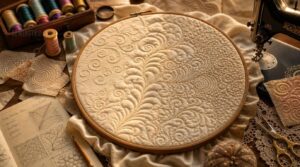
Free motion quilting opens up a whole new world once you understand what you’re actually working with.
Once you’re ready to experiment, browsing a variety of machine quilting patterns can spark ideas and help you find your signature style.
The patterns range from simple flowing loops to intricate feather motifs, and knowing the difference helps you pick the right one for your project.
Here’s a closer look at the basics, pattern types, and how beginner designs compare to more sophisticated work.
Free Motion Quilting Basics
Free motion quilting hands you the creative controls — your feed dogs drop, your darning foot takes over, and suddenly the fabric moves wherever you guide it.
Good hand placement keeps things steady while your muscle memory builds stitch by stitch.
Focus early on fabric control and tension tips through simple practice drills, and you’ll feel the difference fast.
Understanding manual fabric control is key for consistent stitches.
Pattern Types and Uses
Once you’ve got that fabric moving, pattern choice becomes your next creative decision.
Think of free motion quilting patterns as falling into two broad families: geometric vs organic.
Meander designs, swirls and curls, and Greek Key designs offer structured rhythm, while feather motifs and botanicals flow freely.
Edge-to-edge designs cover your whole quilt, and motif repetition with adaptive scaling controls density impact beautifully.
Beginner Versus Advanced Designs
Skill Progression Pathways matter more than most beginners expect. Starting with a simple meander or spiral keeps your focus on Mastering Stitch Consistency before layering complexity.
Sophisticated free motion quilting patterns blend Motif Combination Techniques — feathers inside medallions, pebbles beside swirls — demanding both precision and Artistic Expression Development. Work through a beginner collection of free motion quilting patterns first.
Confidence builds the rest.
All-over and Border Patterns
Once confidence clicks, choosing between all-over and border patterns becomes your next creative decision.
All-over designs — florals, paisleys, interlocking circles — repeat seamlessly across the entire surface. Border patterns frame the quilt’s edges with vines or geometric scrolls.
Motif Scale Selection, Pattern Density Balance, and smooth Border-Allover Transitions keep everything cohesive.
Corner Design Adaptation and Themed Pattern Integration let your personality show through every stitch.
Prepare Your Machine and Quilt
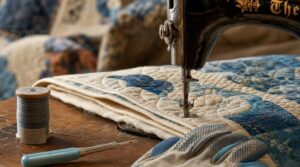
Before your needle touches fabric, your machine needs a few adjustments — and getting them right makes all the difference. It’s less complicated than it sounds, but skipping any of these steps will show up in your stitches.
Here’s what to sort out before you begin.
Lowering The Feed Dogs
Think of your feed dogs as the machine’s autopilot — and free motion quilting means taking the controls yourself. Before anything else, unplug your machine for Feed Dog Safety. Then locate the lever or dial near the rear and drop it down.
Here’s what to check:
- Set stitch selector to straight stitch first
- Clean lint from the bobbin and hook area
- Confirm your quilt sandwich lies completely flat
- Test fabric glide with a light, deliberate touch
Choosing a Darning Foot
Your darning foot is the unsung hero of free motion quilting.
Foot type matters more than most beginners realize — open-toe designs give you clear visibility of your design as it forms, while closed-toe options glide smoothly over seams.
For stability across thick batting, a metal-base foot offers durability.
Check compatibility with your machine’s shank height before purchasing any foot.
Needle and Thread Selection
Getting your needle and thread right makes or breaks free motion quilting. The wrong pairing throws off stitch tension, causes shredding or leaves holes in your fabric. Here’s what to keep in mind:
- Needle size: Use 90/14 for heavier weight quilts, 75/11 for lighter fabrics.
- Material choices: Titanium-coated needles last longer through dense layers.
- Thread compatibility: Cotton thread suits natural fiber quilts; polyester manages most everything else.
- Tension balance: Test on scrap fabric first — always.
Basting The Quilt Sandwich
Basting is the foundation that holds everything together — literally. Layer your quilt sandwich with batting centered between the top and backing on a clean, flat surface.
From there, your three main tools are pins, spray adhesive, and thread. Curved safety pins follow curves without distorting fabric layers. Spray adhesive works fast — apply it 6–12 inches away in light, even passes. Always allow it to dry before handling.
Beginner Free Motion Quilting Patterns
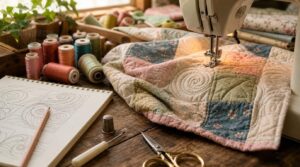
Starting simple is the smartest move you can make with free motion quilting.
five beginner patterns build your confidence without overwhelming your hands or your machine.
Pick one, practice it on scrap fabric, and you’ll feel the rhythm click sooner than you think.
Meander Quilting Pattern
Meander is the gateway pattern for most beginners — continuous, flowing curves that never cross themselves.
Think of it as doodling with your machine.
Meander Design Variations let you experiment: try swirl meanders for softer movement, or tight mini meanders for dense texture.
Thread Contrast Techniques make your stitching pop.
Scale it small for blocks, wide for borders.
Echo Quilting Combinations add beautiful depth alongside it.
Spiral Quilting Design
Think of a spiral as your machine drawing a slow exhale across the fabric — starting tight at the center, then breathing outward.
Here’s how to approach it step by step:
- Scaling Spiral Patterns — Start small, then widen each ring to match your block size.
- Spiral Density Control — Keep ring spacing between ⅛ and ½ inch for consistent texture.
- Directional Flow Techniques — Choose clockwise or counterclockwise to control visual rhythm.
- Combined Spiral Motifs and Off-Center Design — Nest multiple spirals or shift the center point to add vibrant movement to your free motion quilting patterns.
Pebble Quilting Pattern
Where spirals breathe outward, pebble quilting pulls inward — building texture through small, closed loops that mimic smooth river stones.
Pebble Spacing Techniques matter here: circles between ¼ and ½ inch, touching but never crowding.
Vary your Pebble Size Gradation naturally across the block for organic depth.
Thread Color Impact is real — contrasting thread makes each pebble pop beautifully in this free motion quilting tutorial.
Echo Quilting Lines
Echo quilting traces outward from a shape — each line following the one before it, like ripples on still water. Spacing Techniques here are simple: keep lines between ⅛ and ¼ inch apart for layered texture without crowding.
Direction Flow can move clockwise or counterclockwise — both work. Connecting Spirals let you move between motifs smoothly, while Ruler vs. Freehand choices affect your Density Effects throughout.
Loops and Waves
From echo lines, loops, and waves feel like a natural next step — and honestly, they’re just as satisfying.
Loop Spacing Control keeps your texture from looking crowded. Wave Amplitude Mastery means varying your crests for visual rhythm. Try these Motion Practice Drills to build confidence:
- Practice swirls and curls on scrap sandwiches first
- Use Texture Density Tips to balance open versus filled areas
- Explore Motif Pairing Ideas like the Super Swirly Free Motion Design alongside a simple Wavy Walk
- Vary wave amplitude to shift from calm to choppy movement
Decorative Quilting Motifs to Try
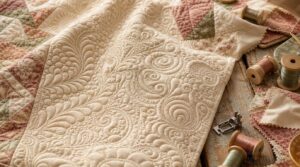
Once you’ve got the basics down, it’s time to push your work into more expressive territory.
Decorative motifs let you add real personality to a quilt — texture, movement, and detail that make people stop and look twice.
Here are five worth adding to your practice sessions.
Feather Quilting Patterns
Feather quilting motifs are among the most elegant designs you can stitch.
Using feather spine techniques, you draw a central line, then bloom petal-shaped quills outward on each side.
Historical feather designs appeared in Baltimore Album quilts — and they’re still breathtaking.
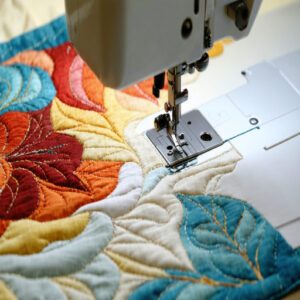
Try feather wreaths, feather border layouts, or feather fusion styles for 3D feather effects that feel light as a feather, free‑motion design.
Greek Key Quilting Design
The Greek Key is one of those quilting motifs with serious historical origins — borrowed straight from ancient Greek architecture and pottery. Its angular precision makes it a standout among Free Motion Quilting Designs, building squared spirals through deliberate right-angle corners.
Use strong color contrast on solid fabric to let the geometry sing.
Pattern variations let you adapt it as a bold border application or an all‑over filler — endlessly adaptable.
Diamond Quilting Motifs
Diamond grid patterns are one of the most adaptable frameworks in free motion quilting. You can shift the whole feel of a quilt just by adjusting scale or density.
Three ways to make diamonds work harder:
- Grid Variations — tighten or loosen spacing for density control that suits your design
- Fill Techniques — drop feathers or pebbles inside each cell for layered texture
- Motif Placement — anchor swirls at intersections and use border diamonds to frame edges cleanly
Seasonal Quilt Patterns
Seasonal quilt patterns let you shift your whole creative focus with just a thread color and a motif.
Swap in cool navy and silver for a festive free motion quilting pattern, earthy burnt orange for autumn, or soft pastels for a floral free motion quilting pattern in spring.
Seasonal Color Schemes, Themed Fabric Selection, and Holiday Motif Integration guide your Seasonal Block Designs naturally — just plan your Seasonal Project Timelines one season ahead.
Appliqué Echo Quilting
Echo quilting wraps your appliqué like a contour map — each line tracing the shape outward, building depth with every pass.
- Stabilizer Use Tips – back delicate appliqués to prevent shifting
- Echo Foot Adjustments – switch to a darning foot for tight curves
- Thread Contrast Effects – try contrasting thread to make echoes pop
- Corner Echo Strategies – taper lines gently at corners
- Motif Integration Ideas – layer echo quilting with meander fill outside
Quilt Patterns Step by Step
Good technique isn’t just about the design you choose — it’s about how you actually execute it, step by step.
Before you stitch a single line on your quilt, a few practical habits will make the difference between frustration and flow.
Here’s what to work through, in order.
Sketching Designs First
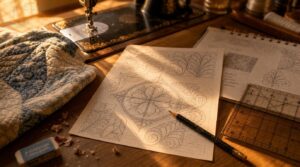
Before you touch your machine, sketch first. Think of it as concept exploration on paper — your pencil does the doodling with thread before your needle ever does.
Quick thumbnails handle composition basics and proportional guides, showing how motifs scale across blocks. Sketch varying densities for texture techniques, and use revision strategies freely — erasing costs nothing.
That simple roadmap makes quilt design planning and free motion quilting far less intimidating.
Using Dry-erase Markers
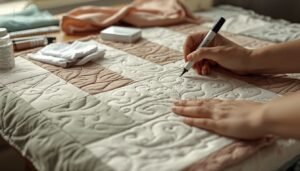
Dry-erase markers are an indispensable tool for planning free motion quilting patterns directly on your quilt top. Their ink erasability means you can sketch, adjust, and erase without commitment.
Check surface compatibility first — test a small area, since some fabric finishes hold ink longer. Use light strokes, standard erasing techniques with a damp cloth, and always prioritize safety by choosing non-toxic formulas.
Quilting From Center Outward
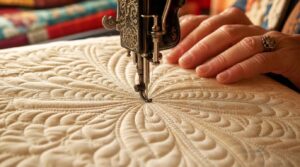
Once your design is sketched, start at the exact center of your quilt — not close to it, but precisely there.
This is your anchor.
Center Stabilization Methods work because every outward stitch distributes tension evenly using Concentric Ring Strategies.
Radiating Pattern Techniques like spirals naturally flow from this point.
Symmetry Maintenance Tips become simple when Tension Management Outward grows from one stable origin.
Managing Large Quilt Sections
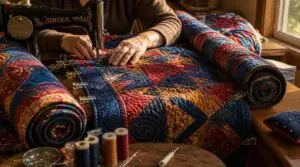
Once your center is stable, the real challenge begins — wrangling a large quilt through a home machine.
Section Division is your best friend here.
Break the quilt into workable zones and use Rejoining Techniques like registration marks to keep everything aligned.
- Roll excess fabric softly for Bulk Management
- Use a side table for Quilt Support Tools and Edge Stabilization
- Re‑baste between sections for quilt layer stabilization
- Apply the sectional quilting method for consistent fabric movement control
Controlling Speed and Tension
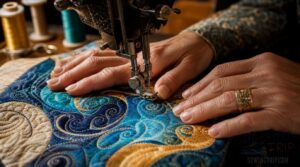
Once your sections are aligned, your next job is staying in sync — matching your hand speed to your machine’s rhythm. Move too fast and stitches stretch; too slow and they bunch.
Think of it like a dance. Consistent quilt speed keeps stitch length even.
Free motion quilting is a dance — sync your hands to the machine’s rhythm and even stitches follow
Thread Balance Techniques, smart Fabric Feed Systems, and basic stitch tension adjustment all work together — your real-time Tension Algorithms do the rest.
Frequently Asked Questions (FAQs)
How do I fix uneven stitches while quilting?
Check your bobbin first — uneven stitches usually trace back to tension or lint buildup.
Adjust your stitch tension, clear debris, and do a few Stitch Rhythm Drills on scrap fabric before touching your quilt.
Can free motion quilting work on a serger?
Technically, no — a serger isn’t built for free motion quilting. Its narrow throat space restricts fabric handling, and tension instability issues make clean stitching nearly impossible.
Stick to a home sewing machine or longarm instead.
What thread colors complement patterned quilt tops?
neutral threads — white, cream, or light gray — are your safest bet on busy patterned tops. They let the fabric shine.
For bolder contrast, try matching one accent color in the top.
How long does a full quilt typically take?
It depends on size, skill level, and design complexity. A baby quilt might take 6–14 hours, while a king-size can demand 40–80 hours. Basting, setup duration, and technique choice all add time.
Are quilting gloves necessary for better fabric grip?
Not exactly necessary, but they’re a genuine upgrade. Quilting gloves give you grip, cut fatigue, and keep fabric from sliding — especially helpful during dense or intricate stitching sessions.
Conclusion
What if the quilt you’ve been imagining is already within reach—just waiting for your hands to lead? Free motion quilting patterns aren’t about being perfect; they’re about building a conversation between you and the fabric.
Every meander you stitch, every feather you practice, deposit something into your muscle memory that no amount of watching can replace. Start simple, stay consistent, and trust the process.
The design that feels impossible today becomes second nature sooner than you’d expect.
- https://www.quiltingdaily.com/free-motion-weekly-52-quilting-fillers-and-motifs-with-susan-brubaker-knapp-2
- https://www.chatterboxquilts.com/motif-practice-sheets
- https://stitchedbysusan.com/freehand-quilting-frolic
- https://freemotionproject.com/free-motion-quilting-project
- https://ctpub.com/products/850-free-motion-quilting-designs