This site is supported by our readers. We may earn a commission, at no cost to you, if you purchase through links.
Machine-sewn zippers can look polished until you notice the puckering, the uneven teeth, the way the fabric pulls slightly wrong.
Hand stitching a zipper takes longer—no argument there—but it gives you something a sewing machine rarely does: total control over every single stitch.
Tailors have relied on this technique for centuries, and couture garments still use it today for one simple reason.
It works beautifully.
Whether you’re working with a delicate silk blouse or a structured wool skirt, zipper installation by hand stitching lets the fabric behave exactly as it should.
Table Of Contents
Key Takeaways
- Hand‑stitching a zipper gives you stitch-by-stitch control that a machine simply can’t match, which is why couture tailors still swear by it.
- Your tools set the tone before you sew a single stitch — the right needle, thread weight, and stabilizing materials are what keep the fabric behaving.
- Prep work like pressing seams flat, stabilizing edges, and centering teeth on the seam line is what separates a zipper that lies smoothly from one that puckers and pulls.
- Finishing strong matters just as much as starting right — removing basting carefully, pressing from the wrong side, and reinforcing stress points are what make a hand‑stitched zipper last.
Tools for Hand-Stitched Zipper Installation
Before you sew a single stitch, your tools make or break the whole job.
A good checklist of essential tools for separating zipper installation saves you from frustrating mid-project scrambles.
Getting the right ones together saves you frustration and keeps your zipper looking clean and professional.
Here’s what what you’ll need to get started.
Hand Sewing Needles for Different Fabrics
Your needle choice sets the tone before you take a single stitch. Use sharps for wovens like cotton or wool — sizes 5 to 10 cover light to medium weight, while sizes 11 to 12 suit delicate fabric.
Switch to ball-point for knits, leather needles for heavy materials, and tapestry needles for embroidery work.
Always match needle eye size to your thread.
Understanding inverse hand needle sizing helps you select the correct diameter for your zipper project.
Best Thread Types and Matching Color
Once your needle’s sorted, thread choice is next — and it matters more than you’d think.
For most projects, 50wt polyester is your best friend. It’s strong, slightly stretchy, and plays nicely with almost any fabric. Here’s a quick guide:
- Polyester Thread Choice — reliable, flexible, works on nearly everything
- Cotton‑Polyester Blend — great look with added strength
- Nylon Strength Options — ideal for high-strain zipper seams
- Fabric‑Thread Color Matching — go one shade darker for a natural blend
- Contrast Stitch Colors — bold choice for decorative topstitching on denim
Match thread to fabric fiber whenever you can. Consider thread weight, as lightweight 50wt polyester works well for fine fabrics.
Pins, Clips, Chalk, and Seam Gauge
Good thread won’t save you if your zipper shifts mid‑stitch. That’s where your marking tools earn their keep.
Use pins or sewing clips to lock the tape in place — glass‑head pins for lightweight fabric, clips where layers get bulky. Tailor’s chalk sets your reference line, and seam gauge calibration keeps both sides equal. Smart pin‑clip choice upfront means cleaner stitches later.
Scissors, Thimble, and Beeswax
Three more tools round out your kit.
Sharp scissors — think shear blade maintenance over time — keep thread trims clean without yanking stitches loose. basic scissor safety tips: fabric only, never paper.
A thimble protects your fingertip through thick zipper tape layers; check your thimble fit guide since loose ones slip.
Rub your thread with beeswax for beeswax thread conditioning — it glides, tangles less, stitches smoother.
Choosing The Correct Zipper Type and Length
Zipper type and length make or break the whole project.
For dresses, a coil or invisible zipper keeps things clean — invisible zipper lengths usually run 9 to 22 inches, perfect for skirts.
Separating vs. closed depends on your opening: jackets need separating, bags need closed.
Coil vs. metal comes down to fabric weight selection — lightweight fabrics need softer, weight‑appropriate zippers.
Match both, and you’re set.
Prepare Fabric and Zipper Placement

Good prep work is what separates a zipper that lies flat from one that puckers and pulls.
Skipping steps like pressing seams or stabilizing the tape is exactly the kind of thing covered in these zipper installation troubleshooting tips that make a real difference in the final result.
Before you touch a needle, there are a few setup steps that make everything click into place. Here’s what to work through first.
Measuring The Zipper Opening Accurately
Getting the measurement wrong here ruins everything downstream. Start by measuring the zipper length from the top of the slide to the bottom stop — that’s your base number. Then do your seam allowance calculation: add 5/8‑inch standard, plus 1/2‑inch if a hook and eye is involved.
Use a tape measure technique along the seam line, not across loose fabric. Keep it flat.
- Use the fabric edge as your edge reference alignment point
- Measure the curved opening measurement along the seam, never straight across
- The bottom stop reference tells you exactly where the opening ends
- A ruler or measuring tape beats eyeballing every single time
Marking The Seam Line and Top Stop
Marking the seam line and top stop is where accuracy becomes visible. Use chalk marking techniques or water‑soluble markers — they vanish cleanly after installation. A seam gauge keeps your spacing consistent on both sides.
| Mark | Purpose |
|---|---|
| Seam line | Guides zipper teeth alignment |
| Top zipper stop | Prevents stitching into hardware |
| Parallel stitch lines | Keeps both tape sides even |
| Top stop transfer | Anchors your hand sewing needle start point |
Run alignment checks before touching your needle.
Pressing Seam Allowances Flat
Press the seam as sewn first — that sets the stitches. Then open the allowances with your fingers while the fabric is still warm and press them flat using an up-and-down motion.
Steam Technique matters here: proper Heat Settings and Pressure Control prevent shine marks.
Use a Support Board underneath for clean seam alignment.
Good fabric handling now makes zipper placement so much easier.
Stabilizing Edges With Interfacing or Stay Tape
Skipping this step is how you end up with a zipper that ripples like a bad hem.
Cut your fusible interfacing about 1 inch wide and run it the full length of the opening.
For stretchy fabrics, knit stay tape beats woven tape — it curves without fighting you. Press using heat appropriate for your fabric, let it cool, then move on.
Aligning Zipper Teeth With The Center Seam
This is where the whole installation either clicks into place or goes sideways.
Lay the zipper face-down with the teeth sitting directly on your centerline marking — not drifting toward either seam allowance. Visual checks matter here. Teeth should track straight from top stop to bottom along the center back seam.
- Teeth centered means both fabric sides meet evenly when closed
- Seam tension stays balanced when zipper alignment follows the pressed seam channel
- Tape folding and edge stabilization keep the tape flat against the seam allowance handling for zippers
Pinning or Clipping The Zipper in Place
Once the teeth are centered, lock that placement down before anything shifts.
Place pins perpendicular to the tape — parallel pins snag your needle path. Space them every 2–3 cm.
On delicate fabric, swap pins for clips to avoid marks.
Either way, the goal is a firm temporary hold at the top and bottom first, then fill in the middle.
Baste The Zipper by Hand

Basting is what keeps everything honest before you commit to the final stitches. Think of it as a test run — a way to hold the zipper exactly where you want it without any pressure.
Basting is your test run — a commitment-free way to hold everything honest before the final stitch
Here’s how to do it right, step by step.
Positioning The Zipper Under The Opening
Flip your garment wrong side up and lay it flat. Place the zipper face down over the opening, focusing on center seam alignment — the teeth should sit directly on your marked seam line.
Check top stop clearance, keeping it about ¼ inch below the edge. Your folded seam edge guides zipper tape tension naturally. Do a quick visual symmetry check before touching a single pin.
Using Uneven Basting Stitches for Control
Now that your zipper is positioned, lock it down with uneven basting stitches before anything shifts.
- Use long stitches (¾–1 inch) on top, short gaps (¼ inch) underneath for edge stability.
- Choose a contrasting thread — thread visibility saves you from stitching over it later.
- Sew near the tape edge for a clear stitching guide.
- Maintain gentle thread tension control; too tight pulls the tape crooked.
- Stitch spacing stays consistent for reliable zipper alignment throughout.
Following Zipper Tape Lines for Straight Placement
Your zipper tape isn’t just fabric — it has woven lines built right in. Those lines are your tape guide alignment, running parallel to the teeth.
Follow them and your seam edge flush placement stays honest. Use a fabric marker for marking the seam lines on dark fabric where the woven guide disappears.
Consistent stitch direction along that visual guide marking keeps tension control steady, and your hand sewing a zipper step‑by‑step guide stays on track.
Checking Symmetry on Both Sides
Folding the garment closed is your best symmetry check. Match both layers and look at the center line — the center line should split the opening evenly.
Check your edge spacing on both sides with a seam gauge. Top-bottom match matters too; uneven tape ends show up fast.
Basting verification here saves you from unpicking later. Loose basting stitches are still easy to reset.
Preventing Shifting Before Final Stitches
Even one loose pin can send your tape drifting mid‑stitch. Lock things down before you commit.
- Stay Tape Application stabilizes the edge so the seam line won’t creep or stretch
- Clip vs Pin Choice matters — clips grip thicker fabric without holes; pins work for lighter layers
- Marking Guide Lines give your basting a fixed path, keeping thread tension control honest on both sides
Sew The Zipper With Hand Stitches
This is where the real work begins — needle in hand, thread ready, zipper basted and waiting.
How you sew the final stitches determines whether your zipper looks store-bought or handcrafted with intention.
Here’s what to focus on as you work through each step.
Starting at The Bottom Edge Securely
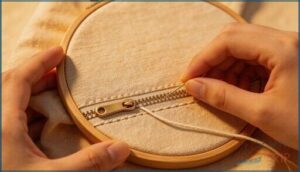
The bottom stop is where every zipper takes its hardest hit. Before anything else, hide your knot under the zipper tape and drop a firm anchor stitch right at the seam edge.
Then work two or three backstitches into that same spot — your backstitch start locks the thread so it won’t slip. Keep thread tension snug, not strangling, and you’ve got bottom stop reinforcement that actually holds.
Using Prick Stitch for Neat Topstitching
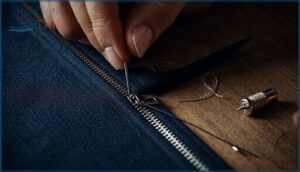
The prick stitch is your secret weapon for couture-looking topstitching. Use a fine sharp needle — size 7 or 8 — and waxed thread matched to your fabric.
Stitch forward about 3/8 inch, then back just one or two threads. That tiny visible dash is your stitch visibility goal. Keep thread tension control snug and consistent. Edge reinforcement happens naturally with this stitch density.
Using Backstitch for Extra Strength

Backstitch is where real seam strength lives. For hand sewing zipper installation, use it at every stress point — especially the top and bottom ends. Each stitch overlaps the last, locking the thread line tight.
That’s your edge anchoring technique in action. Throw in small bar tacks at both ends for stress point reinforcement.
Watch your thread tension control — snug, never strangled.
Keeping Stitch Length and Tension Even
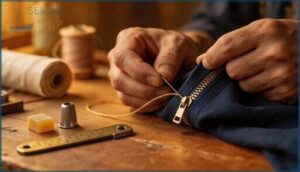
Think of your stitches like a rhythm — break it, and everything shows.
- Keep Needle Angle Control steady so entry and exit points stay consistent.
- Use Thread Waxing Benefits to reduce drag and maintain even tension.
- Apply Fabric Relaxation Methods — never pull the cloth taut while stitching.
- Practice Tension Monitoring Techniques by checking every few stitches.
- Aim for Consistent Stitch Spacing with a seam gauge as your guide.
Sewing Both Sides in The Same Direction

Once your tension feels steady, here’s a rule that saves every zipper: Direction Consistency matters more than most sewists expect.
Sew both sides top to bottom — never reverse. On stretchy fabric, especially, switching directions causes Ripple Prevention to fail fast. That mismatched pull shows immediately. Alignment Check before your second pass confirms both sides match. Same direction, same result, every time.
Reinforcing The Top and Bottom Ends
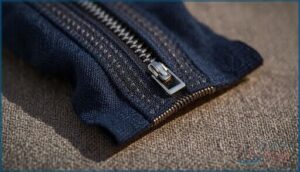
Both ends of your zipper need real protection. At the bottom, a bar tack — six to eight parallel threads wrapped tight with buttonhole stitches — stops the slider cold. A thread-wrapped stopper works too.
At the top, a fabric tab or multi-pass backstitch seam reinforcement manages the pull. Don’t skip the catch stitch stop either. These details separate a lasting zipper from one that fails fast.
Opening The Zipper During Stitching When Needed
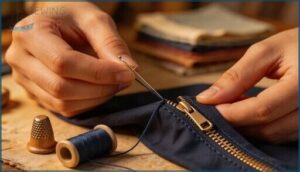
Once your ends are reinforced, the zipper pull becomes your next puzzle. The slider blocks your path — but don’t stop and restart blind.
Here’s the move:
- Lock your needle in the fabric for steady needle positioning.
- Slide the zipper pull past for clear pull access and slider clearance.
- Resume with even stitch continuity, maintaining tension throughout.
That’s how a hand sewing zipper installation guide manages it right.
Finish and Fix Common Problems

The hard part is behind you — now it’s just about finishing strong.
A few quick steps will clean up your work and handle any hiccups that sneak up along the way. Here’s what to check before you call it done.
Removing Basting Without Disturbing Stitches
Basting thread removal is where patience pays off. Wait until your final hand stitches are fully secure.
Then use a seam ripper or small snips — that’s your snip technique — to break the thread without touching your permanent stitches.
These stitch protection tips matter: work in short sections, keep fabric tension control with one hand, and do a cleanup inspection after.
No loose threads near the slider.
Pressing The Zipper Area for a Smooth Finish
Pressing the zipper area is what separates a good result from a great one.
Set your iron to low-to-moderate heat — steam flattening works beautifully here — and press from the wrong side.
Use a pressing cloth for heat protection on delicate fabric. This manages fold line setting and edge crisping at once.
Interfacing press adds stability.
Cool completely before moving.
Fixing Puckering, Twisting, and Misalignment
Fixing problems after stitching starts with honest diagnosis.
Puckering usually means tension adjustment is needed — your stitches are pulled too tight against the grain.
Interfacing stabilization along the opening edge prevents rippling in soft fabrics.
Check grain alignment if the zipper twists.
Redo basting symmetry on both sides when misalignment shows.
Preventing fabric puckering during zipper installation is always easier than correcting it after.
Securing Loose Ends and Trimming Threads
Tidying up your thread ends is where a good zipper becomes a great one. Use solid Knotting Techniques — a tight tailor’s knot pulled snug against the cloth.
Then try the Hidden Tuck Method: run your needle two to three inches inside the seam before cutting. For extra insurance, a drop of Seam Sealant Application like Fray Check locks everything.
Follow smart Tail Trimming Tips — cut after the knot sets, never before. Your Thread Finish Inspection is simple: tug gently. Nothing should move.
Reinforcing High-stress Areas for Durability
Some zippers fail not from bad stitching — but from skipped reinforcement. Hit every stress point with dense bar tacks: tight, overlapping stitches that spread the load.
- Fly Seam Anchors lock the opening against constant pull
- Pocket Corner Reinforcement stops edges from tearing wide open
- Zipper Tape Stabilizing keeps teeth aligned through heavy use
Backstitch over those zones twice. That’s Heavy Seam Support done right.
Frequently Asked Questions (FAQs)
Can hand-stitched zippers be repaired after wear?
hand-stitched zippers can absolutely be repaired.
slider repair methods and tape reinforcement techniques often save the whole zipper.
teeth are intact, a quick hand stitch fix restores full function.
How do you match zipper color to patterned fabric?
Lay the zipper tape on your fabric scrap in daylight. Match the dominant print color, check undertone matching, and decide: blend it in or make it a design accent zipper.
Which zipper works best for stretch or knit fabric?
For knit fabric, a nylon coil zipper is your best friend — flexible, soft, and low-bulk.
Invisible zippers work great at necklines.
Stabilize edges with interfacing first so the knit doesn’t stretch out of shape.
How do you hand-stitch a zipper on leather?
Leather demands respect. Use a strong leather needle, waxed thread, and clips — never pins.
Pre-punch holes for cleaner Stitch Density. Control Leather Tension carefully. Master Leather Edge Prep first, then stitch with confidence.
Can a broken zipper pull be replaced by hand?
a broken zipper pull can be replaced by hand.
Thread a cord or key ring through the slider for a quick fix.
Test it by zipping up and down a few times to confirm smooth movement.
Conclusion
Hand stitching a zipper might just be the single most impactful skill you’ll ever add to your sewing toolkit. Every tailor who’s mastered zipper installation hand stitching knows that feeling—when the teeth align perfectly, the fabric lies flat, and the finish looks like it came straight from a couture atelier.
That’s yours now. You’ve got the technique, the patience, and the know-how. Trust your hands. They won’t lie to the fabric.
- https://thedailysew.com/blog/2018/06/how-to-sew-in-a-zipper-by-hand/
- https://sewsweetness.com/2018/05/video-how-to-slip-stitch.html
- https://threadsmonthly.com/sew-centered-zip/
- https://www.doinaalexei.com/387-hand-baste-zippers-for-stability-during-stitch-application.html
- https://makeit-loveit.com/sewing-tips-install-attach-basic-zipper