This site is supported by our readers. We may earn a commission, at no cost to you, if you purchase through links.
Choosing the wrong stabilizer ruins more embroidery projects than bad digitizing ever will.
It’s the silent variable most beginners overlook—until their stitches pucker, their letters sink into fleece, or their knit fabric stretches sideways mid-design.
Stabilizer isn’t just backing; it’s the foundation your entire design depends on.
In machine embroidery classes, this is where beginners spend the most time troubleshooting—and where experienced stitchers quietly gain their edge.
Once you understand how each type works and why fabric pairing matters, your results shift from unpredictable to consistent.
Table Of Contents
Key Takeaways
- Matching your stabilizer to your fabric type—tear-away for wovens, cut-away for knits, wash-away for sheers—is the single most important skill in machine embroidery.
- Cut-away stabilizer is your go-to for stretch fabrics because it stays permanently in place and keeps your design intact through repeated washing.
- Topping stabilizer sits on top of textured or loopy fabrics like terry cloth to protect your design’s surface and stop stitches from sinking into the pile.
- Proper removal matters just as much as proper application—tear gently, trim close, dissolve with lukewarm water, or use heat-away on fabrics that cannot get wet.
Stabilizers Used in Embroidery Classes
Most machine embroidery classes start with stabilizers — and for good reason. Picking the right one can mean the difference between a clean, crisp design and a puckered mess.
It’s one of those foundational skills covered in depth when you’re getting started with embroidery as a hobby and want results that actually look polished.
Here are the main types you’ll work with in class.
Tear-away Stabilizer Basics
Tear-away stabilizer is your go-to backing for woven, non‑stretch fabrics like cotton, linen, and terry towels. It gives temporary support during stitching, then tears cleanly away when you’re done.
Weight selection matters — lighter weights suit simple designs, heavier ones handle denser stitch counts.
Always inspect for thin spots before hooping, and remove it gently in small sections to protect your stitches.
For medium to heavy knit fabrics, consider using an iron‑on tear‑away stabilizer.
Cut-away Stabilizer Basics
Unlike tear-away, cut-away stabilizer stays permanently behind your embroidery — that’s what makes it the right call for knits, jersey, and stretch fabrics.
It won’t shift or distort through washing and wear.
Mesh weight options range from light to heavy, so match them to your fabric.
Trim close using a gliding cutting technique, and don’t layer more than three times.
The no-show poly-mesh support prevents visible shadows on light‑colored fabrics.
Wash-away Stabilizer Basics
Wash-away stabilizer is the one that simply disappears.
Soak your finished piece in lukewarm water — around 90°F works well — and it dissolves completely.
It comes in several film stabilizer types, mesh vs paper formats, and even liquid coating application options you brush directly onto fabric.
Sticky-back stabilizer versions make positioning easy.
Store it sealed and dry, or humidity will dissolve it before you ever stitch a single thread.
When Topping Stabilizer is Needed
Think of topping stabilizer as a shield for your fabric’s surface. While you tear away, cut away, and wash away stabilizer work underneath, topping sits on top — and it matters for:
- Satin stitch protection on textured loops
- Needle mark reduction on delicate surfaces
- Sheer fabric finish without visible backing
- High-density lettering and appliqué edge smoothness
Stabilizer selection for different fabrics gets easier once you know topping’s role.
Adhesive and Hydro Stabilizer Uses
Some fabrics just won’t sit still in a hoop — and that’s exactly where adhesive and Hydro embroidery stabilizer options shine. Both use water-activated tack for slip-free hoopless stitching on curved surface stitching challenges like collars, cuffs, and shoes.
| Stabilizer Type | Best Use |
|---|---|
| Adhesive stabilizer | Edge-detail reinforcement on small pieces |
| Hydro embroidery stabilizer | Temporary adhesion on textured or plush fabrics |
| Adhesive-backed tear-away | Firm woven items needing easy cleanup |
| Water-soluble adhesive | Delicate fabrics requiring full removal |
Match Stabilizer to Fabric
Picking the right stabilizer starts with knowing your fabric.
Different fabrics behave differently under the needle, so using dressmaker’s carbon paper for fabric marking can help you test placement before committing to a cut.
Different materials behave in completely different ways under the needle, and using the wrong backing can leave you with puckered seams or distorted designs.
Here’s how to match your stabilizer to the most common fabric types you’ll work with.
Cotton and Linen Fabric Choices
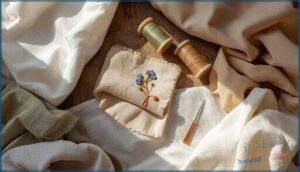
Cotton and linen are your best friends when you’re just starting out. Both are woven, stable, and easy to hoop — but they’re not identical twins.
Here’s what to keep in mind for smart stabilizer selection:
- Weave Tightness — Higher thread count means cleaner stitch edges.
- Fabric Weight — Medium-weight cotton fabric supports moderate designs without buckling.
- Pre-wash Treatment — Always pre-wash to prevent shrinkage post-embroidery.
- Needle Choice — Match needle size to fabric weight for linen especially.
Knit and Stretch Fabric Support

Knit and stretch fabric can fight you at every step of the way — but the right backing puts you back in control.
No-show Mesh cut-away is the go-to for stretch garments because it gives permanent support without bulk.
For slippery knits, Fusible Support bonds directly with Heat Bonding before hooping.
Layered Stabilizing crosses two mesh layers to handle dense designs cleanly.
| Knit Fabric Type | Best Stabilizer | Application Method |
|---|---|---|
| Light jersey | No-show Mesh | Hoop with fabric |
| Slippery knit | Fusible Support | Iron on before hooping |
| Dense design | Layered Stabilizing | Cross two mesh layers |
| Polo/shirt | Single mesh cut-away | Standard hooping |
| Infant items | Soft no-show mesh | Float with basting |
Terry Cloth and Textured Surfaces
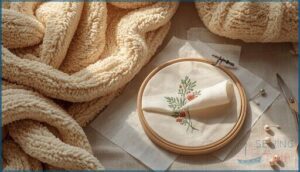
Terry cloth is basically a moving target — those looped piles swallow stitches whole if you’re not prepared. Pile Compression is your first fix: a Water-soluble Topper flattens the nap so your design stays visible.
Terry cloth’s looped piles swallow stitches whole — flatten the nap first with a water-soluble topper
Pair it with Adhesive Backing underneath using Hoop Weight Support to prevent drag.
Smart stabilizer selection for textured fabrics means thinking about:
- Design Density and stitch density — keep fills compact
- Fabric preparation before hooping matters
- Textured nonwoven cut-away for lasting support
- Floating with Adhesive Backing on thick terry cloth
Sheer and Delicate Fabric Backing
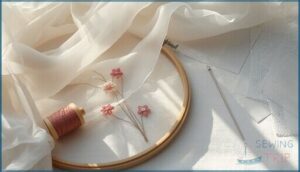
Sheer fabrics like organza, tulle, chiffon, and delicate silks demand a lighter touch. Wash-away stabilizer is your best friend here — it disappears completely, leaving no shadow or bulk behind.
Stabilizer selection for delicate fabrics also means committing to Fine Needle Choice and Light Thread Selection so every stitch sits cleanly. Keep Tension Control gentle, float the fabric rather than hooping it directly, and always do Test Stitching first. Invisible Mesh backing works beautifully when you need quiet, no-show support.
Heavy Fabrics and Dense Designs
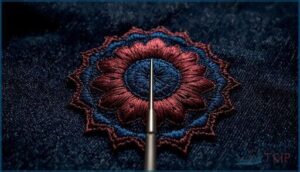
Dense designs on heavy fabrics like denim and canvas don’t forgive poor stabilizer choices. CutAway Stabilizer is your go-to here — it stays in the garment permanently, keeping Heavy Denim Stitching flat through every wash.
For Stitch Density Limits above 20,000 stitches, consider Cut-away Layering Strategies and match your Thick Fabric Needle Selection (90/14 or 100) accordingly.
Finishing Edge Reinforcement with a small stabilizer margin prevents post-trim puckering.
Hoop Stabilizers for Better Results
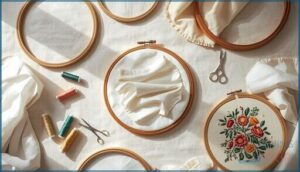
Hooping right makes a bigger difference than most beginners expect.
How you layer your stabilizer, position the hoop, and handle tricky fabrics can mean the difference between clean stitches and a frustrating redo.
Here’s what you need to know to get it right every time.
Layering Fabric With Stabilizer
Getting your stabilizer layer order right makes a real difference in how your finished piece looks. Think of it as building a sandwich — the right layers keep everything from shifting.
For stretchy fabrics, adhesive backing techniques help hold slippery knits in place without direct hooping. You can also combine multi-layer topping strategies with a cut-away base for textured surfaces.
That’s your stabilizer selection guide working in action.
Proper Hoop Placement and Tension
Once your layers are set, how you hoop them determines everything.
- Screw Positioning — Right-handers, aim for 10 o’clock; lefties, 2 o’clock.
- Center Alignment — Mark your fabric center before hooping.
- Hoop Size Selection — Smallest hoop that fits your design wins.
- Even Tension — Taut like a drum, never stretched tight.
- Hand Pressure — Smooth the fabric flat before your final screw adjustment.
Preventing Hoop Slip and Drag Marks
Even with perfect tension, slip happens — usually from a dirty hoop surface or stabilizer that doesn’t extend past the hoop edge.
Hoop Surface Cleanliness matters more than most beginners expect. Here’s what keeps everything locked in place:
| Problem | Fix |
|---|---|
| Stabilizer shifting | Make sure Stabilizer Edge Overlap beyond hoop |
| Drag marks on fabric | Check Moisture Control before hooping |
| Uneven stitch pull | Adjust Thread Tension Balance |
| Fabric stretch distortion | Increase fabric stretch resistance with cut-away |
| Needle skipping | Try Needle Pressure Adjustment |
Floating Hard-to-hoop Items
Some items just won’t sit inside a hoop — think cuffs, collars, or thick towel edges. That’s where floating saves the day. You secure your stabilizer in the hoop, then attach the fabric on top using Temporary Adhesive Sheets or Magnetic Hoop Support instead of hooping the fabric itself.
Try these floating stabilizer approaches:
- Use Foam Float Stabilizer under bulky edges for gentle, even lift
- Apply Hover Hoop Techniques to keep sheer or delicate layers from shifting
- Secure slippery fabrics with adhesive-backed stabilizer sheets before stitching begins
- Watch hoop placement and tension tips closely — loose fabric causes misalignment fast
Using Basting Stitches for Stability
Basting stitches are your secret weapon when fabric keeps shifting mid‑design.
Run a perimeter placement line — about ¼–½ inch from the edge — using contrasting thread so you can spot and pull it easily later.
A long stitch length punches fewer holes and speeds up post‑design removal without snagging your finished work.
| Situation | Basting Tip | Why It Works |
|---|---|---|
| Stretch fabric handling | Cut‑away + basting perimeter | Stops distortion under the needle |
| Floated towels/nap fabrics | Basting box, all four sides | Keeps surface flat during stitching |
| Slippery or sheer layers | Contrasting thread, long stitch | Easy pre‑stitch tension control and clean removal |
Choose Stabilizers by Project Type
Not every project plays by the same rules, and your stabilizer choice should reflect that.
The fabric matters, but so does what you’re actually making.
Here’s how to match your stabilizer to the project in front of you.
Monograms and Lettering
Monogramming looks simple until your letters sink into a knit shirt or pucker on a towel.
For stable woven fabrics, a tear away stabilizer manages most monogram font selection needs. Switch to cut away stabilizer when lettering stitch density increases or your fabric stretches. Embroidery stabilizer types also affect letter size scaling — a washaway stabilizer works well for thread color contrast on textured surfaces, keeping embroidered monogram placement clean and sharp.
Appliqué and High Stitch Counts
Appliqué and high stitch count designs put real pressure on your fabric — that’s where your stabilizer selection guide matters most. Cut-away stabilizer is the go-to for dense fills and edge reinforcement techniques, since it stays put through washing.
Layering stabilizer strategies (like pairing tear-away under cut-away) help manage color change management and tension. Always run a test stitch evaluation first — stitch density guidelines shift depending on your fabric.
Towels and Nap Fabrics
Towels are tricky — fabric nap and pile compression can swallow your stitches whole.
That’s why topper selection matters: a wash-away stabilizer laid over the terry loops holds everything flat during stitching, then dissolves with water. Use tear-away stabilizer underneath for lighter designs. For heavier ones, cut-away holds up through repeated washing.
Watch your thread tension on towels — tight tension pulls the pile.
Stretch Garment Embroidery
Stretch garments are where stabilizer choices really make or break your design.
Cut-away is your go-to — it stays permanently under the stitches, keeping everything intact through wash after wash.
Choosing the right stabilizer for stretchy fabrics means pairing it with smart hoop insertion, balanced thread tension, and lower machine speed.
Keep design density open and airy, and use a ballpoint needle for clean results.
Freestanding Lace and Cutwork
Freestanding lace designs and cutwork are where wash-away stabilizer truly shines — no fabric base, just pure stitch artistry.
Here’s what makes both techniques work:
- Use Layered Wash‑Away for Dense Stitch Support
- Maintain Tight Hoop Tension to prevent distortion
- Apply Lace Underlay Techniques for structural hold
- Rinse carefully when Finishing Lace Shape
- Choose wash-away over cutaway — Stabilizer removal methods after embroidery must leave no visible backing
Remove and Store Stabilizers Properly

Once your design is stitched, how you finish the job matters just as much as the work itself.
Removing stabilizer the wrong way can pull at your stitches and undo all that careful work.
Here’s what you need to know to wrap things up cleanly and keep your materials in good shape for next time.
How to Tear Away Safely
Removing the tear-away stabilizer the right way keeps your design crisp and your fabric intact. Always start at the outer edge — Edge Initiation matters more than you’d think.
| Step | What to Do |
|---|---|
| Gentle Pressure | Tear slowly; don’t yank |
| Layered Removal | Pull one layer at a time |
| Fabric Stabilization | Hold fabric steady while tearing |
| Residue Cleanup | Remove fuzz with a soft cloth |
Trimming Cut-away After Stitching
Unlike tear-away, cut-away stabilizer stays put — you’re just trimming the excess. Use sharp scissor technique to cut about 1/8 to 1/4 inch from your design edge.
That trim border width acts as a stitch protection buffer, keeping things supported without adding bulk. Hold fabric flat for tension control, and do a final edge cleanup so nothing scratchy lingers underneath.
Dissolving Wash-away With Water
Wash-away stabilizer removal is satisfying — a lukewarm soak and gentle agitation, and it simply disappears.
Run warm water over your finished piece, working your fingers through dense stitch areas for thorough residue removal.
Water temperature matters here; lukewarm keeps delicate fibers safe.
Once rinsing runs clear, press — don’t wring — with a towel and lay flat for drying.
Using Heat-away on Non-washables
Some fabrics — silk, velvet, wool — can’t get wet, so heat-away stabilizer is your go-to here. A hot iron breaks it down into small bits, which you simply brush away.
Always test your fabric’s heat tolerance on a scrap first, and use a pressing cloth for fabric protection. Quick removal, no water needed, and design visibility stays clean throughout.
Storing Stabilizers to Prevent Damage
Storing stabilizers correctly is half the battle. Keep them in humidity-controlled storage — away from bathrooms and basements — and use UV-blocking containers to prevent yellowing and brittleness.
Roll orientation tips: stand rolls upright or flat on wide racks. Dust-proof sealing protects adhesive film handling surfaces from lint. Label everything clearly, and your stabilizers will stay fresh and ready for any project.
Frequently Asked Questions (FAQs)
Does Hobby Lobby have embroidery stabilizers?
Yes, Hobby Lobby carries embroidery stabilizer options including tear-away, cut-away, and wash-away types.
Their store product variety covers class materials like Pellon cut-away and Sol-U-Film wash-away, with online availability for easy stabilizer selection.
Can beginners use stabilizers without an embroidery machine?
Absolutely — stabilizers work great for hand stitching too.
Tearaway stabilizer backs fabric while you stitch by hand, cutaway adds lasting support for stretchy knits, and washaway dissolves cleanly once you’re done.
Do stabilizer brands affect embroidery stitch quality?
Brand does matter. Premium stabilizers offer better material strength, adhesion precision, and brand texture uniformity — all of which directly affect embroidery stitch integrity and stitch density impact across your projects.
How do stabilizers differ for hand versus machine embroidery?
Machine embroidery stabilizers handle high-speed tension and dense stitching, while hand embroidery needs lighter backing with easier needle compatibility.
Your stabilizer selection guide and fabric types determine backing removal and material cost for each method.
Are stabilizers safe for childrens clothing and toys?
Like a soft lining in a well‑made jacket, most stabilizers sit safely against skin.
Reputable brands meet non‑toxic certifications, and washaway stabilizer dissolves cleanly, leaving no lint residue to irritate a child.
Can you reuse stabilizer scraps for small projects?
reuse stabilizer scraps for small projects.
Sort them by stabilizer types, match pieces to your hoop size, and save clean offcuts for monograms, test stitches, or appliqué details.
Conclusion
best embroidery stabilizer is the one you never notice—because when it’s right, it disappears into the work. That’s the quiet truth behind every clean stitch and crisp letter.
Mastering embroidery stabilizers for machine embroidery classes isn’t about memorizing rules; it’s about reading your fabric and trusting your judgment. Once that clicks, you stop guessing and start producing work that holds together—beautifully, consistently, every single time.
- https://www.toughkittencrafts.com/stabilizer-breakdown-categories-weights-and-types/
- https://www.bernina.com/en-US/Learn-Create-US/Embroidery-Tips-Tricks/Choosing-the-right-stabilizer
- https://embroiderylegacy.com/how-to-use-machine-embroidery-stabilizer/
- https://www.hooptalent.com/blogs/news/machine-embroidery-stabilizer-chart-the-ultimate-guide-for-perfect-fabric-support
- http://mailto: education