This site is supported by our readers. We may earn a commission, at no cost to you, if you purchase through links.
A seam that puckers on silk chiffon isn’t a tension problem—it’s almost always a thread problem.
Most sewists obsess over needle size or stitch length, but thread weight quietly controls whether your seams lie flat, hold under stress, or slowly unravel after a few washes.
Match it wrong, and even a perfectly executed seam fails the fabric.
The logic behind choosing thread weight isn’t complicated, but it is specific: delicate sheers need 60–100 wt, mid-weight naturals perform best with 40–50 wt, and heavy-duty materials demand 12–30 wt.
Knowing exactly what thread weight to use for fabric types makes the difference between professional results and endless frustration.
Table Of Contents
Key Takeaways
- Thread weight—not tension—is the real cause of puckering, so match it to your fabric first: 60–100 wt for sheers, 40–50 wt for mid‑weights, and 12–30 wt for heavy‑duty materials like denim and canvas.
- Stretch fabrics need thread that moves with them, so choose Seraflex or wooly nylon with 20–30% built-in elasticity to prevent seam pop on knits and jersey.
- Your needle must keep pace with your thread—pair 60 wt with a 60/8–70/10 needle and 30 wt with a 90/14 needle, or skipped stitches and breakage will follow.
- Fiber, ply, and finish matter just as much as weight—polyester resists moisture, silk glides through delicates, and a higher ply count quietly boosts seam strength without adding bulk.
Best Thread Weights for Delicate Fabrics
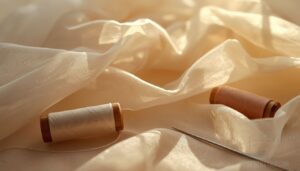
Delicate fabrics have almost no tolerance for error — the wrong thread ruins everything. Getting the weight right is what separates a clean, professional finish from a puckered mess.
A quick look at thread weight basics for beginners can save you from costly mistakes before you cut a single piece of silk.
Here’s what you need to know about thread weight, seam visibility, and why the 60–100 wt range is your best friend with these fabrics.
Silk, Chiffon, Voile, and Organza
These four fabrics share one thing: they punish the wrong thread instantly.
Silk, chiffon, voile, and organza all demand fine silk threads or high‑tenacity polyester in the 60–100 wt range. Their fabric thickness is minimal, so thread weight considerations for delicate fabrics matter enormously here. Chiffon’s structure relies on twisted crepe yarns for its delicate feel.
Here’s what makes each unique:
- Silk chiffon — fluid draping dynamics, moves like water
- Organza — crisp transparency effects, holds structural shapes
- Voile — softer drape, excellent for fabric layering
- Silk — natural sheen enhancement elevates color coordination beautifully
Why 60–100 Wt Reduces Puckering
Thread weight is the real reason puckering happens—not your tension dial. Fine threads in the 60–100 wt range allow reduced tension settings without sacrificing stitch integrity.
Puckering blames tension, but the real culprit is thread weight
That lower tension means synchronized fabric feed, so delicate fibers move through evenly. Loop formation stability stays consistent, minimizing fabric distortion.
Even stitch density follows naturally, and your seams lie flat instead of pulling inward.
Creating Nearly Invisible Seams
Flat seams start with the right details. Keep your seam allowance tight — 1 to 2 mm — so there’s nothing to catch the light.
Set stitch length between 2.0 and 2.4 mm for Stitch Length Optimization on sheers.
Tension Balancing matters too: fine thread tension runs lower, preventing drag.
Foot Selection Techniques, like a walking foot, feed fabric evenly.
Finish edges with a rolled hem to eliminate bulk completely.
Best Thread Weights for Cotton Fabrics
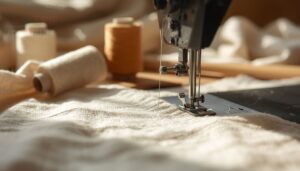
Cotton, linen, and light twill are workhorses — sturdy enough to handle daily wear, but still easy to sew cleanly.
Getting the thread weight right makes all the difference between a seam that holds and one that puckers or pulls.
Here’s what you need to know for each situation.
Cotton, Linen, and Light Twill
Cotton, linen, and light twill share a lot — fiber breathability, natural texture — but they’re not identical.
Each fabric has its own personality, though, so pairing the right technique — like using twin needles for clean parallel topstitching — makes a real difference in the final result.
Linen brings crispness comparison to mind immediately; it’s stiffer and holds structure differently than cotton.
Light twill adds weave drape effects with its diagonal construction.
Cotton threads actually swell slightly when washed, quietly reinforcing seam integrity.
Matching thread weight to fabric type starts here, with knowing your weave.
Why 40–50 Wt Gives Balanced Strength
Here’s the sweet spot: 40wt and 50wt threads deliver tensile flexibility without sacrificing abrasion resistance. That balance directly impacts seam strength and durability on mid-weight fabrics.
Your stitches stay consistent, your seam drape stays natural, and colorfastness stability holds through repeated washing.
Fabric compatibility matters here — these weights blend into cotton and linen without adding bulk or stiffness.
Everyday Garment and Home Sewing Uses
Whether you’re sewing a cushion cover or hemming a cotton dress, 40–50 wt thread manages both without complaint. It’s your go-to for general sewing projects where fabric thickness stays moderate and thread selection shouldn’t be a guessing game.
- Buttonholes stay clean with 40 wt — no crowding
- Topstitching on twill holds crisp lines wash after wash
- Seam finishing techniques stay flat, never stiff
Best Thread Weights for Heavy Fabrics
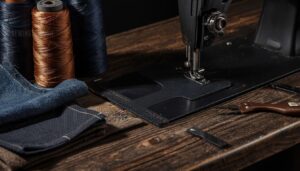
Heavy fabrics don’t forgive weak thread — they’ll chew right through it. You need a coarser, stronger thread to hold seams together under real stress.
Here’s what works best for the toughest materials you’ll sew.
Denim, Canvas, and Upholstery
Denim, canvas, and upholstery don’t forgive weak thread. These fabrics take real punishment — think seam pull tests that reach 150 pounds per inch on upholstery-grade material.
Match that load with heavy-duty thread in the 12–30 wt range.
| Fabric | Thread Weight | Key Benefit |
|---|---|---|
| Denim | 12–18 wt | Heavy-duty thread strength, denim abrasion resistance |
| Canvas | 18–24 wt | Canvas water repellency seam integrity |
| Upholstery | 24–30 wt | Upholstery colorfastness, stable seams |
Leather and Other Dense Materials
Leather is a different beast — dense material stitching demands respect.
For leather thread selection, stick to heavy-duty thread in the 12–30 wt range. Leather’s tight collagen fibers resist needle penetration, so leather needle types matter: use a wedge-point needle to pierce cleanly.
Adjust stitch tension leather-style — slightly looser prevents tearing. Leather ply strategies like 30/2 add strength without bulk.
Why 12–30 Wt Prevents Seam Failure
Heavy fabric punishes the wrong thread fast. That’s why 12–30 wt is your safety net here:
- Load Distribution — spreads seam stress across multiple filaments
- Reduced Bulk — keeps allowances flat and clean
- Stitch Elasticity — flexes under strain without snapping
- Thread Flexibility — bends through dense weaves smoothly
- Interfilament Cohesion — holds twist under repeated stress
Matching thread weight to fabric type protects seam durability long‑term.
Best Thread Weights for Stretch Fabrics
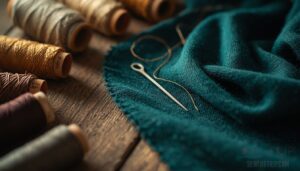
Stretch fabrics play by their own rules, and your thread needs to keep up. Unlike woven fabrics, knits and jersey move with your body — so the wrong thread will pop a seam the moment you reach for something.
Here’s what to know before you sew.
Knits, Jersey, and Elastic Fabrics
Knit fabrics behave nothing like wovens — they stretch, recover, and move with your body. loop structure means your thread has to move with them too.
75/2 or 90/2 polyester thread for most jersey and elastic‑blend knits. elastic recovery without snapping at the seam allowance.
lightweight jersey (120–180 gsm), a 75 wt keeps drape natural and stitches invisible.
Choosing Thread That Supports Stretch
Not all thread stretches equally — and that gap matters on knits. Your elastic yarn choices shape whether seams hold or snap.
Seraflex and wooly nylon both offer real thread elasticity, with 20–30% elongation built in. Coated stretch thread also reduces friction on slippery fabrics. These details directly affect thread weight impact on seam elasticity and fabric drape:
- Polyester stretch thread facilitates recovery testing methods — pull a sewn scrap and watch it spring back
- Stitch length tuning (around 3mm) gives the thread room to flex without seam pop prevention becoming an issue
- Matching thread weight to fabric type keeps elastic thread for knits and stretchy fabrics performing consistently through wash and wear
Avoiding Skipped Stitches and Seam Pop
Skipped stitches usually come down to three things: dirty thread path, wrong needle, or mismatched tension.
Clean your machine’s thread path regularly — lint buildup causes tension spikes mid-seam.
Use a ballpoint needle, adjust stitch length to around 3mm, and match thread weight to fabric type.
A stabilizer under slippery knits improves fabric feed consistency and kills seam pop before it starts.
Match Thread Weight to Needle Size
Getting thread weight right is only half the equation — your needle has to keep up. The wrong needle size causes skipped stitches, thread breakage, and tension headaches that no adjustment can fully fix.
Here’s how to match your needle to your thread weight every time.
Needle Pairings for 30 Wt to 60 Wt
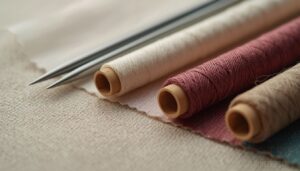
The right needle makes or breaks your stitch. Needle size recommendations for different thread weights follow a clear pattern — match the needle’s eye to the thread gauge so it passes cleanly without fraying.
Here’s a quick guide to needle thread compatibility:
- 30 wt thread — use 90/14 needles
- 40 wt thread — use 80/12 to 90/14
- 60 wt thread — use 60/8 to 70/10
Ballpoint needle selection and needle tip geometry also matter for knits.
Topstitch and Denim Needle Choices
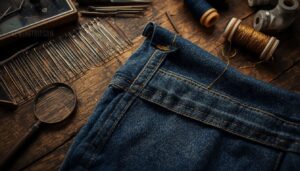
Denim needles are built for punishment. Their thick shaft and sharp tip push through dense layers without bending.
Pair a 100/16 denim needle with 30 wt heavy-weight threads for clean topstitching on jeans.
The needle groove design and needle eye size work together to feed thick thread gauge smoothly.
For parallel lines, a twin needle topstitch setup is worth trying.
Metallic thread needles prevent foil-core thread from shredding mid-seam.
Tension Adjustments for Thicker Thread
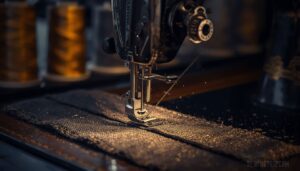
Thick thread throws your machine off balance fast.
Start with upper tension tweaks — raise it one or two settings, then test on scrap.
Bobbin looseness balance matters too; if stitches look uneven underneath, loosen the bobbin slightly.
Don’t ignore presser pressure modulation — too tight causes tunneling.
Check thread guide lubrication and stitch length optimization last.
Small, deliberate adjustments keep heavy weight threads stitching cleanly.
Choose Fiber, Ply, and Finish
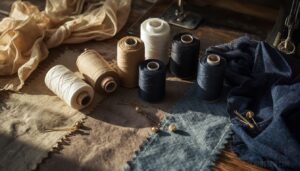
Thread weight gets you started, but fiber, ply, and finish are what make a seam actually hold up. The wrong combination can mean shrinkage, breakage, or a seam that looks great until the first wash.
Here’s what to look at before you thread your machine.
Cotton, Polyester, and Silk Thread
Fiber type is just as important as thread weight. Each material behaves differently under tension and wash cycles.
- Cotton threads (40–60 wt) suit natural fabrics and breathe well
- Polyester threads offer excellent thread breakage prevention and moisture resistance for washable projects
- Silk thread (60–100 wt) glides through delicate weaves without distortion
Matching thread weight to fabric type starts with picking the right fiber first.
How Ply Count Affects Strength
Think of ply count as your thread’s backbone. A 40/2 thread — that’s 40-weight twisted from two plies — spreads load across both strands, giving you better Multi Ply Abrasion resistance and Elongation Control than a single-ply equivalent.
Ply Twist Balance keeps tension even, while Load Distribution reduces seam stress on heavy fabric types.
Higher ply count quietly boosts thread strength without changing your thread weight.
Thread Quality, Coating, and Storage
Thread quality is the silent variable that controls everything else. High-grade threads meet Lubricity Standards that reduce needle friction and skip stitches.
Coating Durability matters too — polyester-coated threads manage abrasion far better than cotton-coated ones at speed.
For storage, aim for Humidity Control between 40–60%, which supports Mold Prevention naturally.
Keep spools dark and cool, and your Colorfastness Testing results will hold wash after wash.
Frequently Asked Questions (FAQs)
What is the best thread weight for sewing clothes?
For most clothing, 40–50 wt thread hits the sweet spot. It’s strong enough for everyday wear, fine enough to avoid bulk, and works across cotton, linen, and light blends without fuss.
Can you mix thread weights in one project?
Yes, you can mix thread weights in one project. Use sample testing first, limit yourself to two weights per seam, and make a thread tension adjustment for each change.
How does thread weight affect stitch length settings?
Heavier thread needs more room per stitch. Fine thread runs tight; heavy thread runs long. Match your stitch length to thread weight for clean, strong seams every time.
Which thread weights work best for hand sewing?
For hand sewing, 50 to 60 weight thread is your sweet spot.
It glides smoothly through most fabric types without tangling, keeps hand needle gauge manageable, and gives you natural thread tension control stitch after stitch.
Does thread color affect seam strength or visibility?
Thread color won’t change seam strength, but it controls stitch visibility completely. Match it to your fabric for invisible seams, or use contrast for bold, intentional detail.
How do I convert thread weight to Tex or Denier?
Converting weight to Tex? Divide 1,000 by the weight number. For Denier, divide 9,000 by it. So 50 wt becomes Tex 20 and Denier Simple math, reliable results.
Conclusion
The seam is pressed. The fabric is flat.
But something’s slightly off—and you won’t know why until it unravels three washes later. That’s the cost of guessing.
Understanding what thread weight to use for fabric types removes that uncertainty completely. It turns every project into a decision you made intentionally, not hopefully.
Choose the right weight, pair it with the right needle, and your seams won’t just hold—they’ll outlast the fabric itself.