This site is supported by our readers. We may earn a commission, at no cost to you, if you purchase through links.
Most embroidery frustrations trace back to one overlooked detail: the needle. Thread that frays mid‑stitch, fabric that puckers around your design, floss that shreds before it even reaches the back of the hoop—these aren’t technique failures. They’re needle mismatches.
The right needle size for embroidery thread isn’t a minor adjustment; it’s the difference between smooth, satisfying stitches and a project you want to abandon.
Hand needles run higher numbers—higher numbers mean finer shafts—while machine needles use a dual metric/US system that confuses even experienced stitchers.
Once you understand how needle size, eye width, and thread weight work together, every fabric and thread combination becomes a straightforward decision.
Table Of Contents
Key Takeaways
- Hand needle sizing runs backward — size 1 is the thickest, a size 12 is the finest, so always check the chart before you assume.
- Your needle eye should be roughly twice your thread’s diameter; any tighter, and friction frays the thread before it even reaches the fabric.
- Match your needle to both thread and fabric — a needle right for cotton floss will tear through delicate evenweave or buckle against denim.
- Replace your needle every two to three projects, or sooner after heavy fabrics; a dull or bent needle causes most of the fraying and puckering you’re blaming on your technique.
Embroidery Needle Size Chart Basics
Needle size charts look confusing at first — until you understand the logic behind them. A few key concepts make everything click, whether you’re working by hand or at a machine.
A solid sewing needle size guide breaks down both numbering systems side by side, so the numbers finally start making sense.
what you need to know before picking up a needle.
Hand Needle Numbering Explained
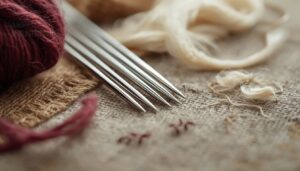
Here’s something that trips up beginners every time: bigger numbers mean smaller needles. That’s the Embroidery Needle Size Inverse Relationship Explained — and once it clicks, everything else makes sense. This numbering inversion logic runs from sizes 1 (thickest) to 12 (finest) for hand needles.
| Needle Size | Shaft Diameter | Best Use |
|---|---|---|
| Size 1–3 | Thickest | Heavy fabric, thick thread |
| Size 5–7 | Medium | General surface embroidery |
| Size 10–12 | Finest | Delicate fabric, single strand |
Refer to the needle size numbering system(https://www.allfreesewing.com/Basics-and-Tutorials/Hand-Sewing-Needle-Sizes) for detailed charts.
Machine Embroidery Sizing Systems
Machine needles speak a different language — literally. Instead of single numbers, they use a dual system like 75/11.
The first number is the shaft diameter in hundredths of a millimeter; the second follows American sizing conventions.
Hoop Size Mapping, Stitch Density Control, and Digital File Scaling all depend on getting this right from the start.
| Metric/US Size | Thread Weight | Common Application |
|---|---|---|
| 65/9 | 60 wt fine | Delicate fabrics |
| 75/11 | 40 wt standard | General embroidery |
| 90/14 | 30 wt heavy | Denim, canvas |
Inverse Size Relationship Examples
Here’s the part that trips up most beginners: hand needle numbers run backward. A size 1 is the thickest — your heavy thread needle for chunky yarn or ribbon. A size 12 is the finest thread needle, barely wider than a hair. Think of it like shoe sizing in reverse.
| Needle Size | Thread Type | Weave Density Impact |
|---|---|---|
| Size 1–3 | Thick yarn, ribbon | Open, loose weaves |
| Size 4–6 | Pearl cotton | Medium weaves |
| Size 7–9 | 2–3 strands floss | Tight cottons, linen |
| Size 10–11 | Single-strand floss | Dense, fine fabrics |
| Size 12 | Ultra-fine thread | Micro-weave fabrics |
inverse sizing chart keeps your needle-to-thread compatibility locked in — no guessing required.
Eye Size and Thread Clearance
The eye is where compatibility lives. A good rule of thumb: your needle eye opening should be roughly twice the thread diameter — that’s your Thread Diameter Ratio sweet spot. Too tight, and you get Thread Friction Reduction failure, fraying fast.
Your needle eye should be twice your thread’s diameter — any tighter, and friction wins
| Eye Size Guidelines | Thread Type | Eye Clearance Tolerance |
|---|---|---|
| Small eye | Single-strand floss | Minimal gap needed |
| Medium eye | 2–3 strands cotton | Moderate clearance |
| Large eye | Pearl cotton, ribbon | Wide tolerance required |
Eye Shape Impact matters too — smooth, polished eyes protect delicate metallics.
Match Needle Size to Thread
Getting the right needle for your thread isn’t guesswork — it’s a simple match once you know what to look for. The type and weight of your thread tell you almost everything you need to know.
Once you understand weight and type, diving into thread weights and quilting-specific recommendations makes the whole matching process click even faster.
Here’s how each thread category maps to the needle that works with it best.
Cotton Embroidery Floss
Cotton embroidery floss is six strands of mercerized sheen-finished thread — and strand separation is your first decision. Use two to three strands for clean outlines, all six for bold coverage.
Your needle eye size should be twice your thread thickness: a size 7–9 crewel needle accommodates two to three strands perfectly. Matching needle size to fabric and thread weight prevents fraying and ensures colorfastness testing pays off.
Pearl Cotton and Thicker Threads
Pearl cotton is a different beast — one thick, lustrous strand that you can’t split. Its Stitch Height Consistency and Thread Luster Impact make it ideal for Satin Stitch Elevation and bold surface work.
- Size 5 pearl cotton: use a size 18–20 chenille needle
- Size 8: a size 22–24 works well
- Needle Eye Size should be twice your thread’s diameter
- Check your Embroidery Needle Size Chart for Thread Thickness and Needle Compatibility
Choosing the Right Embroidery Needle means matching the chunky thread’s Durability Under Tension, Color Saturation Benefits, and Matching Needle Size to Fabric and Thread every time.
Metallic Thread and Specialty Needles
Metallic thread is beautiful — and brutal on regular needles. Specialty needles for metallic threads and leather feature Reinforced Scarf Design, polished eyes, and deeper grooves that reduce fraying dramatically.
Titanium-coated needles outlast chrome versions by up to five times, making them smart Needle Longevity Tips in action. Gold-plated and platinum-plated needles add Heat Management Strategies and Thread Lubrication Techniques built right into the coating.
Thread Weight to Needle Size Guide
Think of thread weight like a highway lane — your needle has to match the load. For 60 wt thread, a 65/9 or 75/11 keeps Eye Clearance Standards tight and clean.
Jump to 30 wt, and you need 90/14 to 100/16. These Weight Needle Ratios aren’t arbitrary — Needle Shaft Diameter directly controls how thread moves through fabric without fraying or drag.
Match Needles to Fabric Weight
Thread isn’t the only thing your needle has to answer to — fabric has a say too. The weight and weave of your material can make or break how smoothly your needle moves through it.
Here’s how to match your needle to four common fabric types.
Tightly Woven Cotton and Linen
Tight weaves demand respect. With quilting cotton or linen, weave density impact is real — force a thick needle through and you’ll distort the whole design.
Stick to fine Crewel needles, sizes 7–9. They pierce cleanly, protect thread tension control, and honor the fabric’s natural breathability and comfort.
Needle eye size importance matters here too: smaller eyes prevent snagging on those dense fibers.
Aida and Evenweave Fabrics
Aida cloth and evenweave fabrics each have their own personality — and your needle needs to match it. Aida’s grid visibility makes counting easy; evenweave demands more stitch precision and rewards you with smoother results.
- 14-count Aida: Use a size 24 Tapestry needle with 2–3 strands
- 18-count Aida: Step up to size 26 for better fabric count compatibility
- Evenweave: Its softer fabric drape suits finer needles for refined pattern scaling
Denim, Canvas, and Heavy Fabrics
From delicate evenweave, we jump to the tough stuff — denim, canvas, and heavy fabrics demand a completely different toolkit.
A denim jacket or thick canvas won’t forgive a fine needle. You need a Heavy-Duty Needle Shaft and Reinforced Topstitch Needles to punch through without puckering. Always do Prewash Fabric Preparation first to reduce shrinkage and soften the weave.
| Fabric | Recommended Needle Size |
|---|---|
| Light denim | 90/14 Crewel or Topstitch |
| Heavy denim | 100/16 – 110/18 |
| Canvas | 100/16 Sharp or Chenille 18 |
| Elastane Blend Stitching | 90/14 ballpoint option |
| Duck canvas | 110/18 Heavy Topstitch |
Pair your needle with Abrasion-Resistant Thread for long-lasting results. Your embroidery needle size chart and fabric weight recommendations for needle size choice make heavy fabric compatibility straightforward.
Knits and Stretch Fabrics
Heavy fabrics need force — knit fabrics need finesse. Knits stretch because of their elastane content, usually 2–10%, and a ballpoint needle is your best friend here.
It nudges fibers apart instead of piercing them. For four-way stretch knits, this matters even more. Fabric drape, knit curl control, and weight measurement all factor into your needle selection guide for smart fabric stretch management.
Compare Embroidery Needle Types
Not all embroidery needles are built the same, and that’s actually a good thing. Each type manages a specific job — fabric, thread weight, stitch style — and picking the right one makes a real difference.
Here’s a breakdown of the main needle types you’ll want to know.
Crewel Needles for Surface Embroidery
Crewel needles are the go-to for surface embroidery — and for good reason. Their sharp point benefits include clean fabric penetration without enlarging holes, which keeps your work looking polished. The long eye advantages make threading multiple strands easy.
- Sharp tips place stitches precisely on linen and cotton
- Long eyes handle wool, floss, and blended threads smoothly
- Slender shafts support thread tension control stitch by stitch
Sizes 3–9 cover most projects. Check an embroidery needle size chart when matching thread weight to needle size — it’s the fastest way to learn how to choose the right embroidery needle size every time.
Tapestry Needles for Counted Work
Unlike crewel needles, tapestry needles have a blunt tip — and that’s the whole point. That tip shape benefits counted work by sliding between threads instead of splitting them, giving you counted row accuracy without snagging.
For 14-count Aida cloth, grab a size 24. Moving to 18-count? size 26 facilitates thread passage ease and fabric hole fit perfectly, keeping your cross-stitch consistent row after row.
Chenille Needles for Thicker Threads
When thick threads keep fraying or snagging, chenille needles are your fix.
Their sharp tip performs Fabric Piercing through dense materials like felt and wool, while the long Eye Length and Shaft Durability manage embroidery thread thickness without shredding.
Sizes 24 to 28 cover most needs — check your needle size chart and match Thread Compatibility before starting.
Needle Care keeps them performing longer.
Machine Embroidery Needle Options
Machine embroidery needles aren’t one-size-fits-all. Ballpoint vs sharp tips matter — ballpoint glides through knits, while a sharp needle pierces dense cotton cleanly. Needle point styles, groove design, and needle coating all affect stitch quality.
Titanium coated needles last five times longer than standard chrome, worth every penny in high-volume work. Match needle size to thread weight, and metallic needle care means swapping them every four hours.
Fix Fraying, Breakage, and Puckering
Even the best stitch work falls apart when your needle isn’t doing its job.
Fraying, breakage, and puckering are almost always fixable — once you know where to look.
Here’s what to check first.
Needle Too Small for Thread
too-small needle eye is the quiet saboteur of clean embroidery. Thread friction builds fast when your thread barely fits through, causing thread fraying, thread breakage, and stitch skipping.
Heat build-up follows, weakening fibers mid-project. Eye burrs worsen this, shredding strands further.
Needle bending happens too, once the smooth flow stops. Your embroidery needle size chart exists for a reason — use it.
Needle Too Large for Fabric
Going too big causes real damage. Excessive needle diameter tears through fabric fibers instead of parting them, leaving visible stitch holes that survive washing.
Fabric puckering follows quickly — tension concentrates around the oversized shaft, bunching delicate weaves.
Thread snagging and stitch skipping increase because the eye-to-thread ratio is off.
Nail your needle size selection for embroidery projects by matching needle weight to fabric weight. Always.
Dull or Bent Needle Signs
A dull needle is sneaky — it doesn’t announce itself. Tip flattening is the first red flag: run your finger along the point and feel for that subtle bluntness. From there, stitch skipping and thread fraying follow fast.
A bent needle adds noise tapping as it misaligns with the presser foot. Heat buildup and uneven tension round out the warning signs.
When to Replace Needles
Think of needle replacement like an oil change — skip it too long, and things break down fast. Replace every 2–3 projects as part of your Project Completion Cycle.
Run an Eye Burr Inspection before each session. Watch for Skipped Stitch Detection or a Heat Sheen Warning on the tip.
Heavy Fabric Wear dulls needles faster, so swap sooner after denim or canvas work.
Top 5 Embroidery Needle Sets
Finding the right needle set doesn’t have to mean trial and error. The five options below cover a solid range of needle types, sizes, and materials — so there’s something useful no matter what you’re stitching.
Here’s what’s worth your attention.
1. Clover French Embroidery Needle Assortment
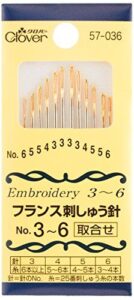
Clover French Embroidery Needle Assortment covers sizes No. 3 through No. 9 — that’s seven sizes, two of each, for a total of 14 needles. That range accommodates everything from thick 5–6 strand floss down to delicate single-strand detail work.
elongated, polished eyes thread easily and resist fraying. Made from high-quality Japanese steel, these needles hold their sharpness across multiple projects.
Store them dry, and they’ll last. It’s a genuinely adaptable set worth keeping in your kit.
| Best For | Embroiderers and hand-sewers who want a reliable assortment of mid-range needle sizes — especially anyone who struggles with threading fine needles or juggles projects like quilting, felt work, and embroidery. |
|---|---|
| Material | Stainless steel/metal |
| Eye Design | Oversized eye |
| Needle Count | 12 needles |
| Size Variety | 4 sizes (No. 3–6) |
| Storage Case | None included |
| Use Cases | Embroidery, quilting, repairs |
| Additional Features |
|
- Sharp, smooth tips that glide through fabric without snagging or pulling threads
- Oversized eyes make threading a breeze, even if your eyesight isn’t what it used to be
- Covers four useful sizes (No. 3–6) in one pack, so you’re ready for most everyday hand-sewing projects
- Doesn’t include very fine (No. 1–2) or heavier (No. 7) sizes, so it’s not a true all-in-one set
- Metal needles can rust if they get damp and aren’t stored carefully
- Only 12 needles total — frequent sewers may burn through the pack faster than expected
2. Large Eye Stainless Steel Sewing Needles
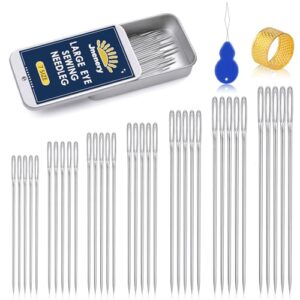
If you need more variety without spending much, the JNENERY 86-A214 set delivers. You get 35 stainless-steel needles across seven lengths — from 1.57" up to 2.56" — plus a threader and thimble, all for $3.99.
The oversized eyes help if your vision isn’t perfect, and the rust-resistant steel holds up well over time. Fair warning: the larger needles aren’t razor-sharp, so dense fabrics like denim may push back a little.
| Best For | Casual sewers, crafters, and beginners who want a budget-friendly, all-in-one needle kit for everyday repairs and light projects. |
|---|---|
| Material | Stainless steel |
| Eye Design | Large oversized eye |
| Needle Count | 35 needles |
| Size Variety | 7 lengths |
| Storage Case | Metal tin box |
| Use Cases | Quilting, leather, fabric repair |
| Additional Features |
|
- 35 needles across seven lengths for just $3.99 — solid value for the price
- Large eyes and rust-resistant stainless steel make these easy to use and built to last
- Comes with a threader, thimble, and a compact metal tin — everything you need in one place
- Larger needles aren’t very sharp, so pushing through thick fabrics like denim takes extra effort
- Needle sizes don’t match standard sewing numbering, which can be a headache if you’re following a pattern
- The thimble and threader feel cheap, and the needles rattle around loosely in the tin
3. FIVEIZERO Hand Sewing Needle Set
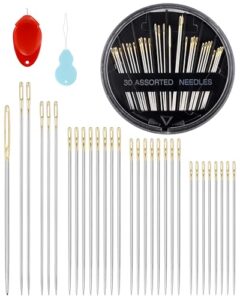
At $3.79, the FIVEIZERO F2312-XHZ-1 punches well above its price.
You get 30 stainless-steel needles in six sizes — ranging from 31mm to 51mm — plus two needle threaders tucked into a compact round case.
The gold-plated eyes make threading noticeably easier, especially with thicker floss.
One thing to watch: a few users report slightly jagged eye edges that can snag delicate thread.
For everyday embroidery and repairs, though, it’s a solid, portable starter set.
| Best For | Beginners and casual sewers who want a versatile, affordable needle set for everyday repairs, embroidery, and light crafting. |
|---|---|
| Material | Stainless steel |
| Eye Design | Large gold-plated eye |
| Needle Count | 30 needles |
| Size Variety | 6 sizes |
| Storage Case | Round plastic case |
| Use Cases | Embroidery, quilting, leather |
| Additional Features |
|
- 30 needles in six sizes means you’re covered for everything from quilting to canvas work
- Gold-plated eyes and two included threaders make threading way less frustrating
- The compact round case keeps everything organized and easy to grab on the go
- Some needle eyes have jagged edges that can snag or split delicate thread
- The eye openings may be too small for very thick embroidery thread
- Needle lengths top out at 51mm, so bigger upholstery or leatherwork projects might need something longer
4. FIVEIZERO Stainless Steel Large Eye Needles
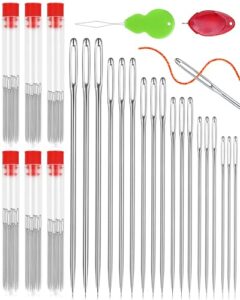
Want more variety without paying more? This set delivers 60 stainless-steel needles across six lengths — 40mm to 66mm — packed into a compact metal tube with a built-in threader.
That’s serious range for one kit. The large, polished eyes handle embroidery floss and pearl cotton without fraying, and the sharp points glide through linen, denim, and canvas cleanly.
One caveat: the gauge runs fine, so skip it for heavy upholstery work. For everyday hand embroidery, though, it’s hard to beat the value.
| Best For | Crafters and hobbyists who do a mix of hand sewing, quilting, or embroidery and want one versatile needle set that covers a wide range of projects. |
|---|---|
| Material | Stainless steel |
| Eye Design | Large eye |
| Needle Count | 60 needles |
| Size Variety | 6 lengths |
| Storage Case | Metal tube case |
| Use Cases | Quilting, leather, embroidery |
| Additional Features |
|
- Six lengths (40mm–66mm) in one kit gives you real flexibility across different stitch depths and fabric weights.
- Large eyes make threading fast and easy — especially helpful if your vision isn’t what it used to be.
- The metal tube case keeps everything organized and travel-ready, with a built-in threader so nothing gets lost.
- The fine gauge won’t hold up to heavy upholstery or thick leather — you’ll need something sturdier for those jobs.
- Needles can bend under too much pressure, so they’re not built for rough handling.
- The 66mm max length is a ceiling for larger-scale stitching tasks that need more reach.
5. Stainless Steel Large Eye Sewing Needles Wooden Case
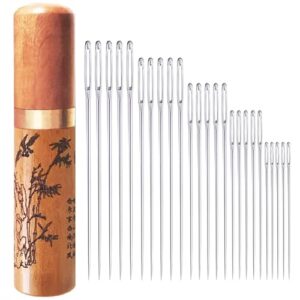
Twenty-five needles, five lengths, and a sandalwood case that smells better than any sewing room you’ve ever worked in. That’s the LEN-03 in short.
The extra-large eyes thread easily — a real win if your vision isn’t what it used to be.
Sharp stainless-steel tips handle denim, felt, and multiple fabric layers without bending.
The brass-fitted case keeps every needle organized and protected. Just keep it dry; the wood doesn’t love moisture.
| Best For | Hand-sewers, embroiderers, and crafters — especially seniors or anyone with low vision who wants easier threading and a sturdy, organized needle set. |
|---|---|
| Material | Stainless steel |
| Eye Design | Extra-large eye |
| Needle Count | 25 needles |
| Size Variety | 5 lengths |
| Storage Case | Sandalwood/brass case |
| Use Cases | Embroidery, cross-stitch, leather |
| Additional Features |
|
- Extra-large eyes make threading fast and easy, even with limited vision
- Sharp stainless-steel tips push through denim, felt, and layered fabrics without bending or breaking
- The sandalwood and brass case is portable, protective, and smells great
- Thicker needle diameter can leave visible holes in delicate or fine fabrics
- The wooden case has no dividers, so sorting needle sizes takes a little extra effort
- Only 25 needles total — heavy users may burn through the set faster than expected
Frequently Asked Questions (FAQs)
What size needle is best for embroidery thread?
Like Goldilocks finding the right fit, most embroidery work lands best on a size 7 to 9 needle. It manages standard cotton floss cleanly, keeps tension balanced, and won’t tear your fabric.
Which needle is bigger, 10 or 12?
Size 10 is bigger. Embroidery needles use an inverse numbering system — the lower the number, the thicker the needle. So a size 10 has a wider shaft and eye than a size
Can you reuse needles across different embroidery projects?
You can, but it’s risky. Reused needles carry fibers, oils, and micro-burrs that snag delicate fabrics and fray thread.
When starting a fresh project, a fresh needle is always the smarter move.
How does needle coating affect embroidery stitch quality?
Coating matters more than most stitchers realize.
A smooth, friction-reducing finish helps thread glide cleanly through the eye, preventing fraying and heat buildup — which means crisper stitches, steadier tension, and fewer frustrating thread breaks mid-project.
Do needle brands differ in size consistency?
Yes, they can.
Even needles labeled the same size vary slightly between brands — shaft diameter, eye clearance, and manufacturing tolerances all differ. Stick with one trusted brand per project for consistent results.
Which needle works best for ribbon embroidery techniques?
Chenille needles are basically the undisputed champions of ribbon embroidery. Their long eye and sharp point handle 4mm to 7mm ribbons beautifully.
Size 18 to 24 covers most ribbon widths without fraying or distortion.
How do you store embroidery needles to prevent rust?
Store them in an airtight container with a silica gel pack.
Keep needles away from bathrooms and kitchens where humidity spikes.
Wipe them dry after handling — your fingertips leave oils that invite rust fast.
Conclusion
A blunt needle drags. The right one glides—and suddenly your stitches look the way you imagined them.
Getting needle size for embroidery thread right isn’t complicated once you understand the relationship between thread weight, eye clearance, and fabric density. Match those three, and fraying, puckering, and breakage stop being your problem.
Keep a small assortment on hand. Swap needles before you blame your technique. The fix is usually sitting in a little paper packet.