This site is supported by our readers. We may earn a commission, at no cost to you, if you purchase through links.
A frayed edge, a nicked stitch, a thread pulled loose—most embroidery mistakes don’t happen at the hoop. They happen at the cutting stage, with the wrong tool in hand.
Dull blades drag across delicate fabric, scissors meant for paper, snag fine threads, and suddenly a piece you spent hours on needs rework.
The right fabric cutting tools for embroidery projects aren’t a luxury; they’re the difference between a clean finish and a frustrating one.
From bent-handle shears that keep your fabric flat to rotary cutters sized for intricate curves, each tool solves a specific problem—and knowing which one to reach for changes everything.
Table Of Contents
- Key Takeaways
- Top 10 Fabric Cutting Tools
- 1. Mundial Bent Trimmer Dressmaker Scissors
- 2. Blue White Polka Dot Embroidery Scissors
- 3. Gingher Knife Edge Applique Scissors
- 4. OLFA 28mm Quick Change Rotary Cutter
- 5. Olfa 45mm Quick Change Rotary Cutter
- 6. OLFA 60mm Ergonomic Rotary Cutter
- 7. Black Decker Cordless Electric Fabric Scissors
- 8. Euro Notions Buttonhole Cutter Set
- 9. Riley Blake Lori Holt Steel Peacock Cutting Mat
- 10. Cottage Mills Acrylic Design Ruler
- Best Scissors for Embroidery
- Rotary Cutter Sizes and Uses
- Cutting Mats and Rulers
- Clean Cuts for Embroidery Projects
- Care, Safety, and Buying Tips
- Frequently Asked Questions (FAQs)
- Conclusion
Key Takeaways
- Matching your cutting tool to the job — bent-handle shears for flat fabric, a 28mm rotary for tight curves, a 60mm for thick layers — is what separates clean cuts from costly rework.
- Your scissors should never touch paper, tape, or anything non-fabric, because even a few wrong cuts dull the blade faster than months of normal sewing use.
- A self-healing mat, an acrylic ruler, and pattern weights aren’t optional extras — they’re what keep your fabric steady and your lines honest while you cut.
- Blade sharpness isn’t a "nice to have": dull scissors fray threads, dull rotary blades skip stitches, and both can quietly undo hours of careful embroidery work.
Top 10 Fabric Cutting Tools
The right cutting tool can make or break an embroidery project — not just in precision, but in how much you enjoy the process. There’s no single "best" tool because different jobs call for different blades, sizes, and grips.
That’s why it helps to start with a solid fabric cutting guide for embroidery before investing in tools you may not actually need.
Here are ten that serious embroiderers actually reach for.
1. Mundial Bent Trimmer Dressmaker Scissors
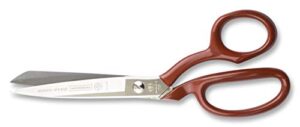
The Mundial Bent Trimmer Dressmaker Scissors (model 270-8SR) are built for people who mean business at the cutting table. That angled blade keeps your fabric flat and still while you cut — no lifting, no shifting.
The hot-forged carbon steel holds a sharp edge through heavy use, and the micro-serrated blade grips fabric instead of letting it slide.
At 8 inches, with ergonomic red grips, these shears handle denim, wool, and layered textiles with ease.
Expect a higher price tag, but the quality earns it.
| Best For | Dressmakers, tailors, upholsterers, and costume designers who need reliable, heavy-duty shears for frequent cutting of thick or layered fabrics. |
|---|---|
| Primary Use | Fabric cutting |
| Material | High-carbon steel |
| Hand Compatibility | Right-handed |
| Item Count | 1 pair |
| Approximate Price | $33.50 |
| Protective Feature | Nickel-plated finish |
| Additional Features |
|
- The bent blade keeps fabric flat on the table, so your cuts stay accurate and your hand stays comfortable
- Hot-forged carbon steel holds a sharp edge through heavy, repeated use
- Micro-serrated edge grips fabric and cuts down on slipping or fraying
- Can feel stiff right out of the box and may need some adjustment before they move smoothly
- Heavier than standard shears, which can get tiring during long sessions with lighter fabrics
- At $33.50, they cost more than basic scissors — and the fixed 8-inch size won’t work for every job
2. Blue White Polka Dot Embroidery Scissors
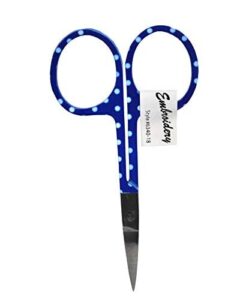
When your work shifts from heavy shears to fine threadwork, you need a completely different tool. These Blue White Polka Dot Embroidery Scissors are built for exactly that — the close, careful snipping that dressmaker scissors can’t manage.
The 3.5-inch high-carbon stainless steel blades come to a sharp fine point, letting you trim right up against your stitches without catching anything you didn’t mean to cut.
The patterned handle is a small but smart touch — easy to spot in a crowded craft bag.
| Best For | Sewers, embroiderers, and quilters who need precise, close-up snips on delicate threads and fine fabrics. |
|---|---|
| Primary Use | Embroidery trimming |
| Material | Stainless steel |
| Hand Compatibility | Right-handed |
| Item Count | 1 pair |
| Approximate Price | Budget |
| Protective Feature | Fine-tip blade |
| Additional Features |
|
- Fine-tipped blades let you trim right up against stitches without nicking surrounding fabric
- Stainless steel construction holds up well against rust and everyday wear
- The polka-dot handle is easy to spot in a crowded craft bag or notions drawer
- Short blade length makes them a poor choice for cutting through multiple layers or thicker materials
- The fine tip can bend if you push them beyond what they’re designed for
- Being a generic brand, long-term durability may not match higher-end scissors like Gingher or Kai
3. Gingher Knife Edge Applique Scissors
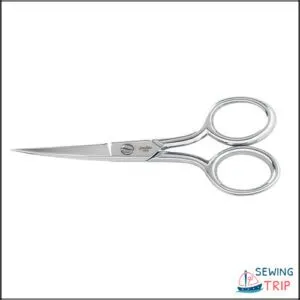
Fine-point scissors handle thread snipping beautifully, but appliqué is a different challenge altogether. That’s where the Gingher Knife Edge Appliqué Scissors earn their place.
The paddle-shaped blade is the real trick here — it lifts the bottom fabric layer out of the way, so you’re trimming only what you intend to. The offset, ambidextrous grips keep your hand above your work, giving you a clear view and steady control. Add a lifetime warranty, and this 6‑inch tool is built to last.
| Best For | Quilters, embroiderers, and fiber artists who need precise, clean cuts on appliqué and layered fabric work — especially lefties or anyone dealing with hand fatigue. |
|---|---|
| Primary Use | Appliqué trimming |
| Material | Alloy steel |
| Hand Compatibility | Ambidextrous |
| Item Count | 1 pair |
| Approximate Price | Mid-range |
| Protective Feature | Leather/tin sheath |
| Additional Features |
|
- The duck-bill blade lifts the bottom layer so you only cut what you mean to — no accidental snips through surrounding fabric
- Works for both right- and left-handed crafters without any awkward adjustments
- Backed by a lifetime warranty, so it’s a one-time buy for most people
- No cushioning on the handle, which can dig in during longer cutting sessions
- Technique still matters — pressing too hard can cut through layers you didn’t want to
- Product images online can be inconsistent, so what arrives might look a little different than expected
4. OLFA 28mm Quick Change Rotary Cutter
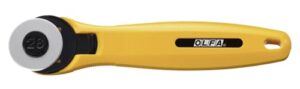
When your work calls for tight curves and intricate corners, the OLFA 28mm Quick Change Rotary Cutter becomes your best friend. That tungsten steel blade navigates miniature patterns and curved templates where larger cutters simply can’t follow.
The contoured, ambidextrous handle fits comfortably whether you’re right- or left-handed, and the quick-change system swaps blades without tools — just slide, click, done. At 0.8 oz, it’s light enough for long sessions without wearing out your hand.
| Best For | Quilters, sewers, and crafters who work with tight curves, small-scale patterns, and intricate templates where a bigger rotary cutter just gets in the way. |
|---|---|
| Primary Use | Rotary fabric cutting |
| Material | Tungsten tool steel |
| Hand Compatibility | Ambidextrous |
| Item Count | 1 cutter |
| Approximate Price | Budget |
| Protective Feature | Built-in blade cover |
| Additional Features |
|
- Tungsten steel blade stays sharp longer and handles fabric, paper, and leather with clean, precise cuts
- Ambidextrous design and contoured handle make it comfortable for lefties and righties alike during long sessions
- Tool-free quick-change system swaps blades fast, keeping your workflow moving safely
- Struggles with stacks thicker than about 3 layers, so heavy-duty cutting isn’t its strong suit
- The 28mm blade size makes it slow and inefficient for long, straight cuts on larger projects
- Only works with OLFA-specific RB28 replacement blades, so you can’t just grab any rotary blade off the shelf
5. Olfa 45mm Quick Change Rotary Cutter

Think of the 45mm as your everyday workhorse — the cutter you reach for without thinking. It’s the sweet spot between the nimble 28mm and the heavy-duty 60mm, handling most garment and quilt work without a second thought.
The tungsten steel blade cuts cleanly through up to 8 layers of cotton, and the quick-change system swaps blades in seconds.
At just 1.6 oz, the aqua ergonomic handle fits both hands comfortably, keeping fatigue in check through long cutting sessions.
| Best For | Quilters, sewers, and crafters who cut regularly and want a reliable, comfortable all-purpose rotary cutter that works for both right- and left-handed use. |
|---|---|
| Primary Use | Rotary fabric cutting |
| Material | Tungsten tool steel |
| Hand Compatibility | Ambidextrous |
| Item Count | 1 cutter |
| Approximate Price | $13.99 |
| Protective Feature | Built-in blade cover |
| Additional Features |
|
- Tungsten steel blade stays sharp and cuts cleanly through up to 8 layers of cotton — no dragging, no fraying.
- Quick-change blade system makes swaps fast and safe, so you stay in your workflow.
- Lightweight at 1.6 oz with an ergonomic grip that keeps hand fatigue low during long sessions.
- Always needs a cutting mat underneath — that blade will go right through a table without one.
- Replacement blades from OLFA can get pricey, and off-brand options may not cut as cleanly.
- Not built for heavy-duty work — thick or abrasive materials will wear the blade down faster than usual.
6. OLFA 60mm Ergonomic Rotary Cutter
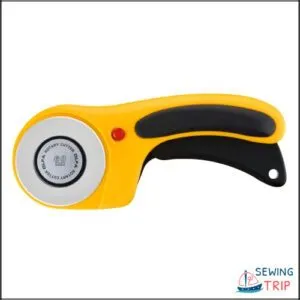
When you’re slicing through quilts, denim, or stacked batting, the OLFA 60mm Ergonomic Rotary Cutter is built for that job.
For detailed finishing work around those layers, reverse appliqué and hand sewing techniques pair perfectly with precision cuts from your rotary cutter.
The oversized 60mm Endurance blade manages up to 12 layers of cotton in one clean pass, and the squeeze-trigger handle retracts the blade automatically — so you’re not fumbling with safety locks mid-project.
It works for both hands, weighs just 4 oz, and swaps blades without tools.
At $31.99, it’s a serious upgrade for heavy-duty cutting sessions.
| Best For | Quilters, sewers, and crafters who work with multiple layers of heavy fabric and want a safer, more comfortable cutter for long sessions. |
|---|---|
| Primary Use | Heavy-duty rotary cutting |
| Material | Steel with rubber grip |
| Hand Compatibility | Ambidextrous |
| Item Count | 1 cutter |
| Approximate Price | $31.99 |
| Protective Feature | Self-retracting blade |
| Additional Features |
|
- The 60mm Endurance blade powers through up to 12 layers of fabric in one pass — great for quilting and heavy-duty projects.
- The squeeze-trigger auto-retracts the blade the moment you let go, which makes it much safer than traditional rotary cutters.
- Truly ambidextrous — the blade swaps sides, so lefties aren’t stuck with an awkward workaround.
- Some buyers report the blade arrives dull or coated in oil, so you might need to clean or replace it right out of the box.
- At $31.99, it costs more than most basic rotary cutters, which could be a dealbreaker if you’re just getting started.
- Very thick or dense materials can still require real pressure, and poor technique may lead to shoulder or arm strain over time.
7. Black Decker Cordless Electric Fabric Scissors
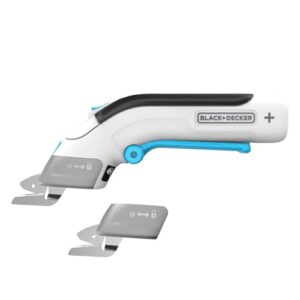
If your hands give out before your project does, the Black & Decker Cordless Electric Scissors (model BCSC115FF) might be exactly what you need.
At just 1.6 oz, they run up to 40 minutes on a USB‑C charge and switch between two blades — one for fabric, one for leather or vinyl.
The two-button safety lock keeps things controlled, and the ergonomic grip reduces wrist strain considerably.
They’re especially handy for trimming appliqués or long fabric runs without stopping to rest your hands.
| Best For | Sewists, quilters, or anyone dealing with wrist pain or fatigue who needs to power through long cutting sessions on fabric, leather, or heavy materials. |
|---|---|
| Primary Use | Multi-material cutting |
| Material | High-carbon & stainless steel |
| Hand Compatibility | Ambidextrous |
| Item Count | 1 unit |
| Approximate Price | Mid-range |
| Protective Feature | Two-button safety lock |
| Additional Features |
|
- Cuts a wide range of materials — fabric, denim, vinyl, cardboard — faster than manual scissors
- Super lightweight at 1.6 oz with up to 40 minutes of runtime on a USB-C charge
- Two-blade system lets you swap between fabric and tougher materials like leather or plastic
- Noticeably loud compared to regular scissors
- Battery can fall short during heavy-duty or extended cutting sessions
- Official replacement blades are hard to find — you’ll likely need to hunt down third-party options
8. Euro Notions Buttonhole Cutter Set
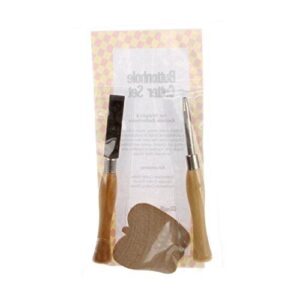
Buttonholes don’t have to be a guessing game.
The Euro Notions Buttonhole Cutter Set (Model 1704) gives you a dedicated knife and circular punch — so straight, keyhole, and English eyelet cuts all come out clean and factory-sharp.
The hardened steel blades hold their edge through regular home use, and the included hardwood cutting block keeps your fabric steady.
At $13.00 and just 1.6 oz, it’s a compact, affordable addition that makes precise buttonhole work feel far less fiddly.
| Best For | Home sewers and small-shop tailors who want clean, consistent buttonholes without a lot of fuss. |
|---|---|
| Primary Use | Buttonhole cutting |
| Material | Steel blade |
| Hand Compatibility | Right-handed |
| Item Count | 1 set |
| Approximate Price | $13.00 |
| Protective Feature | Small cutting board included |
| Additional Features |
|
- Handles straight, keyhole, and English eyelet cuts — no need to swap tools
- Lightweight and compact at just 1.6 oz, easy to store and grab when you need it
- Comes with a cutting board so you’re ready to go right out of the box
- Blades can dull faster than expected with regular use
- The small cutting board may crack under heavy pressure and won’t work well for larger fabric pieces
- At $13.00, some buyers feel the value doesn’t quite match the price
9. Riley Blake Lori Holt Steel Peacock Cutting Mat
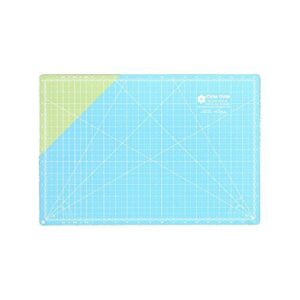
Your cutting surface matters more than most people think. The Riley Blake Lori Holt Steel Peacock Cutting Mat gives you a 12×18 inch, triple-layer self-healing surface that holds up through countless rotary passes.
Both sides have inch-based grids with angle guides at 30, 45, and 60 degrees — genuinely useful when you’re cutting embroidery blocks or bias strips. The non-slip backing keeps it from wandering mid-cut.
It’s designed for quilting, but it performs detailed embroidery cutting just as well.
| Best For | Quilters and fabric crafters who want a reliable, dual-sided cutting mat for precise rotary cuts and detailed patchwork projects. |
|---|---|
| Primary Use | Cutting surface |
| Material | Triple-layer acrylic/PVC |
| Hand Compatibility | Universal |
| Item Count | 1 mat |
| Approximate Price | Mid-range |
| Protective Feature | Self-healing surface |
| Additional Features |
|
- Self-healing triple-layer construction holds up through repeated rotary cutter passes
- Reversible design with inch-based grids on both sides gives you flexibility and extends the mat’s life
- Great for precise curve and corner cuts on soft fabrics like lyocell
- Color may not match what’s advertised — some buyers received steel-gray instead of the expected green or blue
- Self-healing performance can fade over time, with permanent ridges developing after heavy use
- Durability is hit or miss — some users found it didn’t last much beyond a year of regular cutting
10. Cottage Mills Acrylic Design Ruler
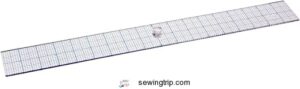
A good ruler is the quiet workhorse of any cutting setup. The Cottage Mills Acrylic Design Ruler measures 2×18 inches — long enough to guide full pattern edges without repositioning.
The clear acrylic lets you see exactly what’s underneath, and the 1/16-inch grid markings stay readable under normal studio light. That centered grip knob is a small detail that makes a real difference, keeping your hand safely away from the blade.
Pairs well with rotary cutters and standard 18-inch mats.
| Best For | Quilters, sewers, and crafters who need a steady, see-through guide for clean cuts and precise layouts. |
|---|---|
| Primary Use | Measuring & guiding |
| Material | Clear acrylic |
| Hand Compatibility | Universal |
| Item Count | 1 ruler |
| Approximate Price | Budget |
| Protective Feature | Laser-cut edges |
| Additional Features |
|
- Clear acrylic lets you see exactly where you’re cutting — no guessing, no surprises
- The centered grip knob keeps your fingers away from the blade and makes repositioning fast
- Dual-side markings mean you can read it from either direction without flipping
- Only comes in one size, so larger projects may need a different tool
- Printed markings can fade over time, especially with regular cleaning
- Acrylic can crack if dropped or used in high-heat conditions
Best Scissors for Embroidery
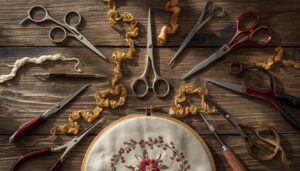
Not all scissors are created equal, and for embroidery, the details really matter. The right pair can mean the difference between a clean snip and a pulled thread.
Here are the key features to look for when choosing your scissors.
Fine-tip Scissors for Thread Snipping
Fine-tip embroidery scissors are the unsung heroes of clean threadwork. Blade Material Selection matters here—stainless steel stays sharp and rust‑free through heavy use.
Here’s what makes them work:
- Spring-loaded Mechanism keeps blades open between snips, reducing fatigue
- Tip Angle Precision lets you cut flush without nicking nearby stitches
- Thread Grip Enhancement via micro‑serrated edges, grabs slippery threads cleanly
For delicate cuts, consider thread snips with short precisely shaped blades. Ergonomic Handle Design gives you the delicate control these tight spaces demand.
Curved Tips for Close Trimming
Where fine-tip scissors leave off, curved-tip embroidery scissors take over. That gentle arc in the blade is your best friend for stitch adjacent access — it lets you slide in close without bumping surrounding stitches.
Curved blade ergonomics naturally follow fabric contours, so fine edge navigation around appliqués feels smooth. For tight area precision and thread slip minimization, nothing else comes close.
Bent Handles for Better Visibility
Bent grips change the game for embroidery scissors. The angled grip improves Wrist Alignment and drops your Elbow Angle naturally, so Shoulder Posture stays relaxed — even through long sessions. That shift gives you a real Visibility Boost along the blade edge.
- Precision Control improves on tight snips near dense stitching
- Ergonomic handle design reduces grip strain over time
- Works across handheld cutting tools of various sizes
- Pairs well with a selfhealing cutting mat for steady support
Micro-serrated Blades for Slippery Threads
Slippery silk or rayon thread has a way of sliding right past smooth blades. That’s where micro-serrated blades earn their place in your toolkit.
The tiny teeth improve Thread Grip Efficiency by biting into fiber before the cut starts — reducing slippage by up to 40 percent compared to smooth edges.
| Feature | Benefit | Best For |
|---|---|---|
| Serrated Edge Geometry | Uniform grip along blade | Silk cutting tips |
| Material Compatibility | Works on cotton, poly, silk | Precision fabric cutting |
| Pressure Reduction | Less hand strain per snip | Long embroidery sessions |
Sawtoothed blades also keep cuts cleaner on chiffon and satin. Simple Maintenance Protocols — rinse, dry, store covered — keep them sharp through dozens of sessions.
Stainless Steel Blades for Lasting Sharpness
Stainless steel shears stay sharp longer because of what’s built into the metal itself. Chromium Content Balance resists rust, while Vanadium Carbide Alloy keeps the edge tough through heavy use. Heat Treatment Optimization locks that in at the microstructure level.
- Sharp blades stay reliable through dense stitching
- Micro-Serrated Edge grips slippery threads cleanly
- Stropping Frequency matters — light honing extends sharpness
- Precision cutting stays consistent across fabric rotary cutter and rotary cutter blades alike
Rotary Cutter Sizes and Uses
Rotary cutters come in three main sizes, and picking the right one makes a real difference in how your embroidery projects turn out. Each size has its own sweet spot — from handling tight curves to powering through thick fabric stacks.
Here’s what you need to know about each one.
28mm Cutters for Tight Curves
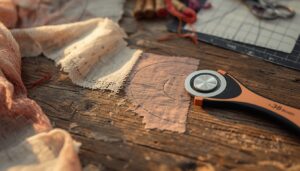
For curved fabric cutting, the 28mm rotary cutter is your go-to for tight, intricate shapes — we’re talking curves down to about one inch. It’s compact, so your fingers stay close for real precision cutting.
Tungsten carbide blade material choice keeps the edge sharp longer, and the quick-change blade mechanism makes swaps safe and easy.
Before cutting embroidery work, use curve marking techniques on scrap fabric first.
45mm Cutters for Everyday Cutting
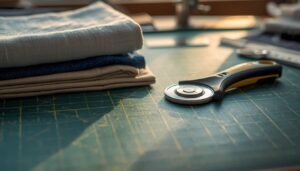
The 45mm rotary cutter is the workhorse of your cutting kit — adaptable enough for quilts, garments, and embroidery backing in one tool. Among rotary cutter size variations 28mm, 45mm, and 60mm, this one hits the sweet spot for everyday use.
Here’s why it earns a permanent spot on your mat:
- Multi-layer Cutting — slices through cotton, linen, and denim cleanly
- Quick Blade Swap — button-release design keeps your workflow moving
- Blade Guard Safety — retracting guard prevents accidental nicks between cuts
- Low Vibration Design — ergonomic grip reduces wrist fatigue on long sessions
60mm Cutters for Thick Layers

When you’re cutting through thick quilting batting, stacked denim, or layered fabric cutting projects, the 60mm rotary cutter is your heavy lifter. Its wider blade glides through dense stacks where smaller cutters stall.
| Feature | What It Does | Why It Matters |
|---|---|---|
| Titanium Coated Blades | Resists dulling on tough fabrics | Fewer blade changes mid-project |
| Adjustable Blade Exposure | Controls cut depth | Safer on thick stacks |
| Ergonomic Grip Design | Reduces hand fatigue | Comfortable for long sessions |
Left-handed Blade Options and solid Blade Guard Mechanisms make it practical for everyone. Rotary Cutter Blades 5pcs 60mm packs keep you cutting longer.
Replaceable Blades for Steady Sharpness
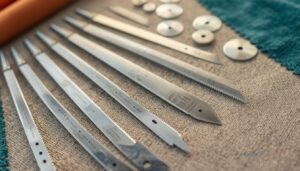
A dull blade doesn’t just slow you down — it wrecks your edges. Replaceable blades keep every cut crisp, whether you’re running Rotary Cutter Blades 5pcs 28mm through curves or Rotary Cutter Blades 5pcs 60mm through thick stacks.
- Snap-in Housing locks blades securely for consistent cutting precision
- Color-coded Sharpness levels guide blade replacement by fabric type
- Titanium Coatings, Ceramic Inserts, and optimized Bevel Angle choices extend blade life across projects
Rotary Cutter Blades 5pcs 45mm round out your kit perfectly.
Ergonomic Handles to Reduce Hand Fatigue
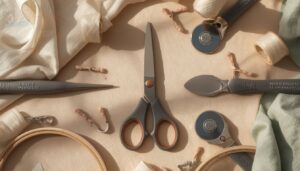
Your hands do a lot of work — ergonomic grips make sure they don’t pay for it later. Contour Grip Design follows your palm’s natural curve, while Non-slip Textured Surfaces keep control even when your hands are tired.
Weight Distribution Balance and Vibration Damping Materials reduce strain across long sessions.
With Adjustable Grip Sizes available, ergonomic features in sewing cutting tools fit nearly every hand comfortably.
Cutting Mats and Rulers
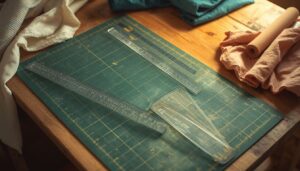
Good scissors get the glory, but your cutting mat and ruler are doing just as much work behind the scenes. right setup keeps your fabric steady, your lines true, and your cuts clean every single time.
Here’s what belongs on your workstation.
Self-healing Mats for Clean Cuts
A self-healing mat is quietly one of the smartest tools on your cutting table. The Mat Healing Mechanism works by letting microscopic particles realign after each pass, sealing cuts within seconds.
Surface Hardness balances firmness and cushion — protecting your blade while ensuring fabric cutting precision and efficiency.
Blade Compatibility with rotary cutters means smooth gliding, less drag, and real fabric handling safety.
Simple Maintenance Practices — wiping clean, rotating your cutting zone, storing away from heat — keep it reliable long-term.
Rotating Mats for Small Embroidery Pieces
Now, if your self-healing mat keeps you reaching around your work, a rotating mat changes that entirely.
Sizes like the Self-Healing Rotating Cutting Mat 12 by 12 inches give you full 360-degree access without disturbing your fabric.
Slide a stabilizer underlay underneath delicate pieces, let the edge guidance rims keep your ruler honest, and spin freely.
Portable lightweight design means easy storage too — no warpage prevention worries if you store it flat.
Acrylic Rulers for Straight Alignment
Once your fabric is flat and your mat is locked in, an acrylic ruler makes the difference between a straight line and a guess.
- Optical clarity lets you see every fabric marking underneath
- Laser-etched scales resist smudging through heavy use
- Parallax error reduction keeps your cuts honest at any angle
- Edge polishing protects delicate threads during alignment
Thickness rigidity matters too — a ruler that flexes mid-cut is just a fancy bookmark.
Pattern Weights Instead of Pins
Pins work, but pattern weights are the smarter move in any sewing room. No poke holes, no puckering — just clean, grain-true cuts every time.
For slippery fabrics like satin, they’re genuinely game-changing.
| Weight Material Choices | Weight Placement Techniques | Weight Maintenance Practices |
|---|---|---|
| Metal (1–4 oz) | Along curved pattern edges | Wipe with soft cloth after use |
| Rice-filled fabric | At fold lines | Store in padded bag |
| Rubberized base | Layered fabric corners | Inspect for burrs regularly |
These fabric cutting tools reward anyone serious about fabric cutting techniques.
Stable Surfaces for Accurate Cutting
Even the sharpest scissors fail you when your surface is unstable. A quality self-healing cutting mat grips the blade cleanly and protects your table, while proper table height ergonomics keep your shoulders from screaming after an hour of cutting straight lines.
- Surface material quality and stability features prevent blade drift mid-cut
- Dust management system keeps fiber buildup from causing slips
- Focused lighting setup reveals grain lines instantly
Clean Cuts for Embroidery Projects
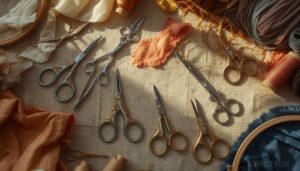
Getting a clean cut in embroidery is less about luck and more about knowing what your tools can actually do. Every little decision — how close you trim, what you use on thick fabric, how you handle a sharp curve — adds up fast.
Here’s what to keep in mind as you work through the details.
Cutting Close Without Nicking Stitches
Getting close to a stitch line without cutting through is like threading a needle — precision beats speed every time.
When trimming near stitches, precision always beats speed
Use Blade Guard Usage on your rotary cutter to lock your path, and keep a Perpendicular Blade Angle along Stitch Safe Zones.
Slow down with Controlled Stroke Speed, and always do Scrap Fabric Mapping first.
Sharp selection — whether fabric scissors, dressmaking shears, pinking shears, or rotary cutters — makes all the difference.
Trimming Appliqué Edges Neatly
Neat appliqué edges start before you ever pick up your scissors. Stabilizer Placement beneath the appliqué keeps everything from shifting mid‑cut.
Then use duckbill appliqué scissors or dedicated fabric scissors at a slight Trim Angle Guidance — angled toward the stitches — to stay within that 1/8 to 1/4‑inch allowance.
Follow with an Edge Reinforcement Stitch, check Thread Tension Control, and finish with Post-Trim Pressing.
Handling Curves and Tight Corners
Curves are where most people lose control — and it shows in the finished piece. Entry Speed Control matters here: slow down before the curve, not during it.
Use Steering Arc Management to guide your fabric scissors or duckbill appliqué scissors in short, deliberate passes — that’s Segmented Curve Cutting. Apply Finger Guidance Technique with light fingertip pressure on your cutting mat, and rotate the piece, not your wrist.
Preventing Fraying on Raw Edges
Raw edges don’t have to unravel your hard work. The right finish makes all the difference — and you’ve got options.
- Serger Overlock – fully encases the edge, ideal for wovens
- Bias Binding – wraps raw edges cleanly for garments
- Pinking Shears – a quick zigzag cut that slows fabric fraying
- Heat Sealing – melts synthetic fibers into a bonded edge
- Edge Tape – locks knit edges flat without bulk
Match the method to your fabric, and your edges will hold.
Matching Tools to Fabric Thickness
Not every tool manages every fabric the same way — and that mismatch costs you clean cuts.
| Blade Size | Best For |
|---|---|
| 28mm | Light fabrics, tight curves |
| 45mm | Mid-weight everyday cuts |
| 60mm | Thick layers, multiple plies |
| Micro-serrated | Slippery threads, edge grip |
Match your rotary cutters to material thickness using fabric weight matching and ergonomic pressure control — your embroidery projects will thank you.
Care, Safety, and Buying Tips
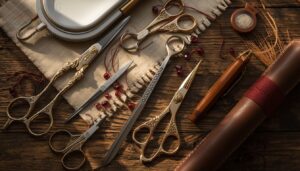
Good tools only stay good if you take care of them. A few simple habits — like proper storage and knowing when a blade needs replacing — can make your scissors and rotary cutters last for years.
Here’s what to keep in mind before you buy and after you do.
Store Scissors With Blade Protection
Good scissors deserve a proper home. Blade guard materials range from plastic to silicone sleeves, each shielding your fabric scissors between embroidery sessions.
Magnetic storage strips keep blades separated and wall-mounted cases offer visibility without exposure.
For travel, blade caps protect tips and maintain alignment. Match the protective sleeve option to your blade type, and replacement becomes far less frequent.
Reserve Fabric Scissors for Fabric Only
Protecting your blades goes beyond storage. Think of your fabric scissors as a dedicated scissor set — fabric scissors are solely for fabric, nothing else.
Paper, tape, and plastic dull edges fast.
Label each pair clearly; labeling discipline sounds small, but it saves blades.
Use separate storage cases for non-fabric shears, and cross contamination prevention becomes second nature — your blade preservation routine practically runs itself.
Inspect Blades for Nicks and Dullness
Sharp blades are the backbone of fabric cutting precision and efficiency.
Start with Edge Visual Checks — hold blades under bright light for a Light Inspection, spotting flat, shiny spots or micro burrs.
Then run a Paper Sharpness Test:
- Slice plain paper cleanly
- Try a Tomato Cut Test — no squashing
- Do a Thread Glide Evaluation along a single strand
- Check Rotary Cutter Blades 5 pcs 28mm, 45mm, and 60mm for nicks on the toe and heel
- Feel for gritty spots signaling worn edges
rotary cutter blades keep every cut honest.
Compare Brands and Replacement Blades
Not all replacement blades are equal, and brand differences matter more than you’d think. Olfa and Fiskars lead on fit tolerance and blade material quality, while Clover performs delicate work beautifully.
For rotary cutter blades 5pcs 28mm sets, check performance metrics like cut length ratings and warranty coverage before buying. Replacement blade options for cutters vary in cost efficiency, so compare packs carefully.
Check Shipping, Discounts, and Guarantees
Before you check out, take a minute to review the fine print — it’s worth it.
Many online sewing supply stores offer free shipping on orders over $60, plus bundle discount options when you buy multiple tools.
Return policy terms usually run 30 to 60 days, and warranty coverage length often includes defects for up to a year.
Watch for discount promotions on sewing accessories, and confirm international duty fees upfront.
Frequently Asked Questions (FAQs)
How do I sharpen dull embroidery scissors at home?
A fine grit stone and a steady 10–15 degree angle are your two best friends here.
Use an angle guide, apply a drop of honing oil, remove any burr, then do a blade alignment check.
What scissors work best for cutting felt fabric?
For felt, carbon steel longevity matters most. Look for fabric scissors with a blade tension screw, ergonomic grip, and heavy-duty blades.
That 60-degree edge angle slices clean through dense fibers without fraying.
How often should rotary cutter blades be replaced?
Dull blades skip and fray instead of cutting clean. For daily quilters, swap blades every 5–10 hours. With thick fabrics, replace sooner — around 3–5 hours of use.
Are fabric cutting tools safe for children to use?
Most fabric cutting tools aren’t child-safe without supervision. Sharp blades, rotary cutters especially, demand adult guidance.
Use age-appropriate tools, practice proper training practices, and apply smart storage solutions to keep little hands protected.
Conclusion
Sharp choices make the sharpest work—and that’s no small thread to pull. right fabric cutting tools for embroidery projects don’t just make cutting easier; they protect every stitch you’ve carefully placed.
A well-matched scissors, clean rotary blade, a stable mat—each one removes a variable that could cost you hours. Invest in tools that respect your craft, keep them sharp, and they’ll return the favor with cleaner edges and fewer regrets.