This site is supported by our readers. We may earn a commission, at no cost to you, if you purchase through links.
tangled thread spool doesn’t just waste your time—it can ruin a project mid-stitch. Thread twists back on itself, weakens at the kinks, and sometimes snaps right when you’re in a rhythm.
Most sewists don’t realize storage is where tangling starts, long before the needle ever moves. How you wind, where you place, and what you put threads in all shape whether they stay smooth or turn into a knotted mess.
The good news: a solid storage system fixes most of it. These steps will get your thread sets organized, protected, and ready to grab without the hassle.
Table Of Contents
Key Takeaways
- Where you store thread matters more than how you sew it — the right container, matched to your spool type and sealed against dust and moisture, prevents most tangles before they start.
- Sorting by fiber type and weight isn’t just tidying up; it’s how you stop cotton, metallic, and embroidery threads from ruining each other’s texture and finish over time.
- three-part label (brand, color number, weight) on every spool — plus matching dots on bobbins — turns a chaotic bin into a system you can work from in seconds.
- Prep matters: rewinding partially used spools, tying off ends, and untangling strands before boxing them away is what keeps your storage system actually working instead of just looking organized.
Choose The Right Storage System
The storage system you choose makes or breaks how well your threads stay tangle-free.
Pairing the right storage with a few clever sewing machine thread tricks keeps everything organized and ready to grab without the hassle.
Not every option works for every setup — it really comes down to what you’re storing and how you work.
Here are the main types worth considering.
Compare Vertical Racks, Stackable Bins, and Labeled Trays

Each storage option has its strengths — here’s how they stack up:
- Vertical racks — maximizes vertical storage with a low floor footprint and high load capacity
- Stackable bins — flexible, dust-resistant thread storage solutions with solid adjustability options
- Labeled trays — best for labeling and color-coding systems at a glance
- Wall-mounted racks — cuts retrieval time dramatically
- Sealed containers — lowest maintenance frequency, great for preventing thread tangles and breakage
For best stacking, consider using true stackable bins that interlock securely.
Match The Container to Spool, Cone, Bobbin, or Floss Sets
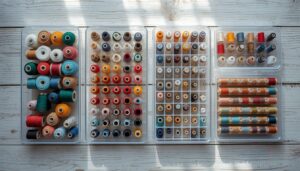
Not every container works for every thread — and that mismatch is where tangles start.
Spool Diameter Fit matters: standard spools need snug inner widths, while cone depth compatibility means taller cones need vertical slots.
Bobbin tray size keeps small bobbins aligned; floss case geometry fits flat bobbins in tidy rows.
Use adjustable divider to reconfigure as your collection grows.
Pick Dust-proof Options for Long-term Storage
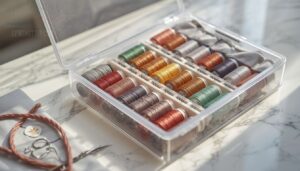
Once your threads are matched to the right containers, the next step is keeping them that way — long term.
Dust and moisture are silent culprits. Use these dust protection essentials:
- Desiccant Lined Boxes with silica gel packets for humidity control
- UV Resistant Enclosures for UV protection against fading
- Microfiber Sleeve Wrap around individual spools
- Locking Lid Inserts for archival storage
Store in a HEPA Filtered Room when possible.
Use Wall-mounted or Countertop Storage for Easy Access

Dust-proof containers handle the long game — but for daily work, you need fast access. Wall-mounted industrial thread racks and slatwall panels with adjustable slatwall baskets let you shift colors around as projects change.
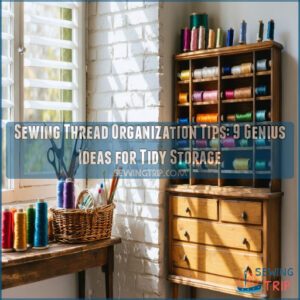
For a deeper dive into mixing and matching these systems, sewing thread organization tips and storage ideas cover drawer dividers and clear containers that pair perfectly with wall-mounted setups.
Position spools at ergonomic height so grabbing thread feels easy. On the counter, magnetic bin holders keep metal bobbins visible, while clear acrylic visibility and non-slip liners stop spools from rolling mid-reach.
Sort Threads by Category

Once you’ve picked your storage system, the next step is deciding what goes where.
Mixing fiber types is a fast track to tangled chaos and wasted time.
Here’s how to sort your threads in a way that actually makes sense.
Group by Fiber Type: Cotton, Polyester, Metallic, and Floss
Mixing fiber types is a shortcut to chaos.
Cotton needs cotton moisture control because it absorbs humidity and can mold.
Polyester’s polyester heat resilience means it behaves completely differently under stress.
Metallic threads demand metallic static mitigation and gentler handling.
Floss relies on floss colorfastness staying intact — and that means no cross‑contamination.
Build your fiber type inventory by keeping each type in its own labeled section.
Separate Threads by Weight and Project Use
Weight zoning isn’t just for pros — it’s what keeps your thread storage from becoming a guessing game. Group your spools by weight classification so heavier 40–50 wt threads never share space with lighter 60–100 wt options. Here’s a simple light-heavy flow to follow:
- Place 40–50 wt near your machine
- Store 60–80 wt in mid-range project bins
- Keep 80–100 wt in labeled secondary trays
- Reserve embroidery weight trays for 40–60 wt floss
Flexible rotation and smart thread organization make preventing thread tangles almost automatic.
Keep Embroidery Threads Apart From General Sewing Thread
Embroidery thread isn’t just "fancy sewing thread" — it has different sheen, finish, and colorfastness requirements. Separate Storage Zones keep your Embroidery thread organization clean and your sewing spools safe from cross-contamination.
| Embroidery Thread | General Sewing Thread |
|---|---|
| Unique Tool Sets, sealed pouches | Standard bobbins, open trays |
| Color Family Isolation by range | Sorted by weight class |
Use Climate-Controlled Compartments and Inventory Segmentation to simplify Labeling and color-coding thread collections — Preventing thread tangles in craft projects starts here.
Store Frequently Used Colors Closest to Your Sewing Area
Think of your sewing area as having Ergonomic Reach Zones — the space closest to your machine is prime real estate.
Use Quick-Grab Bins and Color Proximity Mapping to keep your Visual Color Palette within arm’s reach. Accessibility Zones for your go-to shades cut retrieval time substantially.
Labeling and color-coding systems on Thread organizing cards make efficient thread organization for sewing second nature.
Label and Color-Code Everything

Sorting your threads is only half the battle — if you can’t quickly tell what’s what, you’re back to digging through spools anyway. A solid labeling system turns that chaos into a system you can actually trust.
Here’s how to set it up so everything stays easy to find.
Add Brand, Color Number, and Weight to Each Spool
Every spool needs three things on its label: brand, color number, and weight. Use a standard field sequence — always in that order — so scanning storage takes seconds, not minutes.
Durable label materials with UV-resistant ink keep your thread labeling readable through years of handling.
A simple weight tracking system and color number validation against the manufacturer catalog will seriously sharpen your thread inventory management and tracking.
Use Color-coded Stickers for Fast Visual Matching
Color-coded stickers are the shortcut your thread collection has been waiting for. A well-planned color coding and labeling system lets you grab the right spool in under two seconds — no squinting at tiny numbers.
Use durable vinyl materials that resist moisture and handling.
Sticker size selection matters too: 3–5mm dots fit spools perfectly.
High contrast palettes like blue-on-white boost legibility in dim lighting.
Matte vs glossy finishes? Go matte — less glare.
Your sticker placement strategy should keep dots near the spool end for instant visibility.
Mark Bobbins to Match Their Parent Spools
Stickers on spools are only half the job. Your bobbin-spool sync matters just as much — a mismatched bobbin mid-project is a real headache.
Use matching color-coded labels and a unified identifier system: same number, same dot, same spot. Consistent label placement rules on your bobbins and cards, keep your labeling and color coding systems tight, so thread inventory management stays smooth.
Keep a Printed Chart or Inventory List Near Storage
Your bobbin labels are locked in — now make sure your whole system is visible at a glance.
Pin a laminated printed chart within arm’s reach of your storage area. Divide it by fiber type, weight, and color family. That’s your chart placement working for you. Build a simple update routine: log new spools, note used ones, jot the date.
- Laminate the chart using durable materials so spills don’t wreck it
- Use bold headers and light grid lines for visibility enhancements at a glance
- Keep a dry-erase marker nearby for quick updates to your labeling and color-coding systems
- Support thread inventory management with a digital backup stored in the cloud
- Sync your printed chart with digital apps for thread inventory to cut duplicate purchases
Prep Threads Before Storing

Even the best storage setup falls apart if your threads aren’t ready to be stored. A little prep work goes a long way toward keeping everything neat, tangle-free, and easy to grab mid-project.
Here’s what to do before anything goes back in the bin.
Rewind Thread Smoothly to Prevent Loose Coils
Before you box anything up, take a minute to rewind any partially used spools properly. Start from the core and follow a radial start alignment outward, keeping a smooth directional path the whole way.
Consistent tension matters — too loose and you’ll get saggy coils that unravel in storage. Use parallel sectioning and a uniform wrap count to keep each layer flat, preventing thread tangles and breakage later.
Tie Off or Clip Loose Ends After Winding
Once spool is neatly rewound, don’t skip the finish line. Tie off loose ends using a secure locking method — single knot works for most fibers, but slippery synthetics need a second overhand pass.
Follow tail length guidelines: leave 3–6mm beyond the knot, then use sharp cutting tools for a clean perpendicular cut. Always do a final tension check by tugging lightly.
Store Partial Spools and Bobbins in a Consistent Direction
Consistency is everything once you pick up a partial spool. Face all spool edges the same direction — that’s your Spool Edge Alignment rule, and it makes bobbin storage genuinely smooth.
Use a Directional Tray Design with Visual Lid Indicators to reinforce your Uniform Rotation Standard at a glance. Orientation Guides on lids keep thread organizing cards, tangle‑free sewing habits, and your thread inventory management running without second‑guessing.
Separate Tangled Strands and Straighten Them Before Boxing
Tangled strands before boxing? Don’t just yank — that makes it worse. Work in sections using Sectional Untangling, pulling gently from the center outward with a Light Drafting Motion.
- Use the Finger Straightening Technique to align fibers smoothly
- Practice Consistent End Clipping to stop re-tangling
- Control Humidity Static Control with a low-moisture space
- Separate thread tangles a few inches at a time
Protect Threads From Damage
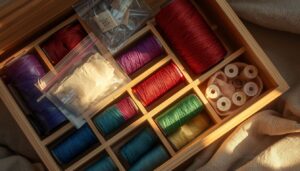
Thread damage sneaks up on you — mold, fading, dust, and brittleness can ruin a whole collection before you notice anything’s wrong.
The good news is that a few simple habits go a long way toward keeping your threads in great shape for years. Here’s what you should be doing.
Keep Storage Dry to Prevent Mold and Mildew
Moisture is the silent enemy of a tidy thread collection. Keep relative humidity below 50 percent using silica gel packets or calcium chloride desiccants inside your bins — that’s your frontline humidity control.
Elevated shelving keeps containers off damp concrete floors, while regular airflow ventilation prevents stagnant air.
For serious collections, climate controlled units offer the most reliable mold prevention and thread moisture control year‑round.
Block Sunlight and UV Exposure to Reduce Fading
Light is sneaky — it fades your threads slowly, and you won’t notice until the damage is done. UV protection isn’t optional for serious collections.
- Hang UV blocking curtains or light filtering shades over storage areas
- Apply window films to block up to 99% of UV rays
- Use reflective coatings on shelving units facing windows
- Store seasonal threads in UV protective pouches
Add Dust Protection With Lids, Cases, or Sealed Pouches
Dust is a slow villain — it sneaks in and weakens fibers before you notice. A plastic box with a lid is your first line of defense, especially one with an airtight seal design or magnetic lid mechanisms that click shut reliably.
For long-term stash, multi-layer pouch barriers made from dust resistant materials like BoPET block particles effectively.
Wall mounted thread storage with plastic covers works too — just keep up a seal maintenance routine to catch worn gaskets early.
Humidity control inside sealed cases, using desiccant packs, rounds out your protective storage to extend thread lifespan substantially.
Rotate Older Thread First to Avoid Brittleness and Waste
Think of your thread stash like a fridge — oldest goes first, no exceptions. A simple FIFO Rotation Process keeps brittleness in check by pulling aged spools forward through Front Queue Placement before newer stock.
Treat your thread stash like a fridge: oldest goes in front, newest goes back
Use Spool Age Tracking and a quick Brittleness Inspection each session.
A short Rotation Checklist makes inventory rotation automatic, cutting thread waste and stretching thread longevity without overthinking it.
Frequently Asked Questions (FAQs)
How do I Keep my thread from tangling?
Tangling usually starts before you even thread your needle. Spool tension, storage habits, and how you handle thread daily all play a role. Get those right, and knots become rare.
How to keep embroidery thread tangle-free?
Keep embroidery thread tangle-free by winding each strand onto thread cards and storing them in a dedicated floss box. Separate strands before use, and apply anti-static conditioner to metallic threads.
How do I Keep my thread tangle-free when hand sewing?
Like a well-tensioned stitch, tangle-free hand sewing starts before you thread the needle.
Use short length cutting, apply anti-static conditioner, and master the smooth pull technique for tension consistency every time.
How do I prevent tangles when hand sewing?
Cut your thread to 18 inches, use a thread conditioner, and match your needle size to your thread weight.
Consistent tension and a smooth thread path keep hand sewing tangle-free every time.
How long should your thread be to avoid tangling?
Aim for 18 to 24 inches — that’s your sweet spot. Shorter lengths mean minimum knot risk and better tension control. For embroidery, 20 inches is your recommended cut length.
How to keep threads tidy?
Tidy threads start with a system, not just good intentions. Group by type, label clearly, use stackable bins, and keep your most-used colors within arm’s reach.
Simple habits make all the difference.
Can I store thread in a regular plastic bag?
You can, but not ideal. Regular plastic bags trap humidity, cause static attraction, and risk chemical off-gassing over time.
For real thread preservation, breathable alternatives or a plastic thread storage box with vents work much better.
How do I untangle severely knotted thread?
The more you pull, the tighter it gets. Slow down.
Use tweezer separation to isolate strands, then apply gentle wiggle with needle guidance to work loops free.
A drop of lotion—lubricant application—helps.
Pin and pick stubborn clusters apart carefully.
What temperature is best for storing thread?
Keep your thread storage between 60 and 75°F. That’s the ideal temperature range for preserving fiber strength and dye vibrancy.
Too warm triggers heat-induced fading. Too cold risks cold condensation when you move spools around.
Should metallic thread be stored differently than cotton?
Yes — metallic thread needs extra care. Its foil integrity is fragile, so upright positioning, corrosion prevention, cool temperatures, and anti-static handling all matter more than they do with forgiving cotton.
Conclusion
Here’s the part most sewists skip—and it’s exactly why the tangles keep coming back. Knowing how to store thread sets to prevent tangling isn’t just about tidiness; it’s about protecting hours of work before a single stitch is made.
Get the system right once, and your thread stays smooth, sorted, and ready every time you sit down. Projects don’t get easier, but at least your thread won’t be the thing slowing you down.