This site is supported by our readers. We may earn a commission, at no cost to you, if you purchase through links.
Most quilters avoid appliqué because they assume it demands perfect edges, invisible stitches, and the patience of a saint. Raw-edge appliqué throws that rulebook out entirely. The fraying, visible edges, and texture that shifts under light—that’s not a flaw, it’s the whole point.
Fabric that’s cut and fused without folding or seam allowances gives quilt blocks a loose, organic quality that turned edges simply can’t replicate. This approach transforms perceived imperfections into intentional design elements, celebrating the material’s natural character.
Once you master fusible web, the right iron temperature, and a few simple stitches, you gain a technique that turns even your smallest fabric scraps into something worth showing off. The process prioritizes creativity and accessibility over meticulous precision.
Table Of Contents
- Key Takeaways
- Raw-Edge Appliqué Basics
- Prepare Templates and Fabrics
- Printing Templates at 100% Actual Size
- Checking Scale With a 1-inch Test Square
- Mirroring Directional Appliqué Designs
- Tracing Shapes Onto Fusible Web
- Spacing Motifs to Prevent Adhesive Overlap
- Pre-pressing Fabrics Before Fusing
- Cutting Motifs Accurately With Sharp Shears
- Layering Appliqué Pieces From Back to Front
- Fuse and Position Appliqué Pieces
- Applying Fusible Web to Fabric Backs
- Using Medium-hot Heat Without Steam
- Protecting The Iron With a Pressing Cloth
- Cooling Fused Pieces Before Handling
- Removing Paper Backing Cleanly
- Aligning Motifs on The Quilt Block
- Using Center Placement Guides
- Temporary Placement With Pins or Washable Glue
- Preventing Shifting Before Stitching
- Stitch Raw Edges Securely
- Straight Stitch Raw-edge Appliqué Method
- Zigzag Stitch for Flexible Edge Coverage
- Blanket Stitch for Decorative Outlines
- Satin Stitch for Dense Edge Finishing
- Choosing Thread Weight and Color
- Adjusting Stitch Length Near Edges
- Using Stabilizer for Dense Stitches
- Sewing Curves With The Needle Down
- Preventing Puckering and Edge Lifting
- Pressing Finished Appliqué Blocks Flat
- Top 6 Raw-Edge Appliqué Tools
- Frequently Asked Questions (FAQs)
- Conclusion
Key Takeaways
- Raw-edge appliqué turns "imperfect" frayed edges into a design feature on purpose, so you can skip the fussy folding and seam allowances that scare most beginners away.
- Fusible web is your best friend here — iron it onto the back of your fabric shapes to hold everything flat and stable before you ever touch the sewing machine.
- Your stitch choice shapes the whole look: straight stitch keeps things clean and simple, zigzag wraps the edge for durability, and blanket or satin stitch adds a decorative finish.
- Your scrap bin is basically a gold mine for this technique — tightly woven cottons and batiks work best because they fray less and fuse cleanly.
Raw-Edge Appliqué Basics
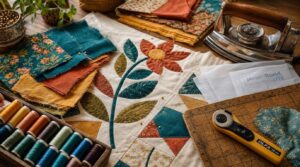
Raw-edge appliqué is one of those quilting techniques that looks impressive but is actually pretty approachable once you understand the basics. No folding, no needle-turn fussing — just fabric shapes fused down and stitched in place.
If you’re just getting started, these appliqué quilting patterns for beginners are a great place to practice the technique without feeling overwhelmed.
Here’s what you need to know before you get started.
What Raw-edge Appliqué Means in Quilting
Raw-edge appliqué is exactly what it sounds like — fabric shapes cut, placed, and left with their edges showing. No folding, no tucking. That’s the Raw Edge Definition in its simplest form: intentional imperfection.
Here’s what makes this Raw-edge appliqué technique special:
- Design Freedom — any shape goes, no seam allowances needed.
- Visual Storytelling — visible edges add texture and movement.
- Fabric Choice Impact — tighter weaves fray less; loosely woven fabrics create softer fringes.
- Edge Finishing — stitching secures edges and prevents excessive fraying.
- Fabric Stabilization — fusible web holds pieces flat before sewing.
Using fusible web reduces fraying is the most effective way to keep raw edges stable.
When to Use Raw-edge Appliqué Techniques
So when does this technique shine? Think seasonal quilt speed — when you need a holiday wall hanging done fast, raw-edge appliqué is your shortcut.
It’s perfect for wall art texture projects, frayed edge charm on folk-inspired blocks, or charitable project efficiency when you’re making dozens of quilts.
Border design simplicity? Raw-edge appliqué technique and supplies keep things moving beautifully.
Benefits for Beginner Appliqué Quilting Projects
Beginners love this method — and honestly, it makes sense why.
- Confidence boost — quick wins on small motifs keep you motivated.
- Reduced hand fatigue — lightweight scraps are easier to handle.
- Budget-friendly quilting — sustainable quilting starts with your scrap bin.
- Creative exploration — no rules, just play.
Beginner appliqué quilting techniques don’t get friendlier than this.
How Visible Fabric Edges Affect Texture
Visible edges do more than you’d think. Edge light interaction is real — raw edges catch light at angles, adding depth that flat seams simply can’t. Fray length impact matters too: longer threads create soft, fuzzy halos; shorter ones stay crisp.
Raw edges catch light at angles, adding depth that flat seams simply cannot match
Stitch density texture builds subtle ridges, while contrast color texture sharpens each motif.
Layered edge depth makes your whole block feel dimensional.
Best Quilt Blocks for Raw-edge Appliqué
Some quilt blocks are practically made for raw edge appliqué. The Morning Glory block’s curved petals love that soft, frayed finish. Leaf Motif designs gain natural movement from exposed edges.
Geometric Tile layouts keep things crisp and structured, while Abstract Scrappy blocks thrive on happy accidents.
Nature Inspired scenes layer beautifully with raw edges, giving each quilt block design real depth and dimension.
Using Fabric Scraps for Appliqué Motifs
Digging into your fabric scrap bin is honestly one of the best parts of raw edge appliqué. Those leftover pieces aren’t waste — they’re waiting for a second life.
- Color Sorting: Group scraps by color family first
- Fabric Types: Stick to cotton and linen for clean fusing
- Texture Mixing: Pair solids with patterns for visual pop
Eco-upcycling never looked this good.
Prepare Templates and Fabrics
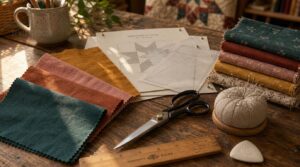
Getting your templates and fabrics ready is where a good appliqué project really begins. A few simple steps upfront save you a lot of frustration later — think of it as laying a solid foundation before you build.
Here’s exactly what to do before you ever pick up your scissors.
Printing Templates at 100% Actual Size
Before you print a single template, check your printer driver settings and set the scale to 100 — not "Fit to Page." That one mistake quietly shrinks or stretches everything. Disable auto-resize in both the print dialog and printer driver, then match your paper size alignment exactly to your file.
Run a calibration test page first and confirm actual size printing with scale verification tools before committing to the full sheet.
Checking Scale With a 1-inch Test Square
Once you’ve printed your template, grab a ruler and measure the 1-inch test square on the page. This scale verification process takes about ten seconds. Ensure the square measures exactly one inch in both directions to confirm accuracy.
If the measurement is correct, you’re ready to proceed. However, if the square is off by more than 1/16 inch, this indicates a critical issue. Such a deviation signals a problem requiring immediate action.
In cases of mismeasurement, reprint immediately to avoid errors. Adhering to this tolerance limit ensures precision in your work.
Mirroring Directional Appliqué Designs
Think of your design like a face — flip it the wrong way, and suddenly everything’s backwards. That’s why mirroring directional shapes before printing matters so much.
Horizontal mirroring swaps left and right, vertical mirroring flips top to bottom, and diagonal mirroring maneuvers rotated blocks.
Label each mirror template clearly, check mirror alignment along the center axis, and you’re set.
Tracing Shapes Onto Fusible Web
Trace templates onto fusible web, using the paper side as your guide. Hold shapes up to a window or lightbox tracing setup for clean visibility.
Pen selection is crucial: grab a fine-point, non-bleeding pen or 0.5 mm mechanical pencil. Always check paper back orientation before marking, and add alignment marking dots for positioning later.
Conduct a quick test swatch first.
Spacing Motifs to Prevent Adhesive Overlap
Once your shapes are traced, spacing becomes your next big win. Leave at least ¼ inch of fusible web clearance between every motif — think of it as building adhesive buffer zones so nothing bleeds into a neighbor.
Use motif placement guides or spacing templates to keep gaps consistent. Mark light pencil lines directly on your block for reliable alignment guides across repeats.
Pre-pressing Fabrics Before Fusing
Now that your motifs are spaced, give every fabric a good press before anything gets fused. Moisture elimination is the real goal here — hidden dampness causes bubbles and weak bonds.
Use a Teflon pressing sheet and press from the back, working center outward for even pressure distribution and crease flattening. Ten to fifteen seconds resolves most fabric tension issues beautifully.
Cutting Motifs Accurately With Sharp Shears
Your fabric is prepped and ready — now let’s cut clean. Sharp fabric scissors make all the difference here. Use long, continuous strokes along your traced line, keeping steady cutting pressure throughout.
Blade alignment is crucial: keep the blade flush against the line without wrist-twisting. For curves, rotate the fabric gently — that’s your curved corner technique for smooth, clean edges.
- Use sharp scissors with micro-serrated blades for slippery fabrics
- Apply consistent cutting pressure to avoid edge puckering
- Keep blade alignment tight against your traced line
- Practice continuous strokes to improve edge smoothness
- Slowly pivot the fabric through curves instead of forcing the blade
Layering Appliqué Pieces From Back to Front
Now that your pieces are cut, it’s time to build depth. Think of layering motifs from back to front like stacking clouds — biggest shapes go down first. This back-to-front depth sequencing keeps edge visibility clean and prevents top pieces from hiding important details below.
Press each layer outward from the center, maintaining spacing consistency, before adding the next.
Fuse and Position Appliqué Pieces
This is where your appliqué really starts to come together. Getting the fusing and placement right makes everything that follows — the stitching, the quilting, the whole finished block — so much easier.
Here’s exactly how to do it, step by step.
Applying Fusible Web to Fabric Backs
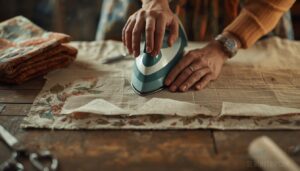
Your Web Selection sets the tone for everything — Heat N Bond Lite is a quilter’s best friend here. For Layered Fabric Prep, place the fusible web adhesive-side down on your fabric’s wrong side. Then press from the back using firm, deliberate lifts.
- Pre-pressing background fabric removes wrinkles first
- Hold each area 8–10 seconds for a solid bond
- Post-Fuse Inspection catches any shy edges before stitching
Using Medium-hot Heat Without Steam
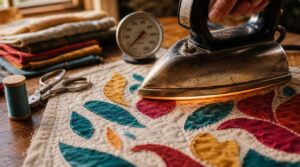
Getting the heat right is half the battle. Set your iron to medium-hot — around 160 to 190°C and keep it dry. Steam is the enemy of Heat n’ Bond Lite’s heat-activated adhesive.
Use a dry iron on a smooth iron bed surface. Apply even heat application with lift-and-press motions, press from the back, and watch your cooldown timing. Thirty seconds sets everything beautifully.
Protecting The Iron With a Pressing Cloth
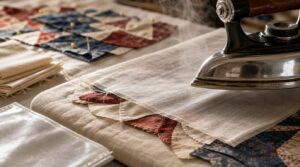
Even your iron needs a little protection sometimes. Slip a pressing cloth between the iron and pressing surface, and you’ve solved two problems at once — preventing fabric shine and keeping adhesive off your iron plate.
Here’s why Cloth Material Choice matters:
- Cotton muslin manages Heat Diffusion Benefits beautifully
- Silk organza protects delicate layers
- Teflon pressing sheet blocks adhesive transfer
- Steam Mitigation Techniques stay simple with a dry cloth barrier
- A clean Cloth Care Routine keeps residue from ruining your next block
Cooling Fused Pieces Before Handling
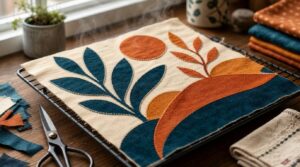
Hot fused fabric needs a breather — and so do you. After pressing, set your raw-edge appliqué piece on a cooling rack for 15 to 30 minutes. This simple surface cooling method keeps adhesive from lifting or warping.
Watch for temperature safety indicators: no steam, no tacky feel. Your post-cooling inspection should confirm edges are flat and the fusible bond is fully set.
Removing Paper Backing Cleanly
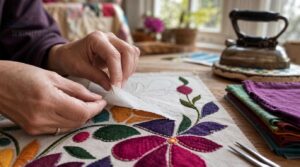
Now comes the satisfying part — peeling away that paper backing. Begin with a gentle lift at a corner, using tweezers if needed. Pull at a shallow angle, slow and steady, like peeling a sticker without tearing it.
- Work in small sections for clean residue removal
- Moisture management matters — keep your workspace dry
- Pellon 725 Paper-Backed Wonder-Under releases smoothly after full cooling
Tear repair is simple: reheat, re-fuse, done.
Aligning Motifs on The Quilt Block
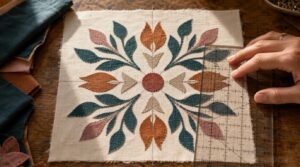
Think of your quilt block like a map — every motif needs its coordinates. Start by marking light crosshairs at the block’s center point, your Reference Grid anchor. Then work outward using alignment guides, checking Axis Symmetry and proportional spacing as you place each piece.
Visual symmetry checks prevent motifs from drifting off-balance, while Fabric Grain alignment keeps edges smooth and reduces puckering.
| Placement Check | Why It Matters |
|---|---|
| Visual symmetry checks | Prevents motifs from drifting off-balance |
| Fabric Grain alignment | Keeps edges smooth, reduces puckering |
Trust your quilt layout planning before fusing anything down.
Using Center Placement Guides
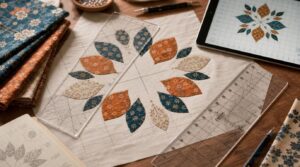
Now that your motifs are mapped out, center placement guides lock everything into place. Draw a simple cross through your quilt block’s center point — this intersection anchors alignment guides for precise positioning. Transparent guide materials, such as clear rulers or tracing overlays, simplify the application of guide creation tips.
Adjustable center templates and Digital Grid Guides ensure consistent spacing checks across every block. These tools support meticulous alignment, maintaining uniformity throughout your design.
Temporary Placement With Pins or Washable Glue
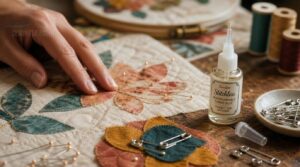
With your center guides in place, it’s time to hold everything still. Fine silk pins offer great Pin Distortion Control on delicate fabrics, while Safety Pin Layering works beautifully for stacked motifs — safety pins are simply easier to reposition.
Prefer Repositionable Glue Timing? You’ve got a 15–30-minute window to shift pieces before it sets. Apply it thin for Glue Residue Prevention, and you’re golden.
Preventing Shifting Before Stitching
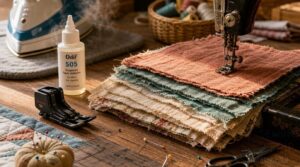
Even after temporary placement and basting, shifting happens — especially with multiple layers. That’s where your walking foot technique saves the day, feeding every layer evenly through the machine.
Use a removable basting thread or temporary fabric adhesive along the edges, then align everything against your grid alignment guide. A quick pre-press layering with a dry iron flattens everything beautifully for smooth, confident stitching.
Stitch Raw Edges Securely
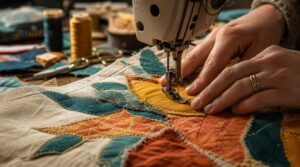
Now that your pieces are fused down, it’s time to lock those raw edges in place with stitching. The stitch you choose shapes the whole look of your finished block, so it’s worth knowing your options.
Here’s a rundown of the methods that work best for raw-edge appliqué.
Straight Stitch Raw-edge Appliqué Method
The straight stitch is your best starting point for raw edge appliqué — simple, clean, and surprisingly effective. Stitch close to the edge, about 1/8 inch in, and shorten the stitch length to around 1.5–2.0 mm for better edge fray prevention.
Monitor your stitch tension settings and the machine’s speed control — slow and steady wins here.
The right needle size choice and thread blend techniques keep everything lying flat.
Zigzag Stitch for Flexible Edge Coverage
The zigzag stitch wraps thread right over the raw edge — giving you edge flexibility that holds up through washing and handling. Set your stitch width to about 3 mm for most fabrics. It’s a key innovation for fabric compatibility across knits and wovens alike.
- Preserves elasticity retention on stretchy fabrics
- Adjusts stitch width for heavier or lighter materials
- Creates decorative textures with contrasting thread colors
- Stitch length adjustment fine-tunes fray resistance beautifully
Blanket Stitch for Decorative Outlines
Blanket stitch is where function meets beauty in raw edge appliqué. Loop size and stitch density shape how finished your edges look—tighter loops give a polished feel, while a double row adds serious color contrast and visual punch. It also manages curved edges beautifully.
As a decorative stitch, it’s one of the best finishing edges in appliqué when choosing stitches for machine appliqué work.
Satin Stitch for Dense Edge Finishing
Satin stitch is the go-to when finishing edges in appliqué for a truly polished look. Think of it as a smooth color ribbon wrapping your shape.
Set stitch density settings between 0.3–0.4 mm for full coverage. For rayon versus polyester, polyester holds up better through washing.
Nail your stitch tension adjustment, match edge color to your fabric, and finish with a light finishing press technique.
Choosing Thread Weight and Color
Thread weight matching can make or break your finished block. For most raw-edge appliqué on cotton fabrics, 40–50 wt thread hits the sweet spot—good coverage without bulk. Use lighter weights (60–80 wt) for delicate fabrics.
Color contrast strategies are your creative lever: match thread to your motif for a subtle blend, or use contrast stitching to make edges pop.
Adjusting Stitch Length Near Edges
Small tweaks make a big difference when it comes to stitch length near the edge. Too short and your fabric bunches; too long and edges lift. For raw edge appliqué, here’s how to dial it in:
- Start with 1/8-inch stitch length near edges.
- Test on scrap fabric first — near-edge testing saves your project.
- Adjust edge stitch tension before touching the final piece.
- Make fabric-specific adjustments: lightweight cotton needs slightly longer stitches.
- Use needle selection guide basics — a universal needle reduces skipped stitches near edges.
Using Stabilizer for Dense Stitches
Dense stitches like satin stitch put real pressure on your fabric — and that’s where stabilizer selection saves the day. Pin a tear-away stabilizer to the back before stitching, then remove it in sections afterward. For heavier fills, using heavy stabilizers keeps everything flat. Water-soluble tips work beautifully on delicate fabric, dissolving cleanly in warm water.
Skip the stabilizer, and you’ll be fighting puckers all afternoon.
Sewing Curves With The Needle Down
Curves are where raw edge appliqué gets interesting — and Needle Down Settings make all the difference. Slow your stitch speed, leave the needle down when pausing, and master the Pivot Technique: lift the presser foot, rotate your fabric, lower, and continue stitching.
Lighter Foot Pressure helps on tight bends, while practicing on scrap circles builds confidence for your zigzag stitching deserves.
Preventing Puckering and Edge Lifting
Even after nailing curves, puckering can sneak up on you. Here’s what keeps edges smooth and flat:
- Pre-wash fabric shrinkage out before fusing — raw edge appliqué hates surprises later.
- Check grain alignment and balanced machine tension before stitching.
- Use lightweight interfacing and appropriate needle size to prevent drag.
Adjusting tension for fusible web and choosing the right stitch types for edge finishing stops fraying before it starts.
Pressing Finished Appliqué Blocks Flat
Press from the center outward using a dry iron and Teflon pressing sheet — good pressure distribution matters here. Skip the steam; Heat Management keeps your fusible adhesive intact.
Got edge curl? Apply light, focused pressure right on it — that’s your Curl Remedy.
Allow a full Cooling Period before moving anything. Store blocks flat for best results.
Top 6 Raw-Edge Appliqué Tools
Having the right tools in your kit makes raw-edge appliqué so much easier — and honestly, more fun. A few well-chosen picks can save you time, frustration, and more than a few crooked cuts.
Here are the six tools worth keeping on your worktable.
1. Famore 8 Inch Bent Fabric Shears
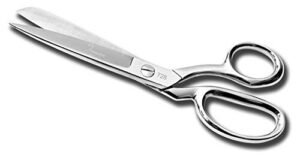
The Famore 8-Inch Bent Fabric Shears might just become your best friend at the cutting table. The curved blade profile keeps your hand lifted off the fabric, ensuring motifs stay perfectly flat while you cut — eliminating shifting or guesswork.
The razor-edge grind on German stainless steel slices cleanly through multiple fabric layers, a critical advantage when trimming appliqué edges close to the needle line.
At $36.98, they represent a solid long-term investment. Left-handed quilters can opt for the dedicated 728L version.
| Best For | Quilters and sewists who do a lot of tabletop pattern cutting and want cleaner cuts with less hand fatigue. |
|---|---|
| Primary Material | German stainless steel |
| Unit Count | 1 |
| Price Range | $36.98 |
| Primary Use | Fabric cutting |
| Durability Rating | High |
| Skill Level | Intermediate |
| Additional Features |
|
- The curved blade keeps your hand elevated so fabric stays flat and doesn’t shift mid-cut
- German stainless steel with a razor-edge grind means smooth, clean cuts through multiple layers
- Lightweight at under 0.2 lb, so extended cutting sessions won’t wear you out
- A few buyers have reported quality control issues like missing blade tips or damaged packaging out of the box
- Left-handed users have to buy a separate version (728L) — it’s not ambidextrous
- The bent design is great for flat tabletop work but feels awkward for handheld or freeform cutting
2. Dritz Dual Purpose Marking Pen
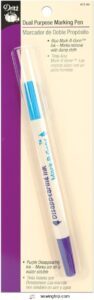
The Dritz Dual Purpose Marking Pen is a quiet workhorse you’ll reach for constantly. One end holds blue Mark-B-Gone ink — water-soluble and easy to wipe away with a damp cloth.
Flip it over, and you’ve got purple disappearing ink that fades on its own within 24 to 36 hours. This is perfect for placement guides you don’t want to wash out mid-project.
Just test on a scrap first, as very thin fabrics can bleed a little.
| Best For | Home sewers, quilters, and embroidery enthusiasts who need clean, removable markings on fabric without leaving behind stains or residue. |
|---|---|
| Primary Material | Polypropylene |
| Unit Count | 1 |
| Price Range | Under $10 |
| Primary Use | Fabric marking |
| Durability Rating | Medium |
| Skill Level | Beginner |
| Additional Features |
|
- Two tips in one pen — blue for wash-away marks, purple for lines that vanish on their own in 24–36 hours
- Works on tricky fabrics like slippery or sheer materials where other markers tend to slip or stain
- Easy to remove with just water (blue) or a little air and time (purple), so no extra cleanup products needed
- The blue ink tip tends to dry out faster, so it may not last as long as you’d hope
- Purple ink can take longer to fade in humid conditions, which might throw off your timing mid-project
- Thin or loosely woven fabrics can bleed — always test on a hidden spot before committing
3. Pellon Wonder Under Fusible Web

Pellon Wonder Under is the fusible web most quilters keep stocked. Its paper-backed design ensures easy, accurate tracing of shapes.
Iron it onto the wrong side of your fabric at medium-hot heat (no steam required). Let it cool, peel the paper backing, then position and press for a permanent bond.
After fusing, it stays soft and sewable, won’t gum up your needle, and withstands washing reliably.
Reliable every single time.
| Best For | Quilters, appliqué enthusiasts, and embroidery hobbyists who want a reliable, easy-to-use fusible web for bonding fabric layers before stitching. |
|---|---|
| Primary Material | 100% polyester |
| Unit Count | 1 |
| Price Range | Under $15 |
| Primary Use | Fabric bonding |
| Durability Rating | Medium |
| Skill Level | Beginner |
| Additional Features |
|
- Paper backing makes tracing and cutting shapes clean and precise
- Stays soft and sewable after bonding — no gummed-up needles
- Holds up through machine washing and dry cleaning
- Adhesive can stick to skin or clothing if handled before it’s fully bonded
- You have to let it cool completely before peeling the backing or you risk a mess
- Not the best choice for heavy or thick fabrics that need a stronger hold
4. Singer Expert Finish Steam Iron
The Singer Expert Finish Steam Iron earns its spot on every serious quilter’s pressing table. At 1700 watts, it heats up fast and holds temperature steadily — exactly what you need when fusing appliqué pieces one after another.
The LCD display with fabric-specific presets takes the guesswork out of heat settings, so you’re not second-guessing yourself mid-project.
Its open-tip soleplate reaches tight spots near seams and edges cleanly.
Lightweight at under three pounds, it won’t tire your hand during long pressing sessions.
| Best For | Quilters and home sewers who need a fast, precise iron that handles everything from delicate fabrics to bulk pressing sessions. |
|---|---|
| Primary Material | Brushed stainless steel |
| Unit Count | 1 |
| Price Range | Under $40 |
| Primary Use | Fabric pressing |
| Durability Rating | High |
| Skill Level | Beginner |
| Additional Features |
|
- Heats up quickly at 1700W and holds a steady temperature, so you can move through a stack of blocks without waiting around.
- The LCD presets and open-tip soleplate make it easy to work near seams, buttons, and tight corners without guessing at your heat setting.
- At under three pounds with a long swivel cord, it’s comfortable to use for extended sessions without fatigue.
- Some irons have shown up with signs of prior use despite being sold as new — worth keeping an eye on when unboxing.
- The auto-off can kick in a bit too eagerly during normal use, which gets annoying mid-project.
- Repeated burst-steam use requires a short recovery time, and occasional spitting has been reported after longer sessions.
5. Diane Aluminum Hair Spray Bottle
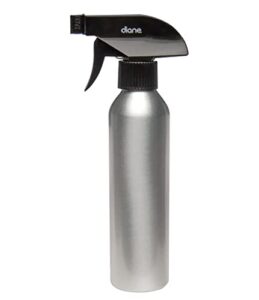
A good misting bottle is quietly one of the most useful tools on your pressing table. The Diane Aluminum Spray Bottle holds 8 oz of water — plenty for a full work session — and its fine-mist nozzle delivers an even, controlled spray over your fabric.
The compact aluminum body won’t tip or corrode, fitting neatly beside your iron without crowding your workspace.
Use it to lightly dampen stubborn wrinkles before fusing or to refresh fabric between pressing steps.
| Best For | Stylists, barbers, and home users who want an easy, even mist for hair care, pressing, or light detailing work. |
|---|---|
| Primary Material | Aluminum |
| Unit Count | 1 |
| Price Range | Under $15 |
| Primary Use | Liquid misting |
| Durability Rating | Medium |
| Skill Level | Beginner |
| Additional Features |
|
- The aluminum body is durable and corrosion-resistant, so it holds up well in busy salon or barber settings.
- At 8 oz, it’s compact enough to sit on a counter without getting in the way, but holds plenty for a full session.
- The adjustable nozzle lets you switch between a fine mist and a direct stream depending on what you need.
- Leaks can be an issue if the spray head isn’t fully tightened or the bottle gets stored on its side.
- Spray head quality isn’t always consistent — some users have had nozzles that fit poorly or stopped working early.
- Strong liquids like high-alcohol solutions or concentrated essential oils can wear down the spray mechanism over time.
6. Dritz Two Inch Safety Pins
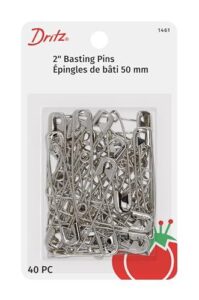
Sometimes the simplest tools do the heaviest lifting. The Dritz Two Inch Safety Pins are exactly that kind of workhorse. Each nickel-plated steel pin measures 2 inches — long enough to grab all three layers of a quilt sandwich without bending or slipping loose.
You get 40 pins per pack, which is plenty for basting a full-size block. The sharp points go in cleanly, and the secure clasp stays closed while you stitch.
Keep a stash nearby whenever you’re pinning appliqué motifs before the final fuse.
| Best For | Quilters and sewers who need strong, reliable pins for basting thick fabrics like denim, quilt sandwiches, or layered projects. |
|---|---|
| Primary Material | Nickel-plated alloy steel |
| Unit Count | 40 |
| Price Range | Under $10 |
| Primary Use | Fabric pinning |
| Durability Rating | High |
| Skill Level | Beginner |
| Additional Features |
|
- Sharp points slide through multiple fabric layers cleanly without a lot of effort
- 40 pins per pack gives you plenty to work with for full-size quilt basting
- Sturdy nickel-plated steel holds firm — less bending and breakage than cheaper pins
- May feel slightly dull on very tight or thick weaves, so you’ll need a little extra push
- Not a great fit for anyone with a nickel allergy — skin irritation is a real possibility
- Only includes the 2-inch size, so if you need smaller pins you’ll have to grab a separate pack
Frequently Asked Questions (FAQs)
Can raw-edge appliqué be done entirely by hand?
Forget the machine — your hands are enough. Yes, raw-edge appliqué works entirely by hand. A simple running or blanket stitch around each shape secures it beautifully, no electricity required.
How do you wash quilts with raw-edge appliqué?
Wash your raw-edge appliqué quilt on a gentle cold cycle with mild detergent. Skip the heat — air dry flat to protect those edges.
Simple, careful washing keeps your quilt looking sharp for years.
Which fabrics fray least with raw-edge appliqué?
Batiks and tightly woven quilting cottons fray the least. Their dense weave holds threads in place even after washing.
Polyester blends and high thread count cottons also stay surprisingly clean-edged over time.
Can you layer multiple appliqué shapes on top?
Yes, absolutely! Layer smaller shapes over a base piece to build depth and dimension.
Fuse each layer from the bottom to the top, then stitch edges as you go to keep everything secure.
How long does fusible web adhesive typically last?
Under normal home laundering, fusible web adhesive usually lasts the life of your fabric bond — often withstanding up to 40 wash cycles before any edge lift appears.
Conclusion
Raw-edge appliqué quilting techniques have a charming way of turning what some might call "creative looseness" into your greatest design strength. Those exposed edges aren’t accidents—they’re personality. Every frayed thread adds warmth, depth, and a handmade story that perfectly folded seams simply can’t tell.
Now that you’ve got the tools, steps, and confidence, your scrap basket just became a treasure chest. Go make something beautifully, unapologetically imperfect.
- https://www.patternpoole.com/post/our-top-tips-for-raw-edge-fusible-machine-applique?srsltid=AfmBOorH4WOfGyCyOF3Lv6Hz0mtqrlXahMCT5Fv2QxWEIrMGP2MwFNcr
- https://quiltsocial.com/raw-edge-and-invisible-machine-applique-tips-for-success/
- https://suzyquilts.com/raw-edge-applique-tutorial/?srsltid=AfmBOorwTMGIEWkz5sVjxPjE5zMD0SVhC2Cktq98yw7ahvS_OsidJ1-b
- https://sherriquiltsalot.com/2022/04/13/the-final-steps-in-raw-edge-applique/
- https://blog.joejuneandmae.com/raw-edge-applique-an-easy-guide/