This site is supported by our readers. We may earn a commission, at no cost to you, if you purchase through links.
A single iron pass can turn a plain quilt block into something that stops people mid-scroll. That’s the quiet magic of fusible appliqué—no pins, no basting, no fighting slippery fabric while trying to keep a shape in place. You bond the piece down, stitch the edges, and move on.
Quilters who once avoided appliqué entirely now reach for it first because the process finally makes sense. Whether cutting a simple circle or layering a detailed deer silhouette, fusible appliqué rewards patience with results that look far more complicated than they were to make.
Table Of Contents
Key Takeaways
- Fusible web bonds fabric shapes in place before stitching, so you skip pins and basting and spend more time on the fun parts.
- Your stitch choice—blanket, satin, or zig-zag—does double duty: it locks the edges down and sets the whole look of your finished piece.
- Precut appliqué kits come with fusible web already applied, which cuts prep time dramatically and makes complex designs approachable for beginners.
- Whether you quilt the background first or fuse pieces onto a raw top, picking one consistent method keeps your layers aligned and your results clean.
Choosing Fusible Appliqué Quilt Designs
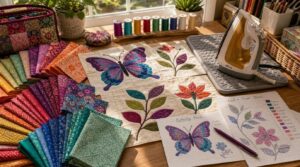
Picking the right design is where your quilt really begins to take shape. The good news is there’s something for every skill level, style, and space in your home.
Whether you’re drawn to bold geometrics or soft florals, quilting patterns for every skill level and style can help you narrow down the perfect starting point.
Here are some great starting points to help you find the right fit.
Beginner-friendly Design Shapes
Start with Circle Basics — they’re forgiving and teach you how to handle smooth curves without stress. Square Foundations and Triangle Modules train your eye for clean placement and scale. Oval Shapes keep things soft and friendly. Understanding the symbolic meaning of circles can inspire harmonious quilt designs.
Modular Grids help you space pieces evenly across your block. Beginner-friendly precut fusible applique shapes and pre-cut appliqué kits do the cutting for you, so you can focus on placement and stitching right away.
Animal Appliqué Patterns
Once you’re comfortable with basic shapes, animal motif appliqués feel like a natural next step. Silhouette Simplification is your best friend here — think bold Highland Cow or Great Blue Heron outlines built from simple layered pieces.
Fabric Texture Matching brings animals to life: try camouflage for deer or plaid for fish. This technique enhances realism by aligning patterns with the creature’s natural environment or stylistic flair.
Precut fusible appliqué shapes make Dimensional Layer Techniques and Trending Color Schemes surprisingly approachable for animal portrait quilts. These tools streamline complex designs, allowing creators to focus on texture and depth without overwhelming technical demands.
Floral and Nature Motifs
Floral and nature motifs open up a whole new world after animals. A garden arrangement of roses, sunflowers, or native blooms brings instant warmth to any project.
- Use exotic florals like orchids for a bold statement block.
- Add leaf detailing with vein lines for realistic texture.
- Explore symbolic meanings — lotus for growth, lily for renewal.
Pre-cut appliqué quilt kits and fabric appliqué kits make these fusible appliqué designs surprisingly simple to tackle, even without appliqué tutorials.
Holiday Quilt Designs
Holiday quilt designs let you tell a story stitch by stitch. Think Narrative Block Storytelling — Christmas Eve scenes, stockings, and snowfall spread across sequential blocks using Signature Holiday Motifs like stars, gnomes, and trees.
| Festive Color Schemes | Seasonal Fabric Pairings |
|---|---|
| Red, green, ivory | Plaid and tartan |
| Emerald and gold | Metallic thread accents |
| White and crimson | Snowy cotton blends |
| Silver and winter blue | Sheer organza overlays |
| Warm brown and rust | Cozy flannel textures |
Pre-cut fused appliqué pieces — like the Christmas Pin Ups Pattern or Seasonal Skinnies Winter Wonderland Skinnies Pattern — make gift-ready presentation simple. Your holiday quilt designs and fusible appliqué quilt patterns come together quickly without sacrificing charm.
Home Décor Project Ideas
Beyond quilts, the fused appliqué technique opens up your whole home. Stitch custom table runners with family initials or seasonal wall hangings that swap out by month.
Create cushion sets with coordinating motifs to tie a room together.
Once your cushions are cut and stitched, trimming armhole seams for a clean finish uses the same 1/4-inch technique that keeps coordinating seams crisp across the whole set.
Quilted placemats, lampshade covers, and gallery wall panels all work beautifully with home decor quilting — small projects, big impact.
Gathering Tools and Materials
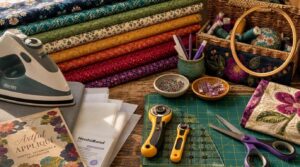
Before you cut a single piece of fabric, you need the right tools in your corner. Having the correct materials from the start saves you time and frustration down the road.
Here’s what you’ll want to gather before your first project.
Fusible Web Types
Not all fusible webbing is the same — and picking the right one makes a real difference.
Paper-backed sheets like HeatnBond and Wonder Under are the most common. Web Weight Options range from featherlite to heavy-duty, so match them to your fabric.
Double-sided Webs work great for layered pieces.
Adhesive Formulation affects flexibility and fabric compatibility, so always check the label before you iron.
Sharp Appliqué Scissors
The right scissors change everything. Fiskars 5″ Micro Tip Easy Action Scissors are a go-to for fusible appliqué — their curved blade design hugs fabric contours, making cutting feel quick and efficient.
Look for:
- A serrated edge to grip fine fibers without slipping
- Nonstick coating to repel adhesive buildup
- Ergonomic grips that reduce hand fatigue
- Sharp, pointed tips for tight corners
Keep up with blade sharpening, and your cuts will stay clean.
Ironing Surface Essentials
Your ironing surface can make or break a fuse. A heat-reflective cover bounces warmth back through fabric, ensuring fusible appliqué bonds set faster and cleaner. Pair this with a steam-perforated surface to allow moisture to move evenly, enhancing adhesion.
For delicate pieces, add a protective pressing pad to shield fabrics from direct heat. Maintain temperature stability—cotton settings typically work best—to prevent scorching or uneven bonding.
A simple board maintenance routine ensures consistent results over time. Regularly inspect and clean your surface to avoid residue buildup, preserving both your tools and fabric quality.
Thread and Stabilizer Options
Your thread choice sets the tone for the whole project. Open Toe Cotton glides cleanly and leaves almost no lint behind. For sparkle, Metallic Thread Stabilizers keep dense stitching from fraying at the edges.
- Use a Cut-Away Stabilizer for stretchy fabrics
- Try Water-Soluble Backings on delicate pieces
- Match Needle-Thread Compatibility to your stabilizer weight
Simple choices. Big difference.
Preparing Appliqué Pieces
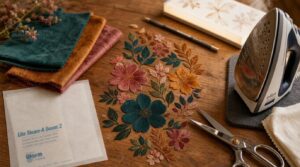
Getting your pieces ready is where the real work begins. There are a few simple steps that take you from a flat sheet of fusible web to a finished shape that’s ready to iron down.
Here’s what that process looks like.
Reverse-tracing The Pattern
Think of reverse-tracing as your pattern’s mirror image — and it’s what keeps everything symmetrical.
To execute this technique, place your pattern under a light box, flip it, and trace the design onto the paper side of your fusible web. This ensures symmetry in your work.
For organized workflow, use the following quick reference:
| Step | What to Do |
|---|---|
| Light Box Setup | Trace reversed design onto fusible web paper side |
| Documentation Techniques | Label each piece with number and grain alignment |
Adjust scale as needed before cutting to ensure precision.
Rough-cutting Fabric Shapes
Once your reverse-traced pieces are ready, grab your scissors and a cutting mat—it’s time to rough-cut. Stay about 1/4 inch outside each drawn line. This gives you room to work without wasting fabric—Waste Reduction starts here.
Keep these tips in mind:
- Use Fabric Grain Alignment to avoid distortion later
- Practice Edge Notching at tight inner corners
- Follow Safety Precautions — keep fingers clear of blades
- Cutting Mat Care extends blade life greatly
- Pre-cut fabric shapes and laser-cut fusible appliqués skip this step entirely
Fusing Web to Fabric
Now that your shapes are rough-cut, it’s time to bond them. Place each piece fusible-side down on your fabric, then press firmly with a dry iron.
Match your Heat Settings to your fabric — cotton tolerates medium-high well, but synthetics need less.
Always use a Pressing Cloth to protect delicate surfaces.
Do a quick Bond Testing check: a cooled edge shouldn’t lift.
Using Precut Appliqué Kits
Skip the tracing and cutting altogether — pre-cut appliqué kits are a revolution for DIY quilting projects. Laser-cut appliqué kits offer cleaner edges and better color coordination right out of the box. Here’s what makes them worth it:
- Fusible web is already applied — no extra prep
- Batch fusion greatly speeds up your workflow
- Budget efficiency improves since waste is minimal
- Heat press options work perfectly for even bonding
- Shipping storage is simple — pieces arrive flat and ready
Arranging The Design Layout
Once your precut pieces are ready, lay them out before you iron anything down. Start with your largest motif near the center — that’s your anchor. Then build outward, using negative space to let each shape breathe.
Think about visual rhythm and color grouping as you go. Scale balance matters too: pair bold pieces with smaller accents so nothing fights for attention.
Stitching Fusible Appliqué Edges
Once your appliqué pieces are fused down, stitching the edges is what really locks everything in place. The stitch you choose shapes the whole look of your finished piece, so it’s worth knowing your options.
Here are five edge-finishing techniques to try.
Blanket Stitch Finish
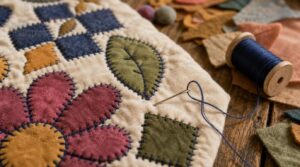
The blanket stitch is your best friend for securing fusible appliqué edges. Place stitches about 2–4 mm apart, keeping loop height consistent—roughly 2 to 3 times your thread thickness. Thread contrast adds a handcrafted, decorative touch.
On your machine, adjust stitch width and length carefully for clean results. It works beautifully on felt, wool, and heavy cotton.
Satin Stitch Technique
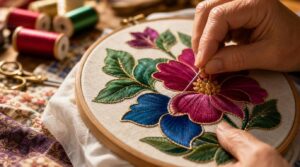
Satin stitch gives your fusible appliqué edges a polished, painted look. Get it right by focusing on three things:
- Thread Selection — use quality embroidery floss or machine thread matched to your quilt design
- Stabilizer Placement — always back your fabric to prevent puckering
- Tension Control — even pressure keeps stitches flat and glossy
Vary stitch direction for shading variations across petals or leaves. Beautiful appliqué stitching awaits.
Narrow Zig-zag Stitching
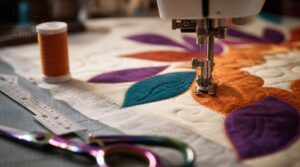
The narrow zig zag stitch excels in fusible appliqué quilt patterns when kept subtle. Set your width calibration between 1 and 2 mm, then adjust stitch length to match your fabric weight.
Thread selection matters—polyester works well on most quilting stitches.
For a sheer edge, lower the width further and consider stabilizer use underneath to prevent puckering.
Invisible Thread Appliqué
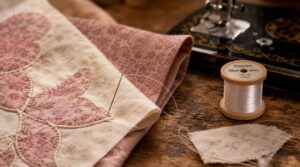
Invisible thread is your secret weapon for a flawless, professional look in appliqué quilting. Nobody sees the stitch — just the design.
To achieve this, follow these essential steps:
- Use a size 60–70 needle for needle selection on delicate layers
- Lower tension slightly for tension calibration without puckering
- Color matching matters: test on scrap testing fabric first
- Store thread away from heat for proper thread storage
Preventing Puckering
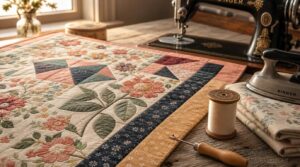
Puckering is almost always a tension problem. Check your thread tension first — balanced tension keeps stitches flat against the fabric without pulling.
Match your stitch length to your fabric weight; heavier layers need longer stitches.
Pre-washing fabrics before the fusing process prevents shrinkage surprises later.
Use a pressing cloth technique when ironing, and always apply stabilizer under delicate pieces before stitching your fusible appliqué edges.
Finishing Your Appliqué Quilt
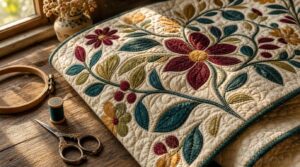
You’ve done the hard work — now it’s time to bring it all together. How you finish your quilt affects everything from how it looks on the wall to how long it holds up over time.
Here are the key steps to get your appliqué quilt across the finish line.
Quilt-before-appliqué Method
This method prioritizes stability by quilting the background first, then fusing heat-activated appliqués on top. This background quilting strategy maintains even tension and prevents shape distortion when handling large layers.
Layer alignment tips, such as basting thoroughly before quilting, ensure smoother placement. It’s ideal for pre-cut appliqué quilt kits placed on a clean, finished surface.
Appliqué-before-quilting Method
Some quilters prefer to fuse first and quilt second. With this approach, you apply pre-cut fused appliqué pieces directly onto the unquilted top, using a heat press technique and careful heat-pressure profiling to lock each shape down. Bond integrity testing—gently tugging each edge—catches any weak spots early.
Pre-quilt tension management keeps your layers from shifting during appliqué stitching and quilt-block sequencing. This step ensures stability before final quilting, maintaining alignment throughout the process.
Quilt-as-you-go Projects
Quilt-as-you-go changes everything for big projects. Instead of wrestling a full quilt under your machine, you build one block at a time. Each block receives its own backing, varied batting, and quilting before assembly.
Quilt-as-you-go lets you conquer big projects one block at a time, no wrestling required
Joining these blocks relies on sashing integration, which maintains a tight grid structure. Front-side stitching ensures seams appear clean and polished.
Pre-cut appliqué quilt kits further streamline the process, accelerating block assembly for even greater efficiency.
Pressing The Finished Block
Once your block is assembled, pressing locks everything in place. Use short steam bursts rather than continuous heat — hold for 8 to 12 seconds per area for consistent pressure consistency. Let each section cool fully before moving on. That cooling period keeps your heat-activated appliqués from shifting.
Check block alignment with a square ruler, and always keep a press cloth handy.
Display and Care Tips
Your finished quilt deserves the same care you put into every iron-on appliqué. Keep it away from direct sunlight and rotate it every two to three months.
- Use UV-protected glass when framing
- Follow a monthly cleaning routine with a lint-free cloth
- Apply smart mounting techniques with acid-free backing
- Maintain environmental controls at 65–75°F and 40–60% humidity
Frequently Asked Questions (FAQs)
Can fusible appliqué be done by hand without a machine?
Yes, you can do fusible appliqué entirely by hand. Use heat-activated fusible web to bond shapes, then finish edges with a hand blanket stitch. No sewing machine needed.
How do you fix a poorly bonded appliqué shape?
Reapply heat with a pressing cloth to reactivate the heat-activated adhesive. Run an adhesion test by gently tugging the edge. Add a supplemental web patch and trim frayed edges before stitching.
What fabrics work best for fusible appliqué projects?
Not every fabric plays nice with iron-on adhesive. Cotton sateen, batik fabric, and linen blends bond cleanly and hold edges well.
Muslin stabilizer and lightweight knit round out your fabric selection beautifully.
Can fusible appliqué pieces be repositioned before stitching?
Yes, you can reposition fusible appliqué pieces before final stitching. You have a brief heat window after fusing to nudge pieces into place.
Work quickly, be gentle, and stitch once you’re satisfied.
How do you transfer appliqué designs onto dark fabric?
Dark fabric is like a night sky — it hides everything. Use chalk markers, iron-on transfers, carbon transfer sheets, or a water-soluble stabilizer to keep your design lines clear and visible.
Conclusion
What once felt impossible now sits finished in your hands. Fusible appliqué quilting designs have a way of doing that—turning hesitation into habit, one pressed shape at a time. You’ve learned the tools, the prep, the stitching, and the finishing.
Now the only thing left is to pick your next pattern and start cutting. Trust the process you’ve built. Every quilt you make from here gets a little easier and a lot more yours.
- https://quiltsocial.com/mastering-fusible-web-types-uses-and-essential-tips/
- https://www.patternsontheprairie.com/post/comparing-fusible-web-brands?srsltid=AfmBOoqNPd3yXfdBs6s2aMzq_JmMGF0Xr4f_7nNhQPCU3OB-dFHEApLg
- https://suepellanddesigns.com/a-practical-guide-to-fusibles-interfacings-and-stabilizers-for-quilters/
- https://thequiltshow.com/quiltipedia/what-is-fusible-applique
- https://katecollerandesigns.com/how-to-do-fusible-applique/