This site is supported by our readers. We may earn a commission, at no cost to you, if you purchase through links.
A sewing machine sitting on a closet shelf for six months collects more dust than you’d think—and that dust works its way into tension discs, feed dogs, and bobbin cases. For sewists working in apartments, craft corners, or shared rooms, storage isn’t an afterthought. It’s half the problem.
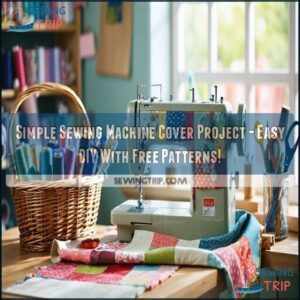
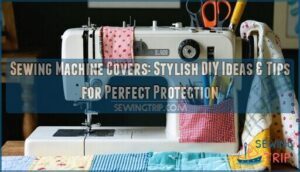
The right sewing machine covers for small spaces do more than keep lint off the needle plate—they fold flat, hold your scissors, and squeeze onto a 2-inch ledge without crowding everything else.
Nine covers worth your attention are lined up ahead, sorted by the storage problems they actually solve.
Table Of Contents
- Key Takeaways
- Best Covers for Compact Sewing Spaces
- Dust Covers That Fit Narrow Shelves and Small Sewing Tables
- Soft Fabric Covers for Machines Stored in Closets
- Foldable Covers for Apartments and Craft Corners
- Covers With Front Pockets for Reducing Accessory Clutter
- Reversible Covers for Extra Storage Without Extra Footprint
- Space-saving Features to Compare Before Buying
- Top 9 Small-Space Sewing Picks
- 1. Brother XR3774 Sewing and Quilting Machine
- 2. Brother XM2701 Lightweight Sewing Machine
- 3. Janome 2222 Mechanical Sewing Machine
- 4. Brother CS7000i Sewing and Quilting Machine
- 5. Janome HD9 Heavy Duty Sewing Machine
- 6. Juki TL2010Q High Speed Sewing Quilting Machine
- 7. Juki TL2000Qi Sewing Quilting Machine
- 8. Juki HZL-F300 Sewing and Quilting Machine
- 9. Odif 505 Temporary Fabric Spray
- Measure Before Choosing a Cover
- Storage Features That Save Space
- Make a Soft Machine Cover
- Protect Machines in Small Areas
- Frequently Asked Questions (FAQs)
- Conclusion
Key Takeaways
- Dust, humidity, and clutter are the real enemies—a well-fitted cover with breathable fabric and sealed edges stops all three before they shorten your machine’s life.
- Measure your machine with a steel tape before buying anything, then add 2–4 mm of clearance on all sides so the cover fits snugly without scratching or wrestling.
- The best small-space covers pull double duty: flat-fold designs slide into a drawer, front zipper pockets swallow cords, and mesh side pockets keep bobbins visible without adding bulk.
- If you move your machine monthly or store it in a shared space, a hard case beats any fabric cover—it cuts setup time by roughly 40% and adds real drop protection.
Best Covers for Compact Sewing Spaces
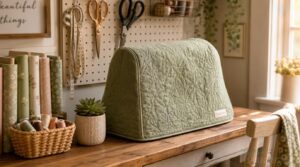
Small spaces don’t leave much room for error — or bulk. The right cover keeps your machine protected without eating up every inch of shelf or table space you’ve got.
A slim, well-fitted cover pairs especially nicely with a compact machine — check out tips on choosing the right sewing machine for small projects like scout patches to make sure your setup stays both tidy and practical.
Here’s what to look for, starting with the fits that work best in tight spots.
Dust Covers That Fit Narrow Shelves and Small Sewing Tables
A narrow shelf doesn’t have to mean a compromised setup. Dust covers built for tight spaces use a slim silhouette with adjustable depth—usually 1.5 to 2.5 inches—so they sit flush without crowding your table.
Three features that actually matter:
- Elastic hem for a no-slide fit
- Corner reinforcement to hold shape on narrow ledges
- Snap closures for quick removal
Soft Fabric Covers for Machines Stored in Closets
Closets trap heat and humidity — not great news for a stored machine. That’s where breathable fabrics earn their keep. Cotton percale and lightly woven polyester blends let air move while blocking dust.
Look for seam reinforcement at stress points and UV protection if your closet gets daylight. A well-made dust cover for sewing machine storage doubles as quiet noise dampening.
Foldable Covers for Apartments and Craft Corners
Apartments don’t give you much room to waste. A foldable cover collapses flat — under 1 inch thick — so it slides into a drawer when you’re done.
Ultra-thin profiles and ventilation channels keep things breathable. Grommet quick-release corners mean no fumbling to uncover your machine.
5 foldable cover features worth checking:
- Magnetic closures that snap shut without snagging thread
- Eco-friendly fabrics that wash at 40°C
- Ultra-thin profiles fitting machines up to 17 inches wide
- Ventilation channels preventing heat buildup in tight corners
- Compact folded size storing flat inside standard drawers
Covers With Front Pockets for Reducing Accessory Clutter
Foldable covers handle the bulk problem, but accessory chaos—scissors on the counter, bobbins rolling away—persists. To tame work surface disorder, consider use visual anchors. A sewing machine cover with a large front pocket consolidates essentials, while Rapid Access Design ensures tools like seam rippers stay within immediate reach, not buried in drawers.
| Feature | Why It Matters |
|---|---|
| Quick-access pockets | Tool retrieval speed during projects |
| Pocket material durability | Resists fraying from daily use |
Customizable Pocket Layout and smart Pocket Placement Strategy transform a single cover into a full organizing solution for sewing accessories, ideal for travel.
Reversible Covers for Extra Storage Without Extra Footprint
A reversible sewing machine cover doubles your storage without claiming extra shelf space. One side uses a heat‑reflective layer to keep your machine cool under bright lights; flip it, and the darker weave hides dust during long breaks.
Color‑coded sides enable flip‑ready organization, while dual‑side pockets with quick‑access pockets hold bobbins and cords on both faces.
Draft‑shield capability is included for added protection.
Space-saving Features to Compare Before Buying
Before you buy, line up these features side by side — they make a real difference in tight spaces:
- Snap-Fold Mechanism and low-profile design collapse the cover flat for drawer storage
- Adjustable Height Fit with a magnetic closure system accommodates slight size differences
- Integrated storage sleeves and quick-access pockets keep cords and feet within reach
Lightweight, soft-sided fabric cases with travel-friendly design beat bulky options every time.
Top 9 Small-Space Sewing Picks
Finding the right machine for a small space means balancing size, weight, and what the cover needs to protect. Each pick below fits common compact cover sizes—so you’re not hunting for something custom.
Here are nine options worth a close look.
1. Brother XR3774 Sewing and Quilting Machine
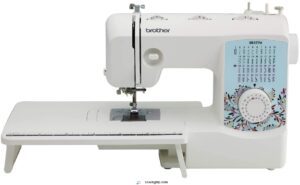
The Brother XR3774 punches above its weight for a small-space machine. At roughly 12–13 pounds, it’s easy to move between a craft corner and the kitchen table.
You get 37 built-in stitches, eight presser feet, and a wide quilting table — real versatility without a bulky footprint.
The drop-in bobbin resists jams, and LED lighting keeps detailed work visible.
One practical note: pair it with a snug medium cover, since its 15.3 × 5.8 × 12-inch frame fits most standard sizes.
| Best For | Beginners and intermediate sewists who want a capable, easy-to-use machine for quilting, everyday sewing, and small repairs without spending a lot. |
|---|---|
| Price | $164.99 |
| Weight | 15 lb |
| Construction | Metal-plastic |
| Color | White |
| Primary Use | General sewing |
| Skill Level | Beginner-Intermediate |
| Additional Features |
|
- 37 built-in stitches and 8 presser feet give you real variety right out of the box — no extra purchases needed.
- The automatic needle threader and drop-in bobbin make setup quick and frustration-free, especially if you’re still learning.
- Lightweight and compact enough to move around easily, so it works whether you have a dedicated craft room or just a corner of the kitchen table.
- Gets noticeably loud and vibrates at higher speeds, which can make it tricky to keep steady on bigger projects.
- The extension table can shift under load, and the machine slides around without a mat underneath — worth knowing before you tackle something large.
- Struggles with thick layers of fleece or minky, and the needle threader gets finicky if you don’t hit it just right.
2. Brother XM2701 Lightweight Sewing Machine
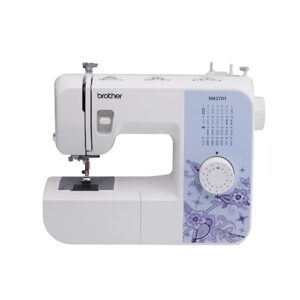
At just 12.6 pounds, the XM2701 is one of the lightest metal-chassis machines you’ll find. Its compact frame—15.3 × 5.86 × 12.01 inches—slides into tight closet shelves without a fight.
You get 27 built-in stitches, an automatic needle threader, and a jam-resistant drop-in bobbin. The free arm accommodates cuffs and sleeves easily.
At $149, it’s a solid beginner pick. Pair it with a small compact cover—fits machines up to 16 inches wide.
| Best For | Beginners and hobbyists who want a reliable, easy-to-use machine for everyday sewing projects like garments, quilts, and simple repairs. |
|---|---|
| Price | $149.00 |
| Weight | 12.6 lb |
| Construction | Metal chassis |
| Color | White |
| Primary Use | General sewing |
| Skill Level | Beginner-Hobbyist |
| Additional Features |
|
- Lightweight and compact — easy to store and move around without much hassle
- Automatic needle threader and jam-resistant bobbin make setup quick and frustration-free
- 27 built-in stitches plus a one-step buttonhole give you plenty of options for a $149 machine
- Struggles with heavy fabrics like thick denim, leather, or anything requiring multiple layers
- The plastic spool pin feels a bit flimsy and could wear down with regular use
- No LCD screen and limited stitch variety compared to higher-end computerized machines
3. Janome 2222 Mechanical Sewing Machine
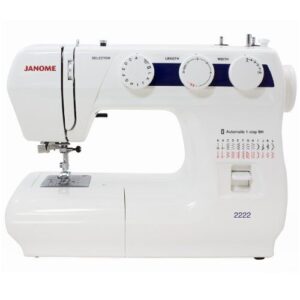
The Janome 2222 is refreshingly no-nonsense. At 13.2 pounds and 15.2 × 6 × 11.6 inches, it fits comfortably on a small sewing table without hogging space.
You get 22 built-in stitches, a four-step buttonhole function, and a convertible free arm — enough for everyday repairs, hemming, and basic quilting.
The manual tension dial puts you in control. No touchscreens, no fuss. Pair it with a small compact cover sized for machines up to 16 inches wide and you’re set.
| Best For | Beginners, hobbyists, and anyone who wants a simple, reliable machine for everyday sewing without a steep learning curve. |
|---|---|
| Price | N/A |
| Weight | 13.2 lb |
| Construction | Plastic housing |
| Color | White and Blue |
| Primary Use | General sewing |
| Skill Level | Beginner |
| Additional Features |
|
- Easy mechanical controls make it approachable if you’re just starting out or prefer keeping things simple.
- Lightweight and portable — the retractable handle makes it easy to take to a class or a friend’s place.
- Quiet and steady even at higher speeds, which makes longer sewing sessions a lot more pleasant.
- The bobbin setup is a bit fiddly — checking the thread and re-threading takes more effort than it should.
- Mostly plastic construction, so it might not hold up well under heavy, regular use.
- No electronic extras like a needle threader or LCD screen, and only 22 stitches — it’ll feel limiting if your projects start getting more complex.
4. Brother CS7000i Sewing and Quilting Machine
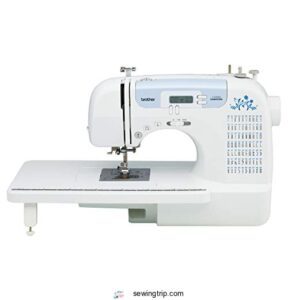
At 16.02 × 6.69 × 12.09 inches, the CS7000i sits right at the upper edge of medium cover territory — so measure twice before you buy. It weighs 17.9 pounds, which is manageable but not featherweight.
You get 70 built-in stitches, an automatic needle threader, and a jam-resistant drop-in bobbin — solid for quilting and garment work.
The included hard case manages transport, but for shelf storage, a medium fabric cover keeps dust off without adding bulk.
| Best For | Beginners and hobbyists who want a versatile, portable machine for quilting, garment sewing, and everyday projects without a steep learning curve. |
|---|---|
| Price | $349.99 |
| Weight | N/A |
| Construction | Metal housing |
| Color | N/A |
| Primary Use | Quilting/sewing |
| Skill Level | Beginner-Hobbyist |
| Additional Features |
|
- 70 built-in stitches plus an automatic needle threader and jam-resistant bobbin make setup quick and frustration-free
- Comes with 10 presser feet and a wide quilting table, so you’re ready for a real range of projects right out of the box
- The hard case and compact size make it easy to pack up and take to a class or a friend’s place
- Struggles with heavy fabrics like denim or leather — not the right pick if that’s your main use
- No presser-foot pressure adjustment, which limits how much you can fine-tune for different materials
- The plastic chassis can feel a little cheap, and the built-in light doesn’t cover much ground on bigger projects
5. Janome HD9 Heavy Duty Sewing Machine
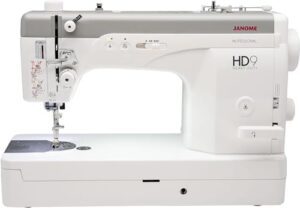
Step up in weight, and the Janome HD9 transforms the conversation entirely. At 21 pounds and 18.5 × 8.5 × 13.47 inches, this isn’t a casual shelf machine—it’s a workhorse. Its cast aluminum body, eight ball bearings, and 1,600 stitches per minute enable it to sew through denim and leather without hesitation.
That heft demands a reinforced cover with padded sides and a snug fit. Add 0.25–0.5 inches of clearance on each dimension, and you’re set.
| Best For | Small-business sewists and serious hobbyists who regularly work with heavy fabrics like denim, canvas, or leather and need a machine that can keep up. |
|---|---|
| Price | $2,099.00 |
| Weight | 21 lb |
| Construction | Metal |
| Color | White |
| Primary Use | Heavy-duty sewing |
| Skill Level | Hobbyist-Pro |
| Additional Features |
|
- Powers through thick, tough fabrics without stalling—denim and leather are no problem
- Metal construction keeps it rock-solid and built to last through heavy use
- Ready to sew within minutes of unpacking, so you’re not wasting time on setup
- At 21 lb, "portable" is a stretch—moving it around often gets old fast
- The $2,099 price tag is hard to justify if you’re only sewing occasionally
- Not much info on stitch variety or advanced features, which could be a dealbreaker for specialized work
6. Juki TL2010Q High Speed Sewing Quilting Machine
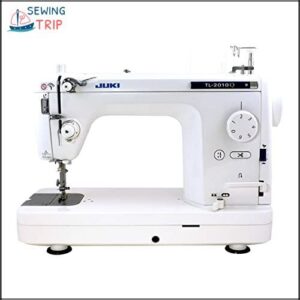
The Juki TL2010Q takes things even further. At 39 pounds and 25 × 14 × 18 inches, it’s built for serious quilting—1,500 stitches per minute, an all-metal frame, and an extended throat for bulky layers.
It won’t tuck into a closet corner easily. You’ll want a heavy-duty cover with reinforced grips and thick padding on all sides.
Add the standard 0.25–0.5 inches of clearance, and ensure your choice can handle the weight without sagging.
| Best For | Serious quilters and sewists who regularly tackle large, heavy projects like multi-layer quilts, denim, or thick bag construction and need a fast, reliable straight-stitch workhorse. |
|---|---|
| Price | $1,301.46 |
| Weight | 39 lb |
| Construction | All-metal |
| Color | White |
| Primary Use | Quilting |
| Skill Level | Intermediate-Pro |
| Additional Features |
|
- Blazing fast at 1,500 stitches per minute—gets big projects done in a fraction of the time
- All-metal frame keeps things rock-steady, even at full speed with bulky fabrics
- Extended throat gives you real room to maneuver large quilts without the usual wrestling match
- Straight stitch only—no decorative stitches, so it’s a one-trick pony (a very good one, but still)
- Bobbin needs daily oiling and isn’t visible during use, which adds a little hassle to your routine
- Presser feet require unscrewing to swap out and won’t work with standard universal feet
7. Juki TL2000Qi Sewing Quilting Machine
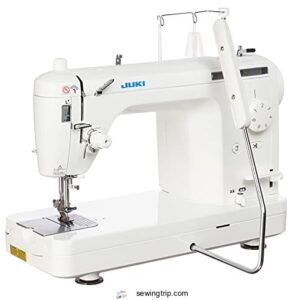
A step down in size from the TL2010Q, the Juki TL2000Qi still means business. It measures 17.8 × 8.6 × 13.8 inches and weighs 25.4 pounds—heavy for its footprint, but manageable on a sturdy table.
This machine maxes out at 1,500 stitches per minute, featuring a straight-stitch-only aluminum frame that ensures minimal wobble during operation.
For cover sizing, add a 0.25–0.5 inches of clearance all around to accommodate the machine’s dimensions.
You’ll want padded sides and a reinforced handle—this machine earns its keep but requires assistance for movement.
| Best For | Quilters and sewists who work with large, heavy projects and need a fast, reliable straight-stitch machine that can keep up with serious production. |
|---|---|
| Price | $899.00 |
| Weight | 25.4 lb |
| Construction | Aluminum die-cast |
| Color | White |
| Primary Use | Quilting |
| Skill Level | Intermediate-Pro |
| Additional Features |
|
- Blazing fast at 1,500 SPM with a rock-solid aluminum frame that barely vibrates, even at full speed
- The extension table and walking foot make tackling king-size quilts or thick, layered fabrics a lot more manageable
- Built-in LED lights and a foot-pedal thread cutter keep your hands free and your workflow moving
- Straight stitch only — if you need decorative or utility stitches, you’ll need a second machine
- No speed control dial means you’re managing 1,500 SPM purely by foot pressure, which takes some getting used to
- The automatic needle threader is hit or miss, and some accessories (like a free-motion foot) cost extra on top of the $899 price tag
8. Juki HZL-F300 Sewing and Quilting Machine
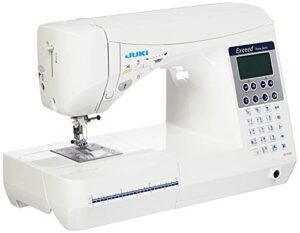
Where the TL2000Qi is built for speed, the HZL-F300 trades raw pace for versatility. It measures 17.5 × 8.3 × 11.4 inches and weighs 25 pounds—nearly the same footprint, but noticeably shorter. That lower profile fits tighter shelves.
Inside, you get 106 stitch patterns, 16 buttonhole styles, and an LCD screen that shows your settings at a glance.
A medium cover—17.5 inches wide minimum—works here. Look for padded sides and a sturdy top handle.
| Best For | Sewers who want one machine that handles everything from denim to delicate decorative stitching, without sacrificing ease of use. |
|---|---|
| Price | N/A |
| Weight | 25 lb |
| Construction | Metal housing |
| Color | White |
| Primary Use | Garment/quilting |
| Skill Level | Intermediate-Pro |
| Additional Features |
|
- 106 built-in stitches plus 16 buttonhole styles give you a lot of creative range in one machine
- The automatic needle threader and thread cutter save real time when you’re switching threads mid-project
- Box feed system handles thick, layered fabrics like quilts and denim without a fight
- No knee lever included, and the presser-foot set is pretty bare — walking and free-motion feet cost extra
- Only one LED light over the stitch area, so detailed throat work can feel dim
- Runs on 120V only, so international use means buying a transformer
9. Odif 505 Temporary Fabric Spray
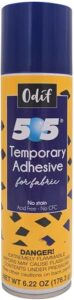
The Odif 505 isn’t a machine cover — but it earns a spot here. When you’re sewing in a small space, pins scatter fast. This temporary fabric spray holds quilt pieces, appliqué, and hems in place without a single pin.
It dries clear, won’t gum your needle, and washes out cleanly. One 7.2 oz can costs $19.99. Use it inside a cardboard box to control overspray.
For tight workspaces, less clutter means more control.
| Best For | Quilters, embroiderers, and sewists working in small spaces who want to ditch pins and keep their workspace tidy. |
|---|---|
| Price | $19.99 |
| Weight | 7.2 oz |
| Construction | Aerosol can |
| Color | N/A |
| Primary Use | Fabric adhesion |
| Skill Level | All levels |
| Additional Features |
|
- Holds fabric, appliqué, and quilt pieces securely without pins or clutter
- Dries clear, won’t gum your needle, and washes out easily after laundering
- Acid-free and odorless — safe to use without worrying about fumes or fabric damage
- Adhesion fades quickly if you don’t sew soon after spraying
- Overspray can be messy — you’ll want to use it inside a box or with a shield
- Pricier than similar sprays and burns through fast on bigger projects
Measure Before Choosing a Cover
Getting the right cover starts with one simple step: measuring your machine.
A cover that’s even half an inch too tight can scratch the casing or leave you wrestling it on every time. Here’s what to check before you buy.
How to Measure Machine Width, Height, and Depth
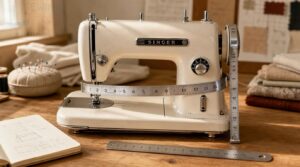
Before you buy anything, grab a steel tape measure—fabric tapes stretch and lie.
Set your machine on a flat, level surface, unplugged. Measure width front-edge to front-edge, depth including any foot pedal overhang, and height to the tallest point.
Record in both metric and imperial. Understanding sewing machine dimensions accurately prevents a too-tight fit every time.
Ideal Clearance for a Snug but Usable Fit
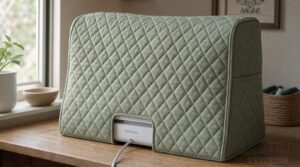
Once you have your measurements, add clearance—not guesswork.
- Clearance Tolerance: 2–4 mm around all sides for a snug, gap-free fit
- Front Access Gap: 10–12 mm so cords and pedals can slide out easily
- Top Vent Width: 5–8 mm to keep heat from building up inside any soft-sided fabric case or lightweight tote
- Edge Seam Allowance: 1–2 mm for a clean finish without bulk
Pocket alignment matters too—position front pockets within 6–8 mm of the edge so nothing gets caught when lifting your portable sewing machine bag.
Compact Cover Sizes for Small Sewing Machines
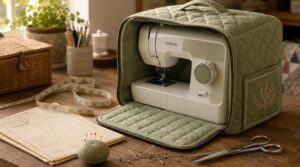
Small machines have a clear size ceiling — 16 inches wide, 12 inches tall, 6 inches deep. That’s your envelope dimensions standard. A dust cover or soft‑sided fabric case built to those numbers fit the Brother XM2701 and Janome 2222 without bunching.
Use size benchmarking and fit verification to confirm profile thickness before ordering any sewing machine cover pattern or lightweight tote.
Medium Cover Sizes for Standard Domestic Machines
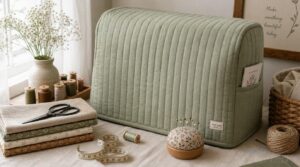
Standard domestic machines need a bit more breathing room. Most medium covers run 15–18 inches wide, 12–14 inches tall, and 8–12 inches deep — your core dimensions guidelines for mid-range models.
Keep these size benchmarks in mind:
- Fit buffer — add 0.5 inches on each side
- Depth envelope — confirm the manufacturer dimensions include the handwheel
- Soft-sided fabric case — lighter than hard shells, easier to store
- Sewing machine cover pattern — check pattern size selection matches your model exactly
When to Choose a Custom Cover Instead
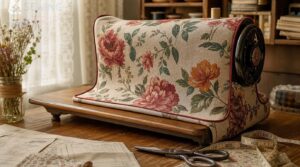
Sometimes a ready-made cover just won’t cut it. If your machine has irregular shapes—an oversized handwheel, a wide extension table, or a rare foot pedal configuration—an exact fit matters.
A DIY custom sewing machine dust cover solves that. You control fabric selection and cutting, design aesthetics, humidity resistance, and quick assembly. For unique models, a custom sewing cover is simply the smarter call.
Common Fitting Mistakes in Tight Storage Areas
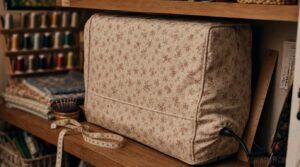
Even a custom cover can backfire if your numbers are off. These mistakes catch small-space sewers most often:
- Incorrect Measurements — measuring with the presser foot raised adds hidden inches
- Lid Clearance — oversized lids hit walls or shelves when opened
- Cord Interference — ignoring cord exits leaves bulges that prevent flush storage
- Shelf Gap Errors — too-tight vertical clearance turns removal into a wrestling match
- Oversized Carry Straps — whether on a soft-sided fabric case or hard dust cover, thick carry straps eat shelf depth fast
Storage Features That Save Space
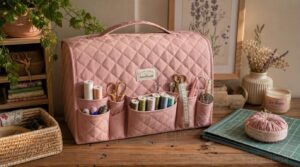
A good cover does more than protect your machine — it pulls double duty as storage.
In a small sewing space, every pocket and handle counts.
Here’s what to look for before you buy.
Front Zipper Pockets for Cords and Foot Pedals
A front zipper pocket sounds simple — until you’re untangling a cord from a foot pedal at 10 p.m.
Look for accessory pockets with dual-side zippers, elastic keepers, and water-resistant fabrics. Most quality quick-access pockets run 6–9 inches wide.
| Feature | What It Does | Why It Matters |
|---|---|---|
| Dual-Side Zippers | Open from either end | Faster cord retrieval |
| Elastic Keepers | Separate cords from pedals | Prevents tangling |
| Water-Resistant Fabrics | Repels moisture and dust | Protects accessories |
Mesh Side Pockets for Needles, Bobbins, and Scissors
Side pockets do what zipper pockets can’t — keep small items visible at a glance. Mesh Visibility means no digging. The stretch net fabric lets you spot bobbins, needles, or scissors without opening anything.
Airflow Benefits are real too: open mesh prevents moisture buildup around stored items.
Reinforced Seams where mesh meets cover edge hold up long-term.
Scissor Compatibility tops out around 6 inches — standard snips fit fine.
Flat-fold Designs for Drawer Storage
Mesh pockets handle the small stuff — but what about the cover itself? If drawer space is your limit, flat-fold designs solve that.
- Hidden hinges keep the front flush — under 2 cm thick when folded
- A quick-snap spine deploys in under 60 seconds
- Corner gussets and elastic retainers hold accessories without bulk
Fold it flat. Slide it in. Done.
Lightweight Covers for Frequent Setup and Takedown
Daily sewers know the drill—cover on, cover off, repeat. That’s why ultra-light materials matter. At under 0.9 pounds, a travel-ready pouch folds your simplified single-layer machine dust cover into an 11×8-inch bundle. Elastic hem grips hold it snug during quick transitions, while snap-lock closures and one-hand access make setup easy.
A lightweight DIY fabric cover or reversible sewing machine cover works just as well.
Handles for Moving Machines Between Rooms
Lugging your machine from room to room wears on your back quickly. A soft-sided fabric case or lightweight travel case with adjustable height grips—or ergonomic V-grips—positions your hands in a neutral grip and reduces strain.
Steel tube grips provide firm support under heavier machines, ensuring stability during transport.
Anti-slip grips and quick-release mounting enhance security, keeping your equipment firmly in place.
For extended journeys, rolling cases streamline the process, making longer hauls smooth and effortless.
Accessory Organization for Small Sewing Stations
When your sewing station is the size of a closet shelf, every inch counts. Front pockets — 6 by 8 inches — hold cords and foot pedals in quick-access pockets. Mesh compartments keep bobbins visible and ventilated. Add labeled zip pouches, adjustable hanging loops, or wall-mounted racks nearby.
Rolling accessory carts and magnetic tool trays handle overflow without stealing surface space.
Make a Soft Machine Cover
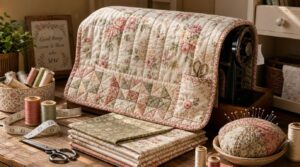
Making your own sewing machine cover is easier than it sounds — and you get a perfect fit every time. The right fabric, a few basic supplies, and a simple pattern are all you need to get started.
Here’s what to pull together before you cut a single piece.
Best Fabrics for Compact DIY Sewing Covers
The fabric you pick decides how well your cover actually works.
For compact spaces, weight and washability matter just as much as looks.
- Cotton Twill — tight weave, hides dust, machine washable
- Polyester Canvas — lightweight, water-resistant, holds its shape
- Heavy Linen Blend — breathable and stiff enough to stand on its own
- Quilted Lining — adds scratch protection without bulk
Basic Supplies for a Small-space Cover Project
Grab ½ yard of your chosen fabric, then check your sewing supplies list:
Matching thread (thread selection matters for durability), fabric cutting tools like shears or a rotary cutter, measuring tape, and tailor’s chalk for clean measuring techniques. Add fusible interfacing for structure, seam finishing tape, and pins.
That’s your full kit.
Creating a Simple Quilted Dust Cover
Think of it as a quilt sandwich — exterior fabric, batting, lining — stacked and stitched together. Pre-wash your fabric first to prevent shrinkage later.
For Batting Selection Tips, an 80/20 cotton blend works best.
Use the Layer Sandwich Method, then follow a Stitch Spacing Guide of ½-inch intervals for even coverage.
Finish raw edges with Edge Binding Techniques using bias tape for a clean, professional result.
Adding Side Pockets Without Adding Bulk
Pockets are optional — but once you add them, you won’t go back. Adding optional features like side pockets and grips keeps your accessories within arm’s reach without turning your soft-sided fabric case into a lumpy mess.
The secret lies in hidden pocket placement along the side seam. Maintain a depth of 4–5 inches, and prioritize slim interfacing choices and low-profile stitching for seamless integration. For closures, zero-bulk solutions like narrow Velcro strips outperform bulky zippers every time.
Using Bias Tape for Clean Finished Edges
Raw edges unravel quickly — bias tape fixes that cleanly. For soft-sided fabric cases, double-fold bias tape is the go-to, as it wraps both faces of the edge without adding extra bulk.
To ensure success:
- Match bias tape type to fabric weight — polyester for denser materials, cotton for lighter ones
- Miter corners at 45 degrees for sharp, flat turns
- Lengthen the stitch slightly on stretchy fabric to prevent puckering
- Sew along the inner fold line so stitches disappear
- Press between every step to set clean edges
Seam placement matters too — keep binding joins at inconspicuous side seams on your sewing machine cover pattern.
Printable Pattern Sizing for Compact Machines
Once your edges are clean, a printable pattern makes the next build faster. Print at 100 percent scale — no "fit to page" — then check the control square against a ruler. Nested templates let you pick the right size without buying separate patterns.
For larger machines, use the tiling method, and label every page clearly before cutting.
Protect Machines in Small Areas
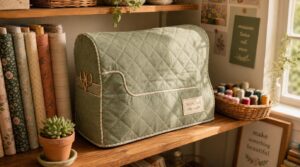
A cover does more than keep dust off — it’s your machine’s first line of defense in tight, shared, or unpredictable spaces. The right one depends on where you store it, how often you move it, and what kind of trouble you’re trying to avoid.
Here’s what to know before you pick.
Why Covering Your Sewing Machine Matters
Your machine isn’t just a tool — it’s an investment worth protecting.
Your sewing machine is an investment — protect it like one
Dust shielding keeps grime out of the bobbin area and feed dogs.
Humidity defense prevents rust on metal frames and moisture damage to electronic controls.
Odor containment blocks kitchen fumes and smoke residue.
Finish safeguarding stops scratches and fading. Together, these add up to real longevity enhancement — fewer repairs, longer life.
Dust Protection for Open Shelves and Shared Rooms
Open shelves invite dust — and shared rooms make it worse. A nonwoven dust panel placed 6 inches above your machine top blocks upward drift effectively.
Seal shelf gaps with removable weatherstripping to reduce air exchange.
Position a HEPA air purifier nearby, not directly overhead.
Keep humidity between 40 and 50 percent.
A breathable soft-sided fabric case beats a hard dust cover here, as it traps lint without trapping moisture.
Moisture-resistant Materials for Tight Storage Spaces
Tight storage spaces — closets, cabinets, under-desk shelving — trap humidity fast. The right cover material makes the difference between a protected machine and a rusty one.
- Polyurethane-coated polyester acts as a moisture barrier, blocking wall dampness without stiffening.
- TPU waterproof liners with heat-sealed seams stop spills from seeping through.
- Closed-cell foam won’t absorb humidity — unlike standard padding.
Microfiber non-slip linings and laminated PVC shells add dust protection while keeping covers flexible enough for tight spots.
Padded Covers for Machines Stored Under Tables
Under-table storage puts your machine at risk from chair legs, dropped tools, and creeping dust. A padded interior — usually 6 to 12 mm thick — manages impact cushioning without bulk.
Look for elasticized hem that hugs irregular bases, a slip-resistant base to prevent sliding, and breathable layers to reduce moisture buildup. Thickness optimization ensures the protective cover remains low-profile, keeping cords accessible.
Cover Care and Cleaning Tips
Your cover pulls double duty — protect it like it protects your machine.
- Stain Removal: Blot spills immediately with a clean white cloth; never rub.
- Washing Frequency: Check the care label. Then use cold water and a gentle cycle.
- Mold Prevention: Store only when fully dry. Humidity above 60% invites mildew quickly.
- Fabric Breathability: TPU-coated, water-resistant fabrics still need monthly air outs to stay fresh.
When to Upgrade From a Cover to a Case
A dust cover has limits—and so does your patience. If you’re moving your machine monthly, frequent relocations alone justify the switch.
Cases cut setup time by roughly 40 percent. They add moisture barrier protection, built-in accessory storage, and real impact protection for drops, making a case simply outperform any cover.
Need security features for shared spaces? That’s your answer right there.
Frequently Asked Questions (FAQs)
How to make a soft cover for a sewing machine?
Sewing something to protect your sewing machine sounds backwards — but it’s one of the smartest DIY home sewing projects and storage solutions you’ll ever tackle. Measure, cut, sew. Done.
Should you cover your sewing machine when not in use?
Yes — always. A protective cover for sewing machine downtime blocks dust, slows rust, and doubles as a Safety Reminder to unplug.
That single habit promotes long-term sewing machine protection without extra effort.
Can covers double as soundproofing for machines?
Not really. A standard fabric cover absorbs minor noise at idle but won’t meaningfully cut motor or gear sounds.
True decibel reduction requires mass‑loaded vinyl, sealed edge design, and padded interior — not a soft dust cover.
Are sewing machine covers safe for humid climates?
Covers can be safe in humid climates — if you choose right. Look for breathable linings, ventilation panels, and moisture-wicking fabrics. Avoid vinyl. Add a desiccant inside for mold prevention.
Do covers affect machine warranties or manufacturer guidelines?
Most covers won’t touch your warranty eligibility — unless moisture buildup, vent obstruction, or non-OEM impact gives the manufacturer a reason to flag your claim. Use breathable fabric. Keep vents clear.
How often should you replace a worn cover?
Check your cover monthly — like clockwork. Replace it when you spot a visible tear, stain accumulation that won’t wash out, failing seam integrity, or sun damage thinning the fabric.
Conclusion
Even the old Victorian sewing parlor had its dust sheet—because leaving your machine exposed was never an option. Sewing machine covers for small spaces work the same way: they’re defensive, not decorative. The right cover keeps lint, moisture, and clutter from shortening your machine’s life.
Measure your machine, match the features to your setup, and choose once. A covered machine is a ready machine—and a ready machine means fewer excuses not to sew.
- https://www.applegreencottage.com/sewing-machine-cover-pattern/
- https://www.threadsmagazine.com/2016/02/11/make-a-sewing-machine-cover
- https://www.diaryofaquilter.com/organize-your-sewing-room/
- https://weallsew.com/how-to-create-an-amazing-sewing-space-in-tight-quarters/
- https://madamsew.com/blogs/sewing-blog/make-a-sewing-machine-cover?srsltid=AfmBOorBZrXgibJ_1PEgqW_YaPzHRxyNDHXA7fedEGUkynFkKKOgP0xU