This site is supported by our readers. We may earn a commission, at no cost to you, if you purchase through links.
Needle turn appliqué has a reputation for being intimidating—and honestly, that’s not entirely wrong. You’re folding tiny raw edges under with nothing but a needle tip and a little nerve. No fusible web, no machine stitching to hide behind. Just you, the fabric, and a stitch so small it practically disappears.
But here’s what nobody tells beginners: the technique rewards patience more than flawlessness. Once your hands find the rhythm, those folded edges start behaving, and the results look like something that took twice the skill it actually did.
The right supplies make all the difference before you sew a single stitch.
Table Of Contents
- Key Takeaways
- Needle-Turn Appliqué Quilt Supplies
- Top 3 Needle-Turn Appliqué Items
- Prepare Appliqué Pieces
- Choose Simple Quilt Motifs for Practice
- Trace Shapes Onto The Fabric’s Right Side
- Add a ⅛-inch to ¼-inch Turn-under Allowance
- Trim Curves Smoothly to Reduce Bulk
- Use Bias Edges for Smoother Curved Shapes
- Mark Placement Lines on The Background Fabric
- Number Layered Appliqué Pieces Before Sewing
- Start With The Bottom Appliqué Layer First
- Stitch Needle-Turn Appliqué
- Secure The Appliqué Piece Before Stitching
- Start on a Straight Edge or Gentle Curve
- Turn The Raw Edge Under With The Needle Tip
- Use Small Slip Stitches Along The Folded Edge
- Space Stitches Evenly for a Neat Finish
- Match Thread Color to The Appliqué Fabric
- Snip Inner Corners to The Marked Line
- Fold Outer Points Carefully to Avoid Bulk
- Keep Stitches Nearly Invisible on The Quilt Top
- Finish Your Appliqué Quilt Block
- Remove Basting Stitches, Pins, or Glue Residue
- Check Edges for Puckers or Loose Stitches
- Press Appliqué Gently From The Wrong Side
- Add Embroidery Details if Desired
- Practice With a Free Appliqué Quilt Pattern
- Use The Finished Block in a Larger Quilt
- Compare Results With Needle-turn Video Tutorials
- Troubleshoot Fraying, Bulky Corners, and Visible Stitches
- Frequently Asked Questions (FAQs)
- Conclusion
Key Takeaways
- Needle-turn appliqué rewards patience over perfection — once your hands find the rhythm, folded edges behave and results look far more impressive than the skill level required.
- Your three non-negotiables before the first stitch are a fine appliqué needle (size 11 milliner’s work great), quilting-weight cotton, and 80-weight thread — the rest is nice to have, not need to have.
- Prep work is honestly half the battle — tracing on the right side, cutting a ⅛–¼ inch turn-under allowance, and clipping curves before stitching saves you from puckered edges and drifting layers later.
- Finishing strong means pressing from the wrong side, checking every edge for loose stitches, and comparing your work to video tutorials — that honest side-by-side look speeds up your learning more than anything else.
Needle-Turn Appliqué Quilt Supplies
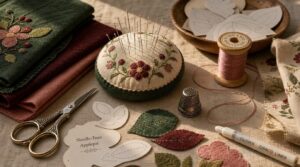
You don’t need a lot of gear to get started with needle-turn appliqué — but the right supplies make a real difference. A few well-chosen tools will save you frustration and help your stitches look clean and intentional.
If you plan to stitch gifts for loved ones, browsing embroidery machines built for gift makers can help you find tools that pair well with appliqué work.
Here’s what you’ll want to have on hand before you sit down to sew.
Quilting-weight Cotton for Appliqué Shapes
Almost every successful needle-turn appliqué tutorial starts with one non-negotiable: quilting-weight cotton. It’s the sweet spot — sturdy enough to hold crisp appliqué pieces, yet flexible enough to fold cleanly under your needle. The tight plain weave resists fraying, and the fabric weight (around 4–5.5 oz) keeps your quilt project flat without bulk. Quilting cotton usually features a standard thread count of about 68 × 68 threads per square inch.
Check color fastness before layering prints, and skip prewashing — it preserves accuracy.
Fine Appliqué Needles for Hand Stitching
Your fabric choice sets the stage — now your needle steals the show. For hand appliqué, tip geometry and fine shaft thickness matter more than you’d think.
Size 11 milliners or straw needles offer tiny eyes, greater control, and serious durability. Coating options like titanium reduce drag beautifully, enhancing performance.
Appliqué needle size comparison tip: longer length selections help sweep the edge under smoothly, ensuring precision in your work.
80. weight Cotton or Fine Silk Thread
Now that your needle’s sorted, let’s talk thread — because the wrong choice unravels everything (literally).
For needle-turn appliqué, ultra-fine 80-weight thread is your best friend:
- Madeira’s Cotona 80-weight thread offers cotton durability without bulk
- Silk thread adds a gorgeous silk sheen but tangles more easily
- Thread breakage drops greatly when you match needle size to thread
- Storage conditions matter — keep spools cool and dry
Cotton blends in; silk glows. Your call.
Water-soluble Pen, Chalk, or Pencil
Now, let’s mark those shapes cleanly. Marker selection really does matter here. A water-soluble pen gives you a fine, precise line perfect for fabric tracing and prepping appliqué pieces. Chalk pencils offer dust-free advantages and erase with a damp cloth.
Always do a fabric test mark first — contrasting color choices are also helpful, especially on darker quilting cotton.
Freezer Paper, Cardboard, or Mylar Templates
Templates make or break your turned-edge appliqué process — so choose wisely.
The Freezer Paper Method is a go-to technique: press the shiny side down, and the heat-fusion process locks it perfectly to fabric. For more template durability, consider a layered approach with cardboard underneath. Mylar’s heat resistance ensures templates withstand dozens of projects.
Always store everything flat to maintain cutting precision every time.
Small Scissors for Trimming Seam Allowances
One good pair of small scissors changes everything in needleturn appliqué work — seriously.
Look for these must-haves:
- Blade Edge Types: Fine-pointed blades cut curved edges without nicking your seam allowance.
- Ergonomic Grips: Reduce hand fatigue during long sessions.
- Safety Features: Blunt tips protect delicate fabric near your template lines.
- Scissor Maintenance: Dedicated trimming scissors stay sharper longer.
Angle blades parallel to your seam allowance guidelines in fabric work — always.
Pins, Glue, or Thread Basting for Placement
Holding your pieces in place before stitching—that’s where many beginners struggle. Pins allow quick repositioning, but ensure you follow a pin grid alignment pattern to prevent shifting. Glue offers a temporary hold, with dry time ranging from 30 seconds to 2 minutes, and any residue washes out easily. For curved seams, thread basting with ¼-inch spacing ensures smoothness.
Honestly, test all three methods on scrap fabric first to build confidence.
Top 3 Needle-Turn Appliqué Items
You don’t need a whole cart full of supplies to get started — just a few key items that make a real difference. Getting the right needle, pins, and hoop will save you so much frustration in the long run.
Here are the three things worth picking up before your first stitch.
1. Colonial Needle Gold Glide Applique Needle
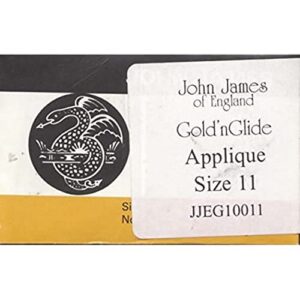
Colonial Needle Gold Glide Applique Needle (size 11) is a truly major advancement. Its gold-coated shaft glides through cotton and silk with significantly less drag, keeping your hand relaxed longer. The needle’s fine design accommodates 60–80 weight thread, while its tiny slip stitches are nearly invisible.
The gold-plated eye resists corrosion from hand oils as well, ensuring smooth performance session after session.
Fair warning, though: you’ll likely need a fine-point threader. *That eye is tiny.
*
| Best For | Hand sewers who do fine appliqué work with delicate threads like 60–80 weight on fabrics such as cotton, silk, or wool. |
|---|---|
| Material | Gold-plated metal |
| Corrosion Resistance | Gold plating resists tarnish |
| Primary Use | Hand appliqué stitching |
| Quantity / Size | 10 needles per pack |
| Durability Concern | Eye plating may wear |
| Skill Level | Intermediate to advanced |
| Additional Features |
|
- Gold-coated shaft glides through fabric with less drag, so your hand stays relaxed during long sessions.
- Gold-plated eye resists corrosion from hand oils, keeping the needle performing well over time.
- Fine, flexible design helps pick up just a few threads at a time, which means cleaner, nearly invisible slip stitches.
- The eye is tiny — you’ll almost certainly need a fine-point threader to get your thread through.
- Too fine for standard or heavy-duty threads, so it’s not a great all-purpose needle.
- Some packs have been reported with packaging defects like foreign fibers inside, which is worth knowing before you buy.
2. Dritz Size 2 Nickel Safety Pins
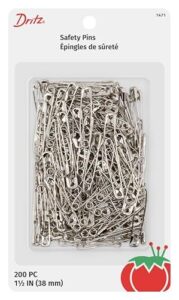
Safety pins might seem boring — but the right ones make a real difference. Dritz Size 2 nickel-plated pins (1½ inches long) offer a practical solution for quilting projects.
Their sturdy yet slim design holds multiple fabric layers securely without distorting appliqué shapes. The nickel finish ensures smooth gliding through quilting-weight cotton, while sharp points prevent fabric snagging.
With 200 pins per pack, you’ll avoid mid-project shortages. These reusable, rust-resistant tools provide genuine reliability for basting appliqué pieces before stitching.
| Best For | Quilters and crafters who need a reliable bulk supply of strong, smooth safety pins for basting, fabric work, or everyday repairs. |
|---|---|
| Material | Nickel-plated steel |
| Corrosion Resistance | Nickel plating resists rust |
| Primary Use | Quilt basting and fabric work |
| Quantity / Size | 200 pins per pack |
| Durability Concern | Nickel plating wears over time |
| Skill Level | Beginner to advanced |
| Additional Features |
|
- 200 pins per pack means you won’t run out mid-project
- Nickel plating glides through fabric cleanly and resists rust over time
- Size 2 (1½ in) hits the sweet spot — sturdy enough for heavy fabric, slim enough not to distort your work
- Some pins may arrive with slightly dull points, making thick materials tougher to pin through
- Only comes in size 2, so you’ll need to buy additional packs if you want other sizes
- Nickel plating can wear down with heavy use, leaving pins more vulnerable to rust in damp storage
3. Darice Wooden Quilting Hoop
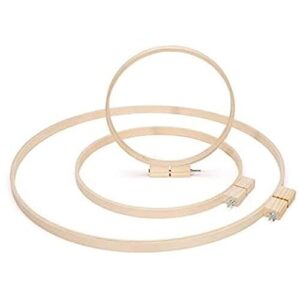
A good hoop is honestly underrated. The Darice 14-inch wooden quilting hoop keeps your fabric taut without constant re-hooping — which means you stay in your stitching rhythm instead of fussing with tension every five minutes.
The screw-tightening mechanism gives you precise control, and the smooth wood finish won’t snag your thread.
It’s lightweight enough for lap work, affordable enough to grab without guilt, and the right size for most appliqué blocks.
Simple, reliable, and genuinely useful.
| Best For | Hobbyists and beginners who want an affordable, comfortable hoop for light quilting, embroidery, or lap work without committing to a pricier option. |
|---|---|
| Material | Natural wood |
| Corrosion Resistance | Wood finish, no metal corrosion |
| Primary Use | Holding quilt layers taut |
| Quantity / Size | 14-inch diameter |
| Durability Concern | Wood can splinter under stress |
| Skill Level | Beginner to intermediate |
| Additional Features |
|
- Holds fabric taut without constant re-hooping, so you can stay in your stitching flow
- Lightweight and easy to hold for long lap-work sessions
- Budget-friendly enough to grab for casual projects or creative experiments
- Wood can splinter over time and doesn’t handle heavy tension well
- The screw assembly has been known to fail under stress
- Not built for professional-grade quilting or heavier fabrics
Prepare Appliqué Pieces
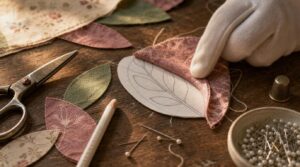
Prepping your pieces well is honestly half the battle — skip this part and you’ll feel it later when your edges pucker or your layers drift. It’s less about ideal and more about setting yourself up so the actual stitching feels easy.
Prep your appliqué pieces well — rushed edges pucker, and drifting layers never lie
Here’s exactly how to get your appliqué pieces ready before the needle ever touches the fabric.
Choose Simple Quilt Motifs for Practice
Picking the right motif makes all the difference when you’re starting out. Think simple shapes, manageable motif size, and strong color contrast — that combo alone saves so much frustration.
- Floral petals or buds — classic beginner shapes
- Circles and squares for clean, predictable edges
- Leaves with gentle curves — great for this needleturn appliqué tutorial
- Symmetrical designs like hearts or stars
- Holiday themes for theme inspiration and quick wins
Trace Shapes Onto The Fabric’s Right Side
Once you’ve settled on your motif, it’s time to mark it onto fabric — and yes, right side up matters here.
| Fabric Marking Tool | Best Use |
|---|---|
| Water soluble pen | Light fabrics, Marking Visibility |
| Chalk pencil | Dark fabrics, easy removal |
| Air-erasable marker | Temporary Marker Removal within days |
| Fine pencil | Mylar heatresistance template tracing |
Use a light-box alignment to keep your template tracing grain-aligned. Always do test swatch checks first — seriously, don’t skip that step.
Add a ⅛-inch to ¼-inch Turn-under Allowance
Once your shape is traced, cutting that turn-under allowance is where the real magic starts. Seam allowance sizing isn’t one-size-fits-all — lighter fabrics need just ⅛ inch, while heavier ones require closer to ¼ inch to accommodate bulk.
Here’s what to keep in mind:
- Test edge tension before committing to a full cut.
- Use bias edges for smoother curve turn-under technique.
- Trim evenly — uneven allowances cause puckers in your TurnedEdge Appliqué process.
- Press turn-under edges lightly to set the fold.
Trim Curves Smoothly to Reduce Bulk
Now that your allowance is trimmed, curves need a little extra love. For outer curves, notching curves — snipping tiny triangles — gives you that bulky edge relief you’re after.
For inner curves, clip into curves with small slits so edges flare flat. Always do a live fold test before stitching.
Smooth seam allowance grading here makes your Turned-Edge Appliqué look genuinely polished.
Use Bias Edges for Smoother Curved Shapes
Cut your curved pieces on the bias — that 45-degree diagonal angle is your secret weapon for smooth turns. Bias cutting techniques let the fabric stretch just enough to ease around petal edges and leaf arcs without fighting you. It’s basically Fabric Grain Alignment doing the hard work for you.
Pre-press those edges along the curve before stitching, and tight arcs suddenly feel manageable.
Mark Placement Lines on The Background Fabric
Marking your background fabric is where your whole design clicks into place. Fold it in half twice — then diagonally — to crease natural center guides for Grain Alignment.
From there, use a water-soluble fabric marking tool (always do Scrap Testing first!) to sketch placement lines with solid Line Visibility.
Washable Marks keep your quilt top clean, and smart Marker Selection means no ghosting after laundering.
Number Layered Appliqué Pieces Before Sewing
Every layered design needs a game plan — and that’s where a simple layer numbering chart saves your sanity. Before prepping pieces, grab your water-soluble pen and tag each shape with a numerical placement guide right on the fabric. Think of it as your layer order checklist comes to life.
- Number bottom pieces first — no guessing later
- Sequential layer tags prevent costly mix-ups
- Numbered basting method keeps everything exactly where you placed it
Start With The Bottom Appliqué Layer First
Think of your bottom layer as the foundation of a house — everything else rests on it. In this needleturn tutorial, layer hierarchy planning starts here.
Glue-baste or pin your base fabric to the background using alignment guides you marked earlier. This stability technique ensures bulk management from the start, keeping fabric to fabric flat so your step-by-step appliqué instructions actually work.
Stitch Needle-Turn Appliqué
Here’s where the real fun begins — needle and thread in hand, fabric ready to go.
The actual stitching process has a rhythm to it, and once you find yours, it honestly feels a little meditative.
Here’s exactly how to work through each step.
Secure The Appliqué Piece Before Stitching
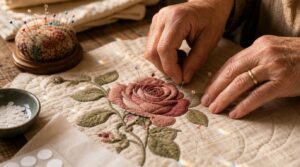
Before your needle touches the fabric, get that appliqué piece locked down — seriously, nothing’s more frustrating than watching your motif creep sideways mid-stitch. Glass head pins, running tacks, or tiny adhesive dots all work great.
Prefer a cleaner hold? Try a starch stabilizer or low-tack sheets. Fusible webbing and safety pins are solid too.
Basting keeps everything honest.
Start on a Straight Edge or Gentle Curve
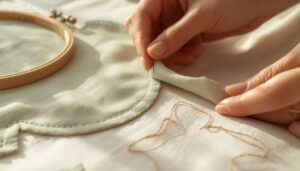
Your starting point matters more than you’d think. In this needleturn appliqué tutorial, edge selection sets the tone for everything — so pick a straight edge or a gentle curve with a radius between 1 and 3 inches.
Fabric tension stays manageable, your consistent stitch length (around 1–1.5mm on curves) is easier to maintain, and these choices create a solid foundation.
This approach ensures concave points and curves won’t pucker before you’ve even found your rhythm, letting you focus on perfecting your technique.
Turn The Raw Edge Under With The Needle Tip
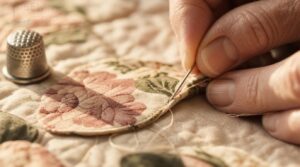
Once you’ve found your rhythm on that straight edge, the real magic of the needleturn technique overview kicks in — turning the raw edge under with your needle tip.
- Needle Grip Technique — Hold your needle at a low angle, almost parallel to the fabric
- Tip Pressure Management — Nudge gently; too much pressure drags the fold out of line
- Micro-Turning Practice — Turn only 1–2 stitches ahead, never more
- Edge Tension Control — Keep the fabric flat against your surface while turning
- Fold Alignment Tips — Follow your marked line exactly so the TurnedEdge Appliqué process stays clean
Preparing fabric edges for appliqué this way — with small, controlled nudges — keeps everything crisp.
Use Small Slip Stitches Along The Folded Edge
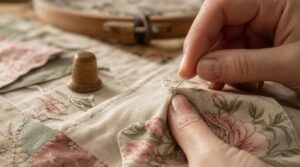
Once you’ve turned that raw edge under, it’s time to anchor it — and that’s where the invisible stitch really shines.
For blindstitch slip stitches, needle entry angle matters: exit right at the fold line alignment, catch just a thread or two of background fabric, then re-enter the fold. Think of it as a tiny tunnel stitch. This tension consistency keeps your TurnedEdge Appliqué lying perfectly flat.
Space Stitches Evenly for a Neat Finish
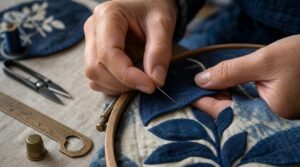
Even spacing is what takes your invisible stitch from "pretty good" to genuinely polished. Think of Stitch Rhythm like breathing — steady, not rushed. Aim for consistent tension and uniform stitch length, about ⅛ to 3/16 inches apart. A little guide line marking goes a long way.
Try these spacing measurement tips:
- Practice on scrap fabric first
- Pause every 4–6 stitches to check alignment
- Use your fold line as a built-in reference guide
Match Thread Color to The Appliqué Fabric
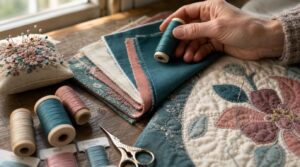
Thread color can make or break your invisible stitch — seriously. Matching thread to your appliqué fabric using color family harmony is the easiest win here. Do a quick lighting test method: hold your thread against the fabric near a window.
Neutral thread choice works great for busy prints, but when edges need definition, try subtle contrast for definition.
Watch the sheen effect balance too — silk catches light differently from matte cotton.
Snip Inner Corners to The Marked Line
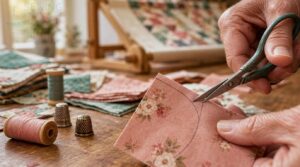
Snipping inner corners is where a lot of beginners get nervous — but don’t be. Use the V‑Notch Technique: make one precise cut right to your marked line. That’s your depth control sweet spot.
Over‑Snipping Prevention is simple — stop exactly at the line. Post‑Snip Pressing settles everything flat.
Follow these step‑by‑step appliqué instructions for preparing fabric edges for appliqué, and those corners behave beautifully.
Fold Outer Points Carefully to Avoid Bulk
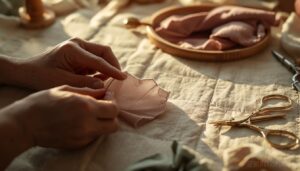
Outer points are honestly the trickiest part of hand appliqué techniques for quilting — but totally manageable. Trim to about ⅛ inch, nail your Fold Angle Precision, and watch bulk disappear. Edge Grain Alignment keeps the tip crisp. Use Bulk Detection Lighting — oblique lamp angle — to catch hidden ridges.
- Trim the tip narrow for Point Tension Balancing
- Layer shapes using Layered Point Sequencing in this needleturn appliqué tutorial
- Press from the back for Turned-Edge Appliqué success
Keep Stitches Nearly Invisible on The Quilt Top
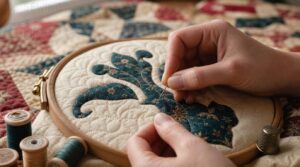
Want stitches that practically vanish? It’s all about Needle Angle Consistency — keep your needle nearly parallel to the fold, and those slip stitches disappear like magic.
Match your thread to the appliqué fabric, practice Stitch Length Uniformity (about ⅛ inch apart), and mind your Thread Tension Control to prevent puckering.
| What to Watch | Common Mistake | Quick Fix |
|---|---|---|
| Slip Stitch Placement | Catching background fabric | Skim just the folded edge |
| Thread color | Using background match | Match appliqué fabric instead |
| Edge Press Technique | Pressing from the front | Always press wrong-side up |
Finish Your Appliqué Quilt Block
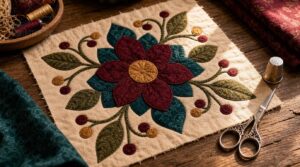
You’re almost there — the stitching is done and your block is looking good. Now it’s time to wrap things up cleanly so all that hard work really shines.
Here’s what to do to finish your appliqué block the right way.
Remove Basting Stitches, Pins, or Glue Residue
Almost done — now let’s clean up! For your thread snipping technique, lift a few basting stitches at a time and snip close without catching the fabric.
With appliqué pins, slide them out at a shallow angle.
Got glue? Residue solvent safety matters here — test isopropyl alcohol on a scrap first.
Finish with post-cleaning pressing from the wrong side for flat, crisp results.
Check Edges for Puckers or Loose Stitches
Run your finger slowly along every edge — that’s your best tool for loose stitch detection. Feel for gaps or snags where the thread didn’t catch fully.
For pucker spotting, look for tiny crescent-shaped waves pulling inward, especially on curves. Edge turn uniformity matters too — uneven folds create shadows visible on the quilt top.
A quick thread tension check now saves frustration later.
Press Appliqué Gently From The Wrong Side
Flip your block over — wrong-side ironing is the move here. Lay a pressing cloth down first, then use a lifting motion (never sliding) to heat-set your stitches without distorting anything.
A stabilizer backing underneath keeps everything flat. This is your cool-down technique moment: let the block rest fully before touching it.
Turned-Edge Applique deserves that patience.
Add Embroidery Details if Desired
Once your block is pressed and rested, embroidery is where things get fun. Think of it as the jewelry on an outfit — totally optional, but wow.
- Satin Fill areas catch light beautifully on petals or leaves
- French Knot Accents add tiny raised centers that beg to be touched
- Chain Stitch Borders or Back Stitch Outlines sharpen edges crispy-clean
Toss in some Metallic Highlights for extra dimension — your invisible stitching deserves a little sparkle.
Practice With a Free Appliqué Quilt Pattern
Want to put all that embroidery practice to real use? Grab a free quilting pattern download — the Aria Quilt is a great starting point. It works as a beginner hand sewing tutorial with built-in difficulty grading and motif selection guidance.
Follow the step-by-step appliqué instructions, adjust your scale, track your stitch count, and you’ll move through this needle-turn appliqué tutorial with real confidence.
Use The Finished Block in a Larger Quilt
So your finished block is ready — now what? Fitting it into a larger quilt design is honestly where the magic happens. Think Grid Layout Planning from the start: map your quilt pattern blocks on graph paper before sewing a single seam.
- Keep consistent sashing width on all four sides.
- Try alternating block orientations for subtle movement.
- Use unified border fabric that echoes your color palette repetition.
- Press seams toward the background to stay flat.
Compare Results With Needle-turn Video Tutorials
Once your block’s sitting pretty in that larger layout, pull up a needleturn appliqué tutorial on YouTube and hold your work right next to the screen. Honest comparison is your fastest teacher.
Check stitch visibility, edge flatness, and technique consistency — does your fold match theirs? This direct comparison accelerates learning and minimizes mistakes.
Video resources for needleturn appliqué compress learning speed dramatically and seriously slash error reduction, too.
Troubleshoot Fraying, Bulky Corners, and Visible Stitches
Even seasoned stitchers hit a rough patch — fraying edges, puffy corners, stitches that scream "look at me." Don’t panic. A Pinking Edge Finish or Fusible Interfacing Application tames fraying fast. Diagonal Corner Trimming kills bulk before it builds. For invisible stitches, lean on Thread Camouflage Techniques and tight Slip Stitch Spacing:
- Match thread to your appliqué fabric, not the background
- Clip inner curves before turning for clean TurnedEdge Applique results
- Revisit your FreezerPaper Method if edges keep shifting
Frequently Asked Questions (FAQs)
What hoop size works best for appliqué quilts?
For most appliqué quilts, an 8–12 inch embroidery hoop hits the sweet spot. It keeps tension consistency solid without distorting your fabric — and you won’t constantly reposition it mid-stitch.
How do you fix a mistake after stitching down?
Grab your seam ripper and breathe — mistakes happen. Carefully open just the affected stitches, realign the edge, re-baste the placement, match your thread color, and slip-stitch it back down. Done.
Is needle-turn appliqué suitable for childrens quilts?
Yes — needle-turn appliqué is actually perfect for kids’ quilts. It’s quiet, slow, and supervised.
Bold design choices, washable materials, and short session planning make it a great fine motor practice activity with minimal sewing safety concerns.
Conclusion
What if the quilt hanging in your living room started with one nervous stitch? That’s exactly how every skilled hand stitcher began.
This needle turn appliqué tutorial quilts your confidence just as much as your fabric—one folded edge at a time.
The fraying, the wobbly curves, the too-visible stitches? All part of the process. Keep your needle moving, trust the rhythm you’re building, and watch those tiny stitches turn into something genuinely beautiful.
- https://suzyquilts.com/needle-turn-applique-tutorial/?srsltid=AfmBOorpPUj5diiIbM0mgEyLWmuzPxRTTP-1qm-OD1VzqpaDP-ZwFBUt
- https://quiltersplanner.com/technique-focus-needle-turn-applique-part-2/
- https://blog.colonialneedle.com/preparation-for-needleturn-applique-tools-tips/
- https://snugglesquilts.com/needle-turn-applique-tips/
- https://www.quiltingboard.com/main-f1/just-little-question-about-needle-turn-applique-t210512.html