This site is supported by our readers. We may earn a commission, at no cost to you, if you purchase through links.
Most quilters hit the same wall: a stack of fabrics they love individually that somehow looks chaotic together. The problem usually isn’t taste—it’s structure. Mixing and matching quilting fabric patterns follows specific rules that experienced quilters rely on every time, whether they’re working with florals, geometrics, or novelty prints.
Start with one fabric that does all the talking. Everything else—color, scale, mood—flows from that anchor. Once you understand how to build outward from a single focal print, choosing supporting fabrics stops feeling like guesswork.
Table Of Contents
Key Takeaways
- Start with one strong focal print and pull 2–4 colors directly from it — that single decision drives your entire palette and keeps every fabric choice feeling intentional.
- Mix prints at different scales (large, medium, small) so the eye has somewhere to travel; using all the same scale flattens your design and creates visual noise.
- Apply the 60-30-10 rule to your colors and weave in solids or neutrals to give busy prints room to breathe — contrast only works when it has quiet space around it.
- Always test fabrics together in natural daylight and build a swatch board before cutting — what looks good in the store can fall apart once it’s next to your other choices.
Start With a Focal Fabric
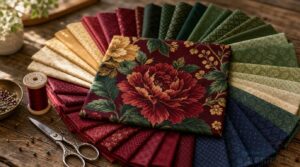
Every great quilt starts with one fabric that does all the talking. That standout print becomes your anchor — the piece everything else lines up around.
From there, exploring a variety of quilting block patterns and design ideas helps you build a layout that lets your anchor fabric truly shine.
Here’s how to find it and put it to work.
Choose One Standout Print as The Quilt’s Design Anchor
Pick a focal fabric first — one dominant print that tells the whole story before you cut a single piece. Think of it as anchor positioning for your design: this focal-print fabric sets the tone, scale, and mood everything else complements.
Place your dominant motif away from edges, leaving negative space around it so it breathes and draws focus naturally.
Remember that even distribution of colors creates a balanced, cohesive look throughout the quilt.
Pull 2–4 Colors From The Focal Fabric
Once your anchor print is locked in, it’s time for hue extraction — pulling 2–4 colors directly from that focal fabric to build your whole palette around.
To ensure cohesion, follow these steps:
- Grab at least one light, one medium, and one dark shade
- Use color family mapping to keep everything in the same tonal neighborhood
- Apply shade balance strategy: pair bright hues with softer near-neutrals
- Start your palette documentation workflow now — note exact color names or codes
This keeps your patchwork cohesive from the first cut.
Use The Focal Print to Guide The Quilt’s Mood
Your focal print isn’t just decoration — it’s mood storytelling in fabric form. A cheerful floral signals warmth; bold geometric shapes feel modern and crisp. That emotional color palette sets the atmosphere alignment for every fabric choice that follows.
Your focal print is mood storytelling in fabric form, setting the atmosphere for every choice that follows
Use it as your theme consistency guide, letting its narrative motifs and visual storytelling shape the quilt’s overall feeling from border to center block.
Match Supporting Fabrics to The Same Color Family
Once your focal point sets the mood, let it lead your supporting cast. Pull two to four of its dominant hues and stick within that color family — that’s your tonal unity at work.
Subtle shade variation adds depth without chaos. Weave in a neutral anchor like cream or gray for balance.
Hue consistency and luster harmony across your swatches? That’s creating cohesive color palettes done right.
Mix Patterns by Scale
Scale is one of the most powerful tools in your quilting toolkit — and one of the easiest to get wrong. When prints are all the same size, the eye doesn’t know where to land.
Here’s how to mix them so everything works together.
Pair One Large-scale Print With Smaller Prints
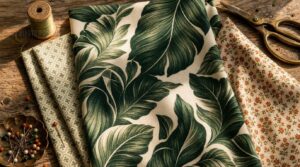
Think of scale hierarchy like a supporting cast — your large-scale print is the star, and smaller prints play the supporting roles. One bold, large-scale print paired with two smaller-scale options creates natural print sequencing and clear visual weight. This print layering approach keeps you’re eye moving without confusion.
Grounding your print layers in classic weaving patterns and textile structures helps you choose supporting textures that complement without competing.
Pattern Scale Harmonization starts here, before you ever pick up scissors.
Use Medium-scale Prints as Transition Fabrics
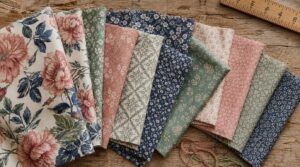
Medium prints are the unsung heroes of scale contrast, sitting comfortably between two and five inches. They handle Shift Color Pull naturally, pulling shared hues from bold and delicate neighbors alike. Weight Matching and Texture Harmony matter here too; midweight cottons keep drape consistent across blocks.
Use Motif Echoing to mirror elements from adjacent fabrics, then confirm everything works with a quick Dry‑Lay Evaluation in natural light.
Add Small Prints for Balance and Detail
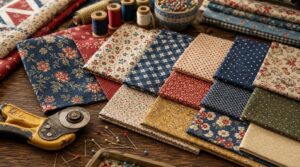
Small prints do the quiet work that keeps a quilt from feeling chaotic. Through Fine Print Sequencing and Miniature Motif Integration, they fill gaps without competing with your larger designs. Think of them as visual punctuation — Detail Contrast Techniques that use Subtle Pattern Layering to steady the eye.
- Place small prints in borders or sashing using Print Placement Rhythm
- Manage pattern repeats to distribute them evenly across blocks
- Apply Balancing Prints and Solids for visual harmony in quilting
- Lean on Pattern Scale and Proportion Techniques and print mixing strategies to create depth
Avoid Using All Prints at The Same Scale
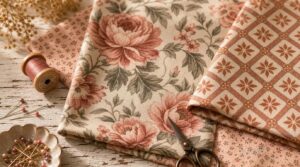
Using all prints at the same scale is one of the fastest ways to flatten your quilt’s visual hierarchy. Without scale contrast, your eye has nowhere to land — no depth perception, no pattern rhythm, just noise.
Mix a bold large print with medium and small options. That scale variety drives eye movement, keeps mixing prints intentional, and builds real visual harmony in quilting.
Place Large Prints in Bigger Quilt Blocks
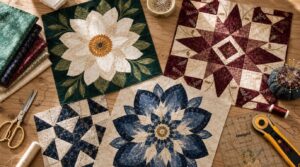
Large prints need room to breathe. A 12-by-12-inch block or bigger gives your pattern scale hierarchy space to shine without crowding key motifs. Focus on motif centering when cutting — keep the design’s focal point near the block’s center. Use generous seam allowances to protect the edges.
Strategic placement and border simplicity around these blocks maintain visual balance throughout your quilt block planning.
Balance Color and Contrast
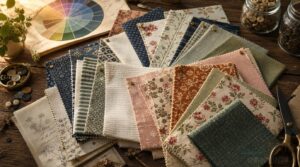
Color can make or break a quilt, even when your patterns are perfectly scaled.
The good news is that a few simple rules take the guesswork out of pairing fabrics that actually work together. Here’s how to keep your colors balanced and your contrast right where you want it.
Apply The 60-30-10 Color Rule
Think of your quilt’s palette as real estate. The 60-30-10 rule divides it simply: Base Color Allocation takes 60% — your calm, dominant field. Supporting Hue Ratio fills 30% with moderate contrast. Accent Pop Placement uses the final 10% to draw the eye.
This Proportion Verification Method drives Mood Through Percentages across every block, making Quilt Design Color Coordination and color palette planning feel instinctive rather than overwhelming.
Use Complementary Colors for Bold Contrast
Once you’ve nailed your proportions, it’s time to add some spark. Complementary colors—those directly opposite on the color wheel, like blue and orange, red and green, yellow and purple—create high-contrast highlights that stop the eye cold.
To apply this effectively:
- Use Complementary Accent Borders to frame focal blocks
- Apply Warm-Cool Pairing for vibrant visual tension
- Keep Saturation Balance by limiting accents to 10–20% of your palette
- Check Contrast Accessibility so your combinations don’t overwhelm
Quilt Design Color Coordination thrives on balancing contrast and cohesion in patterns—bold color contrast, anchored by neutrals.
Use Analogous Colors for Softer Harmony
Not every quilt needs bold contrast. Analogous colors—neighbors on the color wheel—create natural color harmony that feels easy. Think blue-green flowing into teal, or gold warming into amber.
| Hue Family | Lightness Shifts | Saturation Balance |
|---|---|---|
| Blue → Teal | Light to mid | Moderate throughout |
| Gold → Amber | Mid to deep | One subtle accent |
| Sage → Olive | Soft tints base | Desaturated backgrounds |
Hue Gradient and Warm Cool Fusion keep your quilt composition cohesive without flatness.
Add Neutrals to Create Visual Breathing Room
Analogous palettes are calming, but even soft hues need a break. That’s where neutrals earn their place. Cream, gray, oatmeal, or white act as Breathing Border Neutrals—giving your eye a rest between prints.
Layered Neutral Shades with Neutral Texture Contrast, like smooth cotton beside textured linen, add depth without introducing new color. This interplay of materials creates subtle complexity.
The result is visual balance and Weight Balanced Neutrals, ensuring a harmonious composition. This approach fosters natural Visual Flow in Quilt Layouts, guiding the eye seamlessly across the design.
Repeat at Least One Color Across Prints
Neutrals calm the chaos — but color unity is what pulls a quilt together. Pick one anchor color and echo it across at least three fabrics. Vary the saturation: light, medium, dark.
- Repeat your anchor color in both large and small prints
- Use a neutral blender to carry the hue between busy patterns
- Layer warm and cool versions of the same hue for depth
- Let a medium-scale print hold the mid-tone
- Confirm cross-print color unity in natural daylight before cutting
Combine Prints With Solids
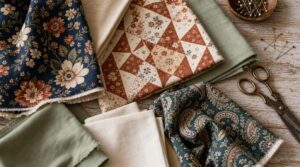
Even the most beautiful prints need somewhere to breathe. Solids and neutrals do that job quietly — they settle the eye and let your bolder fabrics shine without competing.
Here’s how to use them well.
Use Solid Fabrics to Calm Busy Patterns
Think of solid fabrics as the quiet voice in a loud room — they give your eye somewhere to rest. When you’re Mixing Prints with Solid Fabrics, Strategic Placement matters. A solid’s Visual Breathing effect, supported by Sheen Control and Texture Coordination, keeps busy prints from competing.
| Solid Placement | Effect on Busy Prints | Weight Matching Tip |
|---|---|---|
| Sashing between blocks | Separates pattern scale conflicts | Match fabric weight closely |
| Border strips | Frames and calms the overall layout | Use medium-weight cotton |
| Alternating blocks | Creates rhythm across the quilt | Consistent weave prevents drape issues |
Add Blender Fabrics Between Bold Prints
Blender fabrics are the unsung heroes of mixing prints with solid fabrics. They pull shared hues from neighboring bold prints, creating a natural Value Shift that keeps your layout breathing.
A well-chosen Blender Motif Echo enhances Texture Harmony and print scale balance without stealing focus.
For Digital Color Matching, test blenders in daylight against your bolds — you’ll see the Visual Balance in textile design instantly click into place.
Choose Neutrals Like Cream, White, Gray, or Black
Picking the right neutral isn’t just a background decision — it shapes the whole mood. Cream Warm Tone softens edges and pulls vintage fabrics together. White Light Boost makes jewel-toned prints pop. Gray Balancing Anchor holds bold patterns without competing. Black Depth Accent adds grounding contrast.
Use neutrals to give the eye a rest between busy prints — that’s core Neutral KnowHow for balanced color coordination.
Balance Bright Fabrics With Quieter Supporting Fabrics
Bright fabrics are showstoppers — but they need a supporting cast. Pair bold prints with quieter solids or subtle stitchwork textures to create fabric weight harmony and visual cohesion. Use neutrals to give the eye a rest between high-energy patches.
Toned-down accents, understated trim, and gradient transitions bridge loud and calm fabrics naturally, keeping the balancing of colors and prints in a quilt grounded without dulling the drama.
Prevent Visual Overload in Detailed Quilt Layouts
Too many busy prints in one layout is like everyone talking at once — nobody listens. Manage print density by spacing bold fabrics with solids, creating negative space that lets your eye breathe.
Use color blocking to establish visual hierarchy, and repeat one anchor color to build pattern rhythm. Managing pattern repeats this way locks in visual balance and keeps your whole quilt readable.
Test Fabrics Before Cutting
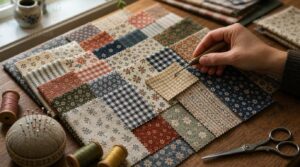
Before you cut a single piece, take time to test your fabrics together — this step alone can save you from expensive mistakes. Small checks now reveal problems that are nearly impossible to fix once everything is sewn.
Here’s what to do before your scissors ever touch the fabric.
Lay Fabrics Together in Natural Daylight
Before you cut a single inch, take your fabrics to the brightest window in your home. Natural daylight is your most honest critic — it performs sunlit color verification better than any lightbulb, and daylight texture reveal shows slubs, sheens, and weave differences you’d otherwise miss.
Testing fabric combinations under natural daylight also flags UV fade risks in vibrant dyes. Use light angle comparison by shifting your swatch grouping from direct sun to shade, so you catch both warm and cool shifts before they’re sewn in permanently.
Create a Swatch Board Before Sewing
Once you’ve checked your fabrics in daylight, build a fabric swatch board before a single seam gets sewn. Think of it as your quilt’s blueprint. Pin a 6×6-inch focal swatch at the center, then arrange coordinating fabrics around it.
Good fabric swatch organization includes:
- A clear Labeling System with fabric name, drape ratings, and Texture Annotations
- Swatch Layout arranged light to dark within each color family
- Care instructions noted for quick reference
This Test Before You Commit approach keeps Creating Cohesive Quilt Designs manageable — and your fabric swatch analysis grounded in reality, not guesswork.
Photograph Fabric Combinations for Comparison
Your swatch board tells a story — your camera helps you read it clearly. Shoot your fabric layout against a neutral backdrop in diffused lighting, keeping white balance consistent with a gray card. Capture texture close-ups alongside full swatch labeling shots. This fabric swatch analysis doubles as a mock quilt assembly process review, sharpening your eye for visual flow and color coordination tools before a single cut.
| Shot Type | What to Capture | Why It Helps |
|---|---|---|
| Full Layout | All swatches arranged in fabric layout order | Reveals overall color coordination |
| Texture Close-up | Fabric surface detail | Shows contrast and weave differences |
| Grayscale Version | Desaturated layout photo | Checks value balance without color bias |
Check Fabric Weight and Drape Compatibility
Your photos reveal colors — but weight consistency and drape behavior tell a different story. Hold each fabric sample and let gravity do the talking. Natural fibers like cotton and linen behave differently from synthetic blends, so fiber drape and weave impact matters here.
Lay samples over a curved surface, checking how each one falls. This test reveals how fabrics interact with shape and movement, exposing subtle differences in flow and stiffness.
Mismatched fabric weights create puckering, uneven blocks, and a quilt that won’t hang right. Ensuring uniform weight and drape properties is critical for structural integrity and visual harmony.
Prewash Fabrics With Similar Care Requirements
Weight and drape won’t matter if your fabrics shrink unevenly after the first wash. That’s why prewashing by fiber wash groups protects everything you’ve built so far.
- Sort by care label hierarchy — when labels conflict, follow the most delicate instruction
- Match temperature cycles: warm for cotton and linen, cold for rayon and synthetics
- Check detergent compatibility — skip optical brighteners to protect color integrity
- Apply consistent drying methods: air-dry delicates, low tumble for sturdy cottons
- Document fabric shrinkage and temperature considerations for future laundry compatibility
Frequently Asked Questions (FAQs)
Can you mix and match fabric for a patchwork quilt?
Yes, you can absolutely mix and match fabrics for a patchwork quilt. In fact, that’s the whole point.
Smart texture layering, drape weight matching, and balancing colors and prints transform scraps into something stunning.
What is pattern mixing?
Pattern mixing is the art of combining different prints, textures, and scales in a single project to create visual rhythm.
Done right, it gives your quilt life, depth, and a look that feels intentional.
Do fabric patterns have to match?
No, they do not. Fabric pattern matching techniques work best when prints share a color, scale contrast, or pattern rhythm — not identical motifs.
Visual rhythm in quilting comes from intentional variety, not perfect uniformity.
How do you mix fabric patterns?
Start with a focal print, then build around it using scale contrast, the 60-30-10 color rule, and weight harmony.
Solid blenders and pattern rhythm keep your mix cohesive without visual chaos.
How do triadic color schemes work in quilting?
A triadic color scheme pulls three colors evenly spaced on the color wheel. Think red, yellow, and blue.
One dominant color anchors the quilt while the other two add accent hue nuance.
Which fabric textures complement each other best?
Smooth silk paired with nubby linen creates natural smooth nubby contrast that adds depth.
Weight harmony matters too — balance sheen, hard-soft pairings, and fiber blend compatibility for texture blending that feels intentional.
How many prints should a beginner quilt use?
Keep it to five to seven prints — enough variety to create visual rhythm without print overload.
For beginners, that range smooths the learning curve and makes balancing colors and prints in a quilt far less overwhelming.
Can vintage and modern fabrics be mixed together?
Yes — vintage and modern fabrics mix beautifully. Weight compatibility and texture contrast are your checkpoints. Let era storytelling guide your choices, and fabric care synergy keep them lasting.
How do you build a consistent quilting mood palette?
Think of your quilt as a story. Every color is a word.
Pick one mood — cozy, bold, fresh — then pull 2–4 emotion hues from nature inspiration or a color wheel reference.
Build visual harmony through this process.
Conclusion
You don’t need a perfect eye for color to master how to mix and match quilting fabric patterns—you need a system. Start with one strong focal print, build your palette from it, and let scale and contrast do the heavy lifting.
Solids and blenders aren’t compromises; they’re what hold the whole thing together.
Test before you cut, trust what you see in daylight, and your fabric stack will stop feeling like chaos and start looking like intention.
- https://modernquiltco.com/blogs/the-modern-thread/beginners-guide-to-fabric-selection-for-stunning-quilts-how-to-coordinate-quilt-fabrics-like-a-pro?srsltid=AfmBOop6iAzdMIjTrzcbYC9PeeXQpgae9ircou_1-JNDz3JIwfC6MoeF
- https://gequiltdesigns.com/blogs/the-quilters-guide-to-color/introduction-to-color-theory-in-quilting-creating-harmonious-designs?srsltid=AfmBOoqXtRa2nYgtFL2z6IdCaMwgCjUU_fHwAEMVDLv6VqWFjEMkiAR6
- https://www.newtoncustominteriors.com/how-to-mix-fabric-patterns/
- https://www.generations-quilt-patterns.com/proportional-scale.html
- https://www.bindingcalculatorquilt.com/quilt-scale