This site is supported by our readers. We may earn a commission, at no cost to you, if you purchase through links.
Most sewists ruin their first pattern attempt before the needle ever touches fabric. Not because they can’t sew—because they grabbed the wrong tools, eyeballed measurements, or marked with a permanent pen they found in the junk drawer. The result? A blouse that fits one shoulder, seams that wander, and a pattern so marked up it’s unusable for round two.
Getting a pattern from paper to finished garment is a system, and every step demands a specific tool doing its job well.
The right cloth tape measure, a sharp rotary cutter, a French curve that actually matches your body—these aren’t upgrades. They’re the baseline. Here’s exactly what belongs in your toolkit.
Table Of Contents
- Key Takeaways
- Essential Measuring Tools for Sewing Patterns
- Best Cutting Tools for Clean Pattern Edges
- Marking and Transfer Tools You Need
- Pattern Paper and Tracing Materials
- Top 8 Sewing Pattern Tools to Buy
- 1. Montada Alpha Numeric Pattern Paper
- 2. Scotch Magic Tape 19mm 21m
- 3. Dritz Clear Multi Curve Ruler
- 4. Lingerie Beachwear Leisurewear Pattern Cutting Guide
- 5. Fiskars Heritage Seamstress Scissors 8 Inch
- 6. Fiskars Classic Stick Rotary Cutter 45mm
- 7. Janome 2212 Front Loading 12 Stitch Sewing Machine
- 8. Brother XM2701 Lightweight Sewing Machine
- Frequently Asked Questions (FAQs)
- Conclusion
Key Takeaways
- Your measuring tools — a cloth tape measure, L-square, and French curves — aren’t upgrades; they’re the foundation every accurate pattern is built on.
- Dedicated cutting tools matter more than you’d think: fabric shears for cloth, separate scissors for paper, and a rotary cutter for clean, multi-layer straight cuts.
- Marking the right way (tailor’s chalk, disappearing-ink pens, or a tracing wheel with carbon paper) is what keeps your seams where you actually planned them.
- The paper you draft on shapes how long your patterns last — Swedish tracing paper and Pellon 30 hold up through repeated use, while brown kraft paper covers big experimental runs on a budget.
Essential Measuring Tools for Sewing Patterns
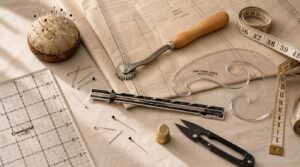
Getting your measurements right is honestly half the battle in pattern making. The tools you use can mean the difference between a perfect fit and a frustrating do-over.
Once you nail the basics, diving into petite pattern adjustments and fitting techniques helps you understand exactly where and why those tweaks make all the difference.
Here’s what belongs in your measuring kit.
Flexible Cloth Tape Measures
Your tailor’s measuring tape is the MVP of your toolkit — don’t underestimate it. A quality cloth tape measure stretches less than 3% under normal use, ensuring your measurements remain consistently accurate.
Look for these essential features:
- Dual-unit markings for instant inch/centimeter switching
- Locking mechanisms to hold readings hands-free
- Ergonomic design for one-handed measuring on curves
- Stretch resistance and easy-care construction for long-term longevity
For precise cloth dimensions, consider using a fabric tape measure.
L-squares and Set Squares
Once you’ve nailed your measurements, keeping lines square is the next major advancement. L-squares and set squares provide precise 90° angles instantly—no guessing required.
Use an L-shaped ruler or grid ruler to draw true grainlines and perpendicular seams. These tools ensure accuracy in layout and construction.
Transparent acrylic sets allow visibility of your pattern underneath, while features like beveled corner alignment, non-slip bases, and durable coatings keep everything steady and accurate.
French Curves and Hip Rulers
French curves offer multiple arc shapes in one tool, ideal for shaping armholes and necklines. Hip curve rulers excel at hip contouring from waist to thigh in a single fluid motion. These specialized tools ensure smooth transitions and seamless integration during pattern grading, maintaining clean, professional results.
Together, they simplify the process of creating smooth transitions and integrating grading adjustments. This combination keeps patterns clean and professional, eliminating harsh lines for refined designs.
Transparent Grading Rulers
Once your curves are smooth, sizing them up — or down — is where a grading ruler earns its place. Transparent grading rulers excel in Material Clarity, with clear polycarbonate ensuring visibility of every underlying line.
Scale Precision is equally critical, featuring millimeter-fine gradations to guarantee pattern accuracy.
Alignment Features, such as built-in crosshairs, secure optimal pattern layout positioning.
Beyond functionality, these tools are durable, easy to clean, and Size Compatible with standard drafting systems — truly useful.
Straight Rulers With Grid Markings
A grid ruler is the quiet workhorse of pattern drafting.
Clear acrylic construction — your Grid Material of choice — lets you see every line underneath.
Dual Scale (metric on one side, imperial on the other) keeps conversions simple.
Non‑Slip Backing holds it steady while you mark.
Length Variants from 6 to 18 inches suit any project.
Wipe clean regularly — done.
Best Cutting Tools for Clean Pattern Edges
Your cutting tools can make or break a clean edge — and not all blades are created equal. Choosing the right cutter for the job keeps your patterns sharp and your fabric frustration-free.
Here’s what belongs in your toolkit.
Dressmaking Shears for Fabric
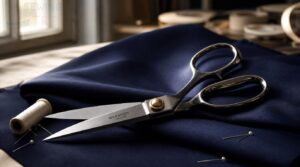
Your dressmaking shears are the unsung heroes of clean, precise cuts. Ergonomic grips reduce hand fatigue during long sessions — and that matters more than you’d think.
Look for high-carbon stainless or vanadium steel for premium edge sharpness and lasting fabric compatibility.
Regular blade maintenance (a drop of oil at the pivot) keeps them gliding through woven fabrics like butter.
Separate Scissors for Paper Patterns
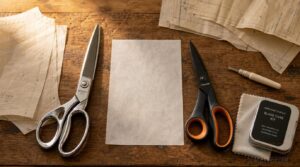
Never use your fabric shears on pattern paper — ever. Paper dulls blades fast, and that’s a rookie mistake you can’t afford.
Dedicated paper scissors with ergonomic grips and thin blades give you clean edges on tracing paper and pattern paper without destroying your good tools.
Build a simple maintenance routine: wipe blades clean, check for burrs, and store them separately.
Material compatibility matters — high-quality scissors handle Swedish tracing paper beautifully.
Rotary Cutters and Self-healing Mats
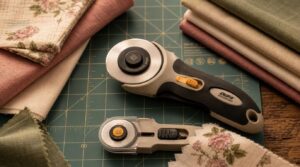
A rotary cutter is basically a pizza wheel built for fabric — and once you try one, there’s no going back.
- Pick blade sizes wisely — 28mm for curves, 45mm for straight runs, 60mm for bulk cutting efficiency
- Always engage the safety lock features when pausing
- Use rotating mat guides to pivot fabric without shifting grain
- Trust self-heal durability — mats reseal cuts, keeping blade replacement cycles longer
Pattern Weights and Fabric Clamps
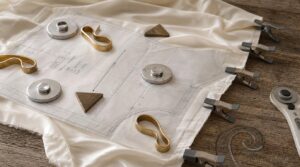
Pins are so last season. Pattern weights and fabric clamps give you pinless cutting advantages that keep delicate silks and slippery satins exactly where you placed them — no grain distortion, no frustration.
| Feature | Pattern Weights | Fabric Clamps |
|---|---|---|
| Material Options | Metal, glass, sand-filled | Steel, aluminum, plastic |
| Shape Selection | Discs, triangles, ribbons | Spring-jaw, padded, magnetic |
| Price Comparison | $10–$50 per set | $5–$15 per clamp |
Marking and Transfer Tools You Need
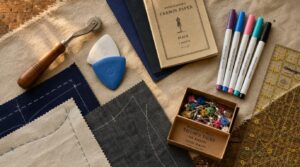
Getting your markings right is what separates a clean finish from a frustrating do-over. The tools you use to transfer lines, points, and notches onto fabric matter more than most beginners expect.
Here’s what belongs in your marking kit.
Tailor’s Chalk for Temporary Markings
Tailor’s chalk is your secret weapon for clean, confident fabric marking. It’s temporary, precise, and brushes off without drama. Made from a clay-talc-wax blend, it glides smoothly across cotton, denim, and wool alike.
Tailor’s chalk glides cleanly across any fabric and disappears without a trace, making it the most confident mark you’ll ever make
- Color Selection: Choose white or pink for dark fabrics, blue for light ones
- Composition Basics: Wax additives help it glide without snagging delicate weaves
- Application Techniques: Hold at 45° for crisp, fine seam marking lines
- Removal Methods: Brush away or wipe with a damp cloth post-fitting
- Storage Tips: Keep chalk dry and capped so tips don’t crumble
Disappearing Ink Fabric Pens
Disappearing ink fabric pens take fabric marking to another level, offering a clear advantage over traditional chalk. These clever sewing accessories write precisely and vanish on their own, requiring no brushing. Most marks disappear within 24–48 hours, though fade timing varies.
Always test on a scrap first to confirm fabric suitability. For best results, apply with light pressure on a flat surface. Adhere to safety guidelines: avoid ironing until marks fully fade.
Cleaning is simple—plain water works effectively.
Tracing Wheels and Carbon Paper
Where disappearing ink leaves off, the tracing wheel picks up — especially when you need crisp, repeatable lines across multiple fabric layers. Pair your wheel with carbon paper, and pattern transfer becomes almost easy.
- Ergonomic Wheel Grips Reduce hand fatigue during long drafting sessions
- Carbon Paper Colors (black, white, blue, red) Match any fabric tone
- Blade Gauge Options Control mark depth for delicate fabric compatibility
Pattern Awls for Dart Placement
Once your dart lines are traced, you need one more tool to nail the peak hole placement: the pattern awl. Think of it as your precision pointer for pattern making and pattern drafting. A good awl punches a tiny hole (about 0.5–1mm) just inside the dart tip, keeping finished fabric clean.
Ergonomic wood grips ensure comfort during long sessions, while dual-purpose awl designs often include built-in guides for added versatility.
Pattern Notchers for Alignment Points
Now that your awl has nailed those dart tips, it’s time to talk notches — the little cuts that keep every seam aligned like magic. A pattern notcher punches clean V-cuts right into your paper edges.
Here’s what makes them worth owning:
- Shape Options — crescent, slot, or triangle cuts for every seam type
- Blade Variety — interchangeable blades adapt to different notch sizes
- Ergonomic Grips — less hand fatigue during long cutting sessions
- Digital Notching — software can now auto-generate notch coordinates
- Maintenance Routine — store blades capped to stay sharp longer
Pattern Paper and Tracing Materials
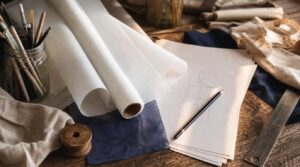
The paper type you choose matters more than most people think. Choosing the wrong type leads to torn edges, smudged lines, and patterns you can’t reuse.
Here’s a look at the best options to keep in your toolkit.
Lightweight and Swedish Tracing Paper
Swedish Tracing Paper is the secret weapon serious pattern makers swear by. At just 28–29 GSM, it’s featherlight but surprisingly tough — you can pin, stitch, and trace it repeatedly without it giving up on you.
Its translucency means no lightbox required; simply lay it over your draft to see every line clearly.
Eco-friendly sourcing from abaca fibers ensures sustainability, making it a reusable master pattern you’ll reach for, every time.
Pellon 30 for Repeated Pinning
Pellon 30 was built for repetitive pattern use. This 100% polyester stabilizer holds its shape beautifully — sewing pins, notched pins, and even pattern weights won’t distort it.
Its lightweight design cuts cleanly with scissors or rotary cutters, leaving crisp, stable edges every time.
With great pin retention strength and solid seam stability, it excels in multi-use applications, making it a smart, cost-efficient choice.
Brown Kraft Paper as an Alternative
Brown kraft paper is the budget-friendly MVP of pattern drafting you didn’t know you needed. Weighing in at 50–80 GSM, it delivers real tear resistance without the specialty price tag. Its cost efficiency makes it perfect for experimental large format pattern-making process runs.
- Works beautifully with a tracing wheel
- Accepts pencil and chalk cleanly
- Allows interfacing reinforcement when layered
- Champions eco-sustainability through recyclable fibers
- Ideal for full-size pattern paper blocks
Storing Patterns to Prevent Creasing
Your patterns deserve better than a crumpled drawer. For flat storage, layer pieces with acid-free tissue and keep heavier patterns on the bottom.
Prefer the rolling method? Wrap loosely around a cardboard tube.
Archival envelopes with silica gel handle humidity control beautifully — aim for 40–50% relative humidity. Store away from sunlight, and your patterns stay crisp for years.
Top 8 Sewing Pattern Tools to Buy
You’ve got the knowledge — now let’s talk gear. These eight tools cover everything from drafting and cutting to marking and stitching, so you’re set up to work with confidence from day one.
Here’s what’s worth adding to your kit.
1. Montada Alpha Numeric Pattern Paper
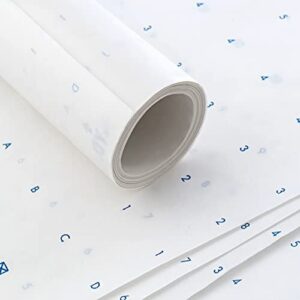
Montada’s Alpha Numeric Pattern Paper offers a 45-inch-wide, 10-yard roll featuring a 1-inch alphanumeric dotted grid, simplifying tasks like dart placements and grainlines. Its design ensures precision and ease in pattern drafting.
The paper’s translucent quality allows effortless tracing over existing work, while its durability withstands repeated erasing and pinning without damage. Compatible with scissors, rotary cutters, and notchers, it integrates seamlessly into any crafting workflow.
Proudly Made in the USA, this paper outperforms fragile alternatives, offering genuinely sturdier reliability than standard tissue paper for long-lasting use.
| Best For | Sewists, pattern makers, and fashion design students who need reliable, precise paper for drafting, grading, and tracing garment patterns. |
|---|---|
| Primary Use | Pattern drafting/tracing |
| Skill Level | Intermediate–Professional |
| Material | White paper |
| Price Range | Budget |
| Handedness | Universal |
| Warranty/Support | Not specified |
| Additional Features |
|
- The 1-inch alphanumeric grid makes it easy to place darts, mark grainlines, and keep everything lined up without guessing.
- Tougher than tissue paper, so it holds up through repeated erasing, folding, and handling during pattern development.
- Works with scissors, rotary cutters, and notchers, so it fits right into whatever workflow you already have.
- The translucency might not cut it in dim lighting — you may need a sunny window or light box to trace effectively.
- It’s thicker than traditional tracing tissue, which could be a problem if your tracing method depends on very thin paper.
- At 45 × 360 inches, the roll is pretty generous — smaller projects will mean trimming and figuring out where to store the rest.
2. Scotch Magic Tape 19mm 21m
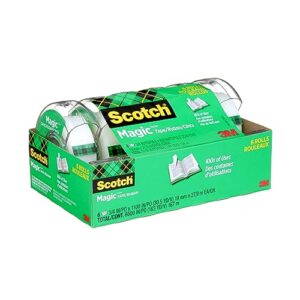
Tape might be the last thing on your pattern-making list — but it shouldn’t be. Scotch Magic Tape (19mm wide, 21m per roll) is a quiet hero in any sewing room. Its matte finish practically disappears on paper, ensuring your pattern pieces look clean and professional.
You can write on it, making it perfect for quick labels or adjustment notes. It won’t discolor your materials, cuts cleanly off the roll, and comes in packs of six.
Reliable, simple, and genuinely useful.
| Best For | Sewers, crafters, and office workers who need a clean, low-visibility tape for pattern work, document repairs, or photo-safe projects. |
|---|---|
| Primary Use | Paper mending/office |
| Skill Level | All levels |
| Material | Clear plastic film |
| Price Range | Budget |
| Handedness | Universal |
| Warranty/Support | Not specified |
| Additional Features |
|
- Matte finish blends in — you barely know it’s there once applied
- You can write right on it, great for labeling pattern pieces or jotting quick notes
- Safe on photos and artwork, so no worrying about discoloration or damage
- Doesn’t grip well on textured or heavy materials — it’s made for smooth paper surfaces
- Not strong enough for anything load-bearing or heavy-duty
- Can show up on dark paper, so the "invisible" magic has its limits
3. Dritz Clear Multi Curve Ruler
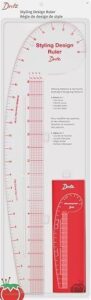
The Dritz Clear Multi Curve Ruler combines four essential tools into one: a straight ruler, French curve, hip curve, and cut-out slots. This versatile 22.75-inch clear plastic piece allows you to see your pattern clearly through it, eliminating guesswork and repositioning.
Its transparent design ensures precision, while the included instruction guide supports beginners. However, the ruler’s 2mm plastic construction is fragile—drops or rough handling risk damage.
| Best For | Sewers and quilters who want one tool that does it all—great for beginners learning pattern drafting and experienced makers tired of juggling multiple rulers. |
|---|---|
| Primary Use | Pattern drafting |
| Skill Level | Beginner–Intermediate |
| Material | Transparent plastic |
| Price Range | Budget |
| Handedness | Universal |
| Warranty/Support | Not specified |
| Additional Features |
|
- Four tools in one keeps your workspace tidy and saves you from buying separate curves and rulers
- Clear plastic lets you see exactly what’s underneath—no guessing, no shifting
- Comes with an instruction guide, so beginners can hit the ground running
- At 2mm thick, it’s pretty easy to crack if you drop it or toss it in a bag
- Some buyers have received it already damaged, which is frustrating right out of the box
- Not built for heavy-duty work—if you need something industrial, go with metal
4. Lingerie Beachwear Leisurewear Pattern Cutting Guide
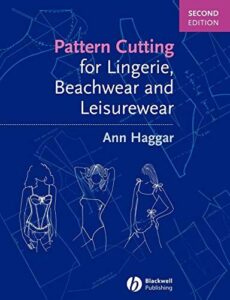
Rulers handle the geometry, but drafting lingerie or swimwear requires a resource that understands the body. The Lingerie, Beachwear & Leisurewear Pattern Cutting Guide (Wiley-Blackwell, $40.31) fills this need.
It comprehensively covers bra cup drafts for A through G cups, tankini blocks, hipster bottoms, and technical details like seam allowances, stretch ease, fabric behavior—all meticulously outlined.
This isn’t beginner material. However, for those prepared to draft custom-fit pieces on their own terms, the book justifies its value.
| Best For | Intermediate to advanced sewers and pattern makers who want to draft custom-fit lingerie, swimwear, and loungewear without relying on commercial patterns. |
|---|---|
| Primary Use | Pattern design reference |
| Skill Level | Intermediate–Advanced |
| Material | Paper/print |
| Price Range | Mid-range |
| Handedness | Universal |
| Warranty/Support | Not specified |
| Additional Features |
|
- Covers a wide range of styles — from bras and thongs to tankinis and bustiers — including harder-to-find guidance for larger cup sizes.
- Packed with trade tips on fabric behavior, finishing techniques, and personal measurements that go beyond basic pattern drafting.
- Works for both hand drafting and CAD workflows, so it fits into different design processes.
- Not beginner-friendly — you’ll need some pattern drafting experience before this book makes sense.
- The text is printed small, which can make it tough to read for extended sessions.
- Coverage of stretchy fabrics like spandex is limited, so you may need extra resources for swimwear-specific materials.
5. Fiskars Heritage Seamstress Scissors 8 Inch
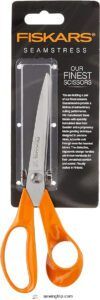
Once you’ve mapped out your pattern details, cutting fabric cleanly is where it all comes together. That’s where the Fiskars Heritage Seamstress Scissors earn their spot in your kit.
The 8-inch Swedish stainless-steel blades stay sharp through silk, denim, and thick layered cuts without snagging. Large, ergonomic finger holes ensure your hand won’t ache after long cutting sessions. At $27.86, plus a lifetime warranty, it’s hard to argue with that kind of reliability.
| Best For | Sewers, quilters, and crafters who need a reliable everyday pair of shears for fabrics ranging from silk to denim. |
|---|---|
| Primary Use | Fabric cutting |
| Skill Level | Beginner–Professional |
| Material | Swedish stainless steel |
| Price Range | Mid-range |
| Handedness | Right-handed |
| Warranty/Support | Lifetime warranty |
| Additional Features |
|
- Swedish stainless-steel blades hold a sharp edge through heavy use and resist rust over time
- Large ergonomic finger holes make long cutting sessions much easier on your hands
- Lifetime warranty at under $30 is genuinely hard to beat
- Plastic handles may feel a bit cheap compared to rubberized or metal-grip alternatives
- Not ideal for very thick or heavy materials that need larger, heavier-duty shears
- Sharp, unrounded tips can catch you off guard if you’re not careful with storage or handling
6. Fiskars Classic Stick Rotary Cutter 45mm
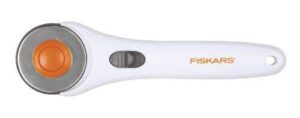
Scissors handle curves beautifully, but straight lines? That’s where the Fiskars Classic Stick Rotary Cutter takes over. Think of it like a pizza wheel built for fabric — roll it along a ruler and you get razor-clean edges in seconds.
The 45mm titanium-carbide-coated blade cuts through up to six layers without dragging. Its ambidextrous handle ensures left-handed users aren’t left out, while the sliding blade guard keeps things safe between cuts.
Just don’t skip the self-healing mat — your table will thank you.
| Best For | Quilters, sewists, and crafters who need fast, clean cuts through multiple fabric layers with a comfortable, ambidextrous grip. |
|---|---|
| Primary Use | Fabric cutting |
| Skill Level | Beginner–Professional |
| Material | Stainless steel |
| Price Range | Mid-range |
| Handedness | Ambidextrous |
| Warranty/Support | Not specified |
| Additional Features |
|
- Titanium-carbide-coated blade stays sharp longer and slices through up to six fabric layers cleanly
- Ambidextrous handle works for both right- and left-handed users, and the sliding guard keeps the blade safely covered between cuts
- Snap-in/snap-out blade system makes swaps quick so you’re not losing time mid-project
- No cutting mat, no mercy — the blade will chew through your table if you’re not careful
- Struggles with thick stacks or dense materials like heavy photo paper, so it’s not a one-tool-fits-all solution
- The 45mm blade can feel limiting for large-scale patterns, and the handle shape may reduce precision on detailed freehand cuts
7. Janome 2212 Front Loading 12 Stitch Sewing Machine
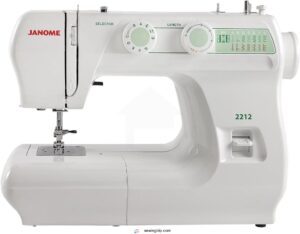
Twelve stitches, one reliable machine — that’s the Janome 2212 in short. It’s mechanical, which means fewer electronics to babysit and more time actually sewing.
The front-loading bobbin system makes thread changes fast, and at 860 stitches per minute, it keeps pace with your momentum.
You get a free arm for cuffs and sleeves, a drop-feed mode for darning, and a solid metal frame that won’t wobble mid-seam.
At $217, it’s a genuinely smart starter investment.
| Best For | Beginners and intermediate sewists who want a no-fuss, reliable machine for everyday projects like garments, repairs, and light quilting. |
|---|---|
| Primary Use | General sewing |
| Skill Level | Beginner–Intermediate |
| Material | Metal and plastic |
| Price Range | Mid-range |
| Handedness | Universal |
| Warranty/Support | Not specified |
| Additional Features |
|
- Mechanical design means fewer things to break — no touchscreens, no software glitches, just straightforward sewing
- Free arm and drop-feed mode make it genuinely versatile for cuffs, sleeves, darning, and free-motion work
- At $217, it’s solid value for a metal-framed machine that’ll hold up through the learning curve
- Only 12 stitches and no embroidery options, so you’ll outgrow it if decorative work is your goal
- Reverse stitching requires holding the switch the whole time — no toggle, which gets old fast
- Synthetic threads can cause jamming; you’ll want to stick with cotton for the smoothest experience
8. Brother XM2701 Lightweight Sewing Machine
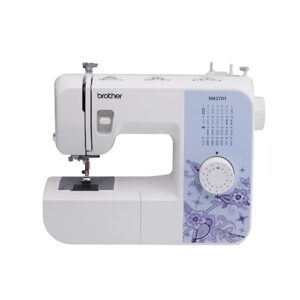
At just $149, the Brother XM2701 punches well above its weight class. You get 27 built-in stitches, an automatic needle threader, and a jam-resistant drop-in bobbin—all in a 12.6-pound machine that fits practically anywhere.
The one-step buttonhole function alone saves beginners hours of frustration. Six quick-change presser feet handle everything from zippers to blind hems without breaking a sweat.
It won’t tackle heavy denim, but for garments, quilts, and everyday projects? Honestly, it’s hard to beat.
| Best For | Beginners and hobbyists who want an easy, reliable machine for everyday sewing projects without spending a lot. |
|---|---|
| Primary Use | General sewing |
| Skill Level | Beginner–Hobbyist |
| Material | Metal chassis |
| Price Range | Budget |
| Handedness | Universal |
| Warranty/Support | 25-year limited |
| Additional Features |
|
- Automatic needle threader and drop-in bobbin make setup quick and frustration-free
- 27 built-in stitches plus a one-step buttonhole cover most everyday sewing needs
- Lightweight and compact—easy to store, move, or use in a small space
- Struggles with thick fabrics like heavy denim, leather, or multiple layers
- Fewer features than computerized machines—no LCD screen or embroidery options
- The plastic spool pin can feel fragile with heavy regular use
Frequently Asked Questions (FAQs)
What tools do I need for pattern making?
You don’t need a fancy studio to get started. A cloth tape measure, L-square, French curves, dressmaking shears, tracing paper, tailor’s chalk, and pattern weights cover the essentials beautifully.
What do you need for sewing patterns?
To work with sewing patterns, you’ll need measuring tools, cutting tools, marking supplies, and the right paper. Think of them as your four-part toolkit — each one plays a specific role.
What are the 5 basic tools of sewing?
The five basics? A tape measure, fabric shears, tailor’s chalk, pins, and a seam ripper. Simple as that. Master these first, and everything else just makes the job easier.
How to hand sew with arthritis?
Arthritis doesn’t have to end your sewing story. Use ergonomic needles sized 70–80, sew in short 15–30 minute sessions, and warm your hands first. Small adjustments make a real difference.
Can I use digital software to create sewing patterns?
Digital software lets you draft, grade, and simulate patterns entirely on screen.
You can resize designs instantly, preview 3D fit on avatars, and export files for cutting machines — all without wasting paper.
What test fabric should I use before cutting?
Cheap calico or muslin is your best bet. Cut a 25 by 25 centimeters swatch, wash it, and inspect for shrinkage, color bleeding, and drape quality.
This critical step ensures no mistakes when handling your actual fabric later. Always test before a single pair of scissors touches your real material.
Do I need a mannequin to fit my toile?
Not necessarily. A dress form is helpful for complex fits, but you can drape muslin directly on your body, pin adjustments while wearing it, and get equally accurate results.
How do I transfer pattern markings onto fabric?
Ironically, the fanciest tool here is just a humble tracing wheel. Roll it over your pattern edges onto carbon paper beneath the fabric — clean lines, instant transfer, no guesswork.
What is the best surface for cutting fabric patterns?
A self-healing cutting mat on a sturdy, flat table is your best bet.
It protects your blades and keeps fabric from shifting.
The built-in grid helps you align grain lines perfectly.
Conclusion
Funny how a junk drawer pen and borrowed kitchen scissors feel like enough—until you’re staring at a blouse with one shoulder higher than the other. Knowing what tools you need to use sewing patterns isn’t just trivia; it’s the difference between a garment you wear and one you hide.
Every ruler, tracing wheel, and rotary cutter earns its place. Building your toolkit right the first time ensures the pattern always has a fighting chance.
- https://thefoldline.com/blogs/pattern-series-get-ready-to-sew/the-sewing-pattern-tutorials-7-top-10-pattern-cutting-tools-for-fitting-and-tracing
- https://www.thesewingretreat.co.uk/post/5-essential-pattern-cutting-tools-books-and-mannequins-to-start-creating-your-own-sewing-patterns
- https://www.wawak.com/cutting-measuring/pattern-making-paper-supplies/pattern-tools/?srsltid=AfmBOoo-_pMp27fpNNa0eg9jlDXlZx58KuQHnMH1KAVFLQadwIv1LJSg
- https://scissortailquilting.com/product-reviews/a-review-of-fabric-marking-tools-and-a-few-tips-tricks-for-successful-fabric-marking/
- https://madamsew.com/blogs/sewing-blog/how-do-these-7-fabric-marking-tools-stack-up?srsltid=AfmBOorpCMwhU8rWzaXB5_VY2SrEzNjiWJ6iCplz6ZbrgxM-2kVXDPgE