This site is supported by our readers. We may earn a commission, at no cost to you, if you purchase through links.

Somewhere between scissors and fabric, something unexpected happens. You cut away the top layer, and suddenly a whole new design blooms underneath—bolder, deeper, more alive than anything you stitched on top. That’s the quiet magic of reverse appliqué quilt patterns, a technique the Kuna people of Panama and Hmong textile artists mastered centuries before modern quilters discovered it.
Most quilters spend years adding to their fabric—layering, piecing, building up. Reverse appliqué flips that instinct: you remove to reveal. The contrast does the heavy lifting, and the results can stop a room cold.
This guide walks you through everything: fabric choices, cutting techniques, pattern ideas, and the small adjustments that separate clean results from frustrating ones.
Table Of Contents
Key Takeaways
- Reverse appliqué works by cutting away the top fabric layer to reveal a contrasting one beneath, giving your quilt real depth without adding a single extra piece.
- Firm 100% cotton in high-contrast pairings — think black and white or red and teal — does most of the visual heavy lifting for you.
- Slow, precise cuts with the right tools (a hobby knife, cuticle scissors, or buttonhole scissors) are what separate clean results from frayed, frustrating ones.
- Don’t toss your cut-out scraps — fuse them onto a coordinating block and you’ve essentially got two quilt tops from one project.
What Are Reverse Appliqué Quilt Patterns?
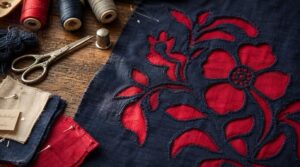
Reverse appliqué flips the script on traditional quilting — instead of adding fabric on top, you cut away the upper layer to reveal what’s underneath. It’s a simple idea that creates stunning, recessed designs with real depth and contrast.
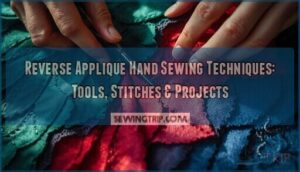
For the finishing touch, hand sewing reverse appliqué techniques give you precise control over those raw edges, keeping the look intentional rather than frayed.
Reverse appliqué cuts away the top layer to reveal hidden fabric beneath, creating designs with striking depth and contrast
Here’s what you need to know to get started.
Cutaway Appliqué Basics
Cutting away the top layer to reveal what’s underneath — that’s the whole idea behind cutaway appliqué. You stack fabrics, slice through the top, and let the color beneath do the talking. It’s Color Blocking Theory made tactile.
Traditional reverse appliqué often employs the needle‑turn appliqué technique for a clean edge finish.
Here’s what makes it work:
- Layering fabric with strong contrast
- Fabric cutting along planned paths using smart Cutting Blade Selection
- Heat Bonding Tips to lock your fabric backing in place
Traditional Versus Reverse Appliqué
Traditional appliqué stitches shapes on top, while reverse appliqué pulls the design from beneath—Layer Visibility is the whole game. Historical origins trace back to Kuna Molas and Hmong textiles, where fabric layering told stories through cutouts. Edge Finishing differs too: traditional turns edges outward, reverse tucks them in. Stitching Speed runs faster by machine, and Pattern Adaptability is what makes this appliqué technique so powerful across quilting methods.
Best Pattern Styles
Pattern choice shapes everything. High Contrast pairings make your reverse appliqué design pop instantly.
Floral Negative Space captures the eye with botanical cutouts that feel alive.
Geometric Tessellation creates rhythm across your quilt pattern design.
Abstract Freeform breaks all the rules beautifully.
Layered Edge Definition highlights every stitch line as part of the design motif.
Pick your style — then commit.
Beginner-friendly Design Features
Starting simple isn’t settling — it’s smart.
Beginner-friendly reverse applique patterns give you:
- Large Motifs with Visible Stitch Lines so you always know where to cut
- Simple Color Palette — one light, one dark — for instant contrast
- Generous Seam Allowance with Guided Transfer Grids so your easy quilting patterns line up perfectly
Fullsize designs mean no enlarging needed. Just trace and go.
Best Fabrics and Tools
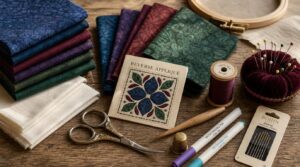
The right materials make reverse appliqué so much easier — and honestly, more enjoyable. Before you cut a single thread, knowing what’s in your kit sets you up for clean results every time.
One tool worth having on hand is a good pair of buttonhole scissors for clean fabric cuts — they let you open up layers precisely without nicking anything you want to keep.
Here’s what you’ll want to have on hand.
Firm Cotton Fabrics
Firm cotton is your best friend in reverse appliqué. Look for durable weave types — plain or twill — that hold crisp edges when you cut.
Mercerization benefits your fabric selection by boosting strength and dye uptake, giving you colorfastness that holds wash after wash.
Thread count matters too: denser weaves mean cleaner cuts and sharper results in your reverse appliqué patterns.
High-contrast Fabric Pairings
Contrast is everything in reverse appliqué. Your fabric layering technique lives or dies by how boldly your layers speak to each other. Smart palette selection makes design motifs pop instantly.
- Black + white — sharpest contrast, cleanest edges
- Navy + ivory — bold but softer
- Red + teal — color theory at its best
- Fuchsia + emerald — saturated, striking
These bold combos and shade pairings transform reverse appliqué patterns completely.
Fusible Web Options
For reverse appliqué, adhesive strength is everything — and not all fusible web delivers equally. Single‑sided web works beautifully for fabric layering, bonding clean and flat. Try repositionable fusible first; it allows placement adjustments before final commitment.
Always match heat settings to your fabric compatibility: use HeatNBond for cotton, while gentler options suit delicate materials. Test your chosen product and settings before finalizing your design to ensure optimal results.
Precision Cutting Tools
Your cutting tools make or break the whole project. A precision knife or hobby knife manages tight curves cleanly—think microedge geometry that stays sharp through dozens of cuts.
Cuticle scissors and buttonhole scissors reach awkward angles without slipping, ensuring precision in delicate work.
Look for tools with runout tolerance and vibration damping built into the handle, which enhance stability and control during use.
Features like coating hardness and flute optimization maintain edge integrity, keeping blades true every single time.
Needles, Thread, and Feet
Your needle, thread, and foot combination matters more than you’d think. Use a No. 8 sharp needle for hand work — ballpoints for knits, sharps for woven cotton.
All-purpose sewing thread manages most projects, but braided thread strength wins on layered builds. Control thread tension carefully to prevent puckering.
Swap in a walking foot for even feeding, or a free motion quilting foot for decorative stitching.
How to Sew Reverse Appliqué
Sewing reverse appliqué comes down to a handful of steps you’ll want to nail every time. Once you get the sequence down, the whole process starts to feel like second nature.
Here’s exactly how to work through it.
Trace The Pattern
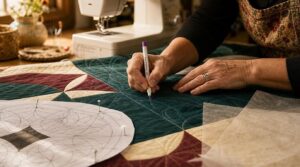
Start with your reverse appliqué patterns and trace every line with precision — this step sets everything up. Use a heat-erasable marker tool so lines vanish after stitching. Fusible web guides keep pieces locked in place.
Download PDF patterns or print patterns for reusable tracing templates.
Keep stitch length control tight. Accurate tracing means cleaner cuts ahead.
Layer The Fabrics
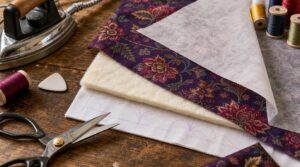
Now that your pattern is traced, it’s time to build your layers. Start with a moisture-wicking base fabric — firm cotton works best. Add your insulating mid-layer, then place the protective outer layer on top.
Apply fusible web to bond everything tight. Watch your seam allowance management here — clean edges start with careful fabric preparation. That’s your double layer quilting foundation set.
Cut The Design
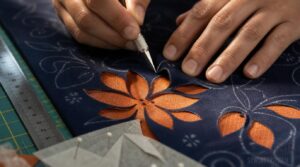
With your layers set, it’s time to cut. Grab a precision knife or utility knife — slow, steady strokes beat rushing every time. Use cutting mat guides for straight lines and sharp corners. Stabilizer layering keeps everything from shifting mid-cut.
For complex floral or geometric shapes, vector pattern sources give you clean lines. Cut carefully. Those cut-out pieces reveal your reverse appliqué technique in action.
Turn and Press Edges
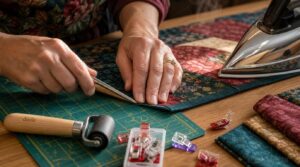
Your cuts are done — now fold raw edges under. A narrow seam allowance (around 3/16 inch) minimizes bulk. Use an edge turner tool to push fabric cleanly, then secure the fold with a seam roller technique.
For pressing, always use a dry, hot iron to achieve crisp results.
Maintain fabric stability with grain alignment methods, ensuring everything lies flat without repositioning.
Stitch by Hand or Machine
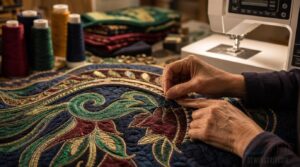
Now your edges are pressed and ready — time to stitch. Hand stitch precision wins on tight curves and tiny motifs, while machine stitch consistency manages long borders fast. Can’t choose? A hybrid stitch approach gives you both.
Match your needle selection to your fabric weight, and watch how stitch length effects on tension influence the outcome. These adjustments ensure your technique aligns with the material’s demands.
With these elements balanced, your reverse applique technique comes together cleanly every time.
Reverse Appliqué Pattern Ideas
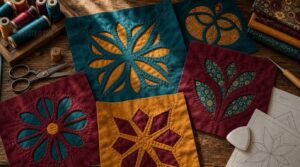
Now comes the fun part — choosing what to make. Reverse appliqué works beautifully across a wide range of projects, from bold quilt blocks to everyday home accessories.
Here are some pattern ideas to spark your next creation.
Floral Quilt Blocks
Flowers are where reverse appliqué truly shines. Consider daisy blocks built from petal geometry—eight small squares framing a center motif, all revealed by cutting away the top layer.
Experiment with bloom scaling to transition from a 6-inch poppy to a 12-inch peony.
Employ contrast techniques and seasonal color palettes to ensure every reverse appliqué design pops.
Geometric Quilt Designs
Geometric shapes hit different with reverse appliqué. Grid Precision keeps your squares, triangles, and hexagons crisp — no wonky edges. Try Tessellation Strategies to lock shapes together seamlessly.
Shape Symmetry and Color Blocking create bold, graphic impact. Want Optical Illusions? Stack triangles or diamonds in your reverse appliqué design.
This fabric manipulation technique turns any appliqué quilt pattern into a show-stopping Reverse Applique Quilting Technique masterpiece.
Decorative Quilt Borders
Borders make or break a quilt — and reverse appliqué design elevates them further. Use Checkerboard Borders for bold rhythm, or opt for Contrast Color Frames to create sharp visual stops. Motif Stitch Borders introduce texture, while Mitered Corners ensure polished edges.
Prioritize Border Width Balance during construction to harmonize your quilt’s overall design. This attention to detail ensures reverse appliqué patterns feel intentional, cohesive, and stunning.
Table Runners and Pillows
Your table runner is the first thing guests notice. Use reverse appliqué patterns to make it unforgettable.
- Match your Color Coordination to seasonal themes — navy and white for winter, warm ochre for fall
- Layer Texture Contrast between linen and cotton for visual depth
- Echo your reverse appliqué design on coordinating pillow inserts
- Follow a simple Maintenance Guide: gentle cycle, air dry, roll for storage
Wall Hanging Patterns
A wall hanging transforms any room into your own gallery of reverse appliqués quilts.
Use Custom Silhouettes and high-contrast pairings—deep navy on white, bold red on black—for instant visual balance.
Scale your reverse appliqué design to ceiling height, then mount it with DIY Hanging Systems like a simple dowel.
Swap seasonal themes to keep your reverse appliqué method feeling fresh year-round.
Tips for Better Results
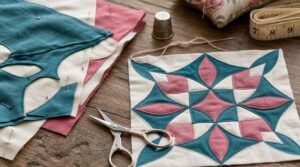
Small habits make a big difference in reverse appliqué. A few smart moves can take your work from "pretty good" to really polished.
Here’s what to keep in mind as you stitch.
Prevent Fraying Edges
Fraying edges can quietly ruin a beautiful reverse appliqué method. Don’t let that happen. Here’s how to lock down every raw edge finishing choice:
- Run zigzag stitching along cut edges — 2.5–4.0 mm width works great.
- Apply edge sealant or fusible interfacing for extra protection.
- Use pinking shears for quick decorative cuts, or French seams where appliqué stitching meets visible sections.
Avoid Puckering Fabric
Puckering sneaks up fast. Lock it down before it starts.
Pre-wash fabrics to prevent shrinkage surprises. Use light interfacing to stabilize layers, then baste them together before machine sewing.
Set your stitch length to 10–12 stitches per inch. Balance thread tension by loosening the top slightly.
Whether you’re using a walking foot or free-motion quilting foot, smooth reverse appliqué patterns start here.
Quilt Negative Space
Now that your layers lie flat, put that negative space to work. Empty background fabric isn’t wasted space — it’s visual breathing room. Think Notan composition: quiet color fields and rhythmic emptiness balance your reverse appliqué patterns.
Simple, evenly spaced quilting lines maintain negative space balance without competing with cut motifs. Your background fabric becomes the unsung hero of the whole design.
Reuse Cutout Pieces
Those cutout pieces you just removed? Don’t toss them. Every shape is a second chance — fuse them onto a coordinating block for instant Cutout Color Pairings with no repositioning needed. Smart Scrap Storage Tips: sort by color family in labeled bags.
Your Motif Planning gets sharper, Negative Space Balance stays intentional, Edge Reinforcement holds clean, and suddenly you’ve got two quilt tops from one project.
Choose Downloadable Patterns
Now that you’re saving scraps, save yourself time too. Grab digital pattern downloads instead of hunting stores.
- Check file size considerations — 2–20 MB is normal
- Follow print scaling tips so pieces print true-to-size
- Review license restrictions before copying
- Explore colorway customization options
- Confirm pattern format compatibility with your printer
Your download link arrives instantly. Start cutting today.
Frequently Asked Questions (FAQs)
What fabric is best for reverse appliqué?
Firm 100% cotton wins every time. It holds shape, presses crisply, and frays less. Denim stability makes bold cutouts pop. Knit flexibility suits raw-edge work.
Always prioritize weight matching and stabilizer compatibility for clean results.
What is reverse appliqué quilting?
Reverse appliqué flips the script on traditional appliqué. Instead of adding fabric on top, you cut away the upper layer to reveal a contrasting fabric beneath — creating natural visual depth through layered construction.
How did Kuna Indians originally develop Mola techniques?
Kuna women transformed body painting into fabric art after missionary contact brought trade cloth and needles.
Through female apprenticeship and cosmological symbolism, mola reverse appliqué patterns evolved — layered, cut, and stitched with purpose.
What is the history of appliqué across different cultures?
Appliqué is nearly 3,000 years old. It traveled the Silk Road diffusion routes, blending cultures along the way — from African geometric motifs to Hmong paj ntaub and vibrant Mola heritage panels.
How do you care for and wash finished appliqué quilts?
All that work, and a rough wash ruins it.
Use cold water, gentle washing, and mild soap. Treat stains fast.
Air-drying flat keeps its shape. Store in breathable cotton.
Inspect stitches often.
Conclusion
Ancient quilters called it "cutting to the truth"—and they weren’t wrong. Reverse appliqué quilt patterns hand you that same power: subtract the surface, expose something richer beneath.
You’ve got the fabrics, the tools, the techniques. Now the only thing left is the first cut. Make it clean. Make it deliberate. That moment when the hidden layer blooms through?
That’s not just good quilting. That’s your hands finally saying exactly what you meant.
- https://creativiu.com/quilting-posts/all-about-applique-how-to-reverse-applique-for-quilt-projects/
- https://odite.in/blogs/news/history-of-applique-embroidery-an-in-depth-exploration
- https://littlelizardking.com/blogs/little-lizard-king-blog/reverse-applique-with-hand-embroidery?srsltid=AfmBOoqATVabiCJjb6tVlBCcmXdthwR63gBnO3U7fKfLwQ0Z4vJnsWzz
- https://thequiltshow.com/quiltipedia/what-is-reverse-applique
- https://www.americanquilter.com/eye-of-the-beholder/