This site is supported by our readers. We may earn a commission, at no cost to you, if you purchase through links.
Somewhere in Hawaii in the 1840s, a woman traced the shadow of a breadfruit leaf onto folded cotton — and in that quiet moment, a quilting tradition was born. What emerged wasn’t patchwork in the European sense, but something far more deliberate: bold, singular silhouettes cut from a single piece of fabric, each one carrying the shape of the islands themselves.
Hawaiian appliqué quilting style grew from that instinct to translate living nature into cloth, blending missionary needlework with deep Polynesian symbolism. The result is a style unlike anything else in textile history — radially symmetrical, two-fabric, and encoded with meaning that only the maker fully understands.
Table Of Contents
Key Takeaways
- Hawaiian appliqué quilting was born in the 1840s when a woman traced a breadfruit leaf onto folded cotton, blending missionary needlework with Polynesian symbolism into a radially symmetrical, two-fabric art form unlike anything else in textile history.
- Every design is cut from a single, unbroken piece of fabric folded into eighths, then stitched onto a white or cream background — a process that demands precision but produces bold, living silhouettes that radiate outward like ripples on water.
- The motifs aren’t decorative choices — breadfruit, taro, ti leaves, and hibiscus each carry layered cultural meanings called kaona, encoding ancestry, protection, and identity into every stitch in ways only the culturally fluent can fully read.
- Antique Hawaiian quilts with strong provenance can fetch $10,000 to $60,000 at auction, reflecting not just collector demand but the enduring power of a tradition passed down through kitchens and quilting circles for nearly two centuries.
What is Hawaiian Appliqué Quilting?
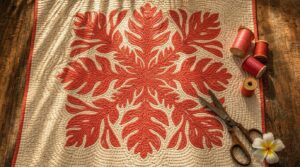
Hawaiian appliqué quilting is one of those crafts that looks simple at first glance but carries layers of meaning, history, and skill in every stitch. It has its own distinct rules — from the bold two-fabric designs to the way each pattern echoes outward across the quilt surface.
Each finished Hawaiian quilt reflects a deeply personal journey, much like the broader story of how quilters evolve across patchwork and quilting traditions.
Here’s what fundamentally defines this style.
Single-piece Appliqué Silhouettes
Hawaiian appliqué design is built on one powerful idea: a single, unbroken piece of fabric becomes the entire motif. These silhouette motifs are cut whole — no separate inner pieces, just one bold shape against a neutral ground.
Fabric weight matters here; too light, and the design loses definition.
Careful placement, balance, and negative space let traditional Hawaiian motifs breathe, while needle turn appliqué and edge stitching keep every contour crisp and culturally intentional.
A common machine‑assisted method is needle turn appliqué technique, which secures edges quickly.
Radial Medallion Symmetry
That single silhouette doesn’t just sit on the fabric — it radiates outward.
Hawaiian appliqué medallion quilts are built on radial symmetry: one central hub scales the entire design, and motifs rotate outward at precise angular intervals. Concentric ring proportion keeps each layer balanced, while radial color sequencing guides the eye naturally from center to edge.
The result is a breathtaking, symmetrical design that feels alive.
Two-fabric Quilt Design
What makes Hawaiian applique so visually striking is its commitment to simplicity: just two fabrics, never more.
A large piece of solid-colored fabric becomes your appliqué design, cut and layered against a contrasting background. Precise edge alignment keeps every silhouette clean, while minimal border allowance sharpens the focus.
Fabric contrast selection — bold color against neutral — does all the heavy lifting. That restraint is the whole point.
White Background Tradition
That two-fabric restraint leads naturally to the white or cream fabric ground — and there’s real intention behind it. White backgrounds are a cornerstone of traditional forms, chosen for light reflectivity and contrast emphasis: the appliqué colors pop cleanly, edges read sharply.
The purity symbolism also matters, honoring cultural preservation through an uncluttered surface.
In exhibition judging and conservation practices, that crisp white field still sets Hawaiian appliqué apart.
Echo Quilting Finish
Once the appliqué is set, echo quilting creates concentric lines of stitching outward from each edge — like ripples spreading across still water. Spacing rhythm matters: keep 1/8 to 1/4 inch between layered echoes for clean depth.
A walking foot technique feeds all layers smoothly and evenly, ensuring structural integrity.
Thread contrast and careful machine settings make every line sharp, honoring Hawaiian quilting’s tradition of cultural preservation through meticulous detail.
History of Hawaiian Appliqué Quilts
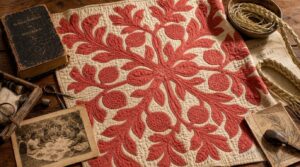
Hawaiian appliqué quilting didn’t appear out of nowhere — it grew from a series of real moments, real people, and real decisions made over more than two centuries.
The tradition carries layers of history that most quilters today never fully hear.
Here’s where it all began.
Missionary Sewing Influence
It all started with New England missionaries arriving in the 1820s, bringing needles, thread, and Christian gender norms that shaped Hawaiian women’s daily lives.
Sewing circles became more than craft time — they were mission school curriculum in action, blending literacy stitching with European fabric exchange.
That colonial influence on crafts quietly planted the seeds for what we now recognize as Hawaiian appliqué quilting.
Early Cotton Patchwork
Cotton scraps were currency in 19th century Hawaiian homes — nothing went to waste. Scrap utilization shaped early Hawaiian quilting, with women stitching geometric block patterns from worn garments and household linens using hand stitching methods rooted in economic resourcefulness.
Natural dye techniques produced earthy, vivid tones on locally available fabrics:
- Light backgrounds highlighted colonial influence on crafts brought through missionary fabric exchanges
- Simple shapes maximized every scrap into appliqué quilting foundations
- Each bedsheet-sized piece carried a family’s resourceful story forward
Breadfruit Shadow Inspiration
One shadow changed Hawaiian quilting forever. Legend holds that in the 1840s, a breadfruit ulu tree’s shadow fell across cloth—and a quilter traced it. That outline became the first nature-inspired motif in Hawaiian appliqué quilting.
The grain-aligned silhouette, stitched with contrast fabric pairing and stippled texture details, expressed cultural identity beautifully.
Focal shadow placement and shadow scale gradient gave each piece its quiet, unmistakable power.
Family-taught Quilting Traditions
Hawaiian quilting didn’t spread through classrooms — it traveled through kitchens, front porches, and quilting circles where native quilters gathered to stitch and share. Intergenerational mentorship shaped every lesson: grandmothers guided hands, oral storytelling connected fabric patterns to family heritage, and fabric scrap reuse taught resourcefulness.
Seasonal quilting rituals marked celebrations, while quilt ledger records preserved names and dates.
Heritage education lived in community building, not textbooks.
Hawaiian Flag Quilts
Few quilts carry as much political weight as Hawaiian flag quilts. Emerging during the reigns of King Kalākaua and Queen Liliʻuokalani, these pieces centered on a Royal Coat-of-Arms medallion within a Four-Flag Symmetry layout — a quiet Sovereignty Expression stitched in fabric.
Flag Stripe Variations accommodated central appliqué designs without losing their meaning. This adaptability preserved the quilts’ symbolic intent while allowing artistic flexibility.
Today, Museum Flag Exhibits and the Hawaiian Quilt Research Project safeguard these powerful examples of Hawaiian quilting heritage, ensuring their historical and cultural significance endures.
Traditional Motifs and Meanings
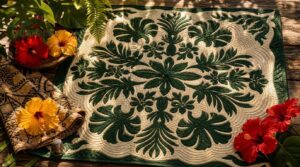
Every motif stitched into a Hawaiian appliqué quilt tells a story — one rooted in the land, the people, and the values passed down through generations. These designs aren’t decorative choices made lightly; each one carries cultural weight and personal intention.
Here are the traditional motifs you’ll encounter most often, and what they mean.
Ulu Breadfruit Designs
Few motifs carry as much weight as the ulu breadfruit in Hawaiian quilting. This appliqué design is a Cultural Resilience Symbol rooted in Generational Storytelling — breadfruit fed entire communities for centuries.
The Layered Fabric Method and Dimensional Stitching bring its lobed silhouette to life with veined leaves and shadowed curves.
Pattern Placement Theory centers the ulu boldly, honoring native plants, cultural heritage, and island-inspired designs through every stitch.
Hibiscus and Plumeria Motifs
If breadfruit speaks to sustenance, hibiscus and plumeria speak straight to the heart. In Hawaiian quilting, these nature-inspired motifs transcend mere decoration — hibiscus embodies beauty and feminine grace, while plumeria conveys warmth and hospitality.
Petal layering builds dimensional blooms, each anchored by a defined central pistil. Symbolic color contrasts, like vibrant pinks against pure white, amplify their significance. A floral border elegantly unifies the composition.
Taro Leaf Symbolism
Few plants carry as much weight as taro — the ancestral lineage of Hawaiian culture runs straight through its roots.
In Hawaiian quilts, the heart-shaped taro leaf isn’t just a beautiful fabric appliqué technique; it’s fertility symbolism made tangible, a protective emblem honoring community resilience and modern advocacy.
- Taro leaves represent ancestral connection and life cycles
- Spiritual symbolism ties the motif to abundance and land
- Cultural heritage quilting uses it to affirm belonging
Ti Leaf Protection
Where taro honors ancestry, ti leaves stand guard. In Hawaiian quilting, ti leaf motifs carry guardianship symbolism — a quiet but powerful form of cultural resistance stitched into every curve. The leaf’s natural moisture barrier inspired its ceremonial shielding role, protecting what matters most.
Sustainable harvesting keeps this nature-inspired motif alive, and durability testing confirms ti leaves’ lasting place in spiritual symbolism traditions.
Hidden Kaona Meanings
Every Hawaiian quilt holds a second conversation — one only the culturally fluent can hear. That’s kaona: the hidden meaning layered into motifs, color choices, and arrangement.
Every Hawaiian quilt speaks two languages — one visible, one only the culturally fluent can hear
Symbolic color codes signal ancestral place names and clan ties. Oral story integration brings seasonal ritual context alive during quilting circles.
Even cross-cultural kaona reflects modern shifts while preserving mana — the spiritual authority woven into Hawaiian quilting as cultural resistance and storytelling through textiles.
Hawaiian Appliqué Quilt Techniques
The magic of Hawaiian appliqué starts long before you thread a needle — it lives in how the fabric is folded, cut, and coaxed into shape. Every finished quilt traces back to a handful of core techniques that quilters have passed down through generations.
Here’s a closer look at the methods that bring these stunning designs to life.
Eighth-fold Cutting Method
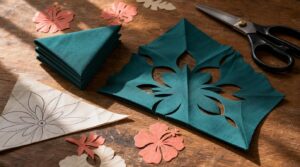
Fold a square of fabric into eighths, and something almost magical happens — angular division precision turns a simple cut into a radiant, symmetrical bloom. This paper cutting technique is the backbone of Hawaiian quilts. Each fold ensures seam alignment and uniform thickness across every petal and curve.
Template reuse keeps your island-inspired designs consistent, while radiant gap spacing lets the appliqué breathe beautifully against its background.
Paper Snowflake Patterns
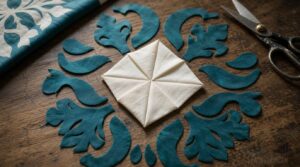
Think of a paper snowflake as your design blueprint. Fold your fabric or paper using the same paper cutting technique — into eighths — then cut geometric motifs: triangles, curves, arcs. Layered transparency reveals the full radial pattern before committing scissors to fabric.
These folding techniques mirror what Pennsylvania Germans brought to American craft traditions, and Hawaiian quilts adopted them beautifully for their bold, nature-inspired appliqué silhouettes.
Needle-turn Appliqué Stitching
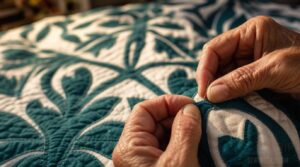
Needle turn appliqué is where Hawaiian quilts truly come alive. You tuck the seam allowance under with your needle as you stitch — no raw edges, no fuss. Thread matching is everything here; choose fine cotton that disappears into the fabric fold.
Select a sharp appliqué needle for clean penetration. Basting tips: lightly secure curves first. This ensures smooth, controlled stitching.
Seam-allowance hiding keeps every edge crisp and invisible, achieving the signature refined look of Hawaiian appliqué.
Raw-edge Appliqué Options
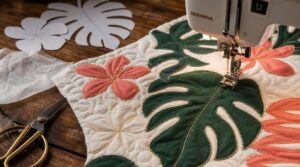
Raw-edge appliqué offers a softer, more relaxed finish than needle-turn, and it’s a legitimate choice in contemporary Hawaiian quilts. You leave the fabric edge unturned, letting it fray slightly for texture. Fusible stabilizers hold shapes in place before stitching, while die-cut templates ensure precise silhouettes.
A walking foot use guarantees even feed during stitching. Metallic thread accents add subtle shimmer along the frayed edges, enhancing the stylistic appeal of this technique.
Concentric Echo Quilting
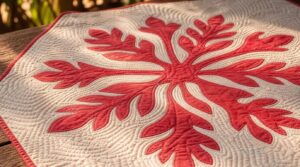
Echo quilting is where Hawaiian quilts truly come alive. Concentric lines of stitching radiate outward from your appliqué like ripples on still water — and that’s no accident. This traditional quilting method transforms a flat appliqué quilt style into something dimensional.
Use free-motion echoes for organic curves or a walking foot for steady ring spacing. Spiral layering adds depth, while thread contrast defines each ring.
Fabrics, Colors, and Modern Uses
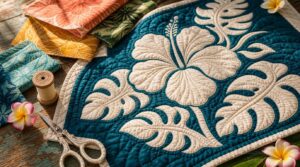
The fabric and color choices behind a Hawaiian quilt aren’t just practical decisions — they are part of the tradition itself. From the bold two-tone palettes of the past to the heirloom quilts gifted at life’s biggest moments, every choice carries meaning. Here’s a closer look at what makes these elements so central to the craft.
Solid-color Appliqué Fabric
Solid-color fabric is the heart of Hawaiian quilts — one large piece of solid-colored fabric does all the visual work. Weight considerations matter here: quilting cotton between 110–140 g/m² gives you the ideal balance for the fabric appliqué technique. Look for:
- Reactive dyes for lasting color
- Pre-wash protocols to prevent shrinkage
- Specialty finishes for clean edges
- Sustainable sourcing for responsible crafting
Cotton Background Choices
The background fabric anchors everything beneath it. While a large piece of solid-colored fabric carries the design, your background provides essential structure. Archival cotton — pre-washed, tight-weave, acid-free — resists yellowing and enables clean basting without distortion. This foundation is critical for long-term stability.
| Background Type | Best Use |
|---|---|
| Bright white cotton | Maximum appliqué contrast |
| Warm cream | Vintage, heirloom feel |
| Ivory/eggshell | Neutral, balanced clarity |
| Subtle woven texture | Depth without distraction |
| Modern blend selections | Easy care, minimal shrink |
Texture contrast shapes the whole mood, adding dimensional richness without overwhelming the design. Selecting the right base fabric—whether smooth or subtly textured—elevates the entire composition.
Lightfastness considerations and dye bleed prevention matter equally. Always pre-test high-quality printed and dyed fabrics to ensure color stability. This diligence allows hand-dyed quilting fabric to achieve its full vibrant potential. Smart fabric selection here makes hand-dyed quilting fabric truly shine.
Traditional Bright Palettes
Color does a lot of the storytelling in Hawaiian quilts. Traditional makers reached for brightly colored fabric — bold red symbolizing courage, royal blue deepened by indigo dyes, yellow for sun-warmed floral motifs, green pairings that echo tropical foliage, and orange accents at flower centers.
These hot and cold colours, layered against white in appliqué medallion quilts, create that unmistakable vivid Hawaiian presence.
Contemporary Color Variations
Today’s makers aren’t abandoning tradition — they’re expanding it. Jewel Tone Pairings like emerald with crisp white push Hawaiian quilts into bold new territory, while Pastel Accent Integration softens blush or pale mint against deeper hues. These approaches honor heritage while embracing contemporary aesthetics.
Gradient Ombre Blocks adds movement, and High Contrast Backgrounds makes appliqué pop dramatically. Such techniques transform flat compositions into dynamic, visually arresting works.
Micro Palette Cohesion keeps every color choice intentional — fresh expressions of a deeply rooted craft.
Heirloom Gift Quilts
Few gifts carry as much weight as a Hawaiian appliqué quilt made to last generations. Using durable fabrics and traditional quilting methods, these memory quilts tell family stories through Hawaiian quilt patterns, custom labels, and carefully chosen motifs.
Their display versatility—wall hanging or heirloom bedcover—makes them endlessly practical.
With thoughtful preservation care, your heritage-crafts piece becomes generational storytelling stitched into the fabric.
Frequently Asked Questions (FAQs)
How large are standard Hawaiian appliqué quilts?
Most Hawaiian appliqué quilts follow standard bed size ranges, commonly ranging from 86 to 100 inches square.
A common centerpiece dimensions target around 88 to 92 inches — suitable for a queen bed without overwhelming the quilt top design.
Can Hawaiian quilts be made by machine?
Yes, you can. Machine quilting speeds up production while keeping stitch length consistent.
Many quilters use a hybrid workflow — machine appliqué for the base, hand quilting for echo lines — balancing thread weight and traditional feel.
What thread works best for invisible appliqué seams?
For nearly invisible stitches, select 004 monofilament nylon on light fabrics or cottonized polyester for a matte finish.
Match thread to your background, not the appliqué, and drop your top tension slightly to achieve seamless results.
Where can you learn Hawaiian quilting today?
You can find classes at community center workshops, private studio classes, and University Extension programs across the islands. Online courses and the Meander Guild’s online quilting community connect learners worldwide.
Do Hawaiian quilts hold monetary or collectible value?
Absolutely — antique pieces with strong provenance and unblemished stitching can command $10,000 to $60,000 at auction.
Collector demand for flag quilts especially reflects serious investment potential rooted in indigenous art and heritage craft preservation.
Conclusion
Picture that first woman in Hawaii, smoothing a breadfruit leaf against folded cotton, trusting her hands to make something lasting. That same instinct lives inside Hawaiian appliqué quilting style — the urge to press nature into cloth and hold it there.
When you cut your first silhouette, fold your first eighth, and pull your needle through, you’re not just making a quilt. You’re continuing a conversation that began in the islands nearly two centuries ago.
- https://shannon-brinkley.com/blogs/shannon-brinkley-studio-1/an-introduction-to-hawaiian-applique
- https://kapaiastitchery.com/hawaiian-quilting-history/
- https://www.kristamoser.com/post/hawaiian-history-of-quilting?srsltid=AfmBOoqQejBYrMt9PDSzfraufgD2z63MECaGihIotojRiC1w7o-FENF9
- https://www.ksbe.edu/article/this-ohana-of-hawaiian-quiltmakers-weave-aloha-into-every-stitch
- https://bitsofaloha.com/blogs/news/the-history-of-hawaiian-quilting-applique-art?srsltid=AfmBOoqBsix9PUMbBJLzYYDXFJiY4hfb_2mdxPPX0tHfUz5y1twIWg8i