This site is supported by our readers. We may earn a commission, at no cost to you, if you purchase through links.
Most quilters discover machine appliqué the same way—by ruining something they loved. A shape shifts mid-stitch, an edge frays past saving, or the tension goes haywire on a curve that looked simple in the pattern. It’s frustrating, but it’s also fixable.
The difference between a ragged result and clean, confident appliqué hinges on decisions made before stitching begins. Edge method, stabilizer choice, thread weight, and stitch settings—each choice compounds the others. When these elements align, machine appliqué transforms from damage control into the satisfying, creative process it was meant to be.
Table Of Contents
Key Takeaways
- Your edge method—raw, turned, or needle-turn—sets the tone for everything else, so choose it based on your project’s complexity and how much prep work you’re willing to do.
- Prep work like prewashing, using freezer-paper templates, and starching your fabric isn’t optional busywork; it’s what keeps your shapes crisp and your edges from fraying mid-project.
- The right stabilizer, thread weight, and needle size work as a team—get one wrong and the others can’t save you, but when they align, your stitches practically disappear.
- Slowing down your machine speed, especially on curves, and dialing in your tension before you touch your actual project are two small habits that separate clean results from frustrating do-overs.
Choose Your Appliqué Edge Method
The edge method you pick shapes everything — how your appliqué looks, how long it takes, and how forgiving its when you’re just getting started.
Each approach has its own strengths depending on your project and how much hand-finishing you enjoy. Here are the main options to help you find your best fit.
Raw-Edge Appliqué Benefits
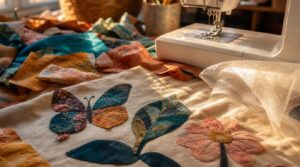
Raw-edge machine appliqué is honestly one of the most liberating techniques you’ll try. Skip the folding, skip the clipping — just cut your shape and go.
Fusible web gives you durable fusion that holds through washing, while lightweight layers keep your quilt top soft and drapable.
You gain genuine design freedom and textured visuals that feel intentional, plus quick assembly that makes complex scenes surprisingly manageable.
Using the least fraying method keeps raw edges tidy during washes.
Turned-Edge Appliqué Uses
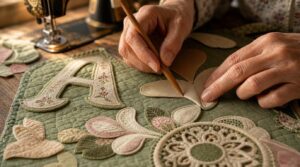
If you want something more polished — think petal shapes, letter appliqués, or delicate motifs — turned-edge machine appliqué is worth the extra prep.
Folding that tiny seam under gives you clean curved radii and edges that lie flat beautifully.
It also holds up in the wash surprisingly well, as tucked edges resist fraying far better than exposed ones ever will.
Invisible Needle-Turn Finish
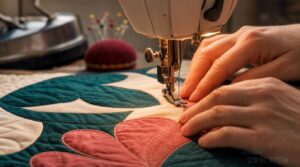
Needle-turn achieves a polished look through Turn Width Optimization—keeping folds between 1 and 2 millimeters to conceal stitches within the crease. Precise Edge Alignment and Stable Cotton Choice are critical; tight-weave fabrics resist fraying effectively, especially around curves.
A Light Press Creasing step before stitching sets the fold, enabling Invisible Edge Securing with tiny, blind stitches for a nearly seamless finish.
Seam Allowance Planning
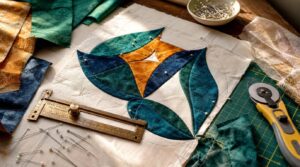
Once your fold is set, seam allowance planning becomes your next decision. Think of it as your Allowance Measurement Guide: a standard ¼ inch seam allowance works for most woven cottons, while lightweight fabrics need less to avoid bulk.
Curve Adjustment Rules matter too — outer curves need a touch more ease. For reversible projects, equal allowances on both sides keep everything aligned cleanly.
Best Method by Project
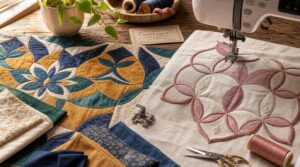
Your best method really comes down to the project itself. For bold quilts with heavy Layer Density Strategy, raw-edge machine applique with fusible web keeps things fast and flat.
Intricate Complexity-Based Method designs — think dense overlapping petals — call for turned-edge machine applique.
Use Visual Style Selection and Fabric Choice Guidance together: delicate fabrics favor finer Size-Driven Technique, while your open toe appliqué foot accommodates both beautifully.
Prepare Fabric, Templates, and Adhesives
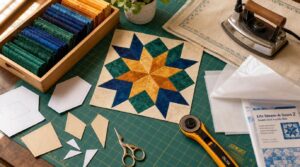
Good prep work is honestly half the battle in machine appliqué. Before you sew a single stitch, a few simple steps will make everything easier — from cutting to placement to final stitching.
Here’s what to take care of before you sit down at your machine.
Pre-Washing Quilt Fabrics
Skipping the prewash is one of those shortcuts that haunts you later. Cotton fabrics shrink 3–5% in their first wash, so washing before you cut keeps your finished quilt flat and true to size. It also controls dye migration between darks and lights before they’re permanently joined.
Skipping the prewash is a shortcut that shows up later — in shrinkage, shifting, and colors that bleed into each other permanently
Here’s a simple fabric preparation routine:
- Color Grouping — Separate darks from lights to prevent cross-color transfer.
- Shrinkage Control — Wash in cool water with mild detergent to minimize fabric shrinkage and distortion.
- Softening Effects — Prewashing removes sizing, improving needle bite and making pieces easier to handle.
- Air Drying — Lay flat or hang dry to avoid extra heat distortion.
Freezer-Paper Template Tips
Freezer paper is your secret weapon for appliqué precision. By pressing the shiny side down onto fabric, it provides a temporary bond with heat, ensuring stability for clean cuts without shifting. Good appliqué preparation begins with these templates, which serve as both guides and stabilizers, reducing guesswork and enhancing the precision of your fabric cutting tools.
| Template Detail | What to Do | Why It Matters |
|---|---|---|
| Shiny side placement | Face down on fabric | Bonds temporarily with heat |
| Grain alignment | Match template to fabric grain | Prevents stretching and distortion |
| Template size planning | Trace on dull side | Keeps design readable |
| Cutting tool selection | Use sharp fabric scissors or rotary cutter | Clean edges reduce fraying |
| Storage envelope labeling | Label by project and date | Can be reused up to 35 times |
Proper preparation starts here—freezer paper appliqué templates streamline your workflow, transforming fabric cutting into a more efficient, accurate process.
Using Fusible Web Correctly
Fusible web is deceptively simple — until you scorch your fabric or end up with pieces that peel off mid-quilt.
Get the adhesive side placement right first: always face it against the wrong side of your appliqué fabric.
Web Heat Settings and Temperature Calibration matter more than most quilters expect. Aim for 120–150°C.
Follow Press Pressure Guidelines firmly and evenly.
Starch for Cleaner Cutting
Starch is one of those quiet game-changers in appliqué preparation steps. A light spray starch application stiffens your fabric just enough to boost fabric cutting precision by around 40% — cleaner edges, sharper points, less fraying.
For Starch Selection, cornstarch-based or rice starch sprays work beautifully. The freezer paper starch method pairs especially well with templates since starch actually improves Template Compatibility, keeping freezer paper from shifting mid-cut.
Let your fabric dry fully before cutting — that Drying & Curing step sets the coating so edges stay crisp. After you’re done, Residue Removal is simple: warm water and quilting soap handle it cleanly.
Simple Shapes for Practice
Start simple — circles, squares, and triangles are your best teachers. The Circle Accuracy Drill trains your hands to ease curves smoothly, while Square Corner Control sharpens your edge-stitching instincts. Triangle Point Alignment gets you comfortable with miters fast.
Practice Shape Size Scaling by cutting pieces around 3 inches wide. Once you’ve mastered the basics of machine appliqué, try Combined Motif Building — flowers, houses, and animals — to advance your skills.
Stabilize for Smooth Stitching
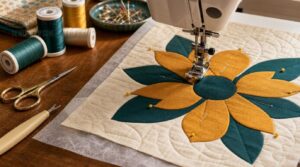
Even the most carefully prepared appliqué can go sideways the moment your machine starts moving — and that’s where stabilizers earn their keep. Choosing the right support underneath your fabric is one of those small decisions that makes a big difference in the finished result.
Here’s what you need to know to keep things flat, smooth, and exactly where you put them.
Tear-Away Stabilizer Uses
Placing a tear-away stabilizer beneath your appliqué pieces is a quilting tip that quietly solves many problems. It delivers edge crispness and bulk reduction while acting as a large area backing for machine appliqué on woven fabrics. It even manages free-motion support beautifully.
Use it as a quilt sandwich layer under dense designs, then tear it away after stitching.
Wash-Away Stabilizer Benefits
When tear-away isn’t practical—for example, on sheer voile or delicate batik—wash-away stabilizer becomes essential. It dissolves completely in warm water, leaving a residue-free finish with no stiff spots, ensuring fabric stabilization without sacrificing drape.
This approach delivers reduced stitch distortion during machine appliqué and enables simplified cleanup afterward. With full delicate fabric compatibility, the stabilizer disappears entirely after rinsing, preserving the fabric’s integrity. Just rinse, and it’s gone.
Adhesive Spray Control
Once the wash-away dissolves, you’re working with clean layers — and that’s exactly when adhesive spray control matters most.
Hold the nozzle at a consistent angle, about 12 inches from your fabric, and keep your spray pattern consistency even across the surface.
Application timing is everything: let the layer moisture settle for 30 seconds before pressing pieces down for reliable adhesive bonding.
Preventing Puckers and Shifting
Even with your adhesive dialed in, puckers can still sneak up on you. Before you hit the pedal, baste your appliqué pieces lightly and check your fabric grain alignment — off-grain layers fight each other all the way through.
Set your presser foot pressure to a middle setting, try an even feed walking foot for multiple layers, and balance your thread tension to keep everything flat and honest.
Set Up Stitches and Tension
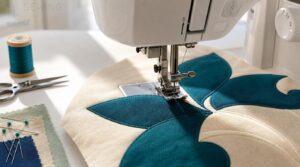
Getting your stitch settings dialed in is where machine appliqué starts to feel less like guesswork and more like control. A few small adjustments to tension, speed, and stitch style can make the difference between edges that pucker and ones that lie perfectly flat.
Here’s what to get right before you sew a single inch of your project.
Small Stitches for Neat Edges
Think of each stitch as a tiny anchor — and the smaller it is, the better it holds without showing. For neat edges, keep your stitch length between 1 and 2 mm; this range delivers consistent stitch results with strong edge fray prevention.
Adjusting stitch width for subtlety matters too — narrower settings reduce stitch visibility and let your thread density and needle entry angle work effectively in the background.
Raw-Edge Tension Adjustments
Raw-edge machine appliqué is unforgiving when tension is off — you’ll see it immediately in how the edge lays. Watch for slight waves or loops as you sew; that’s your cue for tension dial calibration. Balance bobbin tension with your top thread so stitches sink cleanly into the fabric.
Good fabric bite control and edge lay observation keep raw edge finishing neat and fray-free.
Invisible Stitch Tension Tips
Invisible machine appliqué lives or dies on tension calibration. Start with a thread test swatch — same fabric, same thread — before touching your actual quilt.
Balancing top and bobbin tension keeps stitches sinking into the layers rather than sitting on top.
Fine thread weight impacts visibility dramatically, so consistent stitch spacing and pressure control together create that smooth, almost-not-there finish you’re after.
Blind Hem Versus Zigzag
Both options do the job, but they’re not interchangeable. A blind hem stitch keeps blind hem visibility almost nonexistent — its occasional zigzag bites catch the edge while straight stitches carry the load.
A zigzag stitch offers better edge flexibility, especially with stretch variants on knits. It excels at stabilizing raw edges compared to the blind hem method.
Machine setting tweaks matter here: tighter stitch density impacts produce cleaner appliqué edge stabilization and a real reduction in stitch visibility. Proper adjustments ensure optimal results for both techniques.
Slow Speed for Curves
Sewing curves at full speed is like trying to write your signature while jogging — it just doesn’t go well.
Dropping to around 300 stitches per minute provides the micro stitch timing and speed accuracy balance needed for curve overshoot prevention. This slower pace directly addresses the core challenge of maintaining precision during curved stitching.
Additionally, reducing speed minimizes machine vibration control issues, which in turn keeps stitch consistency smooth around curved shapes. The result? Your appliqué techniques actually look intentional, with clean, controlled lines that reflect skill rather than haste.
Select Threads, Needles, and Feet
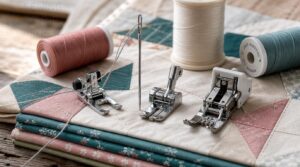
Once you’ve got your tension dialed in, the right thread, needle, and presser foot do more heavy lifting than most people expect. Small choices here make a real difference in whether your stitches disappear into the fabric or stand out like uninvited guests.
Here’s what to reach for.
Fine Thread for Subtle Stitches
Thread weight is the quiet hero of invisible machine appliqué. The lighter the thread, the less it announces itself on your fabric.
- Choose 60 wt thread for stitch visibility reduction on most cottons
- Consider monofilament options on sheers, but adjust tension carefully
- Prioritize ply consistency and smart thread storage to prevent dullness
Sheen selection matters too — matte finishes disappear; shiny threads catch light.
Matching Thread to Fabric
Color harmony testing is where good thread choices get confirmed. Hold your thread over the fabric near a window — natural light evaluation reveals what indoor bulbs hide.
For weight‑appropriate thread selection, lighter fabrics need finer threads so seams don’t stiffen. Fabric fiber pairing matters too: cotton loves cotton.
For busy prints, sheen compatibility and neutral tones win over exact color matching strategies every time.
Needle Size by Thread Weight
Once you’ve nailed your thread match, pairing it with the right needle makes all the difference. Think of the needle eye as a doorway — too narrow and the thread frays; too wide and it damages delicate fabric.
Here’s a quick needle size chart for thread-weight pairing:
- 80–100 wt fine thread → size 60/8–70/10 (fine thread needles keep holes tiny)
- 60 wt thread → size 70/10 (balanced needle eye sizing for invisible appliqué)
- 50 wt thread → size 75/11–80/12
- 40 wt thread → size 80/12–90/14 (heavy thread needles handle thicker diameters)
- 30 wt decorative thread → size 90/14–100/16
Needle size impact on stitch quality is real — wrong sizing causes puckering or skipped stitches fast.
Open-Toe Appliqué Foot
With your needle sorted, the right foot finishes the setup. An open-toe appliqué foot provides genuine visibility along the needle path, enhancing precision.
The snap-on attachment enables quick swaps, while the clearance adjustment ensures optimal stitch length control. Regular lint removal and pre-use machine compatibility checks are essential for smooth operation.
This unobstructed view significantly boosts confidence when navigating curves, transforming your stitching experience.
Troubleshooting Visible Stitches
Even with the perfect foot, stitches can still betray you. Tension mismatch is usually the first culprit—lower your top tension slightly if threads are pooling on the surface.
Stitch skipping often signals needle heat from too-fast sewing, so slow your speed down.
Edge curling? That’s a thread weight impact on visibility—swap to 80 wt thread for invisible machine appliqué results.
Frequently Asked Questions (FAQs)
How do I appliqué around tight inside corners?
Clip into inside corners with a tiny V-notch — that’s your Micro Notching move. Stitch Pull-Back keeps thread taut, while Corner Bias Cutting reduces bulk, giving turned-edge machine appliqué a clean, sharp finish every time.
Can I machine appliqué on stretchy fabric?
Stretchy fabric and machine appliqué? Sounds like a recipe for disaster — but it genuinely works.
Lock in fabric grain alignment, use a ballpoint needle, and thread elasticity keeps everything moving without popping seams.
Whats the best way to layer overlapping pieces?
Work from background to foreground, building your layer sequence so heavier pieces sit below lighter ones.
Weight distribution and grain alignment keep overlaps flat, while fusible web holds everything before your first stitch.
How do I finish appliqué edges after washing?
Think of your quilt like a freshly baked loaf — the washing is the oven test.
Use a satin stitch border or blanket stitch edge for reliable fraying prevention techniques after every wash.
Can beginners appliqué without a specialized sewing machine?
Yes — absolutely. Simple shapes like hearts and leaves work beautifully on budget-friendly machines with basic zigzag capability. Hand appliqué basics require nothing more than a needle, thread, and patience.
Conclusion
Think of machine appliqué quilting tips as a lock-and-key system—each decision you make before stitching unlocks the next one.
Choose the right edge method, and your stabilizer choice becomes obvious. Dial in your tension, and your thread finally cooperates.
No single tip works in isolation, but when they click together, something shifts. The shapes stay put, the edges lie flat, and that frustrating gap between your vision and your finished quilt quietly closes.
- https://blog.bernina.com/en/2024/10/raw-edge-reverse-applique-a-texture-experiment/
- https://www.nationalquilterscircle.com/post/machine-applique-stitch-finish
- https://www.stringandstory.com/blog/quiltingapplique
- https://suzyquilts.com/raw-edge-applique-tutorial/?srsltid=AfmBOopcyvYji0sIlwRJUB_TjP7jQJTU6_gHBEfI544THn5l4rNuYEPv
- https://www.superiorthreads.com/monopoly-clear-spool/p/119-01-CLEAR