This site is supported by our readers. We may earn a commission, at no cost to you, if you purchase through links.
Pins have a place in sewing—but that place isn’t holding down a tissue-weight silk pattern while your rotary cutter tries to track a straight line. One slip, one pucker, and you’re re-cutting. Pattern weights for home sewing studios solve this quietly and completely, letting fabric stay exactly where you put it without a single puncture mark.
The difference shows up fast. Delicate chiffon lies flat. Knit edges stop rolling. Long denim cuts move in one clean pass instead of three frustrated ones.
Getting the right weights—and placing them correctly—changes how your cutting table actually functions.
Table Of Contents
Key Takeaways
- Pattern weights eliminate pin damage and fabric drift by anchoring corners first, then spacing additional weights every 6–8 inches along long edges for uninterrupted rotary cutting.
- Matching weight material to fabric type is essential — smooth, rounded weights for silk and knits, cast‑iron for denim and canvas, and clear glass for precision visibility on medium‑weight fabrics.
- A consistent placement routine (corners locked before edges) prevents grain distortion and bias stretch that pressing can’t fix after the fact.
- Proper storage — color‑coded bins, padded dividers for glass weights, and a cleared cutting table before every session — keeps your workflow efficient and your weights ready to use.
What Are Pattern Weights?
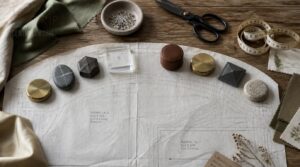
Pattern weights are flat, heavy objects you place on fabric to hold it in place while cutting — no pins required. They come in a range of materials, weights, and designs, each suited to different fabrics and skill levels. Here’s a look at five key reasons they belong in your home studio.
Whether you’re a beginner or a seasoned sewist, exploring pattern weights for quilting can help you find the right style and material for every project.
Pin-free Fabric Holding
Pattern weights serve as the ideal pin alternative, holding fabric and pattern pieces flat without puncturing a single thread. They deliver efficient layout stabilization across every edge and corner.
- No pinholes in delicate fabric
- Faster, cleaner repositioning mid-cut
- Continuous cutting motion without pausing
- Eliminating seam distortion at raw edges
- Full fabric stability across the layout
That’s pattern securing done right. We can use clip‑based pin alternatives to keep fabrics secure without damage.
Rotary Cutting Support
Skipping pins already keeps your layout cleaner — but rotary cutters demand even steadier control. Blade alignment precision stays within 0.02 mm when pattern weights anchor every corner, so your blade tracks the edge cleanly without drift.
A non-slip mat underneath stops fabric creeping mid-pass, letting you run continuous cuts without repositioning. That’s where weights earn their place on the cutting table.
Studio Workflow Benefits
Steady cuts are only half the story. Pattern weights transform your entire sewing workflow by eliminating pin holes, reducing fabric distortion, and keeping your layout locked while your hands stay free for continuous cutting speed.
- Fewer interruptions between cuts
- Cleaner fabric edges without punctures
- Faster, more efficient cutting process
That’s a real upgrade to any home studio routine.
Pattern Placement Accuracy
Cutting clean lines means nothing if your pattern has shifted half an inch before the blade even moves.
Weights placed on each corner anchor the piece firmly, while spacing them along long edges prevents the subtle fabric bias that throws off grain lines. That consistent downward pressure keeps every marking exactly where you placed it — no drift, no guesswork.
Safer Sewing Setup
Replacing pins with weights does more than speed up cutting — it removes a genuine hazard. Pins left on a cutting table create puncture risks, and a stray needle near the floor can mean a serious injury.
Good workspace habits compound that benefit: a bright task light, cords managed off the floor, and tools stored in closed holders keep your studio efficient and safe.
Choosing Weights by Fabric Type
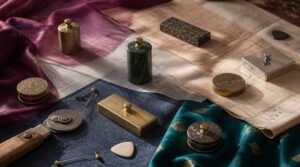
Not every weight suits every fabric — and choosing the wrong one can throw off your whole cut. The good news is that once you know what to look for, matching weights to fabric type becomes second nature. Here’s how to pair them correctly, starting with the most common fabrics you’ll work with.
Delicate Silk and Chiffon
Silk chiffon demands careful weight selection. Sand-filled or ceramic weights protect fabric integrity without snagging fine filaments or disrupting natural drape.
- Choose smooth, rounded weights to preserve silk sheen
- Avoid sharp metal edges that snag sheer textiles
- Place weights on corners for accurate chiffon drape
- Use pin replacement weights to prevent pin damage
- Distribute weight evenly to maintain fabric smoothness
Stretch Knits and Jersey
Stretch knits shift under pressure, so smooth, rounded weights work better here than pins that distort the loops. Jersey’s elastane content means the fabric wants to recover as you cut — weights hold it flat without triggering that pull.
Always test drape first, and pair your layout session with a ballpoint needle to prevent skipped stitches later.
Denim Canvas and Wool
Heavy fabrics demand heavy pattern weights. Denim canvas usually runs 8 to 12 oz per square yard, and wool denim blends push heavier still.
For heavy materials like these, a well-organized workspace makes a real difference—check out these sewing room design ideas for a clutter-free cutting setup that keep heavy fabrics manageable.
- Place cast-iron weights on all denim corners
- Hold heavyweight canvas edges with high-mass metal
- Anchor wool denim blends along full pattern edges
- Rely on weight — not pins — for fabric cutting
Your full layout won’t move mid-cut.
Quilting Cotton Layouts
Quilting cotton’s 44–45 inch standard width gives you a predictable canvas, but that doesn’t mean weights matter less. Low-profile weights distribute pressure evenly across block edges, preventing puckering during cutting, especially when color contrast between fabrics demands precise alignment at every seam.
Evenly spaced weights along the layout’s corners keep large-print blocks from shifting, so your pattern repeat lands exactly where you planned it.
Slippery Patterned Fabrics
Slippery patterned fabrics are where most cutting sessions fall apart. Silk charmeuse and polyester satin shift the moment your hand lifts, skewing motif placement accuracy and pulling the grain off true.
- Lightweight sand-filled weights hold silk grain alignment without scratching
- Smooth-based weights prevent snagging on glossy satin surfaces
- Corner-placed weights counter bias stretch across the layout
- Even spacing stops pattern skew mid-cut
Top 8 Pattern Weight Items
Finding the right pattern weight comes down to matching the tool to your sewing style, fabric type, and skill level.
The eight options below cover a solid range — from beginner-friendly picks to heavy-duty studio staples — so there’s something useful no matter where you’re in your sewing journey.
Here’s what made the cut.
1. Pattern Cutting Weights Assorted Colors
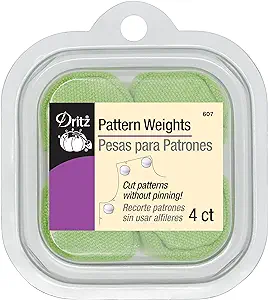
Each set of these steel ball-filled weights comes in assorted colors, making it easy to sort and grab the right piece mid-project.
At 4 oz per unit, they deliver enough downward pressure to hold silk, knits, and slippery patterned fabric flat without a single pin.
The smooth, rounded edges won’t snag delicate fibers, and the four-pack covers most standard pattern layouts.
Especially for rotary cutter users, this setup keeps your edges locked and your blade moving without interruption.
| Best For | Sewists and quilters who work with slippery or delicate fabrics and want a faster, pin-free way to hold patterns in place while cutting. |
|---|---|
| Material | Steel |
| Unit Count | 4 pieces |
| Pin-Free Use | Yes |
| Fabric Safe | Soft rounded edges |
| Primary Use | Pattern cutting |
| Durability Notes | Heavy-duty steel |
| Additional Features |
|
- Holds silk, knits, and other tricky fabrics flat without pins or fabric damage
- Smooth, rounded edges glide safely over delicate fibers and won’t cause snags
- Four-pack covers most standard pattern layouts, keeping your workflow moving
- Can get in the way of a rotary cutter in tighter spaces or when used close together
- The 4 oz weight per piece may feel tiring during longer cutting sessions with large patterns
- Not ideal for very heavy fabrics or multiple stacked layers that need more holding power
2. Prym Blue Pattern Weights Pack
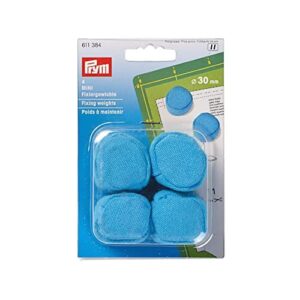
Where those steel-filled weights lean heavier, the Prym Blue Pattern Weights Pack takes a gentler approach. Each of the four cotton-covered pouches holds 30 mm metal balls, giving you steady hold without pressure marks on delicate fabrics like chiffon or satin.
The soft fabric shell won’t snag or scratch, which makes these a smart pick for materials that would show every pin hole. They’re compact, cleanly designed, and built to stay put along pattern edges during rotary cuts.
| Best For | Sewers and quilters working with delicate or lightweight fabrics like chiffon, silk, or satin who want a pin-free way to hold patterns in place during rotary cutting. |
|---|---|
| Material | Cotton |
| Unit Count | 4 pieces |
| Pin-Free Use | Yes |
| Fabric Safe | Soft cotton surface |
| Primary Use | Pattern cutting |
| Durability Notes | Cotton with metal fill |
| Additional Features |
|
- Soft cotton shell prevents pressure marks and snags on delicate fabrics
- 30 mm metal balls provide a steady, reliable hold along pattern edges
- A clean, compact alternative to pins that won’t leave holes in fine materials
- Only four weights included, which may not be enough for larger projects
- Metal balls require careful handling to avoid accidental spills or loss
- Not suited for heavier fabrics or large, bulky cutting patterns
3. Singer Heavy Duty Sewing 4411
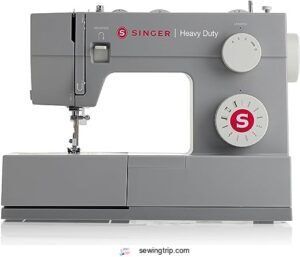
The Prym pouches handle your lighter fabrics with care — but when you’re ready to tackle denim or canvas, you need a machine that keeps up. The Singer Heavy Duty 4411 delivers up to 1,100 stitches per minute, backed by a metal internal frame that holds steady without flexing through heavy layers.
Its 11 built-in stitches and four-step buttonhole cover most project types, and the drop-in bobbin keeps setup quick. At 14.6 lb, it’s solid without being a burden to move around your studio.
| Best For | Home sewers and hobbyists who frequently work with heavy fabrics like denim, canvas, or leather and need a reliable, fast machine that won’t slow them down. |
|---|---|
| Material | Metal/Plastic |
| Unit Count | 1 machine |
| Pin-Free Use | N/A |
| Fabric Safe | Adjustable settings |
| Primary Use | Sewing projects |
| Durability Notes | Heavy-metal frame |
| Additional Features |
|
- Runs at up to 1,100 stitches per minute, making it one of the faster machines in its class for getting through big projects quickly
- The heavy-metal interior frame keeps things stable and precise, even when you’re powering through thick, layered materials
- Drop-in bobbin and built-in LED light make setup and visibility quick and hassle-free
- A few plastic parts (like the spindle) could be a weak point over time compared to fully metal-built competitors
- Stretchy or knit fabrics need extra attention — you’ll have to dial in the right needle and tension settings to get clean results
- Thread jams can crop up if the bobbin is overfilled or tension settings drift, so it rewards users who stay on top of maintenance
4. Madam Sew Rolled Hem Foot Set

The Singer takes care of the heavy lifting — but finishing those hems cleanly is where the Madam Sew Rolled Hem Foot Set earns its place. It includes three precision-cut sizes (½", ¾", and 1") that snap onto any low-shank 7 mm machine, including Brother, Singer, and Janome models.
The curved metal foot rolls the raw edge as you sew, producing a neat hem front and back in a single pass — no pinning, no pre-folding required.
| Best For | Home sewers who frequently hem curtains, tablecloths, scarves, and lightweight garments on a low-shank machine and want clean, professional results without the prep work. |
|---|---|
| Material | Metal |
| Unit Count | 3 pieces |
| Pin-Free Use | Yes |
| Fabric Safe | Metal roller foot |
| Primary Use | Hemming fabric |
| Durability Notes | Precision-cut metal |
| Additional Features |
|
- Three size options (½", ¾", 1") give you flexibility across a wide range of hem widths and fabric types
- The curved metal foot rolls and folds the raw edge automatically, so you get a clean finish on both sides in one pass
- Snap-on design makes switching between sizes quick and easy — no tools needed
- Only works with low-shank 7 mm machines; high-shank users would need an adapter or are out of luck entirely
- Not a good fit for knits or stretchy fabrics, which can distort or feed unevenly through the foot
- There’s a noticeable learning curve, and getting consistent results takes some practice runs on scrap fabric
5. Mini Finger Hand Puppets
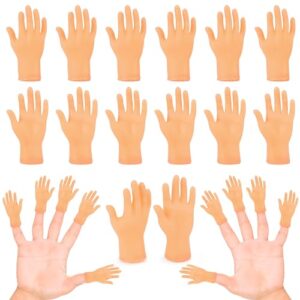
Not every item on this list follows the conventional mold — and that’s exactly what makes the Rclxl Mini Finger Hand Puppets worth mentioning for studio setups shared with younger sewists.
The 30-piece rubber set, split evenly between left and right hands, doubles as a lightweight novelty hold-down for light paper patterns during introductory lessons.
Washable and non-toxic, they’re easy to clean after handling, and keeping a few on the cutting table gives children a tactile, low-stakes way to engage with fabric layout basics.
| Best For | Parents, teachers, and kids who want a fun, tactile way to explore creative play, puppet shows, or light classroom activities. |
|---|---|
| Material | Rubber |
| Unit Count | 30 pieces |
| Pin-Free Use | No |
| Fabric Safe | Non-toxic rubber |
| Primary Use | Party props |
| Durability Notes | Washable rubber |
| Additional Features |
|
- Made from soft, flexible rubber that’s washable and non-toxic — totally safe for kids to handle
- 30-piece set with both left and right hands gives plenty of variety for group activities or performances
- Versatile enough for puppet shows, party gags, stress relief, or even lightweight pattern hold-downs during craft lessons
- The hand shape can flatten out over time with heavy or repeated use
- Frequent scrubbing may fade the colors and wear down the realistic detailing
- Not built for any functional purpose — purely novelty, so expectations should match
6. Clear Glass Sewing Pattern Weights
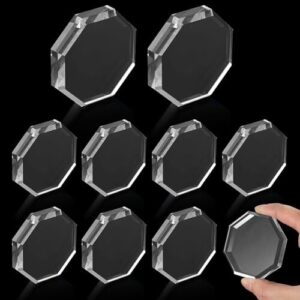
Glass has a quiet elegance that metal and fabric weights simply can’t match. This 10-piece clear glass set measures 2.2 inches in diameter, letting you see exactly where the pattern edge falls before your rotary cutter moves.
Each disc’s smooth, beveled surface won’t snag silk or chiffon, and the non-porous glass resists moisture and dye transfer. They’re heavier than they look — enough to hold medium-weight cottons flat without pins — and wipe clean in seconds.
| Best For | Sewists and crafters who work with medium-weight fabrics and want a clean, pin-free way to hold patterns in place while cutting. |
|---|---|
| Material | Glass |
| Unit Count | 10 pieces |
| Pin-Free Use | Yes |
| Fabric Safe | Smooth glass surface |
| Primary Use | Pattern cutting |
| Durability Notes | Breakable glass |
| Additional Features |
|
- Clear glass lets you see the pattern edge clearly, so cuts are precise and confident
- Smooth, non-porous surface glides over fabric without snagging or leaving marks
- Easy to clean — just a quick wipe and they’re ready for the next project
- Glass can break if dropped, so they need more careful handling than plastic or metal weights
- May be too heavy for very delicate or sheer fabrics
- Slight size variations between pieces are possible due to manual measurement
7. Quilted Bear Fabric Pattern Weights
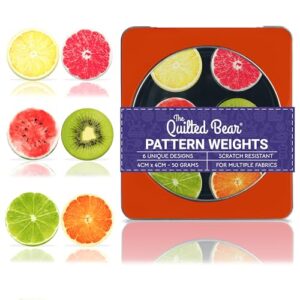
When your sewing space doubles as a craft corner for the whole family, the Quilted Bear Fabric Pattern Weights earn their place quickly. This six-piece set arrives in a printed "Funky Fruit" design with a tin storage container, making it just as practical on the shelf as on the cutting table.
Each weight’s high-density plastic body has a scratch-resistant finish that won’t snag pattern paper or delicate quilting cotton. That’s why beginners and experienced crafters reach for them interchangeably.
| Best For | Quilters, dressmakers, and paper crafters of all skill levels who want a quick, pin-free way to keep patterns and fabric in place while adding a fun, decorative touch to their workspace. |
|---|---|
| Material | Plastic |
| Unit Count | 6 pieces |
| Pin-Free Use | Yes |
| Fabric Safe | Scratch-resistant finish |
| Primary Use | Pattern cutting |
| Durability Notes | Plastic may crack |
| Additional Features |
|
- Scratch-resistant finish keeps fabric and pattern paper safe during cutting
- Versatile enough for quilting, dressmaking, paper crafts, and more
- Comes with a cute tin storage container that looks great on any craft table
- May not hold down very large or heavy pattern pieces reliably
- Packaging can be tricky to open the first time
- The internal plastic holder has been known to crack in some units, so handle with care
8. Wisemen Glass Pattern Weights
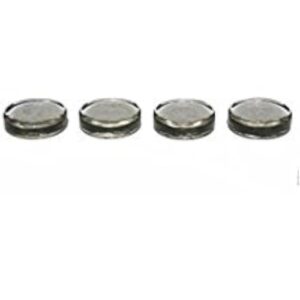
Transparency isn’t just a design choice here — it’s a functional one. The Wisemen Glass Pattern Weights let you confirm fabric alignment without lifting a thing, since the lead-free, food-grade glass discs sit clear against any material beneath them.
Each disc weighs roughly 5.5 oz, with polished rounded edges that glide across silk or satin without snagging. They’re best suited to light and medium fabrics — denim will test their limits. Handle them carefully, though. Drop one, and it won’t forgive you.
| Best For | Sewists and quilters working with delicate fabrics like silk or satin who want a pin-free, snag-free way to hold patterns in place while cutting. |
|---|---|
| Material | Glass |
| Unit Count | 4 pieces |
| Pin-Free Use | Yes |
| Fabric Safe | Ultra-smooth surface |
| Primary Use | Pattern cutting |
| Durability Notes | Breakable glass |
| Additional Features |
|
- Clear glass lets you see exactly where your fabric sits underneath, so placement is always accurate
- Smooth, polished edges glide across delicate materials without catching or leaving marks
- Lead-free, food-grade glass means they’re safe to use around food prep surfaces or for weighting garments during hand-washing
- Too light for heavy fabrics like denim or canvas, which may shift underneath them
- Glass construction means a single drop can shatter a disc
- The 2¾-inch diameter may feel bulkier than expected, especially for detailed or small-scale pattern work
Using Pattern Weights Correctly
Knowing which weights to buy is only half the battle — using them the right way is what actually keeps your fabric from shifting mid-cut.
A few simple habits make the difference between a clean layout and one that creeps out of alignment before you’ve finished a single seam. Here’s how to get the most out of your pattern weights every time you sit down to cut.
Place Weights on Corners
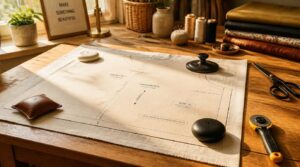
Corner placement is your first line of defense against fabric drift. Anchor each pattern piece at its corners before touching anything else — this locks the layout into position and gives you a stable reference for corner-to-corner alignment across the entire cut.
| Corner Position | Fabric Type | Weight Recommendation |
|---|---|---|
| Top-left | Silk, chiffon | Sand-filled, ceramic |
| Top-right | Quilting cotton | Low-profile metal |
| Bottom-left | Denim, canvas | Cast-iron flat weight |
| Bottom-right | Stretch knit | Smooth, rounded edge |
| Center anchor | Slippery patterned | Rubber-coated base |
That corner stability eliminates the gradual creep that pins can’t always prevent, maximizing cutting speed once your rotary cutter is in motion.
Secure Long Pattern Edges
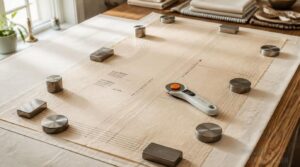
Once corners are anchored, the long edges become your next vulnerability. Place weights every 6 to 8 inches along each edge, keeping the base flush against the fabric with no gaps underneath.
This continuous coverage prevents curling, maintains edge alignment stability, and lets your rotary cutter move without interruption — no pins to dodge, no puncture marks, no pattern shift mid-cut.
Space Weights Evenly
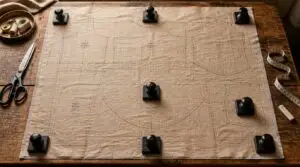
Even spacing isn’t just tidy — it’s what keeps your layout from drifting as you cut. Think of your pattern weights as a grid: corners anchored, edges covered every 6 to 8 inches, and a weight at the center of any large piece to counter bias drape and prevent buckling across the middle.
Cut With Rotary Cutters
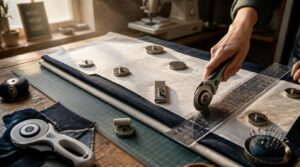
With your layout firmly anchored, the rotary cutter moves without stopping. A 45mm blade suits most garments; step up to 60mm for heavy canvas or denim.
- Apply consistent downward pressure to prevent fabric curling
- Use long, smooth strokes for clean, uniform edges
- Engage the safety lock after every pass
Pin-free cutting means your blade never catches on a pin mid-stroke.
Avoid Fabric Distortion
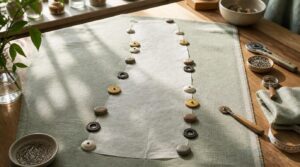
Smooth cutting only matters if the fabric holds its grain. The moment a piece drifts off-grain, bias stretch creeps into every seam allowance, and no amount of pressing fixes a skewed shoulder seam later.
Once fabric drifts off-grain, bias stretch corrupts every seam — and no amount of pressing saves a skewed shoulder
Fabric creep is the enemy here — place weights along long edges, not just corners, to keep the grain parallel and your seam allowances true.
Storing Home Studio Weights

Good storage habits keep your pattern weights ready to grab and your workspace running smoothly between projects. A little organization goes a long way, especially when you’re working with multiple weight types or sharing your studio with younger sewists. Here’s how to store them smartly.
Stackable Weight Storage
A dedicated stackable storage unit keeps your pattern weights, sewing accessories, and cutting tools accessible without cluttering your workspace. Systems with non-slip deck materials and stability locking mechanisms prevent tipping, even under loads up to 250 kilograms.
- Boost vertical space with 4–6 tier modular rack systems
- Choose units with weight capacity limits clearly marked per shelf
- Confirm locking pins engage fully before adding new tiers
Color-coded Organization
Assigning each weight type its own color turns a cluttered drawer into an instant visual index. Color-coded bins let you grab the right weight without second-guessing, cutting setup time noticeably.
Keep a master color key near your cutting table — one glance confirms you’ve selected correctly, reducing cognitive load so your focus stays on the fabric, not the storage system.
Child-safe Storage Spots
When your sewing studio doubles as a family space, storage becomes a safety decision.
- Childproof magnetic locks keep sharp tools secured
- Lidded bins with child-safe latches contain small sewing accessories
- Anchored lower shelves prevent tipping hazards
Store glass weights and metal tools in locked upper cabinets, well out of reach. Corner guard installation on cabinet edges reduces injury risk, keeping your studio both functional and genuinely safe.
Protect Glass Weights
Glass weights need consistent protection to stay functional. PVC coated dividers prevent direct edge contact inside your storage box, while impact-absorbing rubber stops cushion every placement and reduce chipping risk.
| Protection Tool | Purpose |
|---|---|
| Glass edge guards | Block chipping during storage |
| Padded box lining | Cushion movement and impact |
Clean each weight with a microfiber cloth weekly to keep all surfaces scratch-free.
Keep Cutting Tables Clear
A cluttered table is a cutting error waiting to happen. Before you lay down a single pattern piece, clear every surface of scissors, notions, and stray fabric scraps.
Return weights to their tray after each project — that one habit alone keeps your cutting area ready without the scramble of hunting tools mid-session, so your next cut starts clean.
Frequently Asked Questions (FAQs)
Are pattern weights worth it?
Pins work — until they don’t. Pattern weights hold fabric flat, protect delicate fibers from pinholes, and keep your cuts clean and accurate, making them a genuinely worthwhile upgrade to your cutting workflow.
What is the best filling for pattern weights?
Glass beads and poly pellets top the list — smooth, dense, and snag-free on delicate fabrics. For heavier cloth, metal washers inside fabric pouches deliver consistent mass without mess or leakage.
Can pattern weights replace a cutting mat entirely?
No, pattern weights can’t replace a cutting mat. Weights secure fabric and pattern pieces, but mats protect your blade, cushion rotary cuts, and provide grid lines for precise alignment.
How many weights do large pattern pieces need?
Large pattern pieces need at least four weights — one on each corner. Add two more along long edges, and place one near the center if the piece sags or shifts mid-cut.
Do pattern weights work on vertical cutting surfaces?
Vertical surface stability works surprisingly well — weights anchor fabric against a wall-mounted board, replacing pins entirely. Use a rigid backing board to prevent sag, and keep weights clear of your blade path for clean, accurate cuts.
Can children safely use pattern weights independently?
Yes, children aged three and older can use pattern weights safely under supervision, provided they can remove weights independently within seconds and clearly communicate discomfort to a nearby adult.
Are homemade pattern weights as effective as store-bought?
Homemade weights can match store-bought holding power when total mass and surface area align with what your pattern needs — washers, coins, or ceramic tiles wrapped in fabric deliver comparable stability at a fraction of the cost.
Conclusion
Like a well‑pressed seam, the right setup makes every cut cleaner and every result more predictable. Pattern weights for home sewing studios aren’t a luxury—they’re the quiet upgrade your cutting table has been waiting for.
Place them correctly, store them smart, and they’ll outlast dozens of pinning sessions. Choose weights that match your fabrics.
Your cuts get sharper. Your patterns stay true. That’s not a small win—that’s your whole workflow transformed.