This site is supported by our readers. We may earn a commission, at no cost to you, if you purchase through links.
Pins have a way of turning a simple cutting session into a test of patience—one slip, and your silk shifts, your seam allowance disappears, and you’re starting over. Pattern weights for quilting solve that problem without the drama.
A small disc or block of glass, cast iron, or canvas holds your pattern flat while your rotary cutter moves freely across the fabric. No punctures, no puckering, no fighting slippery satin into submission. For quilters working with multiple layers or delicate materials, that stability isn’t a luxury—it’s the difference between a clean cut and a wasted yard.
Choosing the right weight depends on your fabric, your pattern size, and how you work. Here’s what you need to know.
Table Of Contents
Key Takeaways
- Glass weights work best on delicate fabrics like silk and satin, while cast iron handles thick layers of denim or heavy quilting cotton without budging.
- Placing weights near corners and along the grain keeps your pattern from creeping, and spreading them evenly matters more than how heavy each one is.
- Weights beat pins on slippery or multi-layer fabric because they don’t leave holes, distort the grain, or slow you down at the cutting table.
- Matching weight to fabric type is the key decision: lightweight glass (5–6 oz) for fine materials, heavy cast iron (up to 3.5 lb) for bulk, and fabric-covered steel for everything in between.
What Are Quilting Pattern Weights?
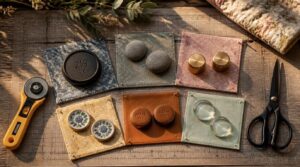
Pattern weights are small, weighted tools that hold your fabric flat while you cut — no pins needed. They come in different materials and sizes, each suited to different quilting needs. Here are six options worth knowing about.
If you’re just getting started, this guide to pattern weights for beginner quilters walks you through what to look for before buying your first set.
Pin-free Fabric Cutting
Switching to pin-free fabric cutting changes how fast you work at the cutting table. Instead of pushing pins through every pattern edge, you simply lay weights on top and start cutting.
No holes, no puckering, no wrestling with slippery layers. Your pattern stays flat, your fabric stays clean, and you move from piece to piece without stopping.
For smoother quilt layers, consider using four basting methods.
How Weights Hold Patterns
Weights work by staying put so your fabric cannot. Place them near corners and outer edges, and the pattern has nowhere to creep. Keep them aligned with the grainline so nothing distorts as you cut.
For larger pieces, spread weights evenly across the surface — weight distribution matters more than how heavy each piece actually is.
Quilting Versus Garment Sewing
Garment sewing and quilting share some tools, but they’re solving different problems. Garments chase three-dimensional fit — curves, movement, drape. Quilting stays flat, building a precise two-dimensional surface layer by layer.
- Quilting demands uniform ¼-inch seam allowances
- Garment fabrics vary from knits to silks
- Quilts prioritize edge alignment across many blocks
- Garments shape; quilts stack
When Weights Work Best
Flat, stable, and dealing with lots of layers — that’s where weights really earn their place. They shine on slippery fabrics like satin or silk, where pins tend to slide.
For complex appliqué cutting or large quilt blocks needing steady alignment, weights keep everything locked down without a single pinhole.
Top 6 Pattern Weights for Quilting
Not all pattern weights are created equal, and the right one depends on your fabric, your project, and how you like to work. These six options cover a solid range of materials, sizes, and price points. Here’s what’s worth knowing about each one.
1. Wisemen Glass Pattern Weights
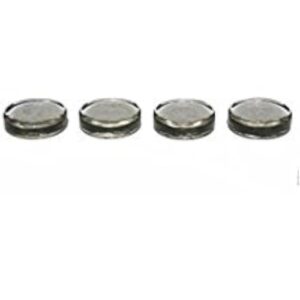
The Wisemen Glass Pattern Weights come in a 4-pack, with each disc weighing around 5–6 oz and measuring 2¾ in × ½–¾ in. They’re made from lead-free soda glass, so they sit smooth and flat without snagging your fabric.
The clear design lets you see pattern markings right through the weight. That’s a real advantage when you need to confirm grain lines or notches at a glance. Just don’t drop them — glass breaks.
| Best For | Sewists and pattern makers working with delicate fabrics like silk or satin who want a pin-free cutting experience with clear visibility of pattern markings. |
|---|---|
| Material | Lead-free glass |
| Set Quantity | 4 pieces |
| Surface Finish | Ultra-smooth glass |
| Shape | Round disc |
| Weight Class | Light (~5.5 oz each) |
| Primary Use | Fabric & paper patterns |
| Additional Features |
|
- Transparent glass lets you see grain lines and pattern markings right through the weight
- Ultra-smooth surface glides over fabric without snagging or leaving marks
- Lead-free, food-grade glass makes them safe for use on garments and delicate materials
- Too light to hold down heavy fabrics like denim or canvas
- Glass construction means they’ll break if dropped or handled carelessly
- The 2¾ in diameter may feel larger than expected for detail work in tight spots
2. Quilted Bear Pattern Weights
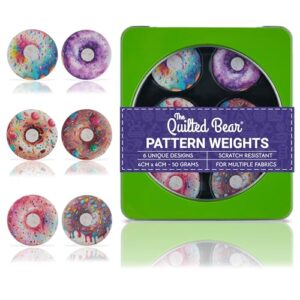
The Quilted Bear Pattern Weights come as a set of six, each roughly 2 in × 2 in, housed in a reusable tin that’s easy to toss in your sewing bag. The acrylic outer shell won’t snag delicate quilting cotton, and the decorative designs make them look right at home on your cutting table.
They pair especially well with medium-weight quilting fabrics, which hold their shape without the bulk that can throw off precise cuts.
One thing to watch: the internal plastic holder can crack with heavy use. They’re best for lighter fabric layers, not thick batting sandwiches.
| Best For | Quilters and crafters who want a pin-free way to hold lightweight fabric patterns or paper in place while cutting. |
|---|---|
| Material | Acrylic & plastic |
| Set Quantity | 6 pieces |
| Surface Finish | Scratch-resistant coating |
| Shape | Square |
| Weight Class | Light (unspecified) |
| Primary Use | Quilting & crafts |
| Additional Features |
|
- Six decorative weights in a handy reusable tin — easy to store and carry
- Scratch-resistant acrylic shell is gentle on delicate fabrics and paper surfaces
- Works double-duty as desk or craft room décor when not in use
- Internal plastic holder can crack with repeated heavy use
- May not hold down thick fabric stacks or bulky batting layers
- The original packaging can be tricky to open the first time
3. Zonon Cast Iron Fabric Weights
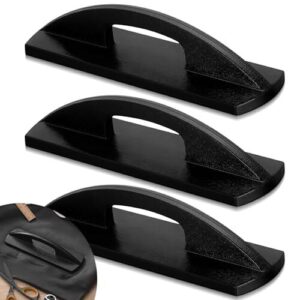
If you need a weight that means business, the Zonon Cast Iron set delivers. Each of the three pieces measures 9.84 × 2.76 inches and weighs 3.5 lb — enough to hold thick fabric layers flat without budging.
The built-in hand grip makes lifting and repositioning easy. A dark protective coating resists rust, though it can wear over time.
These aren’t ideal for delicate fabrics. Save them for denim, canvas, or heavy multi-layer quilts.
| Best For | Dressmakers, tailors, and DIY creators who regularly work with heavy fabrics like denim, canvas, or thick quilt layers and want a pin-free cutting experience. |
|---|---|
| Material | Paper with coating |
| Set Quantity | 6 pieces |
| Surface Finish | Scratch-resistant coating |
| Shape | Round decorative |
| Weight Class | Light (~2.3 oz each) |
| Primary Use | Quilting & crafts |
| Additional Features |
|
- Solid cast-iron build provides serious holding power, keeping even heavy multi-layer fabrics perfectly still while cutting
- Built-in hand grip makes it easy to lift and reposition without awkward fumbling
- Versatile enough to double as a woodworking aid for keeping thin planks flat and warp-free
- At 3.5 lb each, they can be tiring or difficult to handle for anyone with limited grip strength
- Rough ridges near the handle may irritate skin with extended use and could need smoothing
- Pricier than lighter plastic or smaller metal alternatives, and the rust-resistant coating will eventually wear down
4. Blue Canvas Sewing Pattern Weights
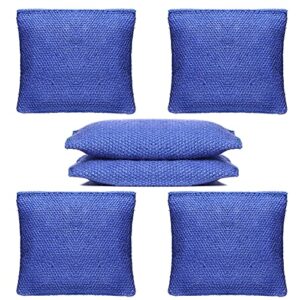
Six small blue canvas blocks make up this set, each measuring 1.77 × 1.77 × 0.39 inches and filled with steel beads. The whole set weighs just 11 oz total, so these are lightweight helpers — not heavy anchors.
They’re best on cotton, linen, or stable quilting fabrics. Stack two together when you need more pressure. They won’t overpower delicate material, and their canvas shell won’t snag or scratch your fabric surface.
| Best For | Sewists, quilters, and crafters who need lightweight, pin-free ways to hold fabric or pattern pieces in place during cutting and layout. |
|---|---|
| Material | Paper with coating |
| Set Quantity | 6 pieces |
| Surface Finish | Scratch-resistant coating |
| Shape | Round decorative |
| Weight Class | Light (~1–2 oz each) |
| Primary Use | Quilting & crafts |
| Additional Features |
|
- Stackable design lets you add weight as needed for different fabric types
- Compact and easy to store or toss in a project bag
- Smooth canvas exterior won’t snag or scratch delicate fabric surfaces
- Individual pieces are quite light, so heavier fabrics may need multiple stacked together
- The full set’s 11 oz total weight isn’t enough for large or dense materials like upholstery
- May feel underwhelming for users expecting traditional heavy-duty sewing weights
5. Longwin Glass Pattern Weights
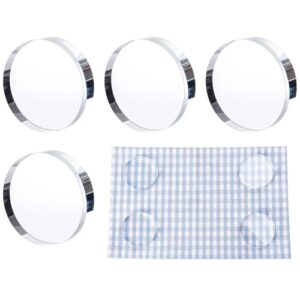
These round glass weights feel different the moment you pick one up. Each disc is 60 mm across and 15 mm thick, weighing 104 g — solid enough to hold pattern pieces flat without pins.
The transparent glass lets you see grainlines and notches clearly while you cut. Smooth-polished edges won’t snag your fabric. The set comes with four pieces, packaged in a reusable gift box for easy storage.
Don’t drop them, though. Glass chips.
| Best For | Sewists and crafters who want a pin-free way to hold patterns in place while keeping grainlines and markings fully visible during cutting. |
|---|---|
| Material | Cast iron |
| Set Quantity | 3 pieces |
| Surface Finish | Black iron coating |
| Shape | Rectangular bar |
| Weight Class | Heavy (3.5 lb each) |
| Primary Use | Pattern & fabric cutting |
| Additional Features |
|
- Clear glass lets you see every detail of your pattern — grainlines, notches, markings — without moving the weight
- Smooth-polished edges are gentle on delicate fabrics and won’t cause snags or pulls
- Reusable gift box keeps all four pieces organized and easy to carry to class or a client’s studio
- Glass can chip or crack if dropped, so they need more careful handling than plastic or metal alternatives
- At 104 g each, they may be too heavy for very light or sheer fabrics
- Four pieces may not be enough to anchor a large pattern without buying an additional set
6. Cast Iron Sewing Pattern Weights
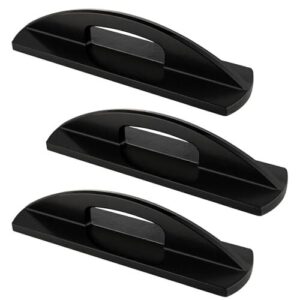
Cast iron is the workhorse of pattern weights. These Alffun 3-pack weights measure 9.8 × 2.8 × 0.4 in and weigh 0.6 lb each — flat, low-profile, and easy to slide around.
The black wear-resistant coating keeps the surface smooth so it won’t snag fabric. An ergonomic handle lets you reposition with one hand mid-cut.
Use these on denim, canvas, or thick wool layers. Skip them on silk or chiffon — too much pressure for delicate cloth.
| Best For | Sewists, quilters, and pattern makers who regularly work with heavy or medium-weight fabrics like denim, canvas, or wool and need reliable, no-fuss weights to keep pieces in place. |
|---|---|
| Material | Canvas & steel beads |
| Set Quantity | 6 pieces |
| Surface Finish | Canvas exterior |
| Shape | Square pad |
| Weight Class | Light (~1.84 oz each) |
| Primary Use | Fabric & paper |
| Additional Features |
|
- Flat, low-profile design slides easily across fabric without catching or bunching
- Wear-resistant black coating protects fabric from snags and scratches
- Ergonomic handle makes one-handed repositioning quick mid-cut
- Surface cavities or minor imperfections are possible due to the casting process
- Too heavy for delicate fabrics like silk or chiffon
- Coating can wear down over time with frequent heavy-duty use
Best Materials for Quilting Fabrics
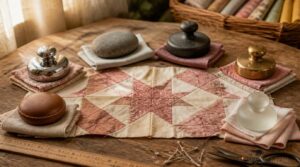
material your pattern weights are made from matters more than most quilters realize. different levels of pressure, grip, and surface protection — and the wrong choice can snag, stretch, or leave marks on your work.
five best materials to look for when choosing pattern weights for quilting.
Glass for Delicate Fabrics
For delicate fabrics like silk, chiffon, and organza, glass pattern weights are your best friend. They’re smooth, inert, and won’t leave dye or residue on light-colored textiles. Their polished, beveled edges prevent fiber fraying, and the clear finish keeps your pattern markings fully visible underneath — no guessing, no lifting.
Store them in a padded case to avoid chipping.
Cast Iron for Layers
Where glass controls the gentle stuff, thick quilt layers need something heavier. Cast iron weights hold multiple fabric layers flat without shifting.
- Carbide formation creates hard, wear-resistant surfaces that last for years
- Bimetallic bonding gives cast iron its dense, stable pressure
- Flat rectangular designs deliver consistent grip across heavy-duty stacks
Don’t use them on delicate fabrics — they’re built for bulk.
Fabric-covered Protective Weights
Fabric-covered weights are the middle ground between glass and cast iron. Their soft outer shell protects delicate quilt fabrics from scratches or pressure marks during pin-free pattern placement.
The dense center — usually metal shot or granulated fill — delivers solid hold without bulk.
That compact footprint keeps them clear of seam allowances, making pattern placement quick and clean.
Canvas and Steel Filling
Some fabric-covered weights take this a step further with canvas and steel bead filling. The canvas exterior stops metal from directly touching your quilt fabric, and the steel interior delivers dense, even downward pressure across every inch.
The filling stays packed tight — no shifting, no air pockets — so each weight holds its position consistently through repeated repositioning.
Scratch Resistance and Grip
Surface friction is your first line of defense. Micro-textured finishes grip fabric from below, reducing slippage during cutting. Matte coatings outperform glossy ones, especially in humid conditions.
Scratch-resistant surfaces — like those on glass and coated cast iron — protect delicate fibers from snags. Hard finishes also hold their edge longer, keeping your fabric protection consistent across hundreds of uses.
Pattern Weights Versus Pins
Pins have their place, but pattern weights change the game in ways you might not expect. Switching to weights affects everything from how your fabric behaves to how fast you move through a cut. Here’s a closer look at where weights genuinely pull ahead.
Preventing Fabric Distortion
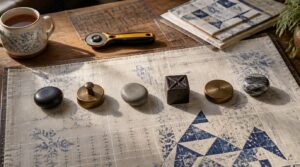
Pins create tiny stress points that tug fabric off grain. Pattern weights distribute pressure evenly, keeping your fabric flat and undistorted from start to finish.
Place them along the lengthwise grain, and fabric tension stays consistent.
A level workspace helps too — uneven surfaces cause subtle shifts that compound across layers, throwing your whole layout off.
Avoiding Pin Holes
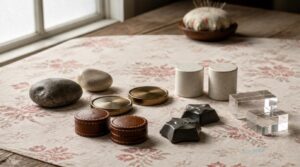
Every time you pierce fabric with a pin, you leave behind a tiny hole that can’t be undone. On delicate quilting cotton or silk, those holes show permanently.
Pattern weights sit on top without breaking a single thread. Clean, dry fabric beneath them stays completely intact — no punctures, no pulled fibers, no regrets.
Pattern weights rest on top of fabric without piercing a single thread, leaving every fiber clean and intact
Faster Cutting Workflow
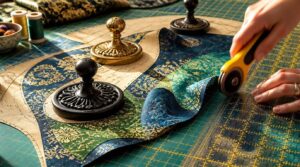
Weights make cutting faster — simple as that. You skip placing and removing every pin, which saves real time across a full pattern layout. Here’s what a smarter workflow looks like:
- Pre-mark your fabric, lay weights down, and cut in one continuous pass
- Pair up — one person places weights while the other cuts
- Keep your rotary cutter sharp and your mat gridded for instant alignment
Handling Slippery Fabrics
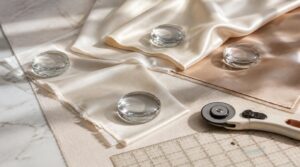
Slippery fabrics like satin and silk don’t play nice with pins. Place a non-slip underlay — felt or muslin works well — beneath your fabric before cutting. This keeps everything stable.
Choose smooth glass weights to hold without snagging.
When sewing, lower your presser foot pressure slightly and use a walking foot to feed layers evenly.
Multi-layer Quilting Accuracy
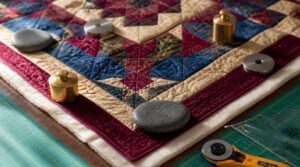
Quilting across three layers demands more than straight seams. Edge alignment slips fast without consistent pressure in every corner.
Weights hold your quilt sandwich flat while you cut, reducing shifting before a single stitch drops. That stability carries through to needle penetration and thread tension — keeping stitches even, top to bottom.
How to Choose Pattern Weights
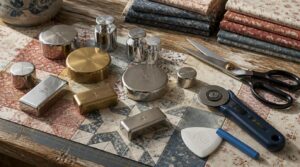
Picking the right pattern weights comes down to a few key factors, and getting them right makes a real difference in how your cutting goes. Things like weight, size, and how many you need per piece all play into the decision. Here’s what to look at before you buy.
Weight and Pressure Needs
The weight of your pattern pieces matters more than most quilters realize. A weight that’s too light will shift mid-cut, while one that’s too heavy can distort delicate fabric. You need even pressure distribution across the full contact surface.
- Lightweight glass (5–6 oz) suits silk and cotton
- Heavy-duty cast iron (up to 3.5 lb) controls denim and thick layers
- Fabric-covered steel balances grip with gentle pressure
Rounded edges help prevent fabric indentation on knit and woven materials.
Size and Footprint
Once you’ve sorted out the right pressure, size is the next call to make.
Glass weights cover about 1.0 to 2.0 inches per piece — compact enough for small quilt blocks. Cast iron spans up to 9.8 inches, anchoring wider cuts.
Bigger footprints mean more stability; smaller ones give you precision on tight corners.
Quantity Per Pattern Piece
Size tells you where to place a weight. Quantity tells you how many.
- Large pieces: 4–6 weights along edges and corners
- Small blocks: 2–3 weights, one at each corner
- Curved or irregular pieces: place weights every 2–4 inches
- Slippery or layered fabric: add extra weights to prevent edge shifting
Durability and Storage
How many times have you placed your weights, only to find them slipping or showing wear? Durability matters here.
Cast iron weights last through 1,000+ placement cycles without bending. Glass needs more care — wipe with a soft cloth regularly. Store all weights in a dry, closed container to prevent rust and moisture damage.
DIY Versus Store-bought Options
Making your own weights costs almost nothing if you use coins, washers, or dried beans wrapped in scrap fabric. Store-bought sets — like a 6-piece canvas and steel bead option — run $15–$18 and are ready to use instantly.
Here’s how they compare:
- Cost — DIY wins on budget
- Consistency — Store-bought delivers uniform weight every time
- Customization — DIY fits odd shapes or corners better
- Assembly time — Store-bought saves prep work entirely
- Beginner ease — Labeled store-bought sets are simpler to learn with
Frequently Asked Questions (FAQs)
Are pattern weights worth it?
Yes. Pattern weights save time, prevent pin holes, and keep fabric flat while cutting. They’re especially worth it if you work with slippery or delicate fabrics where pins cause distortion.
What is the best filling for pattern weights?
The best fillings are steel balls, poly pellets, and metal washers for reliable weight. Rice and lentils work but can attract pests. Pellets resist moisture and clumping better than grain-based options.
Are pattern weights better than pins?
Pattern weights beat pins on slippery fabrics and large pieces. They protect fabric grain integrity, skip pin holes, and speed up cutting. For delicate or multi-layer work, weights win.
How do I clean and maintain pattern weights?
Wipe glass weights with warm water and mild dish soap, then dry with a lint-free cloth. For cast iron, apply a light oil film after cleaning to prevent rust.
Can pattern weights damage delicate quilt fabrics?
They can, if you’re not careful. Rigid weights on silk or velvet may crush nap or leave indentations. Distribute lighter weights evenly and use fabric-covered options to protect delicate surfaces.
Are pattern weights safe for children to use?
Yes, with adult supervision. Choose weights with rounded edges and non-toxic finishes. Avoid small glass pieces near young children — choking hazards are real. Store weights out of reach when not in use.
Do pattern weights work on vertical surfaces?
Not really. Gravity’s downward pull works against flat weights on vertical boards. Heavier weights or suction-anchored options help, but you’ll likely need tape or clips too.
Can I use pattern weights outdoors or traveling?
Pattern weights travel surprisingly well. Pack glass sets in a padded pouch with silica gel. Use a folding table outdoors for stability. Heavier cast iron resists wind but can rust — dry thoroughly after humid conditions.
Conclusion
The right pattern weights for quilting are like a steady hand guiding every cut—quiet, reliable, and exactly where you need them.
Glass works on delicate fabrics. Cast iron holds thick layers flat. Fabric-covered options protect your most precious materials.
Once you match the weight to your fabric and project size, pinning starts feeling like the old way of doing things.
Pick your weights, clear your mat, and cut with confidence.
- https://sewcanshe.com/2013-10-1-sewing-201-it-was-a-revelation-to-me-pattern-weights-a-guessing-game
- https://createwhimsy.com/projects/make-your-own-pattern-weights
- https://so-sew-easy.com/make-sewing-pattern-weights-11-ways
- https://theruffledpurse.com/how-to-make-pattern-weights
- https://madamsew.com/products/pattern-weights