This site is supported by our readers. We may earn a commission, at no cost to you, if you purchase through links.
That old pair of jeans with the blown-out knee? Don’t toss it in the trash. Denim is one of the toughest fabrics you’ll ever sew with, and a single pair holds enough sturdy material for a tote bag, a pillow cover, or a stack of coasters.
Fast fashion piles up in landfills every year, but your closet’s already sitting on a solution. Grab those worn-out Levi’s and turn them into something you’ll actually use again.
That’s where upcycled jeans sewing patterns come in handy. Grab your seam ripper and rotary cutter, because you’re about to give that denim a whole new life.
Table Of Contents
Key Takeaways
- Before cutting, check your denim’s weight and wear, sort it by color, and prewash it to avoid shrinkage and dye bleeding later.
- Save pockets, waistbands, and prep steps like pressing seams flat, cutting single layers, and marking grain direction, to keep your project sturdy and true.
- The right tools, like denim-specific needles and beginner-friendly bag pattern books, make sewing thick denim far easier and less frustrating.
- Old jeans can become bags, home décor, quilts, small accessories, or handmade gifts, turning worn-out denim into useful, one-of-a-kind items instead of landfill waste.
Choose Jeans for Upcycling Patterns
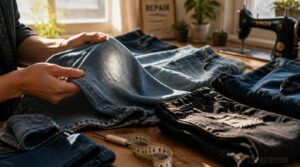
Not every old pair of jeans is cut out for a new life as a bag or quilt. Before you grab your scissors, you’ve got to know what you’re working with. Here’s what to check before picking your denim.
Look closely at the fabric’s weight and wear pattern, since thinner spots may need reinforcement—our guide on hand-sewing denim tears walks through testing thread tension first so your stitches hold.
Check Fabric Weight
Before you cut a single stitch, feel the fabric.
Denim ounces vary wildly—light shirting denim sits around 6-9 oz, classic jeans run 9-12 oz, while heavyweight workwear denim hits 12-16 oz.
Weigh a 100‑sq cm swatch for accurate GSM.
Heavier fabric needs a heavy duty denim needle and holds shape for bags; lighter denim drapes more softly but may need stabilizing.
For the most precise result, use the professional disc method to calculate GSM.
Inspect Worn Areas
Worn spots tell a story—learn to read them before you cut. Run your hands over the fabric to spot friction wear, thinning knees, or fiber loss near seams.
- Checking tensile strength
- Identifying friction wear
- Spotting fiber thinning
- Evaluating color loss
- Checking seam integrity
Weak zones make great upcycling accents, not trash!
Save Pockets and Waistbands
Before you cut apart a worn pair, save those pockets and waistbands—they’re gold for upcycling denim projects.
Original waistbands offer built-in Waistband Structural Use for bag tops or belts. Pockets already have Reinforced Pocket Corners and smart Pocket Placement Ergonomics, perfect for a denim pocket pillow or trim on future denim bag making techniques.
Snip carefully—this is prime denim project inspiration for later!
Sort Denim by Color
Grab all those saved pockets and waistbands, then get ready to sort your denim pile by shade before it hits the cutting table.
- Darks (black, deep indigo)
- Lights (chambray, faded blues)
- Midtones (judgment call!)
- Group by fabric weight, too
- Set aside heavy bleeders for colorfastness testing
This stops dye transfer from ruining your denim patchwork dreams later!
Prewash Before Cutting
Skipping the wash cycle is the fastest way to ruin a project later. Toss your denim fabric in for a warm wash and low tumble dry before cutting your denim—this prevents shrinkage surprises and softens stiff fabric for easier pinning.
Test a swatch first for accurate shrinkage testing, and always prewash to stop dye bleeding.
Then press your denim fabric flat, checking grain line accuracy before you cut.
Prepare Denim for Sewing
Once you’ve picked your jeans, don’t just start cutting right away. A little prep work now saves you a ton of frustration at the sewing machine later. Here’s exactly how to get your denim ready to sew.
Remove Bulky Seams

Those thick inseams and flatfelled seams are bulk bombs waiting to jam your machine. Tackle them first!
- Grade seam layers so they stack thinner
- Clip inner curves near pockets and corners
- Press seams open before stitching over them
For super thick spots, trim one layer shorter than the other. This eases corner tension and keeps your needle happy through heavy, doubled-up denim.
Press Panels Flat
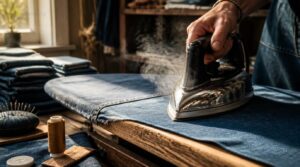
Fifteen seconds with a hot iron saves you twenty minutes of cursing at your machine later.
Steam pressing denim flat knocks down bulky seams and seam allowances so panels lie true, without the waviness that makes stitching wander. Think of it like industrial platen temperature control, but for your ironing board—consistent heat, even pressure. This heavyweight fabric handling step keeps everything smooth before layout, just like thermal expansion joints keep rigid panels stable.
Cut Single Layers
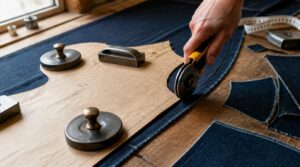
Why fold denim when one flat layer gives truer results? Cutting single layers cuts distortion and keeps grain lines honest—no shifted pattern pieces from folded bulk.
Use pattern weights instead of pins, they won’t shift heavy denim. A sharp rotary cutter delivers clean, precise edges without dragging threads.
Lay pieces close for nesting efficiency, maximizing yield from every scrap—smart practice for any upcycled denim project.
Mark Grain Direction
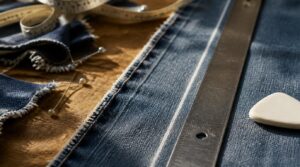
Grain direction is your denim’s built-in roadmap, and ignoring it means fighting the fabric later. Find the selvage edge—that tightly woven strip—and use a straight ruler to mark a chalk line parallel to it.
This keeps warp threads aligned, so your pattern pieces stretch and recover the way they’re supposed to. No weird puckering after you’ve already committed seam allowances.
Trim Fraying Edges
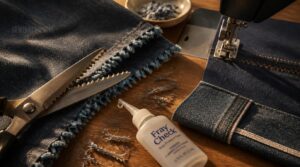
Ever notice how a raw edge unravels the second you look away? Stop that before it starts.
Snip loose threads first, then pick your seam finishing weapon: zigzag, pinking shears, or fray check sealant.
For heavy denim, flat-felled seams beat everything—they bury raw edges completely, giving you long-term edge care without extra bulk in your seam allowances.
Top 4 Denim Sewing Essentials
Now that your denim’s prepped and ready, let’s talk gear. The right needles and a couple of go-to pattern books make all the difference between fighting your machine and actually enjoying the process. Here are the four essentials worth adding to your sewing kit.
1. Schmetz Denim Sewing Machine Needles
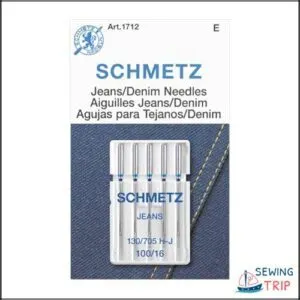
Break enough needles on a thick denim seam and you’ll understand why regular ones just won’t cut it. Schmetz Denim needles use a medium ball point to slide between fibers instead of tearing them, with reinforced blades that resist bending under pressure.
That combo means fewer skipped stitches and way less snapping mid-project. They’re a size 16/100, sold five to a pack, and work great for hemming, top-stitching, or piecing together layered patchwork—basically anywhere your machine’s fighting through stubborn denim.
| Best For | Sewists who regularly work with denim, canvas, twill, or heavy layered quilts and need a needle that can push through thick fabric without snapping. |
|---|---|
| Product Type | Needle |
| Price | Not listed |
| Skill Level | All levels |
| Primary Use | Denim sewing |
| Quantity/Length | 5 needles |
| Compatibility | Home sewing machines |
| Additional Features |
|
- Medium ball-point tip reduces fabric damage and insertion force on tough materials
- Reinforced blade design minimizes deflection and breakage during heavy-duty stitching
- Fits all standard home sewing machines, so switching from regular needles is effortless
- The medium ball point can be too blunt for lightweight or delicate fabrics, leaving visible holes
- A five-pack may run out quickly for anyone sewing denim in high volume
- Not suited for embroidery or fine decorative work that calls for a sharp-point needle
2. Schmetz Jean and Denim Needles
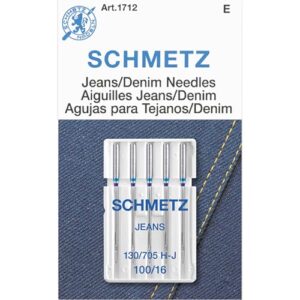
Not all "denim needles" are created equal. Schmetz also makes a dedicated Jeans/Denim line using the same 130/705 H system your machine already takes, so swapping sizes is easy.
You’ll find them from 70/10 up to 110/18, plus twin needle versions for parallel topstitching on pockets or hems. The reinforced shaft and hardened point cut through layered seams with less hand force, and color coding on the shank makes grabbing the right size a snap.
| Best For | Sewists who regularly work with heavy fabrics like denim, canvas, and twill, or who need reliable stitching through thick, multi-layer seams and quilts. |
|---|---|
| Product Type | Needle |
| Price | Not listed |
| Skill Level | All levels |
| Primary Use | Denim sewing |
| Quantity/Length | 5 needles |
| Compatibility | Home sewing machines |
| Additional Features |
|
- Reinforced construction resists bending and breakage, even under heavy use
- Medium ball point and optimized blade design reduce skipped stitches and needle deflection
- Works with all standard home sewing machines, so no special equipment is needed
- Not suited for lightweight or delicate fabrics, since the needle is built specifically for dense materials
- Limited to home sewing machine use, so it won’t fit industrial setups
- Only available in one size (100/16), which may not suit every project or fabric weight
3. Sew Brilliant Bag Designs
Sew Stylish Bag Designs is your next stop once needles are sorted. This pattern book packs in 12 projects, from a breezy beach tote to a magnetic-closure cross-body, teaching piping, eyelets, zippers, and square-bottom bases along the way.
Every step comes with clear photos, so even a basic machine controls it fine. It’s a great way to practice new techniques while turning old jeans into something genuinely useful and stylish.
| Best For | Beginner to intermediate sewers who want structured, photo-guided projects for building bag-making skills on a basic machine. |
|---|---|
| Product Type | Book |
| Price | $19.95 |
| Skill Level | Beginner to intermediate |
| Primary Use | Bag making |
| Quantity/Length | 96 pages |
| Compatibility | Basic sewing machine |
| Additional Features |
|
- 12 varied projects covering everything from a beach tote to a magnetic cross-body bag
- Teaches a wide range of techniques, including piping, eyelets, zippers, handles, and square-bottom bases
- Clear step-by-step photography makes instructions easy to follow
- Finished bag dimensions aren’t listed, so sizes must be estimated from yardage and photos
- No downloadable patterns or templates—cutting guides are book-only
- Some steps may be tricky for complete beginners, leading to possible trial and error
4. Half Yard Bag and Purse Book
Once your needles are ready, grab Half Yard Bags and Purses by Debbie Shore. It packs 24 projects, 12 bags with matching purses, so you get coordinated sets for gifts or yourself.
Totes, backpacks, clutches, messenger bags, and travel styles all use half a yard or less, keeping costs low. Full-size templates and 8 QR video links make it beginner-friendly. The catch? Larger bag designs aren’t really an option here.
| Best For | Beginner and intermediate sewers who want to create coordinated bag-and-purse sets for gifts, personal use, or small-scale selling. |
|---|---|
| Product Type | Book |
| Price | $19.95 |
| Skill Level | Beginner to intermediate |
| Primary Use | Bag making |
| Quantity/Length | 128 pages |
| Compatibility | Basic sewing machine |
| Additional Features |
|
- Great value with 24 projects covering 12 matching bag-and-purse combos
- Low fabric cost since every design needs no more than half a yard of outer fabric
- Beginner-friendly thanks to full-size printable templates and 8 QR-coded video tutorials
- Half-yard fabric limit rules out larger, more spacious bag designs
- Simple patterns may not offer enough challenge or variety for advanced sewers
- Non-spiral binding makes it harder to keep the book flat while working
Sew Upcycled Jean Bags
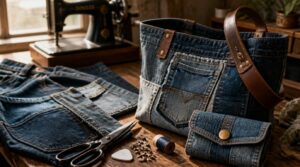
Old jeans make seriously sturdy bags, so this is where your scraps really get to shine. You’ve got options too, from simple totes to purses with a little more style. Grab your favorite pair (or a few) and let’s break down five ways to turn them into something you’ll actually carry around.
Tote Bag Pattern
Ready to level up from scrap projects? A tote bag is the perfect next step once you’ve got a few pairs of jeans stacked up.
Use two jean legs for the main body, add a boxed corner for real capacity, and don’t forget an old belt as grips—instant style! Line it with lightweight cotton, scale the pattern up or down, and attach hardware with sturdy rivets or heavy-duty stitching.
Crossbody Purse Pattern
If your tote bag scratch itched, wait till you try a crossbody. Pick medium-weight denim (8-12 oz) for structure, add foam stabilizer plus cotton lining, and build in:
- An interior zip pocket
- A phone slip pocket
- An adjustable 40-60" strap
Attach straps with swivel clasps and D-rings for smooth, hands-free adjusting.
Patchwork Hobo Bag
Once you’ve got a scrap pile going, this bag turns leftovers into a boho aesthetic showstopper.
Mix washes for patchwork color balancing — light, medium, dark — sewn into a slouchy exterior panel.
Add a lined interior zip pocket for organization, choose brass or antique hardware, and you’ve built a truly sustainable, one-of-a-kind denim purse from sourced, upcycled jeans.
Reinforced Denim Handles
A hobo bag is only as good as its grips — nobody wants straps snapping mid-carry! Boost stress point reinforcement with box X-stitching, plus interfacing inside for stability.
- Denser stitching (12-14 stitches/inch)
- Rivets or bar tacks
- Webbing rated 500-800 lbs
- Leather reinforcement patches
- Belt-loop grips for your upcycled denim tote
Smart hardware attachment keeps your DIY bag projects sturdy for years!
Reused Pocket Details
Those little pockets carry all the character — save them! Preserving original stitching and rivet placement keeps authenticity intact, though rivets can make re-seaming tricky.
| Detail | Why It Matters | Tip |
|---|---|---|
| Fading patterns | Adds distressed charm | Mix light/dark |
| Thread contrast | Pops against new fabric | Keep original color |
| Lining weight | Reduces bulk | Trim if thick |
Perfect for pouches, zippers, and seams on any DIY bag project!
Make Denim Home Décor
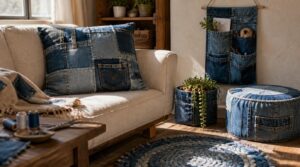
Once your bags are done, don’t stop there—your scrap pile still has plenty to give. Denim’s sturdy nature makes it perfect for the stuff your home sees every day, from the couch to the floor. Here are five projects that turn old jeans into pieces you’ll actually use around the house.
Patchwork Pillow Covers
Ever look at a pile of old jeans and see a pillow instead of a rag bag? That’s the magic of patchwork technique.
Cut squares or diamonds, mix denim shades with cotton scraps for texture, then sew with a 1/4" seam. Add a zipper closure for easy washing. This upcycled denim project brings sustainable decor aesthetics right to your couch—cozy, sturdy, totally one-of-a-kind.
Braided Denim Rug
Got scraps left over from those pillows? Turn them into a floor rug! Cut strips 1-2 inches wide, braid three to five strands, and stitch flat.
- Runners: 2×3 ft
- Standard: 4×6 ft
- Large: 5×8 ft
- Custom widths up to 6 ft
Denim’s serious durability means high-traffic spots hold up beautifully!
Denim Placemat Pattern
Rug scraps too small for braiding? Cut them into 12×18 inch rectangles for placemats instead.
Mix light and dark denim for color blocking, add batting for structure, and finish edges with contrasting topstitching. Repurposed pockets make sweet appliques.
These upcycled denim placemats handle spills, machine washing, and daily dining without fading or fraying.
Jean Pocket Organizers
Got a pile of back pockets left over from other projects? Don’t toss them—turn them into a wall hanging organizer for keys, pens, or craft bits.
- Sort pockets by size
- Arrange in a grid
- Strengthen top edges
- Add a waistband loop for hanging
- Trim fraying edges
This vertical storage trick makes small tools easy to grab, especially in tight entryways or craft nooks.
Simple Denim Curtains
Once your pockets are organized, grab your bigger leg panels for something with real visual impact: curtains. Pick medium-weight denim (8-12 oz) for good drape.
Piece panels together for width, add a light lining for opacity and color-bleed protection, and stitch a simple rod pocket header.
Deep indigo brings that industrial vibe right into your living room—no fancy pattern required!
Create Denim Quilts
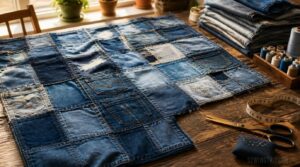
Ready to turn a pile of old jeans into something you’ll actually cuddle up with? A denim quilt is the perfect way to use up every scrap, from tiny pockets to worn-out knees. Here’s how to piece one together, step by step.
Cut Matching Squares
Ever notice how a wonky square can throw off an entire quilt block? That’s why rotary cutting accuracy matters so much here.
Use a sharp rotary cutter and straight edge, align with the grain, and cut single layers when you can. Stick to 5 or 6 inch squares — denim loves that range. Don’t forget your seam allowance precision: ¼ inch per side keeps blocks true for any denim quilt project!
Mix Denim Shades
All-same-wash blocks read flat, so mix it up! Pair a light wash with a dark indigo for real shade contrast balance, then toss in a medium square to bridge the gap smoothly.
Keep color temperature consistent — don’t mix warm, yellowish denim with cool, blue-toned scraps. Distressed pieces next to solid blocks add texture without chaos in your denim quilt.
Add Cotton Backing
Since denim’s so heavy, your quilt needs a breathable partner on the back, and that’s where cotton backing comes in.
- Backing weight: 60-80g for drape, 100-120g for structure
- Prewash to prevent shrinkage surprises later
- Stabilizes those dense denim weaves during quilting
- Smooths seams, cutting down on abrasion
This lightweight layer keeps your upcycled denim project soft, not stiff.
Sew Rag Quilt Seams
Here’s where your denim rag quilt starts feeling like magic: sewing the seams that’ll turn into that shaggy fringe.
Use a 1/2 inch seam allowance every time, and grab a walking foot so those thick layers don’t shift or bunch.
Keep tension even, skip backstitching, and press seams flat before moving on—this keeps your denim star quilt pattern crisp and your rows straight.
Fray Edges Evenly
That fringe is the whole payoff, so don’t rush it. Pull threads parallel to the raw edge, one at a time, using a straightedge to guide uniform fringe length.
- Neat rows of soft, even fringe
- Crisp lines with no jagged bits
- A cozy, finished shaggy edge
Check grain alignment as you go, trim strays, and press lightly to set everything in place.
Sew Small Denim Accessories
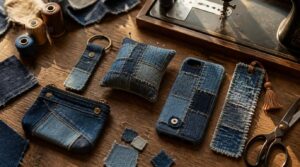
Got some leftover scraps too small for a bag or quilt? Don’t toss them, because tiny denim pieces are perfect for quick, useful projects. Here are five small accessories worth stitching up next.
Zipper Pouch Pattern
Grab an old jean leg, a 7‑9‑inch zipper, and you’ve got yourself a pouch!
Sandwich the zipper between your denim outer and lining fabric, stitch, then flip and topstitch for that clean, professional edge.
Add lightweight interfacing if your denim feels too floppy. Want extra room? Try a boxed bottom for more capacity.
Easy, functional, and totally yours.
Pencil Case Tutorial
Ready to level up from that pouch?
A pencil case adds a lining for extra structure, using an 8 to 12-inch zipper and 1/4-inch seams. Lay pattern pieces on single denim layers, keeping grain lines straight. Topstitch around the zipper for durability, clip pocket corners, and try patchwork scraps or mismatched denim shades for a fun, custom look!
Gardening Apron Pockets
Old jeans make a great denim apron, since the fabric’s already tough enough for garden work. Position pockets at waist height for easy reach—one big harvesting pouch up front, smaller ones for seed packets and plant tags.
Sew tool loops nearby for pruners and trowels, then double-stitch pocket openings so they won’t rip. Add a water-resistant lining and you’ve got a durable, upcycled DIY project that outworks store-bought aprons!
Keychain Scrap Project
Once your apron’s done, those leftover fabric scraps are perfect for a keychain scrap project.
Cut denim into 0.5-0.75 inch strips, sort by color family, and bind the tassel top with thread wrap.
Seal edges with fray check, attach a swivel clasp, and you’ve got handmade accessories—or upcycled denim luggage tags—in under twenty minutes!
Frayed Denim Coasters
Got a scraps pile left? Turn those denim bits into frayed denim coasters—cut 4-inch squares, pull threads along edges for fringe (about 1.5-3 cm looks great), and back with cork or felt for moisture protection.
Mix shades for a patchwork look, let that indigo fade naturally with washing, and hand wash your finished DIY denim coasters to keep fringe intact!
Upcycle Jeans Into Gifts

Old jeans make some of the sweetest handmade gifts around, and they’re way more personal than anything store‑bought.
Whether you’re stitching for a kid, a friend, or your own tree at Christmas, that worn‑in denim brings a warmth that new fabric just can’t match.
Worn-in denim carries a warmth no new fabric can ever match
Here are five easy ways to turn scraps into something someone will actually treasure.
Stuffed Animal Patterns
That worn-out jean leg has enough life left for a whole stuffed critter! Symmetry pattern drafting keeps limbs and ears matching, while proper scaling animal proportions (bigger head, smaller body) gives that cuddly look.
Choose soft material stuffing choices like polyester fill, and stitch felt eyes on securely using safety attachment methods—no loose parts for little hands. Your upcycled denim stuffed animals will last through years of hugging!
Denim Pocket Toys
Snip that back pocket off before you toss the jeans! It becomes the star of a tiny, huggable toy.
- Soft, worn texture for cozy tactile play
- Reinforced seams meet child safety standards
- Mini organizer for beads, buttons, or notes
- Zero waste crafting with denim scraps
Vary pocket sizes for character, and always keep edges tightly sewn—no loose threads near little hands.
Christmas Tree Ornaments
Once the pumpkins have waited for their turn, let your scraps shine as Christmas tree ornaments. Cut small icicles, teardrops, or snowflakes—denim’s rustic texture fits woodland or vintage themes beautifully.
Keep minis under 2 inches for dense branches, add a few medium statement pieces for focal points. Stuff lightly, stitch a loop, and you’re done.
Store them padded, away from heat, so your handmade denim keepsakes last for years.
Stuffed Denim Pumpkins
Nothing says fall like a plump little pumpkin made from your old Levi’s. Mix mismatched denim shades for that classic patchwork texture, stuff firmly with fiberfill, and twist burlap for a rustic stem.
- Combine light and dark washes
- Pack fiberfill tightly for shape
- Wrap stem with twine
- Cluster sizes for a focal point
Perfect upcycled fall decor for any handmade-loving home!
Personalized Appliqué Patches
Turn scrap denim into a signature move: appliqué patches. Pick cotton twill backing for durability, then choose iron-on or sew-on application based on where it’s going. Dense satin stitching keeps edges crisp and washer-safe.
Personalize with initials, logos, or doodles—patches make thoughtful, one-of-a-kind gifts. Wash inside-out, air dry, and your denim inspiration stays fresh for years!
Frequently Asked Questions (FAQs)
How much denim waste do landfills receive yearly?
Denim piles up fast in US textile waste streams, occupying a hefty chunk of landfill space yearly.
Since it can take decades to break down and releases methane along the way, repurposing old jeans through denim recycling really helps a smarter, more circular denim economy.
Why is denim considered ideal for upcycling projects?
Like a workhorse that never quits, denim just keeps going. Its twill weave distributes stress evenly, giving you serious textile durability for bags and décor.
That toughness, plus easy sourcing from thrifted jeans, makes it perfect for sustainable fashion and creative fabric repurposing.
Where can I find old jeans to upcycle?
Your closet’s a great start, but don’t stop there!
Thrift store deals, community clothing swaps, and online denim bundles stretch your budget.
Garage sale finds and brand recycling programs round things out—every source keeps fabric recycling alive and old jeans out of landfills.
Conclusion
Denim never really wears out—it just waits for a new sew-lution. Every scrap you saved, every seam you pressed, proves that upcycled jeans sewing patterns turn worn-out denim into things you’ll actually reach for.
That tote, that quilt square, that patched-up pocket toy? They’re not just projects. They’re proof your closet had more to give.
So keep your seam ripper close, because your next favorite thing might already be hanging in there, faded and waiting.