This site is supported by our readers. We may earn a commission, at no cost to you, if you purchase through links.
A dull rotary blade ruins more projects than most sewers care to admit—and nine times out of ten, a cheap cutting mat is the silent culprit. The surface degrades faster than expected, the blade drags instead of glides, and suddenly your fabric edges look more torn than cut.
Olfa cutting mats sit at a noticeably higher price point than the generic options lining craft store shelves, which makes the question worth asking seriously. The self-healing surface, triple-layer construction, and precision gridlines aren’t just marketing language—they translate directly into how your cuts perform and how long your blades last. Whether Olfa cutting mats are worth the price depends on how you work and what you expect from your tools.
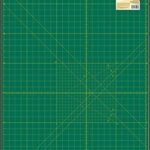
The OLFA 24″ x 36″ cutting mat is one of those tools that quietly does its job without asking for much attention. You lay it flat on your table, grab your rotary cutter, and it just works. The self-healing surface handles repeated cuts surprisingly well — slice through fabric dozens of times in the same spot, and the mat closes back up, staying smooth for your next pass. The grid side is genuinely useful, too. The angle markings aren’t just decoration — they actually help you cut bias strips accurately without guessing or pulling out a protractor.
That said, don’t expect magic. Store it anywhere warm or in direct sunlight, and it’ll warp. It’s also only 1.5mm thick, so it’s not the most heavy-duty mat out there. New out of the box, there’s a faint chemical smell that fades over a week or two. Stick to rotary cutters only — fixed blades will chew it up.
Best For: Quilters, sewers, and crafters who need a reliable, large-format cutting surface for precise rotary work at a permanent tabletop station.
- Self-healing surface reseals after repeated cuts, keeping the cutting area smooth and consistent over time
- Double-sided design offers a gridded side with angle markings for precise cuts and a clean reverse side for general use
- Large 24″ x 36″ size gives you room to cut full fabric panels without repositioning constantly
- At 1.5mm thick, it’s thinner than some competing mats and can show wear marks with heavy use
- Must be stored flat and away from sunlight — heat and UV exposure will cause warping
- Noticeable odor when new that takes time to fully dissipate
Table Of Contents
- Key Takeaways
- What Makes Olfa Cutting Mats Unique?
- How Durable Are Olfa Cutting Mats?
- Are Olfa Cutting Mats Worth The Price?
- How Do Olfa Mats Compare to Other Brands?
- What Sizes and Types Do Olfa Mats Offer?
- What Are The Key Benefits for Sewers and Quilters?
- How Should You Care for Olfa Cutting Mats?
- Frequently Asked Questions (FAQs)
- Conclusion
Key Takeaways
- Olfa’s triple-layer construction and self-healing surface keep cuts clean and blades sharp far longer than budget mats ever will.
- At roughly a dollar a month over five years, a $70 Olfa mat actually costs less than cycling through cheap replacements every year or two.
- Double-sided design with precision gridlines — including 30, 45, and 60-degree angle guides — means you’re getting a proper cutting system, not just a surface to slash fabric on.
- Heat is the one thing that’ll kill your mat fast, so keep it flat, store it away from sunny windows and hot cars, and it’ll easily last a decade.
What Makes Olfa Cutting Mats Unique?
Olfa cutting mats aren’t just another surface to cut on — they’re built around a few specific design choices that separate them from the cheaper options at the craft store.
Those choices come at a cost, though — something worth weighing if you’re still figuring out which cutting mat fits your quilting setup.
If you’ve ever wondered why so many quilters and sewers swear by them, the answer comes down to three core features. Here’s what actually sets them apart.
Self-Healing Surface Technology
The self-healing surface on Olfa cutting mats isn’t magic — it’s material science working quietly in your favor. Tiny PVC particles pack tightly together, separating during a cut and pressing back into place afterward. That healing mechanism keeps your surface smooth and your rotary cutter running clean.
- Shallow cuts close almost immediately
- Surface absorbs blade pressure without gouging
- Cutting efficiency stays consistent across sessions
- Blade protection improves with a forgiving, cushioned feel
- Surface durability outlasts hard plastic or cardboard alternatives
For more information on the layers and durability of these mats, learn about the structure of a stack of self healing cutting mats.
Triple-Layer Bonded Construction
That self-healing surface gets its staying power from what’s underneath it. Olfa cutting mats use triple-layer PVC layering with heat welding—no adhesive, just fused layers that won’t delaminate over years of daily use.
Stiffness tuning gives you a firm core support with softer outer layers, so your rotary cutter glides cleanly while the self-healing surface recovers fast. Cutting mat quality you can actually feel.
For more information on its durability and design, see the triple-layer heat-welded construction.
Double-Sided Design and Gridlines
Flip it over and you’ve got a whole new cutting surface. Olfa cutting mats are double-sided — one face carries high-contrast gridlines for Gridline Accuracy and angle guides at 30, 45, and 60 degrees, while the reverse gives you a clean, line-free surface for patterned fabrics.
Mat Rotation spreads wear evenly across both faces, and that Dual Surface design genuinely doubles your mat’s working life.
How Durable Are Olfa Cutting Mats?
Durability is where Olfa mats either earn their price tag or fall short — and the answer isn’t one-size-fits-all.
How a mat holds up depends on how you use it, how often you cut, and whether the construction actually backs up the marketing claims. Here’s what you need to know across three key areas.
Long-Term Wear Resistance
Olfa cutting mats are built to last — and that’s not just marketing hype. The triple-layer PVC core resists cutting through even under heavy pressure, while the self-healing surface closes up after each pass.
Mat durability depends heavily on wear patterns, though. Spread your cuts across the grid, keep your rotary cutter blade sharp, and surface degradation slows dramatically. Material longevity comes down to how you treat it.
User Experiences With Daily Use
Daily users don’t lie — and the feedback on OLFA cutting mats is consistent. Quilters who cut every single day report that the self-healing surface holds up remarkably well when they build smart user habits:
For quilters who sew on the go, travel-friendly rotating cutting mats offer the same surface durability in compact 12–15 inch sizes with non-slip bases.
- Practice mat rotation to spread wear evenly
- Swap rotary cutter blades frequently
- Shift your cutting zone when you feel resistance
- Reserve a dedicated mat for precision quilt work
Cutting comfort stays reliable longer than you’d expect.
Reinforced Corners and Stability
Corner rigidity isn’t something most people think about until their mat starts buckling mid-cut. OLFA cutting mats use a 3mm triple-layer build that keeps all four corners flat and firm — no drooping, no lifting.
The nonslip backing runs edge-to-edge for grip stability on slick surfaces. Multi-mat clip systems lock panels together, preserving surface integrity and durability across every inch of your workspace.
Are Olfa Cutting Mats Worth The Price?
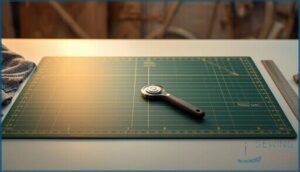
The price tag on an Olfa mat will make you pause — especially when cheaper options are sitting right next to it on the shelf.
But price only tells half the story, and the other half depends entirely on how you cut and how often. Here’s what actually determines whether an Olfa mat is worth your money.
Investment Value for Frequent Sewers
If you sew or quilt regularly, the math on OLFA cutting mats works quietly in your favor. Here’s why frequent sewers consider them a smart investment:
- Mat durability stretches 10-plus years with daily rotary cutter use
- Double-sided surfaces double your usable cutting area
- Sewing productivity improves when your mat stays flat and accurate
That’s real long-term savings — not just a purchase.
Cost Versus Performance
A $70 mat sounds steep — until you run the cost numbers. Spread across five-plus years of daily use, your cost drops to roughly a dollar a month. That’s a value assessment worth pausing on.
At roughly a dollar a month over five years, a $70 cutting mat is barely an expense
| Price Analysis | Budget Mat | Olfa Cutting Mat |
|---|---|---|
| Upfront Cost | $25–$40 | $60–$80 |
| Lifespan | 1–2 years | 5+ years |
| Cost Efficiency | Higher long-term | Lower per month |
Professional Vs. Hobbyist Needs
Your needs — not your budget — should drive this decision.
- Professionals cutting 6–10 hours daily need serious mat durability and consistent self-healing.
- Hobbyists sewing a few hours weekly can stretch a mid-range mat for years.
- Shared studio spaces demand professional tools that survive dozens of users.
- Cutting efficiency matters most when rotary cutters run constantly.
- Casual quilting and sewing crafters treat OLFA cutting mats as a one-time upgrade — not a daily essential.
How Do Olfa Mats Compare to Other Brands?
Olfa isn’t the only cutting mat on the market, and that’s exactly why the comparison matters.
Before you spend your money, it helps to know where Olfa actually stands against the competition. Here’s a closer look at three key areas that separate the brands.
Price and Size Comparison
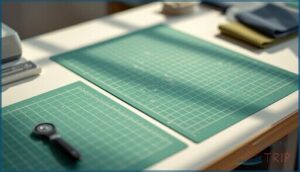
Price points tell the real story. A small 6 x 8 inch Olfa cutting mat runs under $15, while a full 24 x 36 inch mat lands around $70 to $80.
That’s where the value comparison gets interesting — Fiskars often undercuts Olfa on price for the same size options. But cutting mat reviews consistently show Olfa’s durability and self-healing performance justify the cost for frequent users.
Material Quality Differences
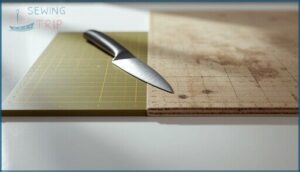
What you’re actually paying for comes down to the PVC composition inside. Olfa cutting mats use a high-quality PVC blend that stays flexible — not brittle.
Here’s how that matters:
- Material thickness hits 1.5–2.0 mm for real density
- Surface finish stays smooth for years
- Core construction uses triple-layer bonding
- Density comparison shows rivals use softer, spongier fills
That difference shows up fast.
Compatibility With Rotary Cutters
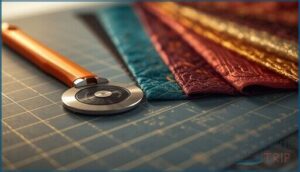
That material quality carries straight into how well Olfa cutting mats work with rotary cutters — and compatibility here isn’t an afterthought.
Olfa designs its self-healing surface specifically for rotary cutters, so blade sharpness holds longer and cutting efficiency stays consistent. Fixed knives? They’ll gouge the mat. Rotary cutting techniques work best when tool compatibility is dialed in from the start.
| Feature | OLFA Cutting Mats | Generic Mats |
|---|---|---|
| Mat Surface Durability | Closes cuts, stays smooth | Pits and grooves build up |
| Rotary Cutter Safety | Engineered for rolling blades | No blade-specific design |
| Fabric Cutting Performance | Up to 470 extra yards per blade | Inconsistent blade contact |
What Sizes and Types Do Olfa Mats Offer?
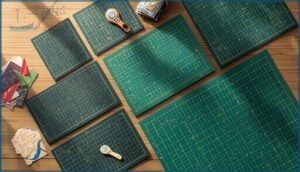
Olfa doesn’t believe in one-size-fits-all, and their lineup proves it.
Whether you’re cutting fat quarters at your sewing table or trimming cards at your craft desk, there’s a mat built specifically for how you work. Here’s a breakdown of the sizes and types worth knowing about.
Standard and Specialty Sizes
Olfa cutting mats come in sizes that cover just about every project you can imagine. The 6 x 8 inch mat accommodates small patchwork and travel projects, while the 24 x 36 inch gives you a full-desk cutting surface for yardage.
Need large format coverage? The 35 x 70 inch continuous grid set spans an entire table. Every size delivers consistent self-healing cutting surface performance, gridline accuracy, and reliable mat size options — no compromises.
Rotating, Folding, and Translucent Mats
Beyond size, the type of mat you pick changes everything. The rotating design — available in 12 x 12 and 17 x 17 inch models — spins a full 360 degrees, boosting craft efficiency by letting you reposition fabric without lifting it.
Folding mats offer portability with a 3.0mm self-healing surface. Translucent mats work on light boxes. Each combines cutting accuracy, blade protection, and mat versatility.
Choosing The Right Mat for Your Projects
Picking the right mat comes down to knowing your workflow. A 24 x 36 inch self-healing surface accommodates full-width quilting fabric with ease, while a 12 x 12 rotating mat speeds up smaller crafting tasks.
Smart mat selection drives better cutting techniques and workspace optimization.
- Match mat size to your most common project scale
- Choose 3 mm thickness for daily cutting sessions
- Use rotating OLFA cutting mats for precise, repositioned cuts
- Pair tool compatibility with your rotary cutter style for longer blade life
What Are The Key Benefits for Sewers and Quilters?
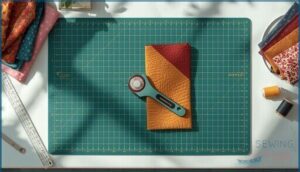
If you sew or quilt regularly, the right mat can change how you work — not just a little, but noticeably.
Olfa mats bring a few specific advantages that matter most to people who cut fabric every day. Here’s what makes them worth your attention.
Accurate Cutting and Measurement
Every cut you make is only as accurate as what’s under your fabric. OLFA cutting mats print 1-inch grids with 1/8-inch hash marks, plus 30, 45, and 60-degree angle lines — so grid alignment isn’t guesswork anymore.
| Feature | Benefit |
|---|---|
| Degree angle lines | Accurate bias and triangle cuts |
| Full-edge gridlines | No lost reference points |
Rotary techniques stay consistent when mat calibration matches your ruler.
Protection for Blades and Work Surfaces
Sharp blades don’t stay sharp on hard surfaces — that’s just physics. Olfa’s self-healing cutting mat acts as a sacrificial layer, absorbing every pass so your blade life extends and your work surfaces stay scratch-free.
- Soft PVC surface maintains blade precision cutting angles
- Self-healing mat closes shallow cuts, preventing groove tracking
- 3mm cushioning stops blades from striking the table
- Wear resistance protects desks, folding tables, and classroom surfaces
- Surface durability reduces how often you replace blades
Enhanced Workflow and Efficiency
Time adds up fast when you’re constantly repositioning fabric. OLFA cutting mats simplify that process — rotating mats let you spin the surface instead of the piece, making efficient trimming of all four block sides without ever leaving your seat.
| Feature | Workflow Benefit | Time Saving Impact |
|---|---|---|
| Rotating mat | Cuts multiple angles in place | Fewer repositioning steps |
| Selfhealing surface | Smooth, uninterrupted rotary cutting | Less downtime between passes |
| Gridlines | Built-in precision measurement | No separate ruler needed |
| Durability | Long intervals before replacement | Workflow optimization maintained |
How Should You Care for Olfa Cutting Mats?
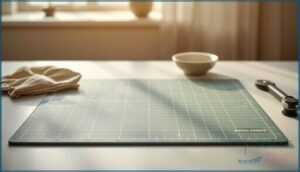
A good cutting mat won’t last if you treat it like a workhorse with no days off.
The way you clean, store, and use your Olfa mat directly affects how long it stays smooth and functional. Here’s what actually has an impact.
Cleaning and Maintenance Tips
Treat your Olfa mat like the precision tool it’s — neglect it, and you’ll feel it in every cut. Keep these maintenance tips close:
- Wipe with a damp cloth and mild soap for routine mat cleaning methods.
- Use cool water only — heat warps the surface permanently.
- Apply a vinegar soak for deep cleaning embedded grime.
- Use a lint roller or soft brush for fiber removal.
- Keep surface protection simple — no metal tools, no pins on the mat.
Extending Mat Lifespan
Rotate your mat 90 degrees each week — this simple habit spreads blade wear evenly and keeps the self-healing surface working as designed.
Smart pressure management means letting a sharp blade do the work, not your wrist. Keep heat away, protect the surface from grit, and match your mat to the right materials.
These maintenance tips are what separate a mat that lasts years from one that gives out in months.
Proper Storage and Usage Practices
Storage is where a lot of crafters quietly lose the battle. Keep your OLFA cutting mat completely flat — under a bed or cutting table works well.
Avoid cars, sunny windows, and heaters; heat is the self-healing surface’s worst enemy. For vertical hanging, use a full-width clamp, not two small clips. These mat storage tips protect your investment and your rotary cutters.
Frequently Asked Questions (FAQs)
Is a self-healing cutting mat worth it?
Cut to the chase — yes, a selfhealing cutting mat is worth it. The Olfa Cutting Mat delivers blade protection, cutting accuracy, and mat durability that outlasts cheaper options by years.
What is the best brand of cutting mat?
Olfa cutting mats consistently top brand comparisons for rotary cutting mat accuracy and durability.
User reviews and product tests point to Olfa Products as the go-to choice for serious sewers who need reliable cutting mat materials.
How long do self-healing cutting mats last?
You get what you give — a well-maintained self-healing cutting mat lasts 5 to 10 years with regular use.
Olfa cutting mats’ self-healing surface and cutting mat durability make them outlast cheaper alternatives easily.
How do you maintain olfa cutting mats?
Keep your mat clean with mild soap and cool water — never hot. Rotate it regularly, store it flat, and keep sharp blades on hand.
Simple maintenance routines protect the self-healing surface and extend durability greatly.
Are olfa cutting mats the best?
For top performance and surface resilience, OLFA cutting mats consistently earn professional choice status across product reviews and comparisons.
User satisfaction stays high thanks to blade preservation and long-term durability — making them a reliable cutting mat selection guide favorite.
How long should a cutting mat last?
With proper care, a quality self-healing cutting mat lasts 5 to 10 years for regular home use. Daily heavy cutting shortens that. Rotating your mat and storing it flat adds years.
What types of projects can OLFA Cutting Mats be used for?
OLFA cutting mats handle quilting projects, fabric cutting, paper crafting, model making, and DIY home tasks.
Whether you’re sewing garments, trimming quilt blocks, or cutting cardstock, these cutting mats work reliably with rotary cutters across nearly every crafting application.
What are the advantages of using an OLFA Cutting Mat?
Like a solid workbench that never lets you down, OLFA cutting mats deliver cutting accuracy, mat durability, and a self-healing surface that keeps rotary cutters sharp — boosting your crafting efficiency every single session.
Are OLFA Cutting Mats heat resistant?
No, OLFA cutting mats aren’t heat resistant. They’re PVC-based, so heat damage and mat warping happen fast.
Keep them away from irons, sunny windows, and hot cars to protect that self-healing surface.
How easy is it to clean an OLFA Cutting Mat?
Cleaning an OLFA cutting mat is a breeze. Wipe it with a damp cloth and mild soap after each session.
For deep cleaning, soak it in cool water with white vinegar — done.
Conclusion
A sharp tool in steady hands changes everything—and that’s exactly what Olfa delivers. If you cut fabric regularly, the question of are Olfa cutting mats worth the price answers itself the moment your blade glides clean instead of dragging.
The self-healing surface protects your blades, your work, and your time. Cheap mats cost you more in replacements and ruined projects. Invest once in quality, and your cutting table becomes a place where precision actually happens.
- https://www.allbrands.com/products/2937
- https://olfa.com/products/olfa-rm-mg-24-x-36-green-double-sided-rotary-mat
- https://shopsavvy.com/answers/how-long-does-the-olfa-24x36-cutting-mat-take-to-self-heal
- https://excelblades.com/blogs/diy/how-do-self-healing-cutting-mats-work
- https://rhinocuttingmat.co.uk/everything-you-need-to-know-about-self-healing-cutting-mats/