This site is supported by our readers. We may earn a commission, at no cost to you, if you purchase through links.
Your sewing table does more than hold your machine — it shapes how you work, how long you can sew comfortably, and whether your projects actually turn out the way you envisioned. Sewers who upgrade from a basic folding table often describe the shift as dramatic: more control, less fatigue, fewer fabric mishaps mid-seam.
The problem is that most tables look nearly identical online. Same dimensions, same photos, wildly different real-world performance. Machine footprint alone can quietly eat up 20 percent of your usable surface before you’ve cut a single piece of fabric.
The ten tables reviewed here span different spaces, budgets, and sewing styles — with the specs that actually matter laid out clearly.
Table Of Contents
- Key Takeaways
- Top 10 Best Sewing Tables
- 1. Sew Ready Comet Hobby and Sewing Table
- 2. DWVO Folding Sewing Table with Charging Station
- 3. Sauder Craft Cart Rolling Sewing Table
- 4. Large Folding Multipurpose Craft Station
- 5. Magshion sewing machine storage table
- 6. Folding Multipurpose Sewing Craft Table
- 7. Folding Multipurpose Craft Sewing Station
- 8. Vividwood Foldable Multipurpose Sewing Table
- 9. Sew Ready Foldable Hobby and Cutting Table
- 10. Sew Ready Hobby Cutting Table
- Sewing Table Buying Guide
- Key Features to Compare
- Best Tables by Sewing Space
- Sewing Table Buying Mistakes
- Frequently Asked Questions (FAQs)
- Conclusion
Key Takeaways
- Your machine’s footprint can silently steal up to 20% of your usable surface before you’ve touched a single piece of fabric, so always size your table around your machine first.
- Features like adjustable flush platforms, built-in charging stations, and lockable casters aren’t extras — they’re the details that separate a frustrating setup from one that actually supports your work.
- Height comfort is the most skipped spec and the one your body notices first; aim for a table between 17 and 34 inches to match your posture and protect your shoulders over long sessions.
- The right sewing table isn’t just about where you are today — buy for the projects, machines, and skills you’re working toward, not the ones you’re starting with.
Top 10 Best Sewing Tables
Finding the right sewing table can make a real difference in how much you enjoy your time at the machine. The options below cover a range of budgets, room sizes, and sewing styles — so there’s likely something here that fits your setup. Here are the ten best sewing tables worth considering in 2026.
If you’re also shopping for an extension table, these tips for choosing the right sewing machine extension table can help you find one that matches your machine and projects.
1. Sew Ready Comet Hobby and Sewing Table
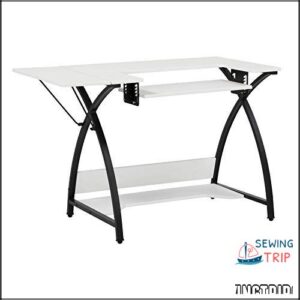
The Sew Ready Comet brings a lot to a small footprint. Its 56.75-inch workspace gives you room to spread fabric without fighting for surface area, while the foldable side shelf adds extra reach when you need it.
What sets it apart is the adjustable sewing platform — it drops down to keep your machine flush with the tabletop, making flatbed sewing noticeably smoother. The lower shelf holds up to 15 lbs, keeping your go-to supplies close without crowding your main surface.
| Best For | Sewists and crafters — especially those on the shorter side — who want an organized, ergonomic workspace without sacrificing too much room. |
|---|---|
| Primary Material | Steel & composite |
| Table Width | 45.5″ |
| Built-in Storage | Lower shelf & platform |
| Expandable Surface | Foldable side shelf |
| Stability Feature | 4 floor levelers |
| Table Height | 30″ |
| Additional Features |
|
- Adjustable sewing platform keeps your machine flush with the tabletop for smoother flatbed sewing
- Foldable side shelf expands your workspace when you need it, then tucks away when you don’t
- Lower storage shelf keeps fabrics and supplies within arm’s reach without cluttering your main surface
- The platform only drops about 3.5 inches, so some machines may still sit slightly above the tabletop
- The table is heavy enough that moving it solo is a real hassle
- The top coating can get damaged if you’re pulling off heavy-duty adhesive tape regularly
2. DWVO Folding Sewing Table with Charging Station
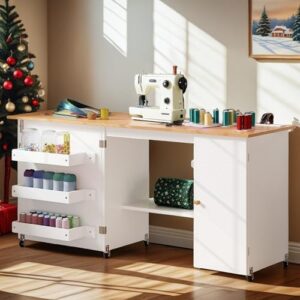
If the Comet won you over with its flush platform, the DWVO takes a different angle — it’s built for sewists who need their workspace to do double duty.
The standout feature is the integrated charging station: two AC outlets and two USB ports sit right at your side, so your lamp, iron, and phone stay powered without hunting for a strip. Six rolling casters — three lockable — let you reposition freely, and the folding design tucks away cleanly when the session ends.
| Best For | Sewists and crafters working in small or multi-purpose spaces who want an organized, mobile workstation with built-in power access. |
|---|---|
| Primary Material | Engineered wood |
| Table Width | 60.9″ |
| Built-in Storage | 3 shelves & cabinet |
| Expandable Surface | Folding top extension |
| Stability Feature | 6 casters, 3 lockable |
| Table Height | 29.5″ |
| Additional Features |
|
- Built-in charging station with AC outlets and USB ports keeps your lamp, iron, and devices powered without extra cords or power strips
- Rolling casters with lockable wheels make it easy to reposition or store away, giving your space real flexibility
- Generous storage — side shelves, an open layer, and a cabinet with adjustable shelves — keeps supplies sorted and within reach
- Assembly can be slow and tricky, especially the hinges and screw alignment, and you’ll likely want a second pair of hands
- Instructions are illustration-only, which can make the process harder to follow for some
- The casters may struggle on thick carpet, and outlet placement could limit how far your machines’ power cords can reach
3. Sauder Craft Cart Rolling Sewing Table
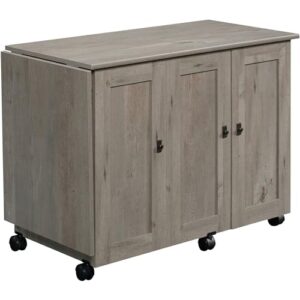
Where the DWVO leans on tech, the Sauder Craft Cart keeps things beautifully simple — and sometimes that’s exactly what you need.
The drop leaf extension folds out to give you extra cutting room, then tucks back when space gets tight. Behind the roll-open door, you’ll find two storage bins, a hidden shelf, and two adjustable interior shelves for organizing notions your way. At 79 pounds in Mystic Oak engineered wood, it rolls easily on locking casters without feeling flimsy underfoot.
| Best For | Crafters and sewists who want simple, organized, mobile storage without the tech bells and whistles. |
|---|---|
| Primary Material | Engineered wood |
| Table Width | 40.08″ |
| Built-in Storage | 2 bins & hidden shelf |
| Expandable Surface | Drop leaf tabletop |
| Stability Feature | Easy-roll casters |
| Table Height | 28.5″ |
| Additional Features |
|
- Drop leaf extension adds cutting space when you need it, folds away when you don’t
- Generous built-in storage with bins, a hidden shelf, and two adjustable shelves keeps everything organized
- Locking casters make it easy to roll between rooms while staying stable during use
- At 79 pounds, it’s on the heavier side despite being on wheels
- Engineered wood may not feel as premium or durable as solid wood over time
- Assembly required, which can be time-consuming given the weight and size
4. Large Folding Multipurpose Craft Station
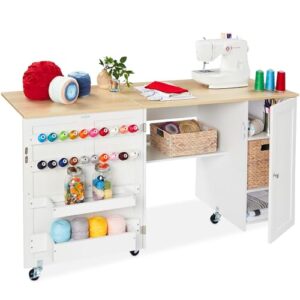
When you need a station that does more with less floor space, this one earns its spot. The convertible folding mechanism transforms it into a compact side table when you’re done — a real advantage in small rooms.
It holds up to 330 lbs on the main surface, rolls on built-in casters, and locks closed with magnetic doors. At 70 lbs total, it’s sturdy enough to feel dependable, yet mobile enough to reposition without a struggle.
| Best For | Crafters, sewers, and home office users who need a versatile, space-saving workstation that can handle heavy equipment while tucking away neatly when not in use. |
|---|---|
| Primary Material | MDF & metal |
| Table Width | 62″ |
| Built-in Storage | Cabinet, pegs & trays |
| Expandable Surface | Folding side extension |
| Stability Feature | Built-in caster wheels |
| Table Height | 31.25″ |
| Additional Features |
|
- Impressive 330 lb main surface capacity makes it suitable for heavy sewing machines, monitors, or other substantial equipment
- Built-in casters and a folding design give you the flexibility to move or store it with minimal effort
- Integrated storage — peg rows, trays, and an adjustable three-section cabinet — keeps tools and supplies organized in one place
- The extended surfaces and shelves max out at just 22 lbs, which limits what you can place on them
- At 70 lbs, moving it up stairs or across uneven surfaces could still be a challenge
- Color options may be limited depending on availability, so you might not get your first choice
5. Magshion sewing machine storage table
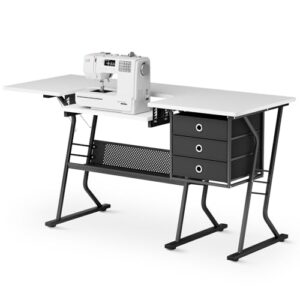
Compact by design, the Magshion sewing machine storage table packs serious functionality into a small footprint. When you’re done for the day, it folds flat to under 5 inches — slim enough to slide into a closet without rearranging your entire room.
If you’re just getting started, this kind of space-saving design is exactly what the guides on sewing machine tables for beginners recommend — practical storage without sacrificing a proper work surface.
The enclosed cabinet keeps notions, bobbins, and thread spools tucked away behind flush-closing doors. That means no cluttered surfaces between sessions. The work surface sits at a standard sewing height, so long project days won’t leave your shoulders paying for it.
| Best For | Sewists and crafters who need an organized, multi-purpose workstation with plenty of storage and surface space for large or ongoing projects. |
|---|---|
| Primary Material | Engineered wood & steel |
| Table Width | 60″ |
| Built-in Storage | 3 drawers & grid shelf |
| Expandable Surface | Foldable side shelf |
| Stability Feature | 6 floor levelers |
| Table Height | 29.5″ |
| Additional Features |
|
- The foldable 9.5-inch side shelf expands your workspace when you need it and tucks away when you don’t
- Three built-in drawers keep small tools like bobbins, needles, and thread neatly organized and within reach
- Height-adjustable platform and six floor levelers make it easy to set up comfortably on almost any surface
- Each drawer only holds up to 6.6 lbs, so heavier supplies will need to live elsewhere
- Assembly is required, which can be time-consuming given the combination of metal frame and wood components
- The desktop is made from particle board and engineered wood, which may not hold up as well as solid wood under heavy daily use
6. Folding Multipurpose Sewing Craft Table
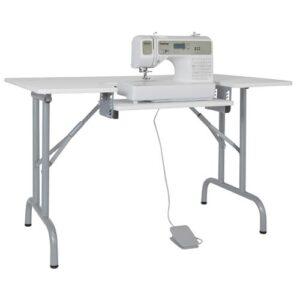
At 47.5 inches wide, this table gives you genuine room to spread out fabric, adjust patterns, and keep your machine in place without crowding yourself. The adjustable drop-down platform offers six height settings, so you can dial in exactly the right angle for your workflow.
When the session ends, it folds away cleanly — no awkward disassembly, no dedicated storage corner required. The engineered wood surface stands up to everyday wear without fuss, and the integrated machine shelf keeps your setup stable throughout.
| Best For | Crafters, sewists, and home office users who need a functional full-width workspace but don’t have the room to keep a dedicated table set up permanently. |
|---|---|
| Primary Material | Engineered wood |
| Table Width | 47.5″ |
| Built-in Storage | Integrated machine shelf |
| Expandable Surface | Full fold design |
| Stability Feature | Folding support legs |
| Table Height | 30″ |
| Additional Features |
|
- Genuinely wide 47.5" surface gives you real room to cut fabric, lay out patterns, or spread a keyboard and monitor without feeling cramped
- Six adjustable height positions on the drop-down platform let you customize the setup to your exact workflow
- Folds away quickly when you’re done — no tools, no disassembly, no dedicated storage corner needed
- Requires assembly out of the box, so plan for some setup time before your first use
- Engineered wood is durable for everyday tasks but won’t have the same feel or longevity as solid wood
- The folding mechanism should be checked periodically to make sure it stays stable over time
7. Folding Multipurpose Craft Sewing Station
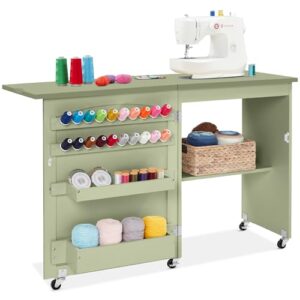
This station packs a surprising amount of function into a compact frame. When open, you get a generous work surface alongside two peg rows, two attached trays, and a large interior shelf — enough to keep thread, tools, and notions genuinely within reach.
Magnetic door locks hold everything secure when you roll it between rooms on its lockable casters. Closed, it shrinks to just 23 inches wide. That’s a full workstation hiding in plain sight as a side table.
| Best For | Crafters, sewers, and hobbyists who need a real workspace but don’t have the room to dedicate one permanently. |
|---|---|
| Primary Material | MDF |
| Table Width | 46″ |
| Built-in Storage | Pegs, trays & shelf |
| Expandable Surface | Convertible fold design |
| Stability Feature | Lockable caster wheels |
| Table Height | 30.5″ |
| Additional Features |
|
- Converts from a full workstation to a compact 23"-wide side table, making it genuinely practical for small spaces
- Built-in pegs, trays, and a large interior shelf keep tools and supplies organized and close at hand
- Lockable casters make it easy to roll between rooms and stay put wherever you land
- MDF isn’t as tough as solid wood, so it may show wear faster with heavy daily use
- Converting to side table mode means manually putting away and reorganizing your supplies each time
- At nearly 47 inches long when open, it still needs a decent amount of clear floor space to actually use
8. Vividwood Foldable Multipurpose Sewing Table
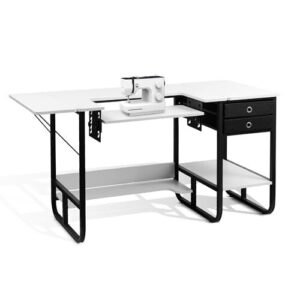
The Vividwood’s 56.7-inch tabletop gives you room to spread out a full quilt without crowding your machine. An adjustable platform shelf lets you raise or lower your machine to create a flush work surface — a small detail that makes a real difference on long projects.
The foldable 8.6-inch side shelf adds workspace when you need it, tucking away when you don’t. Five casters keep it mobile, with two that lock so it stays put while you sew.
| Best For | Quilters, dressmakers, and crafters who need a spacious, organized workspace that can double as a writing or laptop desk. |
|---|---|
| Primary Material | Engineered wood & metal |
| Table Width | 56.7″ |
| Built-in Storage | 2 cloth drawers & shelf |
| Expandable Surface | Foldable side shelf |
| Stability Feature | 6 adjustable levelers |
| Table Height | 30″ |
| Additional Features |
|
- The 56.7-inch tabletop offers generous space for large projects like quilting or dressmaking without feeling cramped.
- The adjustable platform shelf creates a flush sewing surface, reducing strain and improving control during long sessions.
- Built-in cloth drawers and an open lower shelf keep fabric, tools, and notions neatly within reach.
- Assembly can be time-consuming and requires patience to get screws properly aligned.
- The fabric drawers lack the structural rigidity of wood or plastic, so they’re better suited for lightweight items.
- Some users notice minor vibration or bounce during heavy machine use, which may affect precision work.
9. Sew Ready Foldable Hobby and Cutting Table
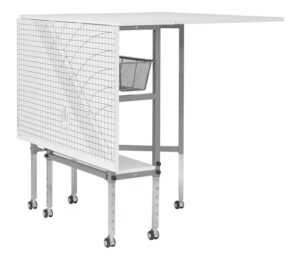
The Sew Ready Foldable Hobby and Cutting Table is built for sewists who need a serious cutting surface without sacrificing storage space. At 58.75 inches wide, it gives you room to lay out full fabric lengths, while the built-in grid with inch, centimeter, and angle markings means fewer tools cluttering your workspace.
Two mesh drawers and a lower shelf keep supplies close. When the project’s done, the table folds to just 12.25 inches wide — easy to tuck away.
| Best For | Sewists, quilters, and crafters who need a spacious, precise cutting surface but are short on space. |
|---|---|
| Primary Material | Steel frame |
| Table Width | 58.75″ |
| Built-in Storage | 2 mesh drawers & shelf |
| Expandable Surface | Foldable panel sections |
| Stability Feature | Locking casters |
| Table Height | 29.75″ – 38.75″ |
| Additional Features |
|
- Generous 58.75" wide surface with a built-in grid (inches, centimeters, and angles) for accurate cutting without extra tools
- Folds down to just 12.25" wide for easy storage when not in use
- Adjustable height and built-in mesh drawers and shelf keep your workspace ergonomic and organized
- Rotary blades can’t be used directly on the tabletop surface, so you’ll need a cutting mat
- Height adjustments may require a second person to help reposition
- Grid lines can be slightly misaligned across the hinged sections, which may affect precision cutting
10. Sew Ready Hobby Cutting Table
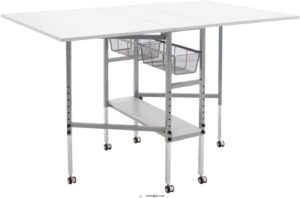
The last table on this list pulls double duty without apology. The Sew Ready Hobby Cutting Table stretches to nearly 60 inches wide — enough room to spread full fabric lengths flat — while wire mesh drawers and a bottom shelf keep your tools exactly where you need them.
Six casters let you roll it wherever the project takes you, and two lock it in place. At 58 lbs, it’s sturdy, practical, and built to last through serious cutting sessions.
| Best For | Sewers and crafters who need a large, organized cutting surface that can adapt to different working heights and fold away when not in use. |
|---|---|
| Primary Material | Steel frame |
| Table Width | 58.75″ |
| Built-in Storage | 2 wire drawers & shelf |
| Expandable Surface | Full fold design |
| Stability Feature | Standard support legs |
| Table Height | 29.75″ – 38.75″ |
| Additional Features |
|
- Nearly 60 inches of workspace gives you plenty of room to spread out full fabric lengths without awkward folding or bunching
- Adjustable height (29.75" to 38.75") lets you dial in a comfortable working position and save your back during long sessions
- Folds down to just 12.25" wide, so it tucks away easily in tight spaces when the project’s done
- At 58 lbs, moving or assembling it solo can be a bit of a workout — you’ll probably want a second pair of hands
- Wire mesh drawers work great for larger tools, but small notions like pins or buttons can slip right through
- You’ll need to unfold and set it up each time you use it, which adds a step if you were hoping for a grab-and-go setup
Sewing Table Buying Guide
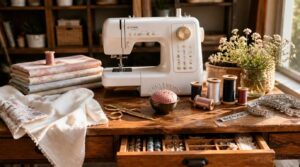
Picking the right sewing table comes down to a handful of factors that can make or break your workflow. Before you spend a single dollar, it’s worth knowing what to look for so you don’t end up with a table that fights you instead of helping you. Here are the five key things to check before you buy.
Workspace Size
How much room do you actually need? A single workstation with clearance requires roughly 1.4 by 1.4 meters — enough for your machine, chair, and leg room. Aisle space of at least 0.9 meters keeps movement comfortable.
To make the most of your space, consider your functional arm reach when arranging tools.
Compact sewing solutions work beautifully in tight rooms. Surface depth between 600 and 800 millimeters works for most projects without cramping your workspace or your creativity.
Machine Weight Capacity
Once you’ve sorted out your space, the next question is whether your table can actually handle your machine. Most hobby tables support between 25 and 100 kilograms, but that range matters. A heavy-duty sewing machine on a weak frame will flex and vibrate, throwing off your stitching.
Steel frames with reinforced crossbars offer the best sewing machine stability — look for tubular construction and solid welds.
Table Surface
The surface shapes every cut and seam. Melamine laminate finishes resist stains and wipe clean fast. A matte texture also cuts glare when you’re guiding fabric through a curve.
- Smooth surfaces prevent thread snags
- Matte finishes reduce eye strain
- Water-resistant surfaces survive dye spills
- Rounded edges prevent injuries
- Cutting grids guide fabric cuts
Choose a sturdy sewing table surface wisely.
Storage Options
A smooth surface keeps your workspace clean, but storage keeps it functional. Vertical rack systems and modular drawer organization let you sort thread, scissors, and notions without hunting. Hidden compartment solutions tuck rulers and cutting mats out of sight.
Integrated cord management channels reduce tangling near your machine. Good sewing room organization means less setup time and more actual sewing.
Portability
Where your table ends up matters. A folding sewing table earns its keep when portability is the priority.
- 18-pound lightweight frame — easy solo transport
- Compact folding design — 40% smaller footprint
- Lockable wheels — stable on any floor
- Fits through a 30-inch doorway folded
- No-tool assembly — ready in six minutes
Sturdy mobile frames and non-slip feet keep your setup protected between rooms.
Key Features to Compare
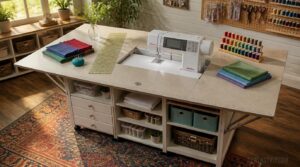
Not all sewing tables are built the same, and the right features can make a real difference in how you work. Before you buy, it helps to know which specs actually matter for your setup. Here are the key features worth comparing.
Adjustable Height
Your posture shapes your stamina. Electric sit-to-stand sewing machine stands range from 22 to 48 inches, letting you shift mid-session without breaking focus. Many of the best sewing tables store up to four ergonomic preset heights, so moving between tasks takes one press.
| Adjustment Type | Height Range | Key Benefit |
|---|---|---|
| Electric motor | 22–48 inches | Smooth, fast sit-to-stand versatility |
| Manual crank | 22–44 inches | Fine 1–5 mm precision |
| Fixed with risers | Set height only | Budget-friendly stability |
Anti-collision sensors stop the desk from lowering onto your machine.
Folding Extensions
Quilting a king-size quilt demands real estate. Folding extensions — drop leaves that hinge from the table’s edge — can add 12 to 24 inches per side instantly. Laminated plywood and aluminum are common material choices, each balancing durability with weight.
Locking mechanisms keep the surface flush and stable under fabric pressure. Grease-free pivot hinges stay reliable long-term with minimal upkeep.
Built-in Storage
Built-in storage turns a sewing cabinet from a flat surface into a full workspace. Thread organization improves when pull-out trays hold up to 96 spools, while storage drawers with soft-close slides protect fabric bundles.
Magnetic strips handle tool accessibility for scissors and seam rippers. Cord management channels route power lines cleanly, keeping your table clear and your focus exactly where it belongs.
Wheels and Casters
Locking caster wheels change everything about how you use a portable sewing machine table. When you’re mid-project, the last thing you want is your table drifting across the floor.
Look for polyurethane or rubber wheels — both handle heavier loads and reduce vibration transfer. Larger diameters roll more smoothly over rugs. Always confirm each caster’s load capacity rating before buying.
Charging Stations
Some best sewing tables now include built-in charging stations — a practical upgrade for any sewing station setup.
Why it matters:
- Keeps your phone charged for tutorials
- Powers LED task lights
- Charges sewing machine accessories like cutters
- Reduces cord clutter on your sewing table
Check USB-A, USB-C, and outlet counts before buying.
Best Tables by Sewing Space
Not every sewing table works for every space, and the wrong choice can make your setup feel cramped before you even thread a needle.
The good news is there’s a solid match for nearly any room situation, whether you’re tucked into a small corner or sharing space with other hobbies. Here’s a breakdown of the best tables by the type of space you’re working with.
Small Sewing Rooms

Working in a small sewing room forces you to think smarter about every inch.
An L-shaped layout keeps cutting, pressing, and stitching within arm’s reach — no wasted steps. Pair that with a compact foldable sewing table that tucks against the wall when you’re done, and a wall-mounted pegboard above for scissors and rulers, and even a tight space starts working like a proper studio.
Shared Craft Spaces

Tight solo rooms demand clever layouts — shared craft spaces demand something more: clear zone organization. Carve out distinct areas for sewing, cutting, and finishing so no one’s rotary cutter ends up buried under someone else’s fabric.
A central tool library keeps shared equipment accessible without the chaos. Personal lockable storage protects your patterns and works-in-progress between sessions.
Quilting Work Areas
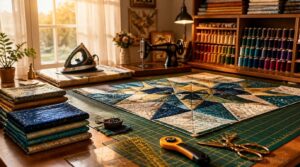
Quilting demands more real estate than most sewing projects. Your table needs room for a large cutting mat — ideally 24 by 36 inches — plus a nearby pressing station so you’re not hauling fabric across the room between steps.
Set your machine surface at elbow height (28–30 inches) and arrange lighting from the front and side to keep stitches clearly visible.
Portable Sewing Setups
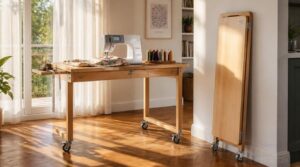
Not everyone sews in a dedicated room. A folding sewing table gives you a real workspace — 28 to 32 inches high when open — then collapses to under 35 inches for compact storage behind a door or under a bed.
Look for quick-setup hinges, locking casters, and a built-in tray to keep notions from scattering between sessions.
Multi-use Hobby Rooms

A hobby room that pulls double duty demands flexible sewing room furniture that shifts between tasks without friction. Fold-down workstations shrink your footprint by up to 40 percent when not in use, while mobile tool carts keep essentials within arm’s reach.
Maintain at least 36 inches of clear floor space between zones — your future self, mid-project, will thank you.
Sewing Table Buying Mistakes

Even seasoned sewists make table-buying mistakes that cost them comfort, efficiency, and money in the long run. Most of these slip-ups come down to a few overlooked details that seem minor until you’re actually sitting down to sew. Here’s what to watch out for before you buy.
Ignoring Machine Size
Your machine’s footprint shapes every decision around it. A mismatch between machine and table shrinks your usable workspace by up to 20 percent, strains your wrists after long sessions, and leaves almost no room for fabric feed on bulky projects.
Watch for these five warning signs:
- Tabletop sagging under heavier machines
- Restricted accessory compatibility for sergers or embroidery arms
- Awkward reach causing wrist strain
- Insufficient fabric feed area
- Workspace obstruction limiting movement
Choosing Weak Frames
A flimsy frame is a slow disaster. Thin metal tubing and particleboard bend under load, and welds loosen after repeated use — leaving your table wobbling mid-seam.
Look for a heavy-duty metal frame with corner brackets and reinforced joints. Weight capacity matters too: weak frames often fail below 100 pounds, which won’t safely support most sewing equipment.
Overlooking Comfort Height
Height is the detail most people skip — and they pay for it in aching shoulders and tight hips. Comfort height sits between 17 and 19 inches, and getting it wrong forces awkward postures that drain your focus and precision.
Shorter users need seats closer to 17 inches; taller sewers need room to avoid hunching. An adjustable height sewing table protects your body across every session.
Skipping Storage Needs
Storage isn’t an afterthought — it shapes how smoothly your whole session runs. Without it, scissors get buried, thread spools scatter, and fabrics pile up until your usable work surface shrinks to almost nothing.
Clutter-driven inefficiency slows you down before a stitch is even made. Sewing machine tables with built-in sewing accessory storage keep your workflow clean and your tools exactly where you need them.
Buying Too Small
A table that’s too small doesn’t just feel cramped — it actively fights you. Fabric maneuvering becomes a constant battle, pattern layout gets compressed, and bulky projects like quilts need endless repositioning.
If you plan to upgrade your machine later, a compact foldable design won’t keep pace. Invest in workspace dimensions that match where your skills are headed, not just where you’re now.
Buy for the sewist you’re becoming, not the one you are today
Frequently Asked Questions (FAQs)
How do I choose the right sewing table?
Knowing your limits is what sets you free. Measure workspace clearance first, then check machine weight capacity and surface durability. Match those numbers to your room and posture, and the right choice becomes obvious.
How often should I oil my sewing tables wheels?
Oil your sewing table wheels every 1 to 3 months under normal use. For dusty rooms or daily sessions with heavy duty sewing equipment, shorten that to every 2 to 4 weeks.
Can I use a sewing table for other crafts?
Yes, a sewing table works well for other crafts. Remove the machine and you’ve got a multipurpose surface ready for fabric cutting, scrapbooking, or beadwork. Built-in storage keeps your tools organized no matter the project.
Whats the best way to clean a sewing table?
Protective finishes need a touch-up every 1–2 years. Dust with a microfiber cloth first, then wipe your melamine laminate finish with mild soap and water. Dry immediately to maintain a water resistant surface and prevent damage.
Are sewing tables suitable for left-handed sewers?
Most sewing tables work well for left-handed sewers when set up thoughtfully. Look for reversible table edges, left-side storage, and adjustable height options to keep your workspace comfortable and controls within natural reach.
Can I modify a regular table into a sewing table?
A regular table can absolutely become a functional sewing station. Strengthen the frame, cut a flush machine insert, smooth the surface, and adjust the height to your elbows — roughly 29 to 34 inches.
Can sewing tables accommodate industrial-grade machines?
Think of a heavy-duty metal frame as the backbone of your workspace. Many tables accommodate industrial-grade machines through surface rigidity and vibration dampening tech, with weight capacities usually exceeding 150 pounds for stable, consistent stitching.
How do I reduce vibration during high-speed sewing?
Place a vibration dampening mat under your sewing machine and install machine isolation pads beneath each foot. Level your table feet with a spirit level, then reduce speed when starting heavy fabrics to limit torque shock.
What materials make the most durable sewing surfaces?
The softer the surface feels, the faster it fails. Laminated hardwood and melamine-coated particle board outlast bare wood by years, while scratch-resistant coatings and moisture control keep your sturdy cutting table performing long after cheaper surfaces show wear.
Can IKEA furniture be configured as sewing workstations?
Yes — IKEA modular furniture can absolutely be configured into a functional sewing workstation. Pairing a Kallax unit with a large tabletop creates a solid, organized setup that rivals purpose-built sewing tables.
Conclusion
Studies show sewers spend an average of 6 hours weekly at their workspace — that’s over 300 hours a year shaped by the table beneath their machine.
The right best sewing table doesn’t just hold your equipment; it holds your focus, your posture, and your results. Skipping surface space or ignoring height comfort quietly costs you more than convenience. Choose based on how you actually sew, not just how a table photographs. The right fit changes everything.