This site is supported by our readers. We may earn a commission, at no cost to you, if you purchase through links.
Your machine’s dial holds more power than most sewers ever use. Those numbered patterns aren’t decorative features—they’re precision-engineered solutions to specific fabric challenges, each calibrated to handle tasks that would take manual stitchers hours to perfect.
The straight stitch alone operates at tensions and feed rates impossible to replicate by hand, while the zigzag prevents fraying through mechanical thread manipulation your fingers can’t match.
Understanding what each built-in stitch actually does transforms your machine from a motorized needle into a specialized tool system. Once you know which pattern solves which problem, fabric compatibility stops being guesswork and becomes mechanical certainty.
Table Of Contents
Key Takeaways
- Built-in stitches are pre-programmed patterns that automate specific sewing tasks with precision impossible to replicate by hand, transforming your machine from a motorized needle into a specialized tool system.
- The five core stitches every machine needs are straight stitch for seaming, zigzag for versatility and edge finishing, buttonhole for garment construction, blind hem for invisible finishes, and overcast for preventing fabric fraying.
- Fabric weight, stretch, and texture dictate which stitch to use—lightweight fabrics need shorter stitch lengths (2.0-2.5mm) to prevent puckering, while heavy fabrics require longer lengths (3.5-4.0mm) for proper seam strength.
- Most stitch problems trace back to threading errors, worn needles, or incorrect tension settings, and consistent quality requires regular maintenance including needle replacement every 8 hours and bobbin area cleaning weekly.
What Are Essential Built-in Stitches?
Built-in stitches are pre-programmed stitch patterns that come standard on your sewing machine, ready to use with the turn of a dial or press of a button. Unlike stitches you create manually by adjusting settings each time, these are automated functions designed to handle specific tasks efficiently.
From basic straight seams to decorative embellishments, understanding the best built-in stitches helps you choose the right machine for your sewing projects.
Let’s break down what they’re, how they function, and why they’re different from manual stitching techniques.
Before diving into those details, it helps to explore how automatic stitches work on modern machines and what sets them apart from hand-sewn methods.
Definition of Built-in Stitches
Built-in stitches are predefined stitch patterns stored directly in your sewing machine’s firmware. You’ll access them through the machine controls—whether that’s a dial, touchscreen, or button interface.
Understanding which sewing machines are best for your needs often starts with comparing their built-in stitch libraries and capabilities.
These integrated options include straight stitch, zigzag stitch, and other essential sewing machine stitches, giving you instant stitch customization without manual adjustments. The user interface makes switching between patterns quick and consistent.
For quilters on a budget, these features are often available in a quality sewing machine under five hundred dollars without sacrificing reliability.
How Built-in Stitches Work
When you select a builtin stitches pattern, the sewing machine’s motor control system activates the needle movement sequence stored in memory. The needle travels through fabric, creating stitch formation through interlocking loops—whether you’re running a straight stitch or zigzag stitch.
The Singer Quantum Stylist 9980 includes over 600 built-in patterns, giving you instant access to decorative designs and utility stitches at the touch of a button.
Thread tension and fabric feed synchronize automatically, maintaining consistent stitch length as the mechanism pulls material forward at the programmed rate.
Manual Vs. Built-in Stitches
Your sewing machine manages most tasks through builtin stitches like straight stitch, zigzag stitch, and blind hem—motor-driven patterns requiring minimal stitch control. Manual stitching, however, gives you direct command over needle placement and fabric handling at any sewing speed. Here’s what separates them:
- Builtin stitches execute preprogrammed sequences automatically
- Manual methods demand constant operator input and adjustment
- Machine limitations restrict which patterns come preset
- User preference determines workflow and finishing techniques
- Builtin options deliver consistency; manual control offers flexibility
Core Stitches Every Machine Should Have
Your sewing machine comes with a toolbox of stitches, and knowing which ones actually matter makes all the difference. Most machines include dozens of options, but only a handful will handle 90% of your projects.
Let’s break down the five core stitches that should be on every machine, and what makes each one essential.
Straight Stitch and Its Uses
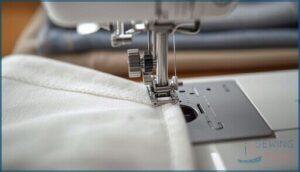
The straight stitch is your machine’s workhorse, handling everything from seaming cotton shirts to topstitching denim jackets. You’ll use it for fabric joining, seam reinforcement, and creating crisp lines on any project.
Adjust your stitch length between 2.0-3.0mm for most woven materials, and dial your stitch tension to keep threads balanced. Master this fundamental sewing technique, and you’ve unlocked half your machine’s built-in stitches potential.
Zigzag Stitch for Versatility
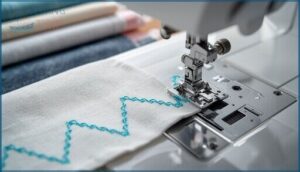
Adjust your stitch width and stitch length, and you’ll tackle stretch seams, fabric edge finishes, and decorative touches with this single zigzag stitch.
Set width between 2-5mm to finish raw edges without a serger, or narrow it to 1mm for delicate appliqué work.
Your machine’s versatility shines here—reinforcing knit seams, preventing fraying on wovens, and adding decorative finishes across any project you’re building.
Buttonhole Stitch for Garment Construction
Most garments need secure, professional button closures, and your buttonhole stitch delivers that precision with sewing automation. You’ll find this stitch combines satin-stitch bars with reinforced ends, creating consistent openings across fabric compatibility ranges.
Modern garment construction demands this functionality—whether you’re working with lightweight cotton or medium-weight linen, buttonhole techniques adapt through width and density adjustments. Master stitch selection here, and your sewing machine stitches produce ready-to-wear results every time.
Blind Hem Stitch for Invisible Finishes
Professional trousers and skirts demand invisible hemming, and your blind hem stitch delivers exactly that finish. This pattern alternates between straight stitch segments along the fabric edge and periodic zigzag catches, hiding the seam on your garment’s face.
You’ll need precise stitch tension and folding accuracy—sewing machine stitches work best when you’ve positioned the fabric fold correctly for consistent hemming techniques and sewing precision.
Overcast/Overlock Stitch for Edge Finishing
Raw fabric edges unravel quickly without proper seam finishing techniques, but your overcast stitch prevents fabric fraying through dense edge finishing. This sewing machine stitches pattern mimics serger results, wrapping thread around the fabric edge with adjustable stitch density.
You’ll control overlock settings through width adjustments—narrow for lightweight materials, wider for heavy fabrics. The overlock stitch delivers professional seam finishing techniques without dedicated equipment.
Choosing The Right Stitch for Your Fabric
Your fabric tells you which stitch it needs, but you have to know how to listen. Weight, stretch, and texture all play a role in stitch selection, and getting it wrong means puckered seams or broken thread.
Your fabric’s weight, stretch, and texture dictate which stitch holds strong without puckering seams or snapping thread
Let’s match your fabric to the right stitch every time.
Matching Stitch Type to Fabric Weight
Your fabric’s weight determines which stitch will hold strong without damaging the material. Lightweight fabrics need shorter stitch lengths (2.0–2.5 mm) to prevent puckering, while heavy fabrics require longer lengths (3.5–4.0 mm) for proper seam strength.
Match your stitch to fabric weight:
- Light fabrics: Use short straight stitch for delicate seams
- Medium fabrics: Standard 2.5–3.0 mm length balances strength and fabric elasticity
- Heavy materials: Longer stitches reduce strain during construction
- Zigzag stitch: Adjust width based on fabric compatibility needs
- Thread tension: Calibrate settings to match fabric weight categories
Stitch Selection for Stretchy Vs. Woven Fabrics
Stretch stitches keep seams flexible on knits, while straight stitches lock woven edges without puckering. For knit fabric tips, choose a narrow zigzag stitch or built-in stretch stitch options to maintain seam elasticity. Woven edge finishing demands a standard straight stitch for crisp lines. Conduct fabric stretch tests on scraps to verify fabric compatibility before final assembly.
| Fabric Type | Best Stitch Selection | Why It Works |
|---|---|---|
| Stretch/Knit | Narrow zigzag, stretch triple | Maintains seam elasticity, prevents thread breakage |
| Woven Cotton | Straight stitch, overcast | Crisp seams, controlled woven edge finishing |
| Mixed Panels | Wide zigzag on knit side | Balances fabric compatibility at transitions |
Adjusting Stitch Settings for Different Materials
Once you’ve matched your stitch selection to fabric type, fine-tune the settings for ideal results. Material selection drives every adjustment, from stitch length to thread tension. Fabric thickness dictates stitch density—heavier materials need longer stitches, while delicate fabrics require shorter ones to prevent puckering.
Key adjustments for fabric compatibility:
- Lightweight fabrics – Reduce stitch length and sewing speed, balance thread tension to avoid waves
- Stretch materials – Increase stitch width on zigzag, lengthen stitches for movement without breakage
- Heavy or specialty fabrics – Boost stitch density, use reinforced patterns with backstitching for durability
Stitch Settings and Machine Adjustments
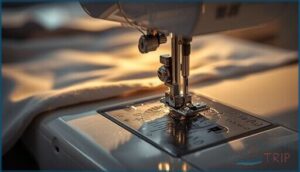
Knowing which stitch to use is only half the battle—your machine settings determine whether that stitch actually works. The right combination of length, width, tension, and presser foot transforms a mediocre seam into a professional finish.
Let’s break down the three key adjustments that’ll give you control over every stitch your machine offers.
Selecting Stitch Length and Width
Two settings control every seam you create: stitch length and stitch width. For standard woven fabrics, you’ll want your stitch length set between 2.5 to 3.0 mm. Linen and cotton need shorter settings, around 2.0 to 2.5 mm, while knits demand longer stitches—2.5 to 4.0 mm—to accommodate stretch without distorting fabric thickness.
| Fabric Type | Recommended Stitch Length |
|---|---|
| Woven fabrics | 2.5 to 3.0 mm |
| Linen/Cotton | 2.0 to 2.5 mm |
| Knits | 2.5 to 4.0 mm |
| Decorative | Start minimum, adjust up |
Most household sewing machines max out between 5 to 7 mm for stitch width on zigzag patterns. When working with decorative stitch selection, start near minimum width and test on scrap fabric. Thread tension and seam allowance both affect how your settings perform, so adjust in small increments while monitoring results.
Balancing Tension for Even Stitches
Once your stitch length and width are set, thread tension determines whether stitches lock evenly or loop on one side. Top thread tension that’s too tight causes loops underneath, while loose bobbin tension creates skipped stitches.
Start with your sewing machine settings at mid-range, then test on scrap fabric. Adjust in small increments—one or two notches—checking both sides until you achieve balanced stitch formation without puckering.
Presser Foot Choices for Built-in Stitches
Your presser foot changes how fabric feeds through stitches. Match the foot to your stitch, and you’ll refine every seam.
A zigzag foot manages decorative and stretch work, while a walking foot keeps knits and suede feeding evenly. Buttonhole feet guide automated buttonhole programs, and edge feet perfect topstitching.
For blind hem stitch, swap to a blind hem foot—it’s your shortcut to invisible hems.
Troubleshooting Common Stitch Issues
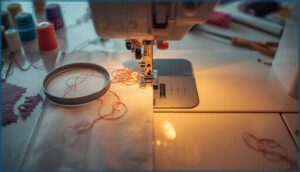
Even the best sewing machine throws a tantrum now and then, turning out wonky stitches or skipping altogether. The good news is that most stitch problems trace back to a handful of fixable issues, not some mysterious machine curse.
Let’s walk through the most common culprits and how to get your stitches running smoothly again.
Identifying and Fixing Stitch Problems
When your stitches start looping, skipping, or puckering the fabric, you’re looking at one of three culprits: threading errors, a worn needle, or tension that’s gone sideways.
Start with these stitch error correction steps:
- Rethread completely, upper and bobbin
- Replace the needle, even if it looks fine
- Check thread tension issues using scrap fabric
- Verify your stitch selection matches the fabric weight
Most stitch quality improvement comes from fresh needles and proper machine calibration tips.
Importance of Needle and Thread Compatibility
Without the right needle for your thread weight, you’ll face thread breakage, skipped stitches, and fabric damage along every seam. Needle selection directly affects stitch formation—too small, and friction shreds the thread; too large, and holes appear where fabric compatibility fails.
Match your thread and needle selection to the fabric’s weight, then verify tension settings on scrap material before sewing your project. Understanding the proper needle sizing systems is essential for achieving perfect stitches.
Maintenance Tips for Consistent Stitch Quality
Your machine delivers clean, reliable stitches only when you maintain it properly, and that means more than occasional dusting. Regular lubrication after every 8 to 10 hours of sewing keeps mechanisms smooth, while machine cleaning removes lint that causes skipped stitches.
To preserve stitch quality through every project, follow these essential maintenance steps:
- Replace your needle every 8 hours of active sewing to prevent thread shredding and uneven tension
- Clean the bobbin area weekly to maintain consistent stitch length and stitch width across fabrics
- Check tension settings and thread quality before each project for balanced, professional results
- Schedule professional servicing every 2 to 3 years to recalibrate feed mechanisms and correct timing issues
Poor sewing machine maintenance directly causes tension problems, irregular stitch formation, and fabric puckering. When you invest fifteen minutes in sewing machine settings and needle replacement between projects, you’ll avoid frustrating mid-seam breakage and maintain the precision your work deserves.
Top Essential Stitching Tools and Accessories
Even the best built-in stitches won’t perform without the right tools backing them up. Your machine needs quality accessories to deliver consistent, professional results every time you sew.
Here are three essentials that belong in every serious stitcher’s toolkit.
1. Brother Metal Sewing Machine
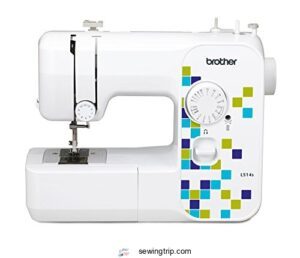
You’ll find the Brother metal sewing machine delivers dependable performance for mastering essential built-in stitches. Its metal frame provides the machine durability and stability you need for consistent straight stitch and zigzag stitch results, even at higher sewing speeds.
The user interface simplifies stitch variety selection, letting you switch between sewing machine stitches without guesswork.
With 11.2 pounds of solid construction and corded electric power, this machine won’t vibrate or shift during extended sessions, making it an excellent foundation tool for developing your stitching skills.
| Best For | Beginners and home sewers who want a sturdy, reliable machine that handles everyday garment construction and basic projects without the hassle of complicated features. |
|---|---|
| Material | Metal |
| Brand | Brother |
| Primary Use | General Sewing |
| Skill Level | Beginner Friendly |
| Durability | Metal Chassis |
| Color | White |
| Additional Features |
|
- Metal frame construction keeps the machine stable and reduces vibration, even when you’re sewing at higher speeds or working with thicker fabrics.
- Simple interface makes it easy to switch between built-in stitches without digging through confusing menus or settings.
- Corded electric power gives you consistent performance without worrying about battery life or power drops mid-project.
- At 11.2 pounds, it’s on the heavier side, so moving it around or storing it frequently might be a bit of a workout.
- The plug may require an adapter if you’re using it outside certain countries, which adds an extra step before you can start sewing.
- Long-term durability isn’t fully proven yet since some users haven’t put it through extensive use over time.
2. Framad Sewing Machine Presser Foot Set
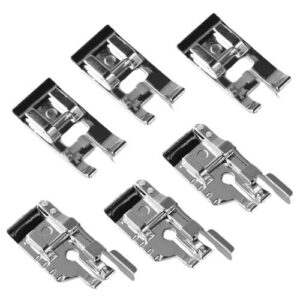
The Framad presser foot set gives you six specialized feet that access advanced stitching techniques your machine’s built-in stitches were designed to perform. The 1/4” quilting foot delivers precise seam allowances for piecing work, while the edge joining foot creates smooth finishes on binding projects.
You’ll appreciate the durable zinc alloy construction with transparent soles, letting you see exactly where your straight stitch or zigzag stitch lands.
Check your machine’s compatibility—these presser foot types fit Baby Lock, Brother, Janome, and Singer low-shank models, expanding your sewing techniques from basic seams to advanced quilting accessories applications.
| Best For | Sewists and quilters who want to expand their machine’s capabilities with specialized feet for precise seaming, binding, and edge finishing without buying brand-name accessories. |
|---|---|
| Material | Zinc |
| Brand | Universal Fit |
| Primary Use | Specialty Sewing |
| Skill Level | All Levels |
| Durability | Zinc Alloy |
| Color | Silver |
| Additional Features |
|
- Transparent soles let you see your stitching line clearly for better accuracy on detailed work
- The 1/4″ quilting foot maintains consistent seam allowances for piecing projects
- Durable zinc alloy construction holds up better than plastic alternatives
- Only works with low-shank machines, so you need to verify compatibility before buying
- No warranty information provided, which could be a concern if a foot arrives defective
- May require adjustment period to learn which foot works best for specific techniques
3. Gutermann Sewing Thread Set
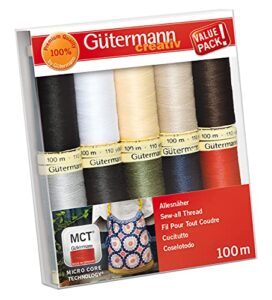
You won’t master your machine’s built-in stitches without thread that matches the task. Gutermann Sew-All polyester sets offer 10 basic colors in 100-meter spools, using Micro Core Technology for tear-resistant seams across different fabric types.
The Tex 30 weight manages everything from straight stitch construction to zigzag finishing, maintaining consistent thread quality at various stitch length settings.
Your sewing machine performs best when thread compatibility meets fabric weight—this set covers buttonholes, blind hems, and overcast edges without mid-project spool changes.
| Best For | Anyone learning to sew who needs reliable thread in common colors for practice projects, garment alterations, and basic machine stitching tasks. |
|---|---|
| Material | Polyester |
| Brand | Gütermann |
| Primary Use | Thread Supply |
| Skill Level | All Levels |
| Durability | Micro Core Technology |
| Color | 10 Colors |
| Additional Features |
|
- Micro Core Technology creates strong, tear-resistant seams that won’t unravel during washing or wear, even when using finer needles
- Ten basic colors cover most everyday sewing needs—hemming pants, replacing buttons, and basic repairs—without buying individual spools
- Universal compatibility with domestic sewing machines means the thread feeds smoothly and reduces lint buildup during longer sessions
- 100 meters per spool runs out quickly on larger projects like quilts or curtains, requiring multiple sets for ambitious work
- Smaller spool size surprises some buyers who expect more thread for the price point
- Hand-wash-only care instructions limit use on items you’d prefer to throw in the washing machine
Frequently Asked Questions (FAQs)
Can decorative stitches replace functional stitches in projects?
Decorative stitches won’t replace functional stitches where seam integrity matters. Straight stitch and zigzag stitch handle fabric stress better, ensuring stitch durability. Structural reinforcement requires proven stitches, not decorative limits.
How do specialty stitches differ from core stitches?
Core stitches handle seams and finishes with standard sewing machine setups, while specialty stitches offer decorative stitches, stretch stitches, and stitch variations requiring different presser feet, stitch customization, and sophisticated techniques for fabric compatibility.
What stitches work best for leather or vinyl?
Before sewing machines had electric motors, leather workers relied on awls—but your straight stitch manages dense fabric stitches best.
Use heavy duty threads, zigzag stitch for edge finishing, and adjust tension for vinyl seam durability.
When should you use a triple straight stitch?
You’ll need a triple straight stitch when reinforcing high-stress seams on jeans, backpacks, or pockets. This technique runs three parallel straight stitches simultaneously, dramatically increasing seam strength and fabric durability without added bulk.
Do all machines have the same buttonhole styles?
Not every machine speaks the same buttonhole language. Your model’s specifications determine which buttonhole variations you’ll find—whether basic four-step, keyhole, or rounded styles.
Check your manual for available stitch customization options.
Conclusion
Picture your machine’s stitch selector as a mechanic’s socket set—each position engineered for specific torque requirements. The essential built-in stitches you’ve mastered now give you mechanical advantage over every fabric scenario.
That zigzag won’t just finish edges; it’ll prevent jersey from curling mid-seam. Your buttonholes will align perfectly because the machine cycles at calibrated intervals.
You’re no longer operating by trial and error—you’re matching engineered solutions to material properties with technician-level precision.
- https://www.schmetzneedles.com/needle-know-how/
- https://www.singer.com/blog/sewing-tips-and-techniques/understanding-thread-tension
- https://www.digitizingmadeeasy.com/creative-cutwork-embroidery-with-organza/
- https://journals.sagepub.com/doi/abs/10.1177/00405175211019133
- https://www.mhthread.com/blog/products/thread-sizing