This site is supported by our readers. We may earn a commission, at no cost to you, if you purchase through links.

A cutting mat that looked immaculate six months ago now resembles a road map of scratches and grooves. Does this sound familiar? Most quilters blame the mat itself—cheap materials, bad batch—but the mat is rarely the problem. Dull blades, heavy pressure, and a few overlooked habits do the real damage, often within weeks of a new mat’s first use.
The good news: most of these culprits are completely preventable once you know what to look for. Understanding why your cutting mat deteriorates quickly is the first step toward making it last years instead of months.
Table Of Contents
Key Takeaways
- Dull blades and heavy cutting pressure are the top culprits behind mat damage — swap your blade every 100 cuts and let sharpness do the work, not force.
- Cutting in the same spot repeatedly carves permanent grooves, so rotate your mat 90 degrees weekly to spread wear evenly across the surface.
- Harsh cleaners like acetone and abrasive scrub pads destroy the self-healing layer fast — stick to mild soap, isopropyl alcohol, and soft brushes instead.
- Heat, direct sunlight, and uneven storage surfaces warp and crack mats over time, so always store yours flat in a cool, shaded spot between 18°C and 25°C.
Why Cutting Mats Wear Fast
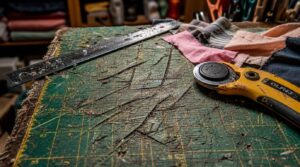
Your cutting mat doesn’t wear out overnight — it’s usually a handful of small habits adding up over time. Some culprits are obvious, others easy to overlook.
Understanding what makes a precision sewing cutting mat surface last longer starts with recognizing the small, repeated mistakes most crafters don’t even notice.
Here’s what’s most likely breaking down your mat faster than it should.
Dull Rotary Cutter Blades
A dull blade is quietly destroying your mat with every pass. Unlike stainless steel, carbon blades dull faster when exposed to moisture, and you won’t always notice until the damage is done.
Watch for these red flags:
- Increased cutting resistance on light fabrics
- Ragged, frayed edges instead of clean lines
- Visible nicks along the edge bevel angle
- Repeated scoring needed to cut through layers
Replace dull blades every 100 cuts. Rotary blade sharpening kits can help, but dullness detection matters most — catch it early. Using a proper straight blade selection guide helps prevent premature mat wear.
Too Much Cutting Pressure
Swapping out a dull blade helps — but pressing too hard undoes that progress instantly. Excessive force pushes fibers deep into the mat, creating small gouges that grow into larger gouges over time. Heat buildup from friction glazes the cutting surface, killing durability fast.
Proper blade geometry and sharp blade usage mean you need far less downward force than you think.
| Pressure Level | Effect on Mat | Result |
|---|---|---|
| Light (under 5 N) | Minimal fiber embedding | Long mat life |
| Moderate | Surface compression | Gradual wear |
| Heavy (over 5 N) | Force distribution fails | Permanent grooves |
Pressure monitoring is your mat’s best friend.
Repeated Cuts in One Area
Pressure alone isn’t the whole story — where you cut matters just as much. Hitting the same spot repeatedly turns small gouges into larger ones fast.
Heat buildup softens the surface, debris concentration traps fibers, and surface flattening kills grip. Groove coalescence follows quickly.
Watch for these warning signs:
- Visible cutting line grooves forming a dense cluster
- Deep cuts that self-healing cutting mats can’t close
- Rulers sliding on a flattened patch
Use sacrificial backing to spread the damage.
Thick or Unsuitable Blades
The blade you choose matters more than most quilters realize. Excessive thickness in a blade widens the wedge cutting into your mat, and that extra bulk transfers more heat transfer energy with every pass. Incompatible profile and wrong edge geometry accelerate blade dulling fast.
For fine fabrics, sharp blades with correct blade material and a thin profile mean cleaner cuts and real tool wear reduction — protecting both the blade and mat.
Wrong Mat for Quilting
Not every mat belongs in a quilting room. Soft craft mats and thin core mats wear down quickly under rotary blades, deepening grooves that show through fabric and throw your ruler off track.
A non-healing surface cannot close those cuts, leading to irreversible damage. Without a compatible blade rating match, heat-induced warping occurs, compromising precision further.
Treat your fabric cutting mat as a core quilt supply, not an afterthought—prioritize durability and compatibility to protect your tools and craftsmanship.
Your cutting mat is a core quilt supply — treat it like one
Cleaning Mistakes That Cause Damage
Clean your mat matters just as much as how you cut on it. The wrong products or habits can quietly strip away the self-healing layer before you ever notice the damage.
Here are the most common cleaning mistakes that could be wearing out your mat faster than anything else.
Harsh Solvents and Acetone

Acetone feels like a quick fix, but it’s quietly destroying your mat. It attacks PVC polymers, dissolves grid-line adhesives, and raises serious vapor safety concerns in enclosed spaces. Stick to spot cleaning with rubbing alcohol, mild soap, or DIY cleaning solutions instead.
If you’re unsure which cleaners are safe, beginner’s guide to cutting mats walks you through proper care for self-healing surfaces built to handle rotary cutters.
Watch what these harsh solvents actually do:
- Solvent compatibility fails fast — acetone melts vinyl mat surfaces on contact
- Mineral spirits and degreasers strip protective barriers and grid coatings permanently
- Bleach solution weakens the self-healing polymer layer over time
- Rapid evaporation concentrates damage in one small area instantly
- Alternative cleaners like isopropyl alcohol clean safely without the destruction
Embedded Lint in Grooves
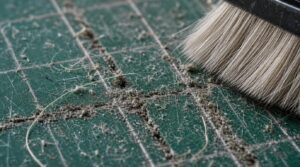
Lint looks harmless, but groove lint trapping is one of the sneakiest ways your mat loses precision. Fabric fiber removal isn’t just cosmetic — once lint crystallization effects set in, those dried, hardened particles roughen the surface and throw off your blade contamination risk too. Use a soft brush or lint-free cloth for regular micro-groove cleaning, then follow up with fiber extraction tools like masking tape or a silicone pad for stubborn buildup.
For routine maintenance, start with a lint-free cloth to clear loose fibers quickly. When deeper cleaning is needed, a soft brush dislodges embedded fabric fibers from grooves. For hardened residue, a masking tape press lifts crystallized particles effectively.
| Problem | Tool | Result |
|---|---|---|
| Loose lint and dust removal | Lint-free cloth | Clears surface fibers fast |
| Deep groove lint trapping | Soft brush | Dislodges embedded fabric fibers |
| Hardened lint crystallization effects | Masking tape press | Lifts residue from grooves |
Adhesive Residue Buildup
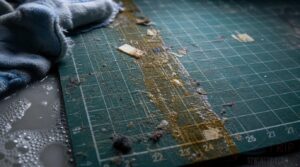
Sticky tape residue is quite a mat killer. When adhesive transfers into grooves, it traps dust and fibers, raising the adhesive surface unevenly and throwing off your cuts.
Adhesive Type Selection matters — silicone-based adhesives cling harder to porous mats. Use Protective Liner Application under materials to prevent transfer.
Warm soapy water manages most adhesive residue removal, but check Solvent Compatibility first — acetone destroys your mat instantly.
Scrubbing With Abrasive Tools
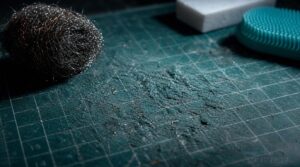
Grabbing a rough scrub pad feels like a quick fix — but it’s quietly wrecking your mat. Abrasive Pad Types matter more than most people realize. Steel wool and harsh scourers cause serious Surface Scratch Depth damage and leave rust-causing fibers behind.
Safe options instead:
- A silicone mat scrubbing pad or soft dish scrubber
- A magic eraser for light residue
- Fine-grit sandpaper only on cured repair spots
Vigorous scrubbing also triggers Heat Build-up, warping your mat. Watch for Tool Wear Indicators — a loaded, rough pad causes Fiber Contamination, pushing debris deeper into grooves.
Skipping Routine Cleaning
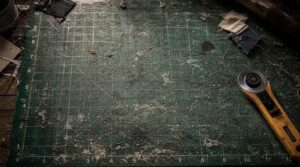
Even skipping one week of basic cleaning starts a chain reaction. Dust and grit act like sandpaper—that’s Grit-Induced Abrasion quietly wearing your mat down. Trapped moisture fuels Biofilm Formation, which smells and degrades material.
| Problem | Fix |
|---|---|
| Micro-scratch Accumulation | Regular cleaning routine weekly |
| Moisture Retention | Dry fully after cleaning solution use |
Adhesive surface maintenance and cleaning frequency prevent deep cleaning emergencies later.
Cutting Habits That Extend Lifespan
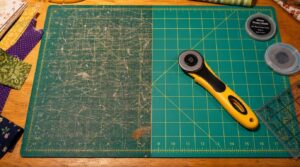
How you cut matters just as much as what you cut on. Small habit shifts — like swapping blades more often or spreading your cuts around — can add years to a mat’s life.
Here are five cutting habits worth building into your routine.
Replace Blades Regularly
Think of your blade like a kitchen knife — the duller it gets, the harder you push. That extra pressure is what gouges your mat.
A simple Blade Replacement Schedule keeps you ahead of tool wear. After about 100 cuts, swap it out, log it in a Blade Tracking Log, and store spares in a labeled Spare Blade Storage case.
Sharp blades, less damage — it’s that straightforward.
Rotate The Mat Often
Sharp blades help, but where you cut matters just as much. If you always work in the same spot, that zone wears out fast while the rest stays untouched.
A simple rotation schedule fixes this. Rotate your mat 90 degrees weekly to keep wear even:
- Turn 90° every week for even wear across all four zones
- Log each rotation date for reliable wear logging
- Rotating usage zones reduces heat buildup and aids heat mitigation
- Consistent edge longevity comes from balanced pressure across all sides
- Pair rotation with flat storage for warping prevention and storage best practices
Use Lighter Pressure
Rotation spreads the damage, but pressure determines how deep it goes. Excessive downward force exceeds a mat’s self-healing capacity, leaving permanent grooves. Pressure Gradient Training addresses this by emphasizing Force Sensory Feedback—letting sharp blades execute precise cuts.
Mastering Proper Hand Positioning and Blade Angle Optimization ensures steady Cutting Rhythm Control, preventing slips and blade dulling. These techniques collectively minimize unintended damage while maintaining efficiency.
| Technique | Benefit |
|---|---|
| Light, consistent cutting technique | Prevents deep scoring |
| Blade Angle Optimization | Reduces blade dullness |
| Hand Positioning above cut line | Lowers downward force |
| Cutting Rhythm Control | Avoids stray grooves |
Cut on Both Sides
Your mat has two faces — use them both. Flipping your self-healing cutting mat on a regular flip schedule gives each side a break and promotes balanced wear across the surface. This simple step helps with warping prevention tips, as balanced blade contact keeps the mat flat longer.
Use Side Identification markings to maintain grid consistency, and run a quick dual-side inspection for blade dullness or deep grooves before switching.
A black-and-white reversible mat makes reversible-mat usage especially straightforward.
Avoid Deep Repeated Cuts
Every repeated cut in the same groove chips away at self-healing technology faster than you’d think. Good Cut Path Planning—shifting your blade path slightly each session to spread wear—is critical to mitigating this damage.
Maintain a steady Controlled Cutting Speed and a shallow Blade Angle to enhance abrasion resistance. Complement these practices with Regular Groove Inspection to detect early damage, and apply a Protective Overlay during intensive use for added durability.
Storage Problems That Ruin Mats
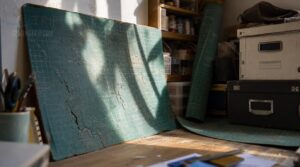
You might be doing everything right at the cutting table and still watch your mat deteriorate faster than it should. The culprit is often how you store it.
Here are the storage mistakes that quietly destroy your mat — and what to do instead.
Direct Sunlight Exposure
Direct sunlight triggers UV polymer degradation that strips the plasticizers keeping your mat flexible, and sunlight fading causes surface discoloration you can’t reverse. UV degradation turns that self-healing layer brittle after roughly 200 hours of exposure.
Always store your mat in a cool dry environment, away from direct sunlight.
Heat and Warping
Heat quietly destroys cutting mats. Thermal expansion from uneven temperature exposure warps edges and corners — especially when temperature differentials build across the surface. Polymer mats soften near 60°C, exceeding their glass transition temperature and causing permanent distortion.
Protect your mat by practicing heat source management:
- Keep mats away from radiators, lamps, and sunny windows
- Store flat between 18°C–25°C consistently
- Use heat-resistant mats near irons or warm tools
- Never leave mats on surfaces directly above heat sources
- Prevent warping by avoiding prolonged heat damage exposure
Rolling Rigid Mats
Rolling a rigid cutting mat might seem like a space-saving win — but it’s actually one of the fastest ways to destroy it. Unlike mats built with a hinged slat mechanism, interlocking seam system, or edge strip reinforcement for flexibility, rigid PVC mats crack under that curve.
The foam core’s durability also suffers. Micro-cracks form and spread with every cut, compromising the mat’s integrity over time.
Always store flat to prevent this damage. Avoid rolling or bending, as these actions accelerate wear and reduce the mat’s lifespan.
Uneven Storage Surfaces
A wobbly shelf does more damage than you’d think. Uneven storage surfaces warp your mat silently over time, making flat storage nearly impossible to achieve. Here’s what’s actually happening:
- High points concentrate pressure, creating permanent grooves.
- Temperature gradients across uneven shelves cause differential expansion.
- Edge sag leads to delamination along contact points.
- Weight distribution shifts accelerate bowing and misalignment.
Use Rubber Base Stabilizers, Leveling Floor Pads, or Adjustable Shelf Ramps to keep your shelf storage for mats perfectly level — preventing mat warping before it starts.
Ideal Flat Storage
Think of your mat as a living surface — it needs the right home to stay that way. Store it flat on a stable surface inside a climate-controlled zone, ideally between 18°C and 25°C.
Use modular shelf units with anti-slip inserts and clear edge protection to prevent shifting. A cardboard storage pocket keeps it dust-free, while flat storage and consistent conditions are your best defense against mat warping.
Top 6 Cutting Mat Care Items
The right tools make mat care a lot easier than it sounds. These six items cover everything from deep cleaning to smarter cutting habits.
Here’s what’s worth keeping in your craft space.
1. MR Lion Makeup Brush Cleaning Pad
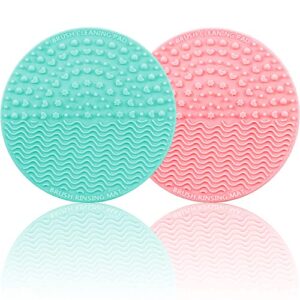
The MR Lion Cleaning Pad pulls double duty as a cutting mat care tool. Its multi-textured silicone surface—designed to clean makeup brushes—works surprisingly well for scrubbing embedded fibers and adhesive residue from mat grooves.
The suction cup base keeps it steady during use, while the soft silicone ensures it won’t scratch your mat’s surface.
Each pack includes two pads, providing a backup. Rinse it clean after each use for repeated reliability.
| Best For | Makeup artists and hobbyists who want a hands-free, reusable way to deep-clean brushes, sponges, and puffs without damaging delicate bristles. |
|---|---|
| Material | Silicone |
| Primary Use | Brush cleaning |
| Pack Size | 2 pads |
| Reusability | Reusable |
| Portability | Compact, lightweight |
| Surface Design | Multi-textured bumps |
| Additional Features |
|
- Comes with two pads (green and pink) so you always have a backup ready
- The suction cup keeps it locked in place, freeing up both hands while you clean
- Soft silicone is tough on product buildup but gentle enough not to wreck your brush tips
- Heavily pigmented makeup and ink can stain the surface pretty fast if you’re not rinsing regularly
- The suction cup sits a bit tall, which can make it wobbly on certain sink edges
- It really needs a cleaning solution to work well—dry brushing doesn’t do much
2. Gypsy Quilter Heart Shaped Mat Cleaner
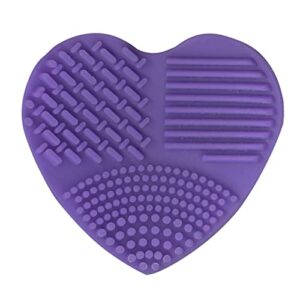
The Gypsy Quilter Heart Shaped Mat Cleaner is a purpose-built tool for quilting mats, earning its place at your cutting station. Its ridged silicone surface effectively lifts lint, fabric fibers, and pet hair from grooves when rubbed along your mat.
Slide your fingers into the grip opening for easy handling. At about 3 inches across, the compact design ensures convenient storage anywhere.
Cleanup is simple: rinse the cleaner with warm, soapy water when finished. Silicone dries fast, leaving it ready for use again in minutes.
| Best For | Quilters and crafters who want a quick, easy way to keep their self-healing cutting mats clean between projects. |
|---|---|
| Material | Food-grade silicone |
| Primary Use | Mat cleaning |
| Pack Size | 1 scrubber |
| Reusability | Reusable |
| Portability | Compact, pocket-sized |
| Surface Design | Ridged scrubbing surface |
| Additional Features |
|
- Ridged silicone surface pulls lint, fabric fibers, and pet hair out of mat grooves really well
- Finger-grip design makes it comfortable and easy to use
- Rinses clean in seconds and dries fast, so it’s always ready to go
- At $14.95, it costs more than similar silicone cleaners you might find in a craft store
- The small size means more passes on larger or heavily soiled mats
- Won’t cut it as a standalone solution for thick residue or a deep clean
3. June Tailor Quilter Cut and Press Mat
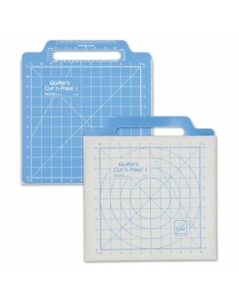
If cleaning tools are one piece of the puzzle, a smarter work surface is another. The June Tailor Quilter Cut and Press Mat gives you two surfaces in one compact 11×11-inch board — a hard cutting side that’s tough on rotary blades in the best way, and a cushioned pressing side for ironing blocks without distortion.
It’s a genuine space-saver beside your sewing machine. The built-in handle makes it easy to grab and go for classes or guild days.
| Best For | Quilters and sewists who want a portable, dual-purpose surface for cutting and pressing small blocks or patches without cluttering their workspace. |
|---|---|
| Material | Metal/hard surface |
| Primary Use | Cutting and pressing |
| Pack Size | 1 board |
| Reusability | Reusable |
| Portability | Carry handle included |
| Surface Design | Dual-sided board |
| Additional Features |
|
- Two surfaces in one — flip it to cut, flip it to press, no switching tools mid-project
- Compact enough to live beside your sewing machine and easy to toss in a bag with the built-in handle
- The hard cutting mat is gentler on rotary blades, so they stay sharp longer
- At 11×11 inches, it’s too small for long seams or anything larger than a small block
- Not ideal for thick or heavily layered fabrics that need serious pressing power
- Heavy daily use may wear it down faster than a dedicated cutting mat or pressing board would
4. Omnigrid Portable Cutting and Pressing Station
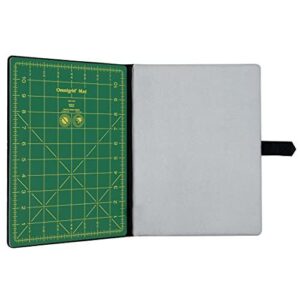
The Omnigrid Portable Cutting and Pressing Station takes the two-in-one idea even further. It folds in half, snapping shut with a Velcro closure, so it tucks into a tote bag without a second thought. Built for guild days, retreats, or any time your workspace doubles as your lap, its design prioritizes convenience.
One side features a 12×18-inch gridded cutting mat, while flipping it open reveals a nonstick pressing surface ideal for small blocks. This dual functionality ensures efficiency in compact settings.
Compact, sturdy, and genuinely travel-ready, the station excels in portability without compromising durability. Its thoughtful construction makes it a reliable companion for on-the-go crafting.
| Best For | Quilters and crafters who need a compact, portable workspace for retreats, classes, or on-the-go sewing projects. |
|---|---|
| Material | Rigid plastic |
| Primary Use | Cutting and pressing |
| Pack Size | 1 board |
| Reusability | Reusable |
| Portability | Foldable, tote-friendly |
| Surface Design | Dual cutting/pressing sides |
| Additional Features |
|
- Folds shut with a Velcro closure, making it easy to toss in a tote and go
- Two surfaces in one — a marked cutting mat on one side and a nonstick pressing surface on the other
- Lightweight and lap-friendly, so it works just about anywhere
- The cutting and pressing surfaces are on the smaller side, so anything larger than about 6½ inches is a tight fit
- High heat can warp the ruler side, so it’s not a substitute for a real ironing board
- Contains a chemical flagged by California as a potential health risk, so good ventilation is a smart idea
5. Headley 45mm Rotary Cutter Blades
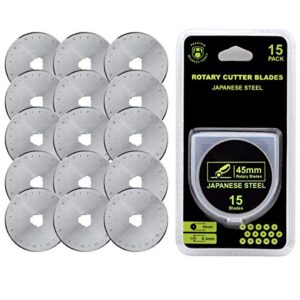
Dull blades are one of the fastest ways to destroy a cutting mat — and that’s exactly where the Headley 45mm Rotary Cutter Blades earn their place in your kit.
Made from Japanese SKS-7 steel, they stay sharp longer than entry-level blades and cut cleanly through multiple fabric layers in a single pass.
The 0.3mm thickness works with your mat’s self-healing surface rather than against it.
At 15 blades per pack, you can swap often without guilt.
| Best For | Quilters, sewists, and crafters who cut through multiple fabric layers regularly and want a reliable bulk-pack blade that won’t break the bank. |
|---|---|
| Material | Japanese SKS-7 steel |
| Primary Use | Rotary cutting |
| Pack Size | 15 blades |
| Reusability | Single-use blades |
| Portability | Boxed bulk pack |
| Surface Design | Pre-oiled blade edge |
| Additional Features |
|
- Japanese SKS-7 steel holds a sharp edge well, so you get clean cuts through up to 10 layers of fabric without dragging or fraying.
- 15 blades per pack means you can swap blades often — a dull blade is never worth pushing through.
- Fits most 45mm handles (Olfa, Fiskars, and others), so no need to buy new equipment.
- Blades come pre-oiled and can stick together — you’ll need to separate and wipe them down before use.
- Long-term edge retention may fall short of premium branded blades if you’re cutting heavy materials day in and day out.
- Only works with 45mm rotary cutters — won’t fit smaller or larger blade sizes.
6. Olfa Double Sided Rotary Cutting Mat
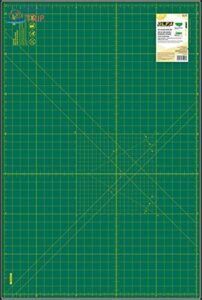
The Olfa Double Sided Rotary Cutting Mat offers two surfaces in one 24×36-inch workspace — a yellow grid side for precise quilting cuts and a solid green side for general work.
At 1.5-mm thick, it’s specifically built for rotary cutters, so the self-healing layer does its job after every pass. Rotating between sides distributes wear evenly, which means neither surface gets overworked.
Store it flat, away from sunlight, and it’ll stay smooth and warp-free for years.
| Best For | Quilters, sewers, and fabric crafters who use rotary cutters and want a large, durable cutting surface that doubles as a permanent workspace. |
|---|---|
| Material | Self-healing composite |
| Primary Use | Rotary cutting |
| Pack Size | 1 mat |
| Reusability | Reusable |
| Portability | Large, flat storage required |
| Surface Design | Double-sided grid and solid |
| Additional Features |
|
- Two usable sides — the grid side keeps your cuts precise, and the solid green side works great for general cutting tasks.
- Big 24×36-inch surface means you can lay out full pattern pieces or multiple fabric layers in one go.
- Self-healing design protects your blades and keeps the mat looking smooth after repeated use.
- Only works with rotary cutters — run a utility knife across it and you’ll regret it.
- At 1.5 mm, it’s on the thinner side, so heavy use may leave visible cut lines over time.
- It needs to be stored flat and away from sunlight, or you’re looking at warping — plus a bit of an airing-out period when you first open it.
Frequently Asked Questions (FAQs)
How to maintain a cutting mat?
Maintaining a cutting mat comes down to a few simple habits: clean it regularly, rotate it often, use sharp blades, and store it flat away from heat and direct sunlight.
Can I repair deep cuts on my cutting mat?
Deep cuts usually can’t be fully repaired. You can try epoxy filler or a repair kit, but expect raised spots that interfere with cutting. Replacement is often the better call.
How do I know when to replace my mat?
Your mat is telling you it’s done when cuts won’t close up anymore, edges start curling, or the surface looks shiny and uneven.
Trust those signs — it’s time for a fresh one.
Does UV light damage cutting mats over time?
UV light damages cutting mats over time. Sunlight breaks down PVC plasticizers within weeks, causing brittleness and fading.
To preserve its self-healing surface longer, keep your mat away from windows.
What temperature is safe for storing cutting mats?
Keep your mat stored between 65°F and 75°F (18°C to 24°C). Temperatures above 85°F soften the material and cause warping, while anything below 50°F makes it stiff and brittle.
Conclusion
They say an ounce of prevention is worth a pound of cure—and your cutting mat proves it every time. Understanding why your cutting mat gets damaged quickly isn’t just useful trivia; it’s the difference between a mat that lasts months and one that lasts years.
Small habits, practiced consistently, protect your investment and keep every cut clean and confident. Swap blades often, rotate your mat, store it flat, and clean it gently.
- https://rhinocuttingmat.co.uk/prolonging-the-life-of-your-cutting-mats-expert-maintenance-guide/?srsltid=AfmBOopXaoxx3KGDhjEFOKi1LDq89nQuGpJ8m-VEQ0vzfa6WpnbuCE4A
- https://ecopecoart.com/blogs/news/cutting-mat-all-you-need-to-know-about-self-healing-cutting-mats
- https://www.kearing.com/self-healing-cutting-mat-guide/
- https://clothhabit.com/adventures-cutting-mats/
- https://mypacklove.com/blogs/heat-transfer-labels/what-is-a-cutting-mat-your-guide-to-types-uses-perfect-cuts?srsltid=AfmBOorD4qQkDIaWlSwu5bGJnsbEMVwUYcqHizwwSrvbohHxMAEaPxM8