This site is supported by our readers. We may earn a commission, at no cost to you, if you purchase through links.
Most quilters pack every inch of their work with pattern, color, and carefully pieced blocks. Negative space quilt design flips that instinct entirely—using open, unstitched areas as a deliberate design element rather than something to fill. The empty fabric isn’t absence. It’s architecture.
A single off-center star block floating on a wide expanse of solid cotton can hit harder visually than an entire sampler quilt fighting for your attention. That tension between what’s there and what isn’t is what makes this approach so compelling. Master it, and you gain real control over where the eye travels, how your quilting texture reads, and what story your finished piece tells.
Table Of Contents
- Key Takeaways
- What is Negative Space Quilting?
- Why Negative Space Designs Stand Out
- Core Negative Space Design Principles
- Choosing The Right Quilt Layout
- Best Fabrics for Negative Space
- Color Strategies for Modern Impact
- Piecing Techniques for Clean Lines
- Quilting Ideas for Open Spaces
- Tools for Planning Negative Space
- Beginner Tips for Better Results
- Frequently Asked Questions (FAQs)
- Conclusion
Key Takeaways
- Empty space isn’t filler — it’s the force that tells your eye exactly where to go, making a single off-center block hit harder than a quilt packed edge to edge.
- Two colors, a solid cotton background, and the rule of thirds are all you need to build a design that stops people mid-scroll.
- Open areas aren’t wasted fabric; they’re your best canvas for echo quilting, straight-line texture, and free-motion fills that reward a closer look.
- Before you cut anything, sketch on graph paper or use a design wall — catching a broken layout early beats ripping seams later.
What is Negative Space Quilting?
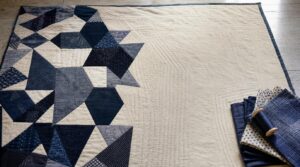
Negative space quilting is one of those concepts that sounds abstract until you actually see it on a quilt. It’s really just about understanding what you put in — and what you deliberately leave out. A few key ideas will make that click fast.
Positive Vs Negative Space
Every quilt has two kinds of space working together. Positive space holds your shapes, blocks, and motifs — the parts your eye lands on first. Negative space is everything around them.
Together, they shape how your eye moves across the whole piece — and customizing quilt layouts lets you experiment with that balance before cutting a single piece of fabric.
It’s the quiet fabric that makes your subject pop. Without that contrast, nothing reads clearly.
Think of it like silence in music. The empty parts aren’t wasted. They’re doing real work. This technique provides essential visual breathing room for the eye.
Modern Quilt Definitions
So what actually makes a quilt "modern"? It’s not just a vibe.
Modern quilting sits at the intersection of minimalist aesthetic and deliberate artistic intent. Think asymmetry. Bold geometry. Negative space used as a feature — not an accident.
- Clean solid blocks replacing busy traditional patterns
- Off-balance layouts that create movement
- Visual balance through restraint, not repetition
It’s design principles over decoration. Always.
Why Empty Space Matters
Empty space isn’t wasted fabric. It’s doing real work.
Negative space creates breathing room that lets your focal shapes land with impact. Without it, even a beautiful block gets lost in noise. That open field pulls the eye exactly where you want it — and holds it there. Visual balance isn’t about filling everything. It’s about knowing what to leave alone.
Negative space isn’t emptiness — it’s the force that pulls every eye exactly where it needs to go
Why Negative Space Designs Stand Out
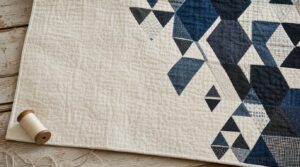
There’s a reason negative space quilts stop people mid-scroll. The open areas aren’t just empty — they’re doing real work. Here’s exactly what makes these designs hit differently.
Stronger Focal Points
Negative space doesn’t just sit there — it works for your focal point. When you surround a single shape with open fabric, that shape draws the eye immediately. A focal element can carry up to three times the visual weight of surrounding motifs, especially when you pair high color saturation with a quieter background.
Here’s what actually strengthens your focal point:
- Increase subject size by 20–40% relative to nearby shapes to establish clear dominance
- Use high contrast values — one vivid color against muted surroundings boosts perceived contrast by up to 30%
- Apply directional light cues through shading to add depth and pull the eye naturally
- Add texture and micro-detail only to the focal area — smooth surroundings make it pop harder
- Isolate with negative space by framing your shape off-center with open fabric on at least two sides
In modern quilting, minimalist aesthetics do the heavy lifting here. You’re not decorating — you’re directing. Visual hierarchy isn’t accidental. It’s built through deliberate framing and isolation, scale differences, and smart color choices. Less fabric doing more work. That’s the whole point.
Cleaner Visual Impact
Clarity is a design choice, not a side effect.
When your negative space ratio is right — roughly 40% of the surface — silhouette clarity sharpens instantly. Uniform margins around your blocks remove edge distractions. Breathing room between elements keeps the composition calm and readable.
In modern quilting, edge sharpness and solid backgrounds do more for visual hierarchy than any extra fabric ever could.
Modern Minimalist Style
Minimalism isn’t a trend. It’s a design decision with roots going back to the late 1950s, and modern quilting adopted it fully.
Intentional visual minimalism strips the composition down to what matters — geometric shapes, clean edges, and open fields that breathe. Amish quilts proved this first. Solid fabrics, limited palettes, nothing wasted. That restraint isn’t emptiness. It’s control.
Room for Quilting Texture
Leaving open space isn’t passive — it’s an invitation. Negative space in modern quilting becomes a canvas for Surface Texture Layers that reward closer inspection.
- Echo Halo Texture traces your focal shape with rippling stitch lines
- Batting Loft Effect raises quilted zones above a flat background
- Tactile Depth Contrast pairs smooth cotton against linen’s natural grain
- Lofted Fabric Depth adds quiet dimension without visual noise
Core Negative Space Design Principles
Knowing that negative space works is one thing. Knowing why it works comes down to a handful of design principles that every strong minimalist quilt relies on. Here’s what’s actually driving the visual power behind those open spaces.
Balance and Proportion
Picture your quilt as a seesaw—visual balance is what keeps everything steady. It’s not just about putting a block dead center. Think of negative space as weighty as any bright patch. Use proportion ratios to let a big block breathe with smaller companions. Here’s a quick cheat sheet:
| Design Element | Creates Balance By | When to Adjust |
|---|---|---|
| Symmetrical layout | Mirroring shapes | For classic calm |
| Scale variation | Mixing big and small | For modern energy |
| Negative space | Even open gaps | For focus and calm |
Move pieces, test combinations, and trust your eye—modern quilting loves a thoughtful balance.
Rule of Thirds
Photographers swear by it. So should you.
The rule of thirds splits your quilt into a 3×3 grid — two vertical lines, two horizontal. Where those lines cross? Those are your power points. That’s where your focal point lands hardest.
Here’s how to use it:
- Place your main block along a vertical third line
- Anchor secondary shapes on a horizontal third line
- Drop your focal point at an upper intersection
- Let negative space fill the remaining two-thirds
- Use grid intersections for active balance — not dead center
That offset placement creates tension. It pulls the eye exactly where you want it. Modern quilting loves this kind of intentional spatial arrangement — and the rule offers enough composition flexibility to bend it when your design calls for something bolder. Subject placement isn’t guesswork. It’s geometry with purpose.
Asymmetrical Layouts
Symmetry is safe. But safe doesn’t stop anyone mid-scroll.
Asymmetrical layouts work because visual weight is distributed unevenly — yet still feels resolved. One bold block anchors the left. Negative space breathes on the right. That off-center emphasis creates spatial tension that pulls the eye through the quilt deliberately, not randomly. The imbalance is the balance. That’s the whole point.
Scale and Contrast
Scale does a lot of quiet work in a negative space quilt. A large open background paired with a small, dark shape creates instant hierarchy — your eye knows exactly where to look. That’s size hierarchy doing its job without a single extra seam.
High contrast color pairs sharpen that effect fast. Light recedes. Dark advances. Simple as that.
Visual Movement
Visual movement guides your eye through the quilt without you noticing. Shapes placed off-center create a natural movement path — your eye follows the line they suggest. Repetition across negative space builds rhythm. Subtle size shifts imply depth. High contrast edges intensify that motion fast.
Asymmetry keeps things tense. Still areas anchor the whole thing so nothing feels chaotic.
Choosing The Right Quilt Layout
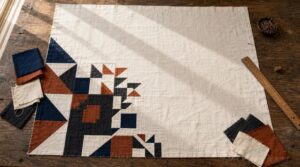
Layout is where a negative space quilt either clicks or falls flat. The arrangement you choose controls how the eye moves, where it rests, and what it remembers. Here are the layout approaches that do that job well.
Off-center Quilt Blocks
Off-center block placement is one of the simplest ways to create real visual tension. Shift your focal fabric slightly toward one side. That small move activates the surrounding background as intentional negative space.
Use high-contrast fabrics to sharpen the offset. Foundation paper piecing keeps your angles clean. The result? Asymmetry that feels deliberate — not accidental.
Floating Shapes
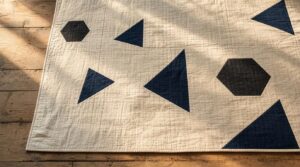
Shape hovering is what separates a good layout from a great one. A single geometric shape — slightly off-center, sitting above a calm solid background — pulls the eye instantly.
Soft edges and size variation add depth without adding clutter. Lighter shapes on dark fabric feel elevated. That depth illusion is pure spatial composition. Minimalist quilting at its most intentional.
Large Open Backgrounds
A large open background is the quilt’s breathing room — and it does serious work. At least one-third of your quilt surface should stay open. That space isn’t empty. It’s intentional.
Thread color matching keeps the background calm. Binding simplicity protects the edge. Lighting enhancement reveals subtle texture. Store flat to protect that spotless open field.
Geometric Arrangements
Arranging geometric shapes isn’t guesswork — it’s a system. Grid alignment techniques lock your blocks into precise placements, so edges meet cleanly and spacing stays consistent.
Try tessellation patterns where repeated shapes tile across the surface with zero gaps. Rotational, reflective, or translational symmetry types each create a different mood.
Place shapes off-center to let negative space breathe and pull focus exactly where you want it.
Design Wall Planning
A design wall turns guesswork into control. Dedicate 4 to 6 feet of horizontal wall space, mark your origin point, and use painter’s tape to outline the quilt perimeter.
- Group blocks light to dark to balance negative space
- Space unsewn blocks with ½-inch gaps to simulate breathing room
- Use cool white LED lighting (400+ lumens) for true color reads
- Photograph straight-on for accurate digital reference
- Log every rearrangement with dates and rationale
Best Fabrics for Negative Space
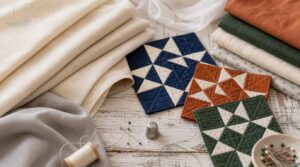
Fabric choice can make or break a negative space design before you even thread a needle. The wrong material muddies the whole concept — the right one lets your open areas breathe and your focal points land hard. Here’s what actually works.
Solid Cotton Fabrics
Solid cotton is the industry standard for negative space quilts. Breathable cotton lets your open areas feel calm, not stiff. A mercerized finish deepens color so your solid fabrics hold their richness across every open expanse. Plain and percale weave types keep surfaces smooth and uniform. Strong dye colorfastness means your minimalist aesthetic stays sharp, wash after wash.
Pre-wash always — shrinkage control matters before you cut.
Low-volume Prints
Think of low-volume prints as solid fabric’s quieter twin. They carry subtle surface texture without shouting over your negative space.
Three things to know:
- Print density stays under 20% — motifs disappear from a distance
- Small-scale motifs read as near-solid in background fabric
- Prewash always — dye migration ruins surrounding minimalist aesthetic
Fiber blends resist fading, keeping modern quilts cohesive after laundering.
Linen and Muslin Options
Linen and muslin bring something cotton solids can’t always deliver — natural texture with restraint.
Linen’s crisp hand softens beautifully over time, giving negative space a lived-in warmth. Its linen breathability and natural strength make it ideal for structured backgrounds. Muslin drapes gently, perfect for fluid, open areas.
| Feature | Linen | Muslin |
|---|---|---|
| Hand Feel | Crisp, textured | Soft, smooth |
| Wrinkle Resistance | Low | Moderate |
| Machine Washable | Yes (low heat) | Yes (quick-dry) |
| Best Use | Structured negative space | Fluid open backgrounds |
Both support a clean minimalist aesthetic — your fabric selection just depends on how much structure you want.
Avoiding Visual Clutter
Fabric choice makes or breaks your negative space. Busy prints fight for attention — even in the background. Stick to solid backgrounds or low-volume prints that stay quiet.
Limit pattern density across the whole quilt, not just the focal area. Visual harmony depends on consistency. When every fabric competes, nothing wins. Keep it calm. Let your subject breathe.
Fabric Weight and Drape
Weight matters more than most quilters expect. A medium-weight cotton (150–350 GSM) holds its shape across large negative space backgrounds without sagging or distorting your geometric shapes. Go too light and that open expanse ripples. Too heavy and it won’t drape cleanly.
Do a quick hang test — let a cut length fall freely and watch how it settles.
Color Strategies for Modern Impact
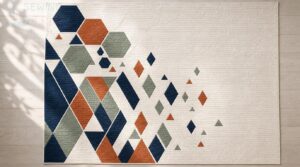
Color does more work in a negative space quilt than most people expect. The choices you make here — palette size, value contrast, background tone — shape how the whole design reads from across the room. Here’s what actually moves the needle.
Two-color Quilt Palettes
Two colors. That’s genuinely all you need. A two-color quilt palette strips your design down to what matters — shape, proportion, and negative space. The result? Geometric shapes that land hard and open backgrounds that breathe.
- Black and white — strongest value gap possible
- Navy and ivory — classic, reads clearly across a room
- Charcoal and cream — softer but still modern
- Deep teal and ivory — calm, cool contrast
- True red and white — bold scale impact, zero confusion
Palette simplicity keeps your color palette focused. Background neutral choices let the contrasting colors do the heavy lifting in modern quilts.
High Contrast Values
Palette choice sets the stage. But value contrast is what makes your design actually land.
High contrast means a large luminance difference between your fabrics — think pure black against white, the widest gap possible. That separation sharpens every edge in your geometric patterns and makes negative space feel intentional, not accidental. Strong value ratios do the visual heavy lifting, regardless of which colors you pick.
Complementary Color Schemes
Complementary colors are one of the sharpest tools in your design kit. Think blue and orange, red and green, yellow and purple — pairs that sit opposite on the color wheel and create instant visual tension. That warm-cool contrast is what makes your focal block pop against the negative space behind it.
Keep saturation balanced. One vivid, one muted. Otherwise they fight.
Analogous Color Harmony
Analogous colors feel like a slow exhale. Adjacent hues on the color wheel — think blue, blue-green, and green — share undertones that naturally belong together, creating smooth color harmony without visual conflict.
In negative space quilting, that cohesion is gold:
- Hue progression guides the eye across geometric shapes
- Varying saturation keeps the palette from going flat
- Warm-cool balance adds depth within a minimalist design
Light Versus Dark Backgrounds
Background choice isn’t just aesthetic — it’s structural. Light solid backgrounds boost brightness and keep edges crisp, making negative space feel open and intentional. Dark backgrounds do the opposite: they pull focus inward, making contrast stitching and bold shapes hit harder.
Match your background to your lighting environment. Bright workroom? Go light. Moody display wall? Go dark. Your minimalist design will thank you.
Piecing Techniques for Clean Lines
Clean lines don’t happen by accident — they’re built, one precise cut and seam at a time. Your piecing technique is what separates a crisp, intentional design from something that just looks a little off. Here’s what actually makes the difference.
Quarter-inch Seam Accuracy
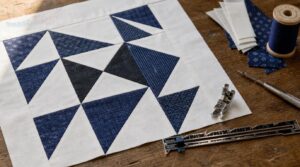
Every misaligned seam quietly shrinks your negative space — and that’s a problem worth solving early.
Quarter-inch seam accuracy starts with your machine foot. Use a dedicated quarter-inch foot to keep fabric edges aligned consistently. Check thread tension too — tight tension pulls fabric inward, narrowing seams. Run a test strip verification using 1.5-inch strips. Press carefully. Use a seam gauge to confirm every join hits that exact mark.
Foundation Paper Piecing
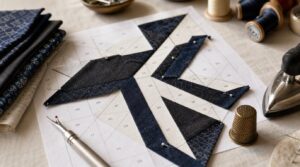
Foundation paper piecing is basically cheating — in the best way possible.
Paper Template Precision gives you a printed guide to stitch directly on, so your piecing line lands exactly where it should. Every angle, every point. The Trim Press Cycle — trim, sew, press — keeps seams flat and your negative space crisp. Once done, Pattern Removal Technique reveals clean, sharp geometry that holds its shape.
Sharp Rotary Cutting
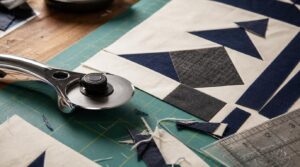
A dull blade is the enemy of clean geometry. Your rotary cutter’s blade — usually 0.3 to 0.5 mm thick, ground to a razor edge — should glide through fabric, not drag. Replace it every 200 to 300 cuts.
Pair it with a cutting mat and rotary templates to lock in precision. That’s how your negative space edges stay sharp and intentional.
Acrylic Template Use
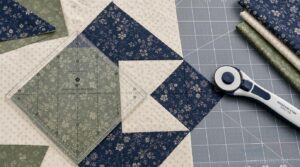
Rotary cutters get you clean cuts. Acrylic templates get you repeatable ones.
Clear PMMA material lets you see exactly what’s underneath — fabric grain, print direction, seam lines. That template transparency advantage means no guessing when placement matters. Align your template, lock in your fabric grain alignment, cut. Same shape. Every time.
Laser edge precision keeps those negative space boundaries razor-consistent across every block.
Pressing Seams Neatly
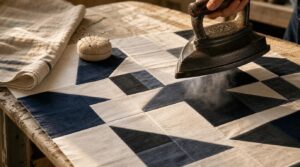
Precise cuts mean nothing if your seams shift under the iron. Flat seam pressing locks every join in place — hold the iron still for 15–20 seconds, no sliding. Press toward darker fabrics to hide bulk.
For open negative space to read cleanly, seam alignment must be exact before you ever touch the iron.
Quilting Ideas for Open Spaces
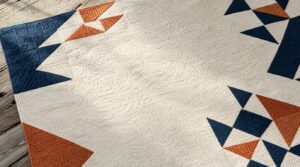
All that open space you’ve carefully preserved? It’s not just breathing room — it’s a canvas waiting for your needle. Here are five quilting approaches that can transform those empty areas into something intentional.
Echo Quilting Effects
Echo quilting is one of the most powerful tools in your negative space arsenal. You’re basically echoing the shapes of the block outward — line after line, like a stone dropping into still water.
Echo line spacing matters more than most people think. Tight gaps of 1/8 inch build depth perception fast. Wider spacing around 1/2 inch keeps things calm and open.
Match your echo direction alignment to the quilt’s dominant lines. It creates cohesion without effort. And choose thread weight carefully — 40 wt thread gives finer, more delicate negative outlines, while 50 wt reads bolder from a distance.
Straight-line Quilting
Where echo quilting creates movement around shapes, straight-line quilting holds the whole design in place. It’s the backbone of minimalist quilt design.
Use a walking foot for even feed across thick layers. Keep your stitch length at 2.0–3.0mm. Consistent parallel row spacing turns open negative space into quiet, structured texture — without competing with your focal block.
Free-motion Filler Designs
Free-motion quilting is where your negative space truly comes alive.
- Stippling — dense, looping fills that create soft, light-catching texture
- Circular fillers — overlapping bubbles that flow across irregular open areas
- Leaf motifs — organic curves radiating from a central stem for natural depth
- Geometric grids — ladders and triangles that echo your quilt’s hard lines
Match your thread path to your fabric. Discreet thread keeps the filler working quietly behind your focal block.
Edge Quilting Shapes
Edge quilting shapes act as a frame — drawing the eye inward and letting your negative space breathe.
Ruler-guided edges give you crisp straight lines or repeatable curves that hug your focal block cleanly. Curved edge patterns soften geometric arrangements and add subtle movement without crowding open areas. Scale them up for sweeping arcs or down for tight accent curves depending on your visual weight goals.
Binding edge integration matters too. Your outermost quilting lines should complement — not fight — your binding choice.
Stitch Density Choices
Stitch density is where texture meets intention. In negative space, the wrong density can flatten everything you’ve worked for — or make it sing.
- 10–14 SPI suits most medium-weight cotton
- Lower density preserves drape on linen and muslin
- Echo quilting needs consistent density for clean halos
- Needle size matching prevents perforation damage on delicate backgrounds
Adjust density changes gradually. Spatial balance depends on it.
Tools for Planning Negative Space
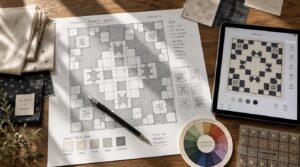
Good design doesn’t happen by accident — it starts with the right tools in your hands. Before you cut a single piece of fabric, planning your negative space on paper or screen saves you from costly guessing games. Here’s what quilters actually use to map it all out.
Graph Paper Sketches
Graph paper is your best friend before a single cut happens. Pencil layout planning on a grid lets you map negative space before committing to fabric. Each square becomes a unit of measure, so proportion accuracy stays locked in from sketch to sewing table.
| Grid Scale Choice | What It Represents | Best For |
|---|---|---|
| 1 square = 1 inch | Full-size block planning | Small quilts |
| 1 square = 2 inches | Mid-scale layouts | Throw quilts |
| 1 square = 4 inches | Large composition drafts | Statement quilts |
| 1 square = 0.5 cm | Fine detail mapping | Intricate piecing |
| Custom scale | Proportional ratio matching | Any size transfer |
Grid scale choices directly influence how your finished design translates to fabric. Use diagonal grid lines for basic perspective guidance when sketching geometric shapes and patterns. A digital overlay printed onto graph paper sharpens your spatial awareness even further, keeping your minimalist quilt design movement intentional and clean throughout every stage of pattern drafting.
Digital Quilting Guides
Digital quilting guides change everything. Instead of redrawing layouts by hand, you get a Digital Pattern Library packed with hundreds of motifs — geometric to organic — all optimized for negative space. Mrs. Quilty’s Digital Quilting Guide 105 Rotary Templates PDF pairs perfectly with your rotary cutters and templates, giving you print-ready precision from the start.
The Interactive Layout Editor lets you resize blocks, test scale, and shift composition until your quilt design feels right — no fabric wasted. A Virtual Wall Preview simulates real fabric texture and lighting, so you see exactly how negative space reads before you sew. Colorway Suggestions help narrow your palette fast. Cloud Collaboration Tools keep every version saved and shareable across devices.
Printable Quilt Patterns
Printable PDF Files take the guesswork out of planning. Download, print, done.
Three things worth knowing:
- Cutting Chart Sheets show exact yardage per size
- Scale Lines confirm your printer hit 100 percent
- Color Key guides every fabric placement decision
Reusable patterns include templates built for negative space — clean outlines, no clutter. Solid modernist design baked right in.
Heat-erase Marking Pens
Once your printable layout is set, you need to mark it on fabric. That’s where heat-erase marking pens earn their place.
The ink uses thermochromic technology — it vanishes with iron heat around 60–70°C. No scrubbing. No laundering. Just press and gone.
Fabric compatibility matters though. Always test on a scrap first. Dark or heavy fabrics can behave differently under heat.
Water-soluble Fabric Markers
Heat-erase pens handle speed. Water-soluble markers handle precision.
Water-soluble fabric markers use water-based ink with glycerin and surfactants — designed to spread evenly and rinse clean. That makes them ideal for mapping out negative space and compositional balance before you commit.
Three things worth knowing:
- Marks disappear after washing — usually one cycle at standard temperatures.
- Test dark fabrics first — visibility drops on dense textiles.
- Light blue or gray tones minimize distraction on white backgrounds.
Beginner Tips for Better Results
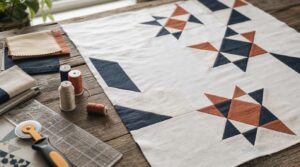
Every great negative space quilt starts with small, deliberate decisions. If you’re just getting started, a few simple habits will save you a lot of rework later. Here’s what actually has real significance.
Start With Simple Shapes
Circles, squares, triangles — that’s your starting point. Basic shape foundations keep your design readable and your negative space intentional.
Before you cut a single piece of fabric, sketch the shape. Map it. Then build your envelope layout planning around it. Simple forms let you swap scale and position fast, so you find your best layout before committing.
Limit Your Color Palette
Once your shapes are locked in, color is your next lever. And fewer colors beat more — every time.
Limit to three colors max: a dominant background, one main shape color, and a single accent for detail.
- Assign 60% to your background color
- Give 30% to your primary shape
- Reserve 10% for accent only
That math keeps your negative space readable and your design tight.
Test Designs First
Sketch it before you sew it. Pin a rough mockup to your design wall and live with it for a day. You’ll catch problems fast — shapes that fight each other, negative space that shrinks too much, or focal points that drift.
| What to Test | Why It Matters | Quick Fix |
|---|---|---|
| Shape placement | Focal point clarity | Shift off-center |
| Color ratio | Background readability | Recheck 60/30/10 |
| Open space amount | Visual breathing room | Trim your design elements |
Leave Enough Open Space
Open space isn’t decoration — it’s doing real work. Aim for 2 to 3 inch margins between blocks so your eye has somewhere to rest. Without that breathing room, even a simple design starts feeling crowded fast.
- Keep margins at least 2–3 inches around blocks
- Reserve unpieced panels near quilt edges for intentional negative zones
- Scale open areas larger than your smallest motifs
- Use solid or pale backgrounds to protect clean lines and clarity
Negative space earns its place when you protect it from the start.
Practice Quilting Samples
Testing before committing saves you hours of frustration. Build a few practice quilting samples using scrap fabric — a simple 6×8-inch sandwich of batting and backing is enough to check stitch tension, seam accuracy, and how your quilting motifs read against solid negative space. What looks perfect on paper sometimes falls flat on fabric.
| Sample Focus | What to Test | What to Watch For |
|---|---|---|
| Stitch Consistency Check | Straight-line and echo quilting | Skipped stitches, uneven spacing |
| Fabric Scrap Testing | Solid vs. low-volume prints | Visual clutter, value contrast |
| Practice Block Planning | Motif scale and placement | Clean lines, negative space balance |
| Sample Documentation | Thread type, needle size, settings | Repeatable results across blocks |
| Error Log Review | Tension and presser foot pressure | Puckering, drifting seam allowances |
Archive your best samples with short notes on what worked.
Frequently Asked Questions (FAQs)
How do I price a negative space quilt?
Start with material costs: fabric, batting, and binding commonly make up 50–70% of your price. Add labor hours multiplied by your target wage, then factor in size, complexity, and market value.
Which quilting styles pair best with Amish designs?
Think of Amish design as a strong foundation — bold color blocks and star integration do the heavy lifting. Straight-line quilting and traditional hand quilting complement it perfectly, letting solid colors breathe.
How do I fix unbalanced negative space after cutting?
Realign blocks first. Re-measure every cut piece, correct cutting errors immediately, then resew seams with a clean 1/4-inch allowance. Use grid planning to adjust margins and restore your quilt design’s sense of balance.
Are negative space quilts suitable for beginner competitions?
Yes. Think of it as your first solo on a quiet stage — less to manage, more room to shine. Large simple shapes, clean edges, and bold contrast tick most beginner scoring criteria perfectly.
Conclusion
Less fabric used, more intention required. Fewer blocks placed, stronger the story told. That’s the quiet logic of negative space quilt design—it isn’t a shortcut, it’s a discipline that demands you trust the empty areas as much as the pieced ones.
The open fields carry real weight. The silence between shapes speaks louder than you’d expect. Once you place each block with purpose, your quilts don’t just stop looking made. They start looking decided.