This site is supported by our readers. We may earn a commission, at no cost to you, if you purchase through links.
You don’t need a $10,000 longarm machine to create stunning quilts that rival professional work! The regular sewing machine sitting on your table right now possesses everything you need to transform fabric layers into beautifully quilted treasures, and mastering this skill opens a world of creative freedom that’s absolutely exhilarating.
Many quilters hesitate because they believe machine quilting demands specialized equipment, but the truth is, your everyday machine—paired with the right techniques, tools, and a bit of confidence—can tackle projects from cozy lap quilts to intricate bed-sized masterpieces.
Once you understand how tension, foot choice, and fabric management work together, you’ll discover that quilting with a regular machine isn’t just possible, it’s incredibly rewarding and fulfilling!
Table Of Contents
Key Takeaways
- You don’t need expensive longarm equipment to create professional-quality quilts—your regular sewing machine, paired with proper tension control, the right presser foot, and confident fabric management techniques, can handle projects from small lap quilts to full-sized bed quilts with stunning results.
- Thorough preparation makes or breaks your quilting success: prewash and press your fabrics meticulously, create a smooth three-layer sandwich with backing-batting-top, baste every 6-8 inches to prevent shifting, and test your tension settings on scrap fabric before committing to your actual project.
- Master foundational techniques like straight-line quilting with a walking foot for even feed, stitch-in-the-ditch for invisible seam anchoring, and free-motion quilting with lowered feed dogs for creative expression—each method builds your confidence while delivering distinct textural effects.
- Essential tools transform frustration into enjoyment: invest in heat-erasable fabric markers for precise pattern transfer, a self-healing cutting mat with angle guides for accurate cuts, sharp rotary cutter blades that slice cleanly through multiple layers, and appropriate thread-needle combinations matched to your batting weight.
Preparing Your Quilt for Machine Quilting
Preparing your quilt for machine quilting sets the foundation for everything that follows, and when you take the time to do this step right, you’ll find that the actual quilting becomes smoother, more enjoyable, and far less frustrating!
Proper quilt preparation transforms the entire quilting experience from frustrating struggle into smooth, enjoyable success
The choices you make now—from selecting your pattern and fabrics to basting your layers together—will determine how easily your quilt moves through your machine and how professional your finished project looks.
Let’s walk through each essential preparation step so you can set yourself up for quilting success!
Choosing a Quilt Pattern and Fabrics
Your quilting design journey begins with pattern and fabric selection—decisions that’ll shape every stitch you make! Choose simple geometric quilt patterns with larger motifs, because they reduce thread changes and simplify machine movement, building confidence as you master quilt making.
Start with a simple patchwork table runner or quilting projects for home decor that let you practice without feeling overwhelmed by a full-sized quilt.
- Pick cotton fabrics with similar weights to maintain even tension across your entire quilt top
- Coordinate colors by balancing light and dark values so your quilting motifs truly shine through
- Test fabric swatches at your planned pattern scale to verify texture mixing reads clearly and beautifully
Preparing Fabric—Washing, Ironing, and Cutting
Once you’ve made your fabric selection, it’s time to prep those beautiful fabrics for quilting success! Prewash cotton pieces in warm water to minimize fabric shrinkage and reduce bleeding risks, then tumble dry on low heat to preserve integrity.
After drying, iron your fabrics flat and square up the edges—then explore sewing machine tutorials for quilting to master tension settings and stitch control before you start layering.
Press out every wrinkle carefully with appropriate heat settings, because smooth fabric makes cutting tools glide effortlessly and ensures your piecing stays accurate throughout your entire sewing techniques journey!
Once your fabric lies flat, understanding your machine’s essential features helps you adjust tension and stitch length to match the material perfectly.
Creating and Basting The Quilt Sandwich
Your pressed fabrics are ready, so now it’s time to build your quilt sandwich—the heart of successful quilting! Layer your backing fabric rightside down on a flat surface, smooth batting on top, then center your beautiful quilt top!
Secure these three layers with your preferred basting techniques:
Many quilters find that machine quilting techniques help secure layers quickly while maintaining even tension throughout the project.
- Position safety pins every 6 to 8 inches across the entire surface
- Apply temporary spray baste in a well-ventilated space for quick adhesion
- Smooth carefully from center outward to eliminate wrinkles and bubbles
- Verify backing extends 4 to 6 inches beyond your quilt top edges for easy handling
This fabric alignment creates the stable foundation you need for beautiful, professional stitching!
Selecting Thread, Needles, and Machine Settings
With your sandwich basted and smooth, you’re ready to select the perfect thread, needles, and machine settings that will bring your vision to life!
Choose 40-weight cotton or polyester blend thread for reliable strength, pair it with a quilters needle in size 80/12 or 90/14 depending on batting density, then set your stitch length to 10–12 stitches per inch and adjust tension control until both sides show balanced, beautiful stitches!
Essential Tools for Quilting With a Regular Machine
Now that your quilt sandwich is ready and your machine is set up, you’ll need a few specialized tools to make the quilting process smoother and more precise! The right supplies can transform your experience from frustrating to enjoyable, helping you create beautiful, professional-looking results with your regular sewing machine.
Let’s explore the essential tools that will support you through every step of your quilting journey, from marking your design to cutting fabric with accuracy and ease!
1. Madam Sew Fabric Chalk Marker
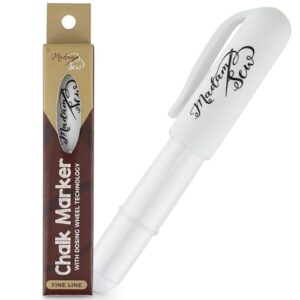
You’ll absolutely love how the Madam Sew Fabric Chalk Marker transforms your quilting precision, bringing Chalk Marker Tips and professional Fabric Marking into your hands with seamless ease!
This refillable marker uses dosing wheel technology that dispenses chalk consistently across cotton and synthetic fabrics, creating crisp, visible lines for your quilting techniques.
Available in white, yellow, and red, it works beautifully on light and dark materials alike, and best of all, the marks wash away completely after you’ve finished sewing, leaving your quilt spotless and professional-looking!
| Best For | Quilters and sewers who need precise, temporary fabric markings that wash away cleanly after stitching. |
|---|---|
| Primary Use | Fabric marking |
| Brand | Madam Sew |
| Suitable For | Quilting and sewing |
| Material Type | Chalk |
| Skill Level | All levels |
| Durability | Refillable |
| Additional Features |
|
- Dosing wheel technology ensures consistent, even chalk dispensing for crisp, professional lines every time
- Refillable design in three colors (white, red, yellow) works on both light and dark fabrics
- Washable marks remove completely with water, leaving no residue or stains on your finished projects
- Not compatible with delicate fabrics like silk or nylon, limiting versatility
- Struggles with curved lines and intricate designs where precision is needed
- Higher price point compared to traditional tailors chalk options
2. Madam Sew Heat Erasable Fabric Marking Pens
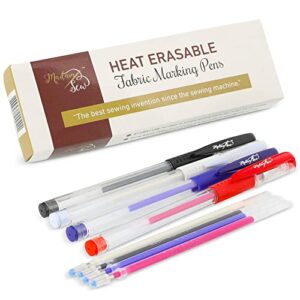
When precision quilting design demands clarity that vanishes on command, you’ll want the Madam Sew Heat Erasable Fabric Marking Pens in your arsenal of quilting tools! These marking tools feature 0.7mm tips that deliver intricate, detailed lines on fabric, and the erasable ink disappears completely when you press your iron over the marks—heat removal that’s almost magical!
Available in four colors with free refills included, they’re perfect for transferring complex patterns to your quilt top before you begin sewing, though proper pen maintenance and testing on scrap fabric ensures the best results every time!
| Best For | Quilters and sewists who need precise, temporary markings for detailed pattern work that can be easily removed with heat when the project is complete. |
|---|---|
| Primary Use | Fabric marking |
| Brand | Madam Sew |
| Suitable For | Quilting and sewing |
| Material Type | Gel ink |
| Skill Level | All levels |
| Durability | Long-lasting |
| Additional Features |
|
- Fine 0.7mm tip creates clean, precise lines perfect for intricate quilting designs and detailed fabric work
- Marks disappear completely with a simple press of an iron, making cleanup quick and hassle-free
- Comes with four color options plus free refills, giving you versatility across different fabric colors and extending the value
- Ink can darken or bloat if left on fabric too long before erasing, so you need to work within the recommended timeframe
- White ink reportedly doesn’t perform well, limiting options for marking on darker fabrics
- Some users experience ghost lines that don’t fully disappear after ironing, especially if heat isn’t applied evenly
3. Fiskars Self Healing Cutting Mat
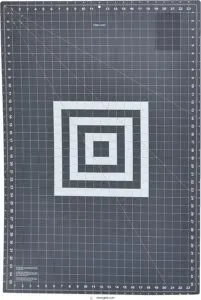
Accurate measuring and clean cutting transform your quilting project from frustrating guesswork into confident precision, and the Fiskars Self Healing Cutting Mat delivers exactly that with its extra-large 24″ x 36″ surface, dual-sided grids, and angle lines at 30, 45, and 60 degrees!
Self-healing benefits mean the surface resists cut marks and returns to near-original condition after use with your rotary cutter, while proper mat storage solutions—keeping it flat and away from heat—preserve its shape and guarantee quilting accuracy for years of fabric crafting ahead!
| Best For | Quilters, sewers, and crafters who need a large, durable work surface for cutting fabric with rotary cutters and want precise angle measurements for projects. |
|---|---|
| Primary Use | Cutting surface |
| Brand | Fiskars |
| Suitable For | Quilting and sewing |
| Material Type | Multi-material |
| Skill Level | All levels |
| Durability | Self-healing |
| Additional Features |
|
- Extra-large 24″ x 36″ double-sided surface gives you plenty of room for cutting long fabric strips and large quilt squares without repositioning
- Self-healing material resists cut marks and bounces back after use, so your mat stays smooth and functional through countless projects
- Built-in grids and angle lines (30°, 45°, 60°) make measuring and cutting triangles or bias strips fast and accurate
- Can arrive warped at the corners or with a strong plastic smell that takes time to air out
- Needs to be stored flat and kept away from heat to prevent permanent warping or damage
- May develop sticky residue from packaging that requires cleaning before first use
4. Fiskars Rotary Cutter Tool
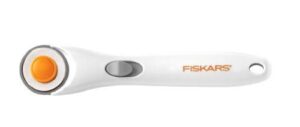
When you’re ready to slice through layers of cotton, batting, and backing with smooth control, the Fiskars Rotary Cutter Tool becomes your most trusted companion at the quilting table, offering a symmetrical design that works beautifully for both right- and left-handed quilters!
This 28mm high-grade steel blade glides through multiple fabric layers with exceptional precision when you apply even pressure against your cutting mat, and the sliding button extends the blade guard for rotary safety between cuts, protecting your fingers and preserving that sharp edge for future sewing projects!
| Best For | Quilters and crafters who need precise control for detailed fabric cuts, curved lines, and intricate patterns, especially those working with smaller projects or trimming tight corners. |
|---|---|
| Primary Use | Fabric cutting |
| Brand | Fiskars |
| Suitable For | Quilting and sewing |
| Material Type | Steel |
| Skill Level | All levels |
| Durability | Lifetime warranty |
| Additional Features |
|
- Works equally well for right- and left-handed users thanks to its symmetrical design, making it accessible for everyone at the quilting table.
- The 28mm blade size gives you excellent maneuverability for detail work, fussy cutting, and navigating curves that larger rotary cutters can’t handle as smoothly.
- Comes with a lifetime warranty and includes a sliding safety guard that protects both you and the blade when you’re not actively cutting.
- The smaller 28mm blade requires more passes and pressure compared to larger rotary cutters, making it less efficient for cutting through thick batting or multiple fabric layers.
- Not ideal for long straight cuts or bulk cutting projects where a 45mm blade would save you significant time and effort.
- The blade can dull faster when used on thicker materials, and you’ll need to apply extra pressure if the edge isn’t sharp enough, which can tire out your hand during extended sessions.
5. Kisswill Rotary Cutter Blades
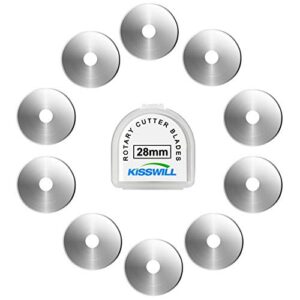
When your rotary cutter starts pulling fabric threads instead of gliding through cleanly, replacing worn blades with Kisswill 28mm replacements restores that essential cutting efficiency you need for precise quilt piecing. These Japanese steel blades maintain superior sharpness through multiple quilting projects while slicing effortlessly through ten fabric layers at once!
Always handle blade replacement with extreme caution for blade safety, store your spares in the protective case to prevent dulling, and wipe away lint after each sewing session to extend rotary maintenance intervals between changes, keeping your quilting techniques sharp and your fabric selection cuts beautifully accurate!
| Best For | Quilters and crafters who work with multiple fabric layers and need sharp, reliable replacement blades that maintain cutting precision through heavy use. |
|---|---|
| Primary Use | Fabric cutting |
| Brand | Fiskars |
| Suitable For | Quilting and sewing |
| Material Type | Japanese Steel |
| Skill Level | All levels |
| Durability | Wear-resistant |
| Additional Features |
|
- Japanese steel construction with tungsten alloy delivers exceptional sharpness that cuts through up to 10 fabric layers cleanly
- Compatible with standard Fiskars 28mm rotary cutters and comes with a protective storage case to keep blades in prime condition
- Cost-effective 10-blade pack means you’ll have plenty of replacements on hand for long-term quilting and crafting projects
- Requires careful handling and storage due to extremely sharp edges, making them less suitable for beginners unfamiliar with rotary cutter safety
- Blade life varies significantly based on usage habits and fabric types, so you might go through them faster than expected on heavy projects
- Performance depends on proper maintenance like regular lubrication and lint removal, which adds extra steps to your crafting routine
Step-by-Step Quilting Techniques on a Regular Machine
Now that you’ve got your quilt sandwich basted and your machine set up with the right tools, it’s time to bring your vision to life with actual stitching!
The techniques you choose will determine the texture, personality, and overall finish of your quilt, and each method offers its own unique advantages depending on your design goals.
Let’s explore the core quilting techniques that will transform your layered fabric into a beautifully finished masterpiece!
Straight-Line Quilting With a Walking Foot
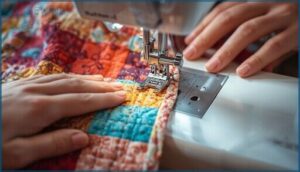
Straight-line quilting with a walking foot transforms your quilt sandwich into a stunning masterpiece, and you’re about to embrace this essential technique. The walking foot moves your top layer at the same speed as the bottom layer, preventing shifting while delivering flawless stitch control, fabric feed, and quilt tension across multiple layers.
- Set your stitch length between 2.0 and 3.0 mm for crisp, professional straight lines that showcase your dedication
- Use light erasable markers to carefully mark evenly spaced lines before you begin quilting
- Align your needle with ruler edges to maintain consistent spacing between each intricate parallel line
- Practice on scrap fabric sandwiches to calibrate your sewing machine settings and build confident momentum
- Quilt from top to bottom in one consistent direction, rotating your work as needed to maintain perfectly straight lines throughout your quilting techniques
Test your tension balance on scraps first, because proper setup ensures every stitch reflects your dedication to quality!
Free Motion Quilting Basics
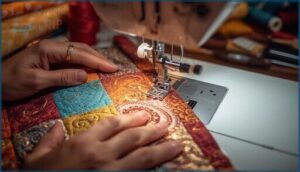
Free motion quilting opens new creative territory beyond straight lines, inviting you to guide fabric freely under the needle while lowering your feed dogs and attaching a darning foot.
You control stitch length through hand speed and fabric movement, balancing thread tension carefully for smooth stitches.
Start practicing simple loops and swirls on scrap sandwiches, building muscle memory that transforms your domestic machine into an expressive quilting tool!
Stitch in The Ditch and Echo Quilting
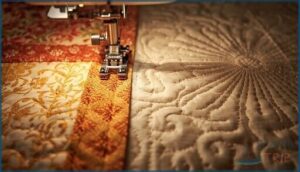
Building on your free motion quilting confidence, you’re ready to master stitch alignment and quilt stabilization through two foundational techniques that’ll transform your quilting design! Attach your walking foot, match thread visibility to your fabric, and embrace these powerful methods for fabric management on any sewing machine:
- Stitch directly in seam lines to anchor layers invisibly while creating a stable framework
- Echo around motifs at consistent intervals using presser-foot guides or rulers for precise spacing
- Combine ditch stitching with echo techniques to build dimensional texture that frames your designs beautifully
Managing Quilt Bulk and Throat Space
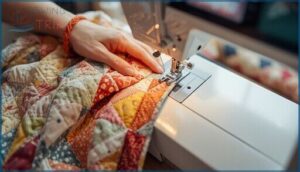
As your quilt sandwich grows, wrestling with quilt bulk management and throat space optimization becomes the next exciting frontier in your quilting journey! Your domestic machine’s limited machine clearance doesn’t have to stop you from tackling larger projects when you master fabric layering techniques and quilting ergonomics—let’s discover these space-saving strategies together!
| Challenge | Solution |
|---|---|
| Bulk under needle | Walking foot distributes feed evenly, pulling multiple layers uniformly through throat space |
| Limited work surface | Extension table holds quilt weight, reducing strain and improving quilting posture |
| Stitch irregularities | Balance top and bobbin tension while clearing lint regularly from bobbin area |
| Sandwich bunching | Smooth basting creates flat layers, minimizing snagging during quilting on a domestic machine |
Tips for Successful Quilting and Finishing Touches
You’re so close to completing your beautiful quilt, and now it’s time to perfect those final details that transform your work from good to absolutely stunning!
In this section, you’ll discover essential troubleshooting strategies that save you from frustration, master the art of creating flawlessly even stitches, and learn the professional finishing techniques that make your quilt worthy of heirloom status.
Let’s walk through these critical steps together, ensuring your quilting journey ends with the confidence and satisfaction you truly deserve!
Troubleshooting Common Machine Quilting Issues
Even the most carefully prepared quilt sandwich can encounter frustrating hiccups during machine quilting, but recognizing common problems quickly transforms obstacles into opportunities for mastery!
Address thread breakage by replacing dull needles immediately, examine tension issues by testing on scrap fabric first, and prevent fabric puckering through proper presser foot pressure adjustments.
Maintain stitch quality with regular sewing machine maintenance, including thorough bobbin area cleaning and consistent thread choice suited to your project’s weight.
Keeping Stitches Even and Tension Balanced
Consistently achieving beautiful, balanced stitches begins with testing thread tension on scrap fabric before you commit to your precious quilt top, ensuring equal top and bobbin thread appearance that signals perfect machine calibration!
Your fabric choice, needle selection, and thread choice work together like a symphony—polyester or cotton-fiber blends provide stable tension, while sharp universal needles in appropriate sizes eliminate skipped stitches during free motion quilting, and diligent sewing machine maintenance keeps your feed dogs performing flawlessly!
Adding Binding and Final Pressing
Attaching your binding transforms raw edges into a clean, professional finish that showcases your hard work. Start by cutting 2.5-inch strips, joining them with precise quarter-inch seam allowances, then pinning every few inches to guarantee smooth edge finishing.
Mitered corners at perfect 90-degree angles add elegance, while your walking foot distributes fabric evenly during attachment.
Final quilt pressing with minimal steam sets those seams beautifully, stabilizing each edge!
Care and Storage for Your Finished Quilt
Your masterpiece deserves proper quilt preservation to maintain its beauty for years to come! Store your finished quilt flat or rolled in breathable cotton bags, avoiding plastic that traps moisture and harms fabric storage.
Consider these essential quilt care practices:
- Keep relative humidity at 40–60% to prevent mold
- Rotate displayed quilts away from direct sunlight
- Use clean cotton gloves when handling delicate textiles
Frequently Asked Questions (FAQs)
Can I quilt without a walking foot?
You absolutely can quilt without a walking foot! Free motion quilting and careful fabric control let you master quilting techniques on your sewing machine, though footless quilting demands careful scrutiny of machine settings and tension.
What batting works best for beginner quilters?
Cotton batting is your best friend when you’re starting out, offering natural fibers that handle beautifully and shrink slightly for charming texture.
Polyester blends deliver forgiving loft that makes quilting techniques easier to master!
How do I prevent fabric shifting while quilting?
Think of fabric shifting like sand slipping through your fingers—you’ll need a walking foot, steady basting with pins or spray, balanced thread tension, proper batting selection, and careful machine calibration to anchor every layer securely!
Should I use cotton or polyester thread?
Your choice hinges on aesthetic outcomes and thread durability! Polyester delivers exceptional tensile strength and tension control for your sewing machine, while cotton blends beautifully with fabric, creating authentic quilting techniques that showcase timeless charm and maintenance ease!
How often should I change my needle?
Replace your needle every 8 hours of quilting to maintain stitch quality and prevent fabric damage.
Skipped stitches, thread tension issues, or snags signal it’s time for fresh quilting needles during machine maintenance!
Conclusion
The machine you thought wasn’t enough becomes everything you need once you trust your hands and embrace the process!
Learning how to quilt with a regular machine transforms limitation into liberation, proving that creativity thrives not through expensive equipment but through practiced skill, patience, and courage to simply begin.
Your next masterpiece waits beneath your needle right now, ready to unfold stitch by stitch into something extraordinarily beautiful and unmistakably yours!