This site is supported by our readers. We may earn a commission, at no cost to you, if you purchase through links.
A tangled bobbin can grind production to a halt faster than a broken needle, yet few realize how much hinges on the precision of industrial sewing machine bobbin winding. Every smooth line of stitches depends on the invisible work happening beneath the fabric—where the right tension and winding technique keep your workflow humming.
Whether you’re running a single-head machine or managing a fleet, mastering bobbin winding means fewer snags, less wasted thread, and machines that perform as reliably as clockwork. The difference between perfect output and frustrating downtime often comes down to what’s happening on that tiny spool.
Table Of Contents
Key Takeaways
- Industrial bobbin winding directly impacts production efficiency by 1–3% through precise tension control, faster winding cycles (up to 6,000 RPM), and reduced thread breakage compared to home machine capabilities.
- Automation in bobbin winding delivers speed increases up to 60% while maintaining consistency, with motorized winders achieving 32% faster performance and pneumatic systems providing 14% better tension uniformity.
- Weekly maintenance—including tension verification within ±0.2 N, cleaning that removes 70% of contaminants, and belt adjustment within ±5%—prevents the 25% reduction in winding consistency caused by dust and fiber buildup.
- High-speed bobbin winders above 2,000 RPM present entanglement hazards, but proper safety measures like interlocked guards and lockout procedures reduce injury risk by 80–90% during operation.
What is Industrial Sewing Machine Bobbin Winding?
Industrial sewing machine bobbin winding is the process of transferring thread onto a small spool that feeds the lower thread during sewing operations. Unlike home machines, industrial setups often use dedicated winding devices that mount directly to your work table for faster, more consistent results.
Understanding how these systems work—and what makes them different from consumer models—will help you get your machine ready for production-level work.
Purpose of Bobbin Winding in Industrial Machines
Precision matters in industrial sewing—especially regarding bobbin winding. You rely on:
- Consistent Thread Tension for smooth stitches and fewer tangles.
- High Bobbin Quality to reduce thread waste and downtime.
- Ideal Winding Speed for peak Industrial Efficiency.
These Bobbin Winding Solutions keep your Sewing Productivity high and guarantee your Bobbin Management never holds you back.
Effective test preparation resources are also vital for understanding complex industrial sewing concepts.
Differences From Home Sewing Machine Bobbin Winding
Unlike home machines, Industrial Sewing Machines push Bobbin Winding to an entirely different scale. You’ll see Winding Speeds up to 6,000 RPM, tighter Thread Tensions, and automation that keeps production humming.
Industrial Bobbin Winders handle heavier Bobbin Materials, offer precise concentricity, and support sophisticated Sewing Machine Parts and Accessories—giving you control and efficiency home setups can’t match.
To guarantee methodological rigor, manufacturers often conduct literature reviews to improve their designs.
Types of Industrial Bobbin Winders
You’ve seen how industrial Bobbin Winding outpaces home setups—now, let’s look at your options. Whether you’re chasing speed or consistency, each Industrial Bobbin Winder brings something different to the table:
- Motorized Winders (32% faster winding)
- Pneumatic Assist (14% better tension uniformity)
- Rotary Winders (up to 6,000 rpm)
- Electronic Tension control
- Automated Systems for hands-off operation
Essential Tools and Setup for Bobbin Winding
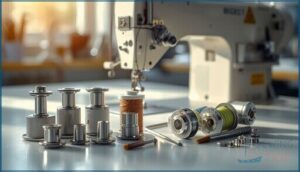
Getting your bobbin winder set up right is the key to smooth sewing. You’ll need to know which tools and machine models work together before you start.
Here’s what you should have in place for reliable bobbin winding.
Table-Mounted Bobbin Winder Components
A table-mounted bobbin winder mounts securely to your machine’s table stand through a throat plate clamp rated for up to 25 kg. Understanding these components ensures reliable operation.
| Component | Function | Key Specification |
|---|---|---|
| Throat Plate Clamp | Secures unit to worktable | 25 kg load capacity |
| Belt-Driven Pulley Systems | Transmits motor motion | 85-90% efficiency |
| Guide Rails | Maintains bobbin alignment | Regular maintenance acts as preventive medicine for your bobbin winder, stopping problems before they disrupt your sewing workflow |
Let’s walk through the key practices that’ll keep your winder running smoothly for years.
Cleaning The Bobbin Winder Mechanism
Your bobbin winder’s cleanliness directly affects thread quality and winding efficiency. Dust and fiber residue can reduce winding consistency by up to 25%, so you’ll want to wipe down surfaces with a lint-free cloth after each shift—this removes roughly 70% of contaminants.
Here’s what clean bobbin winder maintenance should target:
| Component | Cleaning Method | Frequency | Impact |
|---|---|---|---|
| Winder shaft | Soft brush + isopropyl alcohol | After each shift | Reduces tension variation by 12% |
| Housing access panels | Anti-static wipes | Monthly | Lowers jamming downtime by 20% |
| Bobbin slots | Lint-free cloth | Weekly | Maintains capacity accuracy within 2-5% |
| Belt surfaces | Gentle wipe (no oils) | Bi-weekly | Prevents slippage and friction buildup |
Regular bobbin cleaning prevents debris migration that causes misaligned bobbins and thread breakage—keeping your industrial sewing machine running smoothly.
Regular Inspection and Adjustment
Consistency is your best defense against winding drift. You’ll want to check these parameters weekly to keep your industrial sewing machine bobbin winding reliable:
- Tension Control: Verify thread tension stays within ±0.2 N using a calibrated gauge—58% of shops follow weekly inspection schedules.
- Winding Calibration: Measure bobbin fill at 80% capacity to prevent jamming.
- Thread Monitoring: Inspect guides for wear.
- Belt Adjustment: Maintain tension within ±5% of spec.
When to Seek Professional Assistance
Urgency drives smart decisions in machine troubleshooting. If you notice persistent winding faults, belt slippage, or a rise in bobbin housing temperature, it’s time for emergency repairs.
Professional technician training ensures winder calibration and safety protocols are met.
Scheduled maintenance on your industrial sewing machine prevents costly downtime—don’t hesitate to call in a specialist when basic sewing machine maintenance isn’t enough.
Frequently Asked Questions (FAQs)
How do automation features impact bobbin winding speed?
Automation Benefits are clear: Speed Increases up to 60% mean faster bobbin winding, less downtime, and better Winding Efficiency.
Production Optimization lets you thread and swap bobbins quickly, saving labor while keeping your Industrial Sewing Machine running smoothly.
What are the latest technological advances in bobbin winding?
AI Integration and Smart Winding now drive precision in machine operation, with automated systems using IoT Solutions for real-time control.
Nanotechnology—like anti-slip coatings—reduces thread issues, while digital calibration streamlines bobbin winding techniques on modern industrial sewing machines.
Can IoT-enabled winders improve maintenance scheduling?
Yes, IoT Integration facilitates Predictive Maintenance through Realtime Monitoring of Industrial Sewing equipment. Smart Scheduling uses Automated Alerts to reduce downtime, optimizing Sewing Machine Maintenance intervals.
This improves Bobbin Winding efficiency and overall Machine Threading reliability.
How does bobbin winding affect overall production efficiency?
Every stitch starts with a spin—bobbin winding directly lifts production efficiency by 1–3% through faster cycles, reduced thread breakages, and labor savings from automation benefits in industrial sewing operations.
Are there safety concerns with high-speed bobbin winders?
High-speed bobbin winders present real operational hazards. Rotating parts can cause entanglement injuries, especially above 2,000 RPM.
Proper machine safety measures—like interlocked guards and lockout procedures—reduce injury risk by 80-90% during sewing machine operation.
Conclusion
The machines that stitch the world together depend on something smaller than your thumb. Master industrial sewing machine bobbin winding, and you’ve seized control over the single component that separates perfect production from costly delays.
Your tension settings, threading precision, and maintenance routine now form the foundation of reliable operation. When bobbins wind correctly, everything else follows—smooth stitches, minimal downtime, and the confidence that your equipment won’t fail when deadlines loom.
- https://www.sailrite.com/Industrial-Bobbin-Winder-for-Sewing-Machines
- https://www.wawak.com/sewing/sewing-machine-parts-accessories/wawak-electric-bobbin-winder
- https://www.asmsewingsupply.com/automatic-bobbin-winder
- https://www.tradeindia.com/question-answer/what-are-the-types-of-winding-machines
- https://www.linkedin.com/pulse/bobbin-winder-real-world-5-uses-youll-actually-see-2025-dyehf