This site is supported by our readers. We may earn a commission, at no cost to you, if you purchase through links.

Walk through any mid-to-large garment facility and you’ll hear it before you see it—that rapid, rhythmic whirring that keeps production lines moving. The industrial overlock machine sits at the center of nearly every sewn product you own, trimming, stitching, and sealing raw edges in a single synchronized pass.
Most operators underestimate what these machines can actually do until they’ve pushed one beyond basic edge finishing. From four-thread sleeve attachment on high-volume T-shirt runs to rolled hems on sheer lingerie, industrial overlock machine covers far more applications than the average setup—and matching the right configuration to your production demands is where real efficiency begins.
Table Of Contents
- Key Takeaways
- What is an Industrial Overlock Machine?
- 10 Common Uses of Industrial Overlock Machines
- Finishing Raw Fabric Edges on Woven and Knit Fabrics
- Sewing Stretchable Seams for Knitwear and Sportswear
- Attaching Sleeves, Side Seams, and Underarms on T-Shirts
- Joining Neck Ribs to Garment Openings
- Creating Rolled Hems on Scarves and Lingerie
- Producing Decorative Edges, Ruffles, and Gathers
- Serging Narrow Sleeves, Straps, and Lace Trims
- Assembling Upholstery and Furniture Fabric Components
- Manufacturing Towels, Linens, and Household Textiles
- Preventing Fabric Fraying in High-Volume Production
- Key Features That Define Industrial Overlock Machines
- Choosing The Right Industrial Overlock Machine
- Top 10 Industrial Overlock Machines
- 1. Juki MO-1000 Air Threading Serger
- 2. Juki Industrial Overlock Sewing Machine
- 3. Industrial Overlock Sewing Machine Juki
- 4. Electric Overlock Sewing Machine Four Thread
- 5. Industrial Overlock Sewing Machine System
- 6. Jaygovan Serger Overlock Sewing Machine
- 7. Industrial Four Thread Overlock Machine
- 8. Professional 4 Thread Serger Machine
- 9. Heavy Duty Serger Sewing Machine
- 10. Industrial Grade Serger Sewing Machine
- Frequently Asked Questions (FAQs)
- Conclusion
Key Takeaways
- industrial overlock machine trims, stitches, and seals raw edges in a single pass—making it far more capable than a standard sewing machine, which only locks two threads into a seam.
- Thread configuration (3, 4, or 5-thread) is the most critical spec to match against your fabric weight and stretch requirements, directly affecting seam strength, edge finish, and production speed.
- Differential feed is what separates clean results on knits and stretch fabrics from puckered, distorted seams—it’s non-negotiable for sportswear, lingerie, and jersey production.
- Matching machine type to your actual workflow—factoring in SPM, maintenance demands, threading complexity, and total cost of ownership—determines whether the machine works for you or against you.
What is an Industrial Overlock Machine?
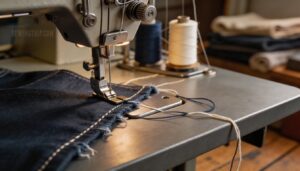
An industrial overlock machine does a lot more than just sewing — it trims, encases, and secures raw fabric edges in a single pass. Understanding what it is and how it works will help you choose the right one for your production line.
From stitch types to thread tension, industrial sewing machine uses and applications break down exactly how these workhorses handle everything from lightweight chiffon to heavy denim.
Here’s what you need to know.
Definition and Core Function
An industrial overlock sewing machine does three jobs in one pass — trim, stitch, and seal.
Through Edge Trim Integration, the built-in knife sets your cutting width before the Loopers Locking Action forms interlocking threads along the raw edge. Fabric Edge Protection comes built into every seam.
You control Stitch Density Control and thread tension adjustment to match any material, while differential feed and Speed-Optimized Seam performance push overlock stitching past 6,000 SPM.
How It Differs From a Regular Sewing Machine
A regular sewing machine locks two threads into a seam — that’s it. An overlock processes up to five, trims the edge, and encases it simultaneously. The Thread Path Complexity alone separates them.
You’re also looking at a wider Machine Footprint Size, higher Power Consumption, and a Stitch Density Range hitting 9,000 SPM — far beyond domestic reach. Edge Finish Automation isn’t a feature on standard machines. It’s the entire point here.
Key Components and Mechanisms
Behind the speed lives a precise system of parts working in concert.
Looper Geometry determines how threads interlock at the edge — upper and lower loopers working in tandem with needle and looper system timing. Blade Adjustment controls cut width via the edge trimmer knife.
Feed Dog Synchronization, driven by differential feed and Servo Motor Control, controls fabric movement. Tension Disc Calibration, alongside automatic thread tension, keeps stitch balance locked while adjustable stitch length accommodates varying fabric demands.
10 Common Uses of Industrial Overlock Machines
Industrial overlock machines show up in more places than most people realize — far beyond basic garment work. Whether you’re running a sportswear line or finishing household textiles, the right application makes all the difference.
Here are 10 common uses worth knowing.
Finishing Raw Fabric Edges on Woven and Knit Fabrics
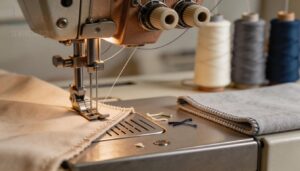
Every fabric edge tells a story — and a frayed one tells the wrong story. Your industrial overlock sewing machine manages fabric edge finishing in a single pass, trimming excess and encasing raw edges simultaneously.
On woven fabrics, a 3-thread stitch keeps bulk low. On knit fabrics, differential feed prevents wave and curl.
Stitch Density Control, Blade Angle Tuning, Presser Foot Selection, and Quality Inspection Protocols keep Edge Trim Waste Management tight and consistent.
Sewing Stretchable Seams for Knitwear and Sportswear
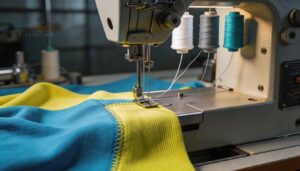
Stretch fabrics don’t forgive tension errors. For knitwear and sportswear, Differential Feed Tuning and Thread Tension Balance work together to keep seams smooth without puckering or distortion.
Flatlock Seam Design eliminates bulk at panel joins, while Elastic Attachment Techniques preserve recovery after repeated flex.
MultiThread Overlock Stitching across 4–5 threads distributes strain evenly — giving your seams the same mobility the fabric demands.
Attaching Sleeves, Side Seams, and Underarms on T-Shirts
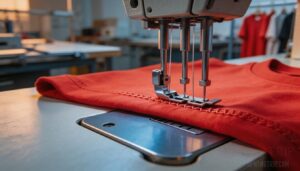
When attaching sleeves, getting Cap Notch Alignment right determines whether your garment hangs clean or pulls.
Your Tshirtmaking overlock machine performs attaching sleeves and joining side seams simultaneously — trimming edges to 1.5 mm while the four-thread stitch locks in durability.
Seam Tension Balancing, Stitch Density Optimization, Armhole Reinforcement, and Pressing Techniques work together to keep every seam flat and recovery‑ready.
Joining Neck Ribs to Garment Openings
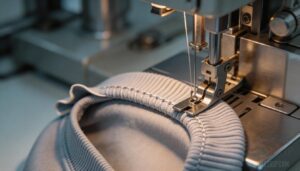
Attaching the neck rib demands Rib Alignment Techniques that keep the opening distortion-free under stress. Your industrial overlock sewing machine uses a 4-thread overlock stitch with Elastic Thread Selection and Stitch Density Optimization to maintain seam strength around curved knit openings.
Differential feed manages rib elasticity while Edge Trimming Precision and Seam Reinforcement Strategies lock the join — clean fabric handling, zero bulk.
Creating Rolled Hems on Scarves and Lingerie
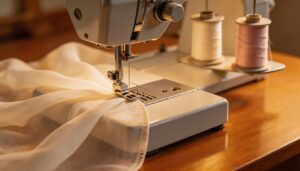
Delicate fabrics demand precision — a rolled hem on chiffon scarves or silk lingerie leaves no room for error. Your overlock machine manages this with a 3‑thread setup, dialing in the right Needle Size and Thread Elongation for a clean, invisible edge.
- Set Hem Width Control to 2–3 mm for tight rolls
- Apply Stabilizer Application on slippery silks to prevent tunneling
- Engage differential feed to manage stretch without distortion
- Follow Post‑Wash Care guidelines to preserve the rolled hem shape
Producing Decorative Edges, Ruffles, and Gathers
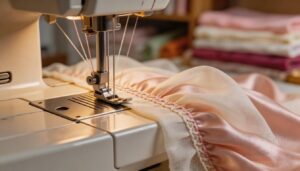
Your overlock isn’t just a finishing tool — it’s a design tool. With Stitch Width Modulation, Thread Color Pairing, and Differential Feed Optimization, you can produce ruffles, decorative edges, and controlled gathers in a single pass.
| Technique | Key Setting |
|---|---|
| Ruffle Depth Settings | Wider stitch width, slower feed |
| Gather Ratio Calibration | Thread tension + needle position |
| Decorative edges | Multithread overedge sewing configurations |
| Differential feed | Counters stretch distortion |
Serging Narrow Sleeves, Straps, and Lace Trims
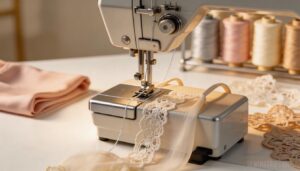
Narrow sleeves, spaghetti straps, and lace trims push your machine’s precision to the limit.
Set Needle Plate Adjustment to minimize trimming, engage Rolled Hem Settings for lightweight knits or chiffon, and let Thread Tension Automation protect delicate lace from distortion.
Fine Gauge Threads run tighter without puckering.
Differential Feed Control prevents curling, while adjustable stitch width keeps every strap edge clean and professional.
Assembling Upholstery and Furniture Fabric Components
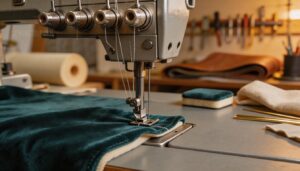
Upholstery demands a different mindset than garment work. Your industrial overlock sewing machine manages the heavy lifting here — thick fabric type variations, foam edge seaming, and panel stitching on sofa components all run cleaner with proper seam finishing.
- Use 4-thread configuration for Corner Reinforcement on armrests
- Set knife clearance wide for Piping Attachment and Zipper Integration
- Balance edge stitching carefully for edge stitching on velvet or linen panels
Manufacturing Towels, Linens, and Household Textiles
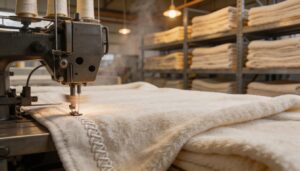
Household textiles follow similar logic to upholstery — edge integrity matters as much as the seam itself.
Bath towels running 400–600 GSM demand overlock stitching with proper Yarn Selection and seam durability to survive repeated washing.
Your industrial overlock sewing machine addresses Dimensional Stability concerns by locking edges before Finishing Chemicals are applied, keeping fabric fraying out of high-speed production runs entirely.
Preventing Fabric Fraying in High-Volume Production
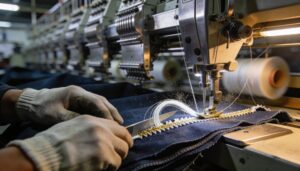
Fraying doesn’t announce itself — it compounds quietly until seam failure shuts down a line.
Fraying compounds quietly — until seam failure shuts down the line
Your industrial overlock sewing machine keeps that from happening through:
- Tension Calibration — balanced thread engagement across all plies
- Blade Timing Sync — knife trims exactly as stitches seal the edge
- Differential Feed Optimization — counters stretch flutter on knits
- Fabric Pre-Treatment — fray-resistant finishes applied before the run
- Edge Sealing Techniques — overedge threads enclose raw fabric completely
That’s Preventing Fabric Fraying Using Overlock Technology working at full production efficiency.
Key Features That Define Industrial Overlock Machines
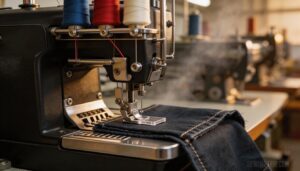
Not all overlock machines are built the same, and the features underneath the hood are what separate a workhorse from a liability.
Knowing what to look for means you won’t end up with a machine that fights your fabric instead of finishing it.
Here are the key features that define a true industrial overlock machine.
Thread Configurations — 3, 4, and 5-Thread Options
Thread configuration is where stitch strength, edge finish types, and fabric compatibility all converge.
Your choice between a 3-Thread Overlock, 4-Thread Overlock, or 5-Thread Overlock directly affects tension adjustment demands, thread consumption, and speed impact on your industrial overlock machine.
| Configuration | Best Use |
|---|---|
| 3-Thread | Light wovens, rolled edges |
| 4-Thread | Knits, stable seam joins |
| 5-Thread | Heavy stretch, high-stress seams |
Built-in Cutting Knife and Edge Trimming System
Every industrial overlock machine relies on a precisely aligned edge trimmer knife that trims excess fabric in sync with stitching — no secondary pass needed. Knife alignment precision keeps cuts consistent across layers, while adjustable trim width lets you dial in narrow or wide finishes.
The quick-change blade system swaps cutting width settings fast.
Safety interlock features disable the knife when covers open, and routine maintenance and calibration keep the knife mechanism performing cleanly at 9,000 SPM.
Differential Feed for Stretch and Knit Fabrics
Differential feed is what separates a machine that processes knit fabrics from one that fights them. Two independently driven feed dogs — Front Feed Adjustment at the front, Rear Feed Control at the rear — regulate fabric stretch in real time.
Set above 1.0 for Stitch Uniformity on jerseys; dial lower for Gathering Effects. Proper Fabric Tension Balance keeps seam strength consistent across every stretchable panel.
The adjustable differential feed knob lets you fine‑tune fabric tension for creative edge finishes.
High-Speed Performance — Up to 9,000 SPM
Speed is where industrial overlock machines truly earn their place on the production floor. A three-phase Servo Motor Design with Direct Drive Efficiency pushes industrial overlock machine speed and performance to 9,000 SPM — with some servo systems hitting 7,000 RPM.
Microcontroller Timing keeps Blade Synchronization precise under load, while Cooling System Optimization prevents thermal throttling.
Electronic speed control and high-speed sewing let you scale output without sacrificing seam consistency.
Auto-Tension Sensors and Independent Looper Control
Automatic thread tension isn’t just a convenience — it’s what separates consistent production from costly rework.
On a quality industrial overlock machine, closed loop control and sensor fusion diagnostics work together to hold seam quality steady run after run:
- Real-time tension sensing adjusts mid-seam without operator input
- Independent looper calibration isolates each thread path
- Fail-safe monitoring flags drift before it damages fabric
- Differential feed pairs with machine settings for stretch control
Choosing The Right Industrial Overlock Machine
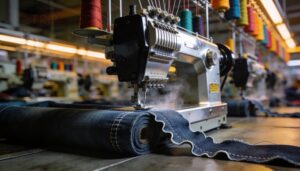
Picking the right industrial overlock machine isn’t just about specs — it’s about matching the right tool to your actual production demands. Get it wrong, and you’re fighting the machine on every run.
Here’s what to think about before you commit.
Matching Machine Type to Fabric Weight and Stretch
Not all overlocks are built for the same job. Match your industrial overlock machine to fabric weight and stretch first — needle gauge selection and thread strength matching determine whether seams hold or fail.
Lightweight knits need ballpoint needles; heavy denim demands thicker gauges.
Dial in fabric tension calibration, stitch density adjustment, and differential feed to achieve seam finish optimization across any fabric compatibility challenge.
Speed and Productivity Requirements for Your Workflow
Your production volume dictates everything here.
Industrial overlock machines push up to 9,000 SPM stitches per minute — but raw speed means nothing without Feed Synchronization and Thread Tension Calibration dialed in.
Stitch Rate Optimization keeps high-speed sewing stable across long runs, while Blade Change Efficiency cuts downtime.
Match production speed to your actual workflow demands, and you’ll see a real productivity increase without burning through materials.
Threading Simplicity and Operator-Friendly Design
Fast machines mean nothing if your operators lose two minutes re-threading after every break. Color-Coded Guides and a Safety Thread Path cut that time dramatically — some setups thread in under 30 seconds.
One-Handed Threading and Ergonomic Needle Access reduce fatigue across long shifts. When automatic thread tension and thread guide alignment are clear, operator training stays short and seam consistency stays high.
Maintenance Needs, Blade Replacement, and Lubrication
Threading may be fast, but a dull blade or dry looper will still kill your throughput. Schedule Blade Sharpness Checks every 8–12 hours of heavy use, and follow your oil cap and maintenance guides for regular lubrication every shift.
Gearbox Oil Maintenance, Differential Feed Alignment, and Thread Tension Audits belong on your maintenance schedule — skipping them turns small drift into costly rework.
Budget, Warranty, and Brand Support Considerations
Keeping blades sharp matters — but so does the investment behind the machine. Mid-range industrial overlock machines run €1,500–€6,000, with financing options stretching 24–60 months.
Factor in total cost beyond the sticker price:
- Warranty extensions up to 3 years (with annual checks)
- Service network coverage in your region
- Replacement parts and support for overlock machines
- Brand reputation — Juki leads globally
- maintenance schedule schedule compliance** of maintenance schedule compliance
Top 10 Industrial Overlock Machines
Picking the right machine comes down to knowing what’s actually worth your time and money. The market has plenty of options, but a handful consistently stand out for performance, durability, and real production demands.
Here are the top 10 industrial overlock machines worth putting on your radar.
1. Juki MO-1000 Air Threading Serger
The Juki MO-1000 makes threading a non-issue — literally. Its built-in air-threading system guides thread through both upper and lower loopers with a single button press, cutting setup time to seconds.
You also get 2, 3, or 4-thread configurations, differential feed for knit control, and a maximum speed of 1,500 SPM with surprisingly quiet operation.
At $1,399, it’s built for serious workshop use.
Just keep the air jets clean — they’ll clog if you skip maintenance.
| Best For | Sewists who work with delicate or stretchy fabrics regularly and want fast, hassle-free threading without sacrificing stitch quality. |
|---|---|
| Thread Count | 2/3/4-thread |
| Max Speed (SPM) | 1,500 |
| Frame Material | Metal |
| Auto Edge Trimming | Yes |
| Differential Feed | Yes |
| LED Work Light | No |
| Additional Features |
|
- The air-threading system is a genuine time-saver — looper threading goes from frustrating to nearly instant
- Runs quietly and stays stable on the table, which is a big deal if you sew for long stretches
- Handles sheer, knit, and lightweight fabrics really well, giving you clean overlock stitches with consistent tension
- At $1,399, it’s a serious investment — not the right pick if you’re just getting started
- The air jets need regular cleaning with compressed air or they’ll start acting up
- The foot pedal connection can work loose over time, which risks breaking needles if you’re not checking it
2. Juki Industrial Overlock Sewing Machine
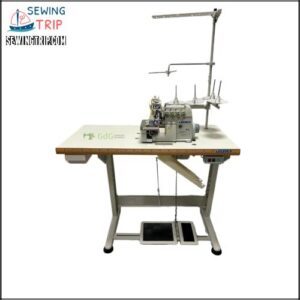
If you need a machine that means business, the Juki MO-68174S (MO-6814S) delivers. It processes light- to heavy-weight fabrics with 4-thread overlock capability and an optional safety stitch, giving you seam strength across garments, activewear, and home décor.
The integrated servo motor keeps noise down during long production runs, and the REX LED light makes stitch visibility on dark fabrics a non-issue.
At roughly 150 lb, you’re not moving it often — so pick your spot carefully.
| Best For | Garment makers, seamstresses, and small production shops who need a reliable, heavy-duty overlocker for consistent, professional-grade seams on a wide range of fabrics. |
|---|---|
| Thread Count | 4-thread |
| Max Speed (SPM) | 7,000 |
| Frame Material | Metal |
| Auto Edge Trimming | Yes |
| Differential Feed | Yes |
| LED Work Light | Yes |
| Additional Features |
|
- The servo motor runs quietly, so long sewing sessions don’t wear on you
- Handles everything from lightweight jersey to heavy home décor fabric without breaking a sweat
- The REX LED light is a genuine help when you’re working with dark or detailed materials
- Assembly is a headache — instructions are sparse, and the table takes real time to figure out
- At 150 lb, this thing isn’t going anywhere once it’s set up, so plan your space in advance
- Some buyers have received the wrong model or mismatched parts, which is frustrating at this price point
3. Industrial Overlock Sewing Machine Juki
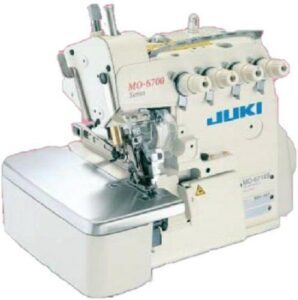
Built for floor-level production work, the Juki MO-6714S is a 2-needle, 4-thread overlock machine running on a 110V industrial clutch motor — capped at 7,000 stitches per minute. It processes knits, jerseys, and woven materials without hesitation, and differential feed keeps stretch fabrics from distorting mid-run.
At 250 lb, it’s not going anywhere once you set it down.
The complete package — table, stand, motor, and light — means you’re operational faster than you’d expect.
| Best For | Small workshops, costume shops, and independent makers who need a reliable, high-speed overlock machine for production-level garment work. |
|---|---|
| Thread Count | 4-thread |
| Max Speed (SPM) | 7,000 |
| Frame Material | Metal |
| Auto Edge Trimming | Yes |
| Differential Feed | Yes |
| LED Work Light | Yes |
| Additional Features |
|
- Screams through up to 7,000 stitches per minute — great for high-volume runs
- Differential feed handles stretchy and tricky fabrics without distortion
- Comes ready to go with table, stand, motor, and light already included
- Only does overlock stitching — you’ll need a separate machine for straight or lockstitch work
- The industrial clutch motor is loud, so expect some noise
- At 250 lb, it’s a beast to move — pick your spot carefully before setting it down
4. Electric Overlock Sewing Machine Four Thread
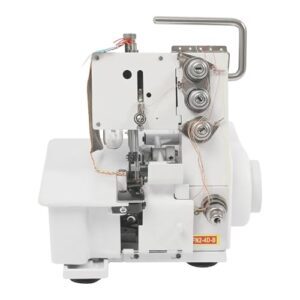
Step down from the heavy-iron territory for a moment — this electric four-thread serger punches well above its weight class for home studios and light-production setups.
A 100W motor drives up to 1,200 stitches per minute, and the four-thread lockstitch finishes edges at 4.5–5.5 mm hem width with independent tension control on each bobbin.
The cast-iron body resists wear, the integrated trimming knife manages edge cleanup automatically, and the LED work light keeps your stitch line visible through long runs.
| Best For | Home sewers and light-production users who want fast, clean edge finishing on a range of fabrics without stepping up to full industrial equipment. |
|---|---|
| Thread Count | 4-thread |
| Max Speed (SPM) | 1,200 |
| Frame Material | Cast-iron |
| Auto Edge Trimming | Yes |
| Differential Feed | No |
| LED Work Light | Yes |
| Additional Features |
|
- Four-thread lockstitch gives you stronger, cleaner seams than a basic three-thread setup — good for denim and heavier fabrics
- 1,200 stitches per minute with automatic edge trimming keeps things moving fast and cuts down on extra steps
- Cast-iron body with an LED work light and anti-slip base makes it stable and easy to use even in longer sessions
- The manual reportedly leaves a lot to be desired, so expect a learning curve if you’re new to sergers
- Shipping packaging has been an issue — some units arrive with a damaged base
- Only runs on 110V, so international buyers or anyone on a 220-240V grid will need a transformer
5. Industrial Overlock Sewing Machine System
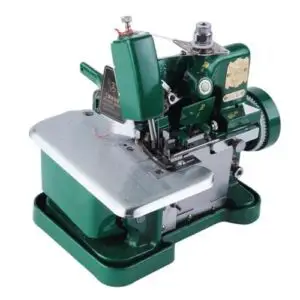
Think of this one as the mid-volume operations that keeps mid-volume operations running without drama. The 3-needle, 3-thread configuration accommodates stitch lengths from 1.5 mm to 3.2 mm, with hem width adjustable between 3.0 mm and 4.0 mm — giving you real flexibility across fabric types.
At 3,000 SPM and a 180/250W dual-rated motor, it won’t race a Juki MO-series, but it holds steady through long runs.
The cast-iron frame resists rust, the integrated knife trims automatically, and at $362.25, it earns its floor space.
| Best For | Small workshops, home studios, and mid-volume garment operations that need clean, fast overlocking on light to medium-weight fabrics without breaking the budget. |
|---|---|
| Thread Count | 3-thread |
| Max Speed (SPM) | 3,000 |
| Frame Material | Cast-iron |
| Auto Edge Trimming | Yes |
| Differential Feed | No |
| LED Work Light | No |
| Additional Features |
|
- Hits 3,000 SPM with automatic trimming built in — seams come out clean and fast with no extra steps.
- Adjustable stitch length and hem width give you real flexibility across different fabric types and projects.
- Cast-iron frame with rust-resistant finish holds up well in humid or heavy-use environments with minimal fuss.
- Tops out at 3-thread overlock, so anything needing a 4- or 5-thread seam is off the table.
- At 13.5 kg, it’s not something you’ll want to lug around between locations regularly.
- Manual controls only — no display or programmable settings, which can slow things down when switching between jobs.
6. Jaygovan Serger Overlock Sewing Machine
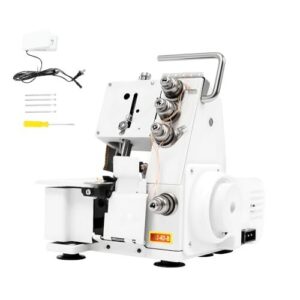
The Jaygovan runs a 4-thread overlock on a 100W motor, topping out at 1,200 SPM — well below industrial pace, but that’s not really the point.
Its cast-iron construction keeps vibration down during longer runs, and the automatic trimming blade performs edge finishing without extra passes.
Stitch width adjusts between 0.1 and 0.13 inches via looper knobs.
Threading is complex, and the factory speed controller is notoriously unreliable — budget for an aftermarket electronic unit.
Best suited for small workshops handling medium-weight fabrics.
| Best For | Home sewers and hobbyists with some sewing experience who want a durable, compact serger for edge finishing medium-weight fabrics like cotton, denim, or silk. |
|---|---|
| Thread Count | 4-thread |
| Max Speed (SPM) | 1,200 |
| Frame Material | Cast-iron |
| Auto Edge Trimming | Yes |
| Differential Feed | No |
| LED Work Light | No |
| Additional Features |
|
- Cast-iron body cuts down on vibration, so long sewing sessions feel a lot more stable
- Automatic trimming blade speeds up edge finishing without extra passes
- Compact footprint works well in small home workshops or tight counter spaces
- Threading is genuinely tricky, and the factory speed controller is often defective right out of the box
- Foot pedal is on/off only — no variable speed without buying an aftermarket controller
- Some units arrive with missing screws or bent metal guides that need adjusting before use
7. Industrial Four Thread Overlock Machine
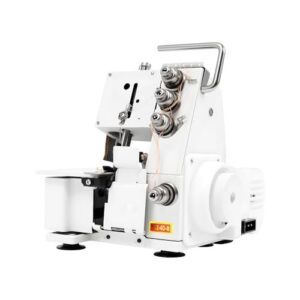
Four threads, two needles, two loopers — and a cutting system that trims as it. That’s the core of a four-thread overlock built for volume work.
You get a stitch width range of 3.0 to 6.0 mm, differential feed that manages knits without distortion, and color-coded looper paths that cut threading time substantially.
Cast-iron frames keep vibration minimal during continuous runs.
If your workflow involves medium-to-heavy fabrics at consistent output, this configuration covers edge finishing without requiring multiple machine passes.
| Best For | Small business owners and high-volume sewers who need fast, reliable edge finishing on medium-to-heavy fabrics like denim, canvas, or upholstery materials. |
|---|---|
| Thread Count | 4-thread |
| Max Speed (SPM) | 1,200 |
| Frame Material | Cast-iron |
| Auto Edge Trimming | Yes |
| Differential Feed | Yes |
| LED Work Light | No |
| Additional Features |
|
- Cuts and stitches at the same time, so you’re not running fabric through twice just to finish an edge.
- Strong 100W motor handles heavier fabrics without bogging down, and the cast-iron build keeps things stable at speed.
- Adjustable stitch length and tension give you real control over the finish — useful when you’re switching between fabric types.
- At 16.5 lb with a fairly large footprint, it’s not something you’ll move around easily — it needs a solid, dedicated workspace.
- Topping out at 1,200 stitches per minute is fine for small-batch work, but it won’t keep pace with a true industrial production line.
- It’s all mechanical — no electronic controls or programmable settings, so if you’re used to digital machines, the adjustment curve is real.
8. Professional 4 Thread Serger Machine
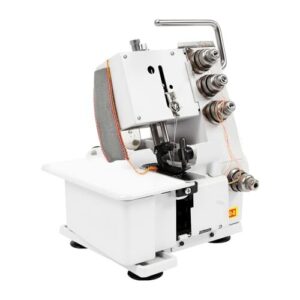
Where the four-thread industrial setup processes raw volume, a professional 4-thread serger brings that capability into tighter, more controlled environments—home studios and small-scale production alike.
With a 100W motor reaching 1,200 SPM, automatic edge cutting, and individual bobbin tension control, it processes cotton, silk, and denim without switching machines.
The cast-iron build keeps vibration down during continuous runs, while the integrated LED and heat-sink window let you work longer without interruption. Compact, capable, and consistent.
| Best For | Home sewers and small-scale producers who need industrial-grade serging without a full factory setup. |
|---|---|
| Thread Count | 4-thread |
| Max Speed (SPM) | 1,200 |
| Frame Material | Cast-iron |
| Auto Edge Trimming | Yes |
| Differential Feed | No |
| LED Work Light | Yes |
| Additional Features |
|
- Hits 1,200 stitches per minute with a 100W motor—fast enough to seriously cut down production time
- Four-thread lockstitch handles cotton, silk, and denim all on one machine, no swapping needed
- Cast-iron build plus a heat-sink window means you can run it continuously without it overheating or rattling around
- Only works on 110V, so international users or anyone with 220–240V outlets will need a transformer
- At 16.5 lbs with a decent footprint, it’s not something you’ll easily tuck away in a small space
- Only takes DP5 80–95 needles—if you run out or need a different type, your options are limited
9. Heavy Duty Serger Sewing Machine
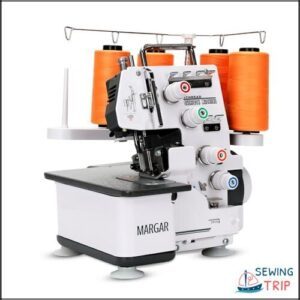
When your workload outgrows a compact studio setup, a heavy duty serger steps in. These machines run AC or DC servo motors continuously for 8 to 16 hours, with power ratings hitting 2.5 horsepower on high-end configurations.
The steel frame — often 25 to 45 kilograms — eliminates the drift you’d get from lighter builds at sustained speed.
Hardened feed dogs, synchronized knife timing, and differential feed keep seam width consistent whether you’re running lightweight synthetics or stacked denim layers through back-to-back shifts.
| Best For | Home sewists and small-studio makers who want serger-level speed and clean seam finishes without stepping up to a full industrial machine. |
|---|---|
| Thread Count | 4-thread |
| Max Speed (SPM) | 1,300 |
| Frame Material | Steel |
| Auto Edge Trimming | Yes |
| Differential Feed | Yes |
| LED Work Light | Yes |
| Additional Features |
|
- Hits up to 1,300 stitches per minute, so you move through fabric fast without sacrificing seam quality.
- Color-coded threading and the quick-thread system make setup way less painful, even if you’re still learning the ropes.
- Low-vibration design with an LED work light means you can run longer sessions without eye strain or fatigue creeping in.
- It’s not a true industrial machine — some users have flagged that a few parts feel cheaper than the price suggests.
- Threading and adjusting the knife system takes some mechanical confidence; beginners may need the manual close by.
- Thread quality matters here — use budget thread and you’ll likely deal with skipping or breakage mid-seam.
10. Industrial Grade Serger Sewing Machine
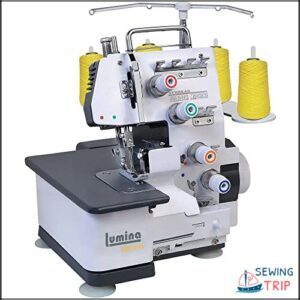
Step up from heavy-duty builds, and you’re looking at industrial grade sergers — machines engineered for continuous operation across long production cycles without compromise. Three-phase or high-power single-phase supply keeps the motor running at sustained speeds, while ball-bearing gear trains and steel-frame construction absorb the punishment of back-to-back shifts.
Color-coded threading, automatic tension sensors, and blade guards aren’t convenience features here — they’re production necessities.
If consistent output at scale is your standard, this category sets it.
| Best For | Sewers and small-studio owners who want professional overlock results on heavy fabrics without jumping to a full industrial setup. |
|---|---|
| Thread Count | 3/4-thread |
| Max Speed (SPM) | 1,250 |
| Frame Material | Metal |
| Auto Edge Trimming | Yes |
| Differential Feed | No |
| LED Work Light | Yes |
| Additional Features |
|
- Blazing fast at 1,250 stitches per minute, with an all-metal frame that handles denim, canvas, and tough woven fabrics without breaking a sweat
- Color-coded threading and factory pre-threading make getting started way less intimidating than most sergers in this range
- Built-in LED light and auto-trim blade keep your edges clean and your workspace bright without any extra fuss
- No speed control for slower settings, so delicate fabrics and beginners might have a rough time dialing it in
- Customer support is email-only with slow response times, which stings if something goes wrong mechanically
- Replacement blades are hard to track down, and the manual’s oiling instructions are a confusing mess
Frequently Asked Questions (FAQs)
What does an industrial overlocker do?
Picture threads wrapping around a fabric edge at 9,000 stitches per minute — that’s an industrial overlocker trimming, stitching, and finishing raw edges in one clean, continuous pass.
What can an overlocker be used for?
An overlocker trims, stitches, and finishes raw edges in one pass.
You can use it for seams, rolled hems, ruffles, lace trims, upholstery panels, and high-volume edge finishing across knit and woven fabrics.
What’s the difference between a serger and an overlock machine?
Sergers and overlock machines are, simply put, the same thing — different names for the same tool. "Serger" is common in North America; "overlocker" dominates everywhere else.
Can you just sew with an overlocker?
Yes, but with limits. An overlocker trims, stitches, and finishes edges in one pass — great for knits and stretch seams.
It won’t handle zippers, buttonholes, or topstitching without a regular machine alongside it.
How often should I oil my overlock machine?
Oil your overlock machine every 8 to 12 hours of operation in high-use environments. For lighter use, every 2 to 4 hours of continuous sewing keeps friction in check.
Can overlock machines sew leather or thick materials?
Think of leather as the final boss — demanding, unforgiving, but beatable.
Yes, industrial overlocks handle leather and thick materials, provided you’re running a heavy-duty model with sharp blades, a solid presser foot, and appropriately sized needles.
What causes thread breakage during overlock stitching?
Thread breakage usually comes down to tension imbalance, a worn needle, or a threading error.
Check those three first — they cover about 90% of cases before suspecting thread quality or feed issues.
Do overlock machines work with all thread types?
Not all thread types behave equally on an overlock.
Polyester is your safest bet for stability, while cotton, nylon, silk, and blends each demand specific tension and speed adjustments to perform reliably.
How do I adjust looper timing properly?
Start by aligning the looper to the needle drop point — timing should be set so the looper tip passes the needle eye with roughly 1–2mm clearance during the stitch cycle.
Can industrial overlocks handle denim and canvas?
Yes — heavy-duty industrial overlocks handle denim and canvas well. Use stronger needles, higher presser foot pressure, and specialty blades.
Differential feed controls thick layers, while a sturdy frame prevents skipped stitches on dense seams.
Conclusion
As you thread your way through the field of industrial sewing, the overlock machine stands as a silent workhorse, weaving efficiency into every stitch. With its versatility and power, it’s clear that industrial overlock machine uses extend far beyond basic edge finishing.
By matching the right machine to your production needs, you open up a world of precision and speed. Make informed choices, and let every seam tell a story of quality and craftsmanship.