This site is supported by our readers. We may earn a commission, at no cost to you, if you purchase through links.
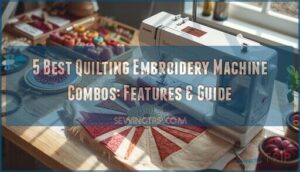
Your workspace shouldn’t force you to choose between piecing a king-size quilt and embroidering a delicate heirloom design. A quilting embroidery machine combo eliminates that trade-off, giving you both capabilities in a single footprint—no swapping machines mid-project or sacrificing counter space.
These dual-function workhorses handle everything from free-motion quilting across yards of batting to stitching intricate 200,000-stitch embroidery patterns, often with automated features that keep your hands on the fabric instead of fumbling with tension dials. Whether you’re binding your first lap quilt or digitizing custom monograms, understanding throat space, embroidery field dimensions, and hoop compatibility will determine whether your combo machine becomes an indispensable studio partner or an expensive dust collector.
Table Of Contents
Best Quilting Embroidery Machine Combos
You’ll find dozens of combo machines on the market, but not all of them handle the unique demands of quilting.
Many shoppers assume they need separate machines, but understanding the real differences between quilting and sewing machines can help you choose a single versatile option.
I’ve narrowed down the field to five models that truly deliver on both fronts—solid quilting performance paired with reliable embroidery capabilities.
Let’s look at what makes each one worth your attention.
1. Singer Quantum Stylist Sewing Machine
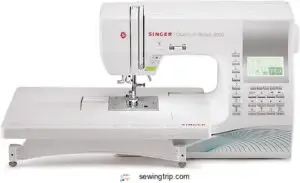
The Singer Quantum Stylist gives you 600 built-in stitches and five alphanumeric fonts for embroidery-style lettering right on your fabric. You’ll appreciate the automatic needle threader and drop-in bobbin system—they save time when you’re switching between piecing quilt blocks and adding decorative touches.
At $549.99, this machine processes thick fabric layers smoothly while the extension table expands your workspace for larger quilts. The 13 buttonhole styles and mirror imaging options let you customize designs without needing separate equipment.
| Best For | Sewers who want a versatile machine that handles everything from quilting and home décor projects to personalized embroidery lettering without breaking the bank. |
|---|---|
| Built-in Stitches | 600 |
| Embroidery Designs | N/A |
| Display Type | LED light |
| Weight | 14.6 lbs |
| Automatic Needle Threader | Yes |
| Embroidery Field Size | N/A |
| Additional Features |
|
- 600 stitches and built-in fonts give you tons of creative options for decorative work and custom lettering
- Automatic needle threader and drop-in bobbin save you setup time between projects
- Extension table and thick-fabric capability make it solid for quilting and multi-layer projects
- The needle threader can be finicky to use despite being automatic
- Limited throat space might frustrate quilters working on larger pieces
- Learning curve requires manual reading to unlock all 600 stitches and features
2. Brother Computerized Sewing Embroidery Machine
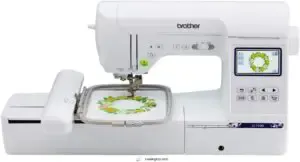
Brother’s SE1900 brings you 138 embroidery designs and a 5 x 7 working field that accommodates everything from quilt labels to decorative blocks.
The 3.2 touchscreen lets you preview and edit designs before stitching—no computer needed for basic work. You’ll get 240 sewing stitches plus automatic threading and tension adjustment.
Import your own designs via USB or stick with the 11 built-in fonts for custom touches. At 22 pounds, it’s light enough to move between workspaces without straining your back.
| Best For | Quilters and home crafters who want to combine everyday sewing with embroidery without buying two separate machines. |
|---|---|
| Built-in Stitches | 240 |
| Embroidery Designs | 138 |
| Display Type | 3.2″ LCD touchscreen |
| Weight | 22 lbs |
| Automatic Needle Threader | Yes |
| Embroidery Field Size | 5″ x 7″ |
| Additional Features |
|
- 138 embroidery designs and 11 fonts built in, plus you can load custom designs through USB
- 5″ x 7″ embroidery area handles most projects, from quilt blocks to personalized gifts
- Touchscreen lets you preview and tweak designs right on the machine
- Extension table sold separately, which is annoying for larger sewing projects
- Needs specific 60-weight bobbin thread for embroidery—can’t just use what you have
- Only works on US voltage (120V), so no taking it overseas
3. Janome Horizon Sewing Machine
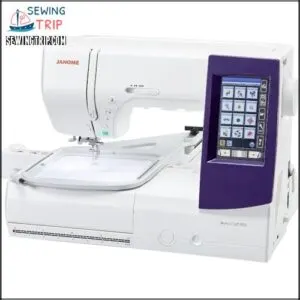
Janome’s Memory Craft 9850 steps up with a serious 6.7 x 7.9 embroidery field—you can tackle larger quilt blocks without re-hooping. The metal frame gives you rock-solid stability while stitching intricate designs.
You’ll find 175 built-in embroidery patterns and a 9mm stitch width for bold decorative work. The color touchscreen makes browsing between your 240 sewing stitches straightforward, though at 23 pounds it’s definitely a stationary setup. Connect a thumb drive to expand your design library beyond what’s already loaded.
| Best For | Intermediate to advanced sewers who want a reliable combo machine for both detailed embroidery work and everyday sewing projects. |
|---|---|
| Built-in Stitches | Various |
| Embroidery Designs | Limited |
| Display Type | Standard |
| Weight | 23 lbs |
| Automatic Needle Threader | No |
| Embroidery Field Size | Various |
| Additional Features |
|
- Large 6.7 x 7.9-inch embroidery area lets you work on bigger designs without constantly re-hooping
- Metal frame keeps everything stable during intricate stitching, plus it runs smooth and quiet
- 175 embroidery patterns and 240 sewing stitches built in, with room to add more via thumb drive
- At 23 pounds, it’s heavy and not easy to move around
- Some users have had trouble with the bobbin case and threading
- Janome-specific accessories can get pricey, and beginners might find it overwhelming
4. EverSewn Sparrow Sewing Embroidery Machine
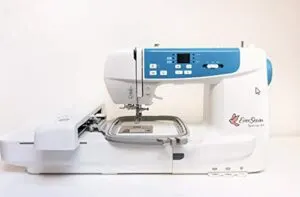
For a lighter alternative, the EverSewn Sparrow X2 weighs just 20 pounds and controls embroidery through your smartphone app. You can monitor stitching progress from another room over its private WiFi network.
Its drop feed function also enables free-motion quilting and embroidery work when you need more creative control.
The 4.75 x 7 embroidery area accommodates hobbyist projects nicely, and it reads standard file formats like PES and DST right from your device. The 6-inch throat space works for quilting, though you’ll need patience learning the app-based workflow—some users report finicky tension.
| Best For | Crafters and beginning embroiderers who want smartphone control and portability without breaking the bank. |
|---|---|
| Built-in Stitches | 103 |
| Embroidery Designs | 80 |
| Display Type | 3.2″ LCD touchscreen |
| Weight | 11.82 lbs |
| Automatic Needle Threader | Yes |
| Embroidery Field Size | 4″ x 4″ |
| Additional Features |
|
- Lightweight at 20 pounds makes it easy to move and store
- Smart device control lets you monitor projects remotely over WiFi
- Reads common embroidery file formats (PES, DST, EXP) directly from your phone
- Some users report tension issues and thread breaking
- Learning curve with the app-based workflow can be frustrating
- Compatibility problems with certain Android devices
5. Brother Sewing And Embroidery Machine
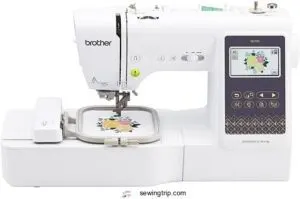
Built-in wireless connectivity puts the Brother SE700 on your desk without tangling cables. You’ll get 135 designs and 10 fonts already loaded, plus a 4 x 4 embroidery field that accommodates monograms and medium blocks comfortably.
The 3.7-inch touchscreen lets you resize and rotate patterns right on the machine, and automatic needle threading saves frustration when you’re switching between sewing and embroidery modes. At 15.6 pounds, it’s portable enough to move between your cutting table and machine cabinet—though that smaller embroidery area won’t fit oversized quilt labels.
| Best For | Crafters who want to add custom embroidery to their sewing projects without investing in a standalone embroidery machine. |
|---|---|
| Built-in Stitches | 120+ |
| Embroidery Designs | 100+ |
| Display Type | Smart device control |
| Weight | 20 lbs |
| Automatic Needle Threader | Yes |
| Embroidery Field Size | 4.75″ x 7″ |
| Additional Features |
|
- Wireless connectivity makes it easy to send designs from your phone or computer directly to the machine
- Automatic needle threader eliminates one of the most frustrating parts of setup
- Touchscreen interface lets you edit designs without switching to a computer
- 4″ x 4″ embroidery area is too small for larger projects like quilt backs or jacket designs
- Threading system can be temperamental and may require multiple attempts
- You’ll need to budget extra for threads, needles, and pattern software beyond what’s included
Essential Features for Quilting and Embroidery
A combo machine needs specific quilting features to handle large fabric layers and intricate piecing work.
The embroidery side requires its own set of capabilities, but the sewing functions matter just as much for quilters. Let’s look at the essential features that make a combo machine actually work for serious quilting projects.
Throat Space and Flatbed Stability
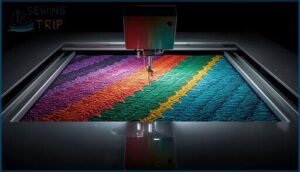
When you’re wrestling a queen-size quilt through tight quarters, throat space becomes your best friend.
Most combo sewing and embroidery machines offer six to nine inches—enough room to maneuver large blocks without fabric bunching around the needle.
Pair that with a rigid flatbed design and optional bed extensions, and you’ll keep your embroidery field stable while guiding heavy layers smoothly across the plate.
Dropping Feed Dogs
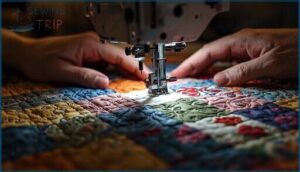
Drop feed is your gateway to free motion control on any combo machine. When you lower those metal teeth beneath the plate, you take over fabric guidance completely—no automatic pulling, just your hands steering every stitch.
That manual stitching freedom lets you trace intricate quilting patterns or dense embroidery fills without the machine wrestling the layers. It’s the difference between following the machine and leading it.
Drop the feed dogs and you lead the machine—not the other way around
For more information on the benefits and technique, see this guide to manual control over fabric movement.
Extendable Table Options
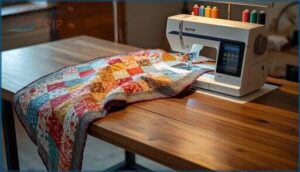
Extra table area transforms how you handle large quilt tops during embroidery field alignment. Look for leaf storage options that slide out smoothly—some combo sewing and embroidery machines offer butterfly or drop-leaf styles with locking pins for stability features.
Match aesthetic finishes to your workspace, but prioritize sturdy metal reinforcement underneath. That expanded surface keeps fabric flat while you switch between quilting and embroidery tasks.
Knee Lifter Functions
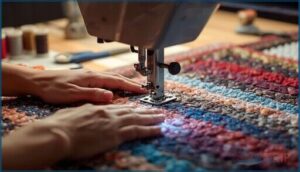
A knee lifter is your third hand when you’re pivoting corners or repositioning layers—it raises the presser foot without you touching anything. Here’s why knee lifter basics matter on combo machines for quilting and embroidery:
- Presser foot control keeps both hands steady on fabric during complex piecing.
- Quilting efficiency jumps when you eliminate repetitive hand movements.
- Fabric management improves with hover-lift features that prevent drag.
- Knee lift mechanism adjustability lets you handle varying thicknesses.
- Sewing embroidery combo machines often include it as standard or add-on.
For a deeper look at the advantages, see how hands-free presser foot control increases sewing efficiency and precision.
Stitch Variety and Quality
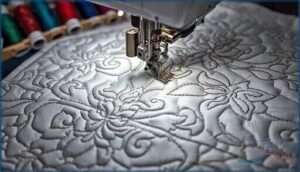
Stitch variety unlocks embroidery designs and quilting stitches that turn your vision into reality. Higher stitch density builds seams that withstand years of use while maintaining fabric support—less puckering, sharper edges. Thread quality determines whether metallic or rayon threads glide smoothly through machine embroidery for quilting. Stitch precision separates beginner fills from professional satin stitches and backstitch borders.
Your combo machine should offer embroidery techniques that balance density, speed, and reliability across every project.
| Stitch Type | Primary Use | Density Impact |
|---|---|---|
| Satin Stitch | Lettering & logos | High density, smooth fills |
| Running Stitch | Outlines & quick motifs | Low fabric impact |
| Fill Stitch | Large area coverage | Controlled density prevents bunching |
| Backstitch | Appliqué corners | Strong, defined edges |
Key Embroidery Capabilities to Consider
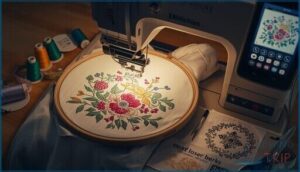
Once you’ve nailed down the sewing essentials, it’s time to focus on what sets embroidery machines apart from their standard cousins.
The embroidery side of your combo machine determines how creative you can get with individual quilt labels, custom blocks, and decorative stitching. Let’s look at the key capabilities that’ll make or break your embroidery experience.
Embroidery Field Size
Your embroidery field size determines what you can actually stitch in one pass—think of it as your creative canvas. Most combo sewing and embroidery machines offer fields ranging from 4×4 to 8×12 inches, directly affecting design scaling and embroidery accuracy.
Here’s what field size limits mean for your machine embroidery for quilting:
- 4×4 inch fields handle monograms and small motifs perfectly
- 5×7 inch fields suit decorative borders and logos with better stitch density
- 6×10 inch fields work beautifully for medium quilt blocks
- 8×8 inch fields let you tackle larger embellishments without repositioning
Hoop selection matters because your actual stitching area runs slightly smaller than the hoop name suggests—a 5×7 hoop usually yields about 5×7 inches of usable embroidery field. For designs exceeding your field, you’ll divide motifs into sections and align them carefully during assembly, though this affects embroidery accuracy. Larger fields give you freedom but demand rock-solid stabilizer to prevent hoop shift and maintain consistent stitch density across the entire design.
Built-in Designs and Fonts
Once you’ve mastered field size, the next power move is exploring what’s already waiting inside your combo machine—those built-in designs and embroidery patterns you can stitch immediately. Most quilting and embroidery machines ship with 80 to 175 embroidery designs spanning florals, geometrics, and seasonal motifs, plus multiple font styles for custom letters and monogram options.
| Design Category | Typical Count | Best For |
|---|---|---|
| Embroidery Motifs | 50–120 designs | Quilt blocks, borders |
| Font Styles | 5–15 alphabets | Labels, personalization |
| Monogram Options | 3–8 arrangements | Heirloom projects |
These libraries give you instant creative freedom without design import hassles—perfect for testing your embroidery patterns before investing in external files.
Design Import Methods
You’ll want to pull in fresh embroidery designs beyond your built-in library—and sewing embroidery combo machines offer five solid routes.
USB transfers and card readers handle DST or PES files up to 100 MB fast. PC connectivity uses cables or wireless connectivity for direct sends.
Cloud sync pulls updates automatically. Built-in embroidery software lets you tweak designs on-screen before stitching. Pick the method that fits your workflow!
Switching Between Sewing and Embroidery
Once you’ve imported designs, mode shift on sewing embroidery combo machines demands four deliberate steps:
- Swap your presser foot for the embroidery foot and select embroidery mode
- Rethread with finer embroidery thread and adjust tension settings
- Hoop your fabric with proper stabilizer choice for stitch support
- Switch to an embroidery needle to prevent fabric perforation
Master these shifts, and your combo machines will handle anything!
Benefits of Combo Machines for Quilters
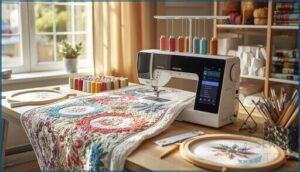
If you’re wondering whether a combo machine is worth the investment, the answer hinges on what you actually need in your workspace. These machines aren’t just convenient—they fundamentally change how you approach your quilting projects.
Let’s look at the real-world advantages that make combo machines such a smart choice for serious quilters.
Space and Cost Savings
Combo machines shrink your footprint by replacing two units with one compact design—freeing 20 to 40 percent of floor space depending on your model.
You’ll pocket serious budget savings too, cutting upfront costs by 15 to 40 percent compared to buying separate sewing embroidery machines.
Energy efficiency adds up monthly, since shared power supplies draw less electricity than dual setups, lowering your utility bills while you stitch.
Versatility for Multiple Projects
Multi tasking reaches a new level when you switch sewing modes to embroidery options mid-project—no second machine required. One afternoon you’ll piece a scrappy nine-patch, the next you’ll stitch monograms onto quilt labels, all without moving your workspace.
- Tackle garment mending, home décor, and heirloom quilts without investing in separate quilting machines
- Jump from straight stitching to dense satin borders in seconds, expanding your quilt customization toolkit
- Explore appliqué, free-motion work, and digitized motifs on the same combo sewing and embroidery machines
Enhanced Efficiency and Workflow
Often you’ll notice efficient production kicks in the moment you combine quilting and embroidery in one workspace. Automated tasks like thread trimming and auto-tie-off free up your hands, letting you focus on creative decisions rather than machine babysitting.
Workflow optimization means switching from piecing to monogramming without unplugging or relocating—sewing embroidery machine reviews consistently highlight how this setup boosts your daily output.
Access to Advanced Features
Premium combo sewing machines bring capabilities you won’t find on basic models. Firmware updates install fresh design libraries and improved hoop technology without buying new gear.
Thread management systems trim jumps automatically, while stitch precision adjustments let you nail sub-millimeter alignment on repeat blocks. Design importing through USB or Wi-Fi connects you to thousands of patterns, transforming computerized embroidery from guesswork into predictable artistry every time you hoop up.
Choosing The Right Combo Machine
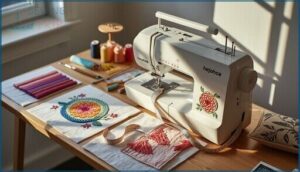
You’ve seen the features that matter, and now it’s time to match them to your reality.
The perfect combo machine depends on your budget, the types of quilts you create, and how much support you’ll need along the way.
Let’s break down the practical considerations that’ll guide you to the right choice.
Evaluating Machine Pricing
You don’t need to drain your savings for a solid machine. Entry-level combos run $600–$1,200, while mid-range models hit $1,200–$2,200 and high-end machines top $3,000.
Smart budget planning means watching for seasonal discounts—10 to 20 percent off isn’t rare. Check sewing machine reviews and embroidery machine comparison sites for price comparison and cost analysis. Don’t skip warranty costs in your calculations!
Assessing Personal Project Needs
Before you dive into sewing and embroidery machine reviews, map your creative territory. Goal setting starts with honest skill assessment—what techniques do you already own versus what you need to learn? Material selection follows naturally once you know your project scope.
Effective time management and project planning will help you choose between basic combo sewing and embroidery machines or feature-rich quilting and embroidery models:
- Define your exact quilting machine output for the next month with concrete product descriptions
- List three specific constraints like fabric type and thread brand that matter for your work
- Write down your top priorities—speed, accuracy, or design complexity—in order
- Identify whether you’re creating for gifts, sales, or skill building
- Note any event dates driving your timeline and milestones
Researching Reviews and Support
Once you’ve mapped your creative goals, customer feedback becomes your compass. Pull sewing and embroidery machine reviews from at least three independent sources—check user forums for real talk about thread jams and bobbin quirks. Review analysis reveals which support channels actually respond: live chat within five minutes beats waiting days for email.
Sewing classes and workshops hosted by brands signal genuine crafting community and resources beyond the sale.
| Support Type | Response Time | Best For |
|---|---|---|
| Live Chat | 5 minutes weekdays | Quick troubleshooting |
| Email Support | Within 24 hours | Non-urgent questions |
| Phone Support | Immediate callback | Complex technical issues |
Warranty and After-Sales Service
Strong customer support turns your combo machines from expensive paperweights into long-term creative partners. Most quilting and embroidery units ship with tiered warranty terms—Brother usually offers 1 year full coverage, 5 years on circuit boards, and 25 years on the chassis.
Here’s what matters:
- Service Centers: Locate authorized repair centers near you before buying your sewing and embroidery machine
- Repair Costs: After year one, you’ll pay labor fees even when parts remain covered
- Maintenance Schedules: Keep receipts—warranty claims require original purchase proof from authorized dealers
Frequently Asked Questions (FAQs)
Can you use an Embroidery Machine to make a quilt?
Yes, you can create quilt designs with embroidery patterns using machine embroidery. Embroidery machines stitch decorative blocks, custom labels, and edge-to-edge quilting techniques.
However, fabric selection and quilting require traditional sewing functions too.
What is the difference between a quilting machine and an Embroidery Machine?
Quilting machines handle thick fabric layers with wider throat space for large projects, while embroidery machines use computerized motion systems for precise decorative stitching within a smaller embroidery field on hooped fabric.
Can an embroidery machine be used for quilting?
Think of it as hitting two birds with one stone—your embroidery machine processes decorative quilting stitches through layered fabric.
Just guarantee adequate throat space, a stable flatbed, and compatible quilting-specific embroidery designs for best stitch precision.
What is the difference between a quilting machine and an embroidery machine?
The main split comes down to purpose and workflow differences.
Quilting machines handle thick layers and long stitching passes, while embroidery machines stabilize fabric in hoops for precise design placement using digitized files.
Is machine embroidery an expensive hobby?
Machine embroidery demands Initial Costs of $600–$8,000 for equipment plus Ongoing Expenses in thread and stabilizers.
Material Waste and Time Investment raise Hobby Budgeting needs, though selling finished Embroidery Designs can offset some expenses.
Can you free motion quilt with an embroidery machine?
Yes, you can free motion quilt on many embroidery machines by dropping the feed dogs and switching to a darning foot.
Throat space and machine setup determine how much fabric you can maneuver comfortably.
How often should I clean my combo machine?
Clean your combo machines after every project—wipe surfaces weekly and deep-clean monthly.
Check user manuals for machine lubrication schedules. Regular maintenance schedules with proper cleaning tools prevent errors and keep sewing machine technology running smoothly.
Can I use regular thread for embroidery projects?
You can substitute regular sewing thread for embroidery, but expect lighter coverage and possible tension hiccups.
Polyester embroidery thread delivers richer color and better durability—always test your fabric compatibility first!
What stabilizers work best for quilting embroidery?
Stabilizer types depend on your fabric selection and embroidery designs.
Cut-away works for dense quilting stitches, tear-away suits tightly woven quilts, and water-soluble dissolves completely—perfect for delicate embroidery field work.
Do combo machines require special needles for embroidery?
Most combo machines perform beautifully with standard embroidery needle types designed for larger thread eyes.
Match needle sizes to your fabric selection and thread compatibility, then calibrate machine tension for impeccable embroidery designs.
Conclusion
The smallest investment often unlocks the biggest creative freedom—that’s the paradox of owning a quilting embroidery machine combo. Instead of juggling two separate tools, you’re mastering one adaptable workhorse that stitches binding seams and monograms wedding quilts without missing a beat.
Your studio stays uncluttered, your workflow stays smooth, and your projects stay ambitious. Match throat space to your quilting scale, prioritize embroidery field size for your designs, and you’ll never outgrow what you build.