This site is supported by our readers. We may earn a commission, at no cost to you, if you purchase through links.
Walk into almost any active guild space and you’ll spot the same bottleneck: six students, two machines, and a project deadline that doesn’t care about the math. Choosing the right quilting machines for community classes isn’t just a budget decision—it’s a workflow decision that shapes how fast beginners build confidence and how often experienced members hit their creative stride.
The wrong machine stalls a whole table. The right one disappears into the background, letting the work take center stage.
From throat space to stitch regulation to oiling schedules, the specs that look minor in a solo studio become critical when a machine runs six hours straight under rotating hands.
Table Of Contents
- Key Takeaways
- Top 10 Quilting Machines for Community Classes
- 1. Juki HZL F600 Computerized Sewing Quilting Machine
- 2. Brother High Speed Sewing Machine
- 3. Singer Quantum Stylist 9960 Sewing Machine
- 4. Brother XR3774 Sewing and Quilting Machine
- 5. Juki TL2000Qi Quilting Sewing Machine
- 6. Janome MC6650 Sewing and Quilting Machine
- 7. Bernette B77 Sewing Quilting Machine
- 8. Brother XR9550 Sewing and Quilting Machine
- 9. Singer 7285Q Quilting Sewing Machine
- 10. Brother CS7000X Sewing and Quilting Machine
- Longarm Vs Midarm Vs Domestic: Which Fits Your Class?
- Key Specs That Matter for Shared Quilting Machines
- Automation Features That Simplify Classroom Workflows
- Budget Planning for Community Class Equipment
- Maintenance Best Practices for Heavily Used Guild Machines
- Teaching Safe Machine Operation in Quilting Classes
- Warranty and Brand Support for Guild Purchases
- Community Access Models for Quilting Class Programs
- Frequently Asked Questions (FAQs)
- Conclusion
Key Takeaways
- Matching your machine type to class size matters more than brand—domestic tabletops work for small beginner groups, midarms handle mid-size guilds, and longarms are worth the investment only when you’ve got the space and experienced quilters to fill it.
- Throat space, motor stamina, and frame construction aren’t minor specs—they’re the difference between a machine that runs six hours straight and one that stalls your whole class by lunch.
- Automation features like speed sliders, drop-in bobbins, and automatic needle threaders don’t just save time—they keep beginners focused on quilting instead of troubleshooting setup problems.
- Total cost of ownership goes well beyond the sticker price—factor in annual maintenance ($175+), needle and bobbin replacements, service contracts, and whether an authorized repair center is actually nearby before you commit.
Top 10 Quilting Machines for Community Classes
Not every quilting machine can handle the demands of a shared classroom—heavy use, mixed skill levels, and long stitching sessions separate the reliable workhorses from the ones that collect dust. These ten machines consistently deliver the throat space, motor strength, and stitch control that community classes actually need.
Each model on our list also features a reliable quilting machine thread cutter that holds up through back-to-back class sessions without skipping a beat.
Here’s what made the cut.
1. Juki HZL F600 Computerized Sewing Quilting Machine
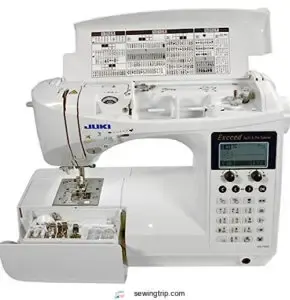
The Juki HZL-F600 is a solid anchor machine for any community class setup.
It runs 255 built-in stitches, a 7-point box feed system, and tops out at 900 stitches per minute — enough variety for beginners while still satisfying more experienced quilters.
The box feed keeps fabric moving evenly across layers, which matters when students are juggling quilt sandwiches.
Dual LED lighting, automatic needle threading, and a full-color LCD make it genuinely easy to pick up.
At $1,495, it’s a real investment — but built to last.
| Best For | Home sewers and quilters who want a feature-rich, reliable machine that can handle everything from everyday garments to large quilting projects without constantly hitting its limits. |
|---|---|
| Automatic Needle Threader | Yes |
| Extension Table | Removable |
| Stitch Count | 255 |
| Weight | ~30 lb |
| LCD Screen | Yes |
| Quilting Capability | Yes |
| Additional Features |
|
- 255 built-in stitches, automatic needle threading, and a color LCD make setup fast and stitch selection genuinely simple — great for both beginners and experienced sewers.
- The large work surface and removable extension table give you real room to maneuver big projects like king-size quilts without fighting the machine.
- Dual LED lighting and low noise operation make long sewing sessions a lot more comfortable.
- At $1,495, it’s a serious investment — probably overkill if you only sew occasionally.
- Struggles with very thick fabrics like multiple denim layers, and the presser foot lift doesn’t always lock down the way it should.
- A few users have run into mechanical hiccups — things like auto-threader failure and needle-holder screw breakage after several months of regular use.
2. Brother High Speed Sewing Machine
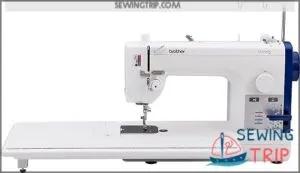
If the Juki HZL-F600 is your class workhorse, the Brother PQ1600S is its speed-focused counterpart.
It hits 1,500 stitches per minute — straight stitch only, but fast and precise. The 11.1" × 23.3" table gives students real room to manage larger quilt sections, and the built-in knee lifter frees both hands while sewing.
Feed-dog control across four color-coded levels keeps layers moving together without guesswork.
At $999.99, it’s a focused machine — built for quilters who know exactly what they need.
| Best For | Serious quilters and sewists who work on large projects and need speed, precision, and room to move. |
|---|---|
| Automatic Needle Threader | Yes |
| Extension Table | Extra Large |
| Stitch Count | N/A |
| Weight | 24 lb |
| LCD Screen | No |
| Quilting Capability | Yes |
| Additional Features |
|
- Blazing fast at 1,500 stitches per minute — great for getting through big projects without losing your mind
- The extra-large workspace makes handling quilts and weighted blankets so much easier
- Built-in knee lifter keeps both hands free while you sew, which is a genuine game changer for quilting
- Side-loading bobbin doesn’t warn you when thread runs out, so you might sew a few inches of nothing
- The needle threader and top tension dial can be frustrating, especially at first
- Not a beginner machine — if you’re just starting out, this one will likely overwhelm you
3. Singer Quantum Stylist 9960 Sewing Machine
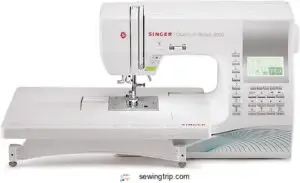
Where the Brother PQ1600S keeps things simple, the Singer Quantum Stylist 9960 swings the other way — 600 built-in stitches, 13 buttonhole styles, and 5 alphanumeric fonts for labeling and personalizing class projects.
Its LCD screen makes stitch selection quick, and the adjustable speed slider lets beginners set a safe ceiling before they build confidence.
At 850 spm with a 6.4-inch throat, it won’t handle king-size quilts — but for mixed-skill classes, it covers a lot of ground.
| Best For | Mixed-skill classrooms and hobbyists who want plenty of stitch variety without stepping into commercial-grade territory. |
|---|---|
| Automatic Needle Threader | Yes |
| Extension Table | Included |
| Stitch Count | 600 |
| Weight | 14.6 lb |
| LCD Screen | Yes |
| Quilting Capability | Yes |
| Additional Features |
|
- 600 stitches and 13 buttonhole styles give you serious creative range for quilting, fashion, and home décor projects
- The adjustable speed slider is a lifesaver for beginners — set a comfortable pace and build from there
- Time-savers like the automatic needle threader and top drop-in bobbin keep frustration low and sewing time high
- The throat plate runs small, so large quilting projects can feel cramped pretty quickly
- 90 days of full warranty coverage is short — you’ll want to register and understand what the 2-year and 25-year tiers actually cover
- There’s a real learning curve here; with 600 stitches and multiple features, the manual isn’t optional
4. Brother XR3774 Sewing and Quilting Machine
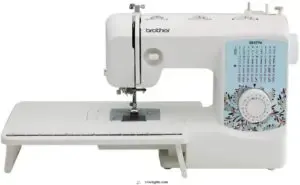
If your class budget is tight, the XR3774 punches above its price tag. It’s compact — 15.3 inches wide, 15 pounds — so it fits smaller classroom setups without crowding the table.
You get 37 built-in stitches, an automatic needle threader, and a jam-resistant drop-in bobbin — exactly the features that reduce frustration for beginners.
The included walking foot and wide extension table handle basic quilting layers well.
It’s not flashy, but for entry-level group classes, it gets the job done reliably.
| Best For | Beginners and hobbyists who want a reliable, affordable machine for clothing, quilting, and everyday sewing projects without a steep learning curve. |
|---|---|
| Automatic Needle Threader | Yes |
| Extension Table | Wide |
| Stitch Count | 37 |
| Weight | 15 lb |
| LCD Screen | No |
| Quilting Capability | Yes |
| Additional Features |
|
- 37 built-in stitches plus a walking foot make it genuinely useful for quilting, not just basic sewing
- The automatic needle threader and jam-resistant bobbin save a lot of frustration for newer sewers
- Compact and light enough to move around, but still handles larger projects with the extension table
- Runs louder and vibrates more than pricier machines, especially at higher speeds
- Struggles with heavy fabrics like thick fleece or minky — not the best pick for plush projects
- The needle threader can get finicky over time, and the short foot controller cord limits where you can set it up
5. Juki TL2000Qi Quilting Sewing Machine
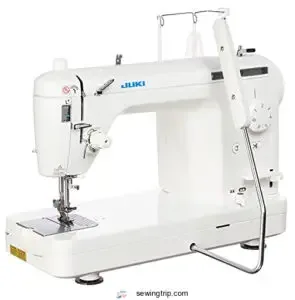
When your class needs speed without complexity, the TL2000Qi delivers. It runs at 1,500 stitches per minute — fast enough for serious quilting sessions — yet stays focused on one thing: straight‑stitch precision.
The aluminum die‑cast frame keeps vibration low, so even all‑day use won’t rattle your seams loose.
You get an automatic needle threader, built‑in thread cutter, and a 23‑inch extension table for maneuvering large quilt tops.
It requires oiling after each use, but that’s a fair trade for this level of reliability.
| Best For | Quilters and sewists who want a fast, no-fuss straight-stitch machine built to handle heavy layers, thick batting, and long quilting sessions. |
|---|---|
| Automatic Needle Threader | Yes |
| Extension Table | Included |
| Stitch Count | N/A |
| Weight | 25.4 lb |
| LCD Screen | No |
| Quilting Capability | Yes |
| Additional Features |
|
- Screams through fabric at 1,500 SPM — great for serious quilting without the wait
- Aluminum die-cast frame keeps things steady and quiet, even during long projects
- Automatic needle threader and thread cutter save time and frustration
- Straight stitch only — if you need decorative or utility stitches, look elsewhere
- Needs oiling after every use, which adds a maintenance step most modern machines skip
- The included walking foot lacks a quilting bar, so you may need to buy extras
6. Janome MC6650 Sewing and Quilting Machine
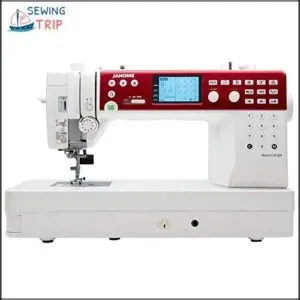
If versatility is what your class is after, the Janome MC6650 earns its spot.
The all-metal 10-inch flatbed manages everything from light denim to layered quilt sandwiches—without the wobble.
You get 172 built-in stitches, 9 one-step buttonholes, and a 3.6-inch LCD screen that keeps navigation simple mid-class.
The automatic thread cutter and needle threader cut setup time considerably.
At 1,000 spm with a speed control slider, beginners stay comfortable while experienced students push the pace.
| Best For | Sewing instructors and serious hobbyists who need a durable, feature-rich machine that works for beginners and advanced students alike. |
|---|---|
| Automatic Needle Threader | Yes |
| Extension Table | Included |
| Stitch Count | 172 |
| Weight | 24.25 lb |
| LCD Screen | Yes |
| Quilting Capability | Yes |
| Additional Features |
|
- Massive 10-inch throat space handles quilts, thick layers, and mid-weight fabrics with ease
- 172 stitches plus an LCD screen and auto-threader make it genuinely easy to jump in and start sewing
- Speed control slider lets total beginners go slow while experienced sewers open it up
- Some users have run into stitch skipping, thread-cutter failures, and motor lock-ups that needed a service call
- At 24 lbs, it’s not something you’re hauling to a class or craft fair without planning ahead
- The instruction manual is thin, so self-teaching certain features takes more trial and error than it should
7. Bernette B77 Sewing Quilting Machine
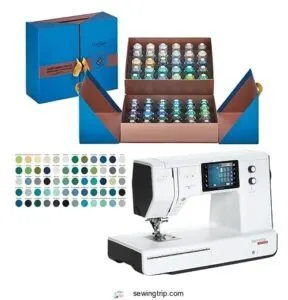
The Bernette B77 brings serious touchscreen control to a class setting — a 5‑inch color display lets students navigate 500 stitches without fumbling through menus. Its Dual Feed system keeps quilt layers moving evenly, top and bottom, which means fewer frustrated students fighting fabric drift.
You get 230mm of throat space, a slide‑on extension table, and 35 dedicated quilting stitches.
One honest note: tension is manual, so build that skill into your lesson plan early.
| Best For | Quilters and sewists of all skill levels who want a feature-rich machine that handles everything from delicate chiffon to heavier projects like leather and multi-layer quilts. |
|---|---|
| Automatic Needle Threader | Yes |
| Extension Table | Extended |
| Stitch Count | N/A |
| Weight | N/A |
| LCD Screen | Yes |
| Quilting Capability | Yes |
| Additional Features |
|
- The dual-feed system keeps multiple fabric layers moving together smoothly, so your seams stay straight and even
- A big throat area plus the extended work table gives you plenty of room to maneuver large quilts without wrestling with the fabric
- Automated thread cutter, needle-threader, and buttonhole stitches save time and cut down on the fiddly stuff
- No automatic thread tension, so you’ll be adjusting it manually — and it can be hit or miss
- Some users have run into mechanical issues like motor errors and the auto needle-threader giving out after a few months
- Customer support can be slow to respond, which is frustrating if something goes wrong and you need help fast
8. Brother XR9550 Sewing and Quilting Machine
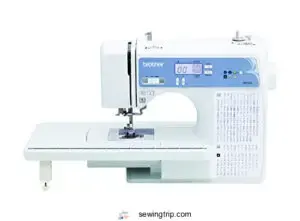
At $269.99, the Brother XR9550 punches well above its price tag for community classes on a tight budget.
You get 165 built-in stitches, a drop-in jam-resistant bobbin, and an automatic needle threader — three features that cut setup time and keep beginners focused on stitching, not troubleshooting.
The drop feed allows free-motion quilting, and the wide table accommodates larger quilt sections comfortably.
It weighs just over 10 pounds and includes a hard case, so moving it between rooms is genuinely painless.
| Best For | Beginners and intermediate sewers who want a versatile, easy-to-use machine for garments, quilting projects, and community classes without breaking the bank. |
|---|---|
| Automatic Needle Threader | Yes |
| Extension Table | Wide |
| Stitch Count | 165 |
| Weight | 10.1 lb |
| LCD Screen | Yes |
| Quilting Capability | Yes |
| Additional Features |
|
- 165 built-in stitches plus drop feed for free-motion quilting gives you a lot of creative room at this price point
- Automatic needle threader and drop-in bobbin make setup quick and frustration-free
- Lightweight at 10 pounds with a hard case included — easy to carry to a class or move around the house
- Won’t keep up with advanced sewers who need more robust, heavy-duty features
- The hard plastic cover has been known to fit poorly, which is annoying for something meant to protect the machine
- Warranty is void outside the US or on non-120V power, so it’s not a great travel companion internationally.
9. Singer 7285Q Quilting Sewing Machine
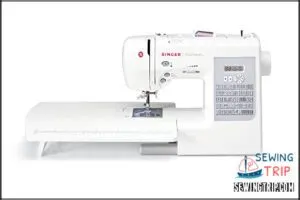
The Singer 7285Q brings a lot to the table for a domestic machine in its range.
You get 100 built-in stitches — including 15 quilting-specific patterns — plus programmable needle up/down, a speed control lever, and a start/stop button that works without a foot pedal. That reduces fatigue in longer class sessions.
The 5.5-inch throat fits piecing and binding work comfortably, and the included extension table accommodates larger quilt tops. Just note the plastic bobbin basket — it’s the one part worth watching under heavy shared use.
| Best For | Quilters of all skill levels who want an easy-to-use machine with plenty of stitch options and built-in features that cut down on setup time. |
|---|---|
| Automatic Needle Threader | Yes |
| Extension Table | Included |
| Stitch Count | 100 |
| Weight | 7.14 kg |
| LCD Screen | No |
| Quilting Capability | Yes |
| Additional Features |
|
- 100 built-in stitches including 15 quilting-specific patterns, so you’re covered for everything from basic piecing to decorative top-stitching
- Start/stop button and speed control let you sew without a foot pedal, which is a real relief during long sessions
- Comes with an extension table and four quilting presser feet right out of the box — no hunting for extras
- No feed-dog lowering switch, so free-motion quilting requires a separate cover plate
- The plastic bobbin basket has a reputation for breaking or causing thread jams under heavy use
- Error code C4 issues have been reported, and getting manufacturer support can be a frustrating experience
10. Brother CS7000X Sewing and Quilting Machine
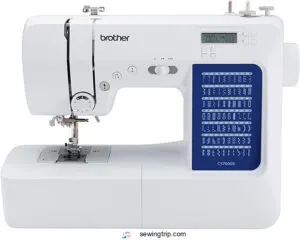
The Brother CS7000X is the kind of machine that earns its spot on a shared class table.
It packs 70 built-in stitches — utility, decorative, quilting, and heirloom — into a 14-pound metal frame that manages denim and thick quilt layers without fuss.
The automatic needle threader, drop-in bobbin, and LCD stitch guide keep setup time short.
You also get a detachable wide table, 10 presser feet, and a 25-year chassis warranty — solid value for any community program.
| Best For | Beginners and intermediate sewists who want a reliable, feature-packed machine for garment sewing, quilting, and classroom use. |
|---|---|
| Automatic Needle Threader | Yes |
| Extension Table | Detachable |
| Stitch Count | 70 |
| Weight | ~14 lb |
| LCD Screen | Yes |
| Quilting Capability | Yes |
| Additional Features |
|
- 70 built-in stitches plus 7 auto-size buttonholes cover everything from basic hems to decorative heirloom work
- Automatic needle threader, drop-in bobbin, and LCD stitch guide make setup quick and beginner-friendly
- Metal frame with detachable wide table handles heavy fabrics and larger quilting projects with ease
- Only works with U.S. 120V outlets — international users need a transformer or adapter
- Fixed needle bar limits some free-motion quilting techniques
- The automatic bobbin-threading system can feel unintuitive, and some users still prefer threading it manually
Longarm Vs Midarm Vs Domestic: Which Fits Your Class?
Not every machine fits every classroom—the gap between a longarm and a domestic tabletop is bigger than you might think.
The right choice comes down to your space, your budget, and who’s sitting at the machine.
Here’s how each type stacks up for community class use.
Longarm Machines for Large Guild Spaces
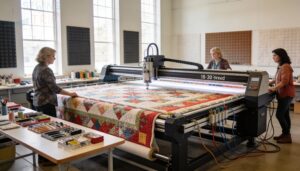
A true longarm machine changes everything for a large guild. Throat spaces run 18 to 30 inches — enough to move a king-size quilt without constant rolling. Frame stability matters too; 10-to-14-foot frames need deliberate Guild Layout Integration, solid Power Distribution Planning, and Noise Reduction Strategies to stay functional all day. The machine also features a 4.3‑inch color touchscreen for easy-to-use control.
| Feature | Spec Range | Guild Benefit |
|---|---|---|
| Throat Space | 18–30 inches | Controls full king-size layers |
| Frame Length | 10–14 feet | Facilitates oversized guild projects |
| Stitch Speed | Up to 3,500 SPM | Powers all-day class sessions |
| Operator Positioning | Front/back controls | Fits multiple quilters ergonomically |
| Automation Features | Thread sensors, regulated mode | Cuts downtime between users |
Extended Table Accessories and clear Operator Positioning Guidelines keep sessions running smoothly.
Midarm Machines for Balanced Space and Budget
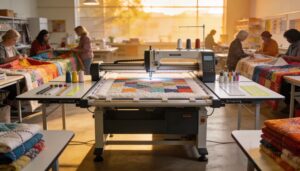
Not every guild has room — or budget — for a full longarm setup. That’s where midarm machines earn their place. With 15 to 22 inches of throat space and a cost-effective frame starting around $1,000, they handle most shared machine needs without the footprint.
| Feature | Midarm Spec | Class Benefit |
|---|---|---|
| Throat Space | 15–22 inches | Moves bulky quilt layers freely |
| Speed | 1,500–2,000 SPM | Steady pace for free quilting workshops and classes |
| Price Range | $1,000–$5,000 | Budget-friendly for community programs |
Modular extension tables, quick change accessories, energy efficient motors, and noise reduction design make midarms practical for busy shared spaces.
Domestic Tabletop Machines for Smaller Classrooms
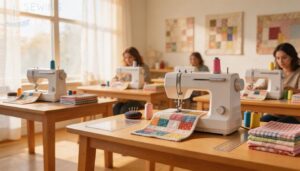
Domestic models are the sweet spot for smaller classrooms — compact footprint, easy portability, and a budget that won’t drain your guild funds. Throat space runs 6–10 inches, which accommodates lap quilts and blocks just fine.
| Feature | Spec |
|---|---|
| Speed Capabilities | 750–1,000 SPM |
| Adjustable Tension | Standard on most models |
| Multi-Function Feet | Walking foot, quilting foot included |
Quiet operation keeps instruction audible. Tabletop machines sit on any standard table — no dedicated floor space needed.
Matching Machine Type to Class Size and Skill Level
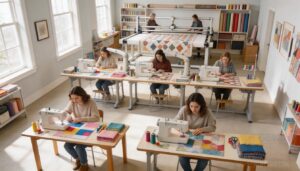
Matching your machine to your class isn’t guesswork — it’s a Space Allocation Strategy paired with Skill Tier Matching.
| Class Profile | Best Fit |
|---|---|
| Small beginner group | Domestic tabletop |
| Mid-size intermediate guild | Mid-arm |
| Large experienced program | Longarm |
Project Scale Compatibility drives the decision. Beginners need simple controls; experienced quilters need throat space. Match both, and your Equipment Utilization Ratio stays high.
Key Specs That Matter for Shared Quilting Machines
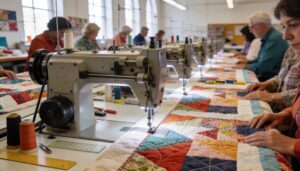
Not every quilting machine holds up when a dozen people use it week after week — and specs are where you separate the reliable ones from the ones that’ll frustrate your class by lunch. Throat space, motor strength, frame construction, and stitch regulation are the four things worth scrutinizing before you spend a dollar.
Here’s what each one actually means for a shared classroom setting.
Why Throat Space Determines Quilt Size Capacity
Throat space is the single measurement that decides what your class can actually quilt. Throat Width Limits shape every project choice — from small lap quilts to king-size quilts.
- 5–6 in. – baby/lap quilts; Quilt Bulk Management becomes a wrestling match beyond 50×60 in.
- 7–9 in. – twin/full; queen-size quilts need constant repositioning.
- 10–12 in. – queen-size quilts flow easily; king-size quilts manageable with breaks.
- 14–18 in. – large throat space eliminates Free-Motion Constraints; Ergonomic Hand Positioning stays neutral all session.
Match Maximum Quilt Dimensions to your class projects using quilt size recommendations and throat requirements before buying.
Motor Power and Stitch Consistency for All-Day Use
Motor stamina matters more than top speed when your shared machine runs all day. A 1.0–1.5 A motor with solid Motor Torque Capacity pushes through denim, batting stacks, and seam intersections without bogging down — that’s your Continuous Duty Cycle doing its job.
Stitch Length Uniformity depends on Power Supply Stability and Motor Heat Management, staying steady session after session.
| Spec | What to Look For |
|---|---|
| Motor power | 1.0–1.5 A for all-day use |
| Stitch consistency | 600–3,500 SPM regulated range |
Heavy duty all-metal construction keeps stitch consistency locked even under load.
Frame Construction and Vibration Dampening for Durability
Frame material shapes how long your shared machine holds up under daily punishment. Steel Frame Rigidity manages repeated stress without flexing — Aluminum Weight Savings keeps setups lighter for shared classroom moves. Composite Material Balance splits the difference on stiffness and weight.
Look for these durability markers in any metal frame or heavy duty all-metal construction:
- Steel rails that resist bending under full quilt loads
- Rubber Vibration Pads under frame legs to cut floor noise
- Adjustable Height Stability for leveling across uneven surfaces
- Frame-mounted carriage alignment that stays true session after session
- Tight-jointed composites where full steel isn’t practical
Stitch Regulation Range for Varied Quilting Speeds
Stitch regulation is what separates a machine that teaches from one that frustrates.
Most regulated systems handle 2 to 22 SPI Density Control, giving you room to run bold edge-to-edge patterns or tight micro detail.
Cruise Precision Modes, Speed Matching Mechanics, and Manual Speed Mode all affect Stitch Consistency Calibration differently.
| Mode | Best Use |
|---|---|
| Cruise Precision Modes | Flowing, continuous designs |
| Manual Speed Mode | Beginner hand-paced control |
| Speed Matching Mechanics | Direction changes, sharp turns |
Automation Features That Simplify Classroom Workflows
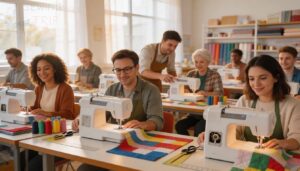
The right automation features don’t just save time — they keep beginners from getting frustrated before they even start sewing. When a machine manages the tedious steps on its own, your class can spend more time actually quilting.
Here are four automation features worth looking for in any shared classroom machine.
Automatic Needle Threaders and Drop-in Bobbin Systems
Two features make shared equipment dramatically easier to manage: automatic needle threaders and drop-in bobbins.
- Automatic needle threaders deliver a real Student Confidence Boost—less squinting, faster starts.
- Bobbin Path Clarity from top-loading designs helps beginners see exactly how thread feeds.
- Quick Thread Loading cuts setup time between students.
- Eye-Protection Benefits reduce strain during repeated Threader Adjustment across long class sessions.
Drop-in bobbins simplify your maintenance schedule too—lint checks take seconds.
Speed Sliders for Beginner-Friendly Operation
Speed sliders are one of those small features that make a big difference in the classroom. Slider Basics are simple: the adjustable speed sliders set a ceiling, so Beginner Speed Settings stay predictable no matter how hard someone presses the pedal.
That’s Pedal Coordination without the panic.
Adjustable Limits let instructors pre-set safe top speeds per station, supporting natural Skill Progression from slow seams to confident free-motion work.
Integrated Thread Cutters and LCD Touchscreen Interfaces
Once you’ve set the speed ceiling, cutting threads is next. One-Click Cutting through automatic thread trimming—like on the JUKI J-350QVP S or Brother Innov-is F580—means no more scissors after every seam.
- Touchscreen Stitch Selection keeps workshops moving fast
- On-screen Parameter Editing and Programmable Thread Trim cut setup time
- Visual Thread Management means cleaner tables, calmer students
That automatic thread cutter and touchscreen interface? They’re classroom peace of mind.
Built-in Stitch Libraries for Diverse Class Projects
Beyond thread management, a solid stitch library is what turns one machine into a full classroom toolkit.
Built-in stitches covering Utility Stitch Variety, Decorative Stitch Selection, and Heirloom Stitch Integration—like the 70 options on the Brother CS7000X—support everything from quilt making to appliqué edges.
Stitch Library Customization and Project-Based Stitch Mapping let you match stitch patterns to each lesson without switching machines.
Budget Planning for Community Class Equipment
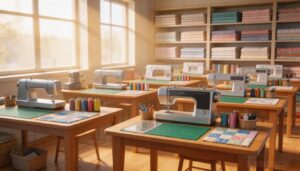
Buying equipment for a community class isn’t just about the sticker price — it’s about stretching every dollar without cutting corners.
A little planning upfront can mean the difference between machines that last a decade and ones that sit unused after the first year.
Here’s what to think about before you spend a single cent.
Funding Through Guild Dues, Raffles, and Dealer Financing
Getting a guild machine funded doesn’t have to mean one big ask. Multi Source Budgeting spreads the weight across three practical layers:
- Dues Allocation Strategy — predictable income, board‑approved, arrives on schedule
- Raffle Ticket Pricing — usually $0.25–$1.00 per ticket; check legal‑compliance raffle rules in your state
- Financing Approval Process — special financing available through dealers like Synchrony covers the remainder
Funding strategies like raffles and dealer financing for guilds work best when combined deliberately.
Total Cost of Ownership Including Maintenance and Service
purchase price is just the opening bid. Factor in a Lifetime Repair Fund—APQS recommends setting aside roughly $175 annually—plus Consumable Parts Expenses, like needles and bobbins, and routine tune-ups running $85–$250 depending on machine complexity.
Service Contract Options and Hidden Shipping Fees for warranty repairs add up fast.
Smart budget planning and financing for quilting guild equipment means knowing the full number before you buy.
Buying Used Computerized Machines to Reduce Upfront Costs
Used computerized sewing machines can cut your upfront costs by up to 50%—a real win for budget planning and financing for quilting guild equipment.
Do a quick Cost-Benefit Analysis: check User Manual Availability, confirm Software Licensing isn’t expired, and factor in Depreciation Impact on older electronics. Resale Value Retention matters too.
This buying guide for quilting sewing machines, tip alone, separates smart guild buyers from regretful ones.
Mid-Range Vs High-End Machine Value Comparison
Mid-range machines—generally priced under $800—cost less upfront and are easier to buy in multiples, which matters when your budget planning and financing for quilting guild equipment has real limits.
high-end models earn a better Feature Payoff Ratio over time through speed, durability, and lower Total Cost Ownership.
Match the machine to actual class demand. Unused features don’t justify the price tag.
Maintenance Best Practices for Heavily Used Guild Machines
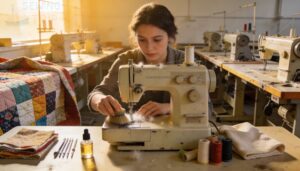
Guild machines work hard — multiple users, long class days, and constant project turnover take a real toll. little consistent care is what separates a machine that lasts a decade from one that’s always in the shop.
Here’s what your maintenance routine should cover.
Cleaning Lint From Bobbin Area and Thread Paths
Lint is the silent troublemaker in any shared classroom.
After every session, run a small nylon brush through the bobbin race—flashlight spotting helps you catch packed fuzz you’d otherwise miss.
Wipe the full thread path with a lint-free cloth, raise the presser foot to open tension discs, and rethread cleanly.
A posted classroom lint schedule keeps that bobbin change routine consistent across all users.
Oiling Schedules and Needle Replacement Intervals
Oil your machines every 6–8 hours of sewing—Lubrication Timing isn’t guesswork; it’s a number you track.
- Check Oil Reservoir Checks before each session
- Apply oil only at labeled Oil Point Frequency locations
- Use Needle Lifespan Tracking to flag needles past 7–8 hours
- Set Needle Change Alerts when switching fabric types
Dull needles break needle tension and invite skipped stitches fast.
Shared Machine Logs for Tracking Service and Repairs
A shared machine log is your maintenance backbone. Tag every entry with Asset Identification details—name, model, serial number, location—so your Service History stays clean and searchable.
Log each session’s Repair Documentation: what failed, who fixed it, and downtime.
Digital Workflow tools auto-timestamp entries, making Performance Metrics like repeat failures easy to spot.
Good records keep your maintenance schedule honest and your Certified Repair Center visits strategic.
Troubleshooting Skipped Stitches and Uneven Tension
Skipped stitches usually trace back to four culprits: Needle Size Selection, Thread Path Inspection, Bobbin Tension Adjustment, or a Hook Timing Check.
Start simple—swap the needle first. Dull or mismatched needles break stitch regulation fast. Then rethread fully, checking every guide.
Fabric Thread Matching matters too; thick seams need clearance. Persistent skipping after a fresh needle points to timing—get it serviced.
Teaching Safe Machine Operation in Quilting Classes
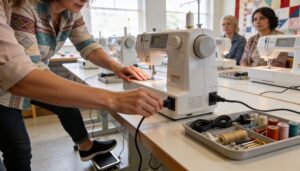
Safety isn’t a footnote in quilting classes—it’s where every session should start. When students know the basics of how to handle needles, cords, and foot pedals, everything else runs more smoothly.
Here’s what to cover before anyone touches a bobbin.
Needle, Presser Foot, and Hand Placement Safety Rules
Safe machine operation starts before the first stitch. Needle Insertion always happens with the machine off and unplugged — flat side back, clamp tight. Lower your Presser Foot Guard before sewing; it blocks finger access automatically. Hand Positioning follows a simple rule: both hands stay at least one inch from the needle.
Master these basics for community building for quilters:
- Keep fingers outside a 4-inch radius around the needle plate — always
- Use a stiletto or tweezers near the needle, never bare fingertips — Needle Proximity matters
- Wear quilting gloves as Protective Accessories for better grip on bulky layers
- Engage handfree presser foot control when repositioning fabric between seams
- Use the built-in needle threader instead of leaning in close to thread by hand
Good quilter ergonomics means your hands guide — they don’t hover dangerously. Training members on safe operation of shared machines builds confidence fast.
Supervision Requirements During Active Machine Use
Good hand habits only go so far — someone experienced needs to be watching.
Every active session requires a trained supervisor present, not just nearby. Supervisor Ratio matters: adjust it based on skill level, age, and any accessibility needs. Some situations call for 1:1 coverage.
| Requirement | Standard Class | High-Risk Situation |
|---|---|---|
| Emergency Qualifications | CPR + first aid accessible | Immediately on-site |
| Training Records | Kept by operator | Verified before machines run |
| Real-time Monitoring | Active throughout session | Continuous, no exceptions |
Safety Induction covers emergency locations, equipment protocols, and machine-specific rules — delivered before anyone touches a foot pedal. Training members on safe operation of shared machines means rule reminders continue throughout class, not just at the start.
Cord and Foot Pedal Safety in Shared Classroom Spaces
Supervision sets the tone — but the floor layout can undo all of it.
Cord Routing Standards keep power and pedal cables along table legs, never crossing aisles. Non-Slip Pedal Mats prevent forward drift during intense quilting.
Pedal Placement Ergonomics call for 30–36 inches of clearance in front of each station. Electrical Inspection Protocols mean checking cords before every session — frayed insulation comes out of rotation immediately.
Progressive Skill Training From Threading to Free Motion
Once the floor is safe, it’s time to build skills — layer by layer.
- Threading Fundamentals & Bobbin Setup — start here; most tension problems trace back to a missed guide
- Feed Dog Control — straight lines first, then disengage for free-motion quilting
- Hand Guidance Practice — slow, steady movement keeps stitch length consistent
- Free-Motion Design — loops, spirals, then open patterns
Automatic needle threaders and speed sliders make this progression genuinely approachable.
Warranty and Brand Support for Guild Purchases
Buying a quilting machine for your guild is one thing — getting real support after the sale is another.
Warranties, service networks, and dealer relationships can make or break the long‑term value of any machine you bring into a shared classroom.
what to look for before you commit.
Evaluating Parts Warranties and Service Network Coverage
Not all warranties protect what actually breaks in a classroom. Consumable exclusions matter — needles, bobbins, and belts are rarely covered, yet they’re your most frequent failures.
Juki voids coverage if unauthorized technicians touch the machine. Brother and Janome both require authorized service centers for warranty claims.
Check network accessibility in your area before buying. A warranty claim process is useless without a Professional Repair and Service Center nearby.
Dealer Vs Online Purchasing for After-Sale Support
Buying from a dealer gets you more than a machine — it gets you Dealer Training Sessions, local setup help, and Local Repair Turnaround that matters when a class is waiting. Online purchases can cut costs, but Online Ticket Response is slower and the Warranty Claim Process often requires shipping.
For guilds managing Parts Availability and shared equipment, a nearby authorized dealer is hard to beat.
Price-Match Guarantees, Financing, and Shipping Policies
Before committing your guild’s budget, understand exactly what you’re getting beyond the sticker price:
- Price Match Guarantee covers identical model numbers from authorized retailers — Match Exclusions apply to Amazon, eBay, and clearance items.
- Financing Terms offer 0% interest for 6–48 months; Credit Requirements start at $150 minimum.
- Free Shipping kicks in over $49.
- Shipping Lead Times run 2–5 business days.
Preferred Brands With Nationwide Service Centers
Not all service networks are created equal. For guild purchases, Juki, Brother, Bernina, Janome, and Singer stand out for dealer network reach and warranty coverage consistency.
Each brand maintains authorized service locations across the U.S., with trained technicians, genuine parts availability and speed, and solid brand support and reputation.
That means less downtime for your sewing machines and long arm quilting equipment when something needs fixing.
Community Access Models for Quilting Class Programs
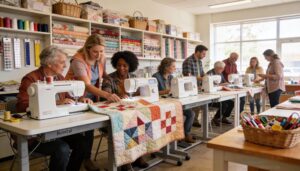
Not everyone can afford afford their own machine—and honestly, they shouldn’t have to. Community programs have found smart ways to open the door, from rentals and drop-in studios to volunteer-led classes stocked with donated supplies.
Here’s how different access models work and what to look for in each.
Machine Rental and Drop-in Studio Options
Not ready to buy yet? Renting gives you real machine time without the commitment.
Most longarm studios require a one-time certification process — covering threading, bobbin loading, and quilt attachment — before your first session.
Hourly pricing generally runs $25 for hand-guided use or $35 for computerized systems.
Studio staffing means help is nearby, and reservation systems keep equipment turnover smooth for everyone.
Scheduling and Rotation Policies for Shared Equipment
Good scheduling is what keeps shared machine access fair for everyone.
Most programs open reservation windows 7 to 30 days out, with time block limits of 90 minutes for domestic machines and 3 to 4 hours for longarms.
- Check-in procedures confirm your booking before you touch anything.
- Skill access rules gate longarm use behind a basic class.
- Waitlist policies release no-shows after a 10–15 minute grace period.
- Shared machine logs track needle changes and tension notes per session.
Nonprofit and Volunteer-Led Quilting Class Programs
Beyond fair scheduling, the real heartbeat of many programs is volunteer-led teaching. Organizations like Project Linus and Quilts of Valor run entirely on experienced quilters mentoring beginners—no paid staff, just community partnerships and shared purpose.
Volunteer-led programs like Project Linus and Quilts of Valor prove that community, not staff, is the true engine of quilting education
Volunteer training keeps class sizes small, inclusive outreach removes cost barriers, and impact measurement through completed quilts proves the program’s worth when guild budgeting decisions come around.
Pairing Classes With Donated Fabric and Discounted Supplies
Donated fabric keeps quilting class costs down—but only if you follow clear fabric donation guidelines. Stick to 100% cotton, 2-yard minimum pieces for backs, and nothing older than 15 years.
A simple sorting workflow separates usable yardage from scraps. From there, discounted supply sourcing and smart kit assembly strategies mean every student walks in ready to sew, not scrambling for materials.
Frequently Asked Questions (FAQs)
Is Kelly Clarkson a quilter?
Yes — Kelly Clarkson is a quilter. She made her first quilt in 2017 and gifted custom quilts to all four Voice coaches in 2018, calling quilting her favorite hobby.
How do quilting classes accommodate left-handed students?
Most classes seat left-handed students at the table’s left end, adjust tool placement to the dominant side, provide left-handed rotary cutters, and mirror instructor demonstrations so cutting and pinning directions feel natural.
What insurance covers shared guild quilting equipment?
Guild liability insurance—usually $295 to $477 annually—covers bodily injury at events but not shared machine damage. Property add-ons and equipment riders protect guild-owned hardware.
Venue requirements often mandate additional insured endorsements.
How many students can share one machine weekly?
Most shared machines handle 4–6 students weekly, with 90–120-minute time slot allocation per person.
Skill level impact, space constraints, and class size guidelines all shape your scheduling and rotation policies for fair guild machine access.
Do quilting classes offer certification or completion credentials?
Credentials, certificates, and completion badges depend entirely on provider policies. Some classes issue a certificate of achievement after an assessment; others offer only the experience itself — no formal credential attached.
Conclusion
As the quilting needle dances through fabric, a community comes alive—each stitch weaving together creativity and connection. When choosing quilting machines for community classes, you’re not just selecting equipment; you’re shaping experiences.
The right machines empower—whether you’re a beginner or seasoned quilter.
With these top picks and expert insights on workflow, specs, and maintenance, you’re poised to create a thriving quilting hub.
Equip your space, ignite passion, and let every stitch tell a story—together.
- https://www.foxcountryquilts.com/module/class/462753/longarm-quilting-101---3-days-of-classes
- https://babylock.com/beginner-quilting-and-sewing-machines
- https://graceframe.com/QuiltersPlayground
- https://www.shopdomesticity.com/quilting-classes
- https://threadtheneedlequilts.com/blogs/news/longarm-quilting-machine-maintenance-tips