This site is supported by our readers. We may earn a commission, at no cost to you, if you purchase through links.
Most quilters don’t realize that something as small as a metal bar—barely an inch tall—can determine whether your presser feet collection is worth a fortune or utterly useless. That bar is the shank, and getting it wrong means expensive accessories that simply won’t fit your machine.
Low shank machines dominate the home quilting market for good reason: they sit closer to the fabric, giving you a clear sightline to your needle and smoother control over every stitch. Choosing among quilting sewing machine low shank models comes down to knowing your measurements, your project needs, and which features actually move the needle on your finished quilts.
Table Of Contents
- Key Takeaways
- What is a Low Shank Machine
- How to Identify Low Shank Models
- Low Shank Vs High Shank
- Quilting Features That Matter
- Best Low Shank Machine Brands
- Top 5 Low Shank Picks
- Best Beginner and Intermediate Models
- Presser Feet for Quilting
- How to Choose The Right Model
- Care and Compatibility Tips
- Frequently Asked Questions (FAQs)
- Conclusion
Key Takeaways
- Measuring the shank height on your machine before buying any presser feet saves you from wasting money on accessories that simply won’t fit.
- Low shank machines sit closer to the fabric than high shank models, giving you better visibility and control for free motion quilting and precise piecing.
- Brands like Janome, Juki, and Brother dominate the low shank market because they pair reliable stitch quality with broad presser foot compatibility right out of the box.
- Matching your machine to your project type — whether that’s lightweight cotton piecing or thick multi-layer sandwiches — matters more than brand loyalty or price tag alone.
What is a Low Shank Machine
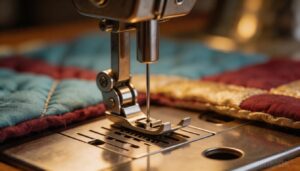
If you’ve ever shopped for presser feet and hit a wall of confusing specs, the shank is usually where the mystery starts. It’s a small part, but it controls everything about how your feet attach and perform.
Before buying any feet, it helps to know your shank size — the same principle applies when you’re adapting home sewing skills to industrial machines, where shank compatibility gets even more specific.
Here’s what you need to know to make sense of it all.
Shank Definition and Presser Foot Role
Think of the shank as your machine’s handshake with its presser feet. It’s the metal bar that drops from the needle bar, and a single screw holds your chosen foot in place.
Shank materials affect wear resistance and how smoothly foot pressure distributes across your fabric. Whether you’re using a universal presser foot or a specialty quilting foot, low shank compatibility determines what fits.
Standard Low Shank Measurements
Knowing your shank’s exact size saves you from buying feet that won’t fit.
For low shank machines, the key numbers are:
- Shank height measurement — screw hole to needle plate is between 14 mm and 32 mm
- Foot clearance dimensions — presser foot base clears 6 mm to 9 mm vertically
- Throat plate recess — stays under 6 mm to maintain consistent low shank ruler alignment
- Pinion alignment specs — needle-to-foot offset holds within 0.5 mm to 1.2 mm tolerance
These shank tolerance ranges and adapter compatibility gaps explain why measuring shank height to determine low or high matters before buying any accessory.
Why Low Shank Machines Suit Quilting
Once you’ve got your measurements sorted, it’s easy to see why a low shank sewing machine is practically built for quilting. The lower shank height keeps your low shank foot hugging the fabric, which makes free motion quilting and horizontal rotary hook action genuinely responsive.
| Quilting Benefit | Why It Matters |
|---|---|
| Closer Needle View | Easier pattern alignment |
| Reduced Friction | Smoother fabric glide |
| Quicker Stitching | Better rhythm and control |
| Quieter Operation | Less fatigue on long sessions |
| Compact Machine Size | Fits most home setups |
Domestic Vs Industrial Shank Systems
Domestic low shank machines are built for home quilters — lightweight, affordable, and easy to swap feet on. Industrial systems handle heavier load capacity and higher torque requirements, but they’re loud, specialized, and rely on dealer repair service networks for maintenance.
For most quilters, shank material differences between the two rarely matter. Stick with domestic, and you’ll have everything you need.
How to Identify Low Shank Models
Knowing your shank type saves you from buying the wrong feet and wondering why nothing fits. The good news is that identifying a low shank machine takes just a quick measurement and a little know-how.
most reliable ways to figure out exactly what you’re working with.
Measuring From Screw Hole to Needle Plate
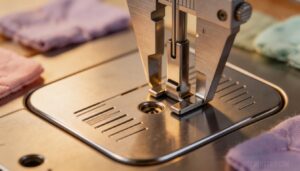
Grab a precision caliper and measure from the screw hole markings down to the needle plate surface — on most low shank sewing machines, that distance lands between 1.0 and 1.25 inches.
This shank measurement guide helps with foot placement verification and needle plate alignment before buying any accessory. Standard measurement increments of 1/16 inch keep your shank height accurate and your quilting frustration‑free.
Measuring From Bed to Thumb Screw Center

Measuring from the sewing bed to your thumb screw center is the second check worth making. Use digital calipers — they’re your best precision tools here — and look for a distance between 12 and 18 millimeters.
This shank measurement guide catches measurement errors quickly, keeping tolerance limits tight. On a low shank sewing machine, small calibration procedures like this protect your accessory fit every time.
Low Shank, High Shank, and Slant Shank
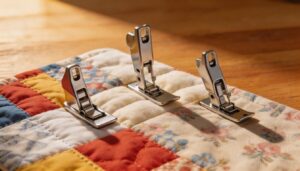
There are three shank types you’ll encounter, and knowing the difference saves you from buying the wrong quilting foot entirely.
- Low shank – sits closest to the fabric, ideal for precision piecing
- High shank – offers more clearance for thick quilt sandwiches
- Slant shank – angled needle bar, common on older Singers
Your low vs high shank comparison starts with that measurement.
Common Identification Mistakes to Avoid
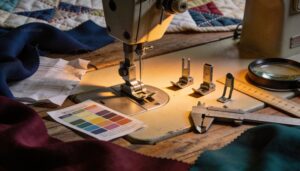
Even experienced sewists get tripped up here. Small oversights lead to incompatible feet and wasted money.
| Mistake | What Goes Wrong | Quick Fix |
|---|---|---|
| Misreading Screw Markings | Confusing Shank Labels on body or plate | Check manufacturer specs directly |
| Ignoring Color Stickers | Assuming Universal Fit without testing | Verify with a foot fitting test |
| Skipping Compatibility Check | Wrong presser foot compatibility assumed | Measure shank length before buying |
Low Shank Vs High Shank
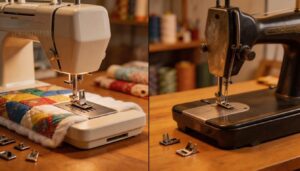
Choosing between a low shank and high shank machine isn’t just about specs — it changes how you work with fabric every single day. The differences show up in everything from how your quilt sandwich feeds through to which presser feet you can actually use.
Here’s what sets them apart.
Clearance and Fabric Handling Differences
The gap between your foot and the needle plate matters more than most quilters realize. On a low shank sewing machine, that shorter Needle Plate Clearance keeps fabric sitting close to the feed dogs, which means better Layered Fabric Guidance and serious Fabric Drag Reduction through your quilt sandwich.
On a low shank machine, less distance between foot and needle plate means better fabric control through every quilt layer
| Feature | Low Shank | High Shank |
|---|---|---|
| Quilt Sandwich Clearance | Medium layers | Thick batting |
| Foot Height Variance | Minimal | Greater |
| Presser Foot Pressure Adjustment | Fine-tuned control | Broader range |
Matching your quilting foot to fabric thickness handling needs makes all the difference.
Piecing, Free-motion, and Ruler Work Impact
Low shank sewing machines genuinely shine when you’re switching between piecing, free motion quilting, and ruler work. That lower profile delivers Needle Visibility Enhancement right where you need it, so Stitch Length Consistency stays on point.
| Technique | Low Shank Advantage |
|---|---|
| Free Motion Quilting | 360° darning foot movement |
| Ruler Work | Ruler Guide Precision with Foot Adapter Compatibility |
Fabric Shift Prevention keeps your quilting foot tracking true on Low Shank Models.
Thick Quilt Sandwiches Vs Lighter Projects
Thick quilt sandwiches push any machine harder than lighter projects do. With multiple-layer quilting, your Feed Dog Load increases quickly, so a walking quilt foot becomes your best friend.
You’ll need Needle Size Selection, Thread Tension Adjustments, and Stitch Density Reduction to keep stitches balanced.
| Factor | Thick Sandwich | Lighter Project |
|---|---|---|
| Needle Size | Larger | Standard |
| Stitch Density | Reduced | Normal |
| Design Simplicity | Recommended | Flexible |
Low shank sewing machines handle both beautifully with the right Low Shank Sewing Machine Feet.
Accessory Compatibility by Shank Type
Not all feet play nice with every machine, and that’s where shank type really matters.
Low shank sewing machines use a Threadless Shank Interface that accepts most universal low shank snap-on adapters straight out of the box. A Slim Presser Foot or Open Toe Design keeps fabric visibility clear, while Metal Adapter Durability prevents wobble during dense quilting passes.
| Shank Type | Compatible Accessories |
|---|---|
| Low Shank | Universal Quilting Foot Attachments |
| High Shank | Brand-specific low shank sewing machine feet with adapter |
Quilting Features That Matter
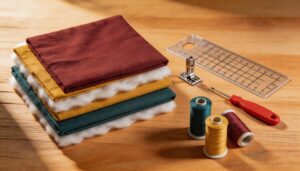
Not every sewing machine is built with quilting in mind, and that gap shows up fast once you start layering fabric. The right features can mean the difference between a frustrating afternoon and a quilt that actually comes together the way you pictured it.
Here’s what to look for before you buy.
Walking Foot and Even Feed Support
A walking foot is your secret weapon for keeping quilt layers moving together. Through Gear-Driven Feed and Dual-Feed Synchronization, it grips fabric from both top and bottom, preventing shifting and puckering across thick sandwiches.
Low-shank sewing machines pair beautifully with Quilting Foot Attachments like the Janome Convertible Even Feed Foot Set, which offers sewing foot compatibility and Adjustable Pressure Foot settings for Layer Stability and Quiet Operation Design.
Drop Feed for Free-motion Quilting
Once you’ve got your layers moving evenly, free motion quilting opens up a whole new creative lane. Flip the Drop Feed Lever, and your Adjustable Feed Dog drops below the needle plate, giving you full control of the fabric’s direction.
Here’s what makes drop feed work so well on low shank sewing machines:
- Drop Feed Safety prevents accidental re-engagement mid-pattern, protecting your stitching flow
- The Fabric Glide Surface reduces drag so your quilt moves smoothly under the presser foot
- A Horizontal Rotary Hook keeps thread tension consistent during free motion quilting
- A low shank adapter lets you swap in a darning foot quickly for stippling or meandering
- Drop Feed Maintenance — clean lint from the feed dog slots regularly to keep movement friction-free
Workspace Size and Throat Space
Think of your workspace as the stage where your quilt performs.
On low shank sewing machines, Throat Width usually runs 6 to 7 inches, giving you solid Fabric Maneuverability without fighting bulk. Bed Length and Free Arm Space determine how often you’re repositioning large quilts.
Ruler Foot Clearance improves with wider throat openings, and a compact design with Horizontal Rotary Hook Compatibility keeps everything running smoothly.
Stitch Quality, Speed, and Control
Stitch quality can make or break your quilt construction, so knowing what to look for matters. Your low shank sewing machine should handle Stitch Regulation, Thread Tension Optimization, and Speed Ramp Management smoothly across every layer.
Here’s what to evaluate:
- Stitch Consistency Testing – Run a test swatch first
- Stitch length adjustment – Match it to your fabric weight
- Thread tension control – Balance top and bobbin threads evenly
- Presser Foot Damping – Reduces bounce at higher speeds
- Stitch Quality Improvement Tools – Built-in regulators help beginners stay consistent
Needle Threader and Automation Features
Threading a needle by hand gets old fast, especially mid-project. That’s where automatic needle threading saves you — most modern low shank machines thread up in under 10 seconds using a Built-in Threader or Dual Assist Threader for thicker threads.
Add a Quick-Set Bobbin, Tension Sensor, and Auto Thread Cut, and your machine manages the tedious stuff so you can focus on quilt construction.
Best Low Shank Machine Brands
Not every brand builds their machines the same way, and that matters more than most quilters realize. Some names consistently show up in quilting circles for good reason — they’ve earned it stitch by stitch.
Here are the brands worth knowing when you’re shopping for a low shank quilting machine.
Brother Low Shank Quilting Models
Brother builds some of the most accessible low shank sewing machines for quilters at every level. The Brother LX Series and Brother JK Series both shine here, offering snap-on low shank feet, built-in LED work lights, and clear LCD stitch displays.
Key factors to weigh before buying a low shank sewing machine from Brother:
- Machine weight stays light for portability
- Noise level runs quieter than many competitors
- Accessory bundle value includes free motion quilting feet
Janome Low Shank Quilting Models
Janome has quietly earned a loyal following among quilters who want reliability without the guesswork. Their low shank sewing machines come with built-in guide markings on each foot and color‑coded bands that tell you at a glance which foot does what.
| Feature | Janome Benefit |
|---|---|
| Adjustable Stitch Length | Fine-tune for piecing or free motion quilting |
| LED Illumination | Brightens your quilting area clearly |
| Extension Table Compatibility | Accommodates larger quilt sandwiches |
| Janome EasyLine Series | Great for beginners building confidence |
| Janome Sewist Series | Decorative stitches plus quilting precision |
Choosing a low shank sewing machine from Janome means getting a machine that genuinely works with you.
Singer Low Shank Quilting Models
Singer has been a household name for generations, and their low shank sewing machines keep that tradition alive.
The Singer Tradition Series, including the Singer Tradition 2277, gives you solid Singer Thread Tension control, manageable Singer Machine Weight for easy transport, and a quiet Singer Noise Level that won’t disrupt your space.
Choosing a low shank sewing machine from Singer also means dependable Singer Service Support and accessible free motion quilting capabilities.
Juki Low Shank Quilting Models
Juki takes things up a notch from Singer’s reliability. The Juki Model Lineup, especially the Juki HZLF300, is a favorite among quilters who want low shank sewing machines built for serious work.
Juki Weight Distribution keeps the machine steady, and the Juki Noise Level stays quiet during long sessions. With solid Juki Warranty Coverage, free motion quilting, and dependable Free Motion Quilting Tools, it’s a smart, confident choice.
Baby Lock, Bernette, and Kenmore Options
Not every quilter needs the top-tier options. Baby Lock, Bernette, and Kenmore low shank sewing machines offer real value depending on where you are in your journey.
The Babylock Joy covers basics with a solid Stitch Count Range and simple Buttonhole Options.
Bernette Series models add an LED Display and Knee Lift Mechanism for free motion quilting,
while Kenmore keeps Machine Noise Level low and remains budget-friendly.
Top 5 Low Shank Picks
Finding the right low shank foot or machine doesn’t have to feel like a guessing game. These five picks cover a range of quilting needs, from precision ruler work to clean edge stitching.
Here’s what made the cut.
1. DreamStitch Low Shank Metal Quilting Presser Foot
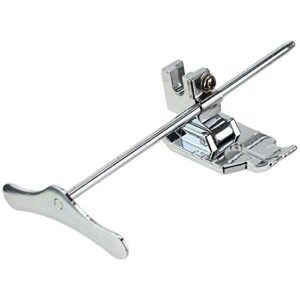
At just $10.90, the DreamStitch Low Shank Metal Quilting Presser Foot punches well above its price. It’s built from durable metal alloy, so it endures repeated quilting sessions without wearing out like plastic alternatives do.
The built-in 1/4" guide keeps your seams consistent, and the clear body lets you watch every stitch land exactly where you want it.
It fits a wide range of low-shank machines, including Singer, Kenmore, and Pfaff models, making it a genuinely adaptable pick for any quilter’s kit.
| Best For | Quilters who want precise, consistent 1/4" seams without breaking the bank. |
|---|---|
| Material | Metal |
| Shank Type | Low shank |
| Price | $10.90 |
| Brand | DreamStitch |
| Quilting Use | Patchwork quilting |
| Compatibility | Singer, Kenmore, Pfaff |
| Additional Features |
|
- Sturdy metal build that holds up way better than plastic feet over time
- Built-in 1/4" guide takes the guesswork out of keeping seams straight
- Works across multiple low-shank brands like Singer, Kenmore, and Pfaff
- Only works with low-shank machines, so check your machine before buying
- The 1/4" guide is fixed — you can’t adjust it for other seam widths
- Metal construction makes it a little heavier than what some sewers are used to
2. HONEYSEW Low Shank Ruler Foot
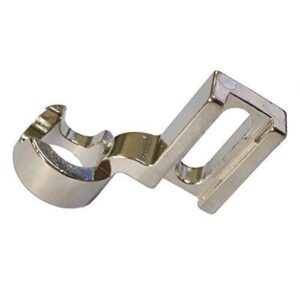
If you want to step up your ruler work, the HONEYSEW Low Shank Ruler Foot is worth a serious look. At just $6.90, it’s surprisingly capable — the high-sided edge keeps your ruler from slipping under the needle, and the open toe gives you a clear view of every stitch line.
It’s all-metal, fits most low-shank machines right out of the box, and manages free-motion quilting with ease.
Just note it may not suit every Janome or Juki model, so check your clearance first.
| Best For | Quilters using low-shank machines who want an affordable, reliable ruler foot for frame and free-motion quilting. |
|---|---|
| Material | Metal |
| Shank Type | Low shank |
| Price | $6.90 |
| Brand | HONEYSEW |
| Quilting Use | Frame quilting |
| Compatibility | Brother, Singer, Janome, JUKI |
| Additional Features |
|
- High-sided edge keeps your ruler from slipping under the needle — safer and more precise
- All-metal build feels solid and durable for the $6.90 price tag
- Fits a wide range of low-shank machines right out of the box
- Won’t fit every low-shank machine — Janome Horizon 8200QCP and Juki HZL-600 users may have clearance issues
- Installing it means fully removing the presser-foot screw, which can be a hassle
- Not ideal for thicker rulers or heavy batting without testing the fit first
3. Janome Quilts of Valor Sewing Machine
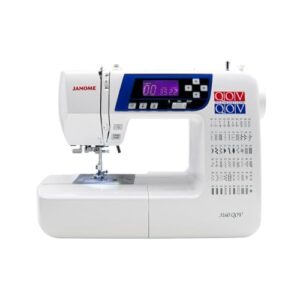
The Janome Quilts of Valor is built for quilters who mean business.
At $749, you get 60 built-in stitches, six one-step buttonholes, and a full rotary hook bobbin that keeps things running smoothly. The Advanced Plus Feed System processes everything from delicate piecing to bulky quilt sandwiches without a fight.
Add in the automatic needle threader, speed control, and backlit LCD, and setup feels almost easy.
It’s portable enough to take to class, yet solid enough to handle serious project work.
| Best For | Quilters and home sewers who want a reliable, feature-packed machine that handles everything from delicate piecing to thick quilt sandwiches — and need something portable enough to take to class. |
|---|---|
| Material | Metal |
| Shank Type | Low shank |
| Price | $749.00 |
| Brand | Janome |
| Quilting Use | General quilting |
| Compatibility | Universal low-shank |
| Additional Features |
|
- 60 built-in stitches and six one-step buttonholes give you serious variety without digging through menus
- The automatic needle threader and thread cutter save time and frustration, especially during long sessions
- Lightweight and compact enough to pack up and go, but sturdy enough for real project work
- At $749, it’s a solid investment, and you may still need to buy extra presser feet or needles separately
- The extension table doesn’t lock to the machine, which can feel a little wobbly mid-project
- Not the best fit if you want advanced embroidery — it’s a quilting and garment machine first
4. HONEYSEW Edge Guide Quilting Foot
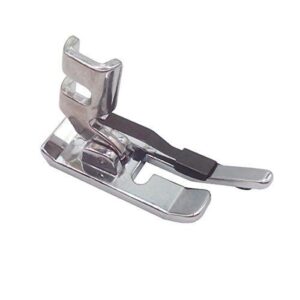
At just $8.90, the HONEYSEW Edge Guide Quilting Foot punches well above its price tag. The built-in guide keeps your fabric locked into a consistent quarter-inch seam, so your piecing lines up block after block without constant adjusting.
It fits most low-shank machines — Singer, Brother, Juki, and more — with a simple screw-on setup.
Keep in mind the edge guide can feel lightweight on thicker layers, so stick to cottons and batiks for the best results.
| Best For | Quilters and piecers who need consistent quarter-inch seams on low-shank machines — especially anyone working with vintage Singers or doing high-volume quilt piecing. |
|---|---|
| Material | Plastic |
| Shank Type | Low shank |
| Price | $8.90 |
| Brand | HONEYSEW |
| Quilting Use | Patchwork quilting |
| Compatibility | Singer, Brother, Babylock, Juki |
| Additional Features |
|
- Keeps your seams locked at a steady quarter inch, block after block, without constant adjusting
- Fits a wide range of low-shank machines right out of the box — no fuss
- At $8.90, it’s hard to beat the value for how much time it saves
- The edge guide feels a bit flimsy on thicker fabrics, so heavier layers can be tricky
- Some users find it reads closer to 3/8" and may need a needle position tweak to dial it in
- Compatibility can be hit or miss on newer machines that don’t have a standard screw-on low-shank interface
5. CYCHIRV Low Shank Open Toe Ruler Foot
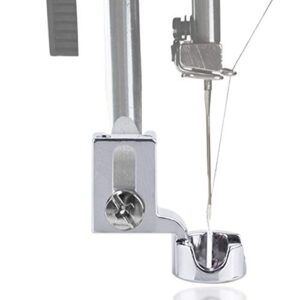
If ruler work is on your quilting list, the CYCHIRV Low Shank Open Toe Ruler Foot at $8.99 is worth a close look. The open-toe design gives you a clear view of your stitching path, and the quarter-inch offset from needle to edge keeps your ruler work tight and consistent.
It fits most low-shank machines — Brother, Singer, Janome, and more — with easy installation. Just note that some machines may need a small needle adjustment for perfect center alignment.
| Best For | Quilters of any skill level who want precise ruler work on a low-shank machine without spending a lot. |
|---|---|
| Material | Metal |
| Shank Type | Low shank |
| Price | $8.99 |
| Brand | CYCHIRV |
| Quilting Use | Free-motion quilting |
| Compatibility | Brother, Singer, Janome, Kenmore |
| Additional Features |
|
- Open-toe design keeps your stitching path fully visible, so detailed work like feathers and circles is much easier to follow
- The quarter-inch needle-to-edge offset makes ruler alignment accurate and consistent every time
- All-metal build at $8.99 is solid value — durable enough for high-speed quilting without the brand-name price tag
- May not fit well on high-shank or larger-frame machines, so double-check your machine type before buying
- Some models like the Janome Memory Craft may need a manual needle adjustment to get proper center alignment
- Height has to be set manually, and if it’s off, you can run into fabric clearance issues
Best Beginner and Intermediate Models
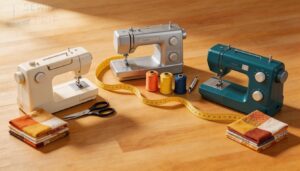
Finding the right machine doesn’t have to feel overwhelming, whether you’re just starting out or ready to level up your quilting game. The models below cover a solid range of skill levels, budgets, and features — so there’s a good chance one of them fits exactly where you’re right now.
Here’s a closer look at six low shank machines worth considering.
Brother LX3817
The Brother LX3817 is one of those budget-friendly sewing machines that punches well above its price tag. Its Built-in Stitch Library covers everyday needs, and the Buttonhole Function makes finishing simple.
Sewing machine compatibility with presser feet is broad — ideal for free motion quilting, as a low shank sewing machine. The Compact Design fits tight spaces without sacrificing utility.
Brother Simple 3030
The Brother Simple 3030 is a solid starting point if you’re just getting into quilting.
Its Front-loaded Bobbin makes thread changes quick, and the Free Arm Design accommodates sleeves and curved edges easily. LED Illumination keeps your workspace bright, while Thread Tension Adjustment helps you dial in clean stitches across fabric weights.
- Quiet Operation suits home sewing spaces
- Low shank foot compatibility is broad
- Drop feed accommodates free motion quilting feet
- 30 built-in stitches cover everyday quilting needs
Singer Tradition 2277
The Singer Tradition 2277 punches above its price tag for quilters who want reliability without the learning curve. Its 23-stitch Built-in Stitch Count covers everything from straight seams to decorative work, while Simple Controls keep setup stress‑free. The Top Loading Bobbin drops in fast, and the Free Arm Utility manages curved quilt edges cleanly — a genuine low shank sewing machine workhorse. It also includes an automatic needle threader feature that speeds up setup.
| Feature | Detail |
|---|---|
| Built-in Stitch Count | 23 stitches |
| Free Arm Utility | Yes, removable |
| Top Loading Bobbin | Drop‑in style |
| Freemotion Quilting | Drop feed compatible |
| Noise Level | Moderate, home‑friendly |
Before buying, factors to evaluate for a low shank sewing machine include your typical project size and whether a low shank machine feature guide aligns with your skill goals — the 2277 checks both boxes comfortably.
Janome Sewist 721
The Janome Sewist 721 steps things up a notch from basic entry models. Its Metal Frame Stability keeps stitching smooth, and the Free Arm Design manages cuffs and sleeves without fuss.
You get a Buttonhole Function, Zipper Foot Included, and a Built-in Light for better visibility.
For free motion quilting, just drop the feed dogs.
It’s a smart pick when budget and warranty considerations for sewing machines matter on low shank sewing machines.
Juki HZL-F300
Step up from the Sewist 721, and the Juki HZL-F300 feels like a serious upgrade. Its Box Feed System keeps fabric moving smoothly — no shifting, no bunching.
Add the Knee Lifter Feature, Automatic Thread Trim, and LCD Stitch Display, and quilting just clicks. The Needle Up/Down control is perfect for free motion quilting foot work with quilting rulers on low shank sewing machines.
Bernina B330
Want precision stitching without wrestling with your machine? The Bernina B330 brings 350 built-in stitches, a clean LCD Interface, and a Top Loading Bobbin that makes setup quick and painless.
Its Knee Lift keeps your hands free mid-quilt, and the Auxiliary Table gives you real workspace.
- Programmable Sequences for quilt borders
- Presser Foot Interchangeability with low shank sewing machines
- Shank Type Conversion Options via adapters
- Smart Quilters Equipment Selection support
Presser Feet for Quilting
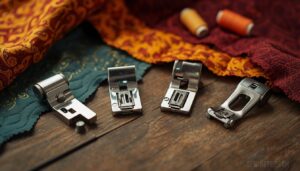
The right presser foot can make or break your quilting results, so it’s worth knowing what’s out there before you buy. Low-end machines work with a wide range of specialty feet, each built to handle a specific part of the quilting process.
Here are the key types you’ll want to know about.
Walking Feet for Even Fabric Feeding
A walking foot is the secret weapon for multiple layer quilting. It uses dual-action feed to grip your quilt sandwich from top and bottom simultaneously, so layers don’t shift or pucker.
Look for adjustable pressure, interchangeable soles, and an anti-stick coating for smooth fabric feeding. Lint prevention is easy with regular cleaning.
Most low shank machines accept these feet without adapters.
Free-motion and Darning Feet
Free motion quilting feet open up a whole new world of creative control. The Hollow Underside and Rounded Edge Profile let your fabric glide smoothly, while Micro Grip Technology and a Toe Grip Design keep everything steady. The Transparent Foot improves visibility so you can follow your design confidently.
Janome Darning Foot and Janome Convertible Free Motion Quilting Foot Set both snap onto low shank machines easily, though presser foot adapters are available if needed.
Edge Guide Feet for Straight Quilting
If straight-line quilting feels like guesswork, an edge guide foot changes everything.
The slim metal or roller guide bar slides along your fabric edge, locking in a consistent distance every time. Edge distance adjustment is smooth and quick — just slide and lock.
These low shank feet snap on easily, offer great durability and wear, and deliver that smooth fabric glide that keeps your borders crisp and uniform.
Ruler Feet and Ruler Thickness
Ruler feet take your free-motion quilting from "close enough" to precise — but only if your rulers match the foot’s Ruler Thickness Limits. Most low shank ruler feet work best with standard ¼-inch quilting rulers, and many presser foot sets include Adjustable Guide Clearance screws for fine-tuning.
Key things to check before you quilt:
- Ruler Foot Materials — stainless steel wears longer against ruler edges
- Standard toe width runs 6–8mm for a slim guiding edge
- Medium Ruler thickness (¼ inch) fits most Sewing Foot Sets
- Ruler Compatibility Charts help match your machine’s low shank spacing
- Ruler Foot Maintenance means wiping the guide edge clean after every session
Snap-on Vs Screw-on Foot Systems
Snap-on presser feet win on Quick Change Speed — press, click, done. No screwdriver, no fuss, just Alignment Precision built right into the fitting.
Screw-on feet trade that convenience for Heavy-Duty Stability, letting you reposition a low shank presser foot before locking it down for ruler work.
Both offer a solid Compatibility Range, though Thread Wear is something to watch with screw-on systems over time.
How to Choose The Right Model
Picking the right low shank machine comes down to more than just price or brand name. A few key factors can make or break how well a machine fits your quilting life.
Here’s what to look at before you buy.
Matching Budget to Quilting Needs
Budget Planning starts with being honest about how you actually quilt. Under $200 gets you a reliable low shank starter, but cost vs quality becomes real fast when you need walking feet or ruler work.
Mid-range machines ($200–$500) hit the sweet spot for domestic machine quilting solutions, covering feature prioritization and accessory investment without breaking the bank. Don’t overlook resale value and warranty considerations either.
Mechanical Vs Computerized Low Shank Machines
Think of it as a fork in the road: mechanical low shank sewing machines keep things simple with hands-on tension control and Maintenance Simplicity, while computerized models offer a friendlier User Interface with guided prompts that flatten the Learning Curve fast.
Cost Differences are real, but so is reliability. Your quilting style — tactile or tech-driven — should drive that decision.
Project Type and Fabric Compatibility
Your machine choice should match what you actually sew.
Low shank machines handle silk quilting, batik fabric handling, and cotton quilting beautifully, but denim stitching and heavy canvas need a walking foot to push through. For multi-layer fabric handling and quilt ruler usage and accessories, low shank setups give you solid control across most project ideas for low shank machines.
Leather quilting? Possible, but only with the right foot.
Portability, Size, and Table Space
Once you’ve matched your fabric needs, size becomes your next consideration. A lightweight sewing machine under 10 pounds with a built-in handle makes it easy to take your low shank setup anywhere. Most domestic machine quilting solutions fit a standard 30-inch table, and extension table options add valuable width for larger quilts.
Here’s what shapes your space decision:
- Lightweight design keeps your machine portable without sacrificing power
- Travel case compatibility protects your investment between classes or retreats
- Vertical spool pin reduces tabletop clutter in tight workspaces
- Extension table option expands your quilting surface when projects grow
Warranty, Parts, and Long-term Value
A solid warranty does more than protect your wallet — it tells you how much the brand stands behind its product. Look for transferable extended coverage, since warranty transferability adds a real resale premium if you ever sell.
Strong service network access means genuine parts compatibility stays within reach. For low shank machines, replacement parts for unique shank styles are widely available, making long-term ownership genuinely worry‑free.
Care and Compatibility Tips
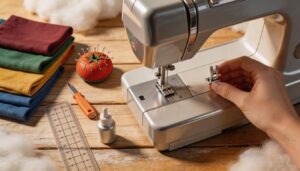
Taking care of your low shank machine doesn’t have to be complicated, but a few habits make a real difference in how long it lasts. The same goes for compatibility — knowing what works with your specific machine saves you time, money, and frustration.
Here’s what you need to keep in mind.
Cleaning Lint From The Presser Foot Area
Lint is the silent troublemaker in sewing machine maintenance — and your presser foot area is where it loves to hide. After heavy quilting sessions, use these four tools to keep your low shank clean:
- Lint Brush Types — stiff-bristle brushes clear the needle plate without scratching
- Air Duster Use — loosens packed debris from tight corners safely
- Vacuum Attachment — pulls loose fibers away from the feed dogs
- Cotton Swab Oil — reaches stubborn dust near the clamp
Keep a maintenance checklist handy so nothing gets missed.
Oiling and Checking Screws Regularly
Once you’ve cleared the lint, don’t stop there — oiling and tightening screws keep your low shank running smoothly for years.
| Task | How Often |
|---|---|
| Oil Application Frequency | Every 6–12 months |
| Screw Tightening Schedule | Weekly during heavy use |
| Maintenance Log Tracking | After every session |
Use one drop of light machine oil per pivot point, wipe excess immediately, and snug each presser foot screw with a precision screwdriver — never overtighten. Sewing machine maintenance prevents stitch inconsistencies before they start.
Using Adapters for Bernina and Pfaff
If your machine is a Bernina or Pfaff, adapters are your best friend for expanding low shank foot options.
Bernina adapter types split into old-style and new-style mounts, so check your model year before buying.
Pfaff adapter selection follows a similar logic — match your model number first.
For smooth adapter mounting steps, seat the shank firmly and tighten evenly before testing on scrap fabric.
Preventing Needle and Foot Interference
Even a perfectly measured low shank setup can cause headaches if needle and foot alignment gets ignored. Before every session, run through these quick checks:
- Foot Height Check: Confirm your low shank presser foot clears the needle plate by at least 2mm
- Needle Plate Alignment: Make sure the plate sits flush — any unevenness risks needle strikes
- Thread Path Management: Route thread cleanly to prevent loops catching under the foot
Foot Lip Adjustment, shank measurement verification, and presser foot compatibility checks together protect your needle clearance and keep stitching smooth.
Storing Low Shank Feet and Attachments
Think of your presser feet like a toolkit — disorganized chaos costs you time.
Use a presser foot holder with labeled compartments for compartment organization, keeping each low shank foot matched by type. A magnetic foot tray holds screws safely during swaps.
Store sewing foot sets in travel foam cases, track them on an inventory spreadsheet, and keep moisture control in mind — humidity warps plastic and rusts metal.
Frequently Asked Questions (FAQs)
What are the most sought after vintage Singer models?
Singer collectors obsess over a handful of legends.
The 221 Featherweight Collectibility speaks for itself, the 201A Speed Reputation is unparalleled, and the 501A Slanted Design still turns heads at every swap meet.
Is Pfaff a low shank machine?
Pfaff isn’t a single shank type — it depends on the model. Many newer Pfaff machines use a low shank system, while older or heavy-duty models run high shank.
Is Juki a low shank machine?
Juki’s home models are low shank, making them compatible with standard low shank presser feet.
Industrial models like the Juki TL98 differ, so always check your specific model’s specs before buying feet.
Are low shank machines suitable for travel sewing?
Yes, low shank machines are great travel companions.
Many weigh under 20 pounds, offer quick setup, and run quietly. Their compact design and universal presser foot compatibility make on-the-road sewing genuinely practical.
How noisy are low shank quilting machines during use?
Low shank quilting machines generally run between 60 and 75 decibels — about as loud as a normal conversation, making them easy to use without straining your ears during long quilting sessions.
Do low shank machines support embroidery attachments?
Most low shank machines do support embroidery attachments.
You can use a satin stitch foot, open toe foot, or embroidery foot adapters to get started, depending on your brand’s presser foot compatibility.
What thread types work best for quilt layers?
Cotton thread is your best friend for quilt layers.
Match thread weight to your batting loft, use 50-weight for fine work, and reach for polyester blends when stitching dense, multilayer sandwiches.
How does stitch length affect quilting results?
Think of stitch length as the heartbeat of your quilt. Too short or too long throw everything off.
Around 0–5mm keeps batting compression balanced, seam visibility clean, and quilt texture smooth without fabric puckering.
Are low shank machines suitable for heavy denim?
Yes, a low shank machine works with heavy denim well when you use a heavy-duty needle, adjust stitch length, and dial in foot pressure control.
The Singer Heavy Duty 4452 is a solid pick.
Which tension settings work best for batting thickness?
Balancing tension for batting thickness is like tuning a guitar—start Top Tension Tuning one notch lower for dense layers, adjust Stitch Length, calibrate Foot Pressure, and consider Thread Weight Impact for smooth stitch formation on domestic machine quilting.
Conclusion
Did you know that 70% of quilters upgrade their machines within five years due to compatibility issues? Don’t let that be you.
By choosing a quilting sewing machine low-shank model that fits your needs, you’ll access a world of creative possibilities. With the right machine, you’ll enjoy smoother stitching, better control, and a wider range of accessory options.
Invest wisely, and happy quilting will become your new reality, bringing joy and fulfillment to your craft.