This site is supported by our readers. We may earn a commission, at no cost to you, if you purchase through links.
A metal bobbin case and a folding handle don’t sound like much on paper. But put them on an 11-pound machine you can carry to a class or stash in a closet, and they start to matter a lot.
That’s the pitch behind the Janome 3128: fewer bells and whistles, more of the stuff that actually holds up over years of hemming, patching, and the occasional buttonhole marathon. No computer screen, no auto-thread gimmicks — just a mechanical workhorse built for people who want control, not a menu of options they’ll never touch.
This reviewsjanome 3128 breakdown gets into what that stripped-down approach means for your stitching, your wallet, and whether it’s the machine that’ll actually get used instead of collecting dust.
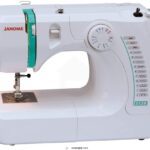
You’ll notice the weight first — at just 12 pounds, this machine picks up and moves like it’s meant to travel. That’s the whole point of the 3128: it’s built for hobbyists who sew on a table one day and stash the machine in a closet the next. The body mixes stainless steel with plastic, which keeps things light but also means you can’t toss it around like an all-metal workhorse. Treat it gently during transport and you won’t have issues.
Where it comes up short is detail — Janome doesn’t give you a deep spec sheet here, so you’re working with the basics: stitch options, portability, straightforward operation. That’s fine if you’re new to sewing and just want something reliable for simple projects, but if you’re chasing embroidery features or heavy-duty fabric work, this isn’t your machine. It’s a no-frills starter machine, and it does that job honestly.
Best For: Beginners and casual hobbyists who want a lightweight, portable machine for basic home sewing projects rather than advanced or heavy-duty work.
- Lightweight 12-pound build makes it easy to carry between rooms or store away
- Stainless steel components add durability without weighing the machine down
- Simple, basic configuration that’s approachable for beginners learning to sew
- Plastic parts need gentler handling than all-metal machines to avoid damage over time
- Limited published feature details make it hard to know full capabilities upfront
- Basic configuration may leave more experienced sewers wanting advanced stitch options
Table Of Contents
Key Takeaways
- The Janome 3128 is a mechanical, dial-controlled sewing machine offering 8 utility stitches, adjustable stitch length/width, and a 4-step buttonhole function without any digital screens or menus.
- Its front-loading metal bobbin system, three-piece feed dog design, and free-motion capability (with drop feed dogs) make it reliable for everyday sewing and beginner-friendly free-motion practice, though it’s not built for heavy denim or leather.
- At 11 pounds with a folding handle, it’s designed for portability, and it comes with a standard foot kit, bobbins, needles, a seam ripper, foot pedal, and vinyl dust cover (no hard case).
- Janome backs the machine with a 25-year mechanical parts warranty (plus 5 years electrical and 1 year labor), and its steel frame construction supports long-term durability and strong value for beginners and hobbyists.
Janome 3128 Key Features Overview
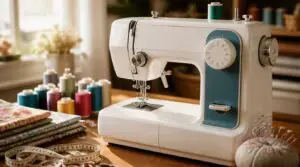
The Janome 3128 keeps things simple, but that doesn’t mean it skimps on what actually matters. Before you decide if this machine fits your sewing life, you’ll want to know what it brings to the table mechanically. Here’s a rundown of the five features that shape how it controls day-to-day stitching.
If you’re curious how its shank type affects presser feet and attachments, this guide on Janome low shank vs high shank machines breaks it down clearly.
8 Built-in Utility Stitches
Boot up the Janome 3128 and you’ll find eight built-in utility and stretch stitches sitting right on the stitch selector.
Straight stitch controls seams, zigzag provides fabric fraying prevention on raw edges, and satin stitch adds dense coverage for appliqué.
Stretch stitch utility covers jersey knits, while a narrow decorative option offers surprising versatility.
Turn the dial, pick your stitch pattern, done.
Adjustable Stitch Length and Width
Past the stitch selector, two more dials give you real control: length and width.
Stitch length adjustment runs up to 4mm, shorter for wovens to dodge fabric perforation, longer for knits. Zigzag width adjustment hits 5mm max.
Adjusting length changes the movement of feed dogs to control fabric progression.
- Short length = dense, fray-resistant seams
- Long length = stretch-friendly knit seams
- Wide zigzag = sturdy edge finishing
- Narrow width = near-straight stitching
Together, they shape your stitch footprint—and tension often follows suit.
4. Step Buttonhole Function
Buttonhole sizing accuracy matters more than most beginners expect, and the 3128 controls it in four labeled steps: bottom bar tack, left side, top bar tack, right side.
You align fabric manually between each stage, giving you manual alignment techniques and real stitch density control—not a one-touch guess.
Holes up to 1-1/8 inches come out reinforced, evenly spaced, and honestly, pretty satisfying to watch stitch by stitch.
Front-Loading Bobbin System
Under the hood, the 3128 runs a vertical oscillating hook bobbin system—front-loading, metal case, easy access.
Perks:
- Quick thread changes mid-project
- Bobbin tension adjustment via a small screw
- Sturdy metal bobbin holds more thread
- Simple lint removal keeps stitches clean
That front door swings open fast, no fabric removal needed. Small habit, big payoff for stitch quality.
Combined with Janome’s solid warranty coverage, this easy front-loading design is just one more reason the Janome Horizon 8900QCP review highlights it as a long-term investment piece.
Free Arm and Portability
Slide the flatbed off and you’ve got a free arm design built for tubular garment stitching—sleeve cuffs, pant legs, no fuss.
| Free Arm | Portability |
|---|---|
| Detachable arm mechanism | 11 lbs total |
| Sleeve cuff maneuvering | Folding handle |
| Narrow reach access | Compact workspace storage |
| Latch-secured | Standard power |
| Quick reconfigure | On-the-go ready |
For an entry-level machine, that’s real flexibility packed into a lightweight transport-friendly frame.
Performance and Sewing Quality
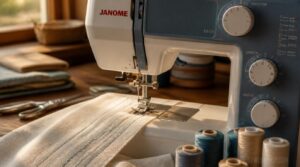
Specs on paper are one thing, but how a machine behaves under the needle is what really matters. The Janome 3128 has some real strengths here, plus a few quirks worth knowing before you sit down to sew. Here’s what you can expect once the pedal hits the floor.
Stitch Speed and Consistency
Run this machine at its top 650 spm, and it stays smooth and quiet — no rattling, no drama.
That speed ceiling actually helps beginners: slower isn’t always safer. Finding the right speed means matching your foot pressure to fabric weight, avoiding skipped stitches, and keeping stitch length uniform without needle deflection creeping in on denser layers.
For a mechanical sewing machine, stitch quality stays impressively consistent throughout.
Sewing Different Fabric Types
Cotton, linen, and lightweight blends all glide through without fuss, thanks to a three-piece feed dog system that keeps fabric moving evenly. Denim’s a different beast — its diagonal twill weave adds bulk, so:
- Use sharper, thicker needles
- Lengthen your stitch slightly
- Ease up on speed
- Watch for skipped stitches on thick layers
Fiber content matters just as much as weight here.
Manual Thread Tension Control
Tension discs squeeze your thread between two metal plates, and the Thread Tension Regulator dial controls how tight that grip is. Higher numbers mean more pressure.
| Setting | Symptom | Fix |
|---|---|---|
| Too tight | Puckered fabric | Lower dial |
| Too loose | Loose loops | Raise dial |
| Balanced | Even stitches | Keep as-is |
Run a scrap fabric test first — adjusting Upper Bobbin Balance on the Janome 3128 saves real fabric from mistakes.
Free-Motion Sewing Capability
Want to try stippling without a walking foot slowing you down? The Janome 3128 lets you drop the feed dogs for true feed dog manipulation, giving hands full control over stitch paths.
- Drop feed dogs manually
- Practice loops for muscle memory
- Use contrasting thread on scraps
- Keep light presser foot pressure
- Try gliding aids on tricky fabric
Stitch density depends on your hand speed, not the machine, so practice drills pay off fast.
Ease of Use for Beginners
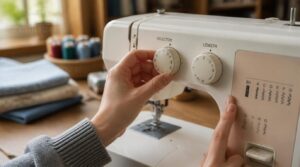
A good sewing machine shouldn’t feel like it needs an engineering degree to run, and the 3128 sticks to that promise. No screens, no menus, no guesswork—just dials and buttons that do what they look like they’ll do. Here’s what actually makes this machine easy to pick up and start using.
Simple Dial-Based Controls
No LCD screens, no menus buried three taps deep — just turn a knob and feel it click into place. The stitch selection dial on the Janome 3128 covers 8 stitches with real detent feedback, so you know you’ve landed the setting by touch alone.
| Dial | Range | Adjustment |
|---|---|---|
| Width | Up to 5mm | Manual crown |
| Length | Up to 4mm | Manual crown |
| Tension | Manual | Clockwise/counterclockwise |
Threading and Bobbin Winding
Getting thread loaded up right is where most beginners either build confidence or give up entirely. The easy threading system on the 3128 follows a marked path from spool pin to needle, and skipping a guide is the #1 cause of tangles.
For bobbin winding:
- Seat a full spool for slack-free feeding
- Thread through the tension disc
- Leave a 4–6 inch tail
- Wind to 85–90% (avoids bulges)
- Trim flush before inserting
The push-pull bobbin winder and front loading bobbin keep it foolproof.
Lightweight, Portable Build
Once your bobbins are wound and thread is flowing smoothly, the next question is whether this machine actually travels well — and it does.
At under 6 pounds, the compact chassis with its built-in carry handle makes hauling it to class or a friend’s house painless. Folded down to roughly 12×6 inches, the durable exterior casing shrugs off scuffs from tote bags and car trunks alike.
Instruction Manual and Setup
Portability means little if setup trips you up, so let’s talk paperwork. The printed manual walks you through unboxing safety first, then initial threading steps with clear diagrams.
Quick checklist before sewing:
- Match parts against the included list
- Thread needle-to-bobbin correctly
- Test-stitch on scrap fabric
Jammed thread? The troubleshooting section catches it. Wipe lint from feed dogs regularly—simple maintenance, real payoff.
Included Accessories and Presser Feet
A machine is only as good as what comes in the box with it, and the 3128 doesn’t leave you scrambling for extras. Janome packed in the basics you’ll actually reach for on day one, not just filler to pad out the packaging. Here’s what you’re getting.
Standard Foot Kit
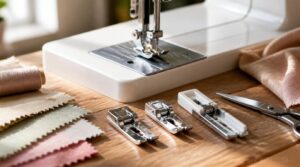
Three feet come standard: a zigzag foot for everyday stitching, a 1/4-inch seam foot for precise seams, and a sliding buttonhole foot. That covers most beginner projects without buying extras.
Foot kit compatibility follows Janome’s snap-on standard, so swapping presser feet takes seconds—no screwdriver, no fuss. It’s a lean, practical starter kit, not a zipper-foot-included deluxe set, but it gets you sewing.
Bobbins, Needles, Seam Ripper
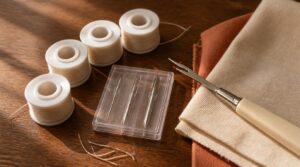
Four bobbins, a three-pack of needles, and a seam ripper round out the small parts kit — the stuff you’ll actually replace.
- Bobbins: fill via front-loading bobbin system; even winding prevents thread bunching
- Needles: swap sizes 60–110 by fabric weight; sharp for wovens, ballpoint for knits
- Seam ripper: forked tip lifts stitches without snagging fabric — go slow near seams
Foot Pedal and Dust Cover
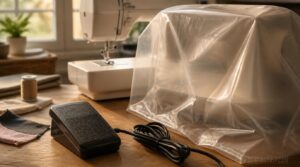
The foot control pedal operates the machine’s main drive — press for speed, ease off to slow, hands stay free for fabric.
| Component | Material | Key Benefit |
|---|---|---|
| Foot Pedal | Plastic/rubber | Speed control |
| Dust Cover | Vinyl | Dust protection |
| Connector | Standard jack | Electrical safety |
The vinyl dust cover fits snugly, keeping lint out. Wipe both regularly — no liquids near electronics.
Warranty, Durability, and Value
A machine’s only as good as what stands behind it once you’ve owned it a few years. That’s where warranty and build quality come in, and Janome backs the 3128 with more than a friendly handshake. Here’s what you’re actually covered for—and what’s holding this thing together on the inside.
25. Year Mechanical Warranty
Twenty-five years is longer than most marriages last, and Janome backs the 3128’s gears with exactly that. The 25-year mechanical parts warranty covers metal components and drive parts against defects, but skip maintenance records or use non-authorized service, and coverage evaporates.
Janome backs the 3128’s gears with a 25-year warranty—longer than most marriages last
Good news: it’s transferable if you sell the machine. Wear parts like belts and bulbs? Not included—that’s normal wear, not a defect.
Metal Frame Build Quality
Pick up the 3128 and you’ll feel it immediately—this isn’t flimsy plastic pretending to be sturdy.
Janome built it on a heavy duty metal frame with:
- High-strength steel resisting flex
- Corrosion-resistant coating
- Solid weld joints preventing misalignment
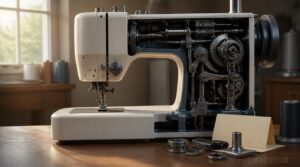
- Precision-aligned components for consistent stitches
That steel frame durability explains why these mechanical sewing machines outlast trendier digital models—vibration stress just doesn’t rattle them loose.
Is The Janome 3128 Worth Buying
So who’s this machine actually for? Beginners, mostly—and hobbyists dusting off old skills. With strong cost-to-feature ratio, eight stitches, and that steel frame backing a 25-year warranty, it earns its keep.
Skip it for heavy denim or leather work, but for hemming, basic garments, and learning the ropes, this beginner-friendly sewing machine delivers real long-term value without draining your wallet.
Frequently Asked Questions (FAQs)
What are common problems with Janome?
Ever wonder why a reliable machine suddenly skips stitches?
Common Janome gremlins include bobbin tension errors, needle size mismatch, lint buildup, feed dog malfunctions, and thread breakage—usually solved with basic sewing machine maintenance, not costly repairs.
What is the most reliable Janome sewing machine?
Reliability across the Janome lineup often points to mechanical over digital models, since fewer electronics mean fewer failures.
The 3128 fits that mold nicely, with sturdy metal construction and simple, low-maintenance parts built for years of dependable, beginner-friendly stitching.
What is the most trouble-free sewing machine?
Mechanical machines with straightforward dial controls, like the Janome 3128, tend to be most trouble-free—fewer error codes, easier maintenance, and a gentler learning curve than digital models packed with menus beginners can accidentally mess up.
Which is better, Brother or Janome sewing machine?
Brother wins on feature-rich value and price; Janome wins on stitch precision, maintenance frequency, and resale value. Like the 3128, Janome favors durable, beginner-friendly craftsmanship over flashy extras — a smarter long-term investment.
What does QDC mean in Janome?
Not the fancy machine you’re eyeing — just a name. QDC stands for Quilting Decor Couture, Janome’s badge for models built around decorative stitching options and specialized quilting accessories, like the 3160QDC, not something the 3128 carries.
What is the warranty coverage for the Janome 3128?
You get a 25-year mechanical parts warranty, plus 5 years on electrical components and 1 year free labor. It’s non-transferable, excludes wear items like needles and bulbs, and commercial use drops coverage to just 1 year.
Can the Janome 3128 be used for quilting projects?
Yes, with the right expectations. The 1/4-inch seam foot nails standard quilting allowances, and its multi-layer fabric handling experiences batting well.
Essential stitches cover piecing, though free-motion quilting demands manual feed-dog dropping and practice.
Does the Janome 3128 come with a hard case for storage and transport?
No hard case here — standard bundles include a vinyl dust cover instead. It wraps the whole machine for storage, though for regular transport, pair it with a padded tote or box for safer, bump-free travel.
Can the Janome 3128 be used for embroidery or monogramming?
Not really—no embroidery module here. You get eight utility stitches for decorative stitching, but true monogramming needs freehand skill and light fabric. Fine for simple initials, not detailed designs.
Can the Janome 3128 sew heavy fabrics like denim?
Denim’s doable, not ideal—the heavy duty metal frame helps, but this stays a lightweight machine.
Swap in a denim needle, slow your stitching speed, and consider a walking foot for thick layers; occasional hems work fine; heavy denim projects will test its limits.
Conclusion
Picture a mom hemming curtains one night and stitching a Halloween costume the next morning — that’s the kind of range this machine combats without complaint.
This Janome 3128 review breakdown keeps circling back to one truth: simplicity is the feature. No screens to freeze, no software to update, just dials and gears that’ll outlast trendier machines.
If you want a dependable workhorse that rewards actual use, this one earns its spot on your table.
- https://sewing.patternreview.com/review/machine/3214
- https://www.justanswer.com/small-appliance/h4yso-bought-used-janome-3128-will-stitch-zig-zag.html
- https://www.premierstitching.com/janome-3128-sewing-machine-with-exclusive-bonus-bundle
- https://www.ebay.com/p/134342539
- https://www.manua.ls/janome/3128/manual