This site is supported by our readers. We may earn a commission, at no cost to you, if you purchase through links.
Picture twenty-eight seventh graders, scissors‑impatient and elbow‑to‑elbow at cutting tables, all reaching for the same dull blade.
That chaos? I lived it for three semesters before I finally rethought my whole setup.
One slipped rotary cutter (mine, embarrassingly enough) and a Band‑Aid moment later, I went down a rabbit hole of researching blade guards, grip styles, and lock mechanisms built for actual kid hands.
Turns out, the right rotary cutters for classroom sewing change everything—fewer accidents, cleaner cuts, way more confident students.
Here’s what landed on my table after testing again.
Table Of Contents
Key Takeaways
- Safety features like automatic blade retraction, lock buttons, and covered storage matter more than brand or color when choosing classroom rotary cutters.
- Blade size should match the project—28mm for curves, 45mm for everyday sewing, 60mm for thick fabrics, and 90mm for long straight cuts.
- Ergonomic touches like soft-grip handles, ambidextrous designs, and proper wrist alignment keep students cutting comfortably and safely for longer sessions.
- Pairing a good cutter with the right accessories—self-healing mats, acrylic rulers, pattern weights, and proper blade disposal—rounds out a truly safe classroom cutting setup.
Top 6 Classroom Rotary Cutters
After years of watching students wrestle with cheap, dull cutters (and one too many frustrated sighs over crooked lines), I’ve narrowed down my favorites for the classroom.
These six rotary cutters have earned their spot through actual use, actual cuts, and actual durability tests by actual middle schoolers.
Whether you’re outfitting a classroom or a single eager crafter, this guide to kid-safe rotary cutters breaks down which blades and guards actually hold up to young hands.
Here’s what I trust enough to hand to my own students.
1. Fiskars Titanium Rotary Fabric Cutter
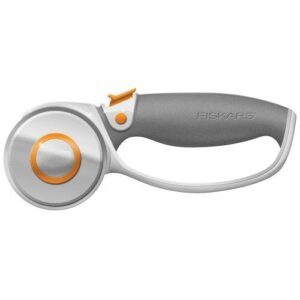
Let’s kick things off with my classroom go-to: the Fiskars Titanium Rotary Fabric Cutter.
Its 45mm blade wears a titanium coating—three times harder than regular steel—so it stays sharp through stack after stack of felt and vinyl projects, semester after semester.
The SoftGrip handle fits sweaty middle-school hands beautifully, and the retractable, locking blade keeps curious fingers safe between cuts.
Honestly, I implore you to start your classroom toolkit here; it’s earned its keep in my room more times than I can count!
| Best For | This rotary fabric cutter is best for quilters, crafters, and upholstery or paper-notepad makers who need clean, precise cuts through thick or multiple layers of material. |
|---|---|
| Blade Size | 60 mm |
| Handle Type | Soft-grip loop |
| Safety Mechanism | Sliding retract button |
| Ambidextrous Use | Yes |
| Warranty | Lifetime |
| Primary Materials | Titanium-carbide blade, steel body |
| Additional Features |
|
- The 60mm titanium-carbide blade is coated three times harder than steel, so it holds its edge through heavy, repeated use
- The soft-grip loop handle has an ergonomic curve that cuts down on hand fatigue during long projects
- The reversible blade mounting and sliding, retractable design make it comfortable and safe for both right- and left-handed users
- The original blade can dull after several heavy-use projects, and replacement blades tend to be pricey
- Some users notice slight blade wobble, so a steady hand and straight edge are needed for the cleanest cuts
- Very thick or dense materials often require a self-healing cutting mat and multiple passes to cut through cleanly
2. Turquoise Rotary Cutter Kit
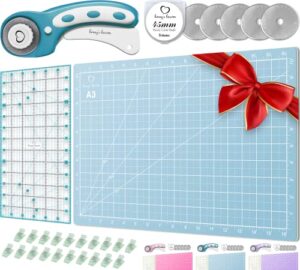
If you want a whole kit in one box, the Turquoise Rotary Cutter Kit is a sweet deal. It bundles a 45mm blade, self‑healing mat, acrylic ruler, and a blade screwdriver—everything your students need, no scavenger hunt required.
The safety lock and retractable cover keep blades tucked away between cuts, and that contoured, non‑slip grip works for righties and lefties alike, and the weight distribution eases wrist strain during long cutting sessions.
My only gripe? Read the safety guide first!
| Best For | This kit is best for sewing students, quilters, and crafters who want an all-in-one rotary cutting setup with built-in safety features for comfortable, extended cutting sessions. |
|---|---|
| Blade Size | 45 mm |
| Handle Type | Trigger handle |
| Safety Mechanism | Lock button + trigger guard |
| Ambidextrous Use | Compatible grip |
| Warranty | Not specified |
| Primary Materials | SKS-7 steel, stainless handle |
| Additional Features |
|
- Comes as a complete kit—blade, self-healing mat, acrylic ruler, and blade screwdriver—so there’s no need to hunt down extra tools.
- Dual safety design with a lock and retractable cover keeps the blade tucked away between cuts.
- Contoured, non-slip grip suits both left- and right-handed users and helps ease wrist strain during long projects.
- Blade replacement can still feel fiddly, even with the included screwdriver.
- Not ideal for very thick stacks, like multiple layers of denim or leather, which may need extra passes.
- The acrylic ruler is smaller than the mat, so longer cuts may require repositioning it partway through.
3. Olfa Aqua Rotary Cutter 45mm

Now, if you’d rather skip the kit and grab a standout single cutter, the Olfa Aqua Rotary Cutter 45mm is my classroom darling.
That bright aqua handle isn’t just cute—it’s easy to spot on a cluttered table! The Quick Change blade system swaps blades with one lever, no fumbling with screws, and the built-in blade guard snaps shut automatically.
The contoured grip fits righty or lefty hands beautifully, slicing through up to eight layers of cotton like butter.
| Best For | Quilters and sewists who want a comfortable, easy-to-spot cutter for everyday fabric cutting, including those with arthritis or anyone doing long cutting sessions. |
|---|---|
| Blade Size | 45 mm |
| Handle Type | Finger-groove handle |
| Safety Mechanism | Quick-change blade cover |
| Ambidextrous Use | Yes |
| Warranty | Not specified |
| Primary Materials | Tungsten-tool steel, alloy handle |
| Additional Features |
|
- Quick-change blade system makes swapping blades fast and fuss-free, with no screws involved
- Ergonomic aqua handle is comfortable to hold and works equally well for left- or right-handed users
- Cuts through up to 8 layers of cotton cleanly in a single pass
- Requires a cutting mat or protective surface since the blade is extremely sharp
- Blade dulls faster when used on tougher materials like heavy leather or adhesive-backed fabric
- Limited to about 8 layers of cotton, so thicker stacks need extra passes or a bigger cutter
4. Fiskars 45mm Rotary Fabric Cutter
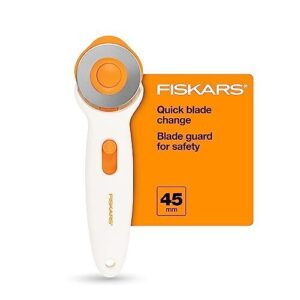
Speaking of grips, the Fiskars 45mm Rotary Fabric Cutter wins my heart for its long, soft loop handle—it practically melts fatigue away during marathon cutting days.
The symmetrical design means lefties and righties share cutters without complaint (a teacher’s dream!).
Snap‑in blade changes take seconds; no tools needed, and that orange activation button slides the guard shut for safe storage.
Lightweight and budget‑friendly, it pairs with any standard mat or ruler—perfect for stocking a full classroom set.
| Best For | Quilters, sewers, and crafters of all skill levels—including classrooms or shared workspaces with both left- and right-handed users—who need a lightweight, comfortable cutter for slicing through multiple fabric layers with clean, precise edges. |
|---|---|
| Blade Size | 45 mm |
| Handle Type | Ambidextrous handle |
| Safety Mechanism | Sliding lock button |
| Ambidextrous Use | Yes |
| Warranty | Lifetime (blade excluded) |
| Primary Materials | Titanium carbide, stainless housing |
| Additional Features |
|
- Symmetrical, ambidextrous handle design lets left- and right-handed users share the same cutter comfortably
- Quick-snap blade replacement requires no tools, making maintenance fast and hassle-free
- Slices through multiple layers of fabric, felt, vinyl, and quilting material in a single pass
- Blade can dull more quickly when cutting thick or abrasive materials
- Lifetime warranty covers the cutter itself but excludes the replaceable blade
- Not ideal for deco mesh or other specialty mesh materials, with some users reporting blade stalling
5. 45mm Pink Ergonomic Rotary Cutter

Every classroom needs one cutter that students actually fight over, and the 45mm Pink Ergonomic Rotary Cutter is mine. That curved handle hugs your palm and keeps your wrist neutral, so cutting feels less like work. The blade locks away behind a secure guard the second you set it down—safety first, always.
Keep the blade gliding smoothly by wiping away lint after each session, and if your sewing kit also includes precision tools like a seam ripper for professional tailoring work, the same gentle care routine helps it stay sharp too.
I implore you to grab one for color-coding stations; the pink finish makes spotting a wandering cutter ridiculously easy. Ambidextrous geometry means lefties cut as comfortably as righties.
| Best For | This rotary cutter is best for crafters, quilters, and classroom or workshop settings where comfort, safety, and easy-to-spot tools matter most. |
|---|---|
| Blade Size | 60 mm |
| Handle Type | Loop handle |
| Safety Mechanism | Sliding lock button |
| Ambidextrous Use | Yes |
| Warranty | Lifetime |
| Primary Materials | Titanium carbide, molded plastic |
| Additional Features |
|
- Soft-grip, dual-sided handle keeps the wrist neutral and reduces hand fatigue during long cutting sessions
- Integrated safety-lock button folds the blade away for safer handling around kids or busy workspaces
- Comes with 5 extra replacement blades in a built-in case, cutting down on downtime
- Plastic housing may feel less sturdy than metal-body rotary cutters
- Not built for heavy-duty materials like thick leather or upholstery
- Only available in pink, which won’t suit everyone’s taste
6. Fiskars Rotary Cutting Kit
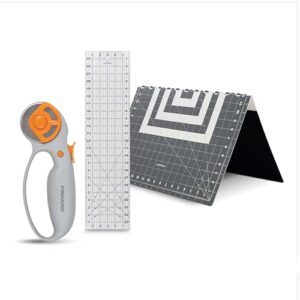
Three tools, one box, zero guesswork—that’s the Fiskars Rotary Cutting Kit.
You get a 45mm blade, a self-healing mat, and a clear patchwork ruler with grid lines for accurate alignment.
The ambidextrous design lets lefties and righties share stations without drama, and a retractable blade guard keeps everything locked down between cuts.
If you’re stocking a brand-new classroom cart, this bundle is honestly your easiest starting point—everything matches, nothing’s missing, and setup takes minutes.
| Best For | quilters, sewists, and crafters who need precise, multi-layer cuts on fabric, felt, paper, or vinyl along with a compact setup that’s easy to store or take on the go. |
|---|---|
| Blade Size | 45 mm |
| Handle Type | Dual-sided handle |
| Safety Mechanism | Safety-lock fold button |
| Ambidextrous Use | Yes |
| Warranty | Not specified |
| Primary Materials | SKS7 steel, plastic housing |
| Additional Features |
|
- 45 mm precision-ground steel blade with a comfort-loop handle slices through multiple layers in a single pass
- 18" x 24" self-healing mat folds down for easy storage and transport
- 6" x 24" ruler includes seam allowance markings plus 30°, 45°, and 60° angle guides for accurate sewing and quilting cuts
- The mat’s fold line can flex during use, sometimes causing the blade to skip when cutting across the crease
- The blade and mat aren’t covered under the lifetime warranty, so blade replacement is an ongoing cost
- Ruler markings are inches-only, which isn’t ideal for anyone working in metric measurements
Classroom Safety Features to Prioritize
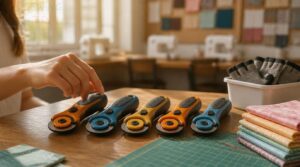
Picking a cutter is the fun part, but keeping your students safe? That’s where the real homework happens. Here are the five safety features I refuse to compromise on in my own classroom.
Automatic Blade Retraction
Here’s something wonderfully reassuring: the blade retracts automatically the second your student lets go—like a turtle ducking into its shell! A spring mechanism, plus material contact sensors, trigger this instant retraction even mid-slide.
That speedy retraction calibration is real hand safety.
I implore you, never skip this feature when shopping.
Safety Lock Buttons
Think of a safety lock button as a tiny bodyguard! Look for dual-stage activation, tactile feedback, and color-coded indicators:
- Press-and-slide locking
- Audible click confirmation
- Locking mechanism redundancy
These child-friendly designs build real hand safety habits. Honestly, that satisfying click reassures nervous beginners more than any lecture on safety precautions ever could.
Covered Blade Storage
Picture a built-in garage for your blade! Covered storage—snap-on blade guards, recessed chambers, integrated blade slots—shields little fingers from harm.
Magnetic centering keeps blades aligned, blocking accidental ejection. Tough guards resist classroom wear and solvents, while translucent covers reveal blade sharpness at a glance.
These safety features, paired with your safety lock, mean peace of mind for every classroom toolkit.
Ambidextrous Student Use
Every classroom has lefties and righties sharing the same cart of tools, so why buy separate sets? A good rotary cutter works for both, thanks to symmetrical handle design and balanced weight distribution.
Look for dual-sided markings, reversible safety features, and run ambidextrous training routines, so left‑handed tools and right‑handed tools become one less thing to worry about—just smart safety features for every student.
Safety Gloves and Rules
Symmetrical grips solve half the safety puzzle—gloves and ground rules finish the job. Pick cut‑resistant gloves rated level 3+, sized snugly (no rolling cuffs!), and teach kids to peel them off inside‑out when done. Set firm rules: hands behind the blade, lock engaged when set down.
- No gloves during needle threading
- Inspect for tears before every use
- Replace damaged gloves immediately
- Wash hands before donning
Wearing proper gloves can lower cut injuries by up to 70% according to cut injury reduction stats.
Best Blade Sizes for Students
Here’s something I wish someone had told me my first year teaching: blade size matters just as much as blade brand.
Pick the wrong size and even the safest cutter feels clunky in a kid’s hands.
Let’s break down which size fits which job, so you (and your students) never have to guess.
28mm for Curves

When your students tackle appliqué edges or small pattern pieces like pocket curves and armhole openings, the 28mm rotary cutter is genuinely the right tool for the job — not the 45mm they’ll reach for by habit. Its smaller blade diameter gives students real precision curve control without overcutting or fabric bunching.
| Curve Project | Why 28mm Works Best |
|---|---|
| Appliqué shapes | Navigates tight radii cleanly |
| Armhole openings | Follows curved seam lines accurately |
| Curved hemlines | Maintains smooth, continuous edges |
| Quilting arcs | Cuts small templates without slipping |
| Pocket curves | Reduces misalignment on short curves |
For appliqué edge accuracy, encourage students to rotate the fabric rather than forcing the cutter to pivot — short, controlled passes beat one long, wobbly stroke every time. Always remind them to engage the rotary cutter safety lock the moment they set the cutter down, keeping it a true kidsafe crafting tool in your shared workspace. For beginners especially, the 28mm offers a forgiving, confidence-building entry point into precision cutting.
45mm for Everyday Sewing
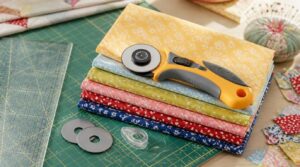
Once curves are conquered, your students will reach for the 45mm rotary cutter for nearly everything else. Universal blade compatibility makes replacements simple, and its layer cutting capacity slices 4-6 cotton layers cleanly for beginner pattern precision.
Textured grips add grip texture benefits, preventing fabric fraying, while built-in safety features make it the go-to fabric cutting tool for sewing projects.
60mm for Thick Fabrics

Now, when denim or canvas jackets show up on your cutting table, hand your students the 60mm blade. The Fiskars 60mm Rotary Cutter slices 8-10 layers with real denim cutting efficiency, keeping canvas layer stability tight for bulk project speed.
Its width fights fabric puckering beautifully, delivering heavy textile precision—plus the same safety features your students already trust.
90mm for Long Cuts

When a project calls for yards and yards of straight yardage, the 90mm blade is your champion. Its wide swath efficiency covers large sections fast, and carbide segments deliver straight edge precision while resisting heat buildup.
- Best for long straight cuts, not curves
- Carbide segment durability reduces friction wear
- Universal housing fits most rotary cutter brands
- Pairs with safety features students already know
Matching Size to Projects
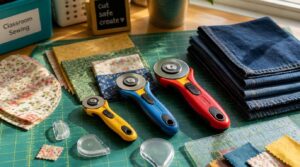
Once you’ve tried a few sizes, blade size selection becomes instinct, not guesswork.
| Project Type | Best Blade |
|---|---|
| Small/curves | 28mm |
| Mixed fabric | 45mm |
| Thick layers | 60mm |
Think fabric thickness selection and layer count management together—a sharp 45mm balances tool versatility balance with everyday curve precision needs for safe, confident kidsafe crafting tools use!
Ergonomics for Classroom Cutting

Here’s something I learned the hard way: a rotary cutter that makes your hand ache after ten minutes is one nobody wants to pick up again. Comfort isn’t just a nice bonus in a classroom—it’s what keeps kids cutting safely instead of rushing through with a death grip.
A rotary cutter that hurts little hands in ten minutes is one nobody wants to pick up again
So before we get to accessories, let’s look at the handle features that actually make a difference for young hands.
Soft Grip Handles
Your students’ hands will thank you. A soft cushion grip handle isn’t a luxury—it’s hand strain reduction in action.
Look for textured, slip‑resistant rubber that accommodates sweaty palms, plus solid material durability against dye and solvent exposure. Thermal comfort matters too; nobody wants a hot, sticky handle mid‑project.
Choose a generous grip circumference, and watch hand fatigue practically disappear!
Loop Style Cutters
What makes loop style cutters really feel like a natural extension of your hand?
- Palm pressure distribution spreads evenly
- Thumb rest precision guides fabric
- Ambidextrous grip utility fits all
- Enhanced cut visibility keeps lines clear
- Reduced grip fatigue lasts hours
These ergonomic rotary cutters add real safety features for cutters, complete with a safety lock for confident, controlled classroom use.
Bent Handle Designs
Ever notice how a bent handle just feels right in your palm? That gentle 15–35 degree slope boosts Wrist Alignment Benefits, cutting Forearm Twist Reduction during long sessions.
Pivot Point Stability comes from a rigid inner core, while Grip Texture Utility keeps fingers secure.
This smart ergonomic design makes your rotary cutter a genuinely safer handheld cutting device!
Reduced Wrist Strain
Here’s the real magic: ergonomic rotary cutters tackle wrist strain relief from every angle.
Smart grip force distribution spreads pressure across your palm, while minimizing lateral deviation, keeps cuts straight without twisting.
Reducing forearm rotation and neutral wrist posture team up, and vibration dampening effects soften each pass.
Add safety locks, and you’ve got serious craft ergonomics fighting hand fatigue!
Left-handed Comfort
Now let’s talk about my left‑handed makers, because you deserve gear that fits! A true left-handed grip cuts wrist torque and boosts cutting visibility instantly.
Look for symmetric guards, balanced weight, and a safety guard with smart rotary cutter safety lock placement. These left‑handed tools prove ergonomic rotary cutters truly work for every hand in your room.
Essential Rotary Cutting Accessories
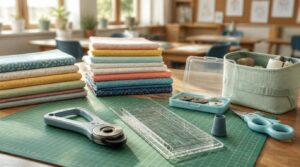
Here’s the truth nobody tells you when you buy your first rotary cutter: the cutter is only half the equation. The right accessories are what actually keep little fingers safe and your cuts looking sharp, class after class. Let’s run through the five essentials I keep stocked in my own classroom, no exceptions.
Self-healing Cutting Mats
Every self-healing cutting mat is your blade’s best friend! Thicker mats, 5 to 7mm, even boost surface resiliency and add mat longevity for years of cutting.
Store mats flat and away from heat to prevent warping.
Wipe lint with a damp cloth, then clean sticky residue safely with mild soap.
This protective work surface keeps blades sharp and desks scratch-free!
Acrylic Quilting Rulers
A good mat needs a good ruler riding on top of it, and that’s where the acrylic quilting ruler earns its keep.
Look for clear gridline visibility, 1/8-inch markings, and a sturdy 3-4mm thickness that won’t flex mid-cut.
Non-slip bases boost cutting precision, while angled guidelines (30°, 45°, 60°) keep your ruler guide honest for crisp, accurate triangles!
Pattern Weights
Once your ruler’s in place, pattern weights keep things from sliding while you cut. Skip pins entirely—safer for young hands!
- Ceramic or metal weights (2–4 oz) for stability
- Fabric-covered options prevent imprinting
- Magnetic weights for metal mats
- Various shapes cover curves and corners
- Store in a labeled tray, away from edges
Blade Disposal Containers
Here’s something teachers forget until it’s too late: where do those used blades actually go? You need a puncture-resistant container with a secure, locking lid—not your classroom trash can.
Look for sharps compliance, decent container capacity, and a labeled spot away from cutting stations. Empty it two-thirds full, and always include safe disposal training so students handle blades responsibly, not casually.
Replacement Fabric Blades
Don’t wait until a blade snags fabric mid-cut—stock replacement blades now. Steel vs. carbide matters: carbide holds its edge longer, though it costs more upfront. Blade thickness varies (0.5mm–0.8mm), so match it to your cutter.
OEM vs third-party blades aren’t interchangeable—verify fit first.
Watch for edge wear—dragging, snagging, uneven lines.
Bulk purchase benefits your budget and keeps blade durability steady all semester long.
Classroom Use and Maintenance Tips

Owning a great rotary cutter is only half the battle, friends. The real magic happens in how you use it and take care of it day after day, especially with twenty-five sets of hands sharing the same tools.
So let’s walk through the habits that’ll keep your classroom safe, your blades sharp, and your sanity intact.
Cutting Away From Body
Here’s the golden rule I drill into every student: the blade always moves away from you, never toward you. Picture an outward trajectory, starting at the cutting line and pushing past the fabric’s edge.
Square those shoulders, lock elbows, keep the non-cutting hand in the guard zone, and don’t twist your wrist. Stable rhythm, steady angle—every single cut.
Keeping Fingers Clear
Fingers are smarter than blades, so let’s keep it that way!
Use the two-hand technique: guide hand grips the ruler, cutting hand stays tucked behind it, never in line with the blade.
Run a quick dry run on scraps, do a mirror check, then keep that fabric cutting tool moving forward, away from you, always.
Cleaning Lint After Use
You’d be amazed how much fabric lint hides in your rotary blade housing!
- Brush blade and guard gently
- Vacuum tight gaps and seams
- Wipe plastic housing, dry fully
- Wash lint screens monthly
- Log cleaning for tool maintenance
This routine prevents rust buildup and keeps fabric cutting tools sharp, safe, and classroom-ready all year!
Replacing Dull Blades
Skipping or frayed cuts are clear dullness indicators.
| Sign | Fix |
|---|---|
| Jagged cuts | Replace now |
| Extra pressure | Check edge |
| Visible nicks | Discard safely |
| Frayed fabric | Swap blade |
Replace blades fast: grab replacement tools, align the edge, lock it in. Send the old blade for safe disposal in a sharps bin, wipe the head, and test-cut scrap fabric for blade sharpness retention.
Safe Shared Storage
Once that old blade’s gone, your storage routine matters just as much.
Lock cutters in a secure blade container inside your craft room cabinet, with guards on every blade. Run an equipment checkout log so you know who’s holding what.
Set access control protocols, plus a regular tool maintenance schedule, and keep sharps disposal kits nearby for safe, no-fuss cleanup!
Frequently Asked Questions (FAQs)
How many layers of fabric can I cut with a rotary cutter?
Think of layers like pancakes—stack too many and your cutter struggles! A sharp 45mm blade processes 4 to 6 layers of quilting cotton, while fabric weight, blade sharpness, and stabilizing your stack all affect true layer cutting capacity.
What age is appropriate for rotary cutter use?
Generally, age 12 and up, though some programs allow 10-11 year olds with close supervision. Always assess each student’s maturity, follow age-based safety policies, and keep a 1-to-4 supervision ratio for true sewing beginners.
Can rotary cutters cut through multiple fabric layers?
Yes—like a knife through warm butter! A sharp blade slices 4 to 6 cotton layers easily, but fabric density, blade sharpness, and rotary cutter size all affect layer capacity, so align stacks carefully and pin slippery or knit fabrics first.
How often should classroom cutting mats be replaced?
Swap your self-healing mat every 12–24 months in busy classrooms—sooner if you notice deep grooves, rippling, or warped surfaces. Quilting and heavy fabrics speed wear, so budget replacements and track your mat’s lifespan closely.
Are rotary cutters safer than scissors for students?
Picture a tug-of-war between control and chaos: a manual rotary cutter’s blade guard mechanism wins, keeping finger placement risks low, while scissors demand sharper student skill levels and steadier precision over control to stay safe.
Conclusion
Last semester, a student named Maya—who’d nicked her thumb the year before on our old blades—cut twelve perfect quilt squares without a single scare, grinning the whole time.
That’s what the right rotary cutters for classroom sewing actually deliver: confidence instead of caution tape.
Pick safety locks over flashy colors, match blade size to the project, and teach the rules before the ruler.
Your cutting table won’t just be safer; it’ll finally feel like a real workshop.
- https://www.bsewinn.com/blogs/inspiration/how-to-use-rotary-cutter
- https://www.goldstartool.com/blog/top-4-rotary-cutter-safety-tips.htm
- https://threadsketchinginaction.com/how-to-use-rotary-cutters-safely-essential-tips-for-quilters
- https://sewnikki.com/8867/best-rotary-cutter-for-quilting-size-and-brand
- https://www.threadsmagazine.com/project-guides/learn-to-sew/a-cut-above-handy-accessories-for-rotary-cutters