This site is supported by our readers. We may earn a commission, at no cost to you, if you purchase through links.
Your first sewing project shouldn’t fail because you grabbed the wrong needle from your grandmother’s dusty tin. Understanding which sewing needles for beginners work best with different fabrics, thread weights, and project types transforms guesswork into confidence—and prevents those “why won’t this work?” moments that make you want to quit.
Most beginners don’t realize that using a ballpoint needle on cotton—or a sharp needle on jersey—can create puckered seams, skipped stitches, and enough frustration to abandon sewing altogether. The right needle makes fabric glide under your fingers, while the wrong one turns simple hems into battles.
Table Of Contents
- Key Takeaways
- Best Sewing Needles for Beginners: Top 9 Picks
- 1. Singer Assorted Hand Sewing Needles
- 2. Bohin Hand Sewing Needles
- 3. Large Eye Blunt Sewing Needles
- 4. Dritz Heavy Duty Hand Needles
- 5. Singer Heavy Duty Sewing Needles
- 6. Hekisn Leather Stitching Needles
- 7. Singer Large Eye Hand Needles
- 8. Dritz Craft Needle Compact Set
- 9. Assorted Hand Sewing Needles Set
- Types of Sewing Needles Explained
- Choosing The Right Needle Size and Type
- Essential Tips for Beginner Sewers
- Sewing Needle Care and Maintenance
- Frequently Asked Questions (FAQs)
- Conclusion
Key Takeaways
- Choosing the wrong needle type for your fabric—like using a sharp needle on jersey or a ballpoint on cotton—creates puckered seams, skipped stitches, and enough frustration to make beginners quit sewing altogether.
- Match needle size to fabric weight by following this simple rule: lightweight materials need 60/8 to 70/10 needles, everyday cottons work with 80/12 to 90/14, and heavy fabrics like denim require 100/16 to 110/18.
- Replace your needles after every project or about 8 hours of stitching, because worn needles cause fabric damage, thread breaks, and skipped stitches that ruin your work before you notice the problem.
- Stock your beginner kit with sharp needles for woven fabrics, ballpoint needles for knits, and denim needles for heavy materials—then store them in a labeled, compartmentalized case with silica gel packets to prevent rust and keep sizes organized.
Best Sewing Needles for Beginners: Top 9 Picks
You’ll need the right needles in your sewing kit—ones that won’t snap, skip stitches, or turn your project into a frustration fest. I’ve rounded up nine solid options that beginners can actually trust, from budget-friendly assortments to specialized needles for tougher fabrics.
Here’s what made the cut (and why you’ll want to keep them on hand).
1. Singer Assorted Hand Sewing Needles
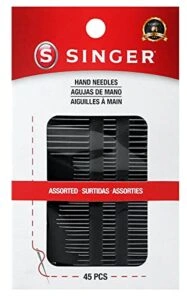
You’ll want a solid starter kit in your sewing arsenal, and Singer’s assorted hand sewing needles deliver exactly that—45 needles spanning sharps, embroidery, tapestry, and chenille styles. This Singer needle quality comes from nickel-plated steel that resists rust, giving beginners the sewing kit essentials they need for hand sewing projects without breaking the bank.
You’re getting variety here: different sizes for different fabrics, from hemming pants to mending tears. Just watch for occasional quality hiccups—some users report rough needle eyes that can fray thread, so inspect before your first stitch.
| Best For | Beginners building their first sewing kit or anyone who needs an affordable variety of needles for basic mending, embroidery, and general hand stitching projects. |
|---|---|
| Material | Nickel-plated Steel |
| Point Type | Sharp |
| Quantity | 45 needles |
| Use Case | General sewing projects |
| Brand | SINGER |
| Storage | Pack |
| Additional Features |
|
- 45-piece variety pack covers multiple needle types (sharps, embroidery, tapestry, chenille) so you’re ready for different fabrics and projects without buying separate packs
- Nickel-plated steel construction resists rust and holds up through regular use
- Great value for the price—you get a solid starter collection without spending much
- Quality control issues reported, including broken or damaged needles arriving in some packages
- Needle eyes can be rough or jagged, which may fray or snag thread during use
- Not ideal for precision work or delicate sewing that requires consistently high-quality needles
2. Bohin Hand Sewing Needles
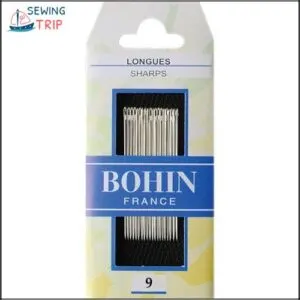
If you’re chasing Bohin needle quality—and trust me, it’s worth it—grab a pack of their size 9 sharps for hand sewing that doesn’t quit on you. These stainless steel beauties stay sharp through light and medium fabrics, making them ideal for sewing beginners who need reliable tools.
You’ll appreciate how they glide through cotton without bending (though that small eye can test your patience when threading). Stock up on Bohin’s product range for solid needle thread management, and you’ll see why experienced sewers swear by them for hand sewing tips that actually work.
| Best For | Hand sewers who want needles that stay sharp through light and medium fabrics without bending, especially if you’re working on quilting or sashiko projects. |
|---|---|
| Material | Metal |
| Point Type | Sharp |
| Quantity | 20 needles |
| Use Case | Light and medium materials |
| Brand | Bohin |
| Storage | Pack |
| Additional Features |
|
- Stay sharp longer than most needles and resist bending even with regular use
- Stainless steel construction glides smoothly through fabric and resists rust
- Great value with 20 needles per pack for consistent quality stitching
- Small eye size makes threading tricky, especially for beginners or thicker threads
- Size 9 might feel too small if you prefer larger needles for easier handling
- Packaging can be overly bulky for the small product inside
3. Large Eye Blunt Sewing Needles
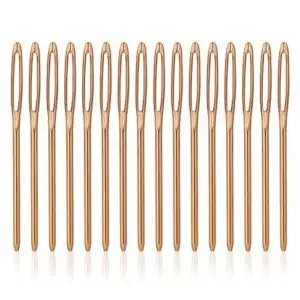
When threading needles feels like wrestling a bear, large eye blunt needles come to your rescue—especially if you’re working with yarn, embroidery floss, or multiple strands at once.
These aluminum or stainless steel tools (often 7cm long, like the rose gold sets with 16 pieces) excel at weaving through loose knits, basting layers, and finishing seams without snagging delicate fibers.
The blunt point advantages mean you won’t pierce through your fabric’s weave, and those eye size variations accommodate thicker threads that’d fray in standard needles—perfect sewing needle selection for beginners tackling hand sewing projects.
| Best For | Crafters, embroiderers, and anyone with vision or dexterity challenges who needs to thread thicker materials like yarn, embroidery floss, or multiple strands without frustration. |
|---|---|
| Material | Aluminum |
| Point Type | Blunt |
| Quantity | 16 needles |
| Use Case | Crochet and embroidery |
| Brand | Generic |
| Storage | Package |
| Additional Features |
|
- Large eyes make threading quick and painless, especially with bulky threads or for people who struggle with tiny needle eyes
- Blunt tips glide through loose weaves and knits without snagging, splitting fibers, or damaging delicate fabrics
- Versatile for multiple crafts—crochet finishing, beading, canvas work, and hand quilting—making them a solid addition to any sewing kit
- Blunt points won’t pierce tightly woven or dense fabrics, so they’re not suitable for all sewing projects
- Aluminum versions may bend more easily than stainless steel with heavy use or thick materials
- Manual measurement means sizes can vary slightly between batches, and rose gold color might look different on your screen versus in person
4. Dritz Heavy Duty Hand Needles
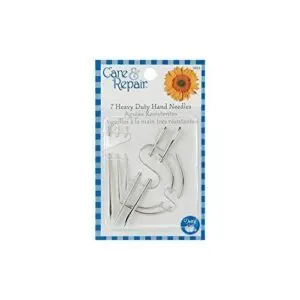
Dritz heavy-duty hand needles step up when you’re tackling thick denim, canvas, or basic upholstery repairs. This 7-pack includes curved and straight options in assorted sizes, giving beginners adaptable tools for hand stitching projects that’d snap lighter needles.
The nickel needle material resists rust and bending under pressure, though you’ll want to avoid excessive force with pliers since some users report breakage.
For fabric compatibility with heavy-weight textiles and leather, these needles deliver solid needle durability at a budget-friendly price, making them smart additions to any starter sewing kit.
| Best For | DIYers and beginners working on thick fabric repairs, upholstery projects, or heavy-duty sewing tasks who need affordable, versatile needles without breaking the bank. |
|---|---|
| Material | Nickel |
| Point Type | Sharp |
| Quantity | 7 needles |
| Use Case | Upholstery and heavy materials |
| Brand | Dritz |
| Storage | Pack |
| Additional Features |
|
- Includes both curved and straight needles in multiple sizes, giving you flexibility for different repair scenarios
- Nickel construction resists rust and handles heavy materials like denim, canvas, and leather reasonably well
- Great value at a budget-friendly price point, especially for occasional use or starter sewing kits
- Durability is inconsistent—some needles can break or bend easily, particularly when using pliers or applying excessive force
- May require extra care during handling to prevent damage compared to premium brands
- Mixed customer feedback on longevity suggests they’re better suited for light to moderate use rather than intensive projects
5. Singer Heavy Duty Sewing Needles
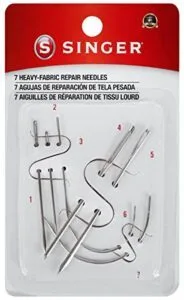
Singer Heavy Duty Sewing Needles bring reinforced shanks and sizes from 90/14 to 110/18—perfect for beginners tackling heavy-duty sewing on denim, canvas, or upholstery.
These sewing machine needles reduce skipped stitches through fabric compatibility with sturdy textiles, and choosing the right needle size prevents needle breakage when you’re working at higher speeds.
Replace them after 2–3 projects to maintain stitch quality, and test on scrap fabric first—that’s sewing for beginners wisdom that’ll save you frustration. Store them labeled and dry, because proper needle replacement habits build confidence in your craft.
| Best For | Sewers working with heavy fabrics like denim, canvas, and upholstery who need reliable needles that won’t skip stitches or break during high-speed sewing. |
|---|---|
| Material | Metal |
| Point Type | Sharp |
| Quantity | 7 needles |
| Use Case | Heavy-weight fabrics |
| Brand | SINGER |
| Storage | Pack |
| Additional Features |
|
- Reinforced shanks handle heavy-duty fabrics without bending or breaking as easily as standard needles
- Available in multiple sizes (90/14 to 110/18) so you can match the needle to your fabric weight
- Compatible with most household sewing machines, making them a versatile choice for different brands
- Need replacement every 2–3 projects, which adds to ongoing costs
- Some users report the needles aren’t sharp enough for certain heavy materials
- Quality can be inconsistent, with reports of needles breaking during use despite the “heavy duty” label
6. Hekisn Leather Stitching Needles
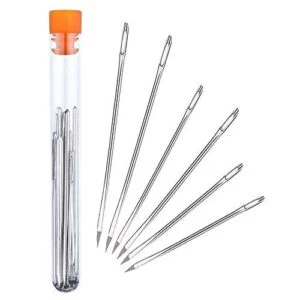
Hekisn Leather Stitching Needles offer hand sewing specialists stainless-steel construction with 1.73-inch length and triangle-pointed tips—essential for beginners exploring leather projects like wallets or belts.
Thread compatibility with waxed linen and needle sharpness for penetrating thick materials give you stitch precision without excessive dulling, and the large eye makes threading straightforward (even in dim light).
Mixed feedback on strength means you’ll want a thimble for tougher jobs, but choosing the right needle from this starter set builds confidence in leather stitching while you’re learning sewing for beginners fundamentals with sewing needles designed for specialty fabrics.
| Best For | Beginners and hobbyists working on small leather projects like wallets, belts, or pouches who need an affordable starter needle set with easy threading. |
|---|---|
| Material | Stainless Steel |
| Point Type | Triangle Point |
| Quantity | 6 needles |
| Use Case | Leather projects |
| Brand | HEKISN |
| Storage | Transparent container |
| Additional Features |
|
- Stainless steel construction with triangle-pointed tips makes penetrating leather easier without excessive dulling
- Extra large eye simplifies threading even in low light, and works well with waxed linen or synthetic threads
- Comes with transparent storage container and multiple needle options at a beginner-friendly price point
- Mixed feedback on strength and sharpness—some users find them too weak or dull for heavy-duty leather work
- Tips may be too large for delicate projects and can sometimes cut existing thread when stitching in reverse
- Limited size variety in the set, with some users wanting more length options for different project types
7. Singer Large Eye Hand Needles
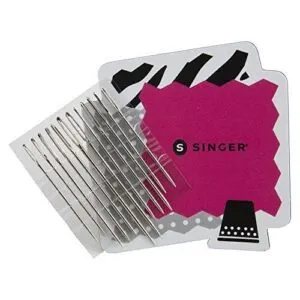
Eye strain vanishes when you thread Singer Large Eye Hand Needles—twelve nickel-plated steel sharp needles (sizes 16–22) on a decorative magnet that keeps your workspace organized while you’re mastering hand sewing basics.
The elongated eye accepts thick threads or multiple strands with sewing precision beginners crave, and thread compatibility with polyester or cotton gives you versatility across projects.
Some find the magnet weak for needle threading storage, but for those struggling with fine strands or tangled threads, this set delivers the sewing needle care fundamentals you need without the frustration.
| Best For | Sewers with vision challenges or anyone who finds standard needle eyes too small, especially when working with thicker threads or multiple strands. |
|---|---|
| Material | Nickel-plated Steel |
| Point Type | Sharp |
| Quantity | 12 needles |
| Use Case | Hand sewing and embroidery |
| Brand | SINGER |
| Storage | Decorative magnet |
| Additional Features |
|
- Extra-large eye makes threading significantly easier, even with heavy-duty or doubled threads
- Nickel-plated steel construction resists rust and holds up well over time
- Built-in magnetic storage keeps all 12 needles organized and easy to grab
- Magnet isn’t always strong enough to keep needles securely in place
- Some users find the needles thinner or lighter than expected for heavy-duty work
- Size range (16–22) may not cover all project needs, especially for very thick or delicate fabrics
8. Dritz Craft Needle Compact Set
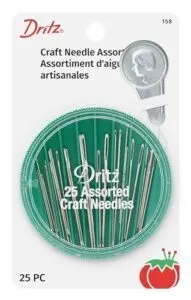
Your sewing kit needs a pocket-sized hero—the Dritz Craft Needle Compact Set delivers 25 hand sewing needles (Betweens, Sharps, Tapestry, and more) in a twist-to-dispense case that fits in your palm, giving beginners true sewing portability without the chaos of loose needles.
This beginner kit includes a needle threader, and the variety lets you experiment with different needle types across projects—from hemming cotton to weaving through canvas.
Some users find the compact storage tricky to open, but for those building foundational hand sewing skills, it’s affordable insurance against “which needle do I use?” panic.
| Best For | Beginners who want an affordable, portable starter set with a variety of needle types for general hand sewing and light craft projects. |
|---|---|
| Material | Alloy Steel |
| Point Type | Sharp |
| Quantity | 25 needles |
| Use Case | Various sewing tasks |
| Brand | Dritz |
| Storage | Compact dispenser |
| Additional Features |
|
- Compact twist-to-dispense case keeps 25 needles organized and portable, with included needle threader
- Wide variety of needle types (Betweens, Sharps, Tapestry, Chenille, Crewel, Straw/Milliners) lets you experiment across different fabrics and projects
- Durable steel needles that don’t bend easily, offering solid value for everyday mending and hemming tasks
- The compact case can be hard to open or use, with needles sometimes getting stuck underneath
- Container quality receives mixed feedback, with some users finding it less convenient than traditional needle storage
- Limited to hand sewing needles only, so not suitable for machine work or heavy-duty upholstery projects
9. Assorted Hand Sewing Needles Set
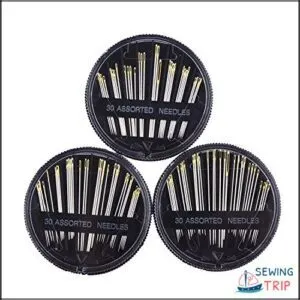
If you’re stocking up on hand sewing needles without breaking the bank, the MEISO Assorted Hand Sewing Needles Set gives you 30 needles per pack—sharps, tapestry, and more—across three packs, making it a budget-friendly choice for beginners building sewing kits.
The large eyes simplify threading, and needle threaders are included, so you’ll tackle everything from beading to canvas work.
Some users report container issues that complicate needle storage, but for those experimenting with different needle types across hand sewing projects, it’s a low-risk way to discover which beginner tools work best.
| Best For | Beginners and hobbyists who want to experiment with different needle types across various hand sewing projects without spending much upfront. |
|---|---|
| Material | Plastic |
| Point Type | Sharp |
| Quantity | 25 needles |
| Use Case | General sewing projects |
| Brand | SINGER |
| Storage | Round compact case |
| Additional Features |
|
- You get 90 needles total (30 per pack, 3 packs) covering sharps, tapestry, and more—great variety for the price
- Large eyes and included needle threaders make threading easier, especially helpful if you’re new to hand sewing
- Works across multiple projects like beading, canvas, upholstery, and embroidery without needing separate specialty needles
- Container quality is inconsistent—some arrive broken, making it tricky to store needles safely
- Quality control issues reported, with some users receiving defective products
- Not ideal if you’re looking for professional-grade or long-lasting needles for heavy use
Types of Sewing Needles Explained
You can’t master sewing without understanding the tools in your hands—and needles are where that knowledge starts. Each needle type is designed for specific fabrics and techniques, so using the wrong one will frustrate you with skipped stitches, broken threads, or damaged material.
Mastering sewing starts with needles—each type handles specific fabrics, and choosing wrong brings skipped stitches and frustration
Let’s break down the essential needle types you need to know, so you can match the right tool to every project with confidence.
Sharp Needles for Everyday Fabrics
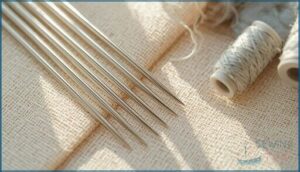
Most of your projects—cottons, linens, everyday blends—need a sharp point to pierce cleanly without skipped stitches or fabric damage. Universal sharps sized 60/8 to 80/12 handle lightweight to medium fabrics beautifully, and stainless steel versions (like Singer or Schmetz) offer needle durability that beginners appreciate.
You’ll find they deliver consistent stitch quality, thread compatibility across weights, and reliable fabric selection guidance right on the package.
Ballpoint Needles for Knits
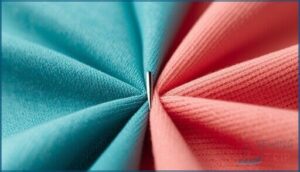
When jersey, ribbed knits, or spandex blends land on your table, swap to a ballpoint—it’ll glide between fibers instead of piercing them, slashing fabric distortion and preventing runs.
For beginners tackling knit fabrics, ballpoint needle sizes matter:
- 70/10 for lightweight jersey
- 80/12 for everyday T-shirt knits
- 90/14 for heavier sweatshirt fleece
- Test on scraps first
Ballpoint needles transform knit seam finishing and stretch stitch techniques, giving you smooth hems without snagging—essential for confident needle selection.
Embroidery and Quilting Needles
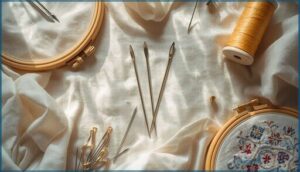
Once you’re ready to explore decorative stitches or layer batting, embroidery needles and quilting needles open new creative doors. Embroidery needles feature longer, thinner shafts (sizes 75/11 to 90/14) with larger eyes—perfect for fabrics like cotton or linen, smooth thread tension, and precise stitch formation. Quilting needles handle multi-thread work and adhesive-backed batting, while tapestry needles (blunt tips) prevent splitting threads during counted cross-stitch.
| Needle Type | Best For | Size Range |
|---|---|---|
| Embroidery Needle | Decorative stitching on cotton, linen | 75/11–90/14 |
| Quilting Needle | Multi-layer projects with batting | 75/11–90/14 |
| Tapestry Needle | Counted cross-stitch, wool embroidery | Blunt, large eye |
Jeans, Denim, and Microtex Needles
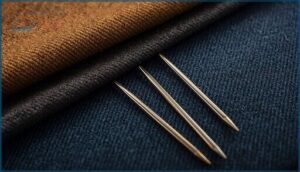
When you’re tackling heavyweight fabrics—thick denim, canvas, or tightly woven synthetics—you’ll need specialized needles. Denim needles (size 90/14 to 110/18) feature a reinforced shaft and sharp point for jeans stitch formation, while microtex needles slice cleanly through high-thread-count fabrics without snagging.
Sharp needles handle synthetic thread management on dense weaves, and proper denim needle selection prevents skipped stitches on heavy fabric sewing projects.
Tapestry and Blunt Needles
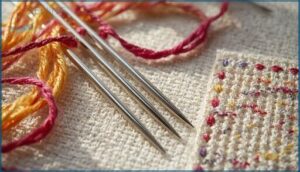
Now let’s talk about blunt-tip needles—you’ll use these for embroidery, cross-stitch, and canvas work. Tapestry needles (sizes 5–12) have long eyes for threading thick floss, and their blunt tips slip between fabric weaves without snagging delicate fibers.
They’re perfect for hand sewing on loosely woven materials, offering stitch precision that sharp needles can’t match—especially for beginners learning needle threading and fabric handling.
Choosing The Right Needle Size and Type
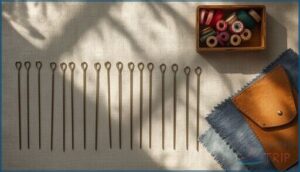
Picking the right needle isn’t about guessing—it’s about matching the tool to your fabric and project. You’ll need to understand what those numbers on the package mean, how they relate to your material’s weight, and which needle type works best for what you’re making.
Here’s how to make those choices with confidence, so you can skip the frustration and get straight to stitching.
Understanding Needle Size Numbers
You’ll see needle size numbers everywhere—on packages, in charts, even stamped on the needles themselves—and cracking this code unlocks sewing precision you didn’t know you needed. Most sewing needles use a dual number system (like 70/10 or 90/14), where the first number represents the European gauge and the second is the American size, both indicating needle thickness and compatibility with fabric thickness.
Here’s what beginners need to remember about needle size charts:
- Smaller numbers (60/8–70/10) mean finer needles for lightweight fabrics and delicate thread compatibility
- Mid-range numbers (80/12–90/14) work for everyday cotton, linen, and most general sewing techniques for beginners
- Larger numbers (100/16–110/18) indicate thicker needle gauge for heavyweight materials like denim or canvas
Matching Needle Size to Fabric Weight
Think of needle size as the matchmaker between your fabric weight and stitch formation tips—get it wrong, and you’ll see puckering, skipped stitches, or worse.
Your fabric weight guide starts here: lightweight wovens pair with 60/8 to 70/10 needles, midweights with 70/10 to 80/12, and heavyweights with 90/14 to 110/18—ballpoint needles need similar sizing for knits to prevent holes and maintain thread tension control.
Selecting Needle Type for Each Project
Fabric compatibility drives your needle selection. Cotton, silk, and wool need sharp needles to slice cleanly without snagging, while ballpoint or jersey needles protect knits from laddering. For denim and heavy fabrics, you’ll want durable jeans needles with forged shafts; embroidery and quilting projects demand microtex needles for precise stitch formation. Universal needles work for basic project planning, but matching needle type to fabric ensures proper thread tension.
Essential Tips for Beginner Sewers
You’ve got the right needles in hand—now let’s make sure you’re using them the way they’re meant to work. The difference between frustrating sewing sessions and smooth, enjoyable projects often comes down to a few simple habits you can build from day one.
Here’s what you need to know about needle care, common pitfalls, and setting yourself up for long-term success.
How Often to Change Your Needle
Your needle’s sharpness won’t last forever—and that’s okay. Change it after every project, or about 8 hours of stitching, to prevent fabric damage and keep stitch quality high.
Needle wear factors like fabric density and sewing speed impact performance, so monitor skipped stitches or snags closely. Universal needles and sewing machine needles benefit from consistent replacement schedules, ensuring your work stays clean and your machine runs smoothly.
Storing and Caring for Needles
Store your sewing needles in a labeled, compartmentalized case to prevent rust and keep sizes organized—humidity control measures like silica gel packets work wonders. Wipe each sewing needle with a dry cloth after use, and check your needle storage tips regularly for corrosion.
These needle care basics and needle organization systems protect your sewing essentials, ensuring every needle size stays sharp and ready when inspiration strikes.
Common Needle Mistakes to Avoid
You’re not alone if you’ve broken a needle mid-seam—most beginners stumble through the same sewing errors. Here’s what trips up new stitchers:
- Using worn needles until they snap, causing needle breakage and fabric damage
- Ignoring needle type for stretchy materials, creating tension issues and skipped stitches
- Forcing thick fabrics through with lightweight needles (hello, bent shafts)
- Skipping incorrect threading checks before blaming your sewing needles
This sewing needle guide helps you sidestep these beginner pitfalls with proper needle care.
Building a Beginner Needle Kit
Once you’ve dodged those mistakes, stock your beginner tools with kit essentials: sharps, betweens, and a universal needle for woven fabrics.
Add a compact needle threader, magnetic needle storage, small scissors, and a measuring gauge.
This sewing needle guide setup covers sewing basics across fabric types—your hand sewing needles stay organized, and you’re ready to tackle any beginner project with confidence.
Sewing Needle Care and Maintenance
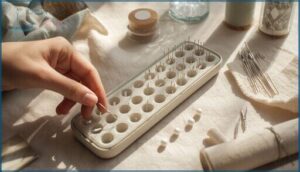
Taking care of your needles isn’t complicated, but it makes a real difference in how well they perform—and how long they last. A little attention to cleaning, storage, and knowing when to toss a worn needle will save you from frustrating thread breaks and fabric snags.
Here’s what you need to know to keep your needles in top shape.
Cleaning and Rust Prevention
Keeping your sewing needles rust-free—whether they’re sharps or any other needle type—means wiping them down with a soft cloth after each project, then storing them in a dry case with a silica gel packet for humidity control.
Metal protection starts with corrosion prevention: avoid moisture, use rust removal wipes if spots appear, and keep your sewing tools organized in airtight containers.
Signs It’s Time to Replace Needles
You’ll know it’s time for a fresh needle when you see bent or broken tips, rust spots, or a rough eye that snags your thread. Needle wear also shows up as skipped stitches, fabric damage along seams, or puckering—especially after 8–12 hours of sewing. Watch for these four red flags:
- Visible bending or breakage on the shaft
- Rust or pitting on the surface
- Excessive skipped stitches during projects
- Fabric fraying or snagging along seam lines
Needle Material and Durability
Beyond replacing worn needles, the material itself determines how long your sharp needles last. Nickel-plated steel offers solid corrosion resistance for everyday sewing. Stainless steel resists rust better, while high-carbon variants stay sharper through dense fabrics. For durability testing on heavy projects, titanium-coated options bend less (though they cost more).
Match your needle type and size to fabric weight, and you’ll see real needle rust prevention in action. Ensuring the quality of sewing tools is essential, similar to conducting scientific study audits to verify the accuracy of research findings.
Frequently Asked Questions (FAQs)
Can I use hand needles in my sewing machine?
No—hand needles lack the flat shank and proper sizing that sewing machines require, and using them risks damaging your needle bar, feed system, or bobbin area while causing skipped stitches and breakage.
What causes needles to break during stitching?
A needle snapping mid-stitch feels like the end of the world—but it’s usually wrong needle size, excessive sewing speed, fabric density, thread tension issues, or poor machine alignment causing deflection and fracture.
Understanding thread tension issues is essential to prevent such problems.
Do needle brands really make a quality difference?
Yes—reputable brands use higher-quality steel, precise heat treatment, and stricter quality control. You’ll notice sharper points, consistent eye alignment, better rust resistance, and fewer skipped stitches, especially when durability tests and consumer reviews compare sewing machine needles across different fabric weights.
How do I thread a needle more easily?
Cut your thread at a sharp angle, moisten the tip slightly, and work under bright task lighting.
You’ll find success jumps from about 53 percent to over 90 percent with a simple wire threader tool.
Are there needles specifically for beading projects?
While sharps handle most fabric projects, beading needles feature ultra-thin, flexible shafts designed for tiny bead hole sizes.
You’ll need specialized beading needle types with longer eyes for beadwork techniques like weaving, plus needle threaders for precision needlecraft techniques.
Conclusion
The right needle removes roadblocks—puckered seams disappear, skipped stitches vanish, and your fabric behaves like it’s working with you instead of against you. Mastering sewing needles for beginners means fewer frustrations and faster progress—because confidence starts when your tools actually cooperate with your vision.
Stock your kit with sharp, ballpoint, and denim options (plus a few specialty choices), match needle size to fabric weight, and change them often.