This site is supported by our readers. We may earn a commission, at no cost to you, if you purchase through links.
Thread a needle, knot the end, and suddenly a blank piece of fabric becomes a canvas. That’s the quiet magic of embroidery—no complex equipment, no steep learning curve, just cloth, thread, and your hands.
Many beginners assume they need years of practice before anything looks good, but a few foundational stitches reveal dozens of beautiful designs almost immediately.
Whether you’re drawn to a cheerful daisy hoop, a sweet heart on a tote bag, or a row of tiny dachshunds, the right pattern makes all the difference.
These simple embroidery patterns for beginners will get your needle moving with confidence.
Table Of Contents
Key Takeaways
- A handful of foundational stitches — back stitch, stem stitch, satin stitch, and French knots — are all you need to unlock dozens of beautiful embroidery designs as a beginner.
- Choosing a pattern you genuinely like (a heart, a dachshund, your home state) makes you far more likely to stick with it and build real skills along the way.
- You don’t need to spend money to get started — sites like Flamingo Toes, Cutesy Crafts, and Hodge Podge Craft offer free beginner patterns with clear stitch guides included.
- Basic materials — a hoop, cotton fabric, DMC floss, and a needle — are truly all it takes to get your first project finished in an afternoon.
Easy Embroidery Patterns
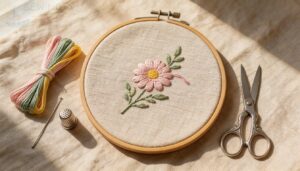
Starting with the right pattern makes all the difference — pick something you actually like, and you’ll want to keep stitching. These four designs are beginner-friendly without feeling boring, and each one builds real skills you’ll use again and again.
If you’re drawn to baby quilts especially, four-patch baby quilt tips and patterns will show you just how quickly simple blocks turn into something genuinely sweet.
Here’s what’s worth trying first.
Modern Flower Embroidery Pattern
Modern flower embroidery patterns are a great entry point if you want to learn floral embroidery patterns for beginners without feeling overwhelmed.
Start with a radial symmetry layout — petals fanning out from a central knot — then try the layered petal technique for instant depth.
Add petal color blocking in jewel tones, leave some negative space, and finish with metallic thread accents.
Clean, modern, and completely doable.
You Did It Hand Embroidery Design
Ready to stitch something that actually means something? The "You Did It" design is a motivational text pattern that packs real punch for a hand embroidery designs for beginners’ project. It uses contrast threads — think navy on cream — so the lettering stays sharp and readable.
Here’s what makes this beginner embroidery pattern collection favorite, so satisfying:
- Back stitch manages the lettering stitch cleanly
- Satin stitch fills the celebratory motif shapes
- small star accent reinforces the achievement theme
- Free beginner embroidery patterns include a full color key
Simple embroidery patterns rarely feel this rewarding.
State Love Stitching Project
Hometown pride looks great on a hoop. The State Love Stitching Project is a hand embroidery designs for beginners’ favorite — you pick your state outline, then fill each section using Regional Color Palettes pulled from Flag-Inspired Motifs and local traditions.
- Trace your State Outline Techniques onto cotton fabric
- Select 4–6 thread colors from your Beginner embroidery pattern collection
- Practice satin stitch across small color blocks
- Join Community Stitch Workshops through Local Craft Partnerships for guided support
Simply Sausages Free Pattern
From state maps to sausage dogs — yes, really! The Simply Sausages free pattern features three dachshunds outlined with clean back stitch, making it a perfect pick from any beginner embroidery pattern collection.
If you want to take it further, free motion embroidery designs can give those little dachshunds even more texture and personality.
| Element | Detail | Tip |
|---|---|---|
| Sausage Outline | Back stitch contour | Keep tension even |
| Steam Detail | Running stitch wisps | Add whimsy above each dog |
| Color Variations | Multi-thread shading | Try variegated floss |
Print it, transfer it using washable fabric pen, and pop it into mini hoops. Free DIY embroidery tutorials make this approachable quickly.
Beginner Embroidery Stitches
Learning a handful of stitches is really all it takes to get started with embroidery. Each one has its own feel and purpose, so it’s worth trying them out one by one.
Here are the four stitches every beginner should know.
Back Stitch Technique
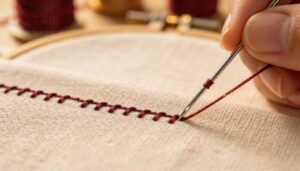
Think of the back stitch as your most reliable tool in any basic embroidery stitches guide—it’s the stitch that does the heavy lifting. Each stitch moves one step forward, then loops back to close the gap, building a clean, unbroken line. That’s what makes it the go-to choice in simple embroidery patterns and beginner embroidery patterns alike.
Here’s what to keep in mind as you practice:
- Consistent Stitch Length — aim for 1–2mm for fine detail, 2–3mm for bolder outlines
- Stitch Tension Control — keep thread taut but relaxed to avoid puckering
- Thread Color Contrast — choose thread that stands out clearly against your fabric
- Outline Precision Tips — mark your line lightly with a water-soluble pen first
- Backing Stabilizer Use — slip one under delicate fabric to keep things smooth
Follow these step-by-step embroidery instructions, and you’ll have steady, confident lines in no time.
Stem Stitch Tutorial
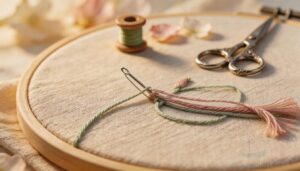
Once you’ve mastered back stitch, the stem stitch feels like a natural next step — it’s your thread moving like a pen across fabric. Bring the needle up, insert it a few millimeters ahead, then re-enter halfway back along the line.
Thread Splitting to 2–3 strands keeps lines fine and controlled.
Watch your Line Tension Tips: even pulls prevent puckering.
Try the Double Stem Technique for bolder outlines, or finish with a Capped Stem Finish for a polished end.
Satin Stitch Guide
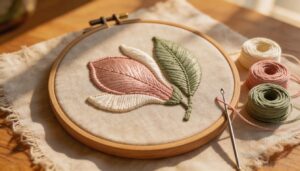
Satin stitch is where embroidery starts to feel like painting. You’re laying smooth, parallel threads side by side until they completely fill a shape — and the result is that gorgeous, glossy finish that makes petals and leaves pop. It’s one of the most satisfying basic embroidery stitches once it clicks.
Satin stitch turns thread into paint, filling shapes with a glossy finish that makes embroidery feel like art
- Thread Selection matters: use 2–3 strands for small beginner embroidery patterns; more strands for bold fills
- Stitch Length stays consistent: uneven lengths create ridges, so keep each pass close and uniform
- Fabric Choice counts: plain-weave cotton or linen helps stitches align cleanly
Try layered shading by blending thread colors across a shape — your step-by-step embroidery instructions are just leveled up.
French Knots Instructions
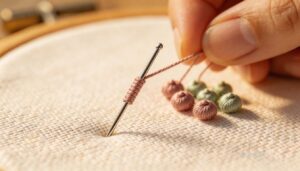
French knots are like tiny beads you stitch right into your fabric — and they’re one of the most satisfying basic embroidery stitches to learn. Your Thread Strand Choice makes a real difference: use 2–3 strands for delicate beginner embroidery patterns.
Follow these step by step embroidery instructions — wrap the thread 2–3 times around the needle (that’s your Wrap Count Tips sorted), hold taut, insert nearby, and pull through.
Tension Adjustment keeps knots round and neat.
Use a Stabilizer Recommendation on slippery fabrics, and match your Needle Size Guide to your fabric weight.
Embroidery Projects for Beginners
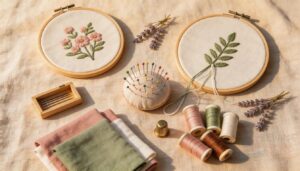
Once you’ve got a few stitches under your belt, it’s time to put them to work on a real project.
The good news is that beginner projects come in all shapes and themes — so there’s something for every mood and season.
Here are some great starting points to get your needle moving.
Heart Embroidery Projects
Hearts are a perfect starting point for anyone building a pattern collection. Try a simple back stitch outline on a tote bag — tote bag hearts look great and take under an hour.
Stitch a small cluster into a wall heart grid for easy home décor, or turn tiny designs into keychain heart embroidery or heart patch ideas for jackets.
Use a heart embroidery free pattern to practice basic hand embroidery stitches without any guesswork.
Holiday Embroidery Patterns
Holiday embroidery patterns are where seasonal magic meets needle and thread. Try a Christmas Tree Motif on a small hoop — most fit neatly at 2 to 4 inches and stitch up fast. A Snowflake Stitch using a back stitch gives crisp, clean edges perfect for tea towels.
Add a Santa Claus Design, Gift Box Embroidery, or Ornament Accents with French knots for festive texture. These simple embroidery patterns make beautiful DIY holiday art and handmade gifts that anyone would love.
Spring and Floral Embroidery
Spring floral embroidery is where color really gets to play. Start with a Daisy Hoop Art project — clean lines, minimal stitching, big reward.
Use Pastel Color Palettes like blush pink and mint green to keep things soft and fresh. Let your stems flow in a Diagonal Stem Composition for natural movement.
Try Variegated Leaf Threads for that sunlit glow, and practice Petal Shading Techniques with long-and-short stitch. Simple embroidery patterns like a floral fill stitch sampler make great first projects.
Beginner Friendly Embroidery Designs
Once you’ve worked with florals, it’s time to branch out with beginner‑friendly designs that keep things simple and fun. Think Simple Color Schemes — stick to three colors max, and you’ll never feel overwhelmed. Basic Fabric Choices, like cotton twill or Aida cloth, make your stitches sit cleanly every time.
Here’s a quick Stitch Learning Path to follow:
- A cheerful bee using satin and stem stitches
- A whimsical rainbow for Basic Hand Embroidery Stitches practice
- A cute cup design for Design Layout Basics
Grab Beginner Embroidery Free Patterns online — they’re perfect for Embroidery projects for kids and teens too!
Free Embroidery Patterns Online
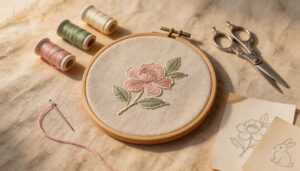
Good news — you don’t need to spend a dime to start stitching. There are some genuinely great websites out there offering free beginner patterns, from florals to fun animal designs.
Here are a few worth bookmarking.
Flamingo Toes Patterns
Flamingo Toes’ free beginner embroidery patterns from Flamingo Toes are a great starting point — charming, manageable, and surprisingly adaptable. Each design uses simple stitch zones clearly separated on the pattern, so you’re never guessing where one area ends and another begins. Try the Monochrome Toe Variant first if you want clean results fast — dark thread on light fabric does all the heavy lifting.
When you’re ready for color, stick to two or three pink tones for cohesive Color Palette Tips that feel polished. Add Toe Shadow Details using a single grey strand beneath each toe for subtle depth. Tiny Dot Reflections at the toe tips? Just a few French knots.
These step-by-step embroidery instructions and Basic Hand Embroidery Stitches make every simple embroidery pattern feel totally achievable.
| Pattern | Key Stitches | Best For |
|---|---|---|
| "I Love Us" | Back stitch, stem stitch | Absolute beginners |
| Floral Deer | Satin stitch, outline stitch | Building confidence |
| State Love | Back stitch only | One-color practice |
| Heart Bundle | Mixed basic stitches | Sampler-style learning |
Cutesy Crafts Designs
Cutesy Crafts is another free resource worth bookmarking. Their beginner embroidery patterns lean into pastel color palettes and whimsical motif pairings — think tiny bunnies nestled beside daisies — making them ideal for kids hand embroidery or quick miniature hoop projects.
Try these three starting points:
- Simple animal designs with clean satin-stitch outlines
- Small floral motifs perfect for button bead accents
- Quote patterns that double as gift packaging ideas
Designs stay uncomplicated, so you’ll build real confidence fast.
Crewel Ghoul Tutorials
Crewel Ghoul is a genuinely fun stop if you’re curious about wool thread techniques and want something a little different. Creator Amanda Fox blends Jacobean motifs with spooky ghoul faces and seasonal Halloween designs, so her patterns have real personality.
Her embroidery tutorials walk you through layered shading and core stitches step by step — perfect for building confidence. Grab her free ebook for simple embroidery patterns, beginner embroidery patterns, and solid embroidery stitch tutorials to get started today.
Hodge Podge Craft Patterns
Hodge Podge Craft is a treasure trove of simple embroidery patterns, with over 120 designs ranging from florals to geometric motifs. Each pattern includes colorway suggestions, practice swatches, and even a cross‑stitch conversion chart. Check out their seasonal releases for holiday‑ready DIY wall art that fits any embroidery hoop size.
Their community gallery lets you see how others tackle beginner embroidery patterns — genuinely inspiring stuff.
- Colorway suggestions with DMC thread numbers included
- Practice swatches to test tension before starting
- Seasonal releases perfect for gifts and holidays
- Community gallery to share your finished projects
Frequently Asked Questions (FAQs)
What are the easiest embroidery designs?
Start with a heart outline using back stitch — it’s quick, clean, and done in an afternoon.
Large Simple Shapes, Basic Color Palettes, and Minimal Stitch Motifs make the best beginner embroidery projects.
Can you embroider on viscose?
Yes, you can embroider on viscose!
Focus on needle selection (size 70–80), use a stabilizer, and prep your fabric first.
Backstitch and stem stitch work beautifully on this smooth, drapey material.
What is the easiest embroidery stitch to start with?
The running stitch is your best first move. It’s just in-and-out — simple, steady, forgiving. Focus on uniform stitch length and tension control, and you’ll build real confidence fast.
What is the easiest embroidery to learn?
Back stitch and stem stitch are your two best friends when starting out.
Both create clean, confident lines and work beautifully in beginner embroidery patterns, from decorating towels to stitching cute motifs.
What is trending in embroidery in 2024?
Embroidery trends for 2024 lean into bold neon thread palettes, metallic accents, and sustainable upcycling.
Modern floral and nature-inspired designs dominate, while accessible learning kits and digital digitization tools make it easier than ever to jump in.
What is the easiest embroidery software to use for free?
If you want free and easy, InkStitch is hard to beat.
It runs on both Windows and Mac, offers live stitch previews, and includes built-in tutorials to get you stitching digitally fast.
It also provides SVG input support(https://www.digitemb.com/blog/best-free-embroidery-software/) for smooth vector conversion.
What materials are needed for embroidery projects?
Getting started takes few essentials.
Grab an embroidery hoop, cotton or linen fabric, DMC 6 strand embroidery floss, and an embroidery needle — and you’re ready to stitch your first project.
Can embroidery be done on any fabric type?
Yes, you can stitch on most fabric types!
Cotton fabric, linen fabric, and denim fabric are your best starting points — they hold stitches cleanly and stay taut in your hoop without fuss.
How to transfer patterns onto fabric easily?
Transferring patterns onto fabric is easier than it looks.
Use a lightbox, carbon paper, or iron heat transfer — each method is beginner-friendly and gets your design onto fabric quickly and accurately.
What are common embroidery mistakes to avoid?
A few small mistakes can unravel a beautiful project.
Watch your fabric hoop tension, avoid overcrowded stitches, and never skip blocking.
Matching thread to fabric prevents a thread mismatch before it starts.
Conclusion
What’s holding you back from creating something beautiful with just a needle and thread?
With these simple embroidery patterns for beginners, you can open up a world of creativity and self-expression. Mastering a few foundational stitches and exploring various projects will boost your confidence.
Try one, then another, and watch your skills grow. Discover the joy of embroidery with simple embroidery patterns beginners love, and turn ordinary fabric into remarkable art, one stitch at a time, effortlessly.
- https://www.lovecrafts.com/en-gb/p/dmc-x-cozy-blue-porcupine-pat05372-downloadable-pdf
- http://jessicanturner.com/2021/02/free-embroidery-pattern-blooming-books.html
- https://stitchfloral.blogspot.com/2018/04/primrose-botanical-embroidery-freebie.html
- https://sublimestitching.com/
- https://www.craftfoxes.com/blog/free-sublime-stitching-arrow-embroidery-pattern