This site is supported by our readers. We may earn a commission, at no cost to you, if you purchase through links.
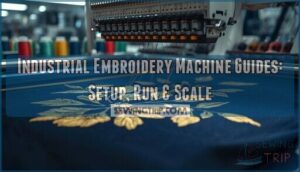
single industrial embroidery machine running at 1,200 stitches per minute can produce more embroidered pieces in one shift than a skilled hand embroiderer completes in a year.
gap between manual craft and machine output is exactly why shops that upgrade from hobbyist setups to industrial equipment don’t just grow—they transform.
raw speed means nothing if your machine is miscalibrated, your stabilizers are wrong for the fabric, or your thread tension is off by a fraction.
Getting from unboxing to profitable production requires understanding the full stack: hardware selection, site setup, software configuration, and the daily maintenance habits that keep downtime off your schedule.
industrial embroidery machine guides walk you through every layer, from choosing between single-head and multi-head models to diagnosing skipped stitches mid-run.
Table Of Contents
Key Takeaways
- Choosing between single-head and multi-head machines isn’t just a budget call — it defines your production ceiling, labor efficiency, and how fast you can scale.
- Raw speed only pays off when calibration, stabilizer selection, and thread tension are dialed in; skip those steps and output quality collapses regardless of what the spec sheet says.
- A disciplined maintenance routine — daily oiling, lint removal, and timely parts replacement — separates shops that run consistently from ones that hemorrhage downtime.
- Scaling your operation means thinking beyond the machine itself: power infrastructure, staffing ratios, software configuration, and workflow batching all determine whether growth actually sticks.
Choosing The Right Industrial Embroidery Machine
Picking the right industrial embroidery machine shapes everything — your output speed, your order capacity, and your bottom line.
If you’re still figuring out your setup, this guide on choosing the right embroidery machine for your space and skill level is a solid place to start.
Get it wrong, and you’re either bottlenecked on small jobs or overspending on capacity you don’t need.
Here’s what to look at before you commit to a machine.
Single-Head Vs. Multi-Head Machines
When weighing single-head against multi-head industrial embroidery machines, your decision shapes everything from production capacity to labor efficiency.
Multi-head machines double or quadruple output with the same operator, slashing labor cost per piece.
Yet, single-head models excel at quick changeover time and fit tight space requirements, making them ideal for sampling, personalization, and lower upfront cost comparison in commercial embroidery setups.
Their affordability makes them attractive for startups. affordable single-head machines
Flatbed Vs. Cylinder Arm Models
Flatbed and cylinder arm models shape your embroidery machine selection by Design Geometry and Fabric Compatibility.
Flatbeds offer stable hooping for banners, shirts, or linens, with flexible Hoop Size Options and high Production Speed Differences.
Cylinder arms, with narrow Needle Access, handle sleeves, caps, and pockets efficiently.
The cylinder arm sewing machines excel at handling heavy leather items.
Your choice influences Machine Embroidery Techniques and commercial output on Industrial Embroidery Machines.
Key Features to Consider (Speed, Needle Count, Area)
Once you’ve settled on your machine’s physical format, the next specs that make or break production are speed, needle count, and embroidery area.
- Stitch Speed Range — Industrial Embroidery Machines generally run 600–1,200 stitches per minute; some reach 1,500.
- Needle Configuration Options — MultiNeedle Machines offer 6–16 needles for smooth Automatic Color Changing.
- Embroidery Area Dimensions — Most single-heads cover 500×500 mm to 700×700 mm.
- Thread Tension Control — Each needle runs an independent servo-driven tension system.
- Needle Count — Higher counts cut run time 30–50% on complex designs.
Leading Brands and Model Comparisons
Speed and area specs narrow your options — but brand choice seals the deal.
A trusted brand makes all the difference, especially when you browse top-rated sewing machines for home sewers that balance fabric control with everyday ergonomics.
Brother vs Tajima comes down to scale: Brother fits growing shops (from ~$5,000), while Tajima multi-head capacity drives large factories. Barudan’s price tier runs $35,000–$50,000 for tank-built reliability. Ricoma warranty coverage stretches five years with bundled training. SWF software integration and Wi-Fi controls round out solid mid-range industrial embroidery machines.
Setting Up Your Industrial Embroidery Machine
Getting your machine running right starts long before the first stitch. Setup done well means fewer headaches down the line — and a smoother path to consistent, professional results.
Here’s what you need to cover to get everything dialed in from day one.
Site Preparation and Power Requirements

Before your machine ever stitches a single thread, your site needs to be ready for it. Industrial Embroidery Machines demand more than just an open floor — they need a planned environment built for production.
- Floor layout: Allow 2–3 meters of clear length per single-head unit, with 1–1.2-meter work aisles
- Electrical circuit: Use a dedicated 220–240V circuit sized to nameplate specs
- Surge protection: Install a surge protector rated at minimum 2,000 joules
- HVAC control: Maintain 20–24°C and 50–60% humidity for consistent thread tension
- Safety clearances: Keep 0.5 meters behind each machine for cable routing and service access
Initial Assembly and Calibration
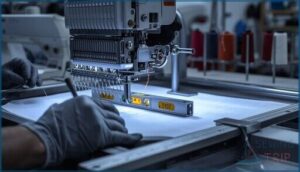
Once your site is ready, calibration is where precision takes over. Start with Frame Leveling — adjust the bolts until the machine sits perfectly balanced, confirmed with a level gauge.
Then verify Needle Bar Height, Hook Timing, and Take-Up Lever Timing by hand‑turning the shaft slowly. Finish with Test Stitch Validation on scrap fabric. If stitches look clean, you’re production‑ready.
Loading Threads, Bobbins, and Needles

Threading your industrial embroidery machine correctly separates clean production from constant headaches. Follow these five steps to get it right:
- Thread Weight Selection — Use 40-weight polyester for durability across all needle count configurations.
- Upper Thread Path — Follow every guide and tension disc in order.
- Bobbin Loading Procedure — Match L-style or M-style bobbins to your hook size.
- Bobbin Tension Calibration — Target 190–220 millinewtons using the drop test.
- Needle System Alignment — Install DBxK5 needles with the scarf correctly oriented.
Installing Embroidery Software

Your embroidery software is the command center between your design files and the machine.
Before installing, confirm your PC meets the system requirements: Windows 10 or 11, 64‑bit processor, and at least 8 GB RAM. Complete driver installation so your machine is recognized via USB.
Handle license activation online or by dongle, then verify file format compatibility — PES for Brother workflows — and configure transfer settings to match your machine model.
Operating Industrial Embroidery Machines
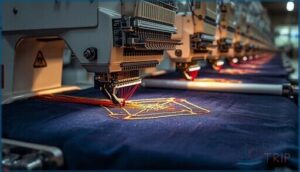
Getting your machine set up is only half the battle — knowing how to run it well is where the real work begins.
From hooping your fabric correctly to managing thread tension across multiple colors, each step directly affects the quality of your finished product.
Here’s what you need to master to keep production running smoothly and consistently.
Hooping and Stabilizer Selection
Hooping properly is where quality either starts or falls apart.
For stretchy knits and high-stitch designs, cut-away selection is your safest call — it stays with the fabric and prevents long-term distortion.
Tear-away application suits stable wovens; wash-away usage works best on sheers.
Adhesive hooping tips matter for collars and bags.
Nail fabric-stabilizer matching and your industrial embroidery machine delivers clean results every run.
Importing and Editing Embroidery Designs
File format compatibility decides whether your design runs or stalls. Save your master in.EMB, then export.DST for universal compatibility across multi-head equipment.
Use a FAT32-formatted USB, drop files in the root folder, and avoid nested subfolders.
On-machine scaling works between 50–200%, but stay within ±20–25% to protect stitch quality.
Apply push-pull compensation values between −0.5 and +1.5 mm for accurate density and clean output.
Thread Tension and Color Management
tension is what separates clean output from a tangled mess.
For rayon, target 100–130 grams of force; polyester needs 120–150 gf because it stretches more.
Start with bobbin tension balancing first, then fine‑tune the top.
When switching thread type to metallics, drop tension slightly — they’re friction‑sensitive.
In your embroidery software, lock needle color assignment before production starts so thread colors stay consistent run to run.
Running Test Stitches and Production
Once tension is locked in, run a test stitch before committing to bulk. Test Stitch Evaluation catches stitch density calibration issues, puckering, and misregistration early.
Use the Sample Approval Process to document fabric, stabilizer, and needle settings for repeat orders. A short Production Pilot Run across all heads confirms consistency. Then your Quality Assurance Checklist keeps Stitch Quality tight throughout the full commercial run.
Maintaining and Troubleshooting Machines

Even the best industrial embroidery machine will wear down faster than it should without a solid maintenance routine behind it. Knowing what to clean, oil, and inspect — and when — keeps your production running without costly interruptions.
Even the best industrial embroidery machine fails prematurely without a solid maintenance routine behind it
Here’s what you need to stay on top of.
Daily and Monthly Cleaning Routines
Consistent embroidery machine maintenance separates high‑output shops from ones constantly chasing downtime. Build these daily and monthly tasks into your workflow:
- Bobbin lint removal — pull the bobbin case every shift and brush out thread debris
- Needle plate dusting — unscrew the plate daily to clear compacted lint from feed dogs
- Rotary hook degreasing — monthly hook wash spray loosens carbon buildup from the raceway
- Thread path sanitizing and hard reach vacuuming — wipe guides daily, vacuum under the machine bed monthly
Preventive maintenance on commercial embroidery machines keeps industrial embroidery technology running at peak performance.
Oiling and Replacing Machine Parts
Cleaning gets you started — but your lubrication schedule is what keeps the machine honest.
Rotary Hook Oil goes on once daily, plus one drop after each bobbin change. Commercial machines running 4‑hour blocks need oiling every cycle. For needle bar lubrication, every 40–50 hours is the standard.
| Task | Frequency | Detail |
|---|---|---|
| Rotary hook oiling | Daily + every bobbin change | One drop; rotate handwheel 50° for access |
| Needle bar lubrication | Every 40–50 hours | Oil lower felt washer; prevents heat buildup |
| Needle bar pivot points | Weekly (heavy use) | One drop per pivot point |
| Rotary hook replacement | When skipping/bunching starts | Position hook point at 1 o’clock |
| Needle bar replacement | Odd noise or uneven movement | Replace with O‑ring and spring in sequence |
Smart preventive maintenance and timely machine parts replacement are what separate reactive repair shops from operations running industrial automation the right way.
Diagnosing Common Issues
Most problems on industrial textile equipment come down to a handful of root causes.
Thread Breakage often traces to a burr on the needle eye or incorrect spool seating. Skipped Stitches usually mean timing drift or lint in the bobbin race.
Hoop Misalignment, Fabric Tension issues, and Error Codes each follow predictable patterns — making Mechanical Troubleshooting and Electronic Diagnosis faster when you know what to look for.
Optimizing Production and Business Growth

Getting more out of your machine isn’t just about running it faster — it’s about working smarter at every stage of production.
Whether you’re fulfilling bulk orders or building a full embroidery business, the right habits and tools make a real difference.
Here’s what to focus on as you push for higher output and steady growth.
Workflow Efficiency Tips
Small inefficiencies compound fast on a production floor.
Group jobs using Thread Color Batching to slash setup time between runs, and apply Hoop Placement Optimization so every operator moves with purpose.
Software Auto‑Digitizing converts artwork quickly, while Batch Scheduling keeps your day structured around Commercial Embroidery Production Optimization goals.
A smart Tool Zone Layout means fewer wasted steps and stronger Production Efficiency Strategies overall.
Scaling With Multi-Head Machines
Stepping up to a MultiHead Machine changes everything about how you plan, staff, and power your shop. Capacity Planning starts with head count — common configurations run 2 to 12 heads, each carrying up to 15 needles.
Modular Expansion lets you add units as orders grow. Factor in Power Infrastructure early, since 12‑head systems can exceed 5,000 watts. Smart Staffing Ratios — roughly one operator per 6 heads — and disciplined Order Allocation keep your Commercial Embroidery Production Optimization on track.
Essential Accessories and Upgrades
right embroidery machine accessories turn a good setup into a great one. HoopMaster stations cut hooping time by 50 percent, while thread stands prevent tangles across multi‑color runs. Auto trimmers handle finishing 6–10 times faster than manual cutting.
Laser aligners slash placement time by 90 percent. Prewound bobbins reduce waste, and timely machine parts replacement — servo motors, bearings, thread cutter motors — keeps everything running without interruption.
Frequently Asked Questions (FAQs)
How much to charge per 1000 stitches of embroidery?
Think of pricing like weaving a tapestry—each thread adds value.
Cost‑Based Pricing starts around $50–$00 per 1,000 stitches, factoring Market Rate Benchmarks, Digitizing Fees, Volume Discounts, Rush Order Surcharges, and Stitch Quality.
Which industrial embroidery machine is best?
No single machine wins for every shop.
Your best pick depends on output goals, budget, and workflow. For most embroidery businesses, matching speed, needle count, and software compatibility to your actual production needs beats chasing specs.
What embroidered items sell well?
Monogrammed towels, custom tote bags, baby bibs, corporate polo shirts, and pet collars move fast.
Custom embroidery drives strong margins across apparel decoration, promotional products, and embroidery business staples—all achievable with high-speed stitching.
What permits or licenses are required for operation?
Running industrial embroidery machines legally means securing a Business License, EIN Requirement compliance, State Seller Permit, Home Occupation Permit if home-based, and Zoning Compliance verification — all before your first production run.
How much floor space does each machine need?
Floor space requirements vary widely — Brother PR655 needs roughly a 30×20 inch footprint.
While a 20-head commercial embroidery machine demands nearly 20 feet of clearance zones, operator walkways, and material handling space.
What electrical requirements do industrial machines have?
Industrial Embroidery Machines demand strict Voltage Standards, Power Consumption, and Frequency Compatibility.
Circuit Load must match machine specs—multi-head units often require 220–240 volts, 2000–5000 watts, and dedicated circuits.
Current Draw varies; improper supply risks immediate electronic and mechanical damage.
Can machines handle specialty threads like metallic?
Ironically, metallic threads are both the showiest and most demanding option. Yes, machines handle them — but only if you adjust tension, slow speed to 400–600 SPM, and refine your thread path.
What training resources exist for new operators?
You’ll find Certification Programs like CEMO, On‑Site Dealer Training, Online Video Courses, In‑House Manuals, and Brand Digital Libraries.
These resources deliver embroidery education, tutorials, machine embroidery tips, and software guidance for new operator mastery.
What safety precautions are needed during operation?
You need Guarded Needle Area, Emergency Stop Access, Proper Grounding, and Protective Gear. Keep a Clean Work Zone, check cables, and never bypass safety.
Routine Embroidery Machine Maintenance and Repair prevents unexpected issues—think Preventive Maintenance for Industrial Machines.
How can machine noise be reduced effectively?
Rubber vibration pads, speed reduction to 700 SPM, regular lubrication, machine balancing, and acoustic treatments like foam panels can drop noise by 20 decibels.
Keeping your industrial embroidery machines running quietly and efficiently.
Conclusion
What separates shop that struggles from one that scales?
It’s not luck—it’s mastery of every layer covered in these industrial embroidery machine guides: hardware selection, precise calibration, stabilizer logic, and maintenance discipline.
Speed means nothing if tension is off or your workflow stalls mid-run.
Apply what you’ve learned here, keep your machine dialed in, and your production floor stops being a bottleneck.
It becomes your sharpest competitive edge.
- https://www.textileschool.com/9162/types-of-industrial-embroidery-machines-a-comprehensive-guide/
- https://www.galaxyemb.com/news/parts-of-an-embroidery-machine.html
- https://www.hooptalent.com/fr/blogs/news/mastering-super-threading-optimize-your-industrial-embroidery-machine-performance
- https://www.maggieframes.com/blogs/embroidery-blogs/master-threading-your-embroidery-machine-foolproof-steps-to-prevent-breaks-and-tangles
- https://www.sewingtime.co.nz/blogs/news/11-embroidery-machine-maintenance-tips-to-maximise-uptime