This site is supported by our readers. We may earn a commission, at no cost to you, if you purchase through links.
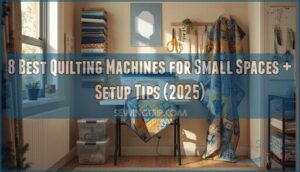
Your apartment’s spare bedroom barely fits a desk and bookshelf, but you’re determined to claim it as your quilting haven—the dream doesn’t require a warehouse-sized studio. Compact quilting machines designed for tight quarters give you the throat space, speed control, and stitch precision you need without monopolizing every square foot of your home.
Whether you’re working from a closet-sized nook or a corner of your dining room, the right machine paired with smart storage strategies can transform limited square footage into a fully functional creative zone.
The key lies in understanding which features matter most when space is at a premium, from portability and weight to accessories that fold, stack, or mount vertically, so you can quilt confidently without constantly rearranging furniture or sacrificing the quality of your finished projects.
Table Of Contents
- Key Takeaways
- Best Quilting Machines for Small Spaces
- 1. Juki Computerized Sewing Machine
- 2. Brother High Speed Sewing Machine
- 3. Singer Quantum Stylist Sewing Machine
- 4. Brother Sewing And Quilting Machine
- 5. Brother Computerized Sewing Machine
- 6. Juki Straight Stitch Sewing Machine
- 7. Janome Sewing And Quilting Machine
- 8. Bernette Sewing And Quilting Machine
- Key Features for Compact Quilting Machines
- Choosing The Right Quilting Machine Size
- Space-Saving Quilting Machine Accessories
- Setting Up a Quilting Studio in Small Spaces
- Essential Maintenance for Small Space Machines
- Maximizing Efficiency in Limited Workspaces
- Quilting Techniques for Smaller Machines
- Comparing Compact Long Arm and Standard Machines
- Storage Solutions for Quilting in Small Areas
- Frequently Asked Questions (FAQs)
- Conclusion
Key Takeaways
- Compact quilting machines with 4-6 inch throat space, adjustable speed control (600-1,500 SPM), and computerized stitch regulation deliver professional-quality results without requiring a dedicated studio, proving small spaces don’t limit creative ambitions.
- Smart storage strategies—including wall-mounted shelving, foldable extension tables, vertical fabric organization, and mobile carts—transform cramped corners into fully functional quilting workspaces by maximizing every square inch.
- Key machine features for tight spaces prioritize portability (under 20 pounds), built-in automatic threading, drop-in bobbin systems, and included extension tables that expand work surface when needed then fold away for storage.
- Breaking large projects into modular sections, adapting patterns to fit smaller throat spaces, and maintaining consistent fabric tension through proper presser foot pressure allow quilters to tackle king-sized quilts even in apartment settings.
Best Quilting Machines for Small Spaces
You don’t need a sprawling studio to create stunning quilts—the right compact machine can transform even a corner of your bedroom into a productive quilting space. The machines we’ve chosen strike that sweet balance between professional features and space-conscious design, giving you the freedom to work without sacrificing quality or your living room.
The right compact quilting machine transforms even a bedroom corner into a professional workspace without sacrificing quality or overtaking your living room
Here are eight quilting machines that prove small spaces can’t hold back your creative ambitions.
1. Juki Computerized Sewing Machine
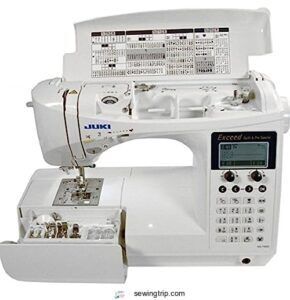
You’ll marvel at how the Juki computerized sewing machine packs 255 built-in stitches, including decorative and quilting patterns, into a compact 18-inch frame that won’t hijack your workspace.
This powerhouse delivers smooth sewing speed across fabrics from delicate jersey to heavy denim, while automatic thread tension and a straightforward LCD user interface let you focus on creating rather than troubleshooting.
With metal construction ensuring serious machine durability and included quilting feet expanding your creative freedom, Juki models prove that small spaces don’t mean compromising on professional-grade performance or versatility.
| Best For | Sewers from beginner to advanced who need a feature-packed machine that handles everything from thin jersey to thick seams without taking over a small workspace. |
|---|---|
| Weight | 30 pounds |
| Built-in Stitches | 255 stitches |
| Automatic Needle Threader | Yes |
| Extension Table | Optional |
| Presser Feet Included | Multiple |
| LCD Display | Yes |
| Additional Features |
|
- 255 built-in stitches with automatic needle threader and intuitive LCD screen make setup quick and transitions between projects effortless
- Metal construction and smooth operation deliver professional-quality results across quilting, garment sewing, and household projects
- Compact design with included accessories and optional extension table fits tight spaces while maintaining a large work surface when needed
- Some users experienced durability issues like broken screws or malfunctioning automatic threaders that required hard-to-get replacement parts
- Struggles with very thick fabrics like four layers of denim, limiting heavy-duty projects
- $1,399 price point and learning curve for computerized functions may be barriers for casual sewers or tight budgets
2. Brother High Speed Sewing Machine
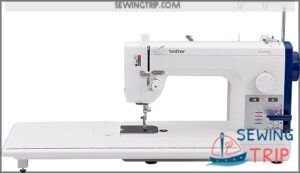
If you’re ready to break free from sluggish stitching, the Brother PQ1600S rockets to 1,500 stitches per minute—perfect for conquering quilts without monopolizing your spare bedroom. This machine comparison winner delivers professional speed settings and precise thread management in a 24-pound package that won’t chain you to one corner.
With its expansive 11.1″ x 23.3″ workspace and push-button thread cutter, you’ll master sophisticated sewing techniques and fabric handling even when square footage is scarce, proving that small spaces can absolutely accommodate big quilting ambitions.
| Best For | Quilters and serious sewers who need lightning-fast stitching and a spacious work area but don’t have room for a full industrial setup. |
|---|---|
| Weight | 24 pounds |
| Built-in Stitches | Straight stitch only |
| Automatic Needle Threader | No |
| Extension Table | Included |
| Presser Feet Included | Multiple |
| LCD Display | No |
| Additional Features |
|
- Blazing 1,500 stitches per minute means you’ll finish quilts in record time without sacrificing precision
- Generous 11.1″ x 23.3″ table and extra throat space let you maneuver bulky projects easily
- Push-button thread cutter and knee lifter keep your workflow smooth and hands-free
- Side-loading bobbin doesn’t warn you when thread runs out, so you might stitch air mid-seam
- Tension dial and needle threader can be fiddly to adjust and may frustrate beginners or those using budget thread
- Pin feed mechanism and general squeakiness may develop after heavy use, requiring maintenance
3. Singer Quantum Stylist Sewing Machine
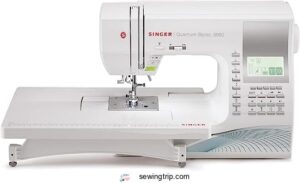
When your quilting room feels more like a closet than a creative command center, the Singer Quantum Stylist offers a solution. With 600 built-in stitches and automatic needle threading, this machine packs a punch in a compact 15″ x 6.25″ x 12″ footprint, perfect for tight spaces.
This sewing and quilting powerhouse provides computerized precision without requiring a dedicated studio. Its drop-in bobbin management and adjustable sewing speed allow you to seamlessly switch between quilting modes and decorative work. The transparent cover ensures thread tension visibility, enabling you to tackle patchwork projects, even in limited spaces.
| Best For | Quilters working in small spaces who need a feature-rich machine that won’t overwhelm their workspace but still delivers computerized precision and versatility. |
|---|---|
| Weight | 14.6 lbs |
| Built-in Stitches | 600 stitches |
| Automatic Needle Threader | Yes |
| Extension Table | No |
| Presser Feet Included | 13 feet |
| LCD Display | No |
| Additional Features |
|
- 600 built-in stitches with automatic needle threading and drop-in bobbin system make it easy to switch between quilting and decorative projects without fuss.
- Compact 15″ footprint fits on standard sewing tables while the lightweight design (14.6 lbs) makes it easy to move or store when space is tight.
- Free-motion quilting mode with included presser feet and adjustable speed control gives you flexibility for both straight-line piecing and creative quilting work.
- The throat plate may be too small for larger quilting projects, limiting your ability to maneuver bulky quilts.
- Mixed reviews on stitching quality suggest performance can be inconsistent, especially for users tackling thick fabric layers.
- The learning curve can be steep for beginners due to the computerized features and the need to frequently consult the manual.
4. Brother Sewing And Quilting Machine
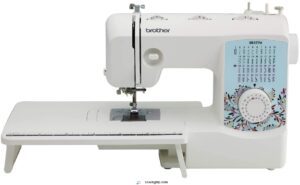
If you’ve outgrown basic features but can’t sacrifice square footage, Brother sewing and quilting machines deliver professional muscle without devouring your workspace. The Brother XR3774 squeezes 37 built-in stitches, including blind hem and decorative options, into a 15.3″ x 5.8″ x 12″ frame weighing just 15 pounds—you can shift it from cutting table to storage shelf without breaking a sweat.
Its automatic needle threader and drop-in bobbin keep setup swift, while the included wide table expands your quilting real estate when baby quilts demand attention, then folds away when you reclaim your room.
| Best For | Beginners and intermediate sewers who need a versatile machine for everyday projects, quilting, and repairs in a compact workspace. |
|---|---|
| Weight | 15 pounds |
| Built-in Stitches | 37 stitches |
| Automatic Needle Threader | Yes |
| Extension Table | Included |
| Presser Feet Included | 8 feet |
| LCD Display | No |
| Additional Features |
|
- 37 built-in stitches with automatic needle threader and drop-in bobbin make setup fast and frustration-free
- Wide extension table gives you extra room for quilting baby blankets and larger projects, then stores neatly away
- Lightweight at 15 pounds with built-in light and free arm design—easy to move and handle different sewing tasks
- Manual stitch selection instead of computerized controls means more hands-on adjustments
- Struggles with thick fabrics like heavy denim seams and lacks an automatic thread cutter
- Analog dials and controls require reading the manual carefully to figure out all the features
5. Brother Computerized Sewing Machine
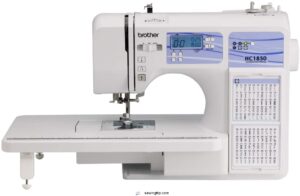
When control over every stitch matters, the Brother HC1850 Computerized Sewing Machine arms you with 185 built-in stitches—130 for sewing, 55 alphanumeric—in a 19.2″ x 12.5″ footprint that won’t hijack your studio. Its LCD display and automatic threading system slash setup time, while precise thread tension and bobbin management keep stitch quality razor-sharp even at high sewing speeds.
You’ll breeze through computerized patterns for quilts or monograms, and the included wide table transforms tight corners into workable real estate without permanently claiming floor space.
| Best For | Sewers who want computerized precision and a wide stitch library without sacrificing desk space—ideal for quilters, crafters, and beginners ready to tackle monograms or decorative projects in compact home studios. |
|---|---|
| Weight | 10.1 pounds |
| Built-in Stitches | 185 stitches |
| Automatic Needle Threader | Yes |
| Extension Table | Included |
| Presser Feet Included | 8 feet |
| LCD Display | Yes |
| Additional Features |
|
- 185 built-in stitches (including 55 alphanumeric options) give you serious creative range for quilting, monogramming, and decorative work without needing multiple machines.
- Automatic needle threader and drop-in bobbin system cut setup frustration to near zero, so you spend more time sewing and less time cursing tangled thread.
- Lightweight at 10.1 pounds and includes a wide table extension, making it portable enough for classes yet spacious enough for larger quilt blocks.
- At 10.1 pounds, the lightweight build can lead to vibration or shifting during high-speed stitching on heavier fabrics.
- 120-volt US-only compatibility limits international use and requires a voltage converter if you move or travel abroad.
- Edge hemming foot and some specialty accessories sold separately, adding to the upfront cost if you need advanced techniques right away.
6. Juki Straight Stitch Sewing Machine
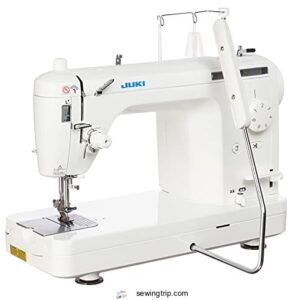
Speed demons, meet the Juki TL2000Qi: this straight stitch sewing machine rockets to 1,500 stitches per minute while its die-cast aluminum frame absorbs vibration, so you can punch through denim, leather, and layered quilt sandwiches without the machine walking across your desk.
At 17.8″ x 8.6″ x 13.8″, it fits compact models’ footprints yet delivers industrial stitch quality and machine durability that slashes repair costs over years of hard use—perfect when small spaces demand Juki’s no-nonsense reliability for serious quilting projects.
| Best For | Quilters and sewers working in tight spaces who need industrial-grade speed and durability for heavy fabrics like denim, leather, and thick quilt layers without sacrificing reliability. |
|---|---|
| Weight | 25.4 pounds |
| Built-in Stitches | Straight stitch only |
| Automatic Needle Threader | Yes |
| Extension Table | Included |
| Presser Feet Included | Multiple |
| LCD Display | No |
| Additional Features |
|
- Blazing 1,500 stitches per minute with low vibration thanks to the die-cast aluminum frame, making quick work of large quilting and heavy-duty projects
- Automatic needle threader and one-pedal operation simplify setup and keep you focused on sewing rather than fiddling with controls
- Extension table included for handling wide fabric pieces, plus the straight stitch design delivers consistent, professional results on multiple layers
- Straight stitch only—no decorative or zigzag stitches, so you’ll need another machine if your projects require variety
- Some users report the needle threader can be finicky or stop working, which means manual threading when it fails
- At 25.4 pounds it’s hefty to move around, and you’ll need to buy a free motion foot separately if you want that quilting option
7. Janome Sewing And Quilting Machine
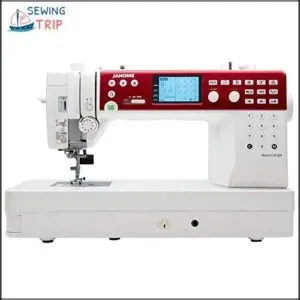
Versatility reigns with the Janome MC6650, a 24.2-pound powerhouse that marries sewing accuracy with quilting speed in a 9″ x 20″ x 12″ footprint.
172 built-in stitches, a built-in needle threader, and a 10″ throat space let you pivot from free-motion quilting to tailoring without swapping machines, reclaiming precious floor space.
Thread tension adjustments and 1,000 stitches per minute keep your projects flowing. Janome models like this deliver machine durability and compact design, proving small spaces don’t mean small ambitions when you choose sewing and quilting combos built for the long haul.
| Best For | Sewers and quilters who want a feature-packed machine that handles both everyday projects and large quilts without eating up their entire workspace. |
|---|---|
| Weight | 24.2 pounds |
| Built-in Stitches | 172 stitches |
| Automatic Needle Threader | Yes |
| Extension Table | Included |
| Presser Feet Included | 12 feet |
| LCD Display | No |
| Additional Features |
|
- 10″ throat space and 172 stitches give you room to tackle everything from intricate quilting blocks to garment construction without feeling cramped
- 1,000 stitches per minute and automatic features like the needle threader and thread cutter speed up your workflow so you spend more time creating
- Adjustable presser foot pressure and extra-high lift let you switch between delicate fabrics and thick layers like denim or leather with ease
- At 24.2 pounds it’s not the easiest machine to move around or take to classes
- Some users report the auto needle threader struggles with synthetic threads and occasional stitch skipping issues
- The instruction manual leaves some users hunting for clearer guidance on features and troubleshooting
8. Bernette Sewing And Quilting Machine
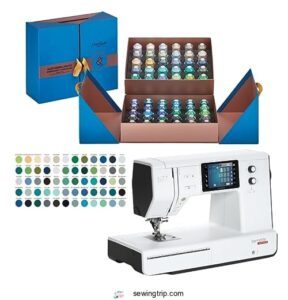
The Bernette B77 delivers 200 built-in stitches, an automatic thread cutter, and dual feed in a 22.95″ x 17.63″ x 13.74″ frame that won’t dominate your sewing corner. User reviews praise this 30.6-pound machine for working with delicate fabrics and leather, and Bernette models generally offer low-shank presser feet compatibility alongside quick-bobbin systems.
Quilting tips for small spaces center on straight-line work with presser-foot guides, and the included 60-piece thread bundle plus eight presser foot soles mean you won’t hunt for Bernette accessories as you start your compact-model sewing and quilting journey.
| Best For | Beginners and hobbyists who want a feature-rich computerized machine with dual feed and 200 stitches but need a compact setup that fits small workspaces. |
|---|---|
| Weight | 30.6 pounds |
| Built-in Stitches | Multiple patterns |
| Automatic Needle Threader | Yes |
| Extension Table | Included |
| Presser Feet Included | 8 soles |
| LCD Display | Yes |
| Additional Features |
|
- Comes with a generous 60-piece thread bundle and eight presser foot soles, so you can start projects right away without hunting for accessories
- Dual feed system and automatic thread cutter make layer management and workflow smoother, especially on longer quilting runs
- Handles a wide range of fabrics from delicate materials to leather, giving you creative flexibility across different project types
- Some users report thread tension issues and problems with stitches not securing properly at the start or end of seams
- Automatic needle threader can break or malfunction, which is frustrating when you’re trying to maintain momentum
- Error messages and occasional motor problems have been mentioned in reviews, and customer support response times aren’t always consistent
Key Features for Compact Quilting Machines
When you’re shopping for a quilting machine that won’t commandeer your entire living space, you need to know which features actually matter and which ones are just marketing fluff. The right compact machine gives you professional-quality results without demanding a dedicated studio, which means understanding the key specs that separate space-smart winners from bulky disappointments.
Let’s break down the four essential features that’ll help you choose a machine that fits your space and your quilting ambitions.
Throat Space and Machine Size
When shopping for a compact quilting machine, throat space—that critical distance from needle to arm—becomes your key factor, usually ranging from 4 to 6 inches in compact models and shaping how freely you’ll maneuver fabric through tight quarters.
Machine sizing and throat depth directly impact quilting ergonomics, so if you’re tackling larger blocks, aim for at least 6 inches to break free from constant repositioning and truly refine your small space setup.
Effective use of clear science techniques can also improve your overall quilting experience.
Stitch Regulation and Speed
When you’re piecing through layers in a tight studio, stitch regulators become your breakthrough for quilting accuracy, letting you dial in consistent stitch lengths from 2.0 to 4.0 mm without second-guessing every seam. Compact models now offer:
- Adjustable speed control (600–1500 SPM) so you can start slow and ramp up confidently
- Real-time thread tension adjustments that keep fabric feed smooth
- Digital displays for fine-tuning in 0.1 mm increments
That precision transforms even modest machines into reliable workhorses worthy of top quilting machine reviews.
To further improve your quilting skills, consider exploring research methodology to boost your understanding of complex patterns and designs.
Computerized Vs. Manual Operation
Once you’ve mastered stitch regulation, you’ll face a liberating choice: computerized controls with automatic threading and saved patterns that hand you precision sewing on a silver platter, or manual operation that demands your dexterity but rewards you with unfiltered control over every quilting technique.
Computerized patterns transform long arm quilting machine work into push-button freedom, while manual models let you rebel against pre-programmed limits and chart your own stitching path.
Portability and Weight
Whether you’re choosing computerized or manual controls, machine mobility matters just as much—because a compact longarm that hinders you to one corner undermines the purpose of space efficiency.
Look for portable frames under 20 pounds with balanced weight distribution and integrated grips, so you can reclaim your tabletop when dinner guests arrive or collapse those foldable tables without recruiting a moving crew.
Choosing The Right Quilting Machine Size
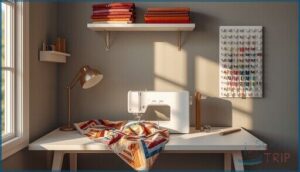
You’ve got to break free from the myth that bigger is always better for quilting machines, because choosing the right size means understanding what your space can actually handle and what your projects truly demand.
The sweet spot lies in balancing throat space, frame dimensions, and setup style so you’re not wrestling with a machine that dominates your room or limits your creative ambitions.
Let’s walk through the key sizing decisions that’ll help you claim your quilting freedom without sacrificing an entire bedroom.
Understanding Throat Space Needs
Throat space—the distance from needle to machine edge—determines how freely you can manipulate fabric during longarm quilting, and choosing the right measurement unlocks quilting efficiency even in tight quarters. Here’s your game plan for workspace optimization:
- Measure your typical quilt width and match throat space to your most ambitious projects for smooth fabric movement.
- Aim for 8+ inches minimum if free-motion quilting fuels your creativity.
- Consider extension tables that expand your working area without commandeering precious square footage.
Small-frame Vs. Mid-arm Options
Once you’ve nailed down throat space, you’ll face the small-frame versus mid-arm showdown—a decision that shapes your quilting speed, arm length, and overall space efficiency.
Small-frame quilting machines squeeze into corners and closets, delivering portability without sacrificing basic long arm quilting machine features, while mid-arm options expand your quilting area per pass, boosting performance on medium projects despite their heftier footprint and price tag.
Tabletop Vs. Stand-alone Machines
Your footprint analysis starts with a simple choice: tabletop quilting machines rest on existing furniture and weigh less, making them space efficiency champions for renters and multi-use rooms. Meanwhile, stand-alone long-arm quilting machine setups demand dedicated floor space but reward you with larger sewing fields, excellent quilting ergonomics, and rock-solid stability that transforms compact longarm performance.
Machine comparison highlights for small space quilters:
- Tabletop models boost portability factors by occupying vertical storage more readily.
- Stand-alone units support heavier quilting machines with integrated stitch regulators and sturdy frames.
- Tabletop configurations adapt quickly when you reconfigure your quilting machine workspace often.
- Stand-alone setups suit long-term optimization in dedicated sewing corners.
Space-Saving Quilting Machine Accessories
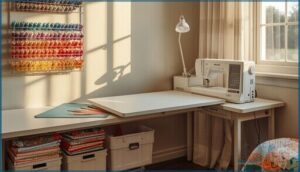
The right accessories can transform your cramped quilting corner into a surprisingly functional workspace, giving you the freedom to tackle projects without battling for every inch.
You don’t need to sacrifice your creative ambitions just because you’re working in a bedroom or basement, since smart add-ons optimize what you’ve already got.
Let’s look at three game-changing accessories that’ll help you reclaim your space and quilt on your own terms.
Foldable Extension Tables
You don’t need a massive studio to spread out your latest masterpiece—foldable extension tables give you the freedom to work big, then tuck everything away when you’re done. These portable tables deploy extra workspace for your quilting machine projects, offering adjustable frames that lock securely for table stability while maximizing space optimization in even the tightest corners.
Whether you’re running a compact longarm or a standard quilting machine, foldable designs adapt to your workflow. Many models include alignment guides for long arm quilting machine setups, anti-slip feet for table stability, and integrated rulers to boost quilting efficiency. Check that hinges lock completely before stitching—wobble kills precision faster than dull needles.
| Feature | Typical Range | Why It Matters |
|---|---|---|
| Extra Surface | 18-24″ width, 12-16″ depth | Accommodates bulky quilts smoothly |
| Weight Capacity | 50-100 lbs | Holds fabric and tools securely |
| Folded Profile | 1.5-3″ thick | Stores vertically or under tables |
| Locking Mechanism | Quick-release clamps | Ensures stability during quilting |
| Material Options | Aluminum or steel | Balances portability with durability |
Compact Quilting Frames
A compact quilting frame lets you break free from the cramped-corner curse, delivering 12 to 20 inches of quilting width without commandeering your entire room. Space optimization meets serious stitching when you choose aluminum or steel frame materials designed for frame portability and machine integration with your long arm quilting machine.
- Foldable legs collapse for vertical storage between projects.
- Adjustable height matches your comfortable working stance.
- Quick-attach rails snap your quilting machine in place instantly.
Multi-purpose Storage Carts
Mobile carts become your sewing studio’s command center, rolling between your quilting machine and cutting table while storing 50 to 150 pounds of fabric, thread, and notions per shelf.
You’ll conquer small space challenges with three- to five-tier cart design options featuring lockable wheels and foldable frames that collapse for storage when your home quilting sessions wrap up, maximizing every square inch of storage capacity.
Setting Up a Quilting Studio in Small Spaces
You don’t need a mansion to create a quilting studio that works beautifully for your projects, and the secret lies in making smart decisions about how you arrange your space. When you’re working with limited square footage, every inch counts, which means you’ll want to focus on room layout, storage that reaches upward instead of outward, and lighting that doesn’t eat up precious floor space.
Let’s break down the three essential elements that will transform your cramped corner into a quilting haven where creativity flows without constantly bumping into furniture or hunting for supplies.
Room Layout and Flow
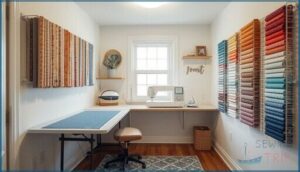
Think of your quilting space as a strategic command center—every inch counts when you’re plotting your creative rebellion. Aisle planning becomes your secret weapon, ensuring at least 36 inches of breathing room between sewing furniture so you can pivot with ease while managing even compact frames.
Here’s how workspace optimization transforms cramped corners into efficient home sewing studios:
- Position cutting and pressing stations along walls to free up your central quilting space
- Design an L-shaped or linear flow that keeps foot traffic away from your active sewing zones
- Install lighting design that eliminates glare on fabric, making precision work feel seamless in tight areas
These spacesaving solutions let you claim full control over your environment, turning limitations into advantages through smart ergonomic setup and storage strategies that actually work.
Utilizing Vertical Storage

Your walls hold untapped quilting freedom—vertical shelving and wall-mounted storage cabinets transform cluttered surfaces into organized command zones. Stack adjustable frames on corner shelves, hang wall racks for rulers and rotary cutters, and tuck foldable tables against unused vertical real estate. Even long-arm quilting machine accessories find homes above eye level, letting your small space breathe while keeping every tool within arm’s reach for maximum creative control.
| Vertical Solution | Best For |
|---|---|
| Wall-mounted cabinets | Thread spools, notions above workspace |
| Adjustable shelving units | Fabric bolts, supply boxes of varying heights |
| Pegboard panels with hooks | Scissors, templates, frequently used tools |
| Corner shelves | Maximizing dead space for small bins |
Lighting Solutions for Tight Areas
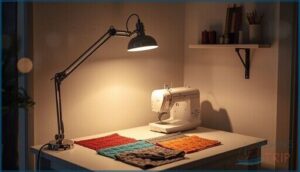
Once you’ve claimed vertical space, proper workspace illumination becomes your next key to success for conquering tight sewing studios. LED options delivering 2,000–4,000 lumens flood your home quilting area with daylight-balanced clarity, while adjustable task lighting with CRI above 90 ensures color accuracy when matching fabrics.
Position fixtures at eye level for shadow reduction, keeping every stitch on your long arm quilting machine or compact quilting machine visible and precise.
Essential Maintenance for Small Space Machines
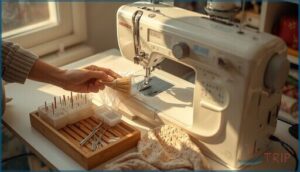
You’ve carved out your perfect quilting corner, but keeping your machine in top shape without a sprawling workshop takes a smarter approach. When space is tight, your maintenance routine needs to work around cramped quarters while still protecting your investment from dust, friction, and wear.
Let’s break down the practical ways you can keep your compact machine running smoothly without sacrificing precious square footage.
Cleaning and Oiling in Limited Areas
Your compact quilting machine craves regular attention, especially when fabric dust swirls through tight quarters. Oil application should target accessible pivot points and needle bars with precision tools, preventing buildup that gums up your sewing machine.
Cleaning intervals need shortening in cramped studios where lint accumulates faster. A soft brush sweeps feed dogs clean, while machine lubrication keeps those moving parts singing—just wipe away excess to stop dust from sticking.
Easy-access Maintenance Tips
You don’t need a contortionist’s flexibility to maintain your quilting machines—smart placement of your oil bottle, lint brush, and spare needles within arm’s reach transforms machine cleaning from a chore into a quick ritual. Keep a small flashlight near your long arm quilting machine to spot hidden thread fragments under the needle plate, and maintain a simple log tracking your sewing machine maintenance dates.
Regularly check thread tension and refresh bobbin care practices to prevent frustrating mid-project hiccups, while organizing your tool kit in a compact pouch ensures you’ll spend more time quilting and less time hunting for that elusive screwdriver.
Storing Machine Tools Efficiently
Once you’ve mastered quick maintenance, your next breakthrough is smart tool organization. Magnetic strips along your table edge corral scissors and seam rippers, while shallow compact shelves transform awkward corners into efficient storage solutions for your crafting tools.
Label clear stackable bins to house bobbins, needles, and oil bottles, creating an efficient layout that keeps your quilting machine accessories visible and your sewing machine maintenance routine delightfully simplified.
Maximizing Efficiency in Limited Workspaces
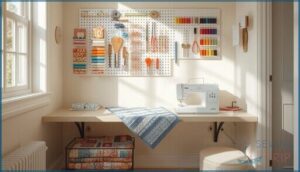
When you’re working with a small quilting space, every square inch counts, and smart organization can be the difference between a cramped mess and a creative haven. You don’t need a sprawling studio to quilt efficiently—you just need to set up systems that let you move quickly between tasks without tripping over fabric stacks or hunting for the right thread.
Here are three game-changing strategies that’ll help you reclaim your workspace and keep your quilting momentum strong.
Organizing Quilting Supplies
You’ll unleash a new level of creative freedom when you turn supply chain management into your secret weapon—designated storage for frequently used crafting tools keeps your quilting machine workspace humming.
Clear labeled notion containers slash search time for threads, while vertical shelving maximizes every inch for fabric storage and sewing and quilting essentials, transforming chaos into a well-organized command center.
Streamlining Fabric Preparation
A portable cutting mat with a grid becomes your breakthrough for fabric cutting precision, letting you square edges and plan layouts within six inches to slash waste.
Press sections with steam, then apply uniform quarter-inch seam allowances using a magnetic guide—this quilting workflow keeps your sewing and quilting rhythm flowing.
Batting selection and fabric stabilization techniques prevent puckering, transforming prep chaos into smooth quilting techniques mastery.
Quick-change Threading and Bobbins
Thread management transforms your workspace when you adopt quick-change systems that slash setup from minutes to seconds, giving you control over every stitch. Long arm quilting machine owners and compact sewing machine users alike benefit from drop-in bobbin types and threading sensors that maintain tension control across polyester, cotton, and specialty threads:
- Drop-in bobbins enable changes in under 15 seconds
- Color-coded threading sensors guide correct paths instantly
- Quick change systems reduce setup by 25–60 seconds
- Tension control stays consistent within 0.2 mm accuracy
- Compatible bobbin types (class 15, low-profile) expand thread options
Regular cleaning around the bobbin housing keeps your quilting machines performing like precision instruments. When comparing quilting machine features in any quilting machine buying guide, prioritize models with jam-resistant cases that won’t slow your creative momentum.
Quilting Techniques for Smaller Machines
Working with a smaller quilting machine doesn’t mean you can’t tackle ambitious projects or achieve professional results, you just need to adapt your approach and lean into techniques that make the most of your compact setup. The key is understanding how to manage fabric flow, break down larger designs into manageable sections, and use smart workarounds that save both space and frustration.
Let’s explore three game-changing techniques that will help you quilt confidently, no matter how tight your workspace might be.
Managing Large Projects in Tight Spaces
You don’t need a massive studio to tackle king-sized quilts—you just need a smarter game plan. Break your project into modular sections that fit your longarm or standard quilting machine’s throat space, then set time-boxed milestones to keep momentum rolling.
Vertical storage and waste-minimization practices free up precious floor space, while dedicated lighting ensures your workflow efficiency stays sharp even when square footage doesn’t.
Adapting Patterns for Compact Machines
Scaling down grand designs isn’t surrender—it’s liberation. Reduce full patterns by 75 percent for your compact longarm’s 4–6 inch throat, then simplify motifs into repeatable blocks that align with narrow seam allowances.
Use quilt simulation software to preview fabric optimization before you cut, and lean on stitch regulation to maintain consistency when piecing those smaller, bolder quilting projects and patterns.
Tips for Smooth Fabric Movement
Smooth fabric guidance transforms your small-space sewing and quilting machine into a precision powerhouse. Keep these fundamentals locked in for impeccable free motion quilting:
- Match fabric tension to thread selection—mismatched pairs cause puckering and skipped stitches that derail stitch quality.
- Calibrate your quilting machine regularly to prevent feed dog drift on dense layers.
- Guide with light fingertips, not heavy palms, maintaining steady wrist control.
- Clean your long arm quilting machine’s bobbin case after every major project to eliminate lint-induced resistance.
Comparing Compact Long Arm and Standard Machines
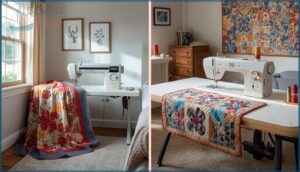
You might be wondering if a compact long arm machine can truly match the power of a standard quilting setup, especially when you’re working within the confines of a spare bedroom or cozy craft corner. The good news is that today’s space-saving long arms pack serious punch, though they do come with a few trade-offs you’ll want to understand before making your investment.
Let’s break down how these two machine types stack up regarding benefits, performance, and what you’re really getting for your money.
Long Arm Benefits in Small Spaces
You’ll find that long arm quilting machines offer surprising advantages even in cramped quarters, thanks to their ergonomic design and smart space optimization. Compact frames let you quilt larger swaths without constant repositioning, which boosts quilting efficiency and saves your back from strain.
If you choose a portable longarm on a wheeled stand, you can reconfigure your small space on the fly, maximizing every square inch while enjoying spacesaving professional results.
Performance Differences
When you compare compact long arm quilting machines to standard models, performance differences surface quickly—motor efficiency and precision control shine in longarm units, while speed variance (600 to 1,200 stitches per minute) lets you dial in the best quilting machines for intricate work. Here’s what sets them apart:
- Stitch Quality: Longarm quilting machines maintain consistent density at higher speeds
- Fabric Handling: Needle-feed mechanisms reduce shifting in tight quarters
- Speed Control: Variable settings match your project complexity
- Regulation Systems: Electronic options deliver smoother curves in cramped studios
Cost and Feature Trade-offs
Now let’s talk money—budget analysis matters when you’re weighing compact long arm quilting machine options against standard models. Entry-level quilting machines start around $100, mid-range units hit $400 to $800, and feature prioritization becomes critical as computerized controls add $150 to $500.
Cost efficiency means balancing throat space, stitch regulation, and portability; tradeoff strategies help you pick the best quilting machines without breaking the bank.
Storage Solutions for Quilting in Small Areas
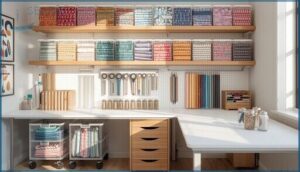
When you’re working with a small quilting space, smart storage becomes your secret weapon for reclaiming control over your creative domain. You’ll discover that every vertical inch and hidden corner can transform into valuable real estate for your fabric stash, tools, and notions.
Let’s explore three game-changing storage strategies that’ll help you break free from clutter and optimize your quilting sanctuary.
Wall-mounted Shelving Ideas
When floor space feels like enemy territory, wall-mounted shelving becomes your rebellion’s secret weapon for storage solutions and space optimization. Floating shelves can support 20–40 pounds, perfect for quilting supplies and your long arm quilting machine accessories.
Corner units capture wasted vertical real estate, while adjustable brackets let you customize shelf organization as your sewing and quilting empire grows—transforming bare walls into functional wall decor that actually works for you.
Under-table Storage Bins
The hidden frontier beneath your quilting machine table holds surprising potential for bin organization and storage solutions when you reclaim that space with clear-labeled bins featuring snap-tight lids.
Smart table management transforms chaos into efficient quilting accessories storage, keeping threads, bobbins, and rotary cutters within arm’s reach while you work on your long arm quilting machine.
- Stackable modular bins optimize vertical space without stealing precious legroom
- Clear-front containers let you spot exactly what you need without rummaging underneath
- Color-coded systems organize by project stage, turning quilting machine comparison shopping into actual productivity
Mobile and Modular Storage Options
Rolling carts with locking wheels transform how you maneuver your quilting machine maintenance supplies in cramped quarters, offering 360-degree pivoting freedom that no fixed shelf can match. Modular shelves stack from 2-tier to 5-tier configurations without eating extra floor space, while folding tables collapse flat to reclaim 60% of your workspace when your long arm quilting machine dominates the space.
Compact racks and storage bins transform vertical walls into clever command centers for all your sewing and quilting essentials.
Frequently Asked Questions (FAQs)
Can I quilt king-sized projects in small spaces?
Absolutely—your king-size dreams aren’t dead yet. Modular frames, wall-to-wall setups that fold like a Murphy bed, and segmented stitching let you conquer oversized projects even in a closet-sized studio without sacrificing quality or your sanity.
How do I prevent fabric bunching on compact machines?
Control fabric tension by lowering presser foot pressure slightly, using a walking foot to synchronize layers, and maintaining steady quilting speed with consistent stitch length—these adjustments prevent bunching on compact longarm and freemotion quilting machines.
Whats the quietest quilting machine for apartment living?
When neighbors share walls, modern brushless servo motors are your ticket to freedom—delivering professional stitching under 60 dB.
Noise reduction transforms apartment quilting, letting you create at any hour without the guilt.
How often should I service a space-saving quilting machine?
Plan on monthly inspections for your quilting machine, with professional servicing every 12-24 months depending on usage intensity.
Daily quilters need more frequent attention, while warranty coverage often requires documented maintenance schedules to stay valid.
Conclusion
Picture your quilting corner humming with purpose: fabric gliding under the presser foot, your machine tucked neatly into its designated nook, and every tool within arm’s reach.
Finding the right quilting machines for small spaces isn’t about compromise—it’s about claiming your creative territory with intention.
You’ve got the knowledge, the machine lineup, and the setup strategies to build a studio that defies square footage, so stake your claim and start stitching without apology.
- https://onlinepubs.trb.org/onlinepubs/nchrp/cd-22/manual/v1appendixb.pdf
- https://academichelpexpress.blog/2024/08/please-use-the-bulleted-points-and-the-rubric-below-to-guide-your-work-your-pa/
- https://www.linkedin.com/posts/bohdanlukianets_tasks-study-research-activity-7373377539521667072-UTEi
- https://www.writingclearscience.com.au/category/writing-guides/writing-research-papers/page/2/
- https://www.sciencedirect.com/science/article/pii/S0749208123000268