This site is supported by our readers. We may earn a commission, at no cost to you, if you purchase through links.
Your first quilt block looked perfect until you measured it. Off by a quarter inch. Then another block, another eighth inch gone. Before you know it, your entire quilt top refuses to lie flat, and those careful seams pucker instead of nest.
The culprit? A flimsy ruler that slips mid-cut or markings so faint you’re squinting and guessing. Precision cutting isn’t about perfectionism—it’s about saving yourself hours of frustration and wasted fabric.
The right quilting rulers for precision cutting give you the control you need, with non-slip grips, crystal-clear markings, and sturdy acrylic that won’t flex under your rotary cutter.
Table Of Contents
Key Takeaways
- Precision cutting with quality quilting rulers prevents common problems like blocks that don’t lie flat, puckered seams, and wasted fabric caused by inaccurate measurements.
- The most important ruler features are non-slip surfaces that anchor your cuts, high-contrast markings visible on any fabric color, durable acrylic construction (1/8 to 1/4 inch thick), and clear gridlines with 1/8-inch increments.
- Different ruler types serve specific purposes: slotted rulers cut consistent fabric strips quickly, square rulers (6×6 or 12×12) square up blocks accurately, rectangle rulers (6×24) handle long cuts and wide panels, and specialty shapes tackle triangles and curves.
- Proper technique matters as much as the ruler itself—use even hand pressure at multiple contact points, cut away from your body on a stable mat, prep fabric with light starch to reduce slippage, and store rulers flat to prevent warping.
Key Features of Quilting Rulers for Precision Cutting
The right quilting ruler can mean the difference between a perfect block and a frustrating do-over.
If you’re exploring longarm options, this guide to quilting rulers for longarm quilting breaks down the features that matter most.
When you’re shopping for rulers, you’ll notice certain features pop up again and again, and they’re worth your attention. Let’s look at the key features that make a quilting ruler worth adding to your toolkit.
Non-slip Surfaces and Stability
A nonslip ruler anchors your cuts with grip materials like rubber and silicone that provide friction control on your work surface. Surface textures—dimples, crosshatch patterns, and micro-ridges—keep quilting rulers planted when you apply rotary pressure.
Ruler weight and stability features matter too; heavier options with uniform mass distribution resist sliding during long, straight cuts. Brands like Omnigrid Omnigrip and non-slip acrylic quilting rulers deliver that solid, wobble-free base you need for precision work.
Clear Gridlines and High-contrast Markings
Gridline visibility transforms your cutting accuracy. High contrast markings—bold black on clear acrylic or bright yellow on dark fabrics—keep your edges aligned every time.
Creative Grids Stripology XL and Omnigrid Omnigrip feature crisp 0.6 mm line thickness that won’t obscure your seam allowances. Look for marking durability that resists fading after hundreds of cuts, and edge clarity that stays sharp under your rotary blade!
Durable Acrylic Materials and Thickness Options
Once you’ve got those crisp lines, your acrylic thickness matters just as much! Quality acrylic rulers range from 1/8 to 1/4 inch thick, giving you the stability your cuts demand.
Choose acrylic rulers with polished edge finishing to prevent snagging. Watch for these durability markers:
- Cast acrylic with tight tolerances for cutting accuracy
- UV-stable formulas that won’t yellow over time
- Scratch-resistant surfaces preserving your gridlines
Non slip acrylic quilting ruler options withstand daily workshop wear!
Imperial Vs. Metric Scale Markings
Your ruler’s scale system shapes every cut you make. Imperial markings show fractional inches like 1/8 and 1/4 for traditional seam allowances, while metric scales offer millimeter precision for modern patterns.
Dual-scale quilting rulers eliminate measurement conversion headaches, giving you both unit standards on one tool. This ruler accuracy ensures cutting precision whether you’re following vintage quilting tools or contemporary fabric cutting guides.
For a deeper dive into imperial and metric system differences, see how each system impacts measuring tools.
Types of Quilting Rulers and Their Uses
Not all quilting rulers are created equal, and choosing the right type can make your cutting faster and more accurate.
Each ruler shape has a specific purpose, from cutting strips to squaring up blocks. Let’s look at the main types you’ll want in your quilting toolkit and how each one helps you work smarter.
Slotted Rulers for Strip Cutting
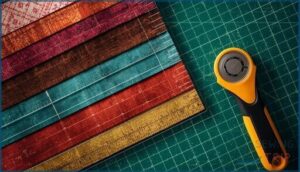
You’ll love slotted rulers for cutting consistent fabric strips every single time. These quilting rulers feature grooves that guide your blade for precision cutting, with slot spacing usually at 1/4 or 1/2 inch intervals.
The Stripology XL Ruler is popular for its multiple subcut options. You can stack several fabric layers and slice through all at once, making strip work fast and accurate. Many quilters appreciate the time-saving benefits and cutting capabilities of slotted rulers for efficiently preparing quilt pieces.
Square Rulers for Block Squaring
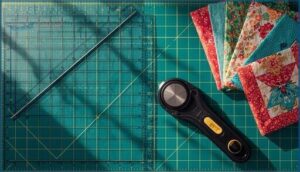
After piecing a block, you need precision to guarantee block accuracy and clean edges. Square rulers deliver that control. Their clear grids and high-contrast lines make fabric trimming quick and reliable.
Here’s why square rulers boost cutting efficiency:
- Corner alignment – Built-in notches help you position blocks flush with gridlines for perfect right angles.
- Size options – Common 6×6 and 12×12 formats match traditional patchwork layouts.
- Squaring techniques – Trim both sides to correct crooked edges after sewing.
- Ruler calibration – Inch scales with 1/8″ subdivisions let you measure down to the smallest detail.
Fiskars sewing ruler and Creative Grids Stripology XL offer trusted quality for quilting and sewing projects.
Rectangle Rulers for Versatile Cuts
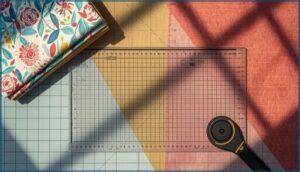
When strip piecing or trimming yardage, you need a tool that gives you reach and flexibility. Rectangle rulers deliver both—their long edges guide rotary blades through wide fabric panels, and clear acrylic construction keeps your cutting line visible from any angle.
| Feature | Typical Specs | Why It Matters |
|---|---|---|
| Size Options | 6×12″, 6×24″ | Match your project scale |
| Ruler Material | Clear acrylic, 1/8″–3/16″ thick | Balance durability and weight |
| Grid Spacing | 1/8″ or 1/4″ increments | Boost cutting accuracy |
| Markings | High-contrast white or black | Improve fabric control |
| Non-Slip Coating | Micro-grip bottom | Secure edge alignment |
Rectangle sewing rulers from Fiskars and Creative Grids offer both imperial and metric scales, so you can switch between seam allowances without second-guessing. Their dual-sided markings support horizontal and vertical cuts, saving repositioning time. For quilting precision and reliable fabric control, choose a ruler with shatter-resistant acrylic—it won’t crack if you drop it mid-project. Quality quilting rulers and quilting supplies protect your investment and keep every cut clean.
Specialty Shapes: Triangles, Circles, and More
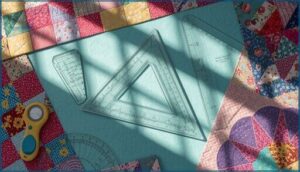
When your pattern calls for Dresden plates or flying geese, specialty shapes transform tricky cuts into straightforward steps.
A circle quilting template guides smooth arcs for appliqué, while triangle block design rulers guarantee perfect 60° or 45° angles.
Reuleaux shape quilting adds curved intrigue to modern layouts. Pair a slotted quilting ruler with a quilting seam alignment ruler in your quilting ruler set—you’ll tackle any geometric challenge with confidence.
Top Quilting Rulers for Precision Cutting
You’ve got plenty of options in the area of precision cutting rulers, but not all of them deliver the same quality.
I’ve narrowed down the field to six standout choices that combine clear markings, stable grip, and reliable accuracy. Let’s look at each one so you can find the perfect match for your quilting projects.
1. Fiskars Sewing Ruler Tool
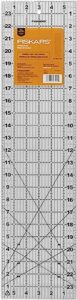
When you’re ready to cut straight from the bolt fabric or tackle long fabric strips, the Fiskars 6″x24″ ruler gives you serious control. Its two-toned markings stay visible on light and dark fabrics, while angle indicators at 30, 45, and 60 degrees help you nail perfect bias cuts every time.
Made from durable acrylic, it won’t warp during marathon cutting sessions. You can add optional non-slip vinyl feet to keep everything steady, though some quilters find the lightweight design takes getting used to.
| Best For | Quilters and sewists who regularly cut long fabric strips or work directly from the bolt and need clear angle guides for bias cuts. |
|---|---|
| Material | Acrylic |
| Primary Use | Quilting and sewing |
| Visibility Feature | Two-toned markings |
| Angle Markings | 30°, 45°, 60° |
| Non-slip Feature | No |
| Made in | Not specified |
| Additional Features |
|
- Two-toned grid markings stay visible on both light and dark fabrics, so you don’t lose your place mid-cut
- Built-in 30-, 45-, and 60-degree angle lines make bias cuts and perfect triangles way easier
- Includes a carrying handle that makes it simple to move between your cutting table and storage
- The lightweight acrylic feels a bit flimsy and can break if you drop it on a hard surface
- Not great for cutting small pieces under 1.5 inches since the ruler is so large
- May slide around during cutting unless you add aftermarket grip pads to the bottom
2. Omnigrid Quilting Ruler
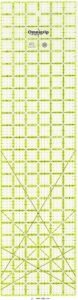
The Omnigrid 6″x24″ ruler brings laser-cut precision to your cutting table with its neon green lines that pop against any fabric color. You’ll love the left and right hand numbering system, which makes measuring natural no matter which hand you prefer.
The non-slip backing grips your fabric firmly while you guide your rotary cutter along those crisp edges. With 1/8-inch increments and a diagonal bias line, you can tackle angle cuts confidently without second-guessing your measurements.
| Best For | Quilters and sewists who need precise cuts on smaller fabric pieces and want clear visibility with a ruler that stays put during cutting. |
|---|---|
| Material | Plastic |
| Primary Use | Quilting and crafting |
| Visibility Feature | Neon lines |
| Angle Markings | Angle system included |
| Non-slip Feature | Yes |
| Made in | Not specified |
| Additional Features |
|
- Neon green lines stand out against any fabric color, making measurements easy to read
- Non-slip backing keeps the ruler stable while you cut, reducing mistakes
- Left and right numbering system works naturally for both right and left-handed users
- Only measures in inches (no metric markings for those who prefer centimeters)
- Some users report the ruler can still shift during use despite the non-slip backing
- Quality control issues mean you might receive a damaged product
3. Slotted Quilting Ruler for Precise Fabric Cutting
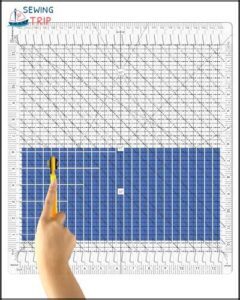
The Karpoulra 12×12 slotted ruler transforms repetitive strip cutting into a smooth, efficient process. You’ll cut strips at 1/2-inch intervals through those 26 grooves without constantly measuring and realigning your fabric. The double-color sight lines work beautifully on both light and dark fabrics, while the nonslip silicone grips keep everything stable as you work.
At 12×12 inches, you can cut squares, triangles, and binding strips with consistent accuracy. Just note that the slots may feel snug with larger rotary cutters.
| Best For | Quilters who cut a lot of strips and need consistent, repeatable measurements without constantly marking their fabric. |
|---|---|
| Material | Acrylic |
| Primary Use | Quilting and sewing |
| Visibility Feature | Double color sight lines |
| Angle Markings | 45°, 60° |
| Non-slip Feature | Yes |
| Made in | Not specified |
| Additional Features |
|
- 26 pre-marked grooves let you cut half-inch strips instantly without measuring each time
- Double-color sight lines make it easy to see your measurements on any fabric color
- Nonslip silicone grips keep the ruler from sliding around during cuts
- The slots might be too narrow if you use a larger rotary cutter
- Not the best choice for cutting longer fabric pieces beyond 12 inches
- Acrylic can crack or break if you drop it or handle it roughly
4. Acrylic Quilting Rulers Set
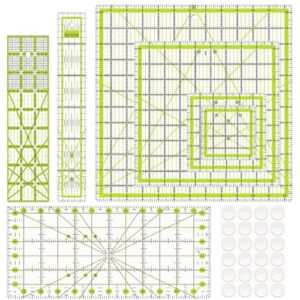
The ZICALSO Acrylic Quilting Rulers Set gives you seven different sizes in one package, so you’ll have the right tool for squaring blocks, trimming seams, and cutting binding strips. These yellow-green rulers feature non-slip rings that grip your fabric securely, while clear markings help you measure accurately every time.
At just 2.05 ounces for the whole set, they’re lightweight yet sturdy enough for daily use. The hanging holes make storage simple, and you’ll find them perfect for quilting, sewing, and even scrapbooking projects.
| Best For | Quilters and crafters who need a complete set of rulers for accurate fabric cutting, trimming, and measuring across different project sizes. |
|---|---|
| Material | Acrylic |
| Primary Use | Quilting and sewing |
| Visibility Feature | Clear markings |
| Angle Markings | Not specified |
| Non-slip Feature | Yes |
| Made in | Not specified |
| Additional Features |
|
- Seven different ruler sizes give you versatility for squaring blocks, trimming seams, and cutting binding strips
- Non-slip rings keep fabric in place for precise cuts without shifting
- Lightweight acrylic construction with hanging holes makes storage and handling easy
- Protective film can leave sticky residue that’s annoying to remove
- One ruler uses centimeter markings instead of inches, which might confuse some users
- Quality control issues mean you might get rulers with marks or film residue out of the box
5. Creative Grids Quilting Ruler Tool
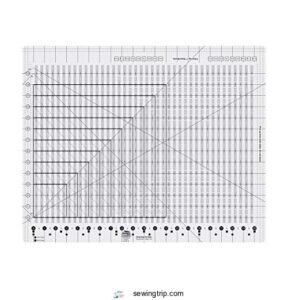
The Creative Grids Quilting Ruler Tool brings professional-level precision to your cutting table with its 17-3/4in x 22in size, perfect for handling larger fabric pieces.
You’ll love the non-slip grip embedded on the underside, which holds your fabric firmly in place with just light pressure. The high-contrast black markings stay visible on both light and dark fabrics, and you’ll find cutting slots every 1/2in plus handy 45 and 60 degree angles for triangles and diamonds.
At $81.99, it’s an investment in accuracy.
| Best For | Quilters and sewers who work with large fabric pieces and need professional-grade accuracy for cutting strips, squares, and angled shapes. |
|---|---|
| Material | Acrylic |
| Primary Use | Quilting and sewing |
| Visibility Feature | Black and white markings |
| Angle Markings | Not specified |
| Non-slip Feature | Yes |
| Made in | Not specified |
| Additional Features |
|
- Non-slip grip keeps fabric secure during cutting, reducing mistakes and fabric waste
- Clear black and white markings with multiple measurement options (whole, half, quarter inch) work on any fabric color
- Built-in angle guides at 45 and 60 degrees make cutting triangles and diamonds simple
- High price point at $81.99 may be out of reach for hobby sewers or beginners
- Static electricity can sometimes cause fabric to shift despite the non-slip surface
- Instruction manual contains typos that could lead to cutting errors if you’re not careful
6. Omnigrid Quilting Ruler Set
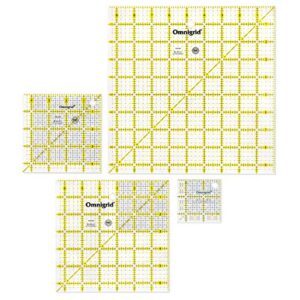
If you’re looking for a complete set that covers all your bases, the Omnigrid Quilting Ruler Set delivers four square rulers in one package: 2-1/2″, 4-1/2″, 6-1/2″, and 9-1/2″. You’ll reach for these constantly when squaring blocks and trimming units.
The heavy-duty acrylic stands up to repeated rotary cutting, and the patented double-sight lines make measurements readable on any fabric color. Left- and right-hand numbering means you won’t struggle regardless of which hand you favor. At 13 ounces total, they’re substantial without feeling bulky.
| Best For | Quilters who want a versatile set of square rulers in the most commonly used sizes without buying each one separately. |
|---|---|
| Material | Acrylic |
| Primary Use | Quilting and sewing |
| Visibility Feature | Black and white markings |
| Angle Markings | 45°, 60° |
| Non-slip Feature | Yes |
| Made in | USA |
| Additional Features |
|
- Includes four essential sizes (2-1/2″, 4-1/2″, 6-1/2″, 9-1/2″) so you’re covered for most squaring tasks
- Double-sight lines work on both light and dark fabrics, making measurements easy to read
- Ambidextrous numbering system works whether you’re left- or right-handed
- Can slip on certain fabrics unless you add grip accessories
- Yellow markings might blend in with similar-colored materials
- Not ideal for very large quilting projects that need bigger rulers
How to Choose The Right Quilting Ruler
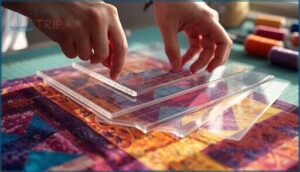
Picking the right quilting ruler isn’t about grabbing the first one you see—it’s about matching the tool to your work. You’ll want to think through a few key factors before you buy, from the size of your projects to how well the ruler stays put under pressure.
Let’s break down what really matters so you can choose with confidence.
Project Size and Quilting Style Considerations
Your quilt size planning and quilting workflow directly shape which ruler you’ll reach for. Larger bed quilts demand long rectangle rulers for efficient fabric cutting and block layout, while wall hangings work beautifully with smaller squares.
Consider these essentials:
- Baby quilts need compact rulers for manageable fabric estimation and precise cutting
- Queen-size projects benefit from slotted rulers that simplify strip work
- Miniature quilting patterns require specialty shapes for tight accuracy
Importance of Non-slip Features
Slip resistance transforms your cutting accuracy. Non-slip acrylic quilting rulers with textured surfaces reduce slippage by 40 to 60 percent, giving you edge stability that prevents mid-cut shifts.
That microgrip texture on your sewing ruler holds fabric firmly without snagging threads, so you’ll maintain a true 90-degree angle throughout long cuts. Better fabric grip means fewer do-overs and less wasted material—essential quilting aids for precision fabric cutting.
Evaluating Ruler Thickness and Durability
Thickness determines stability. A 3 to 4 mm non slip acrylic quilting ruler resists bending under rotary pressure, keeping your cuts true. Check the edge finish—smooth surfaces prevent fabric snags during alignment.
Surface flatness matters too; quality quilting rulers maintain consistent thickness tolerance within 0.2 mm, so your quilting ruler set delivers reliable calibration methods across every slotted quilting ruler and quilting seam alignment ruler you own.
Tips for Using Quilting Rulers Effectively
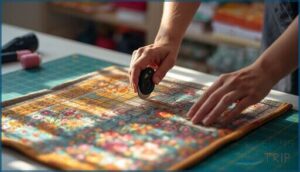
Even the best quilting ruler won’t deliver perfect cuts if you’re not using it correctly.
The right techniques make all the difference between frustrating fabric shifts and clean, accurate lines every time.
Let’s walk through the essential practices that’ll help you get the most from your ruler and keep your cuts spot-on.
Proper Alignment and Grip Techniques
Your cuts are only as straight as your grip allows. Hand positioning starts with palms facing each other, thumbs along the ruler’s side for control. Finger placement matters—press down at multiple contact points to distribute pressure evenly. Keep wrists neutral to maintain ruler stability and cutting accuracy.
- Lead hand: Form a stable C shape with thumb and forefinger around the non-slip acrylic quilting ruler edge for precise alignment
- Trail hand: Wrap around the back of your quilting seam alignment ruler, using your index finger for minor adjustments
- Grip control: Apply light, even pressure across slotted quilting ruler or sliding gauge ruler to prevent shifting
- Body position: Stand beside the cut line—leaning introduces drift and ruins quilting rulers’ accuracy
Preventing Fabric Slippage
Even the best quilting rulers won’t help if your fabric shifts mid-cut. Start by prepping your material—light starch irons out wrinkles that create movement under pressure. Match your cutting mat to your ruler’s edge geometry for stability, and consider ruler stabilizers or non-slip coatings when working with slippery fabrics.
| Method | Best For | Key Benefit |
|---|---|---|
| Starching fabric before cutting | Cotton and linen quilting projects | Reduces weave movement and fabric creep |
| Omnigrid Omnigrip or Creative Grids with textured backing | All fabric types and sewing ruler tasks | Enhanced fabric grip without repositioning |
| Self-healing cutting mat with grid lines | Precision fabric measurement work | Maintains ruler alignment and reduces drift |
Maintaining and Cleaning Your Quilting Rulers
Your quilting rulers work hard for you, so return the favor with simple acrylic care. After each session, wipe away fabric residue and lint with a soft damp cloth to keep grid maintenance sharp.
Avoid harsh cleaning solutions that scratch or fade markings. Store rulers flat in dedicated ruler storage to prevent warping, and inspect quarterly for nicks that compromise precision cuts.
Safety Tips for Rotary Cutting With Rulers
Blade safety starts with keeping your rotary cutter closed between cuts and fingers well behind the cutting line.
Proper cutting posture—standing at a comfortable height with elbows tucked—reduces strain and prevents slips. Use hand protection by steadying your quilting rulers firmly, and always cut away from your body on a stable rotary cutting mat for injury prevention.
Frequently Asked Questions (FAQs)
Can you cut multiple fabric layers simultaneously?
Think of fabric stacking like a sandwich—you can slice through multiple layers at once.
With sharp rotary blades and a stable cutting mat, you’ll cut four to eight woven fabric layers cleanly.
How do you store rulers properly?
Keep your sewing ruler collection safe by storing them flat in shallow drawers, upright in wall-mounted racks, or inside protective cases.
Proper shelf management and edge protection prevent warping and extend your quilting rulers’ lifespan.
Whats the best ruler size for beginners?
A 6 by 12 inch sewing ruler gives you handling ease for small projects and enough project versatility to grow.
This beginner ruler size won’t overwhelm your workspace or strain your initial investment budget.
Do left-handed quilters need special rulers?
Left-handed rulers with mirrored markings and reversed readings aren’t essential, but they do make measuring easier.
Lefty-friendly designs with non-slip edges help you read measurements naturally without twisting your wrist awkwardly.
How often should you replace quilting rulers?
Replace your quilting rulers when edge wear causes nicks, markings fade beyond readability, or accuracy checks reveal consistent measurement drift.
Visible cracks, warping, or compromised non-slip surfaces also signal it’s time for new quilting supplies and materials.
Conclusion
Think of your quilting ruler as the foundation under your house—if it shifts even slightly, everything above it goes crooked. The best quilting rulers for precision cutting keep your blocks square, your seams aligned, and your sanity intact.
Now that you’ve got the right tools in hand, you’re ready to cut with confidence. No more guessing, no more ripping out seams. Just clean lines and blocks that fit the first time.