This site is supported by our readers. We may earn a commission, at no cost to you, if you purchase through links.
A crooked cut at the wrong angle can ruin an entire afternoon of careful fabric planning. Most quilters learn this the hard way—usually somewhere around their third attempt at a precise 45-degree strip.
The right fabric cutting mat for quilting projects doesn’t just protect your table; it keeps your blade sharp, your lines true, and your squares actually square. With dozens of options crowding the market, knowing what separates a mat worth owning from one that warps after a season becomes the difference between frustration and clean, confident cuts every time.
Table Of Contents
Key Takeaways
- A self-healing mat, made of multi-layer PVC (at least 3mm thick), keeps your rotary blade sharp and your cuts accurate far longer than basic plastic surfaces.
- A 24×36 inch mat hits the sweet spot for most quilters—big enough for fat quarters and long strips, without hogging your whole table.
- Built-in angle guides at 30, 45, and 60 degrees let you cut triangles and bias strips right on the mat, no extra rulers needed.
- Store your mat flat, away from heat and direct sunlight, and rotate your cutting position regularly to spread wear evenly and squeeze years of use out of it.
Key Features of Fabric Cutting Mats for Quilting
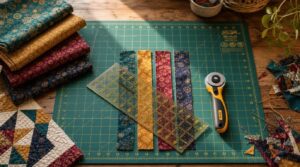
Not all cutting mats are created equal, and knowing what to look for can save you time and frustration at your cutting table.
A quality mat also works great as a protective layer under your machine during cleanups—something worth keeping in mind when you tackle sewing machine repair and maintenance at home.
The right key features make cutting fabric faster, more accurate, and honestly just easier on your hands and back. Let’s walk through the key features that separate a good cutting mat from one that’ll end up collecting dust in your closet.
Self-Healing Surface Technology
A self-healing cutting mat closes up after your rotary blade slices through, keeping the surface smooth for fabric cutting. The top layer uses flexible PVC that compresses under pressure, then bounces back to minimize visible scarring. This healing mechanism protects both your blade and your work surface.
For more details about how these mats help protect work surfaces from cuts, you can find additional resources online.
- Shallow cuts heal best, maintaining cutting accuracy over time
- Multi-layer construction balances surface durability with mat longevity
- Even pressure prevents deep gouges that stop healing properly
Grid Lines and Measurement Markings
Grid lines and measurement markings turn your mat into a built-in ruler for precision cutting. Most mats print a full one-inch grid with hash marks at 1/4 or 1/8 inch to help you line up fabric edges quickly. Look for angle markings at 30, 45, and 60 degrees—they’re lifesavers when cutting triangles or bias strips with your rotary cutter.
| Feature | Purpose | Benefit |
|---|---|---|
| 1-inch grid | Aligns fabric edges | Speeds up cutting setup |
| Angle lines (30°, 45°, 60°) | Guides triangle and bias cuts | Ensures cutting precision without math |
| Hash marks (1/8″, 1/4″) | Marks narrow strips | Improves measurement tools accuracy |
Higher-end mats use color-coded systems and visual hierarchy—thicker lines at full inches, thinner ones for smaller increments—so your eye catches the right mark instantly. Some even highlight common precut sizes like 2 1/2-inch strips with stars or squares, which makes repetitive cuts faster.
Just remember that grid accuracy matters: tiny errors can add up across many strips, so pick one reference system—either your mat or your acrylic ruler—and stick with it throughout your project. For more guidance on choosing a self-healing cutting mat, consider mat thickness, surface texture, and angle markings.
Non-Slip Backing and Stability
A grippy base keeps your cutting mat locked to the table so it won’t slide when you lean on your ruler or push a rotary cutter through layers. Most quilting cutting mats use rubberized nonslip backing that grips laminate, wood, or plastic without leaving residue.
- Grip Materials: Rubber or textured undersides add friction to common sewing tables
- Rotary Safety: Stable mats reduce blade slips and accidental overcuts
- Mat Thickness: Heavier self-healing cutting mats sit more solidly and resist curling
- Stability Features: Rotating models keep the base planted while the top spins freely
Surface Texture and Blade Compatibility
The surface finish on your cutting mat directly affects blade sharpness and cutting accuracy. A smooth, slightly grippy texture lets your rotary cutter glide without catching, while rough surfaces create channels that pull the blade off course. Hard plastic dulls edges fast, but a cushioned self-healing cutting mat absorbs pressure and extends blade wear.
| Surface Type | Effect on Rotary Cutting |
|---|---|
| Fine, matte texture | Blade glides smoothly for straight cuts |
| Rough or grained | Creates channels that deflect the blade |
| Hard plastic | Dulls rotary cutter quickly with deep grooves |
Premium mats pair a soft outer layer with a dense core so your blade runs between fused material instead of gouging solid plastic. That balance keeps your cutting surface level and your strips precise over hundreds of slices.
Portability and Storage Options
When you’re hopping between guild meetings or traveling to retreats, a folding cutting mat that folds down to half its size fits easily in your tote alongside rulers and rotary cutters. Look for designs with hinges below the surface so your blade won’t catch mid-cut.
Travel mats and storage solutions keep your self-healing cutting mat flat and ready:
- Folding designs with hinged sections collapse an 18 x 24 inch quilting cutting mat into a compact portable package
- Vertical holders let you tuck large rotary mats behind furniture or hang them in closets without warping
- Mat carriers pair folding boards with matching rulers for all-in-one kits
- Flat storage under beds or sofas prevents curves and cracks in full-size mats
- Rotating mats in 8 or 14 inch sizes trim blocks without hauling a big board
Portable options balance cutting area with easy transport, so you get precision without the bulk.
For triangle work especially, quilting rulers designed for triangle patterns give you that clean, drift-free edge in a compact size that travels well.
Choosing The Right Cutting Mat Size
Getting the right size mat isn’t just about what fits your table. You need to think about your projects and workspace.
You also need to consider how you’ll actually use it. Here’s what to keep in mind when choosing your cutting mat dimensions.
Standard Mat Sizes for Quilting
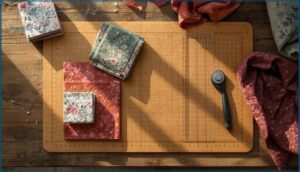
Mat size options matter more than most beginners realize. A 12×18 inch rotary mat accommodates small blocks and charm squares nicely.
Step up to an 18×24 inch quilting cutting mat for fat quarters and everyday cutting efficiency. Need to cut full yardage? A 24×36 self-healing cutting mat gives you the room for serious fabric management and quilting accuracy without constantly repositioning.
Workspace and Table Compatibility
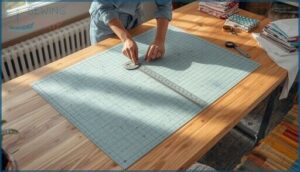
Your cutting mat only works as well as the table beneath it. For proper workspace optimization, make sure your mat sits fully on the surface with an inch or two of table visible on all sides.
Ergonomic height matters too — aim for elbow height, around 34 to 38 inches, so you’re not hunching. Good surface grip and mat placement protect both your quilting board and your back.
Portability Vs. Large Surface Area
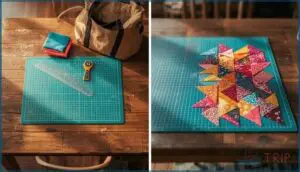
Here’s the real Cutting Mat Tradeoffs dilemma: do you want freedom or room to spread out? A 12×18 inch mat slips easily into a tote for Travel Cutting at guild retreats, while a 24×36 gives you full Space Efficiency for big bed quilts at home.
Many quilters solve this by owning both — one Portable Quilting mat for on-the-go, one large SelfHealing Cutting Mat that stays put.
Mat Thickness and Durability
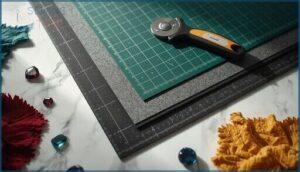
Thickness matters more than most beginners expect. For serious fabric cutting and quilting projects, aim for at least 3 mm — thinner mats groove quickly and won’t last.
- Thickness Benefits — 3 mm withstands daily rotary cuts without breaking down
- Ply Structure — five-ply SelfHealing Cutting Mats outlast basic single-layer boards
- Density Impact — denser surfaces resist deep grooves and protect your blade
- Wear Signs — visible trenches and fibers that won’t spring back mean it’s time to replace
Match Use Intensity to your mat choice for longer-lasting quilting cutting mats and better durability overall.
Material and Durability Considerations
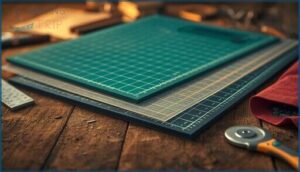
Not all cutting mats are built the same, and the material makes a bigger difference than most quilters expect.
The right construction keeps your mat smooth, protects your blades, and holds up through years of heavy use.
Here’s what to look for before you buy.
Self-Healing PVC Vs. Polyethylene Mats
Most quilting cutting mats use PVC material, and for good reason — that slightly cushioned feel helps your rotary cutter glide cleanly through fabric without chewing up the surface.
Self-healing cutting mats close over shallow cuts, keeping things smooth for accurate fabric cutting. Polyethylene mats are firmer and win on eco-friendliness, but don’t self-heal as well. Your cutting performance and mat durability goals should guide that choice.
Five-Ply Construction and Longevity
Five-ply construction takes everything you liked about self-healing PVC and multiplies it. Each layered core stacks softer outer faces over a harder center, so your blade sinks just enough without hitting solid resistance.
- Surface resilience keeps grooves from becoming permanent channels
- Blade protection improves because the core absorbs pressure evenly
- Mat longevity stretches to five–ten years with normal use
Better fabric cutting and management starts here.
Blade Interaction and Surface Protection
Your blade and mat are in a constant conversation. Press too hard or tilt your rotary cutter off-angle, and surface damage happens fast — permanent grooves that won’t close back up.
| Mistake | What Happens | Fix |
|---|---|---|
| Heavy pressure | Deep grooves, blade wear | Use lighter, steady strokes |
| Wrong cutting angles | Uneven gouges | Keep handle near vertical |
| Skipping cleaning | Fiber buildup dulls edges | Wipe mat after every session |
Self healing cutting mats protect both your edge and your precision cutting results.
Wear, Tear, and Mat Lifespan
Even a well-protected mat eventually shows its age. Wear patterns usually appear first along your favorite cutting lanes — deep grooves that self healing cutting mats can no longer close.
Mat durability depends heavily on rotating your position and swapping dull blades promptly. With smart mat maintenance and care, most quilting cutting mats deliver 4 to 10 solid years before lifespan factors finally catch up.
Rotate your position, swap dull blades promptly, and your cutting mat will reward you with a decade of precision
Top Fabric Cutting Mats for Quilting Projects
Now that you know what to look for, it’s time to find a mat that fits. These seven options cover a solid range of sizes, budgets, and use cases — so there’s likely a good match for your setup.
Here’s a closer look at each one.
1. Olfa Self Healing Cutting Mat
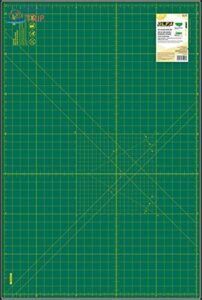
The Olfa Self Healing Cutting Mat is a favorite in quilting circles for good reason. Its triple-layer PVC construction lets shallow cuts close back up, keeping the surface smooth session after session.
The 24″ x 36″ size covers most sewing tables comfortably, and the double-sided design — grid on one side, solid on the other — gives you flexibility depending on what you’re cutting. Store it flat, away from sunlight, and this mat can easily last you a decade.
| Best For | Quilters, sewists, and crafters who need precise, repeatable cuts and want a mat that holds up through years of regular use. |
|---|---|
| Size | 24″ x 36″ |
| Self-Healing | Yes |
| Double-Sided | Yes |
| Material | Plastic/Rubber |
| Angle Markings | Yes |
| Weight | 2.3 lbs |
| Additional Features |
|
- Self-healing surface keeps things smooth even after heavy use — no deep grooves messing up your cuts
- Double-sided design is genuinely useful, grid lines on one side for precise work, clean surface on the other for general cutting
- At 24″ x 36″, it’s big enough to handle most quilting and sewing projects without constantly repositioning fabric
- Can warp if stored upright or left in direct sunlight, so you have to be a little deliberate about storage
- May arrive with a noticeable odor that takes some time to air out
- Not compatible with fixed blade utility knives, so it’s really only useful if you’re working with rotary cutters
2. Fiskars Self Healing Cutting Mat
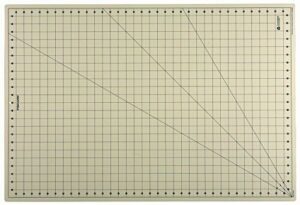
The Fiskars Self Healing Cutting Mat is a solid workhorse for quilters who want precision without fuss. At 24″ x 36″, it accommodates full fabric widths, long strips, and oversized blocks with ease.
The printed 30, 45, and 60-degree bias lines mean you can cut triangles and star points without reaching for extra rulers. It’s double-sided, so you get twice the usable surface. Just keep it flat and away from heat, and it’ll serve you well.
| Best For | Quilters, sewists, and crafters who regularly work with large fabric pieces and need accurate angle cuts without juggling extra tools. |
|---|---|
| Size | 24″ x 36″ |
| Self-Healing | Yes |
| Double-Sided | Yes |
| Material | Polypropylene |
| Angle Markings | Yes |
| Weight | 2.06 lbs |
| Additional Features |
|
- Big 24″ x 36″ surface handles full fabric widths, long strips, and oversized blocks without any awkward repositioning
- Built-in 30, 45, and 60-degree bias lines let you cut triangles and angled pieces right on the mat
- Double-sided design effectively doubles the mat’s lifespan before you need a replacement
- Some users found the mat thinner and more brittle than expected, which can be a problem with heavy use
- The printed grid ink can rub off or smudge over time, making precise measurements harder
- The grid layout may not work well for left-handed users
3. Dahle Self Healing Cutting Mat
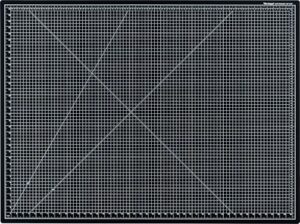
The Dahle Self Healing Cutting Mat is a serious upgrade for quilters who mean business. At 36″ x 48″, it gives you room to spread out full yardage without folding.
The five-layer PVC construction self-heals after every pass, keeping the surface smooth and your blades sharper longer. A half-inch grid with both inch and metric markings, plus 45- and 60-degree angle guides, makes precise cuts genuinely easier.
It’s heavier at 11 pounds, but that stability is exactly what a dedicated cutting station needs.
| Best For | Quilters and serious crafters who need a large, dedicated cutting station for big projects and frequent use. |
|---|---|
| Size | 30″ x 60″ |
| Self-Healing | Yes |
| Double-Sided | Yes |
| Material | Plastic |
| Angle Markings | Yes |
| Weight | 12 lbs |
| Additional Features |
|
- Five-layer self-healing surface keeps itself smooth after every cut, which means your blades stay sharp way longer than they would on a basic mat.
- At 36″ x 48″, you can lay out full yardage flat — no awkward folding or repositioning mid-project.
- The half-inch grid covers inch, metric, and angled guides all in one, so precise cuts are just easier.
- It can arrive rolled or folded and may need a day or two lying flat before it’s ready to use.
- Some users feel the measurement grid has gaps or isn’t as intuitive as it could be.
- At 11 pounds and a higher price point, it’s a real commitment — not the best fit if you’re just dabbling.
4. Idemeet Self Healing Cutting Mat
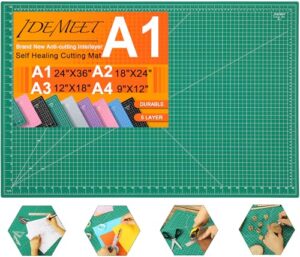
The Idemeet Self Healing Cutting Mat punches above its price tag. At 24″ x 36″ and 0.28″ thick, it gives you real workspace without the premium cost.
The five-ply PVC construction self-heals after each pass, so grooves don’t sneak up on you mid-project. Both sides are printed with inch, metric, and 45-degree angle guides — flip it when one side gets heavy use. It’s a smart pick if you’re building your toolkit on a budget.
| Best For | Artists, quilters, and crafters who want a solid, spacious cutting mat without spending a lot. |
|---|---|
| Size | 18″ x 24″ |
| Self-Healing | Yes |
| Double-Sided | Yes |
| Material | Polypropylene |
| Angle Markings | No |
| Weight | Not specified |
| Additional Features |
|
- Big 24″ x 36″ surface gives you plenty of room to work on larger projects
- Self-healing PVC construction holds up over time and keeps your cuts clean
- Dual-sided with inch, metric, and angle guides — easy to read and genuinely useful
- Some buyers received the wrong item, so quality control can be hit or miss
- A few users mentioned an off-putting smell out of the box
- Warranty and return info is sparse, so you’re a bit on your own if something goes wrong
5. Newbraug Large Self Healing Cutting Mat
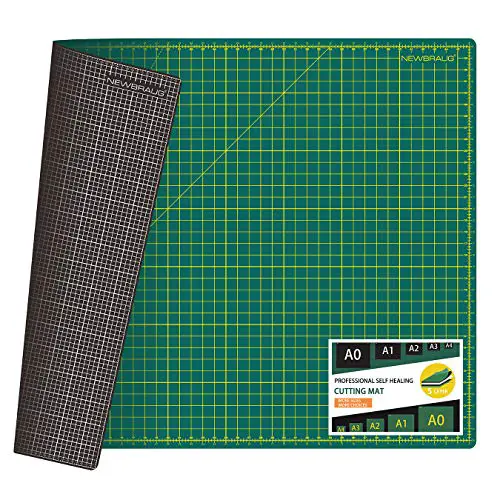
If you’re working with full quilt tops or wide backing fabric, the Newbraug 36″ x 48″ mat is worth a serious look. That footprint covers most standard tables, so you’re not constantly shifting fabric around to finish a cut.
The double-sided green and black design is genuinely useful — flip to whichever color contrasts best with your fabric. Five-ply self-healing PVC keeps the surface smooth through heavy use, and the full-grid markings on both sides help you stay accurate from edge to edge.
| Best For | Quilters and crafters who regularly work with large fabric pieces or full quilt tops and need a spacious, reliable cutting surface. |
|---|---|
| Size | 36″ x 48″ |
| Self-Healing | Yes |
| Double-Sided | No |
| Material | PVC |
| Angle Markings | Yes |
| Weight | 11 lbs |
| Additional Features |
|
- Massive 36″ x 48″ workspace means less repositioning and more accurate cuts on big projects
- Double-sided green and black surfaces give you instant contrast options depending on your fabric color
- Five-layer self-healing construction holds up through heavy rotary cutting without the surface showing wear
- Dimensions may run slightly smaller than advertised, so double-check if you’re cutting to exact specs
- The size and weight make it tough to store and nearly impossible to rotate mid-project
- Hand-wash only care adds a bit of extra hassle compared to easier-to-clean alternatives
6. Sullivans Cutting Mat
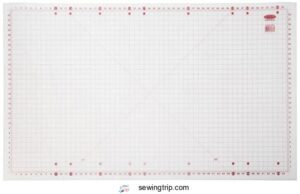
The Sullivans mat plays a different game than most options on this list. Instead of self-healing PVC, it’s made from low-density polyethylene — flexible, odorless, and rollable for easy storage.
At 59 x 36 inches with a clean 56 x 33-inch grid, it covers serious table real estate. The simple yardage markings make long cuts straightforward. It’s also pinnable, so fabric stays put.
Made in the USA, it’s a solid pick for quilters who want a large, low-fuss surface.
| Best For | Quilters and sewers who need a large, no-nonsense cutting surface and want something made in the USA. |
|---|---|
| Size | 24″ x 36″ |
| Self-Healing | Yes |
| Double-Sided | No |
| Material | PVC |
| Angle Markings | Yes |
| Weight | 5.99 lbs |
| Additional Features |
|
- Huge 59 x 36-inch surface gives you plenty of room to work with big pieces of fabric without any shifting
- Flexible, odorless polyethylene material rolls up for easy storage — handy if space is tight
- Clean yardage grid makes long, straight cuts simple and accurate
- Not built for heavy-duty or production use — deep cuts or too much pressure can score or crack the mat over time
- Doesn’t self-heal like PVC mats, so it may show wear faster with regular use
- Needs a large, flat space for storage if you don’t roll it, otherwise it can bend or warp
7. Elan Self Healing Cutting Mat
The Elan mat is built for quilters who want to work large without compromise. Its five-ply PVC construction — recycled inner layers wrapped in self-healing outer surfaces — keeps the board flat and the cutting surface smooth through serious repeated use.
Flip it when one side gets heavy traffic. Both sides carry full grid markings, so you’re never stuck with a plain back. The 36×60 and 36×72 inch options are genuinely generous for big quilt layouts.
| Best For | Quilters and crafters who need a large, durable cutting surface for big projects and precise work. |
|---|---|
| Size | 36″ x 48″ |
| Self-Healing | Yes |
| Double-Sided | Yes |
| Material | Multi-layer |
| Angle Markings | No |
| Weight | Not specified |
| Additional Features |
|
- Five-ply self-healing construction holds up through heavy, repeated use without warping or breaking down.
- Grids on both sides mean you can flip the mat when one side gets worn and never lose your measuring reference.
- The larger size options (up to 36×72″) let you cut big quilt pieces in one go without repositioning.
- Some buyers have received mats that arrived dirty, greasy, or damaged due to poor packaging.
- It’s pricier than most cutting mats on the market, which may be hard to justify for casual crafters.
- At nearly 13 pounds, it’s not easy to move around or store if you’re short on workspace.
Maintenance and Care Tips for Cutting Mats
A good cutting mat is an investment, and a little care goes a long way toward protecting it.
How you clean, store, and inspect your mat makes a real difference in how long it lasts. Here’s what you need to know to keep yours in great shape.
Preventing Warping and Sun Damage
Heat is a cutting mat’s worst enemy. Left in a hot car or near a sunny window, your self-healing cutting mat can warp within hours. For Mat Warping Prevention and Temperature Management, keep these Heat Control Methods in mind.
- Store your quilting cutting mat away from south-facing windows
- Never place hot drinks or irons directly on the surface
- Keep room temperatures between 18–25°C for durability and precision cutting
- Soak slightly warped mats in cool water for Sun Damage Repair.
Proper Storage Techniques
Once your mat is safe from heat, think about where it lives between quilting sessions. Flat Storage is your best friend here — slide your self-healing cutting mat under a bed or cutting table for easy workspace protection.
Vertical Hanging works for smaller mats using a pants hanger. Protective Covers shield the surface, and Mat Transport keeps it flat during travel for real Space Savings.
Inspecting for Damage and Extending Mat Life
Good storage buys time, but regular mat inspection is what really protects your investment. Here’s how to keep your cutting mat working hard for years.
- Run your fingers across the surface weekly — ridges mean the self-healing technology is wearing out.
- Check under bright light for permanent grooves along common cutting lines.
- Watch for fabric snagging — a key damage prevention signal.
- Soak mildly warped quilting cutting mats in cool water to relax curves.
- Rotate your cutting position to spread wear across durable cutting surfaces evenly.
Frequently Asked Questions (FAQs)
What size cutting mat do you need for quilting?
The right cutting mat size depends on your table space and quilting goals.
For most quilting projects, a 24×36 inch mat hits the sweet spot—big enough for fabric management, practical for rotary cutters, and fits standard tables.
Can cutting mats be used for paper crafts?
Yes, cutting mats work great for paper crafts. Your self-healing cutting mat accommodates cardstock, patterned paper, and even thin chipboard without gouging the surface — making it a multifaceted cutting surface for both quilting and paper trimming.
Do cutting mats work with electric cutting machines?
It’s a square peg, round hole situation.
Standard quilting cutting mats don’t work inside electric cutters.
Those machines need their own sticky machine mats for proper fabric cutting accuracy and alignment.
How do cutting mats compare to cutting boards?
Cutting mats and cutting boards aren’t interchangeable. A dedicated cutting mat’s self-healing surface protects your rotary cutters and keeps blades sharp, while a cutting board’s rigid surface dulls them fast.
Are cutting mats safe for children to use?
The mat itself isn’t the hazard—rotary cutters are. Those blades are razor-sharp, so adult supervision and proper child safety tips matter most. Keep young hands away unless they’re ready.
Can you repair a deeply grooved cutting mat?
Not really. Deep grooves in a self-healing cutting mat are permanent. Soaking in cool water or gentle scrubbing helps cosmetically, but true Surface Restoration isn’t possible.
When grooves snag fabric, Mat Replacement Options are your best move.
Conclusion
A quilter without the right mat is like a carpenter without a level—every cut carries the risk of something slightly off, and those small errors stack up fast.
Your fabric cutting mats for quilting projects aren’t just tools; they’re the foundation every precise block is built on. Choose one that matches your workspace, protects your blades, and holds its surface season after season.
The right mat doesn’t just support your work—it sharpens it.
- https://excelblades.com/blogs/diy/how-do-self-healing-cutting-mats-work
- https://www.missouriquiltco.com/collections/quilting-cutting-mats
- https://www.wawak.com/cutting-measuring/cutting/self-healing-cutting-mats/
- https://suzyquilts.com/5-best-cutting-mats/
- http://madebychrissied.blogspot.com/2015/05/How-To-Clean-And-Care-For-Self-Healing-Cutting-Mat.html