
This site is supported by our readers. We may earn a commission, at no cost to you, if you purchase through links.

Cutting clean curves into EVA foam with a dull blade is one of those slow frustrations that quietly ruins a build—the kind where you’re three hours in and your armor piece looks more torn than carved. right cutting tool doesn’t just save time; it changes what’s possible, letting you chase tighter details, smoother bevels, and cleaner seams without fighting your materials at every step.
Cosplay has grown far beyond scissors and box cutters, and the tools built for precision work now span everything from variable-speed rotary cutters for cosplay projects to digital hot knives and cordless electric scissors.
Knowing which one belongs in your kit—and when—separates a finished build you’re proud to wear from one you’re still apologizing for at the convention.
Table Of Contents
- Key Takeaways
- Top 10 Rotary Cutters for Cosplay
- 1. Steelite Mini Cordless Rotary Tool
- 2. Hardell Cordless Mini Rotary Tool
- 3. PHALANX 180W Variable Speed Rotary Tool
- 4. Harvell 12V Cordless Rotary Kit
- 5. Hansmaker 4.2V Cordless Rotary Tool
- 6. Preciva Digital Hot Knife
- 7. Worx ZipSnip Cordless Electric Scissors
- 8. Cooltop 18W Hot Wire Foam Cutter
- 9. Logan Foam Werks Cutter
- 10. Logan Freestyle EVA Foam Cutter
- Best Uses for Cosplay Materials
- Key Features Before Buying
- Cutting Performance and Precision
- Safety and Maintenance Essentials
- Choosing The Right Cosplay Cutter
- Frequently Asked Questions (FAQs)
- Conclusion
Key Takeaways
- Matching your cutting tool to the material — EVA foam, fabric, plastic, or leather — is what separates a clean, professional build from one that fights you at every step.
- Variable speed control is one of the most essential features to look for, since it lets you dial in the right RPM for delicate detail work without tearing or scorching your materials.
- Hot knives and hot wire cutters melt through foam rather than slicing it, giving you burr‑free edges that rotary tools simply can’t replicate on certain materials.
- Safety habits like wearing N95 masks, cut‑resistant gloves, and ANSI‑rated eye protection aren’t optional — foam dust and sharp bits are real hazards that add up fast over long build sessions.
Top 10 Rotary Cutters for Cosplay
Finding the right cutting tool can make or break your cosplay build, so knowing what’s out there is the first step. This list covers ten options that cover a wide range of materials, budgets, and skill levels — from cordless rotary tools to hot wire cutters. Here’s what made the cut.
Whether you’re cutting foam, fabric, or thermoplastics, pairing the right tool with accurate fabric cutting methods can seriously level up the precision of your finished pieces.
1. Steelite Mini Cordless Rotary Tool
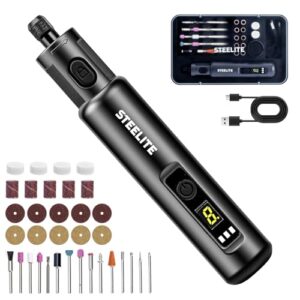
The Steelite Mini Cordless Rotary Tool is a solid starting point for cosplay crafters who need a lightweight, portable option for detail work.
Its pen‑style grip makes it easy to handle during long sessions, and six speed settings between 10,000 and 18,000 RPM give you enough control for engraving, sanding, and trimming foam or plastic.
The USB‑C fast charging and 200‑minute battery life mean you won’t be hunting for a spare charger mid‑project.
| Best For | Hobbyists and cosplay crafters who need a lightweight, portable rotary tool for fine detail work like engraving, sanding, and trimming foam or plastic. |
|---|---|
| Power Source | USB-C rechargeable (3.7V Li-ion) |
| Included Accessories | 51 pieces |
| Primary Application | Engraving and polishing |
| Weight | Not specified (lightweight) |
| Safety Feature | None specified |
| Handle Design | Pen-style ergonomic grip |
| Additional Features |
|
- Six speed settings (10,000–18,000 RPM) give you solid control for delicate, precision tasks
- USB-C fast charging and 200-minute battery life keep you working without interruption
- Pen-style grip and lightweight design make long crafting sessions comfortable and manageable
- Tops out at 18,000 RPM, so it’s not powerful enough for heavy cutting or drilling through metal
- Felt polishing pads are low quality and likely need to be swapped out for aftermarket options
- The internal battery can’t be replaced, and some kits ship without the included wrench
2. Hardell Cordless Mini Rotary Tool
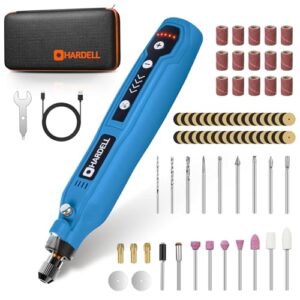
If the Steelite feels a bit underpowered for your needs, the Hardell Cordless Mini Rotary Tool brings more range to the table.
With five speed settings from 5,000 to 25,000 RPM, it takes care of everything from gentle sanding on thin foam to more aggressive grinding on thicker materials.
At roughly 4.8 oz, it won’t tire your hand out during long build sessions, and the rubber ergonomic grip keeps things steady when you’re carving fine details.
| Best For | Hobbyists and crafters who need a lightweight, cordless rotary tool for detailed work like jewelry making, model building, or small-scale woodworking. |
|---|---|
| Power Source | USB-C rechargeable (12V Li-ion) |
| Included Accessories | 69 pieces |
| Primary Application | Detail engraving and carving |
| Weight | 4.8 oz (136 g) |
| Safety Feature | None specified |
| Handle Design | Compact lightweight pen-style |
| Additional Features |
|
- 69 accessories cover a wide range of tasks — engraving, sanding, polishing, carving, drilling, and cutting — so you’re rarely left reaching for another tool
- USB-C fast charging and cordless design let you work anywhere, no outlet required
- At just 4.8 oz, it’s easy to hold for long sessions without hand fatigue
- The motor isn’t built for heavy-duty work, so thick materials or large cutting jobs will push it past its limits
- High-speed settings can cause bit jump on fine drilling, meaning you’ll need to dial in the right speed carefully
- Battery runtime isn’t specified, which makes it hard to know how long you can work before needing a recharge
3. PHALANX 180W Variable Speed Rotary Tool
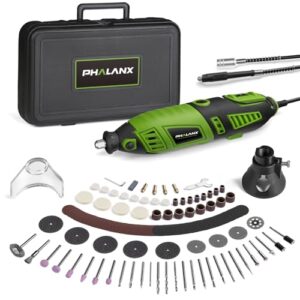
When you need more power than a mini cordless can offer, the PHALANX 180W steps in without compromising control. Its six-speed dial runs from 8,000 to 32,000 RPM, so you can score thin craft foam at low speeds and grind through thicker EVA without switching tools.
The pen-style flexible shaft is genuinely useful for reaching tight spots on armor builds, and the 139-piece accessory kit covers most cosplay tasks right out of the box.
| Best For | Cosplayers and hobbyists who need a powerful, versatile rotary tool for detailed work like engraving, carving, and sanding across a wide range of materials. |
|---|---|
| Power Source | Corded AC (180W, 110V) |
| Included Accessories | 139 pieces |
| Primary Application | Carving and material cutting |
| Weight | Not specified |
| Safety Feature | Gear-blocker safety mechanism |
| Handle Design | Low-noise ergonomic handle |
| Additional Features |
|
- Wide speed range (8,000–32,000 RPM) across six settings gives you precise control for both delicate detail work and aggressive material removal
- The pen-style flexible shaft makes it easy to maneuver in tight spots, great for intricate armor builds or jewelry work
- The 139-piece accessory kit means you’re ready to tackle most tasks right out of the box without buying extras
- The chuck requires manual tightening with a spanner before each use, which adds a small but repetitive step to your workflow
- The flexible shaft can struggle under prolonged low-speed use, and the handle may heat up during long sessions
- Some included bits are lower quality and may wear out quickly on tougher materials, requiring replacement
4. Harvell 12V Cordless Rotary Kit
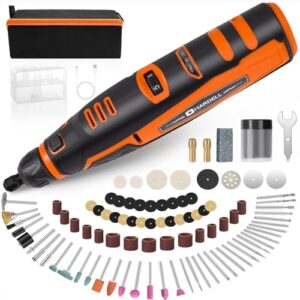
The Harvell 12V Cordless Rotary Kit trades raw wattage for freedom of movement, which makes it a solid pick when you’re working on a prop across multiple rooms or away from your bench.
Running up to 30,000 RPM across six speeds, it manages foam shaping, light sanding, and engraving without needing a wall outlet nearby.
At just 1.1 lb, it won’t tire your hand during longer detail sessions, and the included 94-piece accessory kit keeps most cuts covered.
| Best For | Hobbyists and DIYers who need a lightweight, portable rotary tool for detail work like engraving, carving, or foam shaping away from a fixed workspace. |
|---|---|
| Power Source | 12V rechargeable battery |
| Included Accessories | 94 pieces |
| Primary Application | DIY hobby and craft projects |
| Weight | 1.1 lb (0.5 kg) |
| Safety Feature | None specified |
| Handle Design | Rubber ergonomic grip |
| Additional Features |
|
- Cordless design gives you true freedom of movement — no outlet needed, no cord getting in the way
- Six speed settings up to 30,000 RPM handle everything from delicate engraving to light cutting
- At just 1.1 lb with an ergonomic grip, it’s easy to control during longer, detail-focused sessions
- Tends to overheat under heavy or prolonged use, requiring a 5-minute rest every 30 minutes
- The collet can loosen or break if hand-tightened, which interrupts workflow and raises durability concerns
- Some accessories arrive damaged, and the manual lacks clear visual labeling to help you identify what’s what
5. Hansmaker 4.2V Cordless Rotary Tool
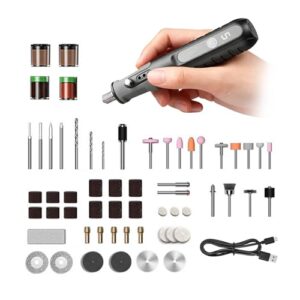
The Hansmaker 4.2V sits at the lighter end of the spectrum, making it a good companion for fine detail work rather than heavy‑duty cutting.
Its five adjustable speed settings range from 5,000 to 25,000 RPM, giving you enough control for foam engraving, polishing, and gentle carving.
Whether you’re polishing or carving, pairing variable-speed control with a steady heat source—like the options covered in this guide to best cordless irons for quilting and sewing—can make your workflow feel seamless from start to finish.
The USB‑C rechargeable battery charges in about an hour, though expect roughly 30 minutes of runtime per session — so keep it plugged in between tasks.
| Best For | Hobbyists and DIYers who want a lightweight, cordless tool for fine detail work like engraving, polishing, and small-scale carving. |
|---|---|
| Power Source | USB-C rechargeable (4.2V Li-ion) |
| Included Accessories | 163 pieces |
| Primary Application | Sanding and light polishing |
| Weight | Not specified (lightweight) |
| Safety Feature | None specified |
| Handle Design | Ergonomic shaped lightweight grip |
| Additional Features |
|
- Five speed settings (5,000–25,000 RPM) give you solid control for delicate tasks
- USB-C charging is fast and convenient — fully charged in about an hour
- Comes with 163 accessories, so you’re ready for a wide variety of light projects right out of the box
- Only about 30 minutes of battery life per charge, which can interrupt longer sessions
- Not built for heavy-duty work like drilling or high-torque cutting
- The power button can be overly sensitive, and bits may loosen with extended use
6. Preciva Digital Hot Knife
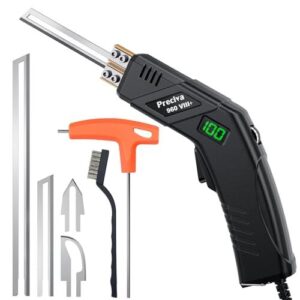
The Preciva Digital Hot Knife takes a different approach from rotary tools — it melts through foam rather than cutting it, which means cleaner, burr‑free edges every time.
With 80 W of heating power and a temperature range up to 600 °C across 20 selectable settings, you have real control over how aggressively the blade moves through EVA foam, XPS, and similar materials.
The included 10 cm and 20 cm nickel‑chromium blades handle everything from broad panel cuts to tighter detail work.
| Best For | DIYers, prop makers, and packaging professionals who need clean, precise cuts through foam and similar materials without the mess of burrs or ragged edges. |
|---|---|
| Power Source | Corded AC (80W, 110–127V) |
| Included Accessories | 3 blades plus shaping blades |
| Primary Application | Foam and fabric cutting |
| Weight | 1.54 lb |
| Safety Feature | Auto over-temperature protection |
| Handle Design | Compact handheld form factor |
| Additional Features |
|
- 20 selectable temperature settings up to 600 °C give you fine-tuned control for different materials and cut depths
- Heats up fast with 80 W of power, and the pure copper blade holder spreads heat evenly for consistent results
- Comes with both a 10 cm and 20 cm blade (plus a spare), so you can switch between detail work and broader cuts
- The display shows a reference number, not actual °C or °F — you’ll need a conversion formula to dial in exact temperatures
- The longer 20 cm blade can twist at higher heat settings, making perfectly straight cuts trickier
- Cutting passes should stay under about 120 seconds, and you’ll need good ventilation since melting foam releases fumes
7. Worx ZipSnip Cordless Electric Scissors
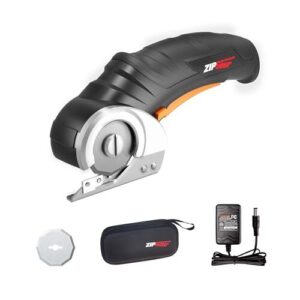
The Worx ZipSnip takes the stress out of repetitive cutting with a cordless, motorized design that runs on a 4V lithium battery and weighs just under a pound.
For fabric, vinyl, thin leather, and cardboard, it processes material up to ¼ inch thick without tiring your hands.
The dual-trigger safety lock-out keeps accidental cuts from happening, and the self-sharpening blade means you don’t need to stop mid-project to swap edges.
| Best For | Crafters, DIYers, and anyone who does repetitive cutting of fabric, cardboard, leather, or packaging and wants to save their hands from fatigue. |
|---|---|
| Power Source | 4V max Li-ion battery |
| Included Accessories | 2 rotary blades |
| Primary Application | Fabric and material cutting |
| Weight | 1 lb (0.45 kg) |
| Safety Feature | Dual-trigger safety lock-out |
| Handle Design | Standard pistol-style grip |
| Additional Features |
|
- Lightweight and cordless — at under a pound, it’s easy to carry and use anywhere without being tethered to an outlet
- Self-sharpening blade keeps cutting performance consistent without interruptions to swap or sharpen edges
- Dual-trigger safety lock-out reduces the risk of accidental cuts during use or storage
- Slow charging time — the stock charger takes around 5 hours to fully recharge the battery
- Struggles with very thick cardboard, tight corners, or bulky materials that exceed its ¼ inch cutting capacity
- The side safety button is designed for right-handed users, making it awkward for lefties or use in tight spaces
8. Cooltop 18W Hot Wire Foam Cutter
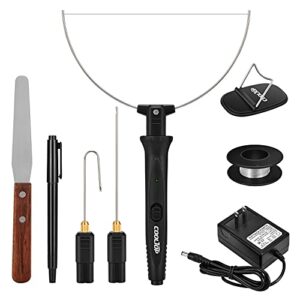
If you’re working with EPS, EPP, or foam board, the Cooltop 18W Hot Wire Foam Cutter is worth keeping on your bench. It heats to around 100°C in under 10 seconds, giving you smooth, clean edges without tearing or scorching.
The 3-in-1 tip system covers straight cuts, hole-punching, and engraving, so you can shape armor panels and add surface texture without switching tools.
Just remember to pause after 30 minutes — the wire needs a break too.
| Best For | Hobbyists and makers who regularly cut or shape low-density foam materials like EPS, EPP, or KT board for crafts, cosplay armor, or prototypes. |
|---|---|
| Power Source | Corded AC (18W) |
| Included Accessories | 3 tip attachments |
| Primary Application | Foam board cutting and engraving |
| Weight | 1 lb (0.45 kg) |
| Safety Feature | Overheat protection with LED indicator |
| Handle Design | Pencil-style plastic handle |
| Additional Features |
|
- Heats up in under 10 seconds and offers three interchangeable tips (cutting, hole-making, engraving) — all in one compact tool
- Built-in overheat protection with an LED indicator adds a layer of safety during longer sessions
- Easy tip replacement and an included cleaning pen keep maintenance quick and painless
- Only works with low-density foams — not suitable for rigid or high-density plastics
- Requires a break after 30 minutes of continuous use, which can slow down bigger projects
- Over-tightening the wire or heavy repeated use can shorten tip life and potentially deform the plastic handle
9. Logan Foam Werks Cutter
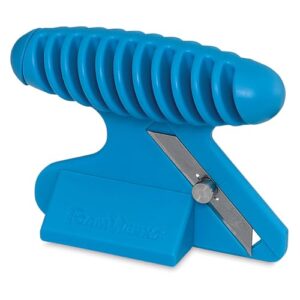
The Logan Foam Werks Cutter is a manual precision tool built specifically for foam board, and it performs straight cuts, 45° bevel edges, and even circles with a calm, steady reliability that powered tools can’t always match. The rotating base switches between straight and bevel mode in seconds, and the adjustable blade depth lets you score partial cuts or V‑notches without punching through.
It’s lightweight at just 0.19 lb, so long prop‑building sessions won’t tire your hand.
| Best For | Hobbyists, picture framers, and cosplay makers who need precise straight and bevel cuts in foam board or EVA foam without the noise and bulk of powered tools. |
|---|---|
| Power Source | Manual (no power required) |
| Included Accessories | 2 utility blades |
| Primary Application | Foam board and mat cutting |
| Weight | 0.19 lb |
| Safety Feature | None specified |
| Handle Design | Ergonomic grip with guide brace |
| Additional Features |
|
- Rotating base makes it easy to switch between straight 90° and 45° bevel cuts in seconds
- Adjustable blade depth lets you score partial cuts and V-notches without cutting all the way through
- Ultralight at 0.19 lb, so it won’t wear out your hand during long crafting sessions
- Blade positioning favors left-handed users, which can cause offset cuts for righties
- Maximum cutting depth of ~5/8 in means it can’t handle foam boards thicker than about ½ in
- Requires a separate straight edge or ruler to keep cuts properly aligned
10. Logan Freestyle EVA Foam Cutter
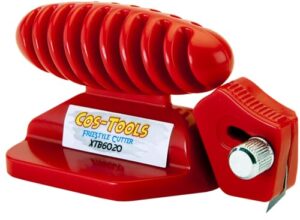
If you’ve ever struggled to trace a pattern freehand on foam, the Logan Freestyle Cutter was built for exactly that. Its curved push-style blade follows irregular shapes smoothly, letting you cut freeform curves without fighting the material.
The 3/16-inch max thickness keeps it focused on standard EVA foam, and the ambidextrous design suits both hands comfortably. Built-in blade storage means spare XB-5 blades stay within reach.
Just note — thicker foam or harder materials will push this one past its limits.
| Best For | Cosplayers and foam crafters who need to cut freeform curves and irregular shapes from standard EVA foam with speed and precision. |
|---|---|
| Power Source | Manual (no power required) |
| Included Accessories | 2 XB-5 blades |
| Primary Application | EVA foam freeform cutting |
| Weight | 0.19 lb |
| Safety Feature | Safety shield included |
| Handle Design | Ergonomic red handle |
| Additional Features |
|
- Push-style blade glides smoothly along freehand curves, making complex shapes easy to cut accurately
- Ambidextrous ergonomic handle keeps it comfortable for long crafting sessions
- Built-in blade storage compartment keeps spare XB-5 blades handy without rummaging through a toolbox
- Maxes out at 3/16 in (5 mm) thickness, so thicker foam builds are off the table
- Only two blades included, meaning heavy users will need to stock up on replacements quickly
- Blade life shortens noticeably when cutting harder or more abrasive materials
Best Uses for Cosplay Materials

Every cosplay material has its own personality — EVA foam, fabric, plastic, leather, and foam board each respond differently to cutting tools and techniques.
Matching the right cutter to the right material is what separates a clean, professional result from a frustrating mess.
Here’s how each material plays to your tools’ strengths.
EVA Foam Armor Cuts
Cutting EVA foam cleanly is one of the most essential skills in cosplay prop making. Keep your blade perfectly vertical during each stroke to prevent angled edges that show gaps in armor panels. A 45-degree bevel cut on panel edges improves both fit and paint adhesion.
- Use 120–220 grit sanding to smooth rough curves after cutting
- Apply heat sealing to close foam pores before priming
- Run long, confident strokes — never short, choppy ones
Refer to the high‑density EVA foam guidelines for ideal armor thickness.
Fabric and Vinyl Trimming
Once your armor panels are trimmed, fabric and vinyl bring the costume to life.
Precision cutting for fabric matters here — a Fiskars 45mm Rotary Cutter paired with a self-healing mat gives you clean, straight edges without fraying.
For vinyl edging, lower speeds prevent cracking while maintaining vinyl color retention across bright, bold costume pieces.
Plastic Prop Shaping
Working with plastic props is where a rotary tool really earns its place. You can use diamond bit smoothing on hard plastic surfaces without chipping delicate edges, and sculpting PLA textures becomes straightforward with fine burr attachments.
For acrylic pieces, milling acrylic edges delivers crisp, clean lines that foam simply can’t match.
Leather Costume Details
Leather demands a different kind of precision. A rotary cutter with edge control excels here — trimming seams, scoring panel lines, and keeping surface tooling patterns crisp.
Use leather layering techniques like double-layering at the chest for structure.
Saddle stitch durability holds under movement stress, while regular conditioning keeps pieces looking stage‑ready.
Foam Board Pattern Work
Foam board pattern work is where your rotary cutter earns its place at the cutting table. Using score and snap along a steel ruler gives you crisp, clean breaks without ragged edges.
Grid scoring techniques let you introduce flex into larger panels, while peel and paste keeps your traced lines accurate.
Finish with interlocking tab assembly for modular, alignment-ready armor templates.
Key Features Before Buying
Before you spend a single dollar on a rotary cutter, knowing what to look for saves you from a tool that fights you halfway through a build. A few key specs make the difference between clean, confident cuts and frustrating do-overs on expensive foam or fabric. Here’s what to check before you buy.
Blade or Bit Compatibility
Not every bit or blade fits every rotary tool, so checking shank diameter compatibility before you buy is essential. Most tools accept 1/8-inch shanks, though some use 3/32-inch or 1/4-inch sizes.
Mismatched shanks cause slippage and heat buildup. Universal adapters can bridge the gap, but always verify your tool’s chuck capacity first.
Variable Speed Control
Variable speed control is one of the most practical features you’ll use in prop building and precision crafting.
Most rotary tools use PWM speed modulation to maintain consistent RPM under varying loads, which means cleaner cuts on EVA foam and thin plastics.
Soft start benefits your work by preventing torque surge at startup, protecting both your bit and your material.
Corded Versus Cordless Power
Choosing between a corded and cordless rotary tool often comes down to where and how you work. Corded tools win on continuous torque stability, never fading mid-cut. Cordless tools give you workspace mobility, though battery life management matters:
- Monitor charge before long sessions
- Swap batteries to avoid charging downtime
- Expect slight power drops under heavy load
Grip Comfort and Weight
When a session runs long, grip comfort and weight become just as important as speed.
A handle diameter of 30–40 mm lets your fingers wrap naturally without crushing your palm.
Tools under 1 kg reduce arm strain greatly, while vibration dampening and textured grips keep your hand steady and fatigue-free through those detailed, hour-long cuts.
Included Accessories and Attachments
What comes bundled with your tool can make or break your workflow. A universal collet adapter lets you swap bits from different brands without frustration, while protective storage cases with foam inserts keep your cutting wheels, sanding drums, and polishing pads organized and safe between sessions.
- Organizing accessory racks
- Battery management solutions
- Flex shaft accessories
- Tool maintenance kits
Cutting Performance and Precision
When crafting cosplay, the difference between a finished piece that looks polished and one that falls flat often comes down to how cleanly and precisely you cut.
In cosplay, polished results live or die by the precision of every cut
Your tools need to handle everything from sweeping armor curves to hair‑thin engraving lines without losing control. Here’s how the right rotary cutter performs across the cuts that matter most.
Clean Curves and Edges
Getting clean curves on EVA foam starts with steady, consistent pressure along your cutting line — rushing through a tight radius almost always leaves scalloped edges. A narrow-profile rotary cutter traces curves with minimal material removal, so your silhouette stays true.
Work in small guided segments, then deburr and lightly sand with 600–1200 grit for a clean edge finish.
Intricate Seam Trimming
Once your curves are clean, seam trimming is where precision cutting really earns its place. Grading seam allowances on layered EVA foam prevents stiff, bulky joins, while notching convex curves stops rippling along outward edges. Managing concave bulk means snipping allowances at regular intervals so panels lie flat.
- Clip tension points along tight bends
- Notch convex curves to reduce rippling
- Grade allowances to minimize bulk
- Trim corners to prevent crowding
Detail Carving and Engraving
Once seams are trimmed, detail carving is where your rotary tool really shows its value.
Using a fine carbide or knife-style bit at low speed, you can engrave shallow texture lines into EVA foam or ABS plastic without tearing.
Light passes with depth-controlled spindle settings, keeping lines consistent, while masking adjacent areas protects surrounding surfaces from accidental slips.
Sanding Rough Foam Edges
After detail work, rough foam edges need attention.
Start with 60–120 grit on a sanding drum attachment to knock down bumps quickly, then switch to 180–220 for a smooth finish.
Use light, short strokes — heavy pressure gouges the surface and thins your edges unevenly.
Wipe dust away often, then seal edges with diluted PVA glue to prep for paint.
Heat Cutting Control
When heat is your cutting tool, temperature control precision is everything. EVA foam melts around 110–130°C, so keeping your settings just above that threshold gives you clean edges without scorching.
Move steadily — hesitating lets residual heat pool and distort the kerf.
Always work in a ventilated space, since heated synthetics release fumes worth taking seriously.
Safety and Maintenance Essentials
Your tools can do astounding things, but none of it matters if you’re not working safely and keeping your gear in good shape. A few simple habits go a long way toward protecting both you and your equipment across every project. Here’s what you need to know before you cut another piece of foam.
Eye and Hand Protection
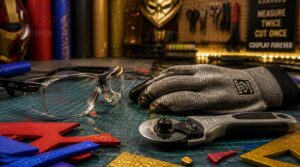
Protecting your eyes and hands isn’t optional — it’s essential every time you pick up a rotary tool.
ANSI Z87.1-rated safety glasses with side shields guard against flying debris and foam particles, while a face shield adds full-face coverage for heavier cuts.
Pair these with cut-resistant gloves rated level 5 to protect against sharp blades without sacrificing the dexterity you need for detailed work.
Dust Mask for Foam
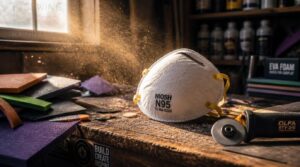
Foam dust is one of the sneakiest hazards in your workshop — invisible particles settle in your lungs long after the rotary tool stops spinning.
- Choose N95 or P100 masks for reliable foam dust filtration
- Check mask seal integrity before every session
- Replace foam nose bridge cushions every 2–4 weeks
- Store masks in a cool, dry place
Cutting Mat Requirements
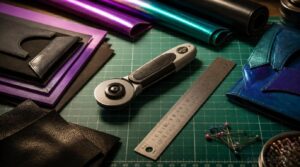
A good self-healing cutting mat is one tool you’ll wonder how you ever worked without. These mats use a soft polymer that reseals after each blade pass, keeping your surface smooth and your cuts accurate.
Choose a 3–4mm thick mat for the best balance of cushioning and rebound, and look for a clear grid system to keep your lines straight and your material waste low.
Blade and Bit Replacement
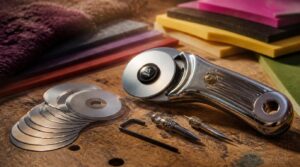
Dull blades and worn bits are the silent saboteurs of clean cosplay cuts. Before swapping anything out, unplug and cool the tool completely.
Loosen the collet with the correct hex key, inspect the old blade for nicks, then seat the new one fully. For rotary tools, 1/8-inch shank bits fit most hobby‑grade collets — carbide removes material fast, while diamond bits handle fine engraving detail.
Cleaning After Each Project
After a long build session, your tools deserve the same attention as your costume. Start by HEPA vacuuming all surfaces and foam scraps before they spread. Then sort offcuts by material for easy recycling.
- Wipe blades with a shop towel, then store in blade covers
- Sanitize bits with alcohol wipes between materials
- Use a damp microfiber cloth on hard surfaces
- Run a HEPA air purifier during and after cleanup
Choosing The Right Cosplay Cutter
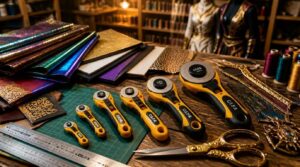
Not every cutter fits every cosplayer, and that’s actually a good thing. Whether you’re just starting out or building full-scale armor, there’s a tool matched to your specific needs and budget. Here’s a breakdown to help you find yours.
Best for Beginners
When you’re just starting out, a lightweight cordless rotary cutter is your best companion for DIY cosplay projects. It gives you freedom of movement without cable snags, and an ergonomic grip keeps your hand steady during foam crafting techniques.
Always practice precision cutting techniques on scrap material first, and look for starter kits that include essential blades and sanding bits.
Best for Armor Makers
Armor builds demand more from your rotary tool than simple cuts. Precision beveling techniques keep your EVA foam seams tight, while heat shaping curves lets plates follow your body’s contours naturally. Look for variable speed control and a brushless motor — they sustain consistent RPM when working through denser layers.
- Bevel edges cleanly for continuous armor joints
- Balance material weight without sacrificing rigidity
- Engrave surface detail for texture realism
Best for Fabric Costumes
Fabric costumes call for a different kind of precision than foam armor. Where armor needs raw power, satin snagging prevention and clean curved seams demand a steady hand and the right blade.
The Fiskars 45mm Rotary Cutter works with most woven fabrics beautifully, while a chiffon micro-blade keeps delicate layers from fraying mid-cut.
Best Budget Option
Not every cosplay budget stretches to a premium tool, and that’s perfectly fine.
The WEN 2305 rotary cutter covers cost-effective cutting across EVA foam and light plastics, running on a budget-friendly 115W motor with speeds reaching 30,000 RPM.
Its cordless-compatible accessories and widely available replacement parts make it a reliable choice for DIY cosplay without long-term frustration.
Best for Detailed Props
When prop-making demands micro carving precision, the Dremel 4000 stands out. Its variable speed control lets you dial in fine edge finishing on EVA foam, execute intricate glyph engraving at 0.8 mm depth, and hold small radius cutting down to 2 mm — all without losing detail depth control.
For cosplay props, that level of accuracy is hard to beat.
Frequently Asked Questions (FAQs)
Can rotary tools engrave text on costume props?
Yes, rotary tools can engrave text on costume props. Use small carbide burrs at low speed, follow a stencil for clean edges, then fill the channels with acrylic paint to boost legibility.
How long do rotary tool bits typically last?
Bit lifespan varies widely — carbide bits handle EVA foam for 25–60 minutes, while HSS bits dull in hard plastics within 5–25 minutes. Feed rate and speed matter just as much as bit material.
What RPM setting works best for thin plastics?
For thin plastics, keep your rotary tool between 18,000 and 24,000 RPM. Too low melts edges; too high causes vibration. Always test on scrap first to confirm clean cuts.
Are rotary tools suitable for outdoor convention use?
Yes, a cordless rotary tool works well outdoors, though you’ll want spare batteries charged and tools stored in weatherproof cases. Keep a mask handy for foam dust and secure your cutting mat against wind.
Conclusion
Even medieval armorsmiths knew a dull edge ruins the work before it starts—your rotary cutters for cosplay projects carry that same truth into every foam panel and fabric edge you shape today. The right tool doesn’t just cut cleaner; it lets your vision lead instead of your frustration.
Match the cutter to your material, respect the blade, and the build stops fighting you. That’s when convention floors start feeling like something you’ve genuinely earned.