This site is supported by our readers. We may earn a commission, at no cost to you, if you purchase through links.

The wrong scissors don’t just slow you down—they destroy your work. Foam tears instead of cuts cleanly, spandex shifts under the blade, and that intricate armor edge you’ve been planning for three weeks comes out ragged and uneven. Cosplay construction demands tools built for the actual materials you’re cutting, not whatever’s sitting in the junk drawer.
Fabric scissors for cosplay face a fundamentally different workload than standard sewing shears. You’re moving between EVA foam, worbla, stretch knits, and heat-transfer vinyl sometimes within the same build. Blade geometry, coating, and handle ergonomics all change how each material responds. The ten picks below cover that full range.
Table Of Contents
- Key Takeaways
- Best Fabric Scissors for Cosplay
- 1. Fiskars PowerArc Heavy Duty Shears
- 2. BoFuYuan Heavy Duty Utility Scissors
- 3. Professional Titanium Coated Sewing Scissors
- 4. RooPro Heavy Duty Utility Scissors
- 5. Livingo Titanium Fabric Scissors
- 6. Heavy Duty Utility Scissors 8 Inch
- 7. Klein Heavy Duty Utility Scissors
- 8. Livingo Heavy Duty 10 Inch Scissors
- 9. Heavy Duty Angled Craft Scissors
- 10. Livingo Heavy Duty Fabric Scissors
- Choosing Cosplay Fabric Shears
- Blade Materials and Coatings
- Blade Length and Cutting Power
- Handles for Marathon Crafting
- Pivot Design and Smooth Cutting
- Specialty Scissors for Cosplay
- Care, Sharpening, and Safety
- Frequently Asked Questions (FAQs)
- Conclusion
Key Takeaways
- Matching your scissors to the specific material — EVA foam, spandex, vinyl, or worbla — matters more than brand name, because the wrong blade geometry doesn’t just slow you down, it ruins the cut entirely.
- Titanium-coated and high-carbon stainless steel blades outperform standard steel in cosplay builds because they stay sharper longer, shed adhesive residue, and resist the rust that sweaty con‑crunch weekends accelerate.
- six-inch shears own detail and curve work, eight‑inch handles all‑purpose seam cutting, and ten‑inch blades deliver the leverage you need when you’re powering through layered foam panels.
- Proper maintenance — wiping blades after every session, cleaning foam residue with isopropyl alcohol, and never touching paper — extends a quality pair’s lifespan far longer than most crafters expect.
Best Fabric Scissors for Cosplay
Not every pair of scissors can keep up with the demands of cosplay — between thick foam, slippery synthetics, and detailed pattern work, you need tools that actually match the job.
From detail snips to heavy-duty cuts, understanding the different types of scissors and their uses helps you pick the right tool for every material in your build.
These ten picks cover the full range of what cosplayers usually reach for, from heavy-duty shears to precision snips. Here’s what made the cut for 2026.
1. Fiskars PowerArc Heavy Duty Shears
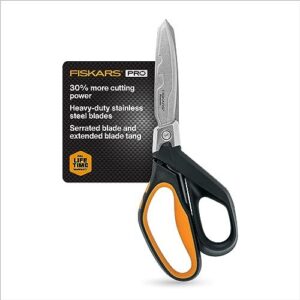
The Fiskars PowerArc Heavy Duty Shears are a serious workhorse for cosplayers tackling thick materials. Their curved PowerArc blades deliver 30% more cutting force exactly where cuts get tough, while the serrated edges grip slippery spandex and vinyl without letting them slide.
At 10.13 inches with a bolted pivot joint, they minimize blade wobble through long seams. The oversized SoftGrip loops handle gloved work comfortably, though smaller hands may find the bulk a tradeoff worth considering.
| Best For | Cosplayers, crafters, and DIYers who regularly cut through tough materials like leather, canvas, vinyl, or plastic clamshells — especially those who work with gloves or have hand fatigue issues. |
|---|---|
| Blade Material | Stainless steel, low-friction coated |
| Overall Length | 10.13 in |
| Handle Design | Oversized SoftGrip loops, textured |
| Rust Resistance | Low-friction coating |
| Heavy Material Use | Leather, canvas, light-gauge metal |
| Color | Orange/Black |
| Additional Features |
|
- PowerArc curved blades deliver ~30% more cutting force, making light work of thick or stubborn materials
- Low-friction coated stainless-steel blades resist rust and hold their edge longer than standard shears
- Oversized SoftGrip loops are glove-friendly and help reduce hand strain during extended use
- The large loop size can feel awkward or uncomfortable for users with smaller hands
- Prolonged repetitive cutting can create a pressure "hot spot" on the thumb
- Bulkier and heavier than everyday scissors, so they’re overkill for simple light-duty tasks
2. BoFuYuan Heavy Duty Utility Scissors
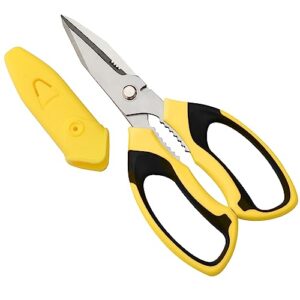
If the Fiskars feels like overkill for your setup, the BoFuYuan Heavy Duty Utility Scissors offer a leaner, more adaptable alternative.
These 8-inch serrated stainless-steel blades grip slippery synthetics and cut through fabric, cardboard, vinyl, and foam without losing their edge.
The ambidextrous PP/TPR handle keeps grip secure even with sweaty hands.
At 0.3 lb, fatigue stays low during long cutting sessions.
The thin protective sheath is the one weak point — store it carefully.
| Best For | Crafters, home users, and light workshop tasks who want a versatile multi-tool scissors that handles everything from fabric and cardboard to thin wire without the bulk of heavy-duty shears. |
|---|---|
| Blade Material | Precision-ground stainless steel |
| Overall Length | 8 in |
| Handle Design | Ergonomic TPR/PP, ambidextrous |
| Rust Resistance | Stainless steel construction |
| Heavy Material Use | Cardboard, carpet, leather, fabric |
| Color | Yellow/Black |
| Additional Features |
|
- Serrated stainless-steel blades grip and cut through tough materials like carpet, leather, vinyl, and foam with ease
- Built-in wire cutter, wire stripper, and bottle cap nutcracker make it a genuinely multi-purpose tool
- Lightweight at 0.3 lb with an ergonomic ambidextrous handle, so long cutting sessions don’t wear your hand out
- The plastic safety sheath is thin and tends to loosen or detach over time with regular use
- Not suited for thick metal or heavy industrial cutting — it’s built for light-duty work only
- Very sharp blades demand careful storage, especially in households with kids or pets
3. Professional Titanium Coated Sewing Scissors
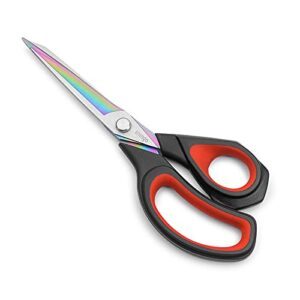
Where the BoFuYuan keeps things lean, the Professional Titanium Coated Sewing Scissors step up the material science. The titanium coating bonds to the high-density stainless steel base, increasing surface hardness and reducing friction between blades — which means smoother strokes through denim, leather, and canvas without the drag.
At 9.45 inches, the blades cut 16-plus fabric layers cleanly.
The coating also sheds adhesive buildup from vinyl and synthetic materials, keeping the edge performing longer between sharpenings.
| Best For | Tailors, quilters, and crafters who regularly work with heavy or layered materials like leather, denim, and canvas and need a durable, low-maintenance cutting tool. |
|---|---|
| Blade Material | Titanium-coated stainless steel |
| Overall Length | 9.45 in |
| Handle Design | Comfort grip, ergonomic contoured |
| Rust Resistance | Titanium coating |
| Heavy Material Use | Leather, canvas, denim, carpet |
| Color | Not specified (H1B) |
| Additional Features |
|
- Titanium coating reduces friction and resists adhesive buildup, keeping blades sharper for longer between maintenance
- Cuts through 16-plus fabric layers cleanly, making it a strong pick for heavy-duty professional use
- Works across a wide range of materials and tasks, from tailoring and dressmaking to everyday household cutting
- The handle may feel bulky or oversized for users with smaller hands
- Extended cutting sessions can cause hand fatigue due to the grip design
- Doesn’t quite match the silky smoothness of high-end Japanese shears for fine or delicate work
4. RooPro Heavy Duty Utility Scissors
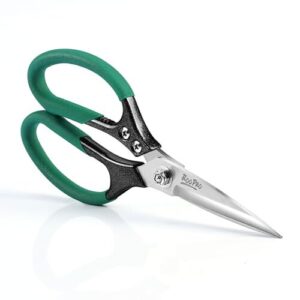
The RooPro Heavy Duty Utility Scissors take a different angle — built for the crafter who needs raw cutting power across mixed materials. High-carbon stainless steel blades hold their edge through dense foam, canvas, and leather without faltering.
The aluminum-alloy handholds with textured grips reduce fatigue during long build sessions, and the adjustable tension screw lets you dial in blade tightness precisely for whatever material you’re working with. Ambidextrous design means neither hand gets left behind.
| Best For | Crafters, DIYers, and hobbyists who regularly cut through tough materials like leather, cardboard, rope, or carpet and need a reliable, fatigue-friendly tool that works equally well in either hand. |
|---|---|
| Blade Material | Rust-resistant stainless steel |
| Overall Length | 8.5 in |
| Handle Design | Aluminum alloy, non-slip texture |
| Rust Resistance | Rust-resistant stainless steel |
| Heavy Material Use | Cardboard, carpet, leather, rope |
| Color | Green |
| Additional Features |
|
- Stainless steel blades stay sharp through heavy use on dense materials like foam, canvas, and leather
- Adjustable tension screw lets you fine-tune blade tightness for different cutting tasks
- Ambidextrous, ergonomic grip reduces hand fatigue during long sessions
- Heavier than standard scissors, so they can feel bulky for light or delicate cutting tasks
- Extremely sharp edges demand careful handling and safe storage to avoid accidental cuts
- Blades will still need periodic sharpening after prolonged heavy-duty use
5. Livingo Titanium Fabric Scissors
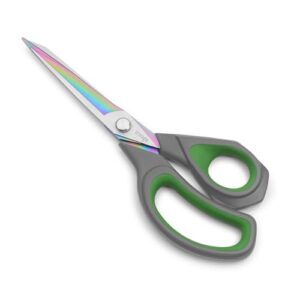
If precision and durability are what your build demands, the Livingo Titanium Fabric Scissors deserve serious consideration.
Forged stainless steel blades with a titanium coating resist rust and adhesive buildup — critical when you’re wrestling glue-backed materials mid-project. That coating also means a smoother glide through woven and non-woven fabrics with less snagging.
The soft-grip rubber grips reduce hand fatigue across long cutting sessions, and at 9.5 inches, these shears deliver enough leverage for 16+ fabric layers cleanly.
| Best For | Sewers, tailors, quilters, and crafters who regularly cut heavy or layered materials and need a durable, fatigue-resistant shear that holds up over long sessions. |
|---|---|
| Blade Material | Titanium-coated stainless steel |
| Overall Length | 9.5 in |
| Handle Design | Ergonomic soft-rubber grip |
| Rust Resistance | Titanium coating |
| Heavy Material Use | Fabric, leather, cardboard, denim |
| Color | Gray/Green |
| Additional Features |
|
- Titanium-coated forged steel blades resist rust and adhesive buildup, staying sharp through 150,000 cuts
- Cuts cleanly through 16 layers of fabric, leather, denim, cardboard, and carpet with minimal snagging
- Soft rubber grips reduce hand fatigue, making extended cutting sessions noticeably more comfortable
- Larger handle can feel bulky or uncomfortable for users with small hands or reduced grip strength
- Heavier build makes it less ideal for delicate or intricate cuts that require a lighter touch
- Falls short of premium Japanese scissors for fine-edge precision on the most delicate fabrics
6. Heavy Duty Utility Scissors 8 Inch
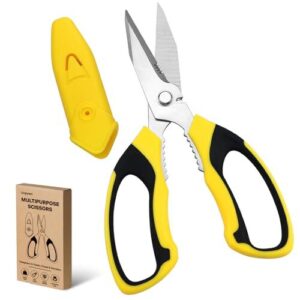
Not every cosplay tool needs to be laser-specialized to earn its place on your cutting table. The Heavy Duty Utility Scissors 8 Inch handle fabric, leather, vinyl, and even light wire without skipping a beat — a genuine multi-tool in scissor form.
If you also sew your own cosplay pieces, keeping that same multi-tool mindset applies to your machine — understanding bobbin case tension problems and how to fix them can save you from turning a simple adjustment into a costly repair.
The stainless-steel blades stay sharp across repeated sessions, and the TPR/PP non-slip handle suits both left- and right-handed crafters equally. For mixed-material builds, these pull consistent weight.
| Best For | Cosplayers and DIY crafters who work across multiple materials like fabric, leather, vinyl, and light wire and want one reliable pair of scissors that handles it all. |
|---|---|
| Blade Material | Stainless steel |
| Overall Length | 8.07 in |
| Handle Design | Ergonomic TPR/PP, non-slip |
| Rust Resistance | Stainless steel, dry after moisture |
| Heavy Material Use | Fabric, carpet, leather, cardboard |
| Color | Not specified (GS-130-01) |
| Additional Features |
|
- Stainless-steel blades stay sharp through repeated use on fabric, leather, carpet padding, and more — no swapping tools mid-project
- Works equally well for left- and right-handed users, making it a solid shared workspace staple
- Built-in wire cutter and protective blade cover add genuine utility and safety beyond basic scissors
- The 8-inch size limits leverage on thick cardboard stacks or dense multi-layer materials, so heavier cuts may still need a dedicated tool
- Blades need to be dried after any moisture exposure to avoid surface staining over time
- Not built for heavy-duty pruning or thick metal wire — pushing past its limits risks damaging the blades
7. Klein Heavy Duty Utility Scissors
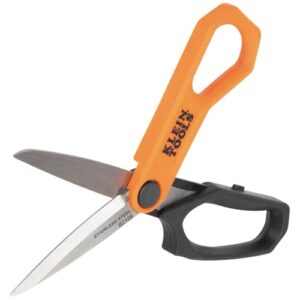
Klein’s T2107 brings a hardware-grade edge to cosplay cutting. The titanium-coated stainless steel blades resist corrosion and shed material adhesion, which matters when you’re pushing through leather, vinyl, or siding on a marathon build session.
At 7 inches, the blade balances reach with control — not too long to feel unwieldy on curves, not too short to lose leverage on straight runs.
The spring-loaded self-opening action is the real differentiator: fewer hand cramps, faster rhythm.
| Best For | DIYers, crafters, and hobbyists who need heavy-duty scissors that can handle fabric, leather, cardboard, and light sheet metal comfortably for extended sessions. |
|---|---|
| Blade Material | Stainless steel |
| Overall Length | 8.44 in |
| Handle Design | Cushion grip, ambidextrous |
| Rust Resistance | Stainless steel construction |
| Heavy Material Use | Fabric, leather, cardboard, plastic |
| Color | Orange |
| Additional Features |
|
- Stainless steel blades stay sharp through tough materials like leather, vinyl, and light sheet metal
- Ergonomic cushion grips reduce hand fatigue during long cutting sessions
- Ambidextrous design with large finger holes works for both left- and right-handed users, including those with bigger hands
- Not built for heavy-gauge metal or thick industrial materials
- On the bulkier side, so it’s not ideal for small, precise detail work
- No locking mechanism, which makes safe storage a bit less convenient
8. Livingo Heavy Duty 10 Inch Scissors
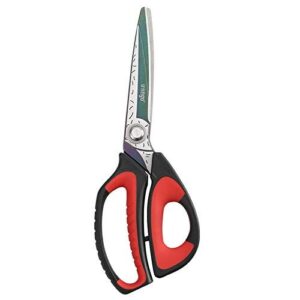
When you need maximum blade reach, the Livingo 10-inch scissors deliver exactly that. The forged 1.4034 stainless steel blades carry a titanium coating that hardens the cutting edge, reduces friction, and sheds adhesive buildup — meaning fewer interruptions when you’re powering through canvas, vinyl, or layered foam.
The large ergonomic loops fit gloved hands without sacrificing control, and the textured grip keeps things steady on slippery synthetics. Both left- and right-handed crafters can use them effectively.
| Best For | Crafters, tradespeople, and DIY enthusiasts who need a heavy-duty cutting tool that can handle tough materials like upholstery, leather, rope, and thick fabrics with ease. |
|---|---|
| Blade Material | 1.4034 stainless steel, titanium coated |
| Overall Length | 10 in |
| Handle Design | Textured double-ring, TPE/PP |
| Rust Resistance | Anti-rust titanium coating |
| Heavy Material Use | Fabric, upholstery, leather, rope |
| Color | Red/Black |
| Additional Features |
|
- Forged titanium-coated blades stay sharper longer and resist corrosion, making them well-suited for demanding, repeated use
- Large ergonomic loops with textured grip work comfortably for both left- and right-handed users, even with gloves on
- Versatile enough for a wide range of materials and settings — from the workshop and garden to the home and office
- Extremely sharp blades require careful handling and proper storage to avoid accidental injury
- Not designed for cutting sheet metal or heavy metallic materials, so there are limits to how industrial the tasks can get
- The titanium coating can wear down over years of heavy, abrasive use, and the higher price tag may be hard to justify for light or occasional use
9. Heavy Duty Angled Craft Scissors
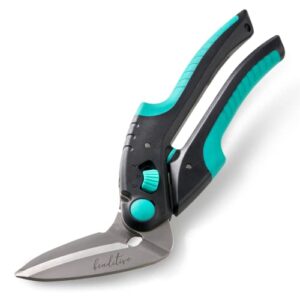
Angled scissors solve a problem most crafters don’t notice until their wrist aches halfway through a carpet installation or foam panel run. The bent-handle design keeps your blades flat on the cutting surface while your hand rides naturally above it — no awkward twisting, no fighting the material.
The 10-inch Japanese stainless-steel serrated blades grip slippery vinyl and thick upholstery without letting the fabric creep sideways. The high-leverage pivot and rubberized ergonomic grip make long sessions genuinely manageable.
| Best For | DIYers, crafters, and tradespeople who regularly cut thick or tough materials like carpet, leather, vinyl, or upholstery and want to reduce hand fatigue during long sessions. |
|---|---|
| Blade Material | Japanese stainless steel |
| Overall Length | 10 in |
| Handle Design | Rubberized ergonomic, angled |
| Rust Resistance | Stainless steel construction |
| Heavy Material Use | Leather, carpet, rubber mats, fabric |
| Color | Silver |
| Additional Features |
|
- The angled handle keeps your hand above the cutting line, making it far more comfortable than standard scissors for flat-surface work
- Serrated Japanese stainless-steel blades grip slippery or thick materials securely, so cuts stay clean and controlled
- The high-leverage pivot and rubberized grip genuinely reduce strain during extended projects like carpet installation or mattress dismantling
- The lock mechanism can be finicky out of the box and may need some fiddling before it stays reliably closed
- Even with the leverage advantage, very dense or resistant materials still require a solid amount of hand force
- The serrated blades are built for heavy-duty use — they’ll wear faster if you’re regularly cutting delicate paper or lightweight fabrics
10. Livingo Heavy Duty Fabric Scissors
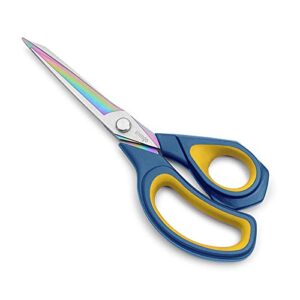
The Livingo Heavy Duty Fabric Scissors round out this list with reliable, workhorse performance. Precision-ground stainless steel blades — forged three times harder than standard steel and finished with a multicolor titanium coating — glide through 16+ layers of denim, leather, and heavy cosplay materials cleanly.
The contoured rubber-grip handholds reduce fatigue during long build sessions.
At 9.45 inches, they hit a practical middle ground between reach and control.
Not the sharpest on ultra-fine fabrics, but genuinely capable on everything else.
| Best For | Sewers, tailors, and crafters who regularly work with heavy-duty materials like denim, leather, and layered fabrics and need a durable everyday workhorse. |
|---|---|
| Blade Material | High-density stainless steel, titanium coated |
| Overall Length | 9.45 in |
| Handle Design | Contoured with rubber inner ring |
| Rust Resistance | Titanium coating, corrosion resistant |
| Heavy Material Use | Leather, carpet, denim, upholstery |
| Color | Navy Blue/Yellow |
| Additional Features |
|
- Blades are forged three times harder than standard steel and titanium-coated, so they stay sharp and resist wear, corrosion, and sticky residue over time.
- Cuts cleanly through 16 layers of heavy materials — denim, leather, carpet, upholstery — making them genuinely versatile for tough projects.
- Contoured rubber-grip handles reduce hand fatigue during long sewing or crafting sessions.
- Handles run large, so users with smaller hands may find them uncomfortable or tiring during extended use.
- Not as razor-sharp as premium Japanese scissors, meaning very fine or delicate fabrics may require extra pressure.
- Blades are extremely sharp, which raises the risk of accidental cuts if you’re not careful during handling.
Choosing Cosplay Fabric Shears

Not all fabric scissors are built for the chaos of a cosplay build — switching between dense EVA foam, stretchy spandex, and delicate organza in a single afternoon demands more than a generic pair from the craft store.
Before you invest in a new pair, there are key factors worth weighing against your specific workflow.
Here’s what to look for.
Costume Fabric Thickness
Costume fabric thickness isn’t a minor detail — it determines which fabric cutting tools can handle your build without stalling mid-cut. Lightweight chiffons measure around 0.25 mm, while heavy satins and vinyls push past 1.0 mm. A digital thickness gauge provides high‑precision readout for evaluating such layers.
- Fiber type impact: Natural fibers like wool run thicker than silky synthetics at equivalent weights
- Weave structure effects: Pile surfaces and tight weaves add measurable bulk beyond base fabric weight
- Interfacing thickness gains: Fusibles and interlining layers compound cumulative thickness, especially at seams
For accurate planning, measure each layer separately and sum totals — layering cumulative thickness demands heavy duty, multi-material compatibility from any shear you choose.
Foam Cutting Needs
Fabric thickness and foam density are two different problems, and they demand different solutions.
EVA foam crafting requires a blade sharp enough to shear cleanly through dense material without compressing or tearing the cell structure. A fine, pointed tip manages detail cuts, while a cutting mat reduces blade friction and protects edges.
Pattern Detail Precision
When foam cuts are done, the real test begins: pattern detail precision decides whether your build looks handcrafted or truly professional.
Notches and grain lines need placement within 1/8 inch, and seam matching across bodice pieces demands scissors that translate CAD-derived tolerances — sometimes ±1/16 inch — faithfully to fabric.
Six‑inch fabric shears give you that control.
Long Seam Cutting
Once your detail cuts are locked in, long seams are where your fabric shears really earn their keep.
Blade length advantage matters here: 8-to-10-inch blades maintain contact across the full seam, reducing strokes and keeping your line true.
- Align fabric grain with ruler guides before cutting
- Apply stabilizing spray to prevent material creep
- Maintain consistent cutting pressure throughout each stroke
Multi-material Compatibility
Most cosplay builds pull from three or four different materials — spandex, foam, pleather, vinyl — and your shears need to handle all of them.
Multi-material compatibility means choosing blades with aligned surface energy tolerance and an elastic modulus mismatch below 2:1 between bonded layers, keeping seam integrity intact during movement.
Blade Materials and Coatings

The blade material dictates almost everything — how long an edge stays sharp, how it manages abrasive foam, and whether it’ll rust after a sweaty con‑crunch weekend.
Not all steel is created equal, and coatings can make a real difference in how a blade performs over months of heavy use.
Here’s what you need to know before choosing.
Stainless Steel Blades
Stainless steel blades earn their reputation through chemistry as much as craftsmanship.
That 10–20% chromium content creates a passive oxide layer, which is what keeps your fabric scissors clean through long cutting sessions involving adhesive-backed synthetics.
The material also balances hardness against toughness, staying sharp without chipping mid‑cut — essential for precision cutting in any cosplay costume construction.
High-carbon Stainless Steel
Where standard stainless steel copes with moisture well, high-carbon stainless steel takes edge performance considerably further.
- Carbon content (0.5–1.0%) drives deeper hardness after heat treatment
- Carbide precipitation resists micro-wear during repeated fabric cuts
- Martensitic structure balances hardness with impact toughness
- Grain refinement via vanadium or molybdenum improves blade stability
The result: professional-grade cutting tools that stay sharper longer through heavy-duty cosplay costume construction.
Titanium Coating Benefits
Titanium coating is less about aesthetics and more about what happens at a microscopic level during every cut. The coating increases surface hardness, forming a protective layer that resists scratching through heavy-duty foam and synthetic fabric work. It also reduces blade friction, so your scissors glide through multiple layers with noticeably less effort — and less hand strain over a long build session.
Edge retention improves noticeably too, meaning fewer trips to the sharpening rod mid-project. The coating also makes cleaning easier, since dust and residue from foam cutting shed more readily off a titanium-treated surface than bare steel.
Rust Resistance
Rust is a slow project-killer. Stainless steel blades form a chromium oxide layer that blocks oxidation, making them far more reliable than plain carbon steel in humid workspaces. High-carbon stainless steel pushes that further, balancing edge retention with corrosion resistance.
Key habits that preserve your blades:
- Wipe blades dry after every cut — moisture is the primary catalyst
- Apply a light protective oil to create a moisture barrier on metal surfaces
- Store scissors in a dry protective sheath, never loose in a damp bag
- Titanium coating adds a hard surface layer that limits water and oxygen contact
Salt air and sweat accelerate pitting fast, so maintenance frequency matters.
Adhesive-resistant Cutting
Adhesive buildup is a friction tax you pay every time you cut foam tape, glued EVA panels, or sticky-backed vinyl.
Coated blades — titanium nitride especially — create a low-adhesion surface that sheds residue instead of collecting it. Serrated edges concentrate force at contact points, breaking adhesive grip segment by segment.
When buildup does occur, clean with an edge-safe solvent immediately.
Blade Length and Cutting Power
Blade length shapes everything from how you tackle thick foam panels to how cleanly you navigate a sharp curve in a pattern piece. The right size isn’t just about reach — it’s about matching mechanical advantage to the specific cutting task in front of you. Here’s how different blade lengths stack up for cosplay work.
Six-inch Detail Cuts

Six-inch blades are purpose-built for tight radius precision, which is exactly what miniature applique work and intricate cornering techniques demand. Their shorter cutting arc reduces fabric shear reduction risk on delicate materials like tulle and lightweight cotton.
- Fine tips reach tight corners without lifting fabric
- Beveled edges minimize fraying on woven cosplay fabrics
- Titanium-coated variants resist foam and glue adhesion
Eight-inch All-purpose Shears

Where six-inch blades max out, eight-inch heavy duty fabric scissors take over. That extra blade length gives you genuine leverage without the unwieldy weight of larger shears, making flexible pattern work across cotton, satin, and spandex feel controlled rather than clumsy.
For cosplay, that balance is everything — cutting speed efficiency through wide seams, with enough maneuverability to stay accurate.
Ten-inch Heavy-duty Blades
When eight-inch shears reach their limits on thick foam panels or stacked armor fabric, ten-inch blades deliver the mechanical advantage that makes the difference.
The longer blade maintains contact across wide material spans, driving clean cuts with leveraged cutting power that reduces strokes.
A thicker spine adds blade rigidity, preventing flex under load — critical for professional-grade cosplay armor fabric work.
Layer Cutting Capacity
Layer cutting capacity defines how many stacked layers your scissors can slice cleanly in a single pass — and it shifts depending on blade geometry, material thickness, and blade condition.
Premium heavy‑duty shears handle 16 or more fabric layers, but cosplay armor fabric work often involves two to five layers of mixed materials, where blade deflection prevention matters most for kerf width consistency.
Straight Versus Curved Cuts

The choice between straight and curved cuts shapes whether your build looks polished or amateur. Straight cuts excel at pattern matching precision, crisp angular detail execution, and guiding cleanly along rulers for long seams. Curved cuts handle silhouette contour accuracy and drape alignment techniques — reducing fabric bunching around armholes and organic edges.
- Sharp corners on geometric armor panels
- Smooth neckline transitions on bodices
- Flowing cape silhouettes with zero bunching
- Clean seam allowances on structured tunics
Handles for Marathon Crafting

When you’re five hours deep into a build and your hand starts cramping, the scissors are usually the culprit. Handle design isn’t just a comfort detail — it’s what separates a productive session from one you cut short. Here’s what to look for across the five handle features that matter most for long cosplay cuts.
Handle design is what separates a productive five-hour build from one you cut short
Soft-grip Comfort
When you’re hours deep into a build, your hands will tell you what your brain tries to ignore.
That’s why SoftGrip grips matter — ergonomic palm molding fills your hand naturally, distributing pressure so no single fingertip bears the load.
A vibration absorption layer beneath the surface kills the subtle buzz from dense fabrics, while hypoallergenic grip materials keep sensitive skin comfortable throughout marathon cosplay sewing sessions.
Bent-handle Control
Bent grips change the geometry of every cut. By placing the pivot closer to your palm and angling the blade toward the fabric plane, they promote a neutral wrist position that greatly reduces ulnar deviation — the sideways wrist bend that quietly accumulates strain during cosplay marathon sessions.
That alignment keeps your hand posture natural, so precision seam trimming and tight pattern corner access don’t cost you comfort.
Oversized Handle Loops
Oversized loops solve a problem you might not notice until hour three of a build.
They distribute load across the palm, reducing the grip intensity required to guide blades through layered EVA foam or vinyl — and that alone noticeably lowers hand fatigue.
Gloved hand compatibility comes built-in, since the wider opening accommodates extra bulk without sacrificing precision control or wrist stability.
Right-handed Designs
Most fabric scissors are engineered around dominant hand alignment, and right-handed designs take full advantage of that.
The blade bevel, rightward blade motion, and pivot leverage all work together so your right hand guides cuts intuitively.
Tactile feedback cues and ergonomic grip geometry reinforce control during long cosplay sewing sessions — every ridge and contour is exactly where your palm expects it.
Left-handed Cutting Comfort
Left-handed crafters often get shortchanged by scissors built around someone else’s grip.
True left‑handed scissors use mirrored blade orientation, positioning the top blade on the left so your cutting line stays visible throughout. Ergonomic thumb spacing and aligned handle geometry reduce wrist deviation, while lightweight rubberized grips lower grip pressure dramatically — keeping hand fatigue at bay during long cosplay sewing sessions.
Pivot Design and Smooth Cutting
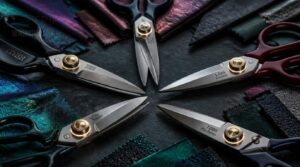
The pivot is where good scissors either earn their reputation or quietly fail you mid‑project.
Everything from blade tension to bearing friction determines how your shears perform across hours of cutting foam, pleather, and layered synthetics.
Here’s what to look for when evaluating pivot design in cosplay scissors.
Adjustable Pivot Screws
The adjustable pivot screw is the single mechanical variable that determines whether your scissors feel dialed-in or sloppy. By turning a knurled cap, you control blade tension precisely — tighter for dense foam, looser for flowing chiffon.
Micro-adjustment increments prevent tension drift mid-project.
Use light machine oil regularly, and don’t exceed the manufacturer’s torque limit or you’ll stress the joint permanently.
Bearing Pivot Systems
Where adjustable pivots give you manual control, bearing pivot systems take over that job automatically. By distributing rotational load across a bearing surface rather than a single contact point, they reduce pivot friction by up to 70%, which translates directly into less hand fatigue during marathon cutting sessions.
Sealed bearing assemblies also block foam dust from degrading the mechanism over time.
Blade Tension Control
Bearing pivots reduce friction automatically, but blade tension control determines whether that smooth rotation actually translates into clean cuts. An adjustable tension screw lets you dial in exactly how firmly the blades press together, preventing blade flutter on slippery polyester and minimizing deflection when pushing through dense foam layers.
Check and retighten tension screws regularly — foam dust creeps into pivot mechanisms and gradually loosens calibration.
Reduced Hand Fatigue
Tension calibration directly affects how hard your hand works on every single cut.
Smooth pivot systems reduce finger force by roughly 12 percent per stroke — that compounds fast across a four-hour build session. Pair that with soft-grip grips and proper wrist alignment, and you’re lowering perceived fatigue by up to 18 percent without changing anything about your technique.
Foam Dust Buildup
Foam dust buildup is the silent enemy of any precision pivot system — fine particles shed during foam shaping and foam cutting lodge directly into the pivot joint, grinding against the bearing surface with every stroke.
- Composite dust layers bond to metal surfaces, especially in humid workspaces where higher moisture increases adhesion
- Airflow efficiency loss of up to 15 percent compounds when dense residue clogs pivot channels
- Specialty solvent usage clears stubborn surfactant-rich deposits that compressed air alone won’t dislodge
- Regular inspection keeps pivot operation smooth and extends your professional-grade cutting tools’ lifespan
Specialty Scissors for Cosplay

Not every cosplay cut is the same, and the right specialty scissors can mean the difference between a clean finish and a frustrating fray. Beyond your standard shears, there’s a whole range of purpose-built tools designed for specific fabrics, techniques, and situations you’ll run into on the cutting table.
Here are the specialty scissors worth keeping in your kit.
Serrated Fabric Shears
Serrated blades solve one of cosplay’s most frustrating problems: slippery fabric control on polyester, satin, and spandex.
The micro-teeth grip the material surface as you cut, eliminating fabric creep across multiple layers. That grip also stabilizes knit cuts, preventing the stretch that causes wavy seam allowances.
Avoid cutting paper — it dulls serrations fast, shortening blade life dramatically.
Pinking Shears
Pinking shears handle one of cosplay’s most persistent finishing problems: fabric fray on seam allowances that unravels during wear or washing. The sawtooth blades create a zigzag edge that shortens exposed thread length, slowing textile fraying mechanically rather than just cosmetically.
They’re also genuinely useful for decorative hem styles on capes or trim panels where the zigzag edge itself becomes a design feature.
Embroidery Snips
Embroidery snips are the scalpel of your toolkit — precision thread trimming without disturbing surrounding stitches.
- Fine blade geometry cuts cleanly at 3–5cm
- Curved tips trace contour lines safely
- Spring-loaded action allows one-handed snip action
- Titanium coating ensures precision and durability
- Lightweight tool portability fits any project bag
Upholstery Shears
Upholstery shears are the industrial‑grade shears that handle what standard scissors simply can’t. With 10–12-inch blades and high‑carbon stainless steel construction, they slice through dense EVA foam, vinyl, and canvas cleanly.
A micro‑serrated edge grips slippery materials without tearing. Titanium coatings add workshop moisture resistance, while the blade tip precision lets you trim tight seam allowances accurately.
Heavy-duty Tailor Shears
Heavy-duty tailor shears are the workhorse of professional-grade cutting tools — built specifically for materials that destroy lesser scissors. High-carbon stainless steel blades deliver superior edge retention through pleather, vinyl, and spandex blends without tearing or snagging.
- Multi-layer fabric precision on dense stacks
- Serrated edge performance grips slippery synthetics
- Heavy material leverage through thick foam panels
- Vinyl cutting durability across long cosplay sessions
- Professional edge retention through repeated use
Care, Sharpening, and Safety
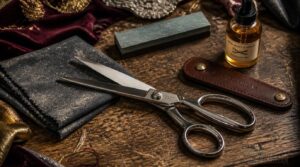
Good scissors are an investment, and how you treat them between projects determines how long they stay sharp. A few consistent habits — cleaning off foam residue, storing blades safely, knowing when and how to sharpen — can add years to a quality pair of shears. Here’s what every cosplayer should know.
Cleaning Foam Residue
Foam residue clinging to your blades is one of those small problems that compounds fast.
Scrape bulk residue off first with a blunt tool, then dab a microfiber cloth with 70% isopropyl alcohol along the blade to dissolve the remaining film.
Always test solvents on a hidden area, and keep antistick titanium coatings clean to preserve their adhesion-resistant properties.
Sharpening Dull Blades
Once your blades are clean, dullness becomes the next enemy. Maintain a consistent angle across every pass — a sharpening guide helps if you’re not confident freehand.
Start with a coarse diamond-coated file to remove nicks, then progress to a ceramic honing rod to realign the edge.
Test sharpness by slicing lightweight fabric cleanly.
Protective Blade Sheaths
A sharp blade deserves protection once it leaves your hand. A protective sheath prevents nicks between sessions and stops accidental cuts during transport.
- Choose Kydex or heavy nylon for rigid, impact-resistant coverage
- Look for drain holes to prevent moisture buildup
- Use snap or tension closures for secure retention
- Confirm sheath length exceeds blade by at least one inch
- Label sheaths clearly for quick tool identification
Safe Storage Options
Once your scissors are sheathed, where you keep them matters just as much. Climate-controlled storage — ideally maintaining 55–65% relative humidity — prevents moisture from compromising blade coatings over time.
For serious collections, inventory tracking software logs each tool’s location, while theft prevention measures like secured cabinets and tamper-evident seals protect your investment between builds.
Avoiding Paper Damage
Your fabric scissors should never touch paper — it’s that simple.
Cutting paper accelerates blade friction against wood pulp fibers, dulling edges faster than most synthetic fabrics do. Dull blades then snag during cosplay sewing, crushing paper fiber integrity rather than slicing cleanly.
Keep a dedicated pair for paper to protect your cutting performance long-term.
Frequently Asked Questions (FAQs)
Can fabric scissors double as craft knife alternatives?
For most cuts, scissors win on fabric handling ease — they require far less hand pressure and won’t gouge or stretch delicate weaves the way a misaligned craft knife can.
How do scissors perform on heat-activated bonding materials?
Heat-activated bonding resists blades until fully cured — tacky adhesive gums edges fast. Titanium-coated blades shed residue better than plain steel, staying cleaner longer through heatseal edging and bonded synthetic layers.
Are cosplay scissors safe for children to use?
Most cosplay scissors aren’t child-safe by default. For younger crafters, choose rounded-tip, lightweight models with silicone grips, and always supervise. Build skills gradually — safety scissors first, then real blades with guidance.
Which brands offer warranties or blade replacement programs?
Fiskars backs many models with warranties up to 25 years. Klein Tools offers a limited lifetime guarantee. Livingo, BoFuYuan, and RooPro usually cover manufacturing defects for one to two years.
Conclusion
A craftsman is only as good as their tools. The right fabric scissors for cosplay don’t just cut material—they cut time, frustration, and the gap between what you envisioned and what ends up on the con floor.
EVA foam, worbla, stretch knit—each demands a blade that respects the material.
Invest in scissors built for the actual work, maintain them properly, and your builds will show exactly that difference where it counts most.
- https://legrandcrafts.com/blogs/blogs/how-to-choose
- https://blog.wawak.com/post/11-kinds-of-sewing-scissors-and-when-to-use-them
- https://www.threadsmagazine.com/project-guides/learn-to-sew/how-to-select-the-best-scissors-and-shears
- https://lacreativemama.com/best-sewing-scissors
- https://sewcanshe.com/10-best-sewing-scissors-what-you-need-to-stay-sharp-in-2026