
This site is supported by our readers. We may earn a commission, at no cost to you, if you purchase through links.
Standard sizing is a myth sewers learn fast. That size 12 pattern from one brand fits like a dream, while a size 12 from another leaves you with armholes in the wrong zip code. Bodies don’t come in standardized boxes—and neither do patterns, especially when you’re pulling from European brands, vintage collections, or independent designers who each run their own numbers.
Knowing how to scale a sewing pattern at home puts that power back in your hands. A few measurements, the right technique, and a test run in cheap fabric can save you from cutting into your good material twice. Here’s exactly how to make it work.
Table Of Contents
Key Takeaways
- Pattern sizing varies wildly across brands and eras, so always measure your own body first and calculate the exact difference before touching scissors or a printer.
- Choosing the right scaling method — whether that’s manual grading, slash-and-spread, or printer scaling — depends on how much you’re adjusting and what kind of garment you’re making.
- Seam allowances, darts, zippers, and straps don’t scale themselves, so every detail needs a deliberate check after you resize the main pattern pieces.
- Sewing a cheap muslin test version before cutting your real fabric is the single step that catches remaining fit problems while they’re still easy to fix.
Measure Before Scaling Your Pattern

Before you cut a single line or fire up the printer, grab your tape measure—this step decides whether your finished garment actually fits. Skipping it is how people end up with sleeves that choke their arms or waistbands that gap like a hula hoop. Here’s exactly what to measure and check first.
If you’re new to this process, learning how to make a sewing pattern from scratch will show you exactly how those measurements translate into pieces that actually fit your body.
Before cutting anything, measure first — or risk sleeves that strangle and waistbands that swallow you whole
Take Key Body Measurements
Where do you even start with scaling a pattern? Right at your own body, with precise measurements.
Grab a flexible tape and check:
- Full bust/chest, snug but not tight
- Natural waist, an inch or two above your belly button
- Hips, shoulder width, and back waist length for torso length
Tape placement accuracy matters here—keep it level, especially across your shoulder bones.
Check Finished Garment Measurements
Once you’ve got your own body measurements written down, flip the pattern envelope over and find the finished garment measurements—not the size chart, the actual flat measurements.
This tells you the ease vs body difference built in already. Knits often run smaller (fabric stretch impact covers the rest), while wovens need closer numbers.
Jot these down for measurement documentation—you’ll measure the difference against your own numbers next.
Compare Size Chart Differences
Here’s where things get interesting. That finished garment measurement you just noted? Now stack it against the pattern’s size chart body measurements — and don’t assume a size 8 means the same thing everywhere.
Bust measurements alone can swing from 34 to 38 inches across brands. European labels often run smaller.
If your pattern is imported, check the unit too — centimeters versus inches trip up everyone eventually.
Understanding the target body type definition helps you align pattern measurements with the brand’s intended fit.
Calculate Needed Adjustments
Once you’ve spotted the gap, run the math. Subtract the pattern’s finished measurement from your target — that’s your measurement delta.
- Divide the delta by the original, multiply by 100 to get your percentage change.
- Convert that into a pattern scaling factor (20% increase = 1.2×).
- Recalculate sizes for bust, waist, and hip separately — they rarely match.
- Apply each scale factor to the corresponding pattern piece.
- Record every adjustment value on a dedicated sheet before touching the pattern.
Account for Wearing Ease
Before you finalize any scaling math, wearing ease needs a seat at the table. Ease allowance is the built-in breathing room — usually 1–4 inches — that keeps a garment comfortable rather than painted on.
For a fitted bodice, bust expansion needs roughly 2–4 cm of ease. Don’t subtract that from your delta; it’s already baked into the pattern.
Choose The Best Scaling Method

Once you know your numbers, you’ve got decision to make: how do you actually get from the original pattern to the new size? There’s no single right answer here—it depends on how much you’re changing, what kind of project you’re working on, and honestly, how much patience you’ve got for paper and tape.
For complex adjustments like repositioning darts or redistributing fullness, these sewing pattern fitting solutions can help you choose the right technique for your specific alterations.
Let’s walk through your options so you can pick the one that fits your project best.
Manual Grading for Garments
Manual grading is your most reliable option when you’re changing more than one size, since it lets you control exactly how the pattern grows or shrinks at each point. Using grade rule documentation, you’ll shift the bust, waist, and hip lines by set increments—often 0.5 to 1 cm per size.
This proportional silhouette integrity keeps darts, armholes, and curves looking right, not stretched or squished.
Printer Scaling for Small Changes
Why fuss with scissors and tape for a half-size tweak? Printer scaling accommodates small changes—usually 90 to 110 percent—right through your printer driver settings in Adobe Reader.
Print the test square first, measure it, then enter a custom scale percentage and disable fit-to-page.
Match your paper size to the tray, and always print at correct scale, never auto-fit.
Grid Method for Enlargement
Ever traced a treasure map as a kid? The grid method works that way—squares guide you while you enlarge a sewing pattern.
- Label grid coordinates
- Maintain aspect ratios
- Check square alignment
- Transfer complex textures
- Correct grid drift
This scaling sewing pattern tutorial keeps pattern resizing accurate, square by careful square.
Slash-and-spread for Fit
Think of slash-and-spread as giving your pattern room to breathe. You cut along designated lines — called slash lines — then spread the sections apart evenly, adding exactly the width you need.
This keeps your grainline integrity intact and distributes fullness without distorting darts. Just make sure you check dart point alignment afterward, especially when resizing a pattern around the bust.
Multi-size Pattern Blending
If your body doesn’t fit neatly into one size, multi-size pattern blending is your answer. Instead of picking a single size, you trace a line that glides between sizes — following your bust in one spot, your hip in another.
Use a French curve to keep those blending curves smooth, then sew a quick muslin to confirm the silhouette sits right before cutting your real fabric.
Resize Pattern Pieces Accurately
Once you’ve picked your scaling method, it’s time to actually work on the pattern pieces — and this is where precision really pays off. A few key steps keep your adjustments clean, accurate, and ready to sew. Here’s exactly what to do.
Trace The Original Pattern

Tracing your paper pattern before any cuts is the smartest move you’ll make. It protects your master copy from damage — forever.
Use any of these for pattern tracing:
- Tracing paper or medical paper
- Plain wrapping paper
- Grid-printed pattern paper
Once traced, label each pattern copy clearly with the pattern name, piece name, and date. Store pieces flat to prevent creasing.
Mark Grainlines and Notches
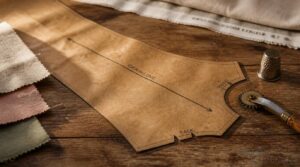
Once your traced pieces are done, mark grainlines and notches before you start scaling anything. The grainline arrow runs parallel to the fabric selvage — it keeps pattern pieces straight and stable for accurate pattern layout. Transfer it exactly. Notch differentiation also matters here: single notches mark front pieces, double notches mark the back, which ensures reliable seam line matching throughout.
| Mark | Location on Pattern | Purpose |
|---|---|---|
| Grainline arrow | Along the length of each piece | Aligns with fabric selvage for stable, straight layout |
| Single notch | Front seam edges | Identifies front pattern pieces during assembly |
| Double notch | Back seam edges | Differentiates back pieces for accurate seam line matching |
Spread Changes Evenly
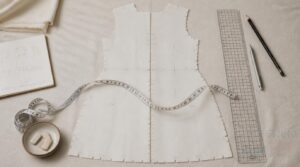
With notches marked, distribute the change evenly across seams—don’t dump a 2-inch increase on one side.
- Side seams
- Bust darts
- Shoulder seams
- Waistline
- Hemline
This even distribution math preserves symmetry, prevents proportional scaling errors, and avoids measurement clustering, keeping seam distribution balanced for clean pattern grading.
Redraw Curves Smoothly
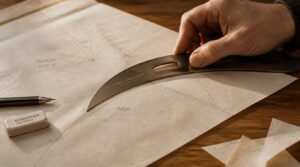
Once those seams are spread, you’ll have choppy little jagged edges where smooth curves used to be. Grab your French curve or hip curve and blend those points back into one continuous line—no bumps, no awkward angles.
Working digitally? A curvature pen tool or smooth tool setting does the same job, aligning tangents so the line flows naturally. Clean curves mean real pattern accuracy.
Label Every Adjusted Piece
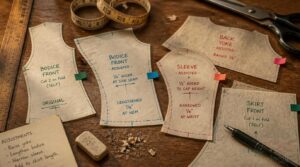
Before you set any piece aside, label it clearly.
Add a unique identifier suffix to each piece name — like "BodyFront-L2" — so nothing gets mixed up later.
Use color-coded labels to separate adjusted pieces from originals at a glance, and jot a quick change log note right on the edge: what changed, how much, and when.
Adjust Seam Allowances and Details
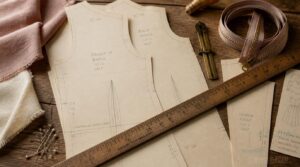
Once your pattern pieces are scaled, the real detail work begins. Seam allowances, darts, straps, zippers — they all need attention too, or your carefully graded pattern won’t come together the way you’re picturing. Here’s what to check and update before you cut a single piece of fabric.
Check Scaled Seam Allowances
Ever noticed how a seam’s strength can change when you scale a pattern? Before you cut, check that scaled seam allowances are proportional, especially in high-stress spots like shoulders or inseams. Here’s what to double-check:
- Bulk reduction at curved edges
- Durability in movement zones
- Zipper tape compatibility and bagged seam alignment
Muslin testing reveals any needed tweaks.
Reposition Darts and Pleats
If your pattern scaling shifts bust, waist, or hip points, you’ll likely need to reposition darts and pleats for a smooth fit. Use the dart pivot method to move fullness, split darts to reduce point stress, or convert darts into pleats for extra volume. Adjust notches and grainlines—small changes here keep your altered garment balanced and looking intentional.
| Dart Technique | Purpose |
|---|---|
| Dart Pivot | Move fullness location |
| Split Darts | Smooth fabric contour |
| Darts to Pleats | Add volume texture |
| Curve Dart Movement | Fit body contours |
Update Straps and Closures
When you scale a bag pattern by 50%, strap width scales too — a 1-inch strap becomes 1.5 inches.
Choose your material wisely: nylon webbing carries heavy loads, while leather adds polish but needs conditioning.
Hardware must match those new proportions, so swap buckles, D-rings, and snaps accordingly.
Reinforce every attachment point with riveted or double-stitched anchoring for lasting durability.
Match Zipper Lengths
Zippers don’t scale themselves — and skipping this step causes puckered seams or gaps that ruin the whole closure. When you upscale a pattern, zipper tape length must match your new fabric edges exactly.
- Measure stop-to-stop along the finished seam edge
- Choose coil, Vislon, or metal zipper by weight
- Trim and reset the top stop for precise closure alignment
Document Every Pattern Change
If you skip documentation, your changes vanish like socks in the wash. Record every alteration with a revision log, noting date, initials, and size. Color-code grading versus darts, and save digital edits as separate layers—track versions for clarity. Annotate schematics to highlight adjustments, and keep a notes column for measurement tolerances and fit rationale.
| Change Type | Date/Initials | Notes/Rationale |
|---|---|---|
| Grading | 6/17/26 PM/JD | +2cm bust, improves fit |
| Dart Shift | 6/17/26 PM/JD | Moved 1cm, fabric drape |
| Seam Allowance | 6/17/26 PM/JD | 1.2cm, matches scaling |
Test Fit Before Cutting Fabric

Before you cut into your real fabric, there’s one step that saves you from heartbreak later — the test fit. A simple muslin mock-up is your chance to catch any remaining fit issues while changes are still easy to make. Here’s exactly how to work through it:
Sew a Muslin Sample
Sewing a muslin sample first is the smartest move you can make before cutting into your good fabric. Grab cheap plain-weave cotton and baste pieces together with long stitches — easy to rip out when adjustments are needed.
Use carbon paper to transfer all darts and notches, then write fit notes directly on the fabric as you go.
Check Bust, Waist, Hips
Once your muslin is basted together, put it on and check the three key fit zones: bust, waist, and hips. Measure each point against your body measurements.
- Bust peak should sit at the fullest chest point
- Waist position must align with your natural narrowest point
- Hip circumference needs 1–2 inches ease for woven fabrics
Mark any gaps directly on the fabric.
Inspect Armholes and Neckline
Once the bust, waist, and hips look right, shift your attention upward.
Slide your arms forward and check the armhole ease — you want 2–5mm of give, not a tight pull. The neckline depth should skim your collarbone comfortably without pressing or gaping.
If notches aren’t aligning with your shoulder seam, that’s your signal to adjust.
Refine Fit Adjustments
Now that the armhole ease and neckline sit right, it’s time to fine-tune the details.
- Raise or lower darts 1–2mm per size to realign the bust point.
- Adjust sleeve cap height 2–5mm for a smooth shoulder.
- Expand neckline width 3–6mm to restore balance.
- Shift hip curve radius 2–4mm for clean shaping.
- Recheck closure placement before finalizing.
Transfer Final Corrections
Once your muslin fits well, transfer every correction back to your pattern pieces carefully.
Redraw smooth lines using a French curve, then verify notch alignment accuracy and check grainlines.
Do symmetry checks on mirrored pieces — flip and compare edges.
Write notes on your pattern pieces, including revision date.
Confirm closure placement scaling before trimming.
Your pattern alteration is officially done.
Frequently Asked Questions (FAQs)
How to scale pattern size?
Scaling a sewing pattern means resizing it to match your measurements while preserving its proportions. Methods include slash-and-spread accuracy, grid method precision, or digital scaling — each suited to different size adjustment needs.
Can I scale patterns for knit and stretch fabrics?
Yes, you absolutely can — but knit and stretch fabrics need a little extra thought. Account for stretch percentage and ease before scaling, or your perfectly sized pattern might end up wearing like a second skin.
How do I grade patterns for petite or tall frames?
Grading for petite or tall frames means adjusting vertical lengths — shortening bodice and skirts 1–3 inches for petite frames, or adding 5–3 inches for tall torsos, then repositioning darts and sleeves proportionally.
What scaling changes work best for childrens patterns?
Children grow fast — so rapid growth scaling is smart. Blend sizes at the shoulders and torso, add 1–2 cm mobility ease, and preserve proportions so the garment fits longer without distorting the shape.
Should I grade differently for lined versus unlined garments?
Yes — lined and unlined garments do need slightly different grading. Lining adds structure, so you can grade more aggressively at curves. Unlined pieces need gentler adjustments to preserve drape without fabric pull.
How do vintage pattern measurements differ from modern sizing?
Vintage patterns used actual body measurements — like a 34-inch bust — not modern S/M/L sizing. Standards varied by brand and country, and less ease was built in, so vintage sizes often run noticeably smaller than today’s equivalents.
Conclusion
A tailor once said fitting a body is like drawing a map—you can’t use someone else’s coordinates and expect to land in the right place. That’s exactly why scale a sewing pattern at home changes everything.
You’ve measured, adjusted, tested, and refined. The pattern now speaks your language.
Trust the muslin, respect the process, and cut your good fabric with confidence. The fit was always yours to claim.
- https://www.sewyours.com/blogs/bag-making-tips-tools-techniques/how-to-scale-print-your-sewing-patterns-for-perfectly-sized-bags
- https://cholyknight.com/2013/12/12/enlarging-book-patterns
- https://happiestcamper.com/pattern-grading-how-to-scale-a-pattern-up-and-down
- https://www.liusends.com/blog/tracing-off-sewing-patterns
- https://sewpdf.com/blog/pdf-patterns-for-beginners-printing-to-correct-scale