This site is supported by our readers. We may earn a commission, at no cost to you, if you purchase through links.
A single wrong turn on the tension dial can unravel hours of careful work—sometimes literally.
Most sewists blame their thread or their fabric when stitches loop and pucker, but the culprit is almost always upper thread tension settings sitting slightly off.
It’s a small mechanical detail with an outsized grip on stitch quality.
Once you understand how tension controls the lockstitch forming between your two fabric layers, you stop guessing and start dialing in with confidence.
The following breakdown covers everything—from reading your tension dial to troubleshooting stubborn loops—so your seams come out clean the first time.
Table Of Contents
Key Takeaways
- upper thread tension dial is the main control for stitch quality—small changes can fix loops, puckers, and uneven seams fast.
- Fabric type, thread weight, needle size, and even room conditions all affect tension, so adjust settings every time you change materials.
- Cleaning your tension discs and logging tension settings for each project help you keep stitches consistent and prevent hidden problems.
- Troubleshoot stitch issues by testing with contrasting threads, checking both sides of the seam, and making quarter-turn dial adjustments until balance is restored.
What is Upper Thread Tension?
Upper thread tension is the invisible force that makes or breaks every stitch you sew. Get it right, and seams look clean — get it wrong, and you’re fighting loops, puckers, and frustration.
When tension throws off your whole seam, fixing loose stitches and thread tension issues walks you through exactly where things go wrong and how to dial it back in.
Here’s what you need to understand first.
The Role of Upper Thread Tension
Upper thread tension is the backbone of every clean seam you sew. It controls how firmly the top thread pulls the bobbin thread into the fabric — forming a secure lockstitch right in the middle of both layers. Get it right, and you’ll see:
- Consistent lockstitch formation across every stitch
- Fabric puckering prevention on delicate materials
- Smooth bobbin interaction without thread dominance
- Thread wear reduction through balanced disc pressure
- Long‑seam stitch uniformity that holds through washing
For most machines the default tension setting is 4.5, as detailed in the default tension setting guide.
How Upper Thread Tension Affects Stitches
Think of your sewing machine’s stitch as a handshake — both threads need equal grip. When upper thread tension runs too loose, the loop position shifts to the fabric’s back, leaving bunched thread underneath. Too tight, and fabric puckering sets in quickly. Balanced thread interlock sits cleanly between layers, locking stitch quality and seam elasticity in place.
A balanced upper thread tension keeps stitches neat and elastic, while too loose or tight tension leads to loops or puckering
Remember to checking the thread pathway before adjusting tension.
| Tension State | What You’ll See |
|---|---|
| Too Loose | Loops visible on fabric underside |
| Too Tight | Bobbin thread pulled to fabric top |
| Balanced | Clean interlock between fabric layers |
| Off-Balance | Reduced seam elasticity and breakage |
Components Involved in Upper Thread Tension
Five parts work together to control upper thread tension on your sewing machine:
- Tension Discs — two or three metal discs that squeeze the thread as it passes through
- Tension Regulator — the dial controlling disc pressure, numbered 0–9
- Thread Guides — small hooks directing thread along its path
- Take-Up Lever — pulls slack after each stitch
- Thread Check Spring — applies pretension before the main discs
How The Tension Dial Works
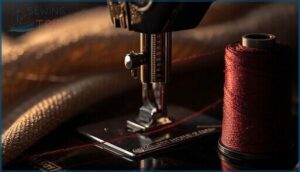
The tension dial is your main control point — get to know it and half your tension problems disappear.
It’s simpler than it looks, but only if you understand what the numbers actually mean and how to move them with purpose.
Here’s what you need to know about finding it, reading it, and using it right.
Locating The Tension Dial
On most sewing machines, the tension dial sits right on the front panel — easy to spot while threading.
If yours looks a little different, this guide to adjusting upper thread tension correctly can help you identify it.
Front panel identification is straightforward: look for a small numbered wheel near the thread take‑up lever path.
Some machines use side panel knob placement instead.
Trace your thread path from the spool downward — wherever it disappears into a narrow slot, that’s your tension dial.
Interpreting Tension Dial Numbers
Most home machines run a dial scale basics from 0 to 9 — that’s your numeric pressure mapping at a glance. Mid-range settings, usually 3 to 6, handle standard fabrics well.
Think of it as a pressure gauge: higher numbers clamp harder on your upper thread tension.
Hit extreme dial indicators like 1 or 9 regularly? Your sewing machine tension needs service, not just thread tension adjustment.
Model-specific calibration matters too — a 4 on one machine won’t match another.
Adjusting The Dial for Desired Results
Adjusting the tension dial is where theory meets practice. For medium cotton, start at 4–5 — that’s your baseline for balanced stitch quality.
Dial calibration tips: go up for heavy denim, down for silk.
Always lower your presser foot before testing — open discs make thread tension adjustment meaningless. Run a test stitch with contrasting thread colors.
One small change at a time reveals your fabric-specific settings fast.
Factors Impacting Upper Thread Tension
Getting your tension right isn’t just about turning a dial — it’s about understanding what’s pulling against your thread in the first place.
Several variables work behind the scenes to throw things off, and knowing them puts you in control.
Here’s what you need to watch for.
Fabric Type and Thickness
Fabric is the real boss of your tension dial — it tells you where to start before you touch a thing. Upper Thread Tension must flex with every material change:
- Sheer Fabric Tension sits low — around 2.0 to 3.5 — to prevent puckering
- Knit Stretch Balance lands at 3.5 to 4.5, giving seams room to move
- Quilting Batting Layers demand a climb toward 5.0 to offset added drag
- Denim Tension Adjustments push up to 6.0 through thick, dense weaves
- Heavy Canvas Settings mirror denim — higher tension locks stitches through resistance
Match your Needle Size to fabric weight too, and Tension Adjustment becomes far more predictable.
Thread Quality and Weight
Ever notice how thread acts like a stubborn river—flowing smooth or rough depending on its quality and weight?
Your Upper Thread Tension depends on Weight Classification, Surface Smoothness, and Material Strength.
For quick reference, check this table:
| Thread Quality | Tension Adjustment |
|---|---|
| 40 wt smooth | Mid-range |
| 70 wt coarse | Lower |
| 60 wt fine | Higher |
| Uneven surface | Unpredictable |
| Strong polyester | Stable |
Needle and Thread Compatibility
Think of your needle and thread as a matched pair — get them wrong, and your Upper Thread Tension fights you the whole way.
- Needle size matching — a 80/12 manages 40-weight thread cleanly; go smaller, and friction spikes.
- Eye-groove fit — thread should fill roughly 40% of the needle eye.
- Ballpoint vs universal — ballpoints protect knits; universals suit wovens.
- Denim needle usage — reinforced points manage heavy thread without shredding.
- Thread weight selection — heavier thread demands a larger needle, always.
Environmental Influences on Tension
Your sewing room itself can quietly sabotage Upper Thread Tension — no dial touching required.
Temperature Effects hit hard: polyester stiffens in cool rooms, and needle friction above 130°C destabilizes Thread Quality under tension.
Humidity Impact swells cotton thread, tightening seams unexpectedly.
Static Electricity makes synthetic thread cling to guides, throwing off Tension Adjustment.
Dust Lint Contamination packs tension discs tighter over time.
Even Altitude Pressure matters — above 1,500 meters, you’ll likely need to nudge the dial up slightly.
Step-by-Step: Adjusting Upper Thread Tension
Adjusting upper thread tension doesn’t have to feel like guesswork. Once you know the right steps, it becomes a straightforward process you can repeat on any project.
Here’s exactly what to do — from setting up your machine to locking in settings you’ll actually use again.
Preparing Your Machine and Materials

Getting your machine ready before touching the tension dial saves you a lot of frustration. Machine cleaning comes first — lint in the tension discs quietly wrecks your upper thread tension before you’ve even started. Then gather your materials deliberately.
- Unplug and raise the presser foot for tension disc inspection
- Cut 2‑inch fabric scrap testing squares from your actual project fabric
- Thread top and bobbin with contrasting colors for clear stitch visibility
- Match needle size to fabric type — 80/12 for cotton, 70/10 for silk
- Confirm thread quality; ditch old or cheap spools that stretch unevenly
Making Incremental Adjustments

Now that your machine is clean and threaded, the real work begins. Use the quarter-turn technique — small clockwise moves tighten upper thread tension, counterclockwise loosens it.
After each adjustment, run a test seam evaluation on your scrap fabric and inspect both sides.
Direction isolation matters here: change one thing at a time.
Symptom-based tweaks — loops below, puckering above — tell you exactly which way to turn.
Documenting Settings for Future Use

Once you’ve nailed the right tension dial setting, don’t leave it to memory. Use Tension Log Templates or Digital Recording Apps—record your upper thread tension, thread, needle, and fabric.
Sample Swatch Labeling with standardized entry formats makes repeatability easy. Project‑specific notes help you recall why a certain adjustment worked, streamlining future thread management and sewing machine maintenance.
- Tension Log Templates
- Sample Swatch Labeling
- Digital Recording Apps
Troubleshooting Common Tension Issues
Even with careful setup, thread tension can throw you curveballs. Knowing what to look for makes fixing issues much easier.
Here’s how you can spot—and solve the most common problems.
Identifying Loops and Puckering
Ever run your finger along a seam and feel bumps or loose threads? That’s your Loop Detection and Puckering Signs at work.
Flip the fabric—loops mean slack upper thread tension, puckers show tightness.
Use a Contrast Thread Test for clarity.
A quick Fabric Feel Test and Stitch Length Check help pinpoint Thread Tension issues, leading to Stitch Quality Improvement.
Diagnosing Uneven or Broken Stitches
Spotting uneven or broken stitches starts with visual stitch clues—alternating long and short stitches, or breaks at thick seams. Stitch length issues and machine speed effects often mask true Thread Tension problems.
If the bobbin thread forms dots on top, your Upper Thread Tension is too high.
Environmental humidity impact can also throw off Stitch Quality, demanding precise tension adjustment for sewing machine troubleshooting.
Rethreading and Cleaning Tension Discs
Clearing tension discs is like brushing grit from gears—essential for smooth Upper Thread Tension.
Use Disc Cleaning Tools:
- Fleece Floss Technique for lint removal
- Paper Sweep Method to grab stubborn debris
- Isopropyl Alcohol Wipe for sticky residue
Afterward, Post-Clean Rethreading ensures thread drops between discs. Check resistance with the Tension Dial—your stitches should look balanced.
When to Check Needle and Bobbin
Whenever you spot stitch imbalance or thread breakage, check for needle wear—especially after a fabric change or several hours of sewing. Bobbin tension matters, too; a poorly seated bobbin can throw off upper thread tension in a heartbeat.
For instance, if your stitches look uneven, inspect needle size and bobbin tension before tweaking thread tension or starting sewing machine maintenance.
Maintaining Consistent Tension Settings
Getting your tension right once is satisfying — keeping it right is where real consistency lives.
A few straightforward habits make all the difference between chasing problems every session and hitting the ground running.
Here’s what to build into your routine.
Using Tension Logs for Reference
Your tension log is a personal cheat sheet — built from your machine, your thread, your fabric. Organize entries by thread weight: 60wt fine, 40wt heavy. Use contrasting thread colors for clear loop visibility, then pin those test strips nearby for fabric matching mid‑project.
Reference charts save real time. Review logs yearly to catch any upper thread tension or tension dial drift before it quietly ruins a seam.
Cleaning and Oiling Your Machine
Dirt is the silent wrecker of upper thread tension — and most sewers don’t see it coming. Build these four habits into your sewing machine maintenance and repair routine:
- Lint removal around thread guides and the needle plate after every project
- Tension disc cleaning with a flossed cotton thread — presser foot raised
- Bobbin area maintenance every three to four bobbin changes
- Oil application — one drop only, on metal joints your manual specifies
Clean discs hold calibration. Dirty ones drift.
Adjusting for Fabric and Thread Changes
Every fabric and thread swap resets the game.
Lightweight chiffon needs fabric tension presets around 2–3 on the tension dial — heavy denim pushes toward 5–6.
Thread weight scaling matters too: fine threads need less resistance, heavy ones need more.
needle size pairing, layered fabric adjustment for thick batting, and even humidity impact on thread flow.
Dial in each combo fresh.
Regular Checks for Optimal Stitch Quality
Dialing in the right combo is half the battle — keeping it is the other half.
- Run a Test Strip Frequency check before every major project
- Do a Stitch Pull Test and Visual Inspection Routine after each bobbin swap
- Follow a Disc Lint Schedule every 8–10 sewing hours
- Review your Tension Log to catch drift early
Consistent habits keep your upper thread tension locked in.
Frequently Asked Questions (FAQs)
What controls the tightness of the upper thread?
Your tension dial controls upper thread tightness — it adjusts tension disc pressure by squeezing metal discs closer or apart. Presser foot linkage and thread guide friction also play a role.
What does an upper thread tension dial do?
Your tension dial controls thread flow control by pressing two discs together — adjusting stitch tightness with every click.
Turn it clockwise for more pressure adjustment, counterclockwise for less.
Simple dial mechanics, big impact on stitch quality.
Can decorative stitches require different tension settings?
Yes, decorative stitches demand different settings. Zigzag Tension runs looser than straight seams — usually 3–4 on the dial. Satin Stitch Balance tightens slightly. Metallic Thread Looseness prevents breakage. Always test first.
Does thread color affect how tension appears visually?
Thread color absolutely affects how tension problems appear on fabric.
Light threads enhance loops through reflection, while dark threads mask minor imbalances.
Two-Color Test Method — contrasting shades reveal upper thread tension faults instantly.
How does machine age impact tension consistency?
An aging machine can silently sabotage your work.
Disc wear, spring fatigue, lubrication degradation, lint buildup, and mechanical misalignment all erode tension consistency — making reliable thread tension nearly impossible without regular sewing machine maintenance and machine calibration.
Should tension differ for stretch versus woven fabrics?
Absolutely — stretch vs. woven fabrics demand different tension dial settings.
Stretch knits need 2–3; wovens work best at 3–
Always run test scrap adjustments first, since fabric elasticity’s impact on stitch formation is real.
Conclusion
Tension, it turns out, is everything—in life and in lockstitches.
Once you’ve got your upper thread tension settings dialed in, something clicks. Your seams lie flat. Your thread stops fighting you. The machine does exactly what you ask.
That control didn’t come from guessing—it came from understanding the mechanics, testing deliberately, and keeping records that actually mean something.
You’ve got the knowledge. Now go put it to work.
- https://www.magnetichoop.com/blogs/news/mastering-your-thread-tension-dial-the-ultimate-guide-to-perfect-stitches
- https://www.sewschool.co.uk/sewing-machine-thread-tension/
- https://threadsmonthly.com/machine-settings-for-cotton/
- https://sabrinawhartonbrown.wordpress.com/2011/05/23/how-to-get-your-sewing-machine-thread-tension-and-stitch-quality-right/comment-page-1/
- https://support.brother.com/g/b/faqend.aspx?c=fi&lang=fi&prod=hf_ev1euk&ftype3=2158&faqid=faqh00100030_017&ot=eu_ot&pfs=1