
This site is supported by our readers. We may earn a commission, at no cost to you, if you purchase through links.
An exposed zipper doesn’t hide—it performs. Unlike concealed zippers tucked away in seams, an exposed zipper sits front and center, so every crooked stitch or puckered edge shows. That’s what makes them intimidating for a lot of sewists, but also what makes getting them right so satisfying.
The good news? Precision beats talent here. With the right tools, a little prep work, and a clear sequence of steps, you can install an exposed zipper that looks intentional, sharp, and completely professional—no matter your experience level.
Table Of Contents
Key Takeaways
- Precision and prep work matter more than raw talent — the right tools, interfacing, and careful marking are what make an exposed zipper look intentional.
- Your zipper foot and stitch settings do the heavy lifting, so dial in your machine on scrap fabric before touching your actual garment.
- Small finishing moves — mitered corners, graded seam allowances, and clipped edges — are what separate a polished result from a homemade one.
- Most exposed zipper problems like puckering, wavy tape, or sticking teeth trace back to skipped prep steps and are easy to fix once you know the cause.
Essential Tools and Materials for Exposed Zippers
Before you sew a single stitch, having the right tools in hand makes all the difference.
From mastering tension to finishing raw edges cleanly, knowing how to sew a French seam is one of those foundational skills worth having in your toolkit from the start.
Exposed zippers aren’t hard to install, but the materials you choose will determine how clean and professional your results look.
Here’s what you’ll need to get started.
Choosing The Right Exposed Zipper
The right exposed zipper makes or breaks your design. For inspiration, study these clean exposed zipper finishes to understand how professional garments balance function and style at the zipper opening.
Start with teeth material choices — metal for bold, structured looks on denim or leather; nylon coil for softer garments. Zipper size strength matters too: a size 5 suits most jackets and skirts, while size 3 works for blouses. Match function type selection and style color coordination to your fabric for a finish that feels intentional.
Zipper Foot and Sewing Machine Setup
Your zipper foot is where precision starts. An adjustable zipper foot slides left or right, giving you clean needle positioning on either side of the tape. Snap it on, manually turn the handwheel to confirm clearance, then dial your stitch length to 3–4mm for crisp topstitching. Adjust presser foot pressure for your fabric weight, and test everything on a scrap first.
For a deeper look at how standard, adjustable, and invisible zipper feet differ in precision and versatility, see choosing the right zipper foot.
Interfacing and Stabilizers
Once your machine is dialed in, interfacing becomes your next decision. Think of it as the backbone behind your exposed zipper — without it, fabric shifts, stretches, and ruins your topstitching.
Interfacing weight selection matters: match it to your fabric, never go heavier. For heat-sensitive fabrics, choose sew-in over fusible interfacing. High-stress spots need cut-away stabilizers.
Stabilizing delicate fabrics early saves rework later.
Marking and Measuring Tools
Good marking tools are just as important as your interfacing choices. Fabric marking pencils draw clean, fine lines without snagging delicate fabric, making them ideal for sewing exposed zippers. Tailors chalk choices depend on weight — clay for denim, wax for texture. Water-soluble pens show up bright on prints, while heat-erasable guidelines suit internal seam marks.
Pair those with rulers and gauges for precise zipper installation techniques every time.
Preparing The Fabric for Installation
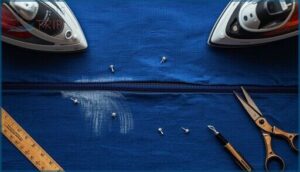
Good prep work is what separates a clean zipper installation from one that fights you the whole way.
Before you sew a single stitch, there are a few key steps that set everything up for success. Here’s what you need to do first.
Marking The Zipper Placement
Accurate marking is the foundation of clean exposed zipper installation. Start by drawing your opening rectangle — usually 0.5 inch wide — directly over the seamline using a water-soluble pen.
For even cleaner results, referencing a step-by-step coil zipper sewing guide helps you dial in precise measurements before you ever pick up a pen.
For center-back guidelines, transfer pattern notches to map your zipper length, adding about 1 inch for clean corners. These symmetrical balance points keep your seamline alignment marks even on both sides.
Applying Fusible Interfacing
Think of fusible interfacing as your zipper’s best support system. Fusible type selection matters — use lightweight woven for quilting cotton, knit fusible for stretch fabrics. For interfacing strip dimensions, cut about 1 inch wide, extending 0.5 inch past each end. Fusing heat technique is simple: press, lift, move — never slide.
Before zipper area stabilization on your actual piece, always do fabric compatibility testing on a scrap first.
- Wrong interfacing weight stiffens your garment
- Under-fusing causes bubbling after a few wears
- Skipping the scrap test risks scorching delicate fabric
- Misplaced strips leave zipper edges unstable
Seam Allowance Considerations
When you plan your seam width for exposed zipper installation, always factor in zipper tape size and fabric thickness. For heavy fabrics, stick with a wider seam allowance—1.5 cm is ideal. Adjust for curved seams and style lines, marking intersections so everything aligns.
More allowance means better finishing options, whether you’re binding, grading, or serging raw edges.
Pressing and Prepping The Seam
Ever notice how a crisp seam can make or break your exposed zipper installation? Start by pressing the seam open in the correct order, using press cloths to protect fabric. Control steam for sharp results.
Align the seam opening, and set up for corner clipping. Interfacing adds stability. These sewing techniques guarantee your zipper sits flat and looks professional every time.
Step-by-Step Exposed Zipper Installation
Now that your fabric is prepped, it’s time to install the zipper. Each step builds on the last, so you’ll want to follow along closely.
Here’s how to get that exposed zipper looking sharp and professional.
Creating and Cutting The Zipper Opening
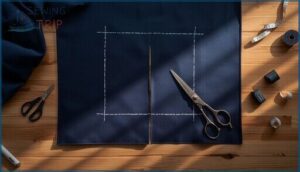
Ready to cut your Exposed Zipper opening? Precision here is your best friend. Follow these five steps for a perfect result:
- Marking Zipper Rectangle with chalk or pen
- Stitching Box Outline along the rectangle
- Cutting Center Slit with sharp scissors
- Diagonal Corner Cuts for crisp edges
- Forming Mitered Corners—press and fold
Positioning and Securing The Zipper
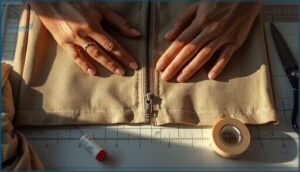
Zipper tape positioning is where good installs are won or lost. Place the zipper face-down behind the opening, keeping the tape edge 6mm from the teeth for balanced exposure. Use a glue stick or Wonder Tape for temporary adhesive support — no pins shifting your work mid-stitch.
Secure the bottom stop carefully, avoiding the metal stopper. Reinforce the zipper area, then you’re set to stitch.
Pinning, Basting, and Alignment
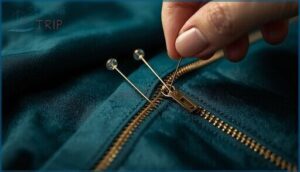
Once secured, your pin placement strategy keeps everything honest. Place pins perpendicular to the tape edge — three per side, spaced two inches apart.
Then baste using a slip basting control technique, stitching every half inch through the tape and folded fabric.
Your alignment check steps are simple: close the zipper and confirm equal tape exposure. Remove pins in sequence as you stitch.
Topstitching for a Professional Finish

With basting done, it’s time to commit. Attach your zipper foot and set your stitch length — 3 mm works for most fabrics, but bump to 4 mm for topstitching heavy fabrics like denim. Control thread tension carefully to avoid puckering.
Press before topstitching for a crisp topstitching line placement, then edgestitch 1/8 inch from the fold for clean, confident garment finishing.
Advanced Techniques and Finishing Touches

Once you’ve got the basics down, a few extra techniques will take your zipper from "good enough" to genuinely polished. These aren’t complicated steps — they’re the small details that separate a handmade look from a professional one.
A few small finishing details are all that separate a handmade look from a truly professional one
Here’s what to focus on next.
Miter-Cut Opening for Clean Edges
The miter-cut opening is where Zipper Installation Methods get really satisfying. Miter Corner Geometry uses two 45-degree cuts at each end of your slot, folding a small Triangle into a Clean Interior Finish. This Bulk Reduction Strategy keeps corners flat instead of lumpy.
- Use Triangle Marking Accuracy before cutting — ruler-drawn lines keep both corners symmetrical
- Press every fold with Crisp Corner Pressing before your zipper foot approaches
- Topstitch with even seam allowance for a sharp, professional exposed zipper frame
Grading Seam Allowances
Once your miter corners are pressed flat, grading seam allowances is your next power move. The purpose of grading is simple — trimming each layer to a different width keeps bulk from stacking.
For heavier fabrics, use noticeable steps between layers. Leave your outer fabric widest, trim inner layers narrower.
Press graded seams with steam, and your exposed zipper lies perfectly smooth.
Decorative Topstitching Options
Now for the fun part — making your exposed zipper a real design statement.
Decorative topstitching turns functional zipper installation into intentional garment finishing:
- Stitch Length Styling: Use 3.0–4.0 mm for visible, crisp single vs double rows
- Thread Color Contrast: Match for texture; contrast to spotlight the zipper
- Double-Needle Effects: Sew two perfect parallel lines in one pass
- Decorative Stitch Patterns: Try scallops or geometric stitching techniques alongside teeth
- Seam Allowance Check: Always confirm clearance before decorative stitching begins
Finishing Raw Edges and Corners
Clean corners make or break your exposed zipper installation. Clip diagonally 2–3mm from each corner point so the opening turns flat without puckering. Then trim seam allowances down to 3–5mm — that’s your Trimming Corner Bulk step.
Use this quick guide for Inside Edge Finishes:
| Fabric Type | Best Finish |
|---|---|
| Lightweight | Narrow overlock + press toward zipper tape |
| Loosely woven | Zigzag + seam sealant at corners |
| Unlined garments | Turn under 3–5mm, slip stitch to tape |
| Heavy fabric | Grade allowances, bind zipper openings with 2.5cm strips |
Faced Zipper Windows get understitched so the facing stays hidden. Corner Clipping Basics done right means your garment finishing looks intentional — not improvised.
Troubleshooting Common Exposed Zipper Issues
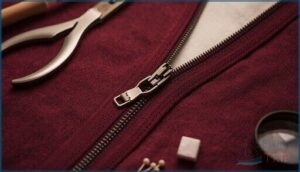
Even the most careful sewist runs into a snag now and then — that’s just part of the process. The good news is that most exposed zipper problems have straightforward fixes once you know what to look for.
Here are the four most common issues you’ll likely face and exactly how to handle them.
Preventing and Fixing Puckering
Puckering is the nemesis of a clean exposed zipper — but it’s almost always preventable. These fabric stabilization strategies keep things smooth:
- Apply a 2–3 cm strip of interfacing along the opening
- Adjust stitch length to 2–2.5 mm for even tension
- Test balancing thread tension on scrap fabric first
- Use steam pressing techniques before and after stitching
- Prewash fabric to prevent postwash pucker remedies later
Aligning Zipper Tape Evenly
Even a perfect exposed zipper installation falls apart if the tape sits crooked. Start with neckline seam matching — close the zipper fully and align both edges before pinning.
For symmetrical tape positioning, pin through the tape every 2–3 cm at right angles. Consistent tape reveal comes down to equal seam allowance on both sides. If tape shift happens, unpick only the last few centimeters and realign.
Smoothing Out Wavy or Stiff Zippers
A wavy zipper usually means the seam stretched during sewing. Preventing zipper waves starts with applying a 2–3 cm strip of lightweight fusible interfacing along the opening before you stitch.
For supporting delicate fabrics, swap to knit fusible interfacing — it stabilizes without stiffening. Steam pressing techniques help too: press the closed zipper with a press cloth.
Adjusting stitch length to 2–2.5 mm also distributes tension evenly, softening stiff tape naturally.
Quick Fixes for Sticking or Misaligned Teeth
A sticking zipper is usually just dirty. Start zipper maintenance by brushing lint and thread from the teeth — that alone fixes most stuck sliders.
Then rub bar soap or candle wax along both rows for smooth zipper care. If teeth are misaligned, gently press them together and ease the slider through.
A bent tooth causing repeated jams? Straighten it with small pliers.
Frequently Asked Questions (FAQs)
Can exposed zippers be added after garment completion?
Yes, you can add exposed zippers to finished garments. With careful seam conversion and smart design change planning, it’s absolutely doable — even working around linings.
How do you shorten an exposed zipper at home?
Measure the new length, mark both tape sides evenly, remove excess teeth with pliers, crimp on replacement stops, then trim the zipper tape clean. Done—your exposed zipper fits perfectly.
Which garment styles suit exposed zippers best?
Structured outerwear, body-con dresses, casual zip tops, modern zip skirts, and statement zip pieces all shine with an exposed zipper — it’s where garment construction meets bold fashion design.
Can exposed zippers withstand regular washing and drying?
Exposed zippers hold up well through regular washing — if you care for them right. Close the zipper before every cycle, wash cold, and skip high heat to protect the coil and extend zipper lifespan.
Are exposed zippers suitable for childrens clothing?
For children’s clothing, exposed zippers aren’t the safest choice. Pinching hazards, choking risks from loose sliders, and skin irritation make concealed or plastic alternatives far better options for garment construction involving kids under five.
Conclusion
Precise, purposeful, and practiced—that’s what separates a zipper that looks homemade from one that looks intentional. Every technique in this exposed zipper installation guide exists to put that control in your hands.
You now know how to prep, position, stitch, and troubleshoot like someone who’s done this a hundred times. Trust the process, trust your tools, and trust the work you put in. That clean topstitch line? That’s yours.
- https://weallsew.com/insert-exposed-zipper/
- https://blog.megannielsen.com/2015/06/tutorial-how-to-insert-an-exposed-zipper/
- https://www.sewdaily.com/sewing/how-to-sew-an-exposed-zipper/
- https://www.doinaalexei.com/sewing-an-exposed-separating-zipper.html
- https://www.facebook.com/sharer.php?u=https%3A%2F%2Fwww.threadsmagazine.com%2F2013%2F06%2F16%2Finstalling-an-exposed-zipper