This site is supported by our readers. We may earn a commission, at no cost to you, if you purchase through links.
A fabric cutting mat works quietly in the background of every project, absorbing blade pressure thousands of times before showing any obvious signs of wear.
What most crafters don’t realize is that embedded lint and dried residue can shorten a mat’s life from a decade to barely two years—not because the material fails, but because the surface never gets proper care.
Those fuzzy ridges building up along your grid lines? They’re shifting your ruler by a millimeter or more without you noticing.
Knowing how to clean a fabric cutting mat the right way keeps your cuts sharp, your blades fresh, and your mat working far longer than neglect ever allows.
Table Of Contents
Key Takeaways
- Embedded lint and dried residue are the real reasons most mats fail early — not heavy use — so cleaning them out regularly can stretch your mat’s life from two years to ten.
- Always remove loose fibers with a lint roller or masking tape before any wet cleaning, because moisture drives debris deeper into the grooves if you skip this step.
- Warm water around 37°C with a drop of mild dish soap is all you need for a safe wash — anything hotter than 45°C permanently warps the mat’s self-healing layers.
- Store your mat flat, away from heat and sunlight, and rotate your cutting zones between projects to spread wear evenly and give the surface time to heal.
Why Clean a Fabric Cutting Mat
A clean cutting mat works better, lasts longer, and keeps your projects on track.
Regular upkeep takes just a few minutes, and this beginner’s guide to cutting mats walks you through exactly how to do it right.
Skipping regular maintenance is one of the fastest ways to ruin an expensive mat — and dull your blades along the way.
Here’s why it’s worth a few minutes of your time.
Extend Mat Lifespan
Caring for your mat consistently is what separates a mat that lasts two years from one that lasts ten.
Consistent mat care is the only thing standing between a two-year mat and a ten-year one
Skipping regular cleaning lets fibers and moisture break down the self‑healing restoration layer over time.
Pair that with proper mat storage, UV protection from sunlight, and smart humidity management around 50%, and you’ve got a mat that stays flexible, accurate, and ready to work.
Improve Cutting Accuracy
A well‑maintained mat does more than last longer — it cuts straighter.
Lint and debris settle into grooves, creating tiny ridges that push your ruler off‑track.
That’s where debris removal and flat surface control become part of your accuracy toolkit.
When your mat stays clean and lies flat, grid alignment stays true, fabric stability improves, and tool readiness means every cut lands exactly where you planned.
Regular mild‑soap cleaning preserves the mat’s self‑healing maintenance routine.
Protect Rotary Blade Sharpness
Your mat’s condition affects more than just accuracy — it directly impacts your rotary blade’s lifespan.
Embedded fibers and debris create micro-abrasions against the blade edge, dulling it faster than normal use. Good rotary blade upkeep for better cutting starts with a clean surface.
- Blade Edge Maintenance — Clear grooves before each session
- Pressure Control — Light, steady strokes reduce edge rolling
- Blade Cooling Breaks — Short pauses prevent heat buildup
- Wear Distribution Rotation — Shift cutting zones to protect the edge
Prevent Lint, Dust, and Residue Buildup
A dull blade often points back to a dirty surface — and lint is usually the culprit.
Fabric fibers, human hair, and airborne dust settle into mat grooves during every session.
Static reduction helps, but regular vacuuming and lint removal techniques do the real work.
Without consistent fabric debris removal and selfhealing mat care techniques, buildup quietly wrecks your cutting lines before you notice.
Keep The Surface Hygienic
Hygiene isn’t just about looks — it protects your work.
Bacteria, mold, and airborne contaminants settle onto your mat between sessions, creating real cross‑contamination risk, especially if you cut multiple fabric types. Regular cleaning and maintaining fabric cutting mats addresses all of this at once:
- Bacterial Barrier – soap‑and‑water washes eliminate surface bacteria
- Mold Prevention – Dry storage stops moisture‑driven growth
- Odor Management – Vinegar rinses neutralize musty smells
- Fiber Transfer Reduction – Clean surfaces keep dyes off your next project
Supplies for Safe Mat Cleaning
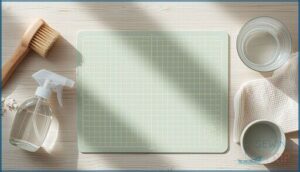
Before you start scrubbing, it helps to gather the right tools — wrong ones can do more harm than good.
Nothing fancy is needed here, just few simple supplies you likely already have at home.
Here’s what to keep on hand before you begin.
Mild Dish Soap
A drop of mild dish soap is all you need — seriously, don’t overdo it.
pH Balanced Formula sits around neutral, so it won’t dry out or damage your mat’s vinyl layers.
Biodegradable Surfactants lift lint and dye residue without leaving buildup behind, making it gentle on vinyl surfaces.
You get a Low Residue Rinse that keeps grooves clear and blades clean.
Warm or Lukewarm Water
Getting the temperature right matters more than you’d think. Warm water — around 37°C — hits the sweet spot for Ideal Cleaning Temperature and Thermal Material Compatibility.
It softens embedded lint and helps mild dish soap dissolve dyes without warping your mat’s PVC layers.
Water above 45°C risks permanent damage.
Lukewarm water delivers real Warm Water Efficiency while keeping your mat safe and flat.
Soft Sponge or Microfiber Cloth
Your tool choice here makes a real difference.
A microfiber cloth wins on Absorbency Comparison — it holds far more water than cotton and uses Static Charge Benefits to trap lint without chemicals.
A soft sponge manages gentle compression in grooves.
Both pass Durability Testing, show strong Chemical Compatibility with mild dish soap and lukewarm water, and support Eco‑friendly Reuse when you air dry them flat.
Soft-bristle Brush
A soft-bristle brush is your secret weapon for grooves a cloth can’t reach. Look for nylon or Taklon bristles — they bend gently at contact, protecting your mat’s printed guides.
Bristle stiffness levels matter: extra-soft works best for fabric lint and selfhealing mat care techniques.
Medium width covers more surface, while narrow heads fit tight corners.
Rinse and air-dry the brush after each use.
Lint Roller or Masking Tape
Both lint rollers and masking tape are surprisingly effective for DIY lint and fuzz removal methods — and they work differently by design. lint rollers use a low-tack adhesive strength that lifts fabric lint without damaging your mat’s surface. masking tape, thanks to its crepe material composition, reaches fibers stuck in grooves.
For eco-friendly alternatives, try a washable silicone roller. Watch your application pressure — dab, don’t drag.
White Vinegar
White vinegar is one of the most reliable DIY cleaning methods you’ll find in your pantry. Its acidic cleaning power — around 4–7% acetic acid — cuts through greasy residue and loosens lint trapped in mat grooves.
For disinfection safety tips, stick to a 1:4 dilution ratio with water. That gentle mix manages fabric cutting surface care without harming your mat’s self-healing layer.
Clean Towel for Drying
Once your mat is rinsed, reach for a clean, lint-free towel — not a paper towel, which shreds and leaves particles behind. Absorbent Material Choice matters more than you’d think:
- Use a microfiber or cotton soft cloth for gentle, streak‑free drying
- Apply Drying Technique Variations — pat, don’t rub
- Follow Towel Maintenance Practices: skip fabric softener, which kills absorbency
Then let it air dry flat.
Remove Lint and Surface Debris
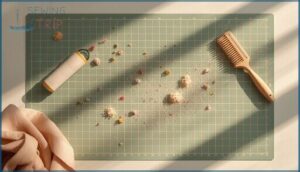
Before any water touches your mat, you need to clear the surface first.
Lint and loose fibers are sneaky — they settle into grooves and mess with your blade’s path more than you’d think.
Here are five simple ways to get your mat clean and ready.
Use a Lint Roller First
Rolling a lint roller across your cutting mat before any wet cleaning is the smartest first move you can make. This quick roller selection and rolling technique step lifts fabric fuzz, loose threads, and surface debris before moisture drives them deeper into self‑healing grooves.
Apply light pressure in straight, overlapping passes — this adhesive maintenance habit boosts cutting mat cleaning efficiency benefits and protects your soft bristle brush work later.
Lift Fuzz With Masking Tape
After you’ve rolled away loose debris, masking tape steps in for stubborn fabric fuzz removal. The Tape Adhesion Mechanics grab fuzz buildup deep in self‑healing mat grooves without harming the surface. For cost‑effective cleaning, wrap tape around your fingers and press firmly.
Try these Practical Application Tips:
- Work in both directions.
- Replace tape as needed.
- Bend mat gently for hidden fibers.
Slightly bend the mat to expose micro‑cuts before applying tape, as described in the slightly bend mat for cleaning guide.
Brush Out Fibers From Grooves
Clearing fibers from grooves is where a soft brush earns its place. Skip hard scrub brushes — they scratch the surface.
Instead, hold your brush at a 45-degree Brushing Angle and use short strokes. Work in 6–8 inch sections using the Sectioning Technique, and keep Pressure Control light.
| Brush Types | Frequency Schedule | Best For |
|---|---|---|
| Old toothbrush | After every session | Narrow grooves |
| Soft nylon brush | Heavy use: every few hours | General fuzz buildup |
| Silicone makeup cleaner | Monthly deep clean | Embedded lint |
Wipe Lines With a Damp Cloth
Once the brush has done its job, a damp cloth takes Residue Removal to the next level. Damp Cloth Prep matters here — wring out a soft cloth in warm water until it’s just barely moist, not dripping.
Use Directional Wiping to clean the cutting mat:
- Wipe along grid lines to lift trapped debris
- Overlap each pass 2–3 cm for full Surface Preservation
- Switch from horizontal to vertical strokes once
- Apply light pressure — never push residue deeper
- Use soap and water on stubborn spots, then re‑wipe with a soft brush
Moisture Control keeps the mat safe throughout.
Avoid Scraping With Metal Tools
Scraping with metal tools is one of the fastest ways to ruin a good mat. Metal edges gouge the PVC layers, leaving scratches that never fully close — and that kills the self‑healing surface for good.
| Safe Tool | What to Use Instead |
|---|---|
| Non‑metal Scrapers | Plastic Edge Tools or plastic scraper |
| Silicone Bump Cleaners | Rubber Eraser Techniques |
| Nylon Brush Alternatives | Soft bristled brush |
Stick to nonabrasive options only.
Wash The Mat Step by Step
Once the lint and loose fibers are gone, it’s time to give your mat a proper wash.
This part doesn’t take long, but the order you do things really matters. Here’s exactly how to work through it.
Mix Soap and Warm Water

Getting the mix right matters more than you’d think.
For solution ratio, combine one teaspoon of mild soap per liter of warm water — temperature control is key here, so aim for 32°C to 38°C. Too hot warps your mat.
For foam management, stir gently using your hand or a plastic spoon as your mixing technique.
Safety precautions are simple: test a small corner first.
Wipe in Gentle Circular Motions
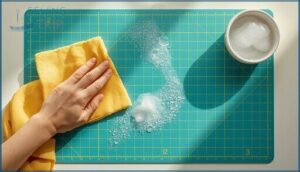
Think of your sponge as a dance partner — move it in small, steady circles rather than dragging it back and forth. Pressure control matters here: light, even strokes keep the self-healing layers intact.
Good cloth selection, like a soft sponge or microfiber cloth, lets mild soap glide smoothly. Moisture balance and motion direction work together to lift dirt without streaking.
Focus on Stained or Fuzzy Areas
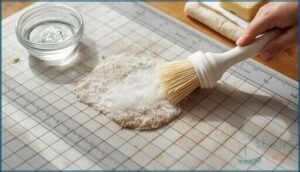
Stained patches and fuzzy buildup need extra attention — don’t just pass over them.
For fuzz, try gentle brush use along the grooves to pull trapped fibers out.
A soft sponge with a vinegar solution ratio of one part white vinegar to four parts water works well for stain removal.
Magic eraser safety tip: use it lightly, since heavy pressure wears the surface down fast.
Rinse Away All Soap Residue
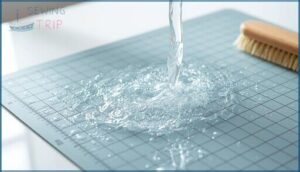
Once the stained patches are handled, rinsing matters more than most crafters expect. Soap water left in grooves clouds your grid lines and attracts fresh lint almost immediately.
Use a gentle water flow at an even rinsing angle — tilting the mat lets gravity do the work:
- Run clean water twice using a double rinse cycle
- Sweep a soft‑bristle brush along grooves under warm water
- Watch for the clear water test — when it runs completely clear, you’re done
Pat Dry With a Clean Towel
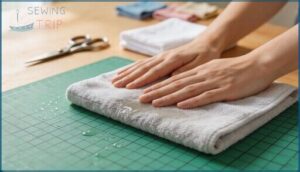
Once the water runs clear, don’t let it sit — grab a clean, lint-free towel right away.
Use Pressure Technique with Edge Blotting: press down gently, don’t wipe. A tight-weave hand cloth wins every time for Absorption Efficiency.
| Towel Material Choice | Moisture Spot Detection | Result |
|---|---|---|
| Microfiber | Lifts surface water fast | Dry towel ready for air dry |
| Cotton hand cloth | Reveals dye or dirt transfer | Safe for hand washing care |
| Paper towel | Leaves debris in grooves | Avoid — store it properly instead |
Air-dry Flat Before Reuse
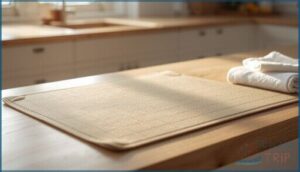
After patting down with a dry towel, lay your mat on a flat surface — don’t rush this part.
- Choose a Flat Drying Surface like a counter or table
- Use Even Airflow Placement — away from vents or windows
- Do a Temperature Moisture Check after 24 hours
- Apply Weight‑Balanced Flattening on curling corners
- Practice Temperature‑Free Drying — no hair dryers
Air dry completely before you store it properly. That’s good cutting mat maintenance.
Remove Stains and Disinfect Safely
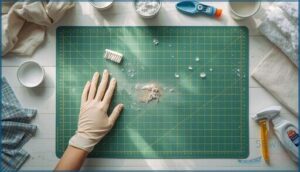
Some stains need more than a basic wash — and that’s okay.
Depending on what got on your mat, there are a few targeted tricks that actually work without damaging the surface.
Here’s what to reach for and when.
Use a Magic Eraser Lightly
magic eraser works like ultra-fine sandpaper — gentle enough to lift stubborn marks without tearing up your self-healing cutting mat. Always use a damp eraser, never dry.
Light fingertip pressure and small circular motions are all you need for effective spot cleaning. That gentle pressure protects the surface and keeps your grid lines sharp.
Follow up with mild soap and water for a thorough clean.
Try a Vinegar and Water Spray
Mixing a simple vinegar solution is one of the easiest ways to tackle surface grime on your cutting mat. For the right Vinegar Dilution Ratio, combine ¼ cup white vinegar per gallon of Cool Water — warm or hot water can warp the mat before you’ve even started cleaning.
Follow this Spray Application Technique:
- Fill a clean spray bottle with your vinegar solution and mist the mat lightly and evenly
- Let it sit for 15–20 minutes — that Contact Time Guidance gives the solution time to loosen residue
- Wipe, rinse, then air‑dry flat for proper Drying and Follow‑Up
This gentle approach keeps your self‑healing cutting mat performing its best.
Remove Marks With Baking Soda Paste
Stubborn marks on your mat don’t always need harsh chemicals. Baking soda paste is a reliable spot treatment technique for stain removal on cutting mats.
Mix a 2:1 paste ratio — two parts baking soda to one part cool water — then spread it gently over the mark. Let it sit for several minutes (dwell time matters here), wipe clean with a damp cloth, and dry flat. Simple self‑healing mat care.
Treat Ink With Rubbing Alcohol
Ink stains are where rubbing alcohol earns its place — but only as a last resort for stubborn stains, not everyday deep clean duty. Before you touch the mat, always do an Alcohol Safety Test on a hidden corner first.
Spot Application Technique:
- Dab a small amount on a cotton ball
- Work from the stain’s outer edge inward
- Watch for Ink Lift Timing — the ink transfers to the cotton fast
For Solvent Damage Prevention on your selfhealing mat care routine, keep contact brief. Surface Drying Tips: air-dry your fabric cutting mat flat after treatment.
Rinse Thoroughly After Spot Cleaning
After spot cleaning, don’t skip the rinse — leftover soap or alcohol clings to the mat’s self-healing pores and causes sticky patches.
Use a gentle spray nozzle with lukewarm water for proper Water Temperature Control, tilting the mat slightly for Tilted Mat Rinsing so residue runs off cleanly.
A distilled rinse also reduces mineral spots.
Blot immediately with a soft cloth, then air dry flat.
Disinfect Only When Needed
Disinfecting your mat every week is overkill — and it can actually backfire. Overuse of cleaning agents strips moisture from the self‑healing surface. Follow these Frequency Guidelines instead:
- Contamination Indicators: Disinfect only when you spot fabric dyes, pet hair, or food residue.
- Safe Disinfectant Choice: Diluted white vinegar (1:3 ratio) covers most hygiene needs without damage.
- Targeted Spot Disinfection: Apply your disinfecting solution with a damp cloth — never pour directly — then practice strict Moisture Control by drying flat immediately.
Skip the food‑safe disinfectant spray and cross‑contamination concerns if you’re cutting clean fabric only.
Store, Moisturize, and Replace
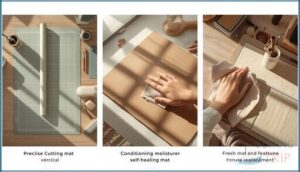
Cleaning your mat is only half the job.
store it, treat it, and know when to let it go makes just as big a difference in how long it lasts.
Here’s what you need to do to keep it performing at its best.
Moisturize Every Few Months
Your self-healing cutting mat is basically a living surface — and like anything alive, it dries out.
Moisturize the mat every 2–3 months to keep it cutting smoothly. Seasonal dryness hits hard in winter when indoor heating pulls moisture right out of the PVC layers.
| Conditioning Frequency | Recommended Solution |
|---|---|
| Weekly-use mats | Every 2–3 months |
| Daily-use mats | Every 4–6 weeks |
| Stored/light-use mats | 2–3 times per year |
| Winter/dry climates | Increase by one cycle |
A simple vinegar solution — one part white vinegar to four parts water — restores mat moisture without leaving residue. Silicone protectant sprays and diluted glycerin moisture treatments also work well. Apply with a microfiber cloth using gentle circular strokes, let it absorb for about 10 minutes, then wipe away any excess.
Store Flat on a Hard Surface
After moisturizing, lay it flat immediately — don’t prop it against a wall to dry.
Flat surface benefits go beyond just looks. A hard flat surface keeps your mat from warping, curling at the edges, or developing subtle bends that throw off your cuts.
For practical setup tips, try these storage options:
- Use a clean workbench or sealed wood shelf
- Slide it into a flat drawer or storage pocket
- Place a silicone sheet between the mat and hard flat surface to prevent scratches
- Keep weight uniformity in mind — avoid stacking tools on top
- Check hygiene advantages by wiping both the mat and surface before storing
Keep Away From Heat and Sunlight
Even a flat surface won’t save your mat if it’s sitting near a heat vent or sunny window. Fabric cutting mats are heat sensitive mats — temperatures above 95°F soften the PVC layers and trigger heat‑induced warping that’s nearly impossible to reverse.
Direct sunlight causes UV-bleaching that fades your grid lines over time. Use sunlight-blocking covers and temperature-controlled storage between 64°F–77°F to protect them.
Fix Minor Warping With Even Weight
A slightly wavy mat can usually be coaxed back flat with even weight and a little patience. Start by lightly dampening the warped area, then warm it briefly with an iron over a pressing cloth.
- Place a large wood board across the full surface for Board Distribution
- Stack 10–15 hardcover books for effective Book Stacking pressure
- Apply weights for 2–8 hours — Timing Duration matters
- Post‑Weight Inspection with a straightedge before reuse
Rotate Cutting Areas to Reduce Wear
Once your mat is flat again, don’t keep cutting in the same spot.
Rotate your cutting mat 90 or 180 degrees between projects for natural Pressure Distribution and Groove Prevention.
Each zone gets rest time, which helps Self-Healing Recovery and Marking Preservation.
This simple habit improves Blade Longevity, extends your cutting mat lifespan, and is one of the easiest self‑healing mat care techniques you can build in.
Replace Mats With Deep Grooves or Cracks
Some damage just can’t be undone. Deep grooves, visible cracks, and a warped cutting mat are clear Irreversible Damage Signs that no amount of cleaning will fix.
Beyond accuracy problems, these create real Safety Risks — blades catch, skip, and jerk unpredictably.
For Replacement Timing, plan on a replacement every one to three years.
Worn mats can be repurposed as workbench protectors — a smart Cost-Benefit Analysis and one of the simplest Disposal Options available.
Top 6 Helpful Cutting Mat Items
Having the right tools makes mat care a lot easier. These six items cover everything from routine cleaning to better cutting results. Here’s what’s worth keeping on your supply shelf.
1. MR LION Silicone Makeup Brush Cleaner
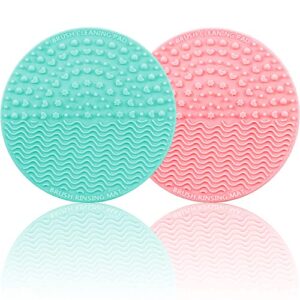
The MR LION Silicone Makeup Brush Cleaner pulls double duty as a handy mat surface scrubber for small jobs. Its raised grooves and multi-texture ridges work into tight spaces, lifting loose fibers and light residue without scratching your mat.
The suction cup backing keeps it anchored to your sink while you scrub — no chasing it around. At under 5 inches and 2.4 ounces, it’s compact enough to stash in your sewing caddy for quick cleanups between projects.
| Best For | Anyone who wants a simple, no-fuss way to keep their makeup brushes clean without spending a lot of time or effort. |
|---|---|
| Material | Silicone |
| Primary Use | Brush cleaning |
| Portability | Lightweight, travel-friendly |
| Weight | 2.4 ounces |
| Compatibility | All brush types |
| Surface Design | Multi-texture silicone |
| Additional Features |
|
- The multi-texture surface does a solid job scrubbing out pigment, oils, and old product from all kinds of brushes
- The suction cup sticks to flat surfaces so it stays put while you work — no holding it down with one hand
- Small and light enough to toss in a travel bag or makeup kit without a second thought
- The suction cup struggles on curved or uneven sink surfaces, so it might not stay put in every bathroom
- It can stain over time, especially with darker makeup products
- Leaving it sitting in water too long makes it slimy and unpleasant to handle
2. Gypsy Quilter Heart Mat Cleaner
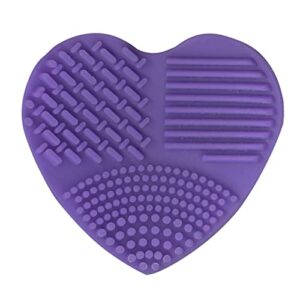
Designed for quilters, the Gypsy Quilter Heart Mat Cleaner is a small silicone pad that punches above its weight. Its three scrubbing textures work into cut grooves to pull out trapped threads, fabric fibers, and pet hair — the stuff a damp cloth just pushes around.
The heart-shaped opening fits your fingers naturally, so you stay in control while you scrub.
At just over 3 inches wide, it’s easy to store and clean with warm soapy water after every use.
| Best For | Quilters and crafters who want a quick, easy way to keep their cutting mats clean and free of threads, lint, and pet hair. |
|---|---|
| Material | Silicone |
| Primary Use | Mat cleaning |
| Portability | Compact and portable |
| Weight | 1.13 ounces |
| Compatibility | Cutting and ironing mats |
| Surface Design | Textured silicone pad |
| Additional Features |
|
- Pulls out trapped threads and fabric fibers that a damp cloth can’t get
- Three scrubbing textures make it effective on cut grooves in self-healing mats
- Tiny, portable, and a breeze to clean with warm soapy water
- Stubborn lint can take some real elbow grease to remove
- Too small for tackling large mats efficiently
- Some users find it overpriced for what it does
3. June Tailor Quilting Cut and Press Mat
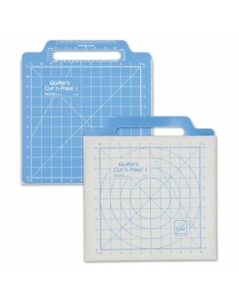
Two tools in one — that’s the whole idea behind the June Tailor Cut n Press II.
One side is a hard plastic cutting surface that protects your rotary blade and holds a printed grid for accurate layout work. Flip it over, and you’ve got a cushioned cotton-poly pressing surface for squaring and flattening blocks.
At 12 by 18 inches and under 3 pounds, it travels easily to guild meetings or classes. The built-in handle makes that even simpler.
| Best For | Quilters, sewists, and crafters who want a compact, travel-friendly tool that handles both cutting and pressing without taking up much space. |
|---|---|
| Material | Cotton and Plastic |
| Primary Use | Cutting and pressing |
| Portability | Carrying handle included |
| Weight | Not specified |
| Compatibility | Quilting and sewing |
| Surface Design | Dual-sided surface |
| Additional Features |
|
- Two tools in one — cuts down on clutter and saves serious workspace
- Easy to grab and go with a built-in handle, great for classes or retreats
- The cushioned pressing side is handy for small blocks, kanzashi flowers, perler beads, and more
- Too small for longer seams or bigger quilt projects
- Won’t replace a full-sized ironing board when you’re piecing a whole quilt together
- The cutting surface can wear down over time with heavy rotary blade use
4. Omnigrid Portable Cutting Pressing Station
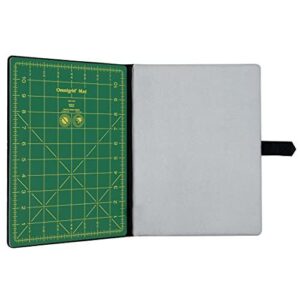
Sometimes you just need everything in one place — and that’s exactly what the Omnigrid FoldAway (Model 2105) delivers.
It pairs a gridded cutting mat with a non‑stick pressing surface side by side, so you’re not hunting for space between tools.
At under 1.5 pounds and roughly 8.75 by 11.75 inches, it folds flat and closes securely for class or travel.
It’s best suited for small projects, trimming, or foundation piecing — not large cuts — but as a compact all‑in‑one station, it earns its spot.
| Best For | Quilters, sewers, and crafters who need a compact, travel-friendly station for small projects, classes, or working beside a sewing machine. |
|---|---|
| Material | Plastic |
| Primary Use | Cutting and pressing |
| Portability | Foldable for travel |
| Weight | 1.48 pounds |
| Compatibility | Quilting and sewing |
| Surface Design | Side-by-side surfaces |
| Additional Features |
|
- Cutting mat and pressing surface in one spot — no shuffling tools around
- Lightweight and folds flat, so it’s easy to toss in a bag for class or travel
- Non-stick pressing surface and gridded mat make trimming and foundation piecing a breeze
- Only measures in inches — no metric markings
- Can slip during ironing or rotary cutting if you’re not careful
- Too small for larger projects or bigger cuts like 10" x 10" squares
5. Headley 45mm Rotary Cutter Blades
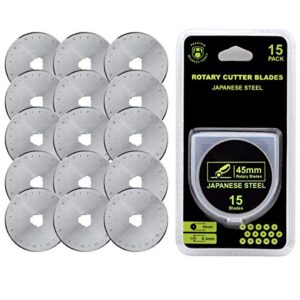
A dull blade is often the real culprit behind ragged cuts and a chewed‑up mat surface. Headley’s 45mm rotary cutter blades are made from Japanese SKS‑7 steel, which holds a sharp edge through layers of fabric, vinyl, and even leather.
Each pack comes with 15 blades and a storage box, so you’re set for a while.
They fit standard Fiskars and Olfa grips, making swaps easy.
Sharp blades mean cleaner cuts and less drag — and that keeps your mat lasting longer.
| Best For | Quilters, sewers, and crafters who go through blades fast and want a reliable, affordable replacement that works with their existing Fiskars or Olfa rotary cutter. |
|---|---|
| Material | Japanese Steel (SKS-7) |
| Primary Use | Fabric cutting |
| Portability | Compact storage box |
| Weight | 2.08 ounces |
| Compatibility | 45mm rotary cutters |
| Surface Design | Oil-coated blade surface |
| Additional Features |
|
- Japanese SKS-7 steel holds a sharp edge and cuts cleanly through up to 10 layers of fabric, vinyl, or leather
- Comes with 15 blades and a storage box — great value for regular crafters
- Fits standard 45mm Fiskars and Olfa handles, so swapping is quick and easy
- Blades come oil-coated, which can feel greasy and make them slippery to handle
- Not individually wrapped, so blades can stick together in the box
- Only fits 45mm handles — won’t work if you use a different size rotary cutter
6. OLFA Self Healing Rotary Cutting Mat
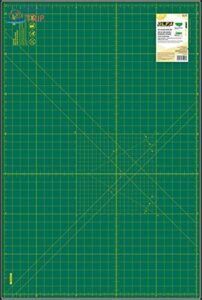
Once your blades are sharp and ready, your mat needs to hold up its end of the deal. The OLFA Self-Healing Rotary Cutting Mat does exactly that.
At 24" x 36" and 1.5mm thick, it’s built with a triple-layer, heat-welded construction that absorbs cuts and reseals the surface.
One side has a grid for precision; the other is clean for general cutting.
Store it flat, away from heat, and it’ll stay smooth and accurate for years.
| Best For | Quilters, sewers, and crafters who use rotary cutters and need a reliable, large-format mat for precise, repeated cutting. |
|---|---|
| Material | Plastic/Rubber |
| Primary Use | Fabric cutting |
| Portability | Flat storage required |
| Weight | 2.3 pounds |
| Compatibility | Rotary cutters |
| Surface Design | Double-sided grid |
| Additional Features |
|
- Self-healing surface keeps things smooth and extends the life of your rotary blades
- Double-sided design gives you a grid for precise cuts and a clean side for general use
- Generously sized at 24" x 36" — plenty of room for quilting blocks, bias strips, and multi-layer cuts
- Only works with rotary cutters — not compatible with fixed blade utility knives
- Thin at 1.5mm, and some users notice cut marks showing over time despite the self-healing claim
- Needs careful storage (flat, out of sunlight) or it can warp
Frequently Asked Questions (FAQs)
What is the best way to clean a cutting mat?
The best way is to wipe it down with mild soap and warm water using a soft sponge, then rinse and air‑dry flat.
Regular upkeep keeps cuts clean and your mat lasting longer.
Can I wash a cutting mat?
Yes, you can wash a cutting mat.
Use lukewarm water and mild dish soap, scrub gently with a soft sponge, rinse thoroughly, then air-dry flat to prevent warping or edge curling.
Can you clean a cutting mat in the dishwasher?
No, don’t put your cutting mat in the dishwasher. The heat and harsh detergents will warp it permanently and strip the self-healing surface. Stick to gentle hand-washing instead.
How often should you replace rotary cutter blades?
There’s no fixed schedule — replace your rotary blade when cuts start skipping, dragging, or fraying fabric edges.
Most quilters swap blades every few weeks with heavy use, or monthly with moderate cutting.
Does mat color affect visibility of cutting lines?
Color does matter. Light mats show dark cutting lines clearly, dark mats reduce glare, and neutral gray keeps things balanced without casting odd tones on your fabric.
Can cutting mats be used on glass surfaces?
You can use a cutting mat on glass, but it’s not ideal.
Glass is slippery, which causes the mat to shift.
Always place a non-slip layer underneath to keep things stable and safe.
Conclusion
Most crafters assume their mat fails from heavy use—but real culprit is neglect. Knowing how to clean a fabric cutting mat regularly is what separates a mat that lasts two years from one that supports you for ten.
Lint hides in grooves, residue dulls your blade, and small buildup quietly ruins your accuracy. Treat your mat like the precision tool it actually is, and it’ll keep returning the favor, cut after cut.