This site is supported by our readers. We may earn a commission, at no cost to you, if you purchase through links.
A cutting mat that warps, cracks, or loses its grid lines doesn’t fail from overuse—it fails from poor storage. The self-healing surface is surprisingly sensitive to heat, pressure, and moisture, and once compromised, no amount of careful cutting will restore it.
Most crafters don’t realize that a single afternoon near a sunny window or leaning against a wall can permanently damage a mat costing $40 or more.
Knowing how to store a cutting mat properly protects that investment, ensuring clean, accurate, and frustration-free cuts for years.
Table Of Contents
Key Takeaways
- Always store your cutting mat completely flat — folding, rolling, or leaning it against a wall even once can cause permanent creases and warping that no amount of careful cutting will fix.
- Heat, direct sunlight, and humidity are your mat’s biggest enemies, so keep it in a cool, dry spot between 65°F and 75°F and away from windows or heaters.
- Protect the surface between uses with a breathable fabric cover, cardboard separators between stacked mats, and gentle handling — small scratches and dents quietly shorten your mat’s lifespan.
- With proper care, a quality cutting mat can last up to five years, but skipping even one storage step — like storing it damp or under heavy tools — can cut that down to months.
Store Cutting Mats Flat
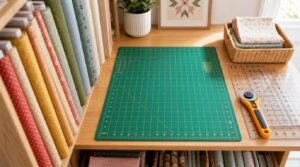
Flat storage is the golden rule for keeping your cutting mat in good shape — if you break it, you’ll pay for it later with warping and uneven surfaces. The way you store it matters just as much as how you use it.
Understanding how self-healing cutting mats work makes it easier to see why flat storage is non-negotiable — the material literally depends on consistent, even pressure to do its job.
Here are the key habits to get right from the start.
Level Shelf Placement
A level shelf is your mat’s best friend. Use a spirit level to confirm side-to-side and front-to-back alignment — even a slight tilt causes warping over time.
Anchor brackets into wall studs for solid load distribution, and add cross braces for extra stability.
Tuck anti-slip padding underneath to keep things from shifting. That’s flat storage done right.
Under-bed Storage
Shelves aren’t your only option. Under-bed storage works surprisingly well — and it’s one of the quietest flat storage methods around. Use a rigid under-bed platform so your mattress stays completely flat, not sagging in the middle. Pull-out trays provide noise-free access without awkward reaching.
Look for ventilated storage bins with magnetic closure lids to maintain airflow and keep dust out.
Rigid Backing Support
A hard flat surface under your mat isn’t optional — it’s what actually holds everything together. Rigid backing prevents warping by keeping pressure even and reducing vibration transfer during storage. For eco-friendly backings, look for formaldehyde-free boards with dimensional stability across temperature swings.
- Use high-density fiberboard or stiff cardboard as a flat storage method
- Prioritize material selection that resists moisture and stays flat
- Edge protection keeps borders from curling or delaminating
Avoid Heavy Objects
Even the best rigid backing won’t save a mat if something heavy is sitting on top of it. Weight limits matter more than people think — exceeding them causes compression damage fast.
| Object Type | Risk Level | Best Practice |
|---|---|---|
| Fabric bolts | Medium | Store flat beside mat |
| Tool boxes | High | Keep off mat entirely |
| Books/binders | Medium | Use even load distribution |
| Cutting rulers | Low | Lay parallel on surface |
| Machines/equipment | Very High | Never place on mat |
Inspect mats regularly for edge curling, reinforce them with reinforced backing boards, and always lift heavy items — don’t drag them across the surface.
Never Fold or Roll
Folding or rolling your mat is a one-way ticket to permanent creases — and once those set in, your ruler line integrity is gone for good. Distorted surfaces throw off measurements and compromise blade glide consistency.
Fold or roll your cutting mat once, and permanent creases will ruin your measurements forever
Store your mat flat, always. Flat storage preserves tension uniformity across the entire surface, keeping edges stable and ensuring crease-free cutting sessions are given, not a gamble.
Control Heat, Sun, and Humidity
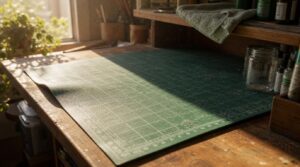
Your cutting mat is more sensitive to its environment than you might think. Heat, sunlight, and moisture can quietly warp or weaken it over time — even when it’s just sitting in storage.
Here’s what to watch out for.
Ideal Room Temperature
Your mat is more sensitive to temperature than you might think. Aim to keep your craft room between 65°F and 75°F year-round — that’s your comfort temperature range and your mat’s sweet spot too. Thermostat settings outside this window invite surface warping fast.
Seasonal adjustments matter, so don’t let summer heat or winter dryness sneak up on you.
Avoid Direct Sunlight
Sunlight is sneakier than heat — it fades your grid lines, dries out the vinyl surface, and quietly weakens the mat’s layers before you notice any damage. UV light blocking is your first line of defense for warping prevention.
To minimize light exposure, adopt these habits:
- Move mats away from windows or glass doors
- Use UV-resistant covers or breathable fabric wraps
- Apply window shade solutions like UV-filtering curtains
- Rotate storage spots to reduce cumulative heat exposure
Sunlit fade prevention is simple — just don’t give UV rays a chance. Remember that the peak UV exposure hours occur between 10 a.m. and 4 p.m., so plan storage accordingly.
Keep Away From Heaters
Heat is a quiet killer for cutting mats. Follow the heater proximity rule — keep mats at least three feet away from any heat source. Radiant heat distance matters because prolonged heat exposure warps foam cores and weakens adhesive layers fast.
Watch for heat damage signs like soft spots or curling edges. These indicate compromised structural integrity.
Use insulation barriers, such as shelving walls, to shield mats from radiant heat. Always allow a cooling period before storing materials near warm areas to prevent residual damage.
Manage Humid Craft Rooms
Humidity is sneaky — it warps mats slowly before you even notice surface swelling or curling. Keep room humidity between 40 and 60 percent to store self-healing cutting mats flat and protected. Placing a hygrometer near your work area enables real-time monitoring of humidity levels.
To prevent curling permanently, run dehumidifier maintenance regularly, seal gaps around windows, add moisture barriers under flooring, and improve airflow. These steps address excess moisture at its source while safeguarding mat integrity.
Dry Completely Before Storing
Never store a damp mat — moisture trapped underneath causes warping fast. After cleaning, lay it flat and run a fan nearby to enhance airflow and accelerate drying. Skip stacking during this phase, as avoiding stacked drying prevents moisture from lingering in corners.
Once dry, do a quick moisture inspection along the edges. Store your mat flat only once it has cooled to room temperature to ensure thorough dryness and prevent damage.
Protect The Cutting Surface
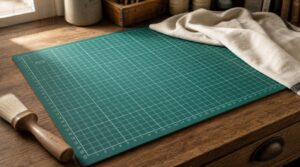
Once you’ve got the environment sorted, the next step is protecting the mat’s actual surface. Even in the right conditions, dust, dents, and accidental scratches can quietly wear it down.
Here are a few simple ways to keep that surface in good shape.
Use Breathable Fabric Covers
A breathable fabric cover is one of the smartest cutting mat storage solutions you can grab. Unlike plastic wrap, it allows moisture wicking to pull dampness away while material permeability lets air flow freely underneath.
- Match cover size within a 2 cm fit tolerance
- Machine wash at 30–40°C following basic cleaning protocols
- Skip fabric softener — it kills breathability
- Store your mat flat inside the cover, dry thoroughly first
Keep Surface Facing Upward
Once your mat is wrapped up, ensure the cutting surface always faces upward—never flip it face-down. Avoiding inverted hanging is critical: pressure from below causes dents and compromises the self-healing layer. Think of it like storing a vinyl record—proper orientation is everything.
| Storage Position | Result |
|---|---|
| Surface facing up | Safe storage, no marks |
| Surface facing down | Dents, abrasion damage |
| Leaning sideways | Edge curling risk |
Edge curling risk arises from improper sideways storage, further emphasizing the need for consistent upright positioning.
Add Cardboard Separators
Keeping the surface face-up is a great start — but stacking multiple mats requires cardboard separators to truly shine. Slip one between each mat for Glue-Free Assembly and Custom Cell Design protection, ensuring surprisingly solid stability.
Their Moisture Resistance and Recycling Benefits make these separators an eco-friendly choice. They simplify craft room organization while safeguarding materials.
For long-term storage, they keep self-healing cutting mats flat and protected, maintaining their integrity without compromising workspace efficiency.
Prevent Dents and Scratches
Cardboard separators help, but dents and scratches can still sneak in from everyday handling. Always use Non-abrasive Handling—set tools down gently, and never drag them across surfaces. Microfiber Protective Wraps and Soft Edge Buffers do the heavy lifting here:
- Wrap mats in microfiber before stacking
- Inspect regularly with Periodic Surface Inspection checks
- Gentle Placement Techniques prevent surface distortion
Safe storage and keeping self-healing cutting mats flat prevent mat warping simply.
Pad Hanger Clips
Hanging your mat on clip hangers is one of those storage tips that actually works — if you use the right clips. Look for stainless steel designs with silicone or rubber cushion pads; their anti-slip design grips without leaving dents. Spring tension adjustment ensures consistent pressure without damaging the surface.
Check cushion pad maintenance regularly — worn pads can mark your mat. Clip material options and installation compatibility matter more than you’d think for safe, long-term storage.
Space-Saving Storage Ideas
Small craft rooms fill up fast, and your cutting mat shouldn’t have to compete for space. The good news is you don’t need a big studio to store it safely.
Here are a few clever setups that keep your mat flat, protected, and easy to grab when you need it.
Closet Clip Hangers
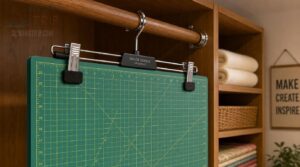
Clip hangers are a surprisingly smart fix for tight craft rooms. Sturdy ones with a rotating hook design let you spin the mat out easily without shuffling things around.
Go for rubber or foam grip variants — they store self-healing cutting mats flat without denting their surfaces.
Adjustable clip tension and load capacity guidelines matter too; pair them with batting padding for clean, damage-free craftroom organization.
Vertical Cabinet Slots

A vertical cabinet slot transforms dead wall space into a functional mat station. Featuring adjustable widths (12–18 inches), wall-mounting flexibility, and integrated ventilation, these units excel at craft room organization.
To optimize functionality:
- Choose slot materials like laminated plywood for durability
- Check weight limits — most hold 15–40 lbs per slot
- Use adjustable dividers to store items flat without pressure
- Prioritize ventilation design to prevent moisture buildup
- Follow wall-mounting best practices using stud anchors
Pegboard Mat Storage
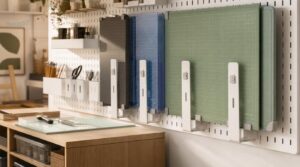
A pegboard system might be the smartest wall real estate you’re not using yet.
Peg Spacing Compatibility and Vertical Peg Modules enable you to store self-healing cutting mats flat and within arm’s reach.
Adjustable Latching Brackets grip mat edges without damage, while Edge Protectors prevent nicks during handling.
The Modular Shelf Design adapts as your collection grows — solid storage best practices built right into your wall.
Flat Rolling Cart
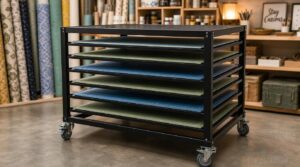
A rolling cart might just be the unsung hero of your craft room. With deck sizes reaching up to 48 inches, it’s built to store items flat without compromise.
- Check load capacity ratings before stacking mats
- Apply Wheel Bearing Care regularly for smooth rolling
- Use Modular Deck Options and Swivel Caster Alignment for stability
Corrosion Resistant Coating ensures long-term workshop readiness.
Stacked Mat Organization
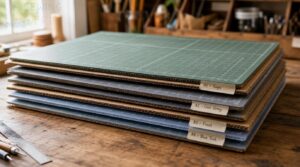
Stacking works beautifully when you do it right. Slip thin cardboard separators — your interleaved pads — between each mat to protect material layers and prevent surface scuffing.
Follow simple height guidelines: don’t stack so high that the bottom mats suffer compression.
Add label tags so you grab the right one fast. Stick to a rotation schedule and store self-healing cutting mats flat for even wear across all your workshop mats.
Top 6 Cutting Mat Care Items
Having the right tools makes mat care way less of a chore.
A few simple products can help you clean, protect, and extend the life of your mat without much effort.
Here are six worth keeping in your craft space.
1. Scotch Brite Clean Lint Roller
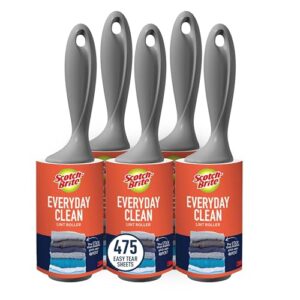
Keeping your cutting mat free of lint and loose threads before storage is a small habit that pays off big. The Scotch-Brite Clean Lint Roller makes it easy—just roll it across the surface, and it lifts fibers, dust, and fuzz in seconds.
Each pack includes 5 rollers with 95 sheets each, so you won’t run out anytime soon. It’s refillable too, which saves money long-term.
Clean mat, longer life. Simple as that.
| Best For | Crafters, sewers, and quilters who want a quick, easy way to keep their cutting mats and workspaces free of lint, threads, and fuzz. |
|---|---|
| Material | Plastic & adhesive paper |
| Primary Use | Lint & debris removal |
| Price (USD) | $20.99 |
| Reusability | Refillable |
| Safety Feature | None noted |
| Portability | Compact roller |
| Additional Features |
|
- Five rollers in one pack means you can stash one in every room—no more hunting for it mid-project.
- Sheets tear off cleanly and the rolling action is smooth and quiet, so it’s actually satisfying to use.
- Refillable design saves you money over time and cuts down on waste.
- Deeply embedded pet hair in thick or felted fabrics can give the adhesive a hard time.
- Sheets can occasionally stick together, which eats through them faster than you’d expect.
- A bit bulky if you’re looking for something slim to toss in a bag or kit.
2. Olfa 45mm Tungsten Steel Ergonomic Rotary Cutter
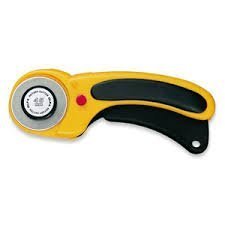
Once your mat is lint-free, the next step is making sure your cuts stay clean and precise. That’s where the Olfa 45mm Tungsten Steel Rotary Cutter earns its spot in your toolkit.
The tungsten steel blade holds its edge through layers of fabric without tearing or dragging. Its ergonomic grip keeps your wrist neutral, so long cutting sessions don’t punish your hand. It’s ambidextrous, self-retracting, and comes with a spare blade — thoughtful details that matter on busy project days.
| Best For | Quilters, sewers, and crafters who work with multiple fabric layers and want a comfortable, safe rotary cutter for long project sessions. |
|---|---|
| Material | Alloy steel & plastic |
| Primary Use | Fabric cutting |
| Price (USD) | Not listed |
| Reusability | Blade replaceable |
| Safety Feature | Auto-retracting blade |
| Portability | Pocket-sized cutter |
| Additional Features |
|
- Tungsten steel blade cuts cleanly through up to six layers of fabric with minimal effort
- Ambidextrous design with an ergonomic grip that reduces hand fatigue — great for people with arthritis
- Self-retracting blade with a lock mechanism keeps things safe around kids and during storage
- Instruction manual is in Japanese only, so figuring out blade changes may require a quick online search
- Blade sharpness out of the box can be hit or miss — you might need to swap to the spare right away
- Only compatible with 45mm blades, so you can’t upgrade to larger or specialty sizes down the road
3. OLipfa Rotary Cutter Safety Shield

A sharp blade means nothing if it catches your finger the moment you lift the cutter. The OLipfa Rotary Cutter Safety Shield fixes that. It snaps onto your cutter and retracts automatically when you press down to cut — then covers the blade the instant you lift off.
The clear acrylic design lets you see exactly what you’re doing, and the spring-assisted latch keeps the shield locked during storage. Simple, smart protection that works without slowing you down.
| Best For | Quilters, crafters, and beginners — especially younger users — who want a safer, more stable way to cut fabric with a rotary cutter. |
|---|---|
| Material | Acrylic |
| Primary Use | Ruler safety guard |
| Price (USD) | Not listed |
| Reusability | Reattachable |
| Safety Feature | Finger guard shield |
| Portability | Attaches to ruler |
| Additional Features |
|
- Clear acrylic keeps your ruler markings fully visible, so your cuts stay accurate
- Stiffens the ruler as you cut, giving you a firmer, more controlled edge
- Easy to attach and move between rulers — no tools needed
- Only fits 24-inch rulers, so it won’t work if you use different sizes
- The adhesive can weaken over time if lint or debris builds up underneath
- Acrylic can crack or chip if you accidentally drop it
4. MR Lion Makeup Brush Cleaning Pad
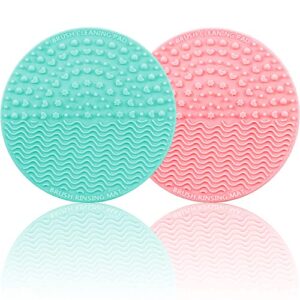
Blade safety handled — now what about keeping your mat clean? The MR Lion Makeup Brush Cleaning Pad isn’t just for beauty routines. Its multi-textured silicone surface works surprisingly well for scrubbing adhesive residue and pigment off your cutting mat.
The suction cup locks it to your sink, ensuring stability while you scrub. Soft enough not to scratch, yet tough enough to lift grime effectively.
Rinse it clean when you’re done, and it’s ready for next time.
| Best For | Makeup artists, hobbyists, and crafters who want a reusable, hands-free way to deep-clean brushes, sponges, and puffs without damaging delicate bristles. |
|---|---|
| Material | Silicone gel |
| Primary Use | Brush cleaning |
| Price (USD) | Not listed |
| Reusability | Fully reusable |
| Safety Feature | Soft surface only |
| Portability | Lightweight pads |
| Additional Features |
|
- Comes with two pads (green and pink) so you can dedicate one to makeup and one to other uses like watercolor brushes
- The suction cup keeps it locked to your sink while you scrub — no holding it down with one hand
- Soft silicone is gentle on brush tips but still lifts pigment, oils, and adhesive residue effectively
- The suction cup sits pretty tall, which can make it wobbly on certain sink surfaces
- Heavily pigmented makeup and ink stain the silicone easily, so you’ll need to rinse it often
- Sitting in water too long makes the pad feel slimy — it works best when you’re not leaving it submerged
5. Gypsy Quilter Heart Shaped Mat Cleaner
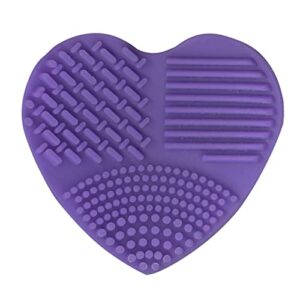
If you want something purpose-built for cutting mats, the Gypsy Quilter Heart Shaped Mat Cleaner (TGQ134) is worth keeping on your worktable. Slip your fingers into the opening, and those ridged silicone surfaces pull dust, fabric fibers, and pet hair right off the mat — helping the self-healing layer do its job longer.
Its compact size (about 3 inches across) ensures it tucks easily into any workspace. After use, simply rinse it with warm soapy water, let it dry, and it’s ready for reuse.
| Best For | Quilters and sewers who want a quick, easy way to keep their self-healing cutting mats clean between projects. |
|---|---|
| Material | Food-grade silicone |
| Primary Use | Mat cleaning |
| Price (USD) | $14.95 |
| Reusability | Fully reusable |
| Safety Feature | Smooth edges |
| Portability | Compact scrubber |
| Additional Features |
|
- Ridged silicone surface lifts dust, lint, and pet hair off cutting mats without much effort
- Easy to rinse clean with warm soapy water and reuse right away
- Compact heart shape fits neatly on any craft table without taking up space
- Small size means more passes needed on heavily soiled mats
- Won’t replace a deep soak for thick or stubborn residue buildup
- At $14.95, it’s pricier than similar silicone cleaners you might find in stores
6. June Tailor Quilter Cut and Press Mat
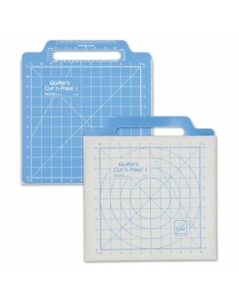
The June Tailor Quilter Cut and Press Mat (Model JT-720) pulls double duty in a small space. One side accommodates precise rotary cuts on a durable, blade-friendly surface — the other flips to a cushioned pressing side that holds up to heat and steam.
At 11 × 11 inches, it fits right beside your sewing machine without crowding your workspace. It’s compact enough to carry to class and sturdy enough to skip the separate ironing board on smaller projects.
| Best For | Quilters and sewists who want a portable, two-in-one work surface for cutting and pressing on small projects or on the go. |
|---|---|
| Material | Metal & fabric |
| Primary Use | Cutting & pressing |
| Price (USD) | $42.79 |
| Reusability | Durable board |
| Safety Feature | Hard cutting frame |
| Portability | Built-in handle |
| Additional Features |
|
- Cuts and presses in one spot — no swapping between surfaces mid-project
- Slim 11-inch footprint sits right next to your sewing machine without eating up your whole table
- Easy to toss in a bag for classes, retreats, or guild nights
- The 11-inch surface is too small for long seams or bigger quilt sections
- Heavy daily use can wear down the cutting side faster than a dedicated mat
- Thick or layered fabrics may not press out evenly on the cushioned side
Frequently Asked Questions (FAQs)
Can you roll up a cutting mat?
Think of your cutting mat like a yoga mat — technically rollable, but not always happy about it.
Flexible, self-healing mats can handle occasional rolling, but thick or rigid ones may crease permanently over time.
How long will a cutting mat last?
With light use, a good cutting mat lasts one to three years. Heavy daily cutting shortens that to six to twelve months.
Higher-quality PVC mats can stretch to five years with proper care.
How often should I replace my cutting mat?
Like a worn-out eraser that just smears instead of cleans, a tired mat works against you.
Replace it every 12–24 months for home use, or sooner if grooves snag your blade or cuts drift off-line.
Can I store cutting mats outdoors temporarily?
Skip it. Even a few hours outside can warp your mat, fade the gridlines, and trap moisture that leads to mildew. Keep it indoors — always.
What causes cutting mat edges to curl up?
Heat, humidity, and improper storage are the main culprits.
When your mat gets too warm or absorbs moisture, the edges expand unevenly — and that’s what causes them to curl up over time.
How do I flatten a warped cutting mat fast?
Lay the mat face-down on a flat surface, place a damp cloth over it, and press with a warm iron.
Stack heavy books on top and leave overnight until it is completely flat.
Conclusion
Your cutting mat is only as good as the care you give it between uses. Treat it like the precision tool it is — flat, cool, dry, and away from pressure — and it’ll reward you with years of clean and accurate cuts.
Knowing how to store a cutting mat properly isn’t complicated, but skipping even one step can cost you a perfectly good mat. Small habits, consistently kept, make all the difference.
- https://snugglesquilts.com/tag/cutting-mat-care
- https://www.huachingdraftingtools.com/cutting-mat
- https://www.nationalsewingcircle.com/post/5-clever-ideas-for-storing-your-sewing-supplies
- https://www.nationalquilterscircle.com/post/caring-for-your-self-healing-cutting-mat
- https://help.cricut.com/hc/en-us/articles/360009554153-Which-materials-should-I-cut-on-the-different-machine-mat-grip-strengths-