This site is supported by our readers. We may earn a commission, at no cost to you, if you purchase through links.
Most sewists don’t realize their cutting board is quietly sabotaging their work.
A grooved surface guides your rotary cutter off-course by fractions of a millimeter—enough to throw off a garment piece or misalign a quilt block after dozens of cuts.
The surface you cut on matters more than most people expect.
Choosing between a cutting mat vs cutting board for sewing isn’t just about price or preference.
It shapes how long your blades last, how accurately your fabric behaves, and how frustrating your cutting sessions feel.
Here’s what each surface actually delivers.
Table Of Contents
Key Takeaways
- Self-healing cutting mats outperform boards for most sewing tasks because they close up after every cut, keeping your surface smooth and your blades sharper for longer.
- cutting surface directly affects blade life, cut accuracy, and how well fabric behaves — so it’s worth choosing carefully, not just grabbing whatever’s cheapest.
- heavy-duty work still earn their place for thick layers, rigid punches, or when you need a firm, stable base that won’t flex.
- mid-range or premium self-healing mat (24×36 inches, 3–5-layer PVC) pays off over time through fewer blade changes and less surface replacement.
Cutting Mat Vs Cutting Board
These two tools look similar but work very differently for sewing. Knowing which one fits your projects saves you time, money, and a lot of dull blades.
If you’re still building your kit, this guide to sewing scissors for beginners breaks down exactly what to look for before you buy.
Here’s a quick breakdown of what sets them apart.
Key Differences at a Glance
At a glance, these two surfaces aren’t interchangeable — they serve different purposes.
| Feature | Cutting Mat | Cutting Board |
|---|---|---|
| Surface Hardness | Soft, self-healing PVC | Rigid acrylic or wood |
| Grid Visibility | Clear grid lines printed in | Often minimal or none |
| Portability Factor | Lightweight, easy to roll | Heavy, stays put |
Thickness, weight comparison, and noise level all differ too. A cutting mat absorbs blade impact quietly. A cutting board doesn’t.
For projects requiring precision, consider the benefits of pin‑friendly cutting mats(https://www.threadsmagazine.com/project-guides/learn-to-sew/rotary-cutters-and-mats).
Best Choice for Sewing Projects
For sewing, a self-healing cutting mat wins almost every time. It works with rotary cutters, craft knives, and pattern wheels — your full toolkit.
Fabric weight considerations matter too: light lawns and heavy denim both cut cleaner on a mat’s surface.
Choosing a self‑healing PVC mat helps maintain blade sharpness and prolongs mat life.
Here’s a tool compatibility matrix to match your project type:
| Project Type | Best Surface |
|---|---|
| Quilting cotton | Self-healing mat |
| Garment dressmaking | Self-healing mat |
| Heavy canvas/denim | Heavy-duty mat (5mm+) |
| Delicate rayon/lawn | Soft self-healing mat |
| DIY/craft projects | Cutting board |
When a Mat Outperforms a Board
A mat pulls ahead when precision matters most. Self-healing self-healing technology closes blade marks fast — that’s your Quick Surface Reset at work. Grid lines and markings keep cuts square every time, giving you Consistent Grid Alignment without second-guessing. Less surface drag means Reduced Fabric Snags and real Blade Edge Preservation.
| Scenario | Mat | Board |
|---|---|---|
| Rotary cutting | Excellent | Poor |
| Bias strip alignment | Easy | Difficult |
| Blade longevity | High | Low |
When a Board Still Makes Sense
Boards still win in a few situations. Heavy duty knives and punches can permanently gouge a Self-Healing Cutting Mat — a rigid Wooden Cutting Board withstands that pressure better.
Thick fabric layers need a firm base that won’t flex.
Boards also offer easy surface cleanup and solid precision ruler support.
Workbench protection matters too.
| Scenario | Cutting Board | Cutting Mat |
|---|---|---|
| Heavy duty knives | Best fit | Gets gouged |
| Thick fabric layers | Firm support | May flex |
| Precision ruler support | Very stable | Good |
| Easy surface cleanup | Simple wipe | Traps lint |
| Workbench protection | Excellent | Moderate |
Fabric Cutting Performance Compared
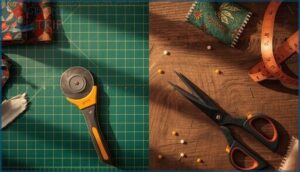
Performance is where the real difference shows up.
The surface you cut on affects your blade, your accuracy, and how the fabric behaves under pressure.
Here’s how mats and boards stack up across five key areas.
Rotary Cutter Performance
A rotary cutter blade is only as good as the surface beneath it. On a self healing cutting mat, blade pressure stays light and consistent — meaning better cut smoothness and edge retention with every pass. Self healing technology absorbs the cut instead of fighting it.
- Precision cuts stay true on the first pass
- Blade longevity improves noticeably over time
- Speed consistency holds through long cutting sessions
- A SelfHealing Cutting Mat protects blade lifespan
- Fewer blade changes, more time sewing
Craft Knife and Scissor Support
Craft knives and scissors need surface that works with them, not against them. A self-healing mat’s blade friendliness lets your knife ride clean, and nonslip feet keep everything anchored so fabric doesn’t shift mid-cut. Scissor pivot tension stays steady on a flat mat surface, and blade path visibility stays clear — no grooves deflecting your line.
can’t match that control.
Precision on Lightweight Fabrics
Lightweight fabrics like chiffon and voile are slippery — one small shift ruins your cut line.
A matte surface finish and micro‑texture surface reduce glare and hold fabric in place during fine grain alignment. grid lines boost edge visibility, and tissue paper backing adds grip under delicate layers.
Self‑healing blade friendliness keeps the surface smooth, so precision cutting on light fabrics stays consistent.
Stability for Heavy or Layered Fabrics
Stack four layers of denim and you’ll feel every weakness in your cutting surface.
3 mm self-healing mat with Core Layer Rigidity keeps things steady — the hard middle layer prevents that spongy feeling that throws off Blade Depth Control.
Layer Compression Resistance and a nonslip base hold your fabric in place.
For heavy duty cutting, material durability and thickness and durability of cutting surfaces matter more than anything else.
Surface Grip and Slip Resistance
Grip matters more than most sewists realize. A self-healing mat’s dense surface holds fabric without letting it drift — that’s Grip Material Choice doing real work.
Non-slip Backing underneath keeps the mat itself from sliding.
Boards don’t offer this naturally.
Dust and Lint build up fast and kill grip, so wipe your mat often.
That’s your best Grip Longevity Tip.
Material and Surface Differences
The surface you cut on makes a bigger difference than most people realize. Each material behaves differently under a blade, and that affects your accuracy, your tools, and how long everything lasts.
Here’s a closer look at what your options actually are.
Self-healing PVC Cutting Mats
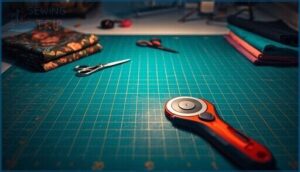
Self-healing PVC cutting mats are the go-to surface for most sewists — and for good reason. The multi-layer PVC core absorbs each cut and closes back up within minutes. That’s self-healing technology doing its job.
Your blades stay sharper longer, cuts stay clean, and the surface holds up through hundreds of projects.
User feedback consistently confirms: mats outperform boards on cutting mat vs board performance every time.
Acrylic Cutting Boards
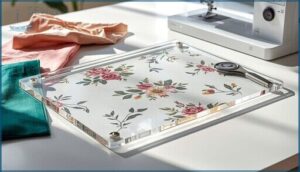
Acrylic cutting boards take a different approach. The clear visibility lets you see exactly where your fabric sits — handy for pattern placement.
The non-porous surface resists staining and cleans up fast, with dishwasher compatibility on most models.
Color customization options are a nice bonus. But scratch repair is harder here than with SelfHealing Cutting Mats, so cutting mat vs board performance still favors self-healing for precision cuts and durability.
Wooden Cutting Boards
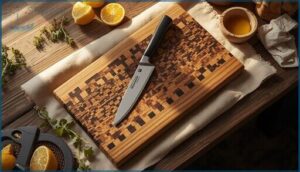
Wooden boards bring real weight to the table — literally. A wooden cutting board stays put while you work, thanks to its natural heft and wooden board stability.
End grain benefits stand out here: the knife slips between wood fibers instead of cutting across them, preserving your blade longer.
- End grain selection slows visible wear
- Food-safe finishes like mineral oil protect the surface
- Regular wooden board maintenance prevents cracking and warping
Plastic Cutting Boards
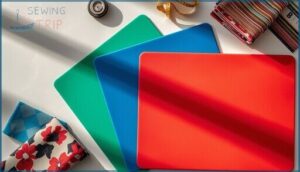
Plastic cutting boards are a step down in heft from wood, but they earn their place in a sewing kit. HDPE material benefits include lightweight portability and easy cleanup—most are dishwasher safe.
color coding system to keep fabric prep separate.
Just watch the edges: edge crack inspection matters, since splits trap fibers quickly.
Printed Grids and Angle Markings
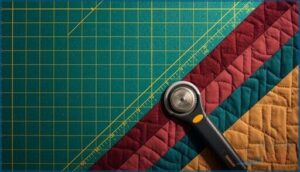
Mats beat boards here — no contest.
Printed grids give you grid measurements right under your fabric, with 1-inch grid lines across the full surface and subdivision options down to 1/8 inch for patchwork. Contrast printing keeps markings and guides readable. Edge label placement means numbers stay visible while you cut.
Angle guide accuracy at 30, 45, and 60 degrees makes bias cuts repeatable.
Size and Thickness Guide
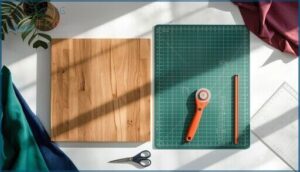
Size matters more than most sewists think. The wrong mat can slow you down, waste fabric, or just make your whole workspace feel cramped.
Here’s how each standard size and thickness option stacks up.
Small (A4 – 12″ X 9″)
Think of the small A4 12 x 9 cutting mat as your go-anywhere sewing companion. It fits neatly on a sewing desk without eating up your space — perfect workspace optimization for tight setups.
- Covers about 1.2 square feet of surface
- Self-healing PVC offers solid blade protection
- Printed grids boost grid visibility for quick alignment
- Portability benefits make it easy to pack and travel
- Material compatibility works for lightweight fabrics and small swatches
Medium (A3 – 12″ X 18″)
The medium A3 12 x 18 cutting mat hits the sweet spot for most sewists. At 12″ × 18″, it’s a reliable portable layout surface that accommodates half-yard cuts, quilt block sizes up to 16″, and garment pieces without repositioning.
| Feature | Medium A3 12 x 18 |
|---|---|
| Table Fit | Leaves room for rulers |
| Layered Fabric Cutting | Up to 4 layers |
| Quilt Block Size | Up to 16 inches |
| Pattern Alignment Tools | Dual-sided grids, angle lines |
| Self-healing | Yes, 3–5 layer PVC |
It’s a solid comparison of fabric cutting mats — this size balances cutting board stability with cutting mat flexibility.
Large (A2 – 18″ X 24″)
The large A2 18 x 24 cutting mat is where workspace optimization really kicks in. At 18″ × 24″, you get edge-to-edge coverage for most garment pieces and quilting layouts — no repositioning mid-cut.
Large fabric handling becomes smoother, seam alignment stays consistent, and the self-healing cutting mat surface holds up to repeated passes.
Material thickness at 2–3 mm keeps cuts clean and controlled.
| Feature | Large A2 18 x 24 |
|---|---|
| Pattern Layout | Full garment pieces |
| Fabric Layers | Up to 6 layers |
| Quilt Block Size | Up to 22 inches |
| Grid Coverage | Dual-sided with angle guides |
| Self-Healing | Yes, 3–5 layer PVC |
Extra Large (A1 – 24″ X 36″)
The extra large A1 24 x 36 cutting mat is your best friend for serious workspace integration. At 24″ × 36″, it accommodates full quilt layouts without repositioning. Pattern layout efficiency goes up fast.
Just remember — portability challenges are real with this size. Store it flat for edge curl prevention, keep it away from heat sources, and it’ll stay smooth for years.
| Feature | Extra Large A1 24 x 36 |
|---|---|
| Pattern Layout | Full quilt and garment spreads |
| Fabric Layers | Up to 8 layers |
| Quilt Block Size | Up to 34 inches |
| Grid Coverage | Dual-sided with angle guides |
| Self-Healing | Yes, 5-layer PVC |
Why 2–3 Mm Thickness Matters
Thickness is the unsung hero of your cutting mat. At 2–3 mm, you get real Pressure Distribution across the blade — protecting both your surface and your edge. Blade Protection improves because the mat absorbs impact instead of deflecting it.
Grid Visibility stays clear longer. Surface Flatness holds steady. Ergonomic Comfort improves too — less downward force means less fatigue during long cutting sessions.
Matching Surface Size to Workspace
Measure your table before you buy. A 24 × 36 inch mat gives solid Surface Coverage for most sewing tasks, but it only works if you can leave a border around it — Border Clearance keeps your Workspace Flow smooth.
Think about Tool Reach too. You need room for your ruler and rotary cutter without crowding the fabric.
Match size to your actual space, not your wishlist.
Self-Healing Benefits for Sewing
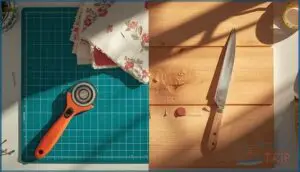
Self-healing mats do something no wooden board or acrylic surface can match — they close up after every cut, keeping your work surface smooth and your blade sharp. That one feature changes how whole cutting session feels.
Self-healing mats close every cut automatically, keeping your surface smooth and your blades sharper for longer
Here’s a closer look at exactly how it works and why it matters for your sewing projects.
How Self-healing Surfaces Work
Ever wonder why your mat looks almost new after dozens of cuts? That’s self-healing technology at work.
The surface uses polymer microcapsules packed with healing-agent release compounds.
When your blade scores the mat, elastic rebound mechanics push the material back together.
UV stabilization keeps the surface stable under bright lights.
temperature influences recovery speed — warmer rooms heal cuts faster, sometimes within minutes.
Blade Longevity Advantages
healing action does more than keep your mat looking good — it protects your blades too. Self-healing technology cushions each pass, so you get reduced cutting pressure and lower heat build-up with every stroke.
Less friction means consistent edge sharpness for longer. Minimal surface burrs prevent microscopic chipping.
Many quilters stretch blade longevity across several full quilts before needing a replacement.
Smoother Cuts With Fewer Grooves
Fewer grooves mean your fabric stays flat — and that’s where cut consistency really shows up.
A selfhealing mat uses groove healing mechanics to close each pass, so surface tension reduction keeps the plane smooth.
Blade glide optimization stays steady, edge preservation holds, and your grid lines stay readable.
Material quality and cutting mat thickness work together to protect blade sharpness after cut.
Why Non-healing Surfaces Reduce Accuracy
A smooth surface keeps your cuts true. Non-healing boards don’t close up after each pass — grooves build up, and groove-induced drift starts pulling your blade off course. Measurement line distortion follows fast, shifting readings by 1–2 mm.
Accuracy killers:
- Blade drag variability from uneven grooves
- Fiber accumulation effects that mask your grid lines
- Surface tension inconsistency under layered fabric
- Precision vs heavy-duty cutting breaks down on worn surfaces
Best Tools for Self-healing Mats
Your rotary cutter is the best match for a self-healing mat — it’s what the surface was designed for.
The right tools make that self-healing properties last longer and keep cuts cleaner.
| Tool | Why It Works | Maintenance Tip |
|---|---|---|
| Rotary Cutter | Glides cleanly, preserves SelfHealing Technology | Use Blade Sharpening Kit regularly |
| Fabric Edge Guide | Locks alignment on grid lines | Pair with Mat Alignment Clamp |
| Non-slip Base Pad | Stops mat shifting mid-cut | Check grip before each session |
| Mat Cleaning Brush | Removes fiber buildup fast | Part of routine cutting mat care |
| Fixed Craft Knife | Works for detail cuts | Keep blade fresh for blade maintenance |
Care, Storage, and Maintenance
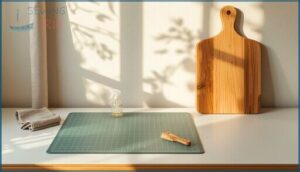
A good cutting surface is an investment—and like any tool you rely on, it needs a little attention to last.
How you clean, store, and care for your mat or board makes a real difference in how long it performs well. Here’s what you need to know.
Regular Cleaning
After every cutting session, give your mat a quick damp cloth wipe to clear away fabric fibers and residue. A mild soap solution works for stickier buildup — just rinse and dry thoroughly so the surface isn’t slippery next time.
Skip abrasives entirely. They scratch the surface and shorten its life.
Clean regularly, and you’ll prevent grit buildup that quietly ruins your cut accuracy.
Proper Storage
Storing your mat flat is non‑negotiable. A flat surface storage spot — like a wide shelf or drawer — keeps it from curling at the edges.
Avoid leaning it against walls. Skip hot spots near radiators or sunny windows; a temperature controlled environment prevents warping.
Vertical hanging support works for rigid boards using clip hangers. Use a dust‑proof cover and moisture‑free placement to protect the grid lines.
Blade Maintenance
Your blade is the real workhorse — treat it like one.
Check for blade wear indicators like fraying threads or pulled fibers instead of clean cuts.
Blade sharpening frequency matters: sharpen scissors every 6–12 months and change your blade often for rotary cutters after 6–10 uses.
Use blade oil application on pivot points.
Practice blade storage practices.
Always swap out the blade guard replacement when changing blades.
Preventing Warping and Curling
A warped mat ruins straight cuts fast. Always use flat storage techniques — a shelf or flat floor space works great. Heat exposure prevention is key: keep your mat away from sunny windows and hot cars. Moisture control matters too. If it gets damp, dry it flat.
For safe recovery methods, apply even pressure application using heavy books until it cools completely.
Maintaining Wooden and Acrylic Boards
Wood and acrylic need different care. For your wooden cutting board, oil conditioning with food-grade mineral oil every two to four weeks keeps it from drying out and cracking. Hand wash only — no dishwashers. Use sanitizing solutions like diluted vinegar for heavy use.
Acrylic cutting boards are easier: scratch polishing with a non-abrasive pad restores clarity.
Moisture control and edge protection matter for both.
When to Replace a Worn Surface
Even with good care, every surface eventually gives out. Here’s when it’s time to swap yours out:
- Deep Grooves that stay open mean the self‑healing properties are gone
- Cutting Resistance — if you’re pressing harder, the surface is failing
- Fabric Snagging on lightweight cotton signals rough, damaged spots
- Warping Damage that makes your mat rock or lift at edges
- Surface Wear Marks — faded grid lines hurt your accuracy fast
Cost and Long-Term Value
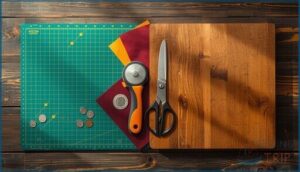
Price matters, but it’s only part of the story. How long a surface lasts — and what it costs to keep it going — tells you a lot more.
Here’s a breakdown of what you can expect at every budget level.
Budget Mats ($5-$15)
Most budget mats land between $5 and $15 — and for occasional sewists, that’s genuinely enough. You get a self-healing PVC surface, basic printed grids, and decent portability factors for small workspaces.
Color choices are usually green or gray. User experience is simple but functional.
The affordability trade-offs? Thinner builds and lighter grids. Good for starters. Not built for daily heavy use.
Mid-Range Mats ($15-$40)
Step up from budget mats and you get real difference.
Midrange mats — $15 to $40 — offer 3–5‑ply PVC, better self healing properties, and noticeably improved Grid Color Contrast.
Most include Non‑Slip Backing and a Rollable Storage Design that actually holds shape.
Weight & Portability stay manageable. Self‑Healing Speed is faster too.
Price vs quality finally makes sense here.
Premium Mats ($40+)
Premium mats push past $40 — and the difference shows immediately.
You get Premium Material Density, Reinforced Edges that won’t peel, and premium thickened buffer layers that protect your blades, cut after cut. Many include Dual-Sided Grids, Modular Backing systems, and Custom Size Options for dedicated sewing tables.
Price vs quality finally aligns with serious use:
- Self-healing properties close cuts faster, keeping your surface smooth longer
- Material quality stays consistent through heavy daily projects
- Reinforced construction resists warping, curling, and edge lift
Upfront Cost Vs Lifespan
A cheap mat might look like a win at checkout, but the initial investment tells only half the story. Budget vs premium cutting mats diverge fast once you factor in replacement cycle and cutting mat durability.
Self-healing technology benefits your wallet long-term — fewer swaps, longer value over time.
Durability ROI is real.
Spend more once, or spend less repeatedly.
Your lifetime savings depend on that choice.
Maintenance Costs Over Time
Maintenance adds up quietly — and that’s where the real cost gap shows up.
- Mats need mild soap cleaning, not expensive supplies
- Wood boards require oil or board cream every few months
- Acrylic boards need polishing to fix scratches over time
- Improper storage causes warping, which triggers early replacement
- Skipping blade swaps wears down your mat faster
Smart cleaning and storage best practices stretch mat lifespan considerably.
Best Value for Frequent Sewists
Frequent sewists get the best return from a large self-healing mat — ideally 24 x 36 inches. The self-healing technology benefits add up fast: fewer grooves mean better blade replacement frequency and lower long-term costs.
Workspace optimization improves too, since you reposition fabric less often.
User review rankings consistently back OLFA and Fiskars for durability.
That’s solid sewing project ROI from one smart purchase.
Top 7 Sewing Cutting Surfaces
Not all cutting surfaces are created equal. Some protect your blades better, some handle heavy fabrics like a champ, and some just make precise cuts easier.
Here are seven worth knowing about.
1. Aneuzs Self Healing Cutting Mat
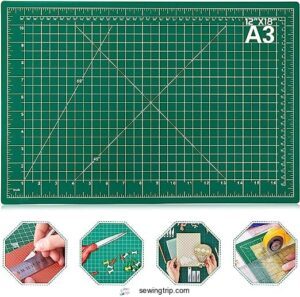
The Aneuzs Self-Healing Cutting Mat is a solid pick if you’re just starting out or working in a smaller space.
At 12 × 18 inches and only $8.99, it punches above its weight.
The 5-layer PVC construction keeps blades sharp, and the double-sided grid — inch markings on one side, metric on the other — covers most sewing needs without extra tools.
It’s lightweight at 330 g, easy to move around, and reliable for everyday fabric and paper cutting.
| Best For | Beginners, hobbyists, and crafters working in smaller spaces who need an affordable, reliable cutting mat for sewing, scrapbooking, or paper crafting. |
|---|---|
| Size | 12 x 18 in |
| Material | PVC |
| Weight | 330 g |
| Double-Sided | Yes |
| Grid Lines | Inch and metric |
| Price | $8.99 |
| Additional Features |
|
- Self-healing surface keeps blades sharp and holds up well to everyday use
- Double-sided grid with both inch and metric markings makes measuring easy without extra tools
- Super affordable at $8.99 and light enough to move around or tuck away easily
- At 12 × 18 inches, it’s too small for large quilting or upholstery projects
- Heavy repeated cutting can scratch the surface and make grid lines harder to read over time
- Offers limited grip on smooth tables, so it may shift around without something to hold it in place
2. Worklion Double Sided Self Healing Cutting Mat
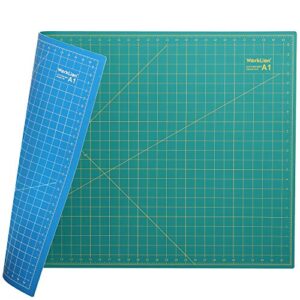
Worklion Double Sided Self-Healing Cutting Mat is built for sewists who mean business. At 24 × 36 inches, it gives you real room to spread out full fabric lengths without repositioning.
The 5-layer PVC core heals after every pass, keeping your rotary blade sharp longer. One side is metric, the other imperial — flip it and you’re done.
Angle guides at 30°, 45°, and 90° make bias cuts easy. At $35.13, it’s solid value for serious work.
| Best For | Quilters, sewists, and crafters who need a large, reliable work surface with both metric and imperial measurements on hand. |
|---|---|
| Size | 24 x 36 in |
| Material | PVC |
| Weight | 16 oz |
| Double-Sided | Yes |
| Grid Lines | Metric and imperial |
| Price | Not listed |
| Additional Features |
|
- Self-healing surface keeps the mat smooth and extends your blade life over hundreds of cuts.
- Double-sided grid (metric/imperial) means you can flip it and work in either system without grabbing a different tool.
- Big 24 × 36 in work area gives you room to lay out full fabric lengths without constant repositioning.
- It comes with a noticeable PVC smell out of the box that can stick around for weeks, especially in smaller spaces.
- Keep it away from heat and direct sunlight — it can warp over time if you’re not careful.
- Heavy-duty cuts (thick leather, dense plastics) will wear down one spot faster, so you’ll need to rotate it regularly.
3. Idemeet 24×36 Self Healing Cutting Mat
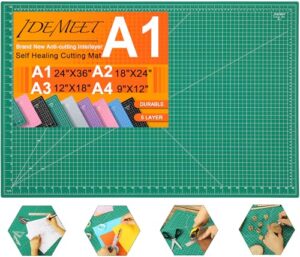
The Idemeet 24×36 mat means business. At 2,600 grams, it’s noticeably denser than most mats in this price range — and that weight translates directly into better self-healing performance.
The reinforced anti-cutting interlayer keeps your rotary blade from bottoming out. Grids cover inches, centimeters, and common angles, so bias cuts stay accurate. Double-sided design adds flexibility.
At $31.44, it’s hard to beat. Just note that some buyers reported inconsistent packaging — order with that in mind.
| Best For | Quilters, crafters, and hobbyists who need a large, durable cutting surface that can handle heavy daily use. |
|---|---|
| Size | 36 x 24 in |
| Material | PVC |
| Weight | 5.94 lbs |
| Double-Sided | Yes |
| Grid Lines | Inch and metric |
| Price | Not listed |
| Additional Features |
|
- Dense 2,600g construction means the mat actually heals well after repeated cuts
- Clear grid markings in inches, metric, and angles make bias cuts and precision work much easier
- Double-sided and rotary-cutter compatible, so it works across a wide range of projects
- Some buyers got inconsistent packaging, which raises the risk of shipping damage
- At 24×36, it won’t fit comfortably on a smaller desk or workspace
- A few customers reported receiving the wrong product, so worth keeping an eye on your order
4. ArtAt Self Healing Cutting Mat
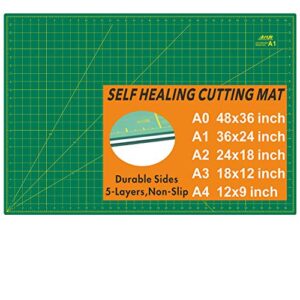
If the Idemeet wins on density, the ArtAt 661A1 wins on coverage. At 36 × 24 inches, it’s one of the largest mats in this price range — and at $38.99, it’s still reasonable for what you get.
Five-layer PVC, a hard white core, and a non-slip backing make it a solid daily driver. Both sides have full grids with 30°, 45°, and 90° guides. Shipped flat, not rolled. That alone keeps it crease-free from day one.
| Best For | Quilters, crafters, and makers who need a large, reliable work surface for sewing, scrapbooking, or vinyl cutting. |
|---|---|
| Size | 36 x 24 in |
| Material | PVC |
| Weight | 16 oz |
| Double-Sided | Yes |
| Grid Lines | Imperial and metric |
| Price | $38.99 |
| Additional Features |
|
- Big 36 × 24 in surface gives you serious room to work without feeling cramped
- Double-sided with full imperial/metric grids and angle guides on both sides — great value for the price
- Non-slip backing and self-healing surface keep cuts clean and blades sharp longer
- Flat packaging is bulky if storage space is tight
- Some units have shipped with minor surface dimples near the edges
- At 3 mm thick, it may not hold up to really heavy-duty cutting tasks
5. Fiskars Self Healing Cutting Mat
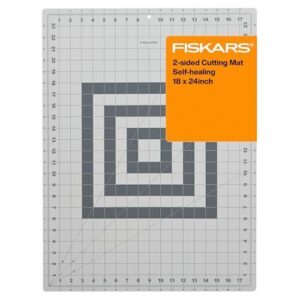
The Fiskars 18" × 24" mat is a reliable workhorse. It’s lightweight at 1.5 lb, double-sided, and includes 30°, 45°, and 60° bias lines — everything you need for quilt blocks and angled cuts.
The self-healing polymer stays smooth after hundreds of passes.
Gray isn’t the flashiest color, but the grid stays readable on most fabrics.
Clean it with warm water and mild soap. Store it flat.
At this size, it manages most garment and quilting projects without taking over your table.
| Best For | Quilters, sewists, and paper crafters who need a dependable, mid-to-large cutting surface with built-in measuring guides for accurate, repeatable cuts. |
|---|---|
| Size | 18 x 24 in |
| Material | Self-healing polymer |
| Weight | 1.5 lbs |
| Double-Sided | Yes |
| Grid Lines | Imperial with bias lines |
| Price | Not listed |
| Additional Features |
|
- Double-sided design gives you two usable surfaces, so the mat lasts significantly longer before needing replacement.
- Built-in 30°, 45°, and 60° bias lines make angled cuts straightforward without reaching for extra tools.
- Self-healing polymer holds up through hundreds of blade passes and stays smooth over time.
- The large footprint can crowd a small workspace, and you may need to swap in a smaller mat for tight setups.
- Gray grid lines can be tricky to see on dark fabrics or in low lighting.
- Thin construction means it can compress under heavy pressure, and it needs careful flat storage away from heat to avoid warping.
6. OLFA Self Healing Rotary Cutting Mat
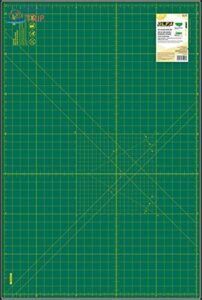
OLFA takes things up a notch. This 24" × 36" mat runs about 1.5 mm thick — slim, but the multi‑layer PVC holds up well under a rotary cutter.
One side has yellow grid lines with 30°, 45°, and 60° angle guides. The reverse is solid green for open cutting.
It’s double‑sided, which stretches the mat’s life considerably. The self‑healing surface stays smooth after repeated passes, and blades stay sharp longer.
It weighs just 2.3 pounds, so it’s easy to move around your workspace.
| Best For | Quilters, sewers, and crafters who need a large, reliable cutting surface with precise measurement guides. |
|---|---|
| Size | 24 x 36 in |
| Material | Plastic/Rubber |
| Weight | 2.3 lbs |
| Double-Sided | Yes |
| Grid Lines | Grid one side only |
| Price | Not listed |
| Additional Features |
|
- Double-sided design gives you grid lines when you need them and a clean surface when you don’t — plus it doubles the mat’s lifespan.
- Self-healing surface keeps things smooth after repeated cuts, and your rotary blades stay sharper longer.
- At 2.3 pounds, it’s light enough to move around easily without being flimsy.
- At 1.5mm, it’s on the thinner side — some users notice cut marks building up over time despite the self-healing claim.
- Can’t be used with fixed blade utility knives, so it’s rotary cutters only.
- Needs to be stored flat and away from sunlight, which can be a hassle if you’re tight on space.
7. Wesiti Large Acrylic Cutting Board
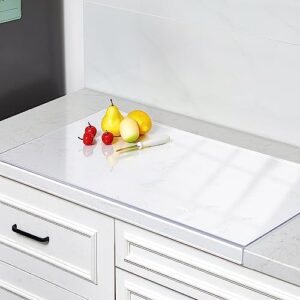
Not every sewist needs a self-healing mat. Sometimes you want something clear, firm, and easy to clean — that’s where the Wesiti comes in.
This 36" × 24" acrylic board gives you a huge, transparent cutting surface. You can slide rulers or pattern pieces underneath and see them right through the board. precision placement.
The built-in lip hooks over your table edge, keeping it steady. shifting mid-cut. At $69.99, it’s a solid option if acrylic suits your workflow.
| Best For | Sewists who want a large, clear work surface that protects their countertop and lets them see rulers or pattern pieces right through the board. |
|---|---|
| Size | 37.4 x 25.59 in |
| Material | Acrylic |
| Weight | 8 lbs |
| Double-Sided | No |
| Grid Lines | None |
| Price | $69.99 |
| Additional Features |
|
- Huge 37" × 25" surface gives you plenty of room to cut fabric and lay out pattern pieces
- Transparent design lets you see through to whatever’s underneath — great for precise placement
- Non-porous surface won’t absorb stains or odors, and cleans up fast with soap and water
- Surface will scratch over time, so it’s not ideal if you want something that stays looking pristine
- Heat can warp or crack it, so keep hot tools away
- Anti-slip pads only grip dry surfaces — on a wet or damp counter, it can slide around
Frequently Asked Questions (FAQs)
What is the best surface for cutting fabric?
A self-healing cutting mat is your best bet. It protects blades, keeps surfaces smooth, and gives you accurate grid lines. For fabric work, nothing else comes close.
Can I use a cutting board as a cutting mat?
You can, but it’s not ideal. Boards lack self-healing surfaces and printed grids. Rotary blades dull faster on hard surfaces. A wooden board works best if you have no other option.
Can I use a cutting mat on carpet?
Yes, but with a catch. Carpet creates an uneven base that causes wobbling and uneven blade pressure. Slide a plywood sheet underneath your mat for firm, stable support.
Do cutting mats work with embroidery projects?
Absolutely. A cutting mat is great for embroidery prep.
Use it to trim stabilizer, cut applique shapes, and keep fabric flat before hooping.
The grid lines help you stay accurate every time.
Are cutting mats safe for children to use?
The mat is fine. It’s the rotary cutter that isn’t. Keep blades locked when not in use, supervise closely, and consider scissors first. Maturity matters more than age.
Can two mats be joined for extra space?
You can join two mats edge to edge to create more cutting space. Just make sure both are the same thickness. Align the grid lines carefully.
A small seam gap can throw off precise cuts.
Do cutting surfaces affect fabric stretch or distortion?
Your cutting surface is the silent partner in every cut. A soft mat cushions blade pressure, reducing stretch on delicate fabrics.
Rigid boards transfer force directly, which can distort bias-cut pieces or lightweight weaves.
Conclusion
Measure twice, cut once—wise words for sewists. Your surface choice shapes every project’s precision.
Cutting mats excel with self-healing tech, extending blade life and ensuring true cuts for intricate work. Boards? Ideal for heavy fabrics needing stability.
Factor in cost, durability, and workspace needs. Whether quilting or tailoring, the right tool transforms frustration into flow.
For most, a quality mat wins long-term. But match your surface to your demands. Master the cutting mat vs cutting board for sewing debate, and watch your accuracy soar.
Now go create—confidently.
- https://www.wawak.com/cutting-measuring/cutting/self-healing-cutting-mats/
- https://www.threadsmagazine.com/project-guides/learn-to-sew/rotary-cutters-and-mats
- https://www.kearing.com/how-to-use-a-cutting-mat/
- https://www.nannocreative.com/en/snijmat-a4-30-x-22-cm-turquoise.html
- https://madamsew.com/products/madamsew-rotating-cutting-mat