This site is supported by our readers. We may earn a commission, at no cost to you, if you purchase through links.
A thread snapping mid-design doesn’t just waste time—it can ruin hours of careful work. Most embroiderers blame tension or machine settings, but the real culprit is usually the thread itself.
Polyester holds 6–9 N of tensile force and shrugs off UV exposure. Cotton weakens by up to 12% when humidity climbs past 70%. Rayon looks stunning but develops micro-tears after roughly 1,000 stitch cycles.
These aren’t small differences—they determine whether your finished piece survives its first wash. Knowing the embroidery thread strength differences between materials, constructions, and weights puts you in control before a single stitch breaks.
Table Of Contents
- Key Takeaways
- Polyester, Rayon, and Cotton Strength
- Thread Construction and Strength Performance
- Thread Weight, Needles, and Breakage
- Fabric, Tension, and Wear Resistance
- Top 7 Embroidery Thread Products
- 1. New Brothread Polyester Embroidery Thread
- 2. New Brothread Mercerized Cotton Thread
- 3. Simthread Multi Color Glow Embroidery Thread
- 4. Brothread Variegated Polyester Embroidery Thread
- 5. New Brothread UV Color Changing Embroidery Thread
- 6. Doublelin Prewound Polyester Bobbins Size A
- 7. Embroidex Embroidery Thread Stand
- Frequently Asked Questions (FAQs)
- Conclusion
Key Takeaways
- Polyester handles stress best — it holds 6–9 N of tensile force and keeps 70–90% of that strength even after 1,000 hours of UV exposure, while cotton loses up to 12% strength in humidity above 70%, and rayon starts breaking down after roughly 1,000 stitch cycles.
- Two-ply thread cuts breakage failures by up to 35% compared to single-ply, because it spreads the load across both strands instead of stressing the core alone.
- Your needle size has to match your thread weight — 40 wt needs an 80/12 or 90/14, while 60 wt calls for a 65/9 or 70/10, and using the wrong size causes friction that snaps thread fast.
- Thread stored above 40°C or in humidity over 60%, weakens before you even touch it, so keep your spools between 15–25°C to protect breaking resistance.
Polyester, Rayon, and Cotton Strength
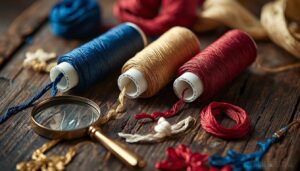
Not all embroidery threads are built the same, and the difference often shows up when your project is under pressure. Fiber type is one of the biggest factors that determines how well a thread holds up over time.
Natural fibers like cotton tend to breathe and age differently than synthetics, so knowing which machine embroidery threads handle wear best can save you a lot of frustration mid-project.
Here’s how the most common options stack up.
Polyester Tensile Strength and Abrasion Resistance
Polyester embroidery thread tops the strength chart for good reason. Its tight molecular packing resists micro-cutting from friction, while high crystalline content from thermal drawing pushes tensile strength to 6–9 N.
You also get strong UV aging resistance — retaining 70–90% strength after 1,000 hours of exposure.
For high‑stress projects, polyester’s low moisture retention keeps performance consistent even in humid conditions.
Testing follows the single‑fiber tensile standard.
Rayon Sheen Versus Long-term Fatigue Resistance
Rayon embroidery thread earns attention for its luxury sheen, but that gloss retention comes with trade-offs.
Micro-shears formation begins after roughly 1,000 stitch cycles, quietly degrading thread durability.
Heat sensitivity matters too — pressing temperatures above moderate levels cut fatigue resistance by up to 25%.
Humidity softening further weakens tensile strength.
For longevity best practices, keep humidity low and pressing temperature controlled.
Cotton Thread Strength in Dry and Humid Conditions
Cotton behaves differently than rayon under stress. In dry conditions, Dry Tensile Modulus rises slightly — cotton threads hit around 2.5–3.0 N per tex, with up to 8% stronger break loads.
But humidity above 70% triggers Humidity Elasticity Loss, softening fibers and cutting strength by 5–12%. Moisture-Induced Creep follows, weakening thread durability over time. Thread Conditioning and Temperature Stability help preserve cotton thread longevity.
Nylon-blend Stretch Versus Breaking Load
Unlike cotton, nylon-blend threads are built to flex. Their Elastane Ratio boosts stretch up to 20%, and Stretch Recovery Speed kicks in within 5–8 seconds.
Breaking loads range from 18–40 N, so Hoop Stress Tolerance stays strong even in high-stress projects. Watch for Humidity Load Reduction and Dark Dye Effect — both quietly trim breaking load and increase thread breakage risk.
Silk and Metallic Thread Strength Trade-offs
Silk embroidery thread works with delicate fabrics well—its Moisture Flexibility lets fibers relax under humidity, reducing thread breakage risk.
Metallic embroidery thread brings Surface Hardness and shine, but Micro-brittleness Junctions form where the wrap meets tight curves, stressing thread tension.
Together, their Load Distribution spreads strain across each stitch. Use proper Stabilizer Compatibility to protect both and extend embroidery thread durability.
Thread Construction and Strength Performance
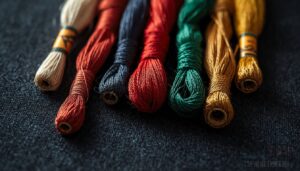
How a thread is built matters just as much as what it’s made of. Construction decisions — like ply count, core type, and outer wrap — directly shape how much stress a thread can handle before it snaps.
Here’s what you need to know about each factor.
Two-ply Versus Single-ply Durability
Two-ply thread isn’t just stronger — it’s built to last longer under real working conditions. The doubled strands shift stress away from the core, cutting breakage threshold failures by up to 35%. That directly improves thread longevity across dense fills and tight weaves.
Two-ply thread cuts breakage failures by up to 35% by shifting stress away from the core
- Core Fatigue: Two-ply reduces core fatigue by distributing load to outer wraps.
- Breakage Threshold: Breakage resistance increases up to 35% over single-ply.
- Elastic Recovery: Single-ply stretches more under needle interaction, weakening over time.
- Thread Durability: Two-ply shows 15–30% better wear after abrasion cycles.
- Thread Weight: Both plies maintain colorfastness across polyester vs rayon constructions.
Core-spun Versus Flat-wrapped Thread Strength
Core-spun thread puts the load where it belongs — in the center. That core load concentration means polyester cores handle heat and friction better than flat-wrapped alternatives, which rely on wrap thickness effect to transfer stress.
Flat wrap uniformity helps with stitch consistency, but high-speed breakage is less common with core-spun.
For longevity, core-spun wins on durability.
How Ply Count Affects Breakage Resistance
More plies mean more filaments sharing the load — and that directly cuts your thread breakage risk. Two-ply polyester resists snapping longer than single-ply under seam stress.
But ply-fabric matching matters: thick plies on fine fabrics cause stiffness and fraying. Needle eye stress also rises when ply count exceeds fabric tolerance.
Match ply to fabric weight, and you’ve got built-in thread breakage prevention.
Why Metallic Wraps Snap More Easily
Metallic threads look stunning — but that foil wrap is their weak point. The metal layer has a higher modulus than the fiber core, so stress concentrates at every bend instead of spreading evenly.
Watch for these failure patterns:
- Surface microcracks form fast under repeated flexing
- Thermal expansion mismatch pulls the wrap loose, causing adhesive delamination
- Edge stress concentration snaps threads at seam corners
Metallic thread optimization starts with lower tension settings.
Stitch Density and Stress on Thread
Pack too many stitches into a small area, and your thread pays the price. Stitch density effects compound quickly — each crossing adds to thread stress accumulation, raising cumulative load at every node.
Heat buildup risks follow, especially on tight knits. Stitch overlap load shortens fatigue life reduction on high-stress projects.
Match stitch density to thread weight, and you’ll avoid costly tension errors.
Thread Weight, Needles, and Breakage
Thread weight affects more than just how your design looks — it directly influences how often your thread breaks and how well your needle supports the load. Getting this pairing right is one of the most practical things you can do to reduce frustration at the machine.
Here’s what you need to know about weights, needle sizes, and matching both to your fabric.
40 Wt Versus 60 Wt Strength Differences
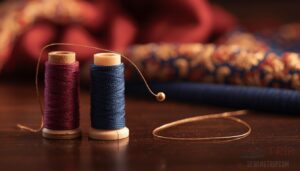
Thread weight shapes everything—strength, feel, and how long your work holds up.
Here’s what separates 40wt vs 60wt:
- Bulk vs Flexibility: 40wt carries higher breaking load; 60wt passes through tight needle eyes with less friction.
- Breakage Fatigue Curve: 40wt lasts longer on synthetic blends under repeated stress.
- Color Fade Resistance: 60wt’s thinner filament holds color saturation better after washing.
Understanding thread weight, 40wt vs 60wt, means fewer thread tension errors and smarter longevity best practices.
When 30 Wt Handles Heavier Fabrics Better
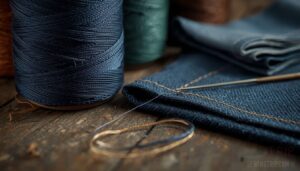
When you’re stitching denim or canvas, 30 wt thread earns its place fast. Its thicker diameter manages bulk stress distribution better than finer weights—spreading needle-entry force across more fibers.
That means fewer snaps mid-seam.
Fabric weight pairing matters here: 30 wt’s thread elasticity impact stays controlled through dense weaves, supporting seam reinforcement techniques that actually hold when you wash heavy items repeatedly.
Needle Sizes for 40 Wt Embroidery Thread
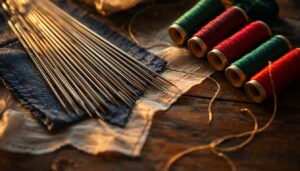
For 40 wt thread, your go-to needle is an 80/12 on medium-weight fabrics.
Move up to a 90/14 when denim or layered quilts are involved— that extra piercing power manages denser weaves without forcing the thread.
Eye size optimization matters here: too small, and friction causes breakage fast.
Match needle sharpness level to fabric type and thread tension balance stays consistent.
Needle Sizes for 60 Wt Embroidery Thread
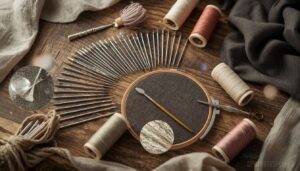
finer thread calls for finer needles. With 60 wt thread, start at a 65/9 or 70/10.
Sharp point needles pierce woven fabrics cleanly without fraying the thread.
On delicate materials, microtext needles reduce fiber damage noticeably.
For longer sessions, titanium coated needles and bonded steel needles hold up better under heat and wear.
Ferrule alignment keeps your needle size consistent and stitches precise.
Matching Thread Thickness to Fabric Density
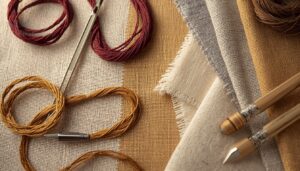
Density-Weight Matrix: heavier fabrics need mid-weight threads, lighter ones need finer.
dense canvas, 40 wt prevents stitch compression and fabric puckering.
Switch to 60 wt on tightly woven cotton to lower the thread pull ratio and reduce distortion.
Always confirm stabilizer compatibility before starting.
Matching thread thickness to fabric weight keeps your stitches clean and your work lasting.
Fabric, Tension, and Wear Resistance
The thread you pick is only half the equation. How fabric behaves, how you set your tension, and how you maintain your machine all determine whether that thread holds or snaps.
Here’s what actually shapes wear resistance from start to finish.
How Fabric Type Changes Thread Strain
Your fabric is never just a backdrop — it’s an active force on every thread you use.
- Satin weave strain pushes local tension up 25% along warp yarns
- Denim density impact raises overall thread strain 10–20% during needle penetration
- Knitted jersey stress drops peak strain 8–15% by spreading load evenly
- Linen friction effect increases junction strain 5–12% through movement
- Silk chiffon elasticity demands careful fabric compatibility and precise thread weight matching
Understanding fiber types and their effect on embroidery helps you control thread tension balance before problems start.
Tension Settings That Reduce Snapping
Wrong tension is one of the most common causes of thread breakage — and it’s fixable.
Set your Upper Tension Reduction slightly below factory default during dense fills. Use Tension Gauge Calibration after every needle change. Keep Consistent Machine Speed on high‑speed machines to avoid sudden snaps. Proper Needle Path Clearance and thread tension balance prevent tension errors before they interrupt your work.
Stabilizers That Protect Weaker Threads
Stabilizers are your first line of defense against thread fraying and breakage — especially with delicate rayon or metallic threads. Matching stabilizer type to your thread weight makes the difference between clean stitches and a tangled mess. Here’s what works:
- Wash-away stabilizers dissolve completely, leaving no residue on fine threads
- Tear-away stabilizers minimize friction during finishing on lightweight materials
- Cut-away stabilizers provide lasting support without stressing weak thread intersections
Fusible stabilizers with adhesive backing prevent slippage on sheer fabrics. Understanding stabilizer benefits and stabilizer use keeps your threads intact from first stitch to last.
Washing, Moisture, and Thread Durability
Every wash cycle is a stress test; your thread either passes or fails.
Moisture swelling weakens cotton by up to 40%, while polyester holds its diameter and wash durability through 20–30 cycles.
Detergent compatibility matters — skip optical brighteners to protect colorfastness.
Stabilizer prewashing reduces thread movement inside fabric.
Air drying benefits every fiber type by cutting heat cycling effects that cause microcracks.
| Condition | Best Practice |
|---|---|
| Humidity impact on thread performance | Use polyester or nylon-blend thread |
| Heat cycling effects | Air dry; avoid high-heat tumble drying |
Friction, Lint, and Damaged Needles
Friction is a slow wrecker — it builds heat at the needle eye, frays fibers, and kills stitch integrity before you notice.
Thread path friction accelerates when lint accumulates, acting like sandpaper on your thread.
Stick to a lint removal routine after every project.
Match needle selection to thread weight, and use needle lubrication to cut heat buildup effects and prevent needle eye abrasion.
Top 7 Embroidery Thread Products
Knowing thread strength on paper is one thing — finding products that actually hold up is another. seven options cover a range of materials, weights, and specialty features worth considering for your next project.
Here’s made the list.
1. New Brothread Polyester Embroidery Thread
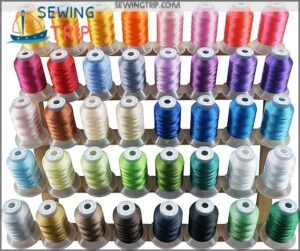
If you want a reliable everyday polyester thread, the New Brothread 40-spool kit is hard to beat.
Each spool runs 500 meters at 40 wt — enough for serious projects without constant restocking.
The 100% polyester construction holds up through commercial washing without fading or bleeding.
You also get a printed color chart and Madeira conversion guide, which makes matching shades to existing designs straightforward.
At $22.94 for 40 colors, it’s a practical choice for machine embroidery across Brother, Janome, Singer, and most major brands.
| Best For | Machine embroidery enthusiasts who want a solid, colorful thread kit that works with most home machines and holds up through regular washing. |
|---|---|
| Material | 100% Polyester |
| Thread Weight | 40 wt |
| Color Count | 40 colors |
| Machine Compatible | Yes |
| Price (USD) | $22.94 |
| Unit Quantity | 40 spools |
| Additional Features |
|
- 40 colors at $22.94 is genuinely great value — that’s under 60 cents a spool
- Color-fast polyester means it won’t fade or bleed, even through commercial laundering
- Comes with a printed color chart and Madeira conversion guide, so matching to existing designs is easy
- No wooden spool rack included — you’ll need to sort out your own storage
- Polyester isn’t ideal if you need natural fiber feel or high heat resistance
- Performance still depends on using the right needle and machine settings, so setup matters
2. New Brothread Mercerized Cotton Thread
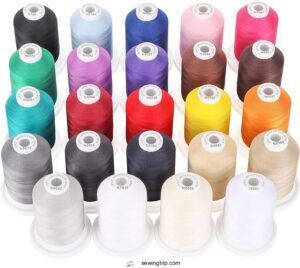
Polyester works with the machine well, but sometimes your fabric calls for something different. The New Brothread Mercerized Cotton Thread is built for natural fabrics — cotton, linen, quilts.
Its 3-ply, 50 wt construction (equivalent to 30 WT, Tex 33) gives you a thicker, smoother yarn with genuine tensile strength for dense stitching.
Mercerizing adds a silk-like sheen and improves dye absorption, so colors stay deep after washing.
Each spool runs 600 meters with a locking base that keeps unwinding from becoming your next problem.
| Best For | Quilters, garment sewers, and anyone working regularly with natural fabrics like cotton and linen who want a strong, low-lint thread with great color retention. |
|---|---|
| Material | 100% Mercerized Cotton |
| Thread Weight | 50 wt (3-ply) |
| Color Count | 24 colors |
| Machine Compatible | Yes |
| Price (USD) | Not listed |
| Unit Quantity | 24 spools |
| Additional Features |
|
- 600 meters per spool means fewer interruptions on big projects, and the locking snap base keeps everything tidy between sessions.
- Mercerized finish gives it a smooth, slightly silky feel with colors that hold up well after washing — great for anything you want to look polished long-term.
- Matches the shrinkage rate of natural fabrics, so you’re less likely to deal with puckering after the first wash.
- It’s thicker than standard 40 wt thread, so you’ll need to check your needle size (80/12 or larger) — easy to overlook if you’re used to switching threads quickly.
- Low elasticity means you should slow your machine down a bit, which isn’t ideal if you’re trying to knock out a big project fast.
- No single-color options, so if you just need a bulk supply of white or black, this probably isn’t the most cost-effective pick.
3. Simthread Multi Color Glow Embroidery Thread
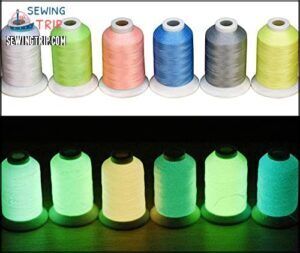
Not every project calls for subtlety. The Simthread Multi Color Glow Embroidery Thread is built for designs that need to be seen — literally.
This 30 wt, 100% polyester set includes six colors and glows up to 8 hours after just 20 minutes of light charging. Each spool runs 914 meters.
It meets CPSC safety standards, so it’s suitable for kids’ costumes and event wear.
Use NM 80/12 or 85/13 needles and stick to dark fabrics for the strongest glow effect.
| Best For | Crafters and costume makers who want eye-catching, glowing embroidery for festival wear, Halloween costumes, or UV-reactive art projects. |
|---|---|
| Material | 100% Polyester |
| Thread Weight | 30 wt |
| Color Count | 6 colors |
| Machine Compatible | Yes |
| Price (USD) | $19.99 |
| Unit Quantity | 6 spools |
| Additional Features |
|
- Glows up to 8 hours after just 20 minutes of light exposure — great for all-night events
- Six-color set with 914 meters per spool is solid value at $19.99
- CPSC-certified and child-safe, so it works for kids’ costumes and school projects
- Colors can look off in daylight — yellow tends to read as green, and some spools are hard to tell apart
- Glow performance drops noticeably on lighter fabrics, so dark backgrounds are basically a must
- Thread can shred or break at high speeds, so it needs a gentler touch than standard embroidery thread
4. Brothread Variegated Polyester Embroidery Thread
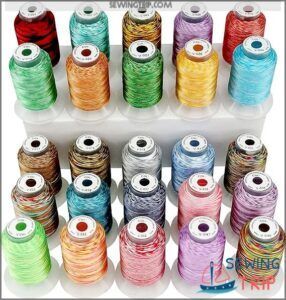
If glow thread deals with the dramatic, this kit deals with everything else.
The Brothread Variegated Polyester Embroidery Thread gives you 25 spools of color-shifting 40 wt thread — 500 meters each — for $23.73. That’s serious coverage.
The 100% polyester construction holds up through commercial laundering without fading.
It runs cleanly on Brother, Janome, and similar machines.
For best results, keep speeds moderate; some variegated colors perform slightly better at lower tension settings.
| Best For | Hobbyists and small-business makers who need a versatile, colorful thread kit that holds up through heavy use and frequent washing. |
|---|---|
| Material | 100% Polyester |
| Thread Weight | 40 wt |
| Color Count | 25 variegated |
| Machine Compatible | Yes |
| Price (USD) | $23.73 |
| Unit Quantity | 25 spools |
| Additional Features |
|
- 25 variegated spools for $23.73 is genuinely hard to beat — that’s a lot of color for the money.
- Color fastness is solid, so your work won’t fade after a few trips through the wash.
- Works with most major machine brands right out of the box.
- Some variegated colors are a bit more fragile, so you’ll want to slow your machine down on longer runs.
- Occasional thread splitting has been reported, especially at higher speeds.
- Spools are on the smaller side, which means more frequent changes during big projects.
5. New Brothread UV Color Changing Embroidery Thread
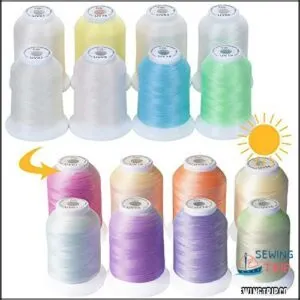
Switching things up under sunlight is where this kit shines. The New Brothread UV Color Changing Thread gives you 8 spools — 500 m each — at $23.39.
Each 30 wt polyester spool holds strong through dense stitch patterns without frequent breaks. The UV coating shifts color under direct sunlight and resets indoors.
Keep wash temps below 104 °F and skip the steam iron. Use a large-eye needle like the SCHMETZ Topstitch 90/14 to cut friction and protect the coating.
| Best For | Embroiderers and crafters who want eye-catching, color-shifting designs on outdoor gear, kids’ clothing, or bags using a machine embroidery setup. |
|---|---|
| Material | 100% Polyester |
| Thread Weight | 30 wt |
| Color Count | 8 colors |
| Machine Compatible | Yes |
| Price (USD) | $23.39 |
| Unit Quantity | 8 spools |
| Additional Features |
|
- 8 spools at 500 m each is solid value — 4,000 m total for $23.39
- Strong 30 wt build holds up through dense stitching without constant thread breaks
- Color shifts back and forth between sunlight and indoors, so the same piece looks different depending on the light
- UV strength matters — weak or indirect light may barely trigger the color change
- Needs specific care: no steam iron, no bleach, and wash water can’t go above 104 °F
- Not great for hand-sewing or knitting; the thin filament can spool and tangle easily
6. Doublelin Prewound Polyester Bobbins Size A
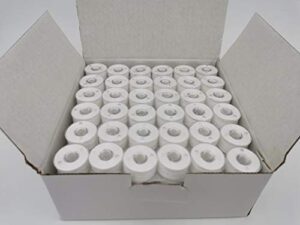
Running low on bobbin thread mid-project is a productivity killer. The Doublelin Prewound Bobbins solve that fast — 144 pre-wound Size A bobbins, each loaded with 60S/2 polyester at roughly 3,600 inches per bobbin.
The 60 wt thread delivers consistent tension across Brother, Babylock, Janome, and Singer machines. Plastic-sided construction resists deformation and stays reusable. White thread suits most light-fabric applications, but won’t work for dark-fabric projects needing contrast.
Compatible only with Class 15 / SA156 machines.
| Best For | Home sewers, embroidery studios, and garment producers who use Class 15 machines and want to skip the hassle of winding bobbins mid-project. |
|---|---|
| Material | 60S/2 Spun Polyester |
| Thread Weight | 50 wt (TEX 20) |
| Color Count | White only |
| Machine Compatible | Yes |
| Price (USD) | Not listed |
| Unit Quantity | 144 bobbins |
| Additional Features |
|
- 144 pre-wound bobbins means you’re stocked for a long time — no more stopping to wind thread mid-project.
- Consistent 60 wt polyester delivers smooth, low-lint stitching across popular brands like Brother, Janome, and Singer.
- Plastic construction holds its shape, stays reusable, and performs close to metal bobbins without the weight.
- Only works with Class 15 / SA156 machines — double-check compatibility before buying.
- White thread only, so dark or contrasting fabrics aren’t a great fit.
- Plastic bodies can crack if forced in too hard, so a little care goes a long way.
7. Embroidex Embroidery Thread Stand
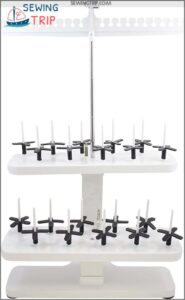
20 spools organized and ready isn’t a luxury — it’s how you stay in control of complex multi-color projects.
The Embroidex Thread Stand holds King cones, snap spools, and cross-wound formats in a sand-weighted polypropylene base that resists tipping during high-speed runs. At 16 × 6 × 19 inches, it fits behind most machines without crowding your workspace.
The integrated thread guides maintain consistent feed paths, which directly reduces tension spikes and breakage.
For $27.99, it’s a practical tool that earns its place fast.
| Best For | Embroiderers who juggle multi-color projects and need their threads organized, accessible, and ready to go without interrupting their flow. |
|---|---|
| Material | Polypropylene Plastic |
| Thread Weight | N/A |
| Color Count | N/A |
| Machine Compatible | Yes |
| Price (USD) | $27.99 |
| Unit Quantity | 1 stand (20-spool cap) |
| Additional Features |
|
- Holds 20 spools of different types, so you can lay out your whole color sequence before you even start stitching
- Sand-weighted base keeps things steady during fast runs, and it’s easy to move between machines
- At $27.99, it’s an affordable upgrade that saves real time on busy projects
- Assembly instructions are vague, and several included accessories leave users scratching their heads
- The base can shift if you’re running heavier spools — you may need to add extra weight
- It’s a fairly large footprint, so smaller sewing tables might not have the depth to fit it comfortably
Frequently Asked Questions (FAQs)
What is the difference between 40 wt and 60 wt embroidery thread?
Think of thread weight like a garden hose — wider means more flow, but less precision. 40 wt is thicker for bold coverage; 60 wt is finer for delicate detail and lighter fabrics.
What are the different thicknesses of embroidery thread?
Embroidery thread comes in several weights — 30, 40, 60, and 80 wt are the most common. Higher numbers mean thinner thread. Each weight suits different fabrics and stitch types.
Does thread color affect overall tensile strength?
Color alone won’t snap your thread — but the dyeing process might. Heat-intensive dye cycles can trim tensile strength by a few percent, especially in polyester and silk threads.
How does thread age impact embroidery durability?
Thread age quietly undermines durability. Older thread becomes brittle, loses elasticity, and breaks more easily under tension.
Cotton degrades fastest; polyester holds longer. Replace any spool showing cracks, stiffness, or powdering before starting your project.
Can thread brand quality vary significantly in strength?
Yes, brand quality matters more than most stitchers realize.
Premium polyester lines can show up to 20 percent higher breaking loads than budget options — same weight, different performance under real stitching conditions.
Which thread holds best on leather or vinyl?
For leather and vinyl, bonded nylon is your best bet. It punches through thick hides cleanly, resists moisture, and holds seams under stress.
Waxed polyester runs a close second for classic durability.
Does thread storage temperature affect breaking resistance?
Storage temperature does affect breaking resistance. Heat above 40°C degrades cotton and rayon, while humidity above 60% weakens natural fibers over time. Keep threads stored between 15–25°C for best durability.
Conclusion
Thread lightly—choose wisely. Understanding embroidery thread strength differences means you’re no longer guessing when a design unravels or a seam gives out after one wash.
Polyester holds under stress. Cotton breathes but weakens in humidity. Rayon dazzles until fatigue sets in.
Match your thread to your fabric, your needle to your weight, and your tension to your material. Every variable you control is one less break you’ll troubleshoot mid-stitch.
- https://sewtechstore.com/collections/embroidery-machine
- https://www.maggieframes.com/collections/industrial-magnetic-hoop
- https://maggieframestore.com/collections/magnetic-hoops-for-industrial-machines
- https://www.advanceprintwear.co.uk/blog/history-of-embroidery
- https://www.centralembroidery.co.uk/eco-friendly-embroidery-sustainable-threads-and-processes/