This site is supported by our readers. We may earn a commission, at no cost to you, if you purchase through links.
Most sewing kits look simple enough—a few spools, a needle or two, maybe some buttons rattling around the bottom. But crack one open, and you’ll notice the thread does almost all the heavy lifting.
It’s what holds a torn seam, keeps a button secure, and quietly determines whether a repair lasts a week or a decade.
The type of thread inside your kit matters more than most people realize. Knowing what thread comes in a sewing kit—and why each type belongs there—turns a generic little box into a tool you actually trust.
Table Of Contents
Key Takeaways
- Most sewing kits rely on all-purpose polyester thread because it works on nearly every fabric, holds up through repeated washing, and fits both hand sewing and machines.
- Thread type matters more than most people realize — cotton suits natural fabrics, nylon handles heavy-duty stress, and silk belongs in premium kits for delicate work.
- Matching your thread to your fabric and project type (repair, seam, or decoration) is the single best way to make sure your stitches actually last.
- A basic kit with neutral colors — black, white, gray, beige, and navy — covers most everyday repairs, but specialty projects call for specialty thread packs.
Sewing Kit Thread Basics
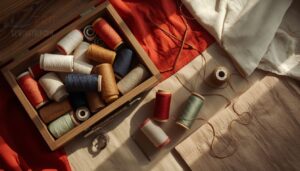
Thread is the one thing every sewing kit can’t live without. Before you start any repair or project, it helps to know what you’re actually working with.
If you’re new to the process, walking through a step-by-step guide to threading a mini sewing machine can save you a lot of frustrating trial and error.
Here’s what most basic kits include.
Why Thread is The Core Supply in a Sewing Kit
Thread is the backbone of every sewing kit — without it, needles and scissors are just decorations. It’s what creates seam strength, holds fabric together through daily wear, and keeps repairs looking clean.
Whether you’re working with polyester thread, cotton thread, or silk thread, the right choice affects fabric compatibility and thread longevity.
Thread selection guides your entire project outcome.
Modern kits often include smart conductive threads for wearable electronics.
How Many Spools Most Kits Include
Most sewing kits pack between 6 and 12 spools — enough for everyday fixes without overwhelming you. Here’s how spool counts usually break down:
- Beginner Kit Count – 6 spools
- Budget Kit Count – 8 spools
- Family Kit Count – 24 spools
- Premium Kit Count – 40+ spools
Travel kits usually carry just 4 to 6 spools for quick, on-the-go repairs.
Common Thread Colors Found in Basic Kits
Once you know how many spools you need, color is the next decision. Most basic kits follow a smart Neutral Palette — black, white, gray, beige, and navy. These aren’t boring choices; they’re workhorses.
| Thread Color | Best Use | Fabric Match |
|---|---|---|
| Black | Contrast Threads, outlining | Dark fabrics |
| White | Buttonholes, light seams | Pale materials |
| Gray | Midtone Blends, repairs | Denim, charcoal |
| Beige | Beige Matching, mending | Khaki, natural fibers |
| Navy | Navy Denim fixes | Jeans, twills |
Thread Color Packs usually build color palettes around these popular color combinations, making matching thread colors to projects surprisingly easy.
Typical Spool Lengths for Repairs and Small Projects
Colors sorted, now let’s talk length.
Most spools in a beginner sewing kit hold 25 to 100 meters — plenty for repair length guidelines like fixing a hem or closing a seam. For a basic repair kit, 40 to 50 meters per spool hits the sweet spot. It’s enough for small jobs without taking up space in your thread storage solutions.
Most Kits Include All-Purpose Polyester Thread
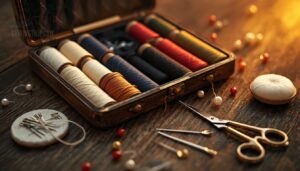
If you’ve ever peeked inside a sewing kit, chances are most of those spools are polyester thread. It’s the workhorse of the sewing world, and there are some solid reasons why it earned that spot.
Here’s what makes all-purpose polyester the go-to choice in kits everywhere.
Why Polyester is The Standard Kit Thread
Polyester thread isn’t in every kit by accident — it simply works. It offers abrasion strength, UV durability, and chemical resistance without complaint.
That durability really shines in detailed work, like when you’re using polyester thread to tackle an embroidery basting box removal — it holds up without fraying or fading under the process.
Low moisture absorption means it dries fast and holds up through repeated washes.
It’s also a cost-efficient pick that fits most machines and fabrics. When choosing the right sewing thread, polyester delivers reliable, budget-friendly sewing results every time.
Stretch, Shrink, and Colorfast Advantages
Thread that stretches with your fabric — then springs back — is worth its weight in gold. That’s elastic recovery at work, and it’s baked into every polyester thread. Here’s what you also get:
- Dimensional stability keeps seams from shrinking after a cold water wash
- Fade resistance locks color through repeated cycles
- Shape retention outlasts cotton thread over time
Best Uses for Everyday Mending and Sewing
For everyday fixes, all-purpose polyester thread covers almost everything. It’s your go-to for seam reinforcement methods on jeans, quick patch techniques on jackets, and basic garment repairs.
Use it as your fabric compatibility guide across wovens and knits.
It works great at medium stitch length selection for clean, even results — and keeps tension steady throughout.
Why It Suits Both Hand Sewing and Machines
One thread, two methods — that’s the quiet magic of all-purpose polyester. Its fine, uniform structure gives you easy threading whether you’re pulling it through a hand needle or loading a machine spool.
It delivers balanced tension and adaptable strength across both. Unlike cotton, its smooth ply resists fraying at speed.
Hand-machine flexibility, built right in.
Other Threads Found in Some Kits
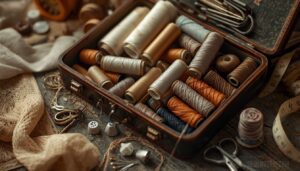
Polyester does most of the heavy lifting, but it’s not the only thread you’ll find tucked inside a sewing kit. Depending on the kit’s purpose, you might spot a few other types alongside it.
Here’s what to look for.
Cotton Thread for Natural Fabrics
Cotton thread is the go-to pick for natural fabrics like linen, hemp, and cotton. It offers breathable comfort and skin-friendly properties that synthetics can’t match — great for baby clothes or anything worn close to the skin.
Its dye absorption is excellent, so colors stay even and rich.
Just plan for slight shrinkage management by pre-washing your fabric first.
Nylon Thread for Stronger, Heavy-duty Seams
Nylon is your best bet when a seam needs to hold up under real stress. It beats cotton in tensile strength and flexes slightly under pressure — so it won’t snap in high-movement areas.
The bonded nylon coating cuts fraying and boosts thread durability across marine stitching and outdoor gear applications.
Its abrasion resistance keeps seams intact through heavy use.
Just confirm needle compatibility before you start.
Silk Thread in Premium Sewing Kits
Silk thread is the quiet upgrade you’ll find in premium kits — and for good reason. Its luxe sheen elevates visible stitches on delicate fabrics, while fine tension control keeps seams smooth and pucker‑free. Think couture applications like chiffon hems or heirloom embroidery.
Silk thread earns its place in premium kits by turning delicate seams into effortless, pucker-free elegance
Three things silk thread does well:
- Moisture management reduces breakage during long stitching sessions
- Colorfastness tips toward minimal bleed after gentle washing
- Glides cleanly for silk thread for appliqué work
Rayon or Polyester Embroidery Thread for Decoration
decorative stitching calls for a different kind of thread. Rayon thread for decorative stitching wins on luster comparison — its warm, high-sheen finish gives embroidery a near-silk glow with rich color depth.
Polyester thread holds strong on UV resistance and colorfastness through washing.
Rayon carries moisture sensitivity, so watch humidity.
Both need proper needle compatibility. Pick your finish: matte, high sheen, or somewhere between.
Invisible, Metallic, Elastic, and Basting Thread Options
Beyond decorative threads, some kits include specialty options worth knowing.
Invisible thread disappears into hems — great invisible uses include knit edges and appliqué.
Metallic thread shines for accents but needs slower machine speeds for metallic care.
Elastic Stitching works best in bobbin for shirring.
Basting thread manages basting removal cleanly, no residue.
Smart Thread Pairing — invisible or elastic with polyester — keeps seams strong.
Thread Sizes and Spool Formats
Thread size matters more than most people realize, and spool format can make or break how organized your kit stays. Once you know what to look for, picking the right thread becomes a lot easier.
Here’s what you’ll find concerning weights, spool sizes, and how it’s all packaged.
Common Thread Weights in Sewing Kits
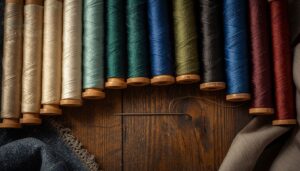
Thread weight is what controls how your stitches actually look and hold. Most kits land in the Tex 40–50 range — that sweet spot where weight impact on stitching stays balanced for everyday projects.
Here’s what you’ll usually find:
- Tex 40 spun polyester thread is suited for general machine sewing.
- Tex 50 cotton thread suits fine hand stitching.
- Tex 60+ follows a quilting weight guide for low‑bulk speed work.
- Tex 30–40 is your heavy‑duty weight choice for denim or upholstery.
- Weight needle pairing matters — heavier thread needs a larger needle eye.
Thread ply affects strength too.
Fine Thread Versus Heavy-duty Thread
Think of fine thread and heavy-duty thread as two different tools — one for precision, one for power.
| Feature | Fine Thread | Heavy-Duty Thread |
|---|---|---|
| Tensile Strength | Light seam loads | High-stress repairs |
| Needle Compatibility | Sizes 60–70 | Sizes 90–110 |
| Puckering Risks | Higher on thin fabrics | Low on thick fabrics |
| Stitch Visibility | Nearly invisible | Bold topstitching |
| Cost Efficiency | Best for everyday mends | Best for denim thread work |
Smart thread selection for different fabrics starts here.
Small Travel Spools Versus Larger Home Spools
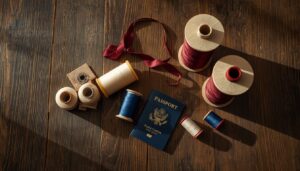
Size matters more than you’d think when you’re picking spools. Travel spools hold 50–100 meters — just enough for quick fixes on the go. Home spools offer 200–500 meters for longer sessions.
These length trade-offs affect machine compatibility, unwinding behavior, and overall thread selection guide decisions.
- Travel spools: lightweight, compact, under 20 grams
- Home spools: wider rims for smoother weight differences
- Travel: hand sewing and emergency repairs only
- Home: better tension control for machine work
- Both need proper storage to avoid kinks
Plastic Hubs, Mini Spools, and Case Organization
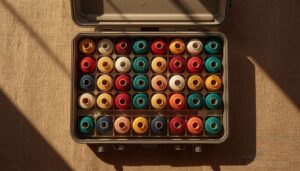
Most mini spools weigh just 2–6 grams, so your sewing box stays light.
Hub Groove Design keeps thread aligned and prevents slippage, while Color‑Coded Hubs let you spot the right shade fast.
Adjustable Case Compartments fit different spool sizes snugly.
Many kits now use Recyclable Case Materials, making your tool storage solutions a smarter, greener choice for any Thread Pack.
How Packaging Helps Prevent Tangles and Mix-ups
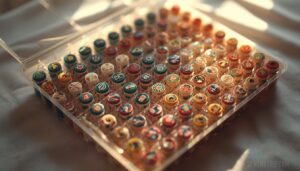
Good packaging does more work than you’d think. A Compact Tray Layout keeps every spool in its place, so you’re not untangling a mess before you’ve even started.
- Clear Divider Design separates colors and prevents contact
- Isolation Sleeve Locks hold spools upright and snug
- Color-Coded Caps and Tamper-Resistant Seals make thread inventory quick and mix-up-proof
How to Choose The Right Kit Thread
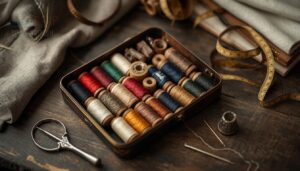
Picking the right thread doesn’t have to feel like a guessing game. A few simple decisions — fabric type, project purpose, and color range — will point you straight to the right spool.
Here’s what to think through before you stitch a single seam.
Matching Thread Material to Fabric Type
Your fabric type drives every thread choice. A linen cotton pairing works because both fibers behave similarly under tension.
Stretch knit compatibility means reaching for polyester or nylon — they flex without snapping. Denim polyester strength supports thick seams.
Silk satin smooth results need fine silk or polyester thread. For outdoor gear, UV resistant polyester holds up longest.
| Fabric | Best Thread |
|---|---|
| Linen / Cotton | Cotton or cotton-polyester blend |
| Stretch Knit | Polyester or nylon spandex blend |
| Denim / Canvas | Heavy polyester |
| Silk / Satin | Fine silk or polyester |
| Outdoor Fabric | UV resistant polyester |
Picking Thread for Repairs, Seams, or Embellishment
Think about what the thread actually needs to do.
For repairs, all-purpose thread wins — it has solid Thread Strength Rating and broad Needle Compatibility.
Structural seams need heavier button and topstitching thread with Fabric Stretch Consideration in mind.
Decorative work calls for embroidery thread or quilt thread.
Basting thread supports temporary holds.
Smart Seam Finish Selection starts with matching purpose first, then Color Matching Tips.
Choosing Neutral Versus Assorted Color Packs
Color is where Repair Simplicity meets Design Flexibility.
Neutral packs — white, black, gray — give you Color Consistency for everyday fixes without overthinking.
Assorted Thread Packs for Crafts open up Color Coordination for Sewing Projects with printed fabrics or bold quilts.
For smart Inventory Management, consider both:
- Neutrals for quick household repairs
- Assorted colors for creative or Seasonal Trends projects
- Both together for Sewing Thread Variety Options
When a Basic Kit is Enough
Sometimes, simple is plenty. If your sewing needs are mostly Quick Repairs — loose hems, popped buttons, small seam splits — a basic kit covers it all.
It’s a smart Budget Sewing choice and a win for Beginner Confidence. Travel Convenience? A basic kit slips right into your bag.
| Project Type | Thread Needed | Basic Kit Works? |
|---|---|---|
| Hem repair | All-purpose polyester | Yes |
| Button reattachment | Neutral thread | Yes |
| Small seam fix | White or black spool | Yes |
When to Upgrade to Specialty Thread Packs
But once your projects grow, a basic kit starts to show its limits. If you’re working with silk, velvet, or heavy canvas, fabric-specific needs call for specialty threads — silk for delicate seams, nylon for durability requirements on tough materials.
Color matching challenges across garments or quilts? A specialty thread color pack selection solves that fast, giving you thread pack convenience for crafters who want consistent, polished results.
Frequently Asked Questions (FAQs)
What does a sewing kit come with?
A sewing kit usually holds essential tools for a sewing starter kit: thread packs, needle types, scissors options, seam rippers, measuring tools, and thread snips — everything you need to handle quick fixes or small projects.
What thread do you get for a sewing machine?
Most machines run best on all-purpose polyester thread. It manages tension adjustment smoothly, works with standard needle compatibility, and suits most fabrics without fuss.
For natural fabrics, cotton thread is a solid swap.
What does sewing thread come on?
Thread comes on a small plastic or cardboard spool.
Most kits use cross-wound or parallel-wound spools with clear labeling conventions for thread type, weight, and color number — keeping your all-purpose thread organized and tangle-free.
What 10 tools should be included in a sewing kit?
Beyond thread, a solid beginner sewing kit needs ten essential tools: Sharp Scissors, Seam Ripper, Measuring Tape, Needle Threader, Thimble, pins, needles, a pin cushion, chalk, and safety pins.
Can old thread weaken or break during sewing?
Yes, old thread can snap like a worn rubber band. Thread aging weakens fibers fast.
Check Storage Conditions, run a Tug Test, and do a Visual Inspection.
Humidity Effects and UV Degradation speed up breakage.
How should thread be stored to prevent damage?
Keep thread in a cool dry environment, away from sunlight and heat.
Use UV protective containers, add silica gel desiccants for humidity control, and practice smart spool organization with clear labels.
Does thread color fade after repeated washing?
Over time, yes — color does fade. Polyester holds up best through repeated cold water washes, while cotton fades faster.
Dye chemistry, detergent choice, and air drying all affect how long your thread stays vibrant.
What thread works best for stretchy knit fabrics?
For stretchy knits, polyester or wooly nylon wins every time.
Polyester’s slight give keeps seams intact through wear and washing.
Wooly nylon adds extra softness and seam elasticity — perfect for activewear.
How do you know when thread needs replacing?
Old thread gives you clear warning signs. Watch for visible fuzz, color fading, or snapping tension.
Lint buildup and inconsistent tension mid-seam mean it’s time to replace before your next project.
Conclusion
Thread is the quiet backbone of every sewing kit—easy to overlook until you need it most.
Now that you know what thread comes in a sewing kit, you can stop guessing and start choosing with confidence.
Match your thread to your fabric, keep a few neutral colors on hand, and don’t underestimate a good polyester all-purpose spool.
The right thread doesn’t just hold stitches together. It holds your work together.