This site is supported by our readers. We may earn a commission, at no cost to you, if you purchase through links.
Buying too little fabric means a frantic trip back to the store—only to find your colorway discontinued. Buying too much turns into a guilt pile that haunts your shelf for years.
Most quilters, especially early on, guess at yardage and hope for the best, which is exactly how a queen-sized project becomes an expensive lesson.
Knowing how to calculate fabric needed for a quilt removes the guesswork entirely and puts you in control before you cut a single thread.
The math sounds intimidating, but it breaks down into a handful of straightforward steps that build on each other cleanly.
Table Of Contents
- Key Takeaways
- Measure Quilt Top Dimensions
- Convert Quilt Size to Yardage
- Add Backing, Binding, and Batting
- Adjust for Waste, Width, and Seams
- Top 9 Quilt Prep Tools
- 1. Brother 1034D Heavy Duty Serger
- 2. Anitor Sewing Machine Carrying Case
- 3. Kingboard Portable Tabletop Ironing Board with Holder
- 4. Aubliss Precut Cotton Fabric Squares
- 5. Entisn White Soft Minky Fabric
- 6. Plotional Natural Cotton Quilt Batting
- 7. iBayam 8 Inch Heavy Duty Scissors
- 8. FIVEIZERO Seam Ripper Set
- 9. Calibre Art Rotating Self Healing Cutting Mat
- Frequently Asked Questions (FAQs)
- Conclusion
Key Takeaways
- Start by locking in finished quilt dimensions, then work through block sizes, sashing, borders, and seam allowances before you buy a single yard — every number flows from that foundation.
- Convert your total square inches into yardage by dividing rows by pieces per row, then round up to the nearest ⅛ yard to protect against shrinkage, miscuts, and pattern repeats.
- Backing needs 4–8 inches of overhang on every side, binding strips require a 10–20% waste buffer for corners and miters, and batting should match your backing dimensions — not the quilt top.
- Always add a 10–15% waste buffer for plain fabrics and bump it to 15–20% for directional prints that demand motif matching and grain consistency.
Measure Quilt Top Dimensions
Before you buy a single yard of fabric, you need to know exactly how big your quilt top will be. That means working through a few key measurements — from block sizes to borders to seam allowances.
If you’re unsure where to start, brushing up on standard lap quilt sizes and dimensions gives you a solid baseline before you start mapping out your blocks.
Here’s what to figure out first.
Choose The Finished Quilt Length and Width
Before anything else, lock in your finished quilt size — length and width — because every yardage number flows from this decision.
A throw usually runs 60×65 inches, while a queen bed needs around 92×108 inches to achieve your desired drape and border overhang.
Match your quilt top dimensions to your bed size and room proportion, then factor in fabric pattern orientation before moving forward.
Consider the side overhang guidelines when determining how much extra width to add.
Add Block Sizes, Sashing, and Border Widths
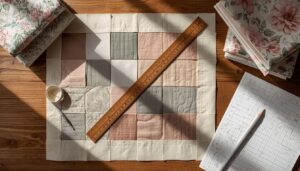
Once your finished dimensions are set, block scale choices shape everything else. A 12-inch block fits four across a 48-inch top, while a 9-inch block gives you more layout flexibility.
Sashing width impact is real — even a 1-inch sashing strip adds inches fast across multiple rows. Add your border widths last, and suddenly your fabric requirements and quilt fabric yardage planning make complete sense.
Account for Seam Allowance in Every Piece
Every piece needs seam allowance added before you cut. Standard allowance sizes for quilting run ¼ to ½ inch per side — that’s your seam allowance math in action.
Use a seam allowance calculator to stay consistent.
Curved seam allowances and fabric type allowances vary, so notch and clip curves to reduce bulk. These seam allowance guidelines keep your Quilt Fabric Yardage Planner and Calculate Fabric Requirements accurate from the start.
Convert The Finished Top Into Total Fabric Area
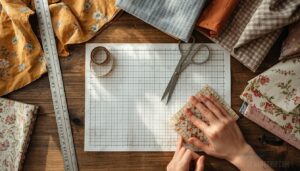
Once your seam allowances are locked in, multiply your quilt’s length by its width to get your Total Area Estimation in square inches. Then layer in your Border Expansion Factor, Backing Size Adjustment (add 4–8 inches per side), and Binding Length Calculation around the perimeter.
Waste Percentage Planning adds a 10–15% buffer.
That full picture drives accurate Calculating Quilt Fabric Requirements — no guessing, no shortage.
Convert Quilt Size to Yardage
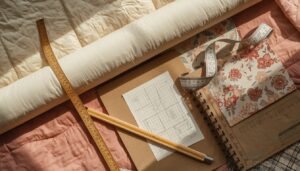
Once you’ve mapped out your quilt top dimensions, the next step is turning all those inches into actual yardage you can bring to the store. This is where the math gets practical, and it’s simpler than it sounds.
Here’s exactly how to work through it, one step at a time.
Match Piece Width to Fabric Bolt Width
Your bolt width is the silent architect behind every clean quilt layout. Standard fabric widths run 42–44 inches for quilting cotton, while home-décor bolts reach 54–60 inches. Matching your piece width to your bolt width is the foundation of Seam Minimization and smart Bolt Width Selection.
- Use a fabric yardage calculator to test different bolt widths before cutting.
- Apply Grain Direction Matching by aligning piece width parallel to the bolt edge.
- Choose 54–60-inch bolts for wide blocks to reduce joins.
- Use Piece Alignment Strategy to keep standard fabric widths consistent across your Ideal Panel Layout.
- Document your bolt width in your pattern notes for future reference.
Calculate Pieces Per Row Across The Fabric
Once you know your fabric width, dividing it by your piece width gives you pieces per row — that’s your Strip Width Ratio in action. Use floor division (round down, never up) for your Effective Width Calculation.
| Fabric Width | Piece Width | Pieces Per Row |
|---|---|---|
| 44 in | 10 in | 4 |
| 44 in | 8 in | 5 |
Always include seam allowances in your Piece Width Tolerance before calculating — skipping this step overestimates your yield.
Divide Total Pieces by Rows Needed
Once you know how many pieces fit per row, dividing your total number of pieces by that count tells you exactly how many rows you need — that’s the Row Allocation Method at work.
- 60 pieces ÷ 6 per row = 10 rows
- Use Remainder Handling for uneven splits
- Apply Even Row Balancing to distribute extras
- Try Flexible Row Sizing for alternating blocks
- Use Row Count Adjustment in your Quilt Fabric Yardage Calculator
This shapes your entire quilt block layout design and drives fabric waste reduction across your cutting layout.
Turn Total Inches Into Yards or Meters
Once you have your total row count, multiply rows by piece length to get total inches — then apply the Inch-to-Yard Formula: divide by 36.
For Metric Conversion Tips, multiply inches by 0.0254.
Keep Decimal Yard Accuracy by tracking at least two decimal places throughout your yardage calculation.
Conversion Calculator Apps handle this fabric measurement conversion instantly, giving you reliable output unit results when converting between yards and meters in fabric measurement.
Round Up to The Nearest ⅛ Yard
Never cut fabric yardage too close — that’s how projects stall at the final seam.
Once your decimal total is calculated, round up to the nearest eighth-yard increment: 4.5 inches each step. result of 3.12 yards becomes 3.25 yards.
This rounding buffer manages shrinkage allowance, facilitates pattern repeat alignment, and keeps your cutting layout optimization intact.
Add extra fabric — that small percentage extra fabric is always worth it.
Add Backing, Binding, and Batting
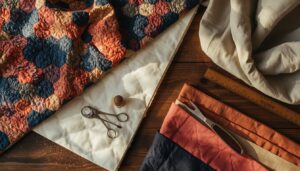
Once your quilt top is calculated, the math isn’t done yet — backing, binding, and batting each need their own yardage. Getting these three right is what takes a quilt from a flat top to a finished, usable piece.
Here’s how to figure out exactly what you need for each one.
Size Backing 4–8 Inches Larger Than The Top
Your backing needs to be bigger than your quilt top — plan for 4 to 8 inches of overhang on every side. That extra fabric buffer gives you room to load, align, and square everything without stress.
Pre-wash shrinkage and quilting tension eat into your margin purpose fast.
Use a cutting layout strategy that keeps seams away from center, and always confirm your backing orientation before cutting.
Estimate Extra Fabric for Binding Strips
Binding is where most quilters underestimate fabric — don’t let that be you. Start with your perimeter measurement: add all four sides in inches, then divide by 36 for yards. Cut strips 2½ inches wide across a 44-inch bolt.
For clean binding calculations, keep these steps close:
- Add 10–20% extra for fabric waste and miter seam extra at corners.
- Include shrinkage allowance if prewashing — budget an extra ⅛ yard.
- Calculate binding length and strip estimation based on total perimeter plus 15 inches.
- Add a pattern alignment buffer for directional prints needing matched corners.
Binding width calculation and seam allowance together determine your final purchase.
Match Batting to The Backing Dimensions
Once your binding strips are cut, batting comes next — and sizing it right saves you from headaches at the frame.
Match your batting to the backing dimensions, not the quilt top. Batting should extend at least 1 inch beyond the backing edges for Edge Trim Allowance during Layer Alignment. Always check Thread Count Compatibility between your Backing Fabric Weight and Batting Thickness — mismatched weights cause rippling.
| Quilt Dimensions | Batting Size | Backing Size |
|---|---|---|
| 40 × 50 in | 42 × 52 in | 44 × 54 in |
| 60 × 80 in | 62 × 82 in | 64 × 84 in |
| 68 × 86 in | 70 × 88 in | 72 × 90 in |
| 90 × 108 in | 92 × 110 in | 94 × 112 in |
| 120 × 120 in | 122 × 122 in | 124 × 124 in |
These numbers take the fabric yardage estimation out of fabric yardage estimation and calculating batting, backing, and binding requirements together.
Plan Yardage for Pieced or Wide Backing
Once batting is sized, it’s time to think about how your backing comes together.
Wide backing fabric (108 inches) often covers a quilt in one piece — no Panel Layout headaches, minimal fabric waste management.
With 42-inch fabric, you’ll piece panels. Add seam allowances for each join, respect the Fabric Grain, and factor piecing adjustments into your Cost Estimation before buying.
Adjust for Waste, Width, and Seams
Getting your yardage math right is only half the battle. The other half is making sure you’ve built in enough room for real-world hiccups—shrinkage, cutting slips, and tricky prints that demand extra care.
Accurate yardage math means nothing without room built in for shrinkage, miscuts, and demanding prints
Here’s what to factor in before you buy a single yard.
Add a 10–15% Waste Buffer for Mistakes
No matter how carefully you cut, mistakes happen — that’s just quilting.
A 10–15% waste buffer is your safety net. For simple cotton blocks, 10% covers minor miscuts and trim waste. Complex borders or prewash shrinkage (which can steal 3–5% of your yardage) push that buffer to 15%.
Add extra fabric before you shop. You won’t regret it.
Increase Allowance for Directional Prints
Directional prints are beautiful — and sneaky. Unlike solid fabrics, they demand a Print Alignment Buffer of 15–20% because every block must face the same way. That’s your Directional Waste Margin at work.
Plan for it upfront with these fabric allowance calculation steps:
- Add Pattern Repeat Allowance by rounding each piece length up to the nearest full repeat
- Apply a Grain Consistency Buffer to keep woven stripes or motifs running true
- Extend borders using Border Print Extension to cover corner turns cleanly
- Mark directional print alignment notes directly on your cut list
- Test directional flow on a swatch before committing your full cut
Add More Yardage for Pre-washing Shrinkage
Before you cut a single piece, prewash your fabric — cotton can shrink 3–5%, and that loss adds up fast across a large quilt.
Build in a Shrinkage Buffer of at least 5%—your Prewash Allowance for peace of mind.
Factor in a Fabric Relaxation Factor and Postwash Length Adjustment to your fabric allowance calculation, keeping your Yardage Safety Margin intact after washing.
Compare Horizontal and Vertical Cutting Layouts
slice your fabric changes everything.
Horizontal cutting runs strips across the bolt width — great for Grain Alignment and keeping Seam Count low.
Vertical cutting follows the fabric length, boosting Waste Efficiency when pieces are tall or narrow.
For ideal cutting layouts, match your Tool Setup to your Pattern Direction.
Horizontal vs Vertical Cutting is the foundation of smart Fabric Cutting Strategies for Horizontal and Vertical Strips.
Factor in Pattern Repeat and Fabric Grain
Pattern repeat and grain direction can quietly sabotage an otherwise perfect quilt. Here’s what to control:
- Measure your pattern repeat interval and round each piece length up to the nearest full repeat.
- Keep grain direction parallel to block edges to prevent distortion after washing.
- Add a waste buffer of 15–20% for directional prints requiring motif matching.
- Avoid bias cut effects near seam edges — bias stretches unpredictably.
- Use repeat waste optimization by centering motifs before cutting for cleaner repeat alignment across seams.
Top 9 Quilt Prep Tools
Having the right tools in your kit makes every step of the quilting process smoother and more accurate. From cutting and pressing to stitching and finishing, each tool below earns its place on your workbench.
Here are nine worth keeping close.
1. Brother 1034D Heavy Duty Serger
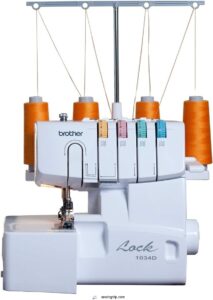
The Brother 1034D is the workhorse, your quilt edges have been waiting for. It runs up to 1,300 stitches per minute and manages everything from lightweight cotton to heavy denim without skipping a beat.
The color-coded threading system makes setup less of a headache, even if you’re new to sergers.
Its built-in knife trims your seam allowance as you sew, so your edges come out clean and consistent every time. That’s fewer fayed ends to fight later.
| Best For | Sewers of all skill levels who want a reliable, heavy-duty serger that can handle everything from delicate fabrics to thick denim with professional results. |
|---|---|
| Primary Material | Metal & Plastic |
| Primary Color | White |
| Price Range | Mid-Range |
| Skill Level | Beginner-Advanced |
| Use Case | Garment Finishing |
| Portability | Low |
| Additional Features |
|
- Blazing fast at 1,300 stitches per minute, and the differential feed keeps stretchy or thin fabrics from puckering
- Color-coded threading makes setup way less intimidating for beginners
- Built like a tank — metal frame and interior components mean this thing holds up to serious use
- Manual threading still has a learning curve if you’ve never touched a serger before
- Some stitch options (blind hem, pin tuck, flat lock) need extra presser feet that don’t come in the box
- At nearly 18 pounds, it’s not something you’ll want to haul around to sewing classes
2. Anitor Sewing Machine Carrying Case
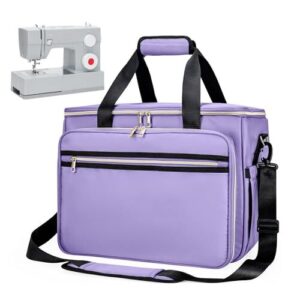
Hauling your sewing machine to a class shouldn’t feel like moving furniture.
The Anitor Carrying Case makes it manageable — its 16.5 × 11 × 12.5-inch exterior fits most standard machines from Brother and Singer, while the hardboard panels and dense interior padding absorb bumps along the way.
The top-opening design means you drop your machine straight in without wrestling it sideways.
Multiple pockets handle your threads, bobbins, and feet.
At $31.99, it’s a practical investment that keeps your setup road-ready.
| Best For | Sewists who regularly take their machine to classes, workshops, or travel and want one bag that handles both the machine and their supplies. |
|---|---|
| Primary Material | Nylon |
| Primary Color | Purple |
| Price Range | Budget |
| Skill Level | All Levels |
| Use Case | Machine Transport |
| Portability | High |
| Additional Features |
|
- Hardboard panels and thick padding keep your machine protected from bumps without a lot of fuss
- The top-opening design makes loading and unloading quick — no awkward maneuvering required
- Plenty of pockets for threads, bobbins, and accessories, so you’re not juggling a second bag
- The extra padding adds weight, so the bag itself isn’t exactly featherlight at 3.6 lb
- Some buyers have received units with a strong smoke odor that needs airing out before use
- Fixed dimensions mean it won’t work for machines that fall outside the standard size range
3. Kingboard Portable Tabletop Ironing Board with Holder
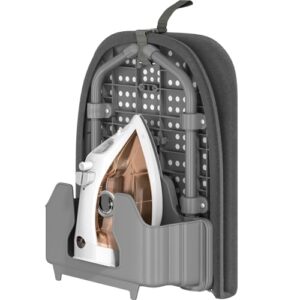
Once your machine is packed and ready to go, you need a pressing solution that travels just as well.
The Kingboard Portable Tabletop Ironing Board gives you a 32″ × 12″ cotton surface that’s scorch- and stain-resistant — plenty of room for pressing quilt blocks flat between seams.
It folds down to 12″ × 16″ for storage, and the built-in iron holder keeps your iron within reach without crowding your workspace.
At $49.99, it’s a smart, space-saving setup for small rooms or on-the-go quilting.
| Best For | Quilters and crafters who need a compact, travel-friendly pressing solution for small spaces, dorm rooms, or on-the-go projects. |
|---|---|
| Primary Material | Cotton & Plastic |
| Primary Color | Black |
| Price Range | Mid-Range |
| Skill Level | All Levels |
| Use Case | Garment Pressing |
| Portability | Medium |
| Additional Features |
|
- Folds down to 12″ × 16″, making it easy to tuck into a closet, bag, or luggage without taking up much room
- The scorch- and stain-resistant cotton surface holds up well to repeated pressing, so you don’t have to baby it
- Built-in iron holder and hanging hook keep everything organized and off your workspace
- The 32″ × 12″ surface is narrow, so pressing larger garments or wide quilt sections can feel cramped
- Separate leg pieces can be a little fiddly to set up and may feel wobblier than a full-size board
- Height options are limited, which could be uncomfortable depending on where you’re working
4. Aubliss Precut Cotton Fabric Squares
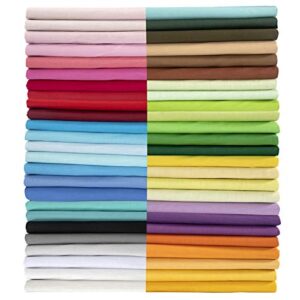
With your pressing setup sorted, the next step is having fabric that’s ready to cut and sew right away. The Aubliss Precut Cotton Fabric Squares come 50 to a pack, each measuring roughly 9.84 inches square — close enough to a 10‑inch layer cake square for most block patterns.
They’re 100% cotton, so they press cleanly and feed through your machine without fuss.
Just note the hand‑trimmed edges can run slightly small, so trim to a consistent size before piecing.
| Best For | Quilters and fabric crafters who want an affordable, ready-to-use cotton bundle for patchwork, practice projects, or colorful block patterns. |
|---|---|
| Primary Material | 100% Cotton |
| Primary Color | Assorted |
| Price Range | Budget |
| Skill Level | Beginner |
| Use Case | Quilting & Patchwork |
| Portability | Medium |
| Additional Features |
|
- 100% cotton means clean pressing and smooth machine sewing without needle jams
- 50 squares per pack with a mix of prints and solids makes it easy to build patterns right away
- Pre-cut convenience saves time, especially for beginners still finding their workflow
- Hand-trimmed edges can run up to 1 cm short, so you’ll want to true them up before piecing
- Thin fabric frays easily and may need interfacing or heat-bonding for anything that takes wear
- Some buyers have reported receiving fewer than 50 squares, so count your pack when it arrives
5. Entisn White Soft Minky Fabric
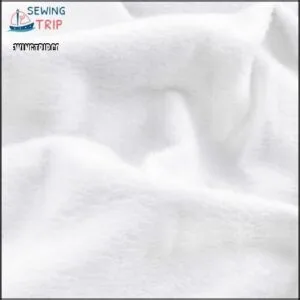
Once your patchwork pieces are pieced and pressed, think about what wraps around them.
The Entisn White Soft Minky Fabric is a smart pick for quilt backing or cozy throws. It’s 100% polyester with a 3 mm pile, cut to 36 by 60 inches per yard. That 60-inch width means fewer seams across a wide backing panel.
Machine wash on gentle, tumble dry low, and it holds its softness after wash. A practical, skin-friendly choice.
| Best For | Crafters and quilters looking for an affordable, lightweight fabric for blanket backing, pillow covers, or plush projects that don’t need a lot of loft. |
|---|---|
| Primary Material | 100% Polyester |
| Primary Color | White |
| Price Range | Budget |
| Skill Level | Beginner-Intermediate |
| Use Case | Blankets & Decor |
| Portability | Medium |
| Additional Features |
|
- Silky, smooth feel that’s gentle on skin — great for baby items or cozy throws
- Wide 60-inch cut means fewer seams when using it as a quilt backing
- Neutral white pairs easily with almost any fabric or color scheme
- Pile can feel shorter than advertised — more suede-like than the plush minky many shoppers expect
- Arrives folded and vacuum-sealed, so deep creases may need a full wash to come out
- Thinner than traditional fleece or thick minky, so it won’t add much warmth or insulation
6. Plotional Natural Cotton Quilt Batting
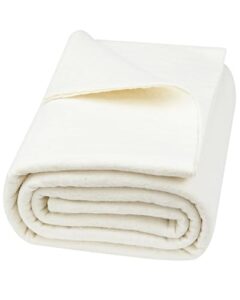
Between your backing fabric and quilt top lies the layer that shapes how your finished quilt feels — the batting.
Plotional Natural Cotton Quilt Batting keeps things simple and traditional. It’s 100% pure cotton, lightweight with a low-to-medium loft, and comes in four bolt sizes, including 71 × 79 in and 79 × 91 in, so you can match it closely to your backing dimensions.
It cuts cleanly, stitches smoothly by hand or machine, and washes without disassembly. Fair warning: unpack it early and let it relax before you layer.
| Best For | Quilters and crafters who want a natural, breathable cotton batting for blankets, throws, lap quilts, or small craft projects without needing a heavy, puffy fill. |
|---|---|
| Primary Material | 100% Cotton |
| Primary Color | White |
| Price Range | Budget |
| Skill Level | All Levels |
| Use Case | Quilting & Crafts |
| Portability | Medium |
| Additional Features |
|
- 100% pure cotton — breathable, natural, and easy to work with by hand or machine
- Comes in four generous bolt sizes, so it fits a range of project dimensions without awkward piecing
- Washes right in the finished quilt — no need to take anything apart
- Ships compressed and creased, so you’ll need to unpack and flatten it before use
- Low-to-medium loft won’t satisfy anyone looking for a thick, cozy, insulating quilt
- May cause slight bearding on dark fabrics after washing, and expect a small amount of shrinkage
7. iBayam 8 Inch Heavy Duty Scissors
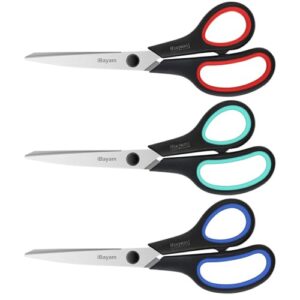
Good scissors make the difference between a clean cut and a frayed edge that you’ll be fixing later.
iBayam 8 Inch Heavy Duty Scissors come in a 3-pack — red, green, and blue — so you can dedicate one pair to fabric only.
2.5 mm stainless steel blades grip quilting cotton, cardstock, and vinyl without dulling quickly. Ambidextrous grip fits both hands comfortably, and the ergonomic grip keeps fatigue low during long cutting sessions.
Color-coding alone is worth it.
| Best For | Crafters, quilters, and students who want a reliable, color-coded set of scissors for paper, fabric, and everyday cutting tasks. |
|---|---|
| Primary Material | Stainless Steel & Plastic |
| Primary Color | Red/Green/Blue |
| Price Range | Budget |
| Skill Level | All Levels |
| Use Case | Cutting & Crafting |
| Portability | High |
| Additional Features |
|
- Three pairs for $8.49 is a genuinely great deal — you get one for the desk, one for the craft room, one for the kitchen
- 2.5 mm thick blades cut through quilting cotton, cardstock, and vinyl cleanly without snagging
- Ambidextrous ergonomic handles work for both hands and keep fatigue down during long sessions
- Not actually heavy duty — forcing them through hard materials like thick leather or metal will dull the blade fast
- The plastic handles can feel a bit flimsy; rough use or dropping them repeatedly may cause breakage
- They’re small and light, which is handy until you can’t find them
8. FIVEIZERO Seam Ripper Set

Every quilter eventually rips a seam — the FIVEIZERO Seam Ripper Set just makes that moment less painful.
The kit includes two large rippers (5.5 in) for heavy fabrics like denim and two small ones (3.5 in) for delicate work on lightweight or embroidered pieces.
A protective red ball tip prevents snagging, and the color-coded ergonomic grips reduce hand fatigue during long correction sessions. Toss it in your sewing box and you’re covered for any unpicking job that comes your way.
| Best For | Quilters, sewers, and DIY crafters who need a reliable, all-in-one unpicking kit for everything from heavy denim to delicate embroidery. |
|---|---|
| Primary Material | Stainless Steel & Plastic |
| Primary Color | Red/Black/White |
| Price Range | Budget |
| Skill Level | All Levels |
| Use Case | Seam Correction |
| Portability | High |
| Additional Features |
|
- You get four rippers in two sizes, so you’re ready for any fabric type without switching kits.
- The mini-ball tip keeps the ripper from snagging and damaging your fabric as you work.
- The compact storage case keeps everything together and easy to grab when you need it.
- The larger eye hole can struggle with tightly woven or layered fabrics — you might need needle-nose pliers to help guide it through.
- Plastic handles are light and comfortable, but they may not hold up as well under heavy, repetitive use.
- The scissors will dull over time with regular use, so expect to resharpen them eventually.
9. Calibre Art Rotating Self Healing Cutting Mat
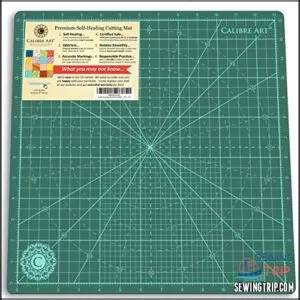
The Calibre Art Rotating Self-Healing Cutting Mat is the kind of tool that quietly transforms your workflow.
Its 14×14-inch self-healing polymer surface spins smoothly while the rubberized base stays put, so you can cut from any angle without twisting your wrist or shifting your fabric.
The printed grid includes 15-degree angle lines for precise diagonal cuts, which is a real advantage when working with angled quilt blocks.
At $34.97, it’s an affordable upgrade that protects your blades and your table.
| Best For | Quilters and crafters who do a lot of repetitive cuts and want to save time, protect their blades, and keep their wrists from screaming at them by the end of a project. |
|---|---|
| Primary Material | Self-Healing Polymer |
| Primary Color | Green |
| Price Range | Mid-Range |
| Skill Level | Beginner-Advanced |
| Use Case | Rotary Cutting |
| Portability | High |
| Additional Features |
|
- The rotating surface is a genuine game-changer — spin your fabric instead of wrestling with it mid-cut.
- Self-healing polymer keeps the mat looking clean and usable way longer than a standard mat would.
- Precise grid with 15° angle lines makes angled cuts way less of a guessing game.
- Fresh out of the box, it can smell pretty strong — give it a day or two to air out before using it.
- Fourteen inches is cozy for smaller projects but won’t cut it (pun intended) for larger pattern pieces.
- The rotating mechanism can wobble a bit if your table isn’t perfectly level or you’re pushing hard.
Frequently Asked Questions (FAQs)
How do I use a quilt fabric calculator?
You start by entering your quilt’s finished dimensions, fabric bolt width, and block sizes.
The calculator instantly generates exact yardage, cutting layouts, and waste estimates — taking the guesswork completely out of fabric shopping.
What is a fabric yardage calculator?
A fabric yardage calculator estimates exactly how much fabric you need for a project.
Enter your dimensions and bolt width, and it instantly tells you the yardage — in yards or meters.
How do I plan my quilt fabric requirements?
Planning quilt fabric starts with knowing your finished dimensions, then working backward through blocks, sashing, borders, backing, binding, and a 10–15% waste buffer to land on a confident yardage total.
What is a quilt sizing calculator?
A quilt sizing calculator tells you exactly how many blocks and how much fabric you need to hit your target quilt size.
Enter your dimensions, and it calculates the math instantly.
Can I use multiple fabric types in one quilt?
Yes, you can mix fabric types in one quilt.
Cotton, linen, and flannel work well together when prewashed and similar in weight. Just match shrinkage rates and keep seam allowances consistent throughout.
How do I calculate yardage for irregular quilt shapes?
Break the shape into separate rectangles, calculate each section’s fabric area individually, then add the totals together. Round up to the nearest ⅛ yard and add your standard waste buffer.
What fabric works best for a beginner quilter?
For beginners, 100% quilting cotton is your best friend. It’s stable, easy to cut, and holds its shape through every seam. Start there, and you’ll build confidence fast.
How do I store leftover fabric after cutting?
Fold scraps neatly, label bins clearly, and sort by size. Store flat in cool, dry spots away from sunlight.
Pre-cut leftovers into common quilting sizes — like 5×5 inches — so they’re ready when inspiration strikes.
Can I mix quilt block sizes in one project?
Absolutely — mixing block sizes is one of quilting’s most creative moves.
Use sashing to unify different dimensions, and plan your layout on graph paper first so seams line up cleanly across rows.
Conclusion
Every yard you calculate with intention is a yard you’ll never scramble to replace. Now that you know how to calculate fabric needed for a quilt—from block dimensions to binding strips—you’re not guessing anymore.
You’re planning. Measure your top, account for waste, add your backing, and round up.
The math becomes second nature quickly, and your fabric shelf stops being a guilt pile. It becomes proof that you know exactly what you’re doing.