This site is supported by our readers. We may earn a commission, at no cost to you, if you purchase through links.
A monogram can transform a plain bath towel into something that feels like a gift—or it can pucker into a wrinkled mess that no amount of steaming will fix.
The difference almost always comes down to one thing: stabilizer. Fabric moves, stretches, and shifts under a needle striking it hundreds of times per minute, and without the right backing, even a perfect design file falls apart on cloth.
Knowing which embroidery stabilizers for monogramming work on which fabrics separates crisp, heirloom-quality letters from frustrating do-overs.
Table Of Contents
Key Takeaways
- Stabilizer isn’t optional — it’s the one thing standing between a crisp monogram and a puckered mess, because fabric shifts under a needle without solid backing.
- Your fabric type drives every stabilizer decision: stretchy knits need permanent cut-away, stable wovens do fine with tear-away, and delicates like silk or chiffon call for wash-away.
- Toppings matter just as much as backing — on textured surfaces like terry cloth or fleece, a water-soluble topping keeps stitches from sinking into the pile before they set.
- Removal technique is part of the craft: tear away from the design, trim cut-away to within ⅛ inch, and fully dissolve wash-away in warm water — rushing any of these steps can undo an otherwise perfect monogram.
Why Monograms Need Stabilizer
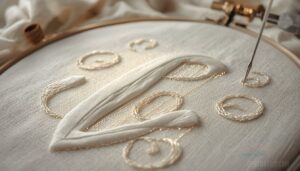
Stabilizer isn’t optional for monogramming — it’s the difference between clean letters and a puckered mess. Your fabric needs a firm foundation to hold still while the needle works through dozens of tight satin stitches.
Pairing the right stabilizer with your fabric type makes all the difference — check out this guide to machine embroidery fabric choices to match your materials before you start stitching.
Here’s why that backing matters so much.
Prevent Puckering and Fabric Distortion
Puckering happens when fabric shifts under needle pressure — and it’s almost always a stabilizer or setup problem. Before you stitch, pre press fabric to remove any slack, then check your hoop alignment and edge clamping pressure so nothing drifts.
test stitch on scrap fabric reveals tension issues early. Match your stabilizer weight to fabric type and stitch count, and distortion becomes a non-issue. Using tear-away stabilizers for stable fabrics like cotton helps prevent puckering.
Keep Small Lettering Crisp and Readable
Small letters demand precision — and stabilizer weight is where it starts. light cut-away keeps fine strokes planted without crowding edges.
Pair that with a sharp micro needle and stitch density around 0.6–0.8 mm, and your letters hold their shape.
Contrast selection matters too: dark thread on light fabric makes even tiny fonts pop.
Font simplicity and consistent hooping tension do the rest.
Improve Stitch Registration and Tension Balance
Once your lettering is sharp, the next challenge is keeping every stitch exactly where it belongs. That’s where stabilizer balance and stitch registration become your best tools. A properly hooped, stabilized fabric locks the material in place so your machine’s Thread Tension Calibration stays consistent through each letterform.
- Match Needle Size Matching to your fabric weight to prevent skipped stitches
- Apply Hoop Pressure Adjustment firmly — tight enough to hold, not enough to stretch
- Use Stitch Density Optimization around 0.4–0.6 mm spacing for satin fills
- Practice Machine Tension Monitoring with a test swatch before full production runs
Support Dense Satin Stitch Monograms
Dense satin fills are where stabilizer choice really earns its keep. When you’re running a heavy stitch count design, the needle hits the same area repeatedly — and without proper Layered Stabilizer Systems and smart Underlay Strategies, the fabric buckles.
Cut Away Stabilizer Benefits and Durability shine here: it holds firm through every pass, keeping Stitch Density Balance and Thread Tension Control exactly where you need them.
Extend Durability on Wearable Items
Want your monogram to survive a hundred washes?
Start with Double-Layer Backing under stress points and pair it with Abrasion-Resistant Threads that won’t fray after repeated cycles.
Stress Point Reinforcement, combined with smart Stabilizer Selection for Stretch Fabrics, keeps the weave intact long-term.
Interfacing Stiffness prevents distortion during wear, while your Stabilizer Weight and Stitch Count Considerations directly impact Stitch Quality — and ultimately, Garment Washing Durability.
Choose The Right Stabilizer Type
Not all stabilizers work the same way, and the type you pick makes or breaks your finished monogram. Your fabric is the first clue — stretch, weave, and weight all point you toward a specific backing.
When the match feels off, walking through a machine embroidery troubleshooting guide can help you pinpoint exactly where your stabilizer choice went wrong.
Your fabric is the first clue — stabilizer choice makes or breaks every monogram
Here’s a breakdown of the main types and when to reach for each one.
Cut-away Stabilizer for Stretchy Fabrics
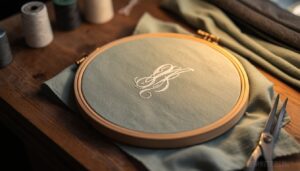
Stretchy fabrics like jersey and spandex are the trickiest to monogram — they shift under the needle and distort your design before you’ve even finished the first letter. Cut-away stabilizer is your fix. It stays permanently bonded beneath the embroidery, giving every stitch a locked foundation. Here’s why it works so well on stretch:
- Fabric stretch analysis shows knits need continuous backing, not removable options that leave gaps after washing
- Design density matching matters — heavier cut-away supports dense satin stitches; lighter weights suit simple single-color monograms
- Stabilizer adhesion methods improve when you pair cut-away with a fusible backing on slippery performance fabrics
- Edge reinforcement strategies like trimming close with pinking shears keep the cut edge invisible and soft against skin
- Stabilizer weight and stitch count considerations guide your choice — high-stitch designs need heavier cut-away to prevent registration drift
Cut-away stabilizer benefits and durability go hand-in-hand: the backing resists shrinkage and keeps your monogram crisp through dozens of washes.
Tear-away Stabilizer for Stable Wovens
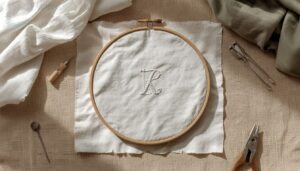
On stable woven fabrics — cotton poplin, twill, linen — tear away stabilizer is the go-to for clean, cost-efficient monogramming. It manages pressure distribution evenly across weave intersections, so needle interaction stays smooth without puckering.
Align it to the fabric grain before hooping, tear parallel to stitch lines after, and you’re done. For moderate stitch density, this stabilizer hits the sweet spot every time.
Wash-away Stabilizer for Delicate Fabrics
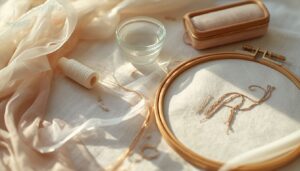
Delicate fabrics like chiffon, organza, and silk demand a gentler hand — that’s where wash‑away stabilizer earns its place. It dissolves completely in water, leaving your sheer fabric untouched and your monogram crisp.
Here’s what makes it work:
- Film Thickness ranges 0.5–3 mils, matching light to medium designs
- Dissolution Time varies by formula — test your swatch first
- Temperature Sensitivity matters; cooler rinses protect heat-sensitive fibers
- Thread Compatibility is strong with rayon and polyester threads
- Breathability Impact stays neutral — no stiffness, no altered drape
Fusible and Adhesive-backed Options
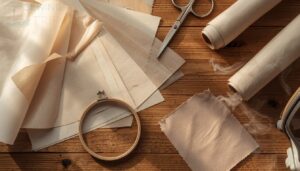
Fusible and adhesive-backed stabilizers solve one big problem: keeping fabric perfectly still without a hoop fight.
Fusible options heat-activate between 270–350°F, and their paper backing handling makes trimming clean before post-fusion trimming around stitch edges.
Adhesive-backed versions offer tackiness variations — low to high — so you match bond strength levels to your fabric’s needs without crushing delicate fibers or over-stiffening dense designs.
No-show Mesh for Invisible Support
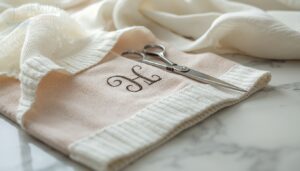
No-show mesh cut-away is the quiet workhorse of knit monogramming. This semi-transparent cutaway stabilizer stays permanently bonded behind your stitches, delivering fabric distortion prevention without adding visible bulk.
Its lightweight drape compatibility keeps garments feeling soft, while stitch flatness assurance means letters sit flush — not raised.
Trim close to the design using edge trimming strategies with pinking shears, and you’re done.
Match Stabilizer to Fabric
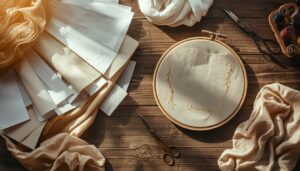
Not every fabric plays by the same rules, and your stabilizer choice needs to match what you’re working with. The wrong pairing can wreck an otherwise perfect monogram, no matter how good your digitizing is.
Here’s how to match your backing to the most common fabrics you’ll encounter.
Stabilizer Choices for Cotton and Linen
Cotton and linen are both stable woven fabrics, but they still need the right backing to keep your monogram sharp. A light stabilizer works well for fine lettering on linen napkins or cotton shirts.
Denser fills, switch to a cutaway stabilizer. When matching stabilizer to fabric types, start with one layer and add a second only if edges pull — that’s your most cost-efficient testing method.
Stabilizer Choices for Knits and Jersey
Knits and jersey are a different animal. Unlike woven fabrics, they move — and that movement will wreck your monogram if your stabilizer can’t keep up.
Cut-away is your go-to for stretch knit support, because it stays permanently bonded and manages jersey tension without letting stitches warp. For stabilizer selection for stretch fabrics, midweight cut-away hits the sweet spot: enough stabilizer weight to control fabric stretch management without stiffening the drape.
Stabilizer Choices for Denim and Canvas
Denim and canvas don’t flex — they push back. That stiffness actually works in your favor, but you still need heavy cut-away stabilizer for dense stitch support on thick weaves. Think multi-layer support for bulky seams, and consider transparent film or white blend backings to stay invisible.
- Use heavy-weight cut-away for dense stitch support
- Layer stiff foam backing on extra-thick canvas
- Match stabilizer weight to your stitch density guidelines
Stabilizer Choices for Towels and Robes
Towels and robes are a different beast — all that terry loop structure fights nap compression and swallows stitches whole.
Use a light tear away stabilizer beneath, then layer a wash away stabilizer on top to protect loop integrity.
For dense monograms, a light cut away stabilizer wins.
| Fabric | Stabilizer Type | Key Benefit |
|---|---|---|
| Terry towel | Tear-away + WSS topping | Prevents nap sinkage |
| Plush robe | Light cut-away | Provides dense satin fill |
| Waffle weave | Wash-away topping | Preserves moisture management texture |
Light, Medium, and Heavy Support Weights
Weight selection guidelines come down to three tiers.
Light stabilizer (1.5–2.0 oz) suits sheer and delicates where fabric drape considerations matter most. Medium stabilizer (2.0–2.5 oz) manages everyday cotton with moderate stitch density impact. Heavy stabilizer (2.5–3.0 oz) locks down denim and canvas under dense fills.
Cost per ounce rises with weight, so always run a test stitching protocol before committing to full production.
Use Toppings for Clean Monograms
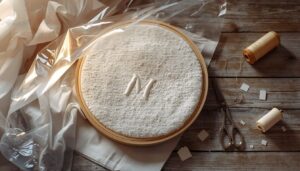
Backing alone doesn’t always tell the whole story — sometimes the top of your fabric needs just as much attention as the bottom. Toppings and specialty techniques help your monogram sit on the surface cleanly instead of getting swallowed by texture or ruined by moisture.
Here’s what to reach for depending on your material and design.
Water-soluble Topping on Napped Fabrics
Napped fabrics like fleece, sherpa, and velour will swallow your stitches whole without the right topping. A water-soluble topping — a colorless, clear film usually 20–30 microns thick — sits over the fabric nap as your needle works, giving it a smooth embroidery surface.
Topping Thickness Control matters for puckering prevention and Colorless Contrast Boost on darker materials. Test for colorfastness first, then activate removal via steam or water.
Prevent Stitches From Sinking Into Towels
Terry cloth is basically a stitch trap — those loops pull thread down before it sets. That’s why pile height matching matters: your topping thickness should sit just above the loop surface, lifting stitches up with the stitch lift technique.
Pair a Wash Away Stabilizer on top with a Cut Away Stabilizer beneath, then fine‑tune hoop tension adjustment and thread tension tuning so your satin fill spacing stays crisp and raised.
Heat-away Topping for Water-sensitive Materials
Some fabrics — leather, silk, and other heat sensitive fabrics — simply can’t get wet. That’s where heat away topping earns its place.
This heat-activated barrier sits above your stitching area, providing moisture-free stabilization and a fiber cushioning effect that keeps delicate weaves from distorting.
Apply it, stitch, then press with your iron — residue-free removal, no soaking required.
Sticky-back Stabilizer for Hard-to-hoop Items
Some items simply won’t sit flat in a hoop — collars, cuffs, socks, curved seams. That’s exactly where stickyback stabilizer saves the day.
This AdhesiveBacked Stabilizer for HardtoHoop Projects eliminates hooping struggles with reliable adhesive tackiness and clean adhesive release after stitching. It manages irregular shape support and bulk surface backing without crushing texture or shifting placement.
- Expose adhesive, press fabric firmly for quick positioning
- Curved seam stabilization stays flat — no bunching
- Peel slowly after stitching for clean removal
Layering Stabilizer for Dense Designs
Dense monograms demand more than a single layer can give. Layering stabilizers for heavy designs is your best bulk management move — start with a lightweight mesh closest to the fabric, then add a heavier cut-away on top.
Use 90-degree alignment between layers for true cross-layer orientation and tension distribution strategy. This dual-weight stacking keeps registration tight without stiffening the drape.
Remove Stabilizer and Finish Neatly
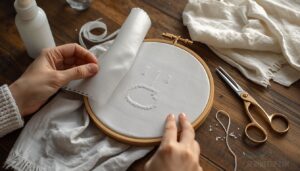
The embroidery is done — now comes the part that separates a clean finish from a sloppy one. How you remove your stabilizer matters just as much as choosing the right type in the first place.
Here’s what to do at each step to keep your monogram looking sharp.
Tear-away Removal Without Damaging Stitches
Once your monogram is stitched, removing the tear-away stabilizer the right way protects every stitch you’ve worked for. Start with scrap testing your technique before touching the final piece.
Use tweezers, handling at the edges for control, then focus on pull direction — always away from the design.
Edge tearing in small passes prevents fabric puckering, and stitch pull mitigation keeps lettering crisp.
Finish with lint removal for clean results.
Trimming Cut-away Close to Embroidery
Cut-away stabilizer stays put permanently — that’s the whole point. Once tear-away is handled, trimming cut-away close to your embroidery is where edge clearance really matters.
Use the curved scissor technique to follow your design’s contours, keeping a 1/8 to 1/4 inch trim margin consistency. This stitch edge preservation prevents fraying and quick fiber snip management leaves everything clean and durable.
Washing Out Soluble Stabilizers Fully
Wash away stabilizer removal is straightforward once you know the Temperature Guidelines and Soak Duration that work. Drop your finished piece into 40–60°C water for 10–20 minutes — warm enough to break down the soluble stabilizer without shrinking your fabric.
- Submerge fully and agitate gently
- Soak 10–20 minutes for standard designs
- Apply Rinse Techniques — flush under lukewarm running water
- Follow Fabric-Specific Washout needs (silk gets cooler water)
- Complete Residue Inspection under good lighting before drying
Dense designs may need a second 5-minute soak. No sticky feel means you’re done.
Cleaning Leftover Fibers and Residue
Even after a proper soluble stabilizer rinse, tiny fibers cling. A slightly damp microfiber lint removal cloth — wiped in one direction — lifts residue without grinding it back in.
For adhesive residue solvent work, a cotton swab with isopropyl alcohol treats tacky spots on sturdier fabrics. Finish with a dry cloth pass, then use the vacuum brush method lightly over dense lettering.
Final Checks for Smooth Monogram Finish
Before you call it done, run through these four checks:
- Stitch Tension Check — confirm top and bobbin tension stayed balanced; no puckering or fabric distortion.
- Edge Finish Inspection — look for skipped stitches within 1 cm of the design.
- Color Consistency Check — scan for dye halos or uneven tones.
- Alignment Accuracy Measurement — verify the design sits within 0.5 mm of your centering mark.
Frequently Asked Questions (FAQs)
Do you add stabilizer before or after embroidery?
Always add stabilizer before embroidery — that’s the whole point. It goes under (and sometimes on top of) your fabric so stitches land cleanly, tension stays even, and nothing shifts mid-design.
Does Hobby Lobby have embroidery stabilizers?
Yes, Hobby Lobby carries embroidery stabilizers both in-store and online — tear-away, cut-away, fusible, and no-show mesh options.
Their brand selection and pricing are cheaper than specialty shops, though quality can vary.
Can you monogram directly onto leather or vinyl?
Leather and vinyl handle monograms beautifully without traditional stabilizers.
Foil Stamping, Laser Engraving, and Embossing Techniques all work well, but Surface Preparation is key — clean, degrease, and seal with a Protective Sealant for lasting results.
How do stabilizers affect embroidery machine speed settings?
Heavier stabilizers increase machine load, so drop your speed 10–30%. Dense satin monograms run best at 400–700 SPM. Stabilizer thickness impact directly shapes thread tension coordination and stitch quality.
Which stabilizers work best for childrens clothing?
For kids’ clothing, cut-away stabilizers on knit fabrics prevent sagging, while lightweight tear-away suits on woven cottons. No-show mesh keeps things skin-friendly.
Always run colorfastness testing before using wash-away stabilizers on delicate pieces.
Does stabilizer choice vary by monogram font style?
Font weight impact is real — a dense ornate interior density demands heavier backing than a clean sans-serif block letter spacing allows.
Tall script support needs cut-away; light serif vs sans styles often manage with tear-away.
How do you store stabilizers to prevent degradation?
Store stabilizers in sealed, airtight containers below 50% humidity. Use opaque packaging for light protection, maintain temperature stability between 10–25°C, and practice inventory rotation so older stock gets used first.
Conclusion
Think of a stabilizer like the frame behind a canvas painting—invisible when the work is done, but responsible for everything holding together. Skip it, and even the finest brushwork warps.
The same logic governs every monogram you stitch. Choosing the right embroidery stabilizers for monogramming isn’t a technical footnote; it’s the decision that separates a crisp, lasting monogram from a puckered disappointment.
Know your fabric, match your support, and your letters will speak clearly for years.